Olif Young died at her home in Hythe Road in 1907 aged 80 years of age. I wonder how she approached her own death. She had had plenty of preparation. Olif’s husband was the Rev Frederick Rowland Young, a Unitarian Baptist Minister and spiritualist about whom much has been written. But was the Rev Young a charlatan as some suggest and that his Doctor of Divinity degree may have been fraudulent.
Olif Wilson was born in Dover, Kent in 1827. By 1851 she was married to the Rev Young and living in Diss, Norfolk with her five year old daughter Juliet and her 10 year old brother Thomas Wilson. However, the Rev Young does not appear to be at home on that census night.
The Unitarian Church – image published courtesy of Local Studies, Swindon, Central Library.
During the 1860s Frederick arrived in Swindon when he quickly ingratiated himself into Swindon’s society. In 1861 he built the Unitarian (Iron Church) in Regent Street, which later proved too large for his small congregation and was removed. In 1875 he built the Free Christian Church in Regent Circus. In 1871 he lived with his family in Rose Cottage, Drove Road where he held spiritualist meetings and ‘terrifying’ seances, before moving to a house he built next to the church in Rolleston Street.
The Rev Young was a prolific writer, producing lectures and a pamphlet entitled ‘Hints How To Make Home Happy’ which included chapters on ‘Courtship Days’ and ‘Thoughts for the Honeymoon.’ He also founded and edited The Christian Spiritualist.
The Rev Young was also a faith healer – his modus operandi was to run the flat of his hands along the arms and legs of his patients. Apparently he had more success with his female patients than his male ones.
Frederick and Olif remained in Swindon for some 20 years before Frederick left the church and they moved to Finsbury Park Road, where he died in 1893.
Olif returned to Swindon and lived out her days here. Was she prepared for her own death, I wonder? Did she greet it with joyful anticipation or dread that the dodgy Rev Young might be waiting for her?
Olif was buried on September 26, 1907 in grave plot E8678 where she lies alone.
Rev Young’s Free Christian Church in Regent Circus was later taken over by the Roman Catholic congregation, pictured here by George Puckey. Upon the completion of the Holy Rood Roman Catholic Church in Groundwell Road, the Nonconformist Chapel became known as the Victoria Hall and was home to the Swindon Museum.
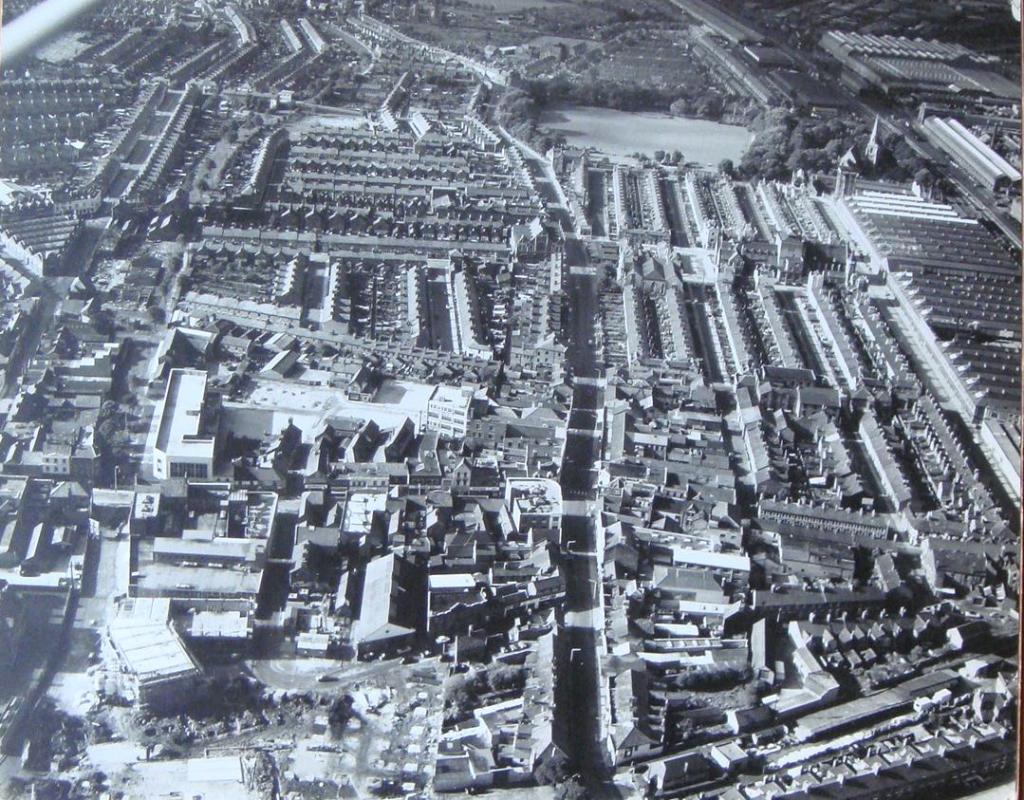
Aerial view of the town centre as demolition begins
The re-imagined story …
Can you remember the town centre as it used to be? I can. All those rows of old Victorian terrace houses, empty and boarded up. What a sight that was. What a disgrace.
Then at last our old fashioned railway town, for so many years stuck in the 19th century, was entering the 20th. There were even plans to demolish the railway village in the 1960s. Knock the lot down, I said.
We were so excited when we saw the new plans for the town centre. We were to have a ‘shopping mall.’ I’d never heard of such a thing – a shopping mall. Swindon was going to become like something out of the American films.
How excited we had been to see the new college rise out of the demolition waste from Horsell Street, all gone at last. And most of Rolleston Street and Byron Street as well.
I don’t get out much these days but this week my granddaughter took me into town to have my Covid booster jab. I thought we were to go to the old railway museum along Faringdon Road until she told me we were to go to STEAM – the museum they built in one of the original railway buildings.
I suggested we had tea in McIlroys afterwards but apparently it was closed more than twenty years ago and demolished soon after. That beautiful store, I couldn’t believe that. I asked her to drive down Regent Street so I could see the changes, but she said its pedestrian only these days.
The town centre has changed out of all recognition. All those terrace houses gone, Brunel Street, Davis Street and most of Havelock Street.
But the old railway village is still there. All tidied up and smart, apart from that dreadful old Mechancis’ Institute building, derelict for more than 35 years now. Knock it down I say.
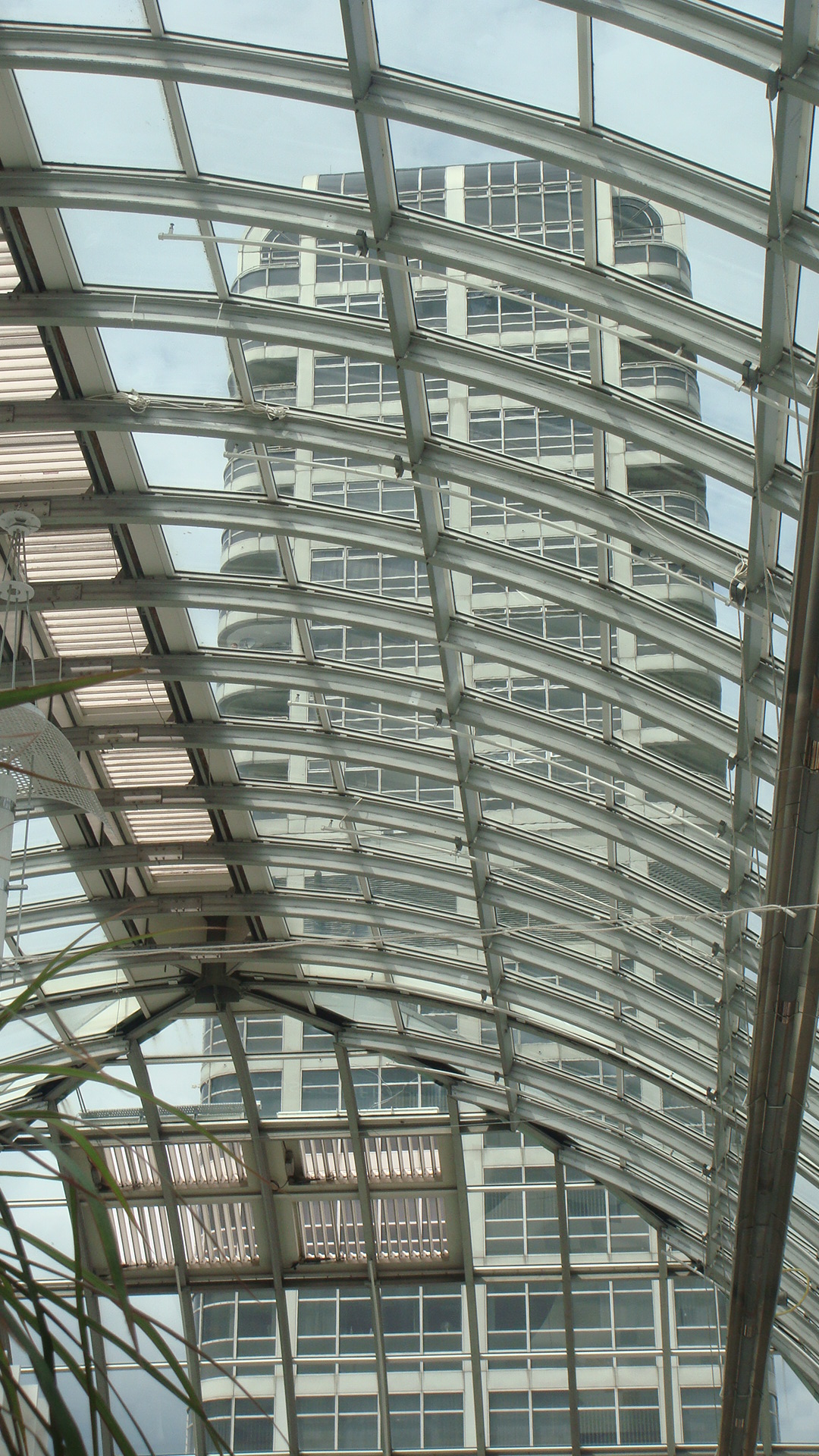
David Murray John Tower built in 1974-6 on the site of the old gas works.
The facts …
The Rolleston Estate, a large land holding that originally belonged to the Vilett family, was crucial to the development of New Swindon. In the 1880s the vast area of prime building land was held in chancery following the bankruptcy of its then owner Colonel William Vilett Rolleston, and was actively holding up the expansion of the town.
But by February 1885 it looked like things might be moving. At a meeting of the New Swindon Local Board it was announced that plans had been submitted by Messrs Maxwell and Tuke of Manchester, surveyors to the Bury Union Building and Investment company, for the development of laying out the Rolleston Estate for building purposes.
Construction began in 1890 when builders William Crombey, a former engine driver from Durham, and John Horsell, who lived in neighbouring Commercial Road, got the ball rolling. They soon began work on streets that would eventually be named Curtis, Crombey and Deacon Streets.
John Horsell was born in 1848 the second son of Charles Horsell, a slater and plasterer and his wife Ann. He married Mary Jane Godwin at Christ Church on 10th February 1872. His address at the time of his marriage was 61 Newport Street and his occupation was that of Surveyor’s Clerk. The couple went on to have eight children.
His obituary published in the North Wilts Herald provides details of his career and his involvement in the development of the town centre at the end of the 19th century.
The Rolleston Estate – Horsell Street now lies beneath the Regent Circus development built in 2014.
Death of Mr John Horsell
The announcement will be received with sincere regret by his many friends of the death of Mr John Horsell, which took place at his residence in Rayfield Grove, Ferndale Road, Swindon, about 10 o’clock on Sunday morning. For the past 20 years the deceased had been a sufferer from gout, which became acute some six years since, and he had been practically an invalid during the last twelve months. His end, however, came somewhat unexpectedly.
The late Mr Horsell would have been 60 years of age had he lived until next May. He was born in what was then Old Swindon. Having left school he went into the office of Messrs Bradford & Foote, solicitors, and afterwards into that of Mr William Read, assistant overseer. After his marriage Mr Horsell became the landlord of the Cold Harbor Inn, Broad Blunsdon, where he remained about a couple of years. He then took the Ely Inn, Wroughton, and was there something like 18 months. Returning to Swindon, he received the appointment of assistant overseer, which he retained for 13 years. For some time after this he carried on the duties of tax collector duties which he had also discharged for some little time prior to his securing the assistant overseership. Then he went into the building business, and took a no mean part in the development of the town. He erected the Rolleston Arms Hotel in Commercial Road, and was proprietor there for eleven years. He has since carried on building operations in the Ferndale Road area, where he resided until his death.
In his time Mr Horsell had interested himself in many friendly and other kindred societies. He was a prominent Odd-Fellow and Forestry, and was a member of the former society for 36 years. He was also a Buffalo, and his enthusiasm for angling was remarkable. Altogether his career has been a varied and many respects a useful one.
A widow and seven children – fours sons and three daughters – are left to mourn a severe loss. Mr Horsell’s two youngest daughters left for Canada a few months ago, one to be married.
Funeral
Many manifestations of regret were in evidence at the funeral, which took place yesterday afternoon. The cortege left Rayfield Grove at 2 o’clock, and proceeded to St. Barnabas’ Church, where the first part of the service was conducted by the Rev. P. Maddocks (vicar). The same gentleman performed the last rites at the graveside in the Cemetery, where a respectful crowd of onlookers had assembled…
Deceased was for 20 years an enthusiastic member of the local Fire Brigade, and to show their last respects to a former comrade the following members attended in uniform and headed the cortege – Ex-Deputy Capt. T. Munday, Lieut. E.R. Bowering, Foreman Selby, Engineer Eden, and Fireman F. Reeve, C. Greenaway, R. Hinton, W. Ludlow and W.H. Gill. There also followed Mr W.H. Smith (secretary of the Swindon and District Licensed Victuallers’ Association of which the deceased was a former secretary). The coffin was of polished elm, with brass fittings, and the breast-plate was inscribed as follows:-
John Horsell,
Died January 13th, 1907
Aged 59 years
List of floral tributes …
The undertakers were Messrs. H. Smith & Son, of Gordon Road, Swindon.
The North Wilts Herald, Friday, January 18, 1907
John was buried in plot D30 in Radnor Street Cemetery on January 17, 1907. His grave is next to that of his son Albert John Horsell Licensed Victualler at the Rifleman’s Arms Hotel. His funeral took place on March 25, 1903. He was just 30 years old. He is buried in plot D29 with his infant son William who died aged 1 year old.
Under construction – the Regent Circus development in Swindon opened in October 2014.




 Radnor Street Cemetery