What was life like for the ordinary people who lived and died in Swindon at the end of the 19th century? So many were incomers, attracted to the town by the many opportunities presented by the Great Western Railway Works and the affiliated jobs that grew up around it, including the food and vibrant retail industries. Some families put down roots and stayed, others moved on. The Jeanes family did both.
Widowed Mary Jeanes appears to have arrived sometime in the 1870s with her daughter Ellen 21 and her 15 year old son (Frederick) John. The family were originally from North Petherton, Somerset and arrived in Swindon via Bridgewater.
By 1881 they were living at 46 Regent Street where Mary’s son worked as a Master Baker. Frederick married and settled down in Swindon. His sister Ellen married Frederick Barnstaple/Barnstable and left. By 1891 they were farming at Llantarnam, Monthmouthshire.
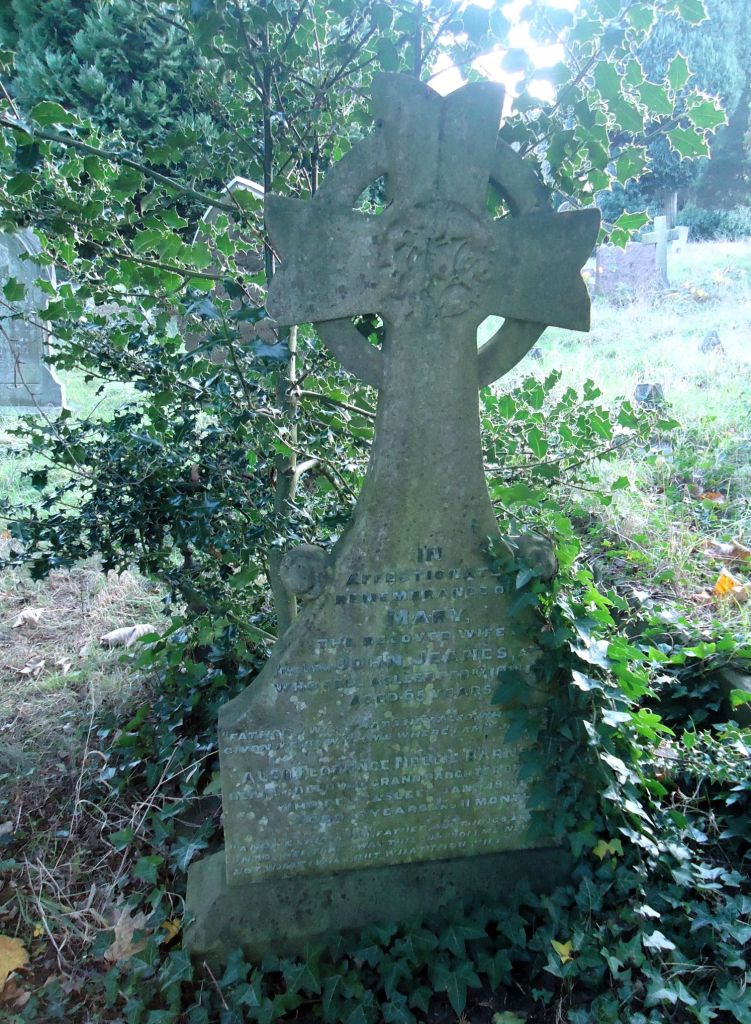
Mary Jeanes died in February 1887 aged 65 and was buried in grave plot A1038. When Ellen and Frederick’s 15 year old daughter Florence Nelly died in 1888 they chose to have her buried with her grandmother Mary in Radnor Street Cemetery.
James Lott opened his ironmongery business in around 1873. By 1881 he was living above the shop at 91 Regent Street with his wife Ellen and their four young children. However, the changeable fortunes of James Lott saw him forced to declare himself bankrupt in 1889.
But by 1891 business was booming again when James was based at numbers 50 and 51 Regent Street. In 1907 he was advertising “the most varied and up-to-date stock of Brushes, Copper Flower Vases and Kettles, Cutlery, Electro-plated Goods, Curb Fenders, Fire Irons and Brasses, Expanding Wood Trellis, Wire Netting, Garden Arches and Tools, General and Furnishing Ironmongery of every description.”
The 1911 census lists him as living above his shop at 5 Temple Street with his wife Ellen and youngest daughter Maud, an elementary school teacher. Temple Street today is unrecognisable from the busy shopping thoroughfare it once was linking Commercial Road with Regent Street. Temple Street has been the scene of several major reconstruction projects in the past 100 years. Today it is the site of work in progress on a Premier Inn due for completion later this year. Pictured below is the large gap left following the demolition of the Baptist Tabernacle.
This image of the site of the demolished Baptist Tabernacle is published courtesy of Local Studies, Swindon Central Library.
And it is still possible to find evidence of James Lott’s work in the pavements around town.
Death of Mr J. Lott
An Old and Respected Swindon Tradesman
The death has occurred of Mr J. Lott, head of the firm of Messrs. Lott & Sons, of Regent street, Swindon.
Mr Lott was one of the oldest tradesman in Swindon. Born near Holsworthy in Devon he came to the railway town in the early ‘70s, and by his energy and enterprise built up the present extensive business.
Mr Lott was connected with the Gooch Lodge of Freemasons, of which he was a Past Master, and was much respected in the town.
The funeral has been fixed for Monday. Mr. Lott was 76 years of age.
Swindon Advertiser Saturday, 10 December, 1921.
Late Mr J. Lott,
Masonic Funeral at Swindon Yesterday
The funeral of Mr J. Lott, of Swindon, took place yesterday afternoon. The Rev. J.E. Rogers officiated, and the masonic ovation at the graveside was delivered by the Rev. W.L. Waugh, Provincial Grand Chaplain.
The mourners were Mr. J.D. Lott and Mr C.R. Lott (sons), Mr E.W. Lott and Master Stanley Smith (grandsons), Mr J.W. Smith (son-in-law), Mr E.W. Daniel (Hendon) and Mr J. Daniel (nephews), Mr A.S. Deacon, Ald. E. Jones, Mr S. Chappell, Mr T. Butler, Mr F.C. Phelps, Mr A.R. Bray (Bristol), Mr W.E. Chappell, Mr J. Wilmer and Mr H. Mitchcock.
The Freemasons, of which deceased was a Past Provincial Grand Officer, were represented by Brs. A.E. Bottomley, D.C.A Morrison, H.J. Hamp, E.O. Twitcher, A.G. While, J.S. Protheroe, T. Mundy and D.A. Lane. Deceased’s employees also attended.
The floral tributes included one from the widow, and others from sons, sons and daughters-in-law and grandchildren, the Wiltshire Lodge of Freemasons and the staff at Regent street.
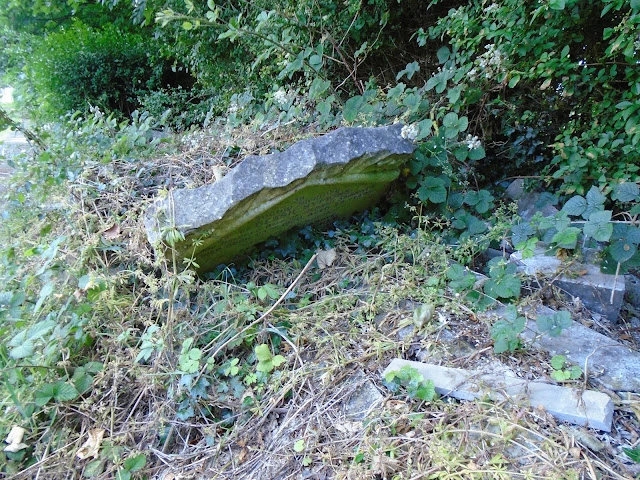
After more than fifteen years of research at the cemetery, I had never before seen this headstone, dumped in one of the cemetery’s peripheral verges.
In Loving Memory of Bessie Symons the beloved wife of Albert Sparkes died April 23rd 1920 aged 53 years. The rest of the inscription is difficult to read. The headstone was not far from its original site on plot E8516, removed for who knows what reason.
The Sparkes family were well known Swindon butchers at the turn of the 20th century. Frederick Sparkes had a shop at 47 Regent Street while his cousin Albert’s shop was at 60 Fleet Street.
The census returns reveal a large household living over the Fleet Street shop in 1911. Albert and Bessie with their three daughters – Gladys Delia Alberta 19, a student teacher, Elsie Muriel Bessie 17, still at school part time while working as a book keeper for her father’s business and nine year old Dorothy Irene Audrey, still at school.
George Howard, a butcher’s apprentice, Ernest Salter, an assistant in the shop and May Beard, butcher’s book keeper, all lodged with the family along with Winifred Hunt, a domestic servant. The property comprised nine rooms, not including the scullery, warehouse, shop and office, so quite a squeeze to accommodate eight adults and a child.
According to the headstone and burial registers Bessie died at her home at 15 Okus Road, Swindon on April 23, 1920 aged 53 and was buried four days later on April 27. However, confusingly the entry in England & Wales, National Probate Calendar (Index of Will and Administrations) 1858-1995 states that she died on 19 May 1919 and that administration was awarded to ‘Albert Sparkes butcher’ on 30 December 1926 when her effects were valued at £45 2s 6d.
Bessie was buried in plot E8516 with her husband Albert who died in 1937 and their daughter Gladys Delia Alberta who died in 1970. Is it possible the headstone was never replaced on the grave after the burial of Gladys?
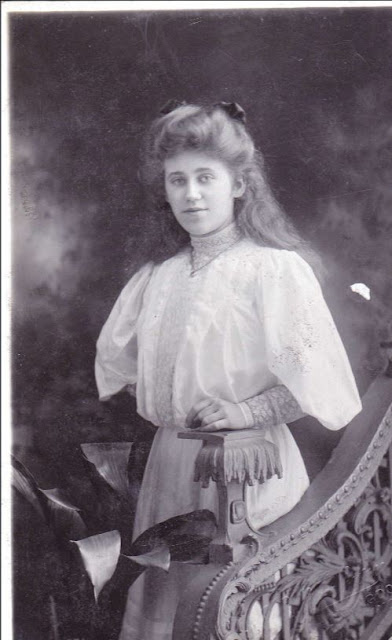
And then I came across the Sparkes family tree published on the Ancestry website by philipacore and some fab photos.
Bessie and Audrey Sparkes
Gladys Delia Alberta Sparkes
Elsie Muriel Bessie Sparkes
The Radnor Street Cemetery volunteers have rescued Bessie’s headstone and it now sits on her grave.
The graves around the chapel area include some well-known names in Swindon’s history, but I must admit I had never heard of Cyril Hammond Montague Jones.
Cyril was the son of William Jones and Jane Moss. William was born in Gloucester in around 1854. He married Jane Moss at St. Luke’s, Gloucester on July 10, 1882 when he described himself as ‘Lay Clerk St Andrew’s, Bristol.’ William and Jane’s two children were both born in Bristol, Edith Hammond Jones born in 1883 and Cyril Hammond Montague Jones in 1885.
By 1891 William and Jane were living in Churcham, Glos with their two young children and a 10 year old nephew. William now states that he is ‘Living on own means’ suggesting he has a private income or inheritance.
The family eventually made their appearance in Swindon at the time of the 1901 census when they were living at 27 Regent Street where William describes his occupation as ‘Draper.’
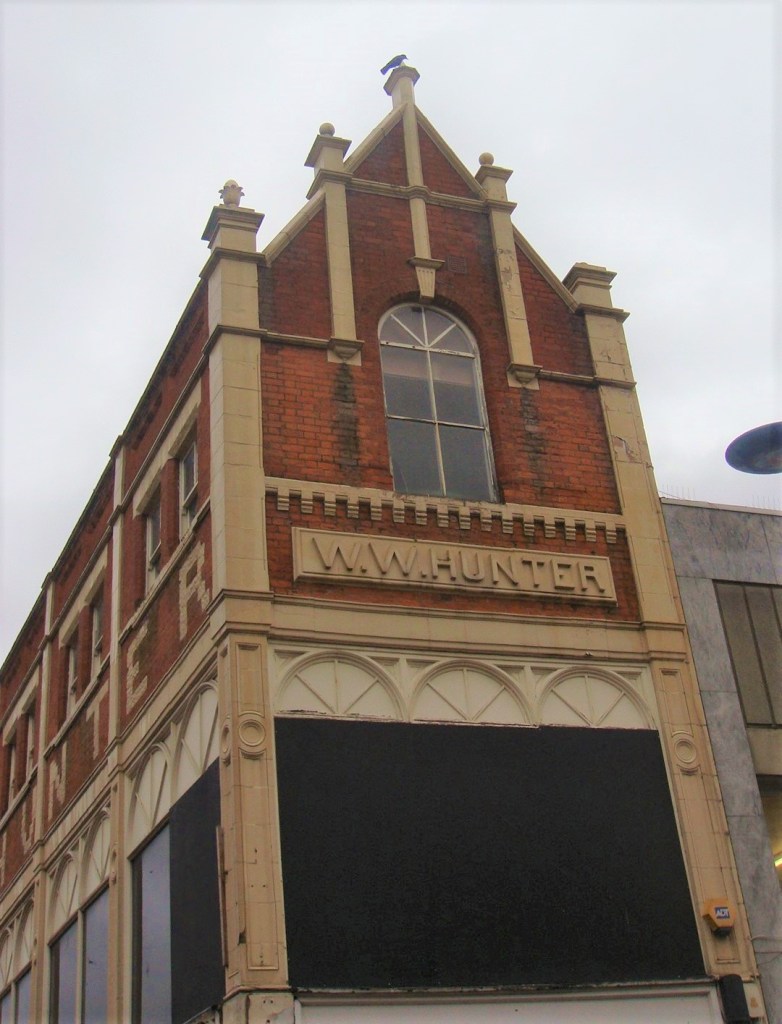
In 1917 Regent Street was the centre of a busy and vibrant shopping area. Morses department store occupied premises at numbers 10, 11 & 12. The 1,000 seater Arcadia Cinema had opened in 1912 on the site of a former shopping arcade. W.W. Hunter’s furniture shop stood on the corner of Edgware Road and Regent Street (look up and you can still see the name in the brickwork). The County Electric Pavilion picture house opened in 1910 and was in operation for more than 20 years. The site was later occupied by F.W. Woolworth and today is home to the One Below Discount Store and Peacocks. Then there was the Artillery Arms at No. 25; F.E. Cottell, jewellers and watchmakers at No 26 and in 1917 Mrs J. Jones, Milliner was at No. 27. Perhaps the nature of their business had changed. There was some fierce competition with Morses at one end of Regent Street and McIlroys at the other.
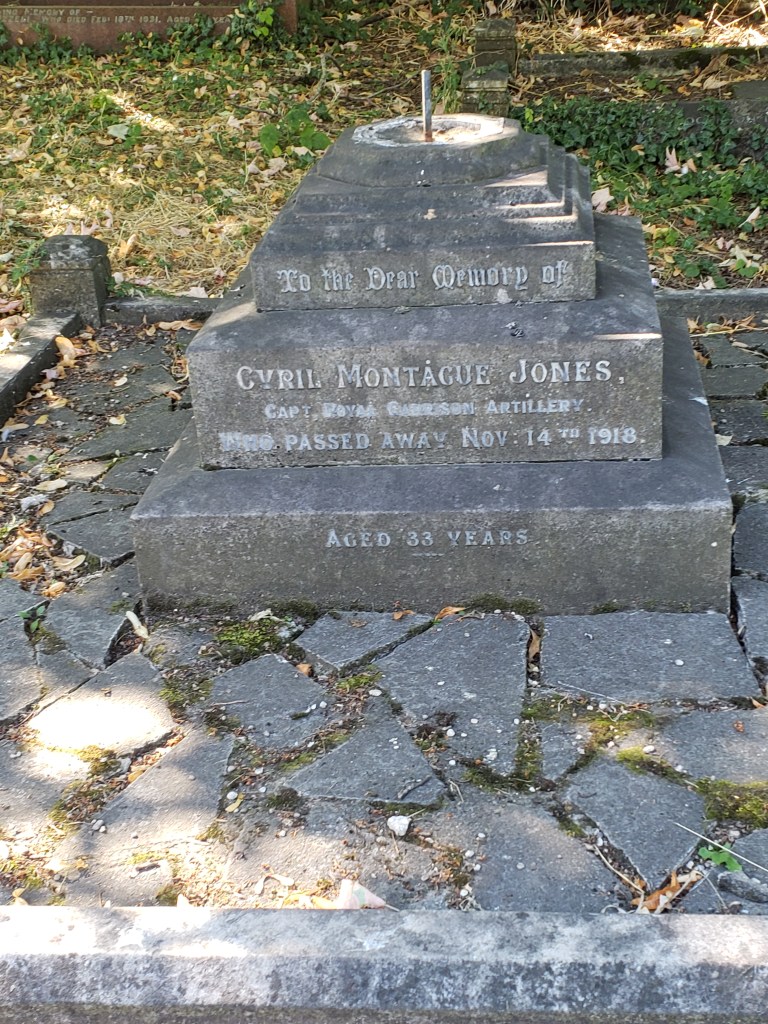
Cyril trained as an architect but on April 1, 1915 he enlisted with the Royal Navy serving on the President before transferring to the Royal Garrison Artillery (RGA). Lieutenant A Captain Cyril Hammond Montague Jones died on November 14, 1918 at the 2nd Eastern General Hospital, Brighton. He was 33 years old. He was buried in Radnor Street Cemetery on November 20 in plot D15A.
This now a large double family plot where Cyril lies with his mother Jane who died in 1924, his father William who died in 1949 and his sister Edith who died in 1965.
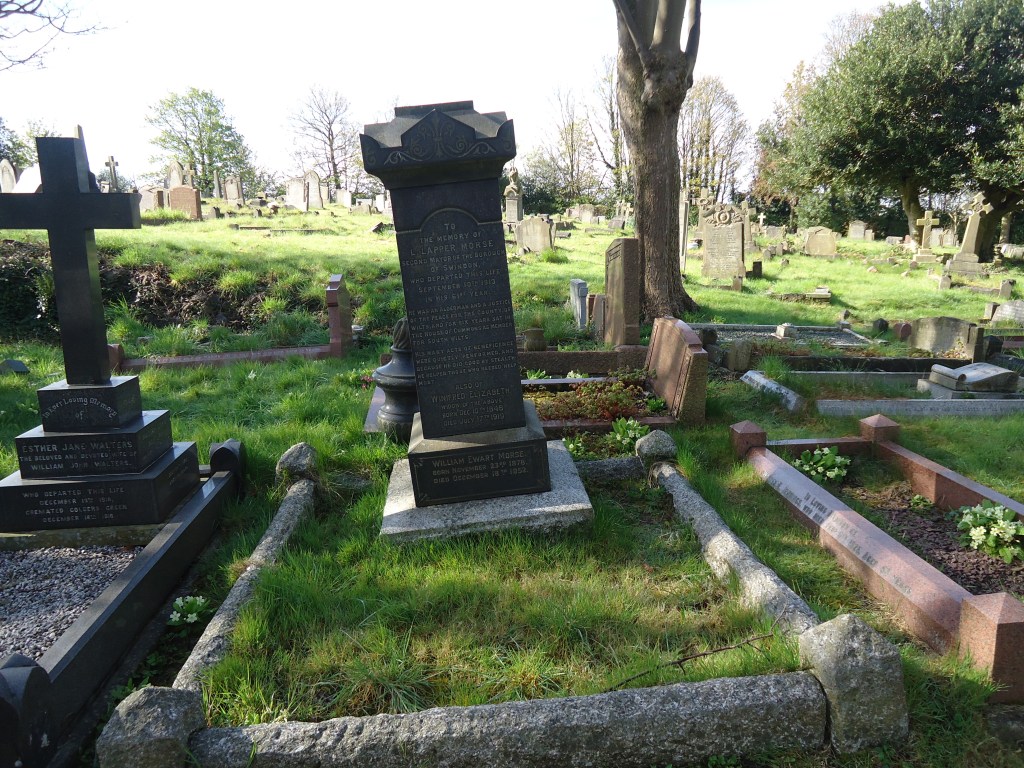
The store closed the day of Mr Levi’s funeral, as a mark of respect. That kind of thing seldom happens now, but things were different in those days.
I had only just started work at Morse’s in the summer of 1913. Drapery assistants worked a long day and as a new, young apprentice I was called upon to do the more menial tasks as I learned my trade. I remember doing a lot of dusting.
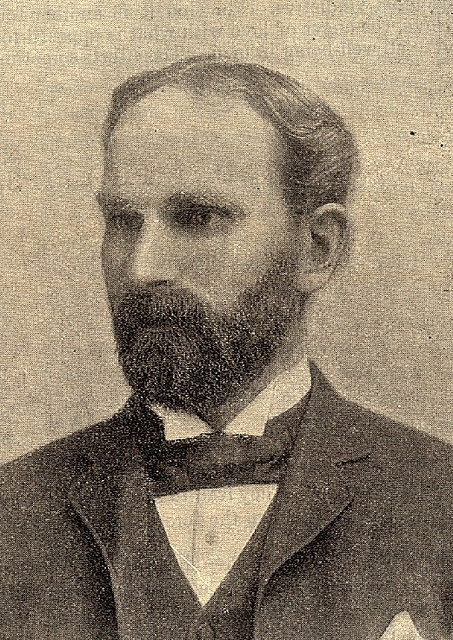
Morse’s had begun as a small draper’s shop in Stratton St Margaret, opened by Mr Levi’s father Charles, more than 50 years ago. It was Mr Levi who opened the Regent Street store where he proudly announced that you could furnish your house ‘cheaply and well.’
I often wondered how much of his own stock he used to furnish his big old house at The Croft where he entertained his political friends and held the large Primitive Methodist conventions. My mum told me not to let the manager at Morse’s hear me speak like that as I would soon get my marching orders.
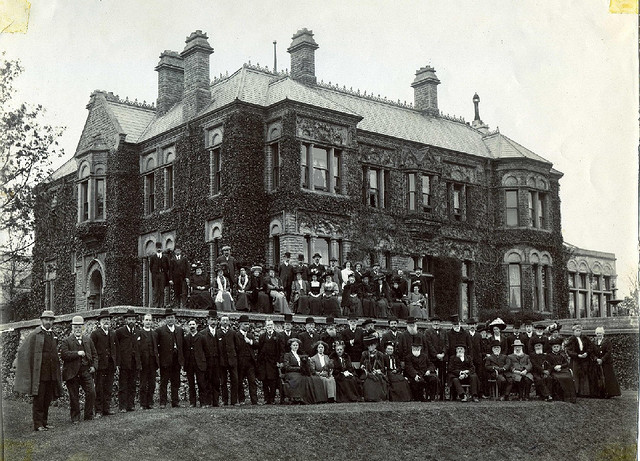
The staff were gathered together when the announcement of his death was made earlier that week. Many were moved to tears. I hung my head but to be honest I didn’t know him, his days of calling into the store and overseeing the business had long passed. We opened late that day, after we dressed the store in black, trimming last used when the old Queen died.
That week in September everyone spoke about Mr Levi in hushed, reverent voices. I wondered if he was really that well liked, or whether this was just the ‘old order’ speaking; those who touched their forelock when the squire drove past in his carriage.
The end of an era, people said. At 16 you don’t really appreciate what that means. But a year later the world was at war. Nothing was ever the same again.
The facts …
The remains of the late Mr Levi Lapper Morse were laid to rest at Swindon Cemetery on Saturday, when nearly 5,000 people witnessed the last rites.
The Cortege, on leaving The Croft, proceeded to the Regent Street primitive Methodist Church. It was headed by a posse of police under Inspector Winchcombe. Then followed the borough magistrates and the Mayor (Mr J.J. Shawyer). The deputy mayor (Mr G. Brooks), and the Town Clerk (Mr R. Hilton). Most of the members of the Corporation and representatives of the principal public bodies brought up the rear of the first portion of the procession. Two carriages laden with beautiful wreaths proceeded the handbier, on which the coffin was laid.
An imposing spectacle was made by the male and female employees of Mr Morse’s business, who came immediately behind the carriages conveying the family mourners. Next were the representatives of religious bodies, and finally about 200 friends and acquaintances who had attend to pay their last tributes of respect.
Besides the family wreaths were tributes from Sir William and Lady Hartley, the members of the Swindon Primitive Methodist circuits, the North Wilts Liberal Association, Members of the second Methodist circuit quarterly meeting, the business staff etc.
A Friend’s Tribute
An impressive panegyric was delivered by the Rev T.M. Pinnock, who described the late alderman as ‘my faithful and true friend for 40 years.” Speaking with evident emotion, the reverend gentleman referred to Mr Morse’s generosity to the Church both locally and in the connexion generally. Without him it would have been impossible for their church in Swindon to be what it was that day. Reference was also made to Mr Morse’s unobtrusiveness and natural business talent, which latter quality he made of immense serve to the Church. “He never forsook the friends of his youth,” added the speaker, “and he died fearing God. He sought to make God’s will the rule of his conduct, God’s service the joy of his heart, and God’s glory was the aim of his life.”
Another brief but earnest tribute was given by the Rev J.D. Thompson (general committee secretary), who said the sympathy of Primitive Methodists all over the country went out to the bereaved.
During the service the hymns “O God our help in ages past” and “Rock of Ages” were sung.
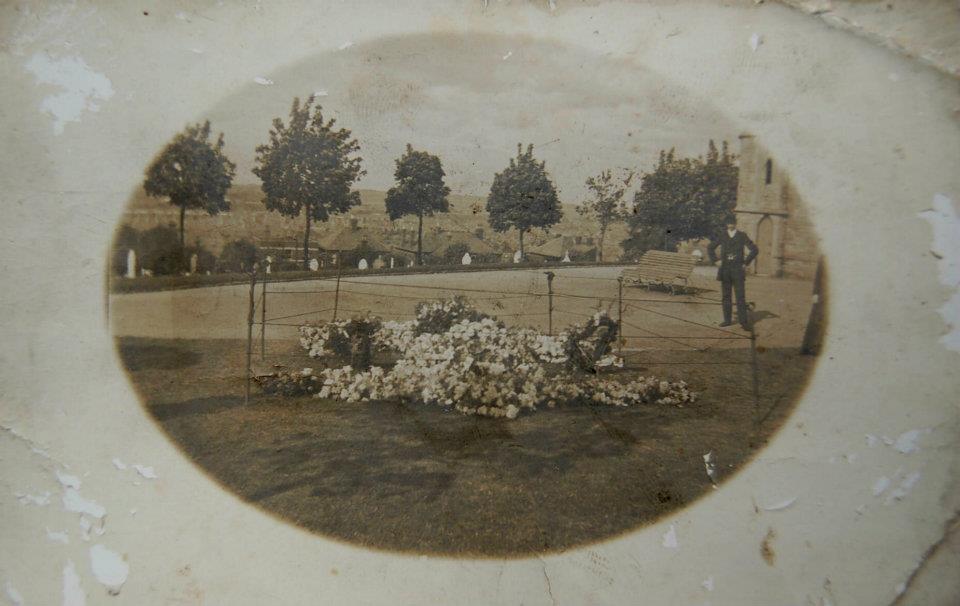
A cordon of police had been drawn round the chapel, on the west side of which was the grave, lined with the deceased’s favourite flowers – red roses – and many other beautiful blooms. Large and sympathetic crowds witnessed the final rites, conducted by the Revs. J.D. Jackson and J. Dobson.
A memorial service was conducted by the Rev T. Mostyn Pinnock (formerly of Swindon), at the Regent Street Church on Sunday night.
Extracts from The Wiltshire Times Saturday published September 20 1913





 Radnor Street Cemetery