George Palmer – cricketer

We have long become accustomed to sensationalist tabloid journalism, but the heading in a Victorian issue of the Swindon Advertiser seems particularly insensitive. When a young cricketer collapsed and died on the pitch the heading read ‘His Last Innings.’

George Palmer was born in Northampton in about 1861 and we learn from the inquest report that he had served in the army in India before arriving in Swindon. At the time of the 1891 census he was lodging with William and Lucy Taylor at 20 Percy Street, Rodbourne where he worked as a Blacksmith’s Striker in the Works. He married Charlotte Annie Varney at the parish church in Fairford just seven months before his death.

His Last Innings

Sudden Death in the Cricket Field at New Swindon

A Cricketer Falls Down Dead

A shocking case of sudden death happened in the Recreation Ground, New Swindon, on Saturday afternoon. A young man named George Palmer aged about 34 years, and living at 15, Percy-street, Even Swindon, was playing for the Even Swindon Cricket Club against another New Swindon team. He was batting and had just hit a ball for five runs. Afterwards he made one run, and had just got to the wicket when he fell down dead. As he fell he uttered the words “Cover up my head,” and never spoke again. A doctor was sent for, who pronounced life extinct. The body was removed to deceased’s home, and Mr Coroner Browne communicated with. Deceased had only been married a few months.

The Inquest

An inquest was held on the body of deceased on Monday afternoon at the Dolphin Inn, Even Swindon, before Mr W.E.N. Browne, County Coroner, and a jury of whom Mr H.G. Hughes was foreman.

The first witness called was Henry Brooks, a GWR employe of 4, East-street, New Swindon, who said he knew deceased well. He had never heard him complain. Witness was umpire in the cricket match in which deceased was playing on Saturday. He was quite cheerful when he commenced playing in the match on Saturday. He had made eight runs, and had run six of them, when he fell down by the wicket. Witness thought deceased was in a fit. He was taken underneath a tree, and as he lay there he said, “put something over my head.” Deceased did not speak again, and died immediately. Witness had heard that deceased received a blow from a cricket ball whilst playing a match a few weeks ago.

Mr Hayward, a juryman, said he heard that deceased said as he was going to the match that he hoped he should not have a fit again.

Wm. Palmer, brother of deceased, said he saw him on Saturday morning, and he was quite well then. Deceased was struck with a ball on the temple about a month ago. On Saturday witness was playing with deceased in the match. He saw deceased fall, and went and fetched some water, but deceased did not speak again.

Dr. Howse, partner with Dr. Swinhoe, said he was called to deceased in the Recreation Ground, and found him quite dead. He had since ascertained that deceased had serves in the Army in India, and had a sunstroke. The circumstance tended to produce a weak heart and the excitement of violent exercise and the heat of the day would cause sudden stoppage of the heart’s action. In his opinion death was due to syncope or sudden failure of the heart’s action.

The jury returned a verdict accordingly.

George was buried not in Radnor Street Cemetery but in the churchyard at St. Mary’s, Rodbourne Cheney on June 19, 1895.

The Funeral

of deceased took place on Wednesday. Mr. Palmer had been a member of the Even Swindon United C.C. since its formation, and was always held in very high esteem by his own clubmates and local cricketers generally. Consequently a very large following from the various clubs in the district attended to pay their last respects, besides a good muster of his old shopmates and friends, numbering altogether upwards of 170. The houses en route to the church at Rodbourne had with few exceptions the blinds drawn and the route was lined with a large concourse of sympathising onlookers. The funeral service was conducted by Rev. C.T. Campbell, who delivered a very touching address at the graveside. The wreaths and flowers sent by various clubs and friends formed quite a floral display. The corpse was borne by eight members of the Even Swindon United C.C.

The Swindon Advertiser, Saturday, June 22, 1895.

Plaum’s Pit

A family of Belgian immigrants have left their name to a beauty spot in Rodbourne Cheney, possibly one of Swindon’s best kept secrets.

Plaum family history facts can be gleaned from notes on the 1911 census made by George Jacques Plaum. At that time he was newly married and living with his wife Catherine and his younger brother Robert Maximilian (who he describes as ‘feeble minded since birth’) at 489 Ferndale Road. He also adds that his father was German and his mother English and that the family had been resident in England since 1888.

Matthias and Clara Plaum had lived in Antwerp, Belgium from at least 1882 to 1887 during which time their children Georgius, Ernestus, Joannes, Robert and Frederick were all born. As George states in 1911, they have been living in England since 1888, so it should be possible to find them on the 1891 census.

On August 25, 1893 Matthias was admitted to the Wiltshire County Lunatic Asylum in Devizes where he sadly died on October 13. Now it was up to Clara to support three sons, one of whom could not work due to a disability. In 1901 she was living at 21 Vilett Street where she worked as a dressmaker. George 19 is employed in the GWR. Younger brother Frederick 13 claims he is a Railway Fitter and Wheel Turner. It is more likely he was an apprentice or perhaps a labourer. Robert is 15 years old. Life was obviously very difficult for them. The Radnor Street Cemetery registers state that Clara died in 1908 at 29 Villett Street aged 48 years. She was buried on December 10 in a public grave with two other unrelated persons.

But by dint of hard work and an entrepreneurial talent, George Plaum and his family prospered.

He purchased the Rodbourne Bathing and Boating Pool in the 1920s with financial help from a Bristol business man. The lake, like the one in Queens Park, began life as a clay pit feeding Victorian Swindon’s rapacious brick making industry. Quarrying came to an end when diggers hit underground springs and forced the closure of the clay pit.

By the 1920s the lake offered a number of leisure activities including swimming, boating and fishing. An additional income was derived from entrance and camping fees and refreshments. Grass, grazing and allotment fees brought in £5 7s 6d in 1925.

Today Plaum’s Pit is home to Plaum’s Pit Angling Club who can be contacted via their website.

Plaum’s Pit swimming pontoon in the 1930s

Image of Plaum’s Pit published courtesy of Brian Robert Marshall

Clayton Joyce – bungalow builder

Clayton Walter Joyce was born in Moredon in 1863 the second son of Charles Joyce, a mason and builder, and his wife Pamela. Clayton started work in the GWR Works and when he married Emily Jones in 1888 he stated that his occupation was that of mechanic. But inevitably he went into the building trading, working as a bricklayer from at least 1891.

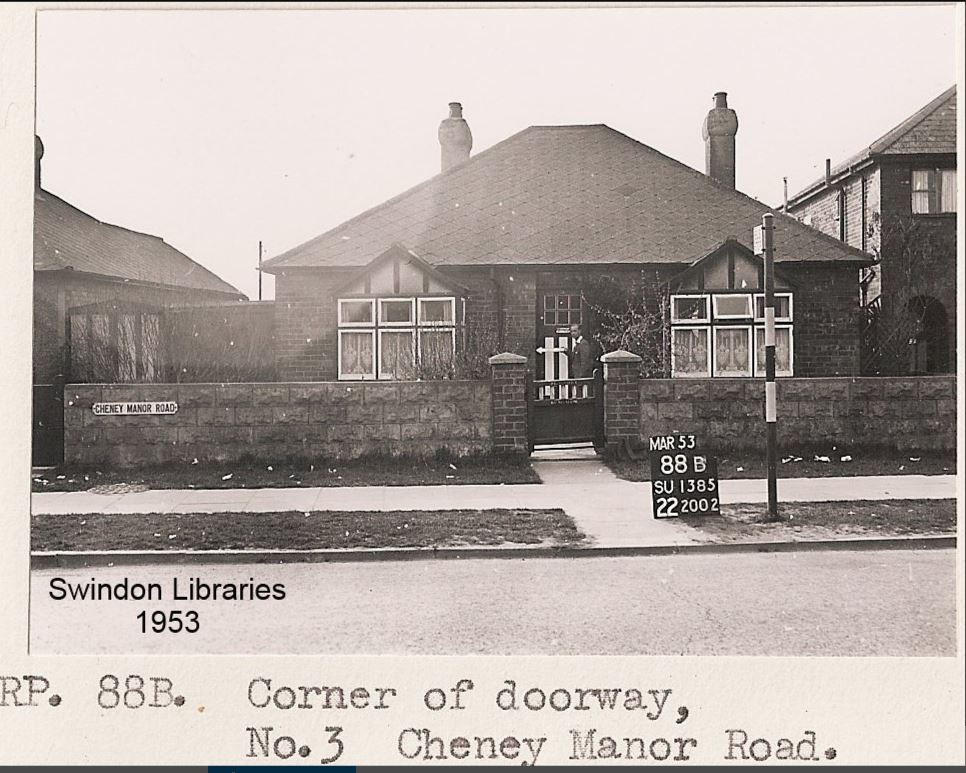
In 1925 Clayton began work on properties in Telford Road, Rodbourne Cheney. He built two bungalows both completed in 1926. That same year he built a bungalow for Mr Keene and began work on a house and shop completed in 1927. In 1927 he went on to build four bungalows, one for Miss Perry, one for Mr Walker and two for Mr G. Mabberley, the man who commissioned his first build in 1925. In 1928 he built a bungalow (nearest shop) and then in 1932 another bungalow in Telford Road for Mr A.J. Thorne in the recently renamed Cheney Manor Road.

This image is published courtesy of Local Studies, Swindon Central Library from the Ordnance Survey Revision Point series of photographs. Could this be one of Clayton Joyce’s bungalows?

By the 1920s Telford Road in Rodbourne Cheney had become a desirable residential area. Builders active in the area include Tydeman Bros who built a house for Mr Keefe in 1928. Our friend James Hinton (who owned the land on which the cemetery was laid out) was also busy in the area and had been for sometime, according to an entry in Architects and Building Craftsmen with Work in Wiltshire Pt 2., James Hinton – Swindon Telford Road, Harcourt Road, Cobden Road, Ferndale Road, new streets and back roads 1905.

Another view of Cheney Manor Road courtesy of Local Studies, Swindon Central Library. Could the bungalow on the right be a Clayton Joyce build?

In 1928 the Swindon Borough boundary was extended to incorporate Rodbourne Cheney and Telford Road was renamed Cheney Manor Road.

Clayton’s wife Emily died in 1925 and was buried on January 31 in grave plot D210. At the time of the 1939 census Clayton was living with his son and his family at 9 Suffolk Street. He died at Ogbourne Hospital in 1945 aged 82 and was buried with Emily on February 7.