William Hall – killed at work aged 13 years and eight months

At 13 years and 8 months of age William was working as a ‘slipper.’ A ‘slipper’ was a young lad who assisted with the movement of wagons by horses. He would place the chocks to ensure that the wagon did not move when parked. They were called slippers because the chock looked like a slipper.* As one of the jurymen remarked during the inquest – ‘he thought it a great shame that the Co. should employ lads at such work. It was very dangerous for the lads so employed.’

William Hall had a short life. You could easily miss him on the 1881 census returns where he is recorded as James William Hall aged 4 years old. He was then living in Llanelly, Carmarthenshire with his parents John and Ellen, and two brothers. William was born in Swindon in 1877 but by 1881 the family had lived in Wales for a few years. His younger brother Thomas was born in 1879 in Llantrisant while Frederick was born in Llanelly in 1883. By 1890 the family were back in Swindon living at 166 Rodbourne Road, handy for the Works where John worked as a Stationery Engine man and where William would soon join him.

The Fatal Accident at the GWR Station

On Saturday, Mr W.E.N. Browne, coroner, held an inquest at the Cricketers’ Arms, New Swindon, on the body of the lad William Hall who received fatal injuries at the GWR Station, New Swindon, on the previous Thursday. Mr T. Wheeler was chosen foreman of the jury, who then proceeded to view the body, which was lying at the GWR Medical Fund Society Hospital. Inspector Wheeler was present to watch the proceedings on behalf of the GWR Co. The following evidence was taken:-

John Hall sworn, said: I am father of deceased, whose age was 13 years and 8 months. He had been only two days in the employ of the GWR Co., but he was at the same work for three days a fortnight ago, but left and did nothing till he was taken on again during the past week.

Henry Roach, shunter, in the Loco. Dept., said he was standing near the E Box in the afternoon. He heard someone call out, and on looking round he saw the second wheel of the van go over the deceased. Witness went to the lad’s assistance and picked him up. He asked deceased how he got under the van, and he replied, “My foot caught in the points, and it threw me down.” Deceased was quite sensible when picked up. The driver was at the horse’s head.

By a juryman: – It was a general practice for boys to be employed in “slipping coaches.”

(A juryman here interposed with the remark that he thought it a great shame that the Co. should employ lads at such work. It was very dangerous for the lads so employed).

Albert James Ford, said he was a driver in the employ of the Great Western Railway Company. Deceased was working with him as a “slipper.” On the day of the accident he was at work with the deceased, as usual. The first he heard of the accident was when the boy, being caught under the wheel, cried out. He went to the lad, and found the wheel had passed over him, and his shoe was left in the points. It was a horse box that was being drawn, but the boy was not riding on it at all. Witness had that same morning cautioned the deceased against walking on the rails, and he was not doing so when the accident happened. If the lad’s foot had not caught in the points the accident would not have occurred.

Mr Cailey, assistant to Messrs Swinhoe, Bromley, & Howse, said deceased was admitted to the hospital about 2.30 p.m. on Thursday. He was suffering from severe injury to the thigh and one arm. Deceased had his boots on when brought to the hospital. He lingered till six o’clock, when he died from exhaustion.

The Coroner having briefly summed up, the jury returned a verdict of “Accidental death.”

The Swindon Advertiser, Saturday, Feb. 15, 1890.
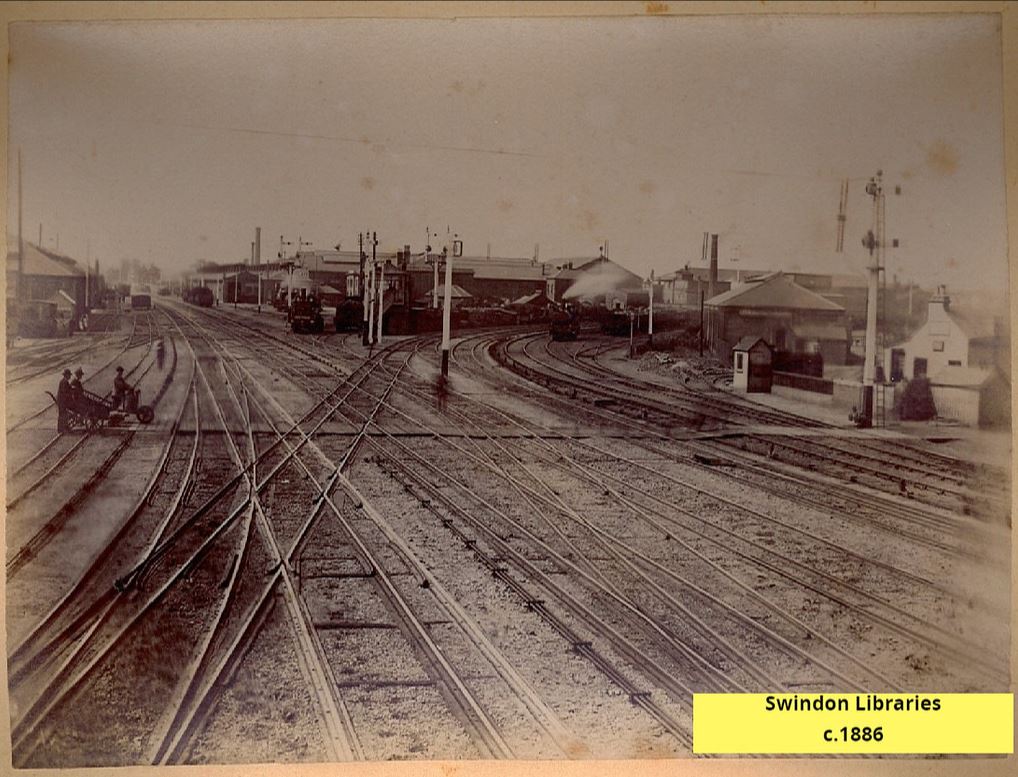
c1886 View of Swindon GWR Works from railway line published courtesy of Local Studies, Swindon Central Library.

Today there is no one left to remember the young boy who was doing the work of a man. No one to remember that William Hall was 13 years and eight months old when he was killed at work.

William was buried on February 18, 1890 in grave plot B1778 – a public grave that he shares with two others.

*Many thanks to David Robert for correcting a previous error.

Season of mists Pt II

And still more, later flowers for the bees,
Until they think warm days will never cease,
For Summer has o’er-brimm’d their clammy cells.

To Autumn by John Keats

Hope you can join me from the warmth of your sitting room where the logs crackle in the hearth and the wind moans down the chimney. You might have expected the cemetery to be inaccessible after the deluge yesterday, but I shall pull on my wellington boots and my raincoat and venture forth.

This is the final resting place of members of the Wall family, husband and wife William and Mary Ann, and their son Arthur Henry.

Arthur was born in 1899, one of William and Mary Ann’s six children of whom sadly only three sons survived childhood.  He grew up in Rodbourne living at addresses in Redcliffe Street, Drew Street, Linslade Street, Montague Street and Jennings Street.  William worked as a Boiler Maker in the railway factory and when young Arthur left school he followed him into the GWR Works and the same trade.

Following the outbreak of war in 1914 Arthur was keen to join up and enlisted in the 2nd Wiltshire Battalion on January 12, 1915.  He gave his age as 19.  He was in fact not yet 16, but recruiting officers were apt to turn a blind eye to a fresh faced, eager young volunteer.  He was posted to France on June 1 where his age was quickly detected and on July 7, 1915 he was sent back to England as being ‘under age and physically unfit for service at the front.’  He spent the following year in service on the home front before returning to France in June 1916, this time in the 1st Hertfordshires.

His service records reveal that on May 12, 1918 he was gassed. His medical records state that his capacity was lessened by 40% and he was left with defective vision and suffering from headaches.  He was discharged on November 23, 1918 as being no longer physically fit for war service.  He received a pension of 11s and returned to Swindon where he married Mabel Pinnegar in 1919.  

Whether Arthur was able to return to work as a boiler maker remains unknown.  In 1920 he wrote to the Infantry Record Office asking if he was entitled to anything under Army Order 325/19 concerning the Territorial extra allowances.  He received this reply:

‘I regret to inform you that you are not entitled to any extra pay or allowances under Army Order 325 of 1919 as you were discharged on 23rd November, 1918. The increase of pay authorised under the Army Order in question was only granted from 1st July, 1919 to soldiers who were actually serving on the date of the order, viz 13th September 1919.

Arthur died on May 22, 1922 aged just 23 years old. Have you noticed the date of death of Arthur and his father William? You can read more about the sad event here.

But for now I think I shall quicken my step and head off home as the rain clouds are gathering again. See you tomorrow to continue our virtual tour of Radnor Street Cemetery.

Rose Morse

Sometimes the details are too scant to piece together the before and after stories.

This is the tragic story of a little girl who died in a wash tub in a back garden at 8 Thomas Street, Rodbourne. Sadly, even her name is incorrectly reported – she is Rose Morris, not Morse.

Her father, Charles James Morris, a 36 year old Engine Fitter, died three years later.

What happened to the bereaved wife and mother Hannah Morris?

Even Swindon

Death of a Child. – A little girl named Rose Morse, aged two years, daughter of Charles Morse, fitter in the GWR Works, New Swindon, and residing at 189 Rodbourne Road, met with a sad death on Easter Monday. She was playing with other children in a back garden at 8 Thomas Street, Even Swindon, when she was all at once lost sight of. One of the other children went into the house and asked a lad named Clifford where the lost girl was. He went out and searched for her, and noticing that a piece of sacking was removed from off the top of a wash tub which was “let into” the ground. The tub contained a small quantity of liquid and some grains. Clifford on looking into the tub, saw the poor little child, suspended from the top of the tub, head downwards, quite dead. He at once raised the alarm, and medical aid was sought. Dr. Bromley (Messrs Swinhoe, Howse and Bromley) quickly attended, but pronounced life to be extinct. – On Wednesday, an inquest was held on the body at the Dolphin Inn, by Coroner Browne. After hearing the evidence, the jury, of whom Mr Jonah Hawkins was foreman, returned a “death from suffocation,” and recommended that a proper covering should be placed firm on such tubs as deceased fell into when placed on the ground.

Swindon Advertiser, Saturday, April 27, 1889.

Rose Ethel Morris was buried in plot B1207, an unmarked public grave, on April 27, 1889. She is buried with three other children; two month old George Mills who was buried the previous day and 4 year old Phyllis Holmes and 2 year old Flora Maude Barnes who both died in 1922.

Charles James Morris died in February 1892 and was buried in plot A875, another unmarked public grave, with three other unrelated persons.

Looking towards the Kent Road gate – Section A to the left and Section E to the right.

The day Nellie Fitch came calling

Jane Tuckey
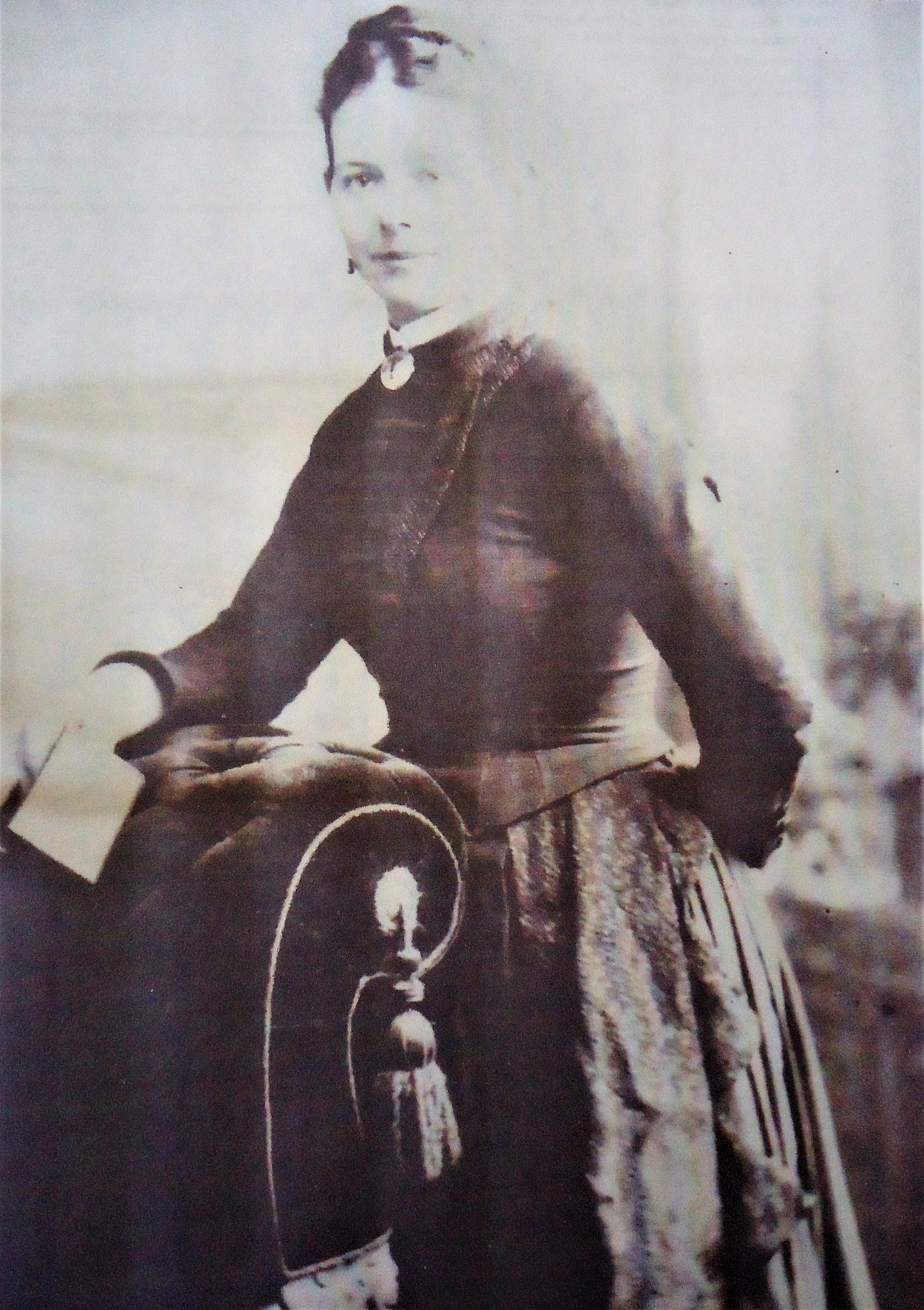
Jane Helena Tuckey photograph courtesy of Peter Guggenheim

The re-imagined story …

Mother went to Mrs Dicks funeral. It was a very quiet affair, she said. Not many at the church and even fewer at the graveside.

“I don’t know why she wasn’t buried at St Mary’s, along with all her family,” said mother. “There’s a long avenue of Tuckey graves in the churchyard there. Great big gravestones enclosed by iron railings. Of course, there was money in the family then.”

A familiar guilty twinge stabbed me.

I used to visit Mrs Dicks most weeks. Mother would send me round with a meat pie or a suet pudding.

“She doesn’t eat very well.”

Mrs Dicks lived opposite us in Hawkins Street. Her husband had died several years before.

“He was a fitter in the Works. Nice man, people said, although a bit of a come down for her. Her first husband had been a wealthy farmer from Chippenham.”

Mrs Dicks’ terrace house was crammed full of great big pieces of dark furniture.

“No doubt from her father’s house in Shaw.”

Sometimes she would open the drawer in the big, old dresser and hand me a tortoiseshell casket and together we would look at her ‘treasures’ as she called them.

Then one day Nellie Fitch came with me.

I usually went to Mrs Dicks on my own but this day Nellie was sitting on our front wall.

“She can smell the pie.”

Nellie Fitch wore shoes with holes in them and her winter coat was too small for her. Nothing unusual about that. During the war most of the kids in Rodbourne wore hand me downs. But then she told me she often didn’t eat.

We didn’t have much, but I always knew I would have a cooked dinner. Nothing fancy mind, but mother was a good, plain cook and she knew how to make a little go a long way.

Nellie’s dad was away fighting the Hun, she told me.

“Nellie’s father disappeared years ago,” said mother. “And so has the layabout she thinks is her father.”

Mrs Dicks opened her front door to a small hallway, just like the one in our house and all the other houses in Hawkins Street.

She was pleased to see me, but less so to see Nellie. I don’t think it was her dirty clothes and shabby shoes that bothered Mrs Dicks. I imagine it was more the fact that now Nellie would know she accepted food from neighbours. Mrs Dicks tried to keep up appearances. She had come down in the world and keenly felt her loss of status. But to me she was just another little old lady who wore old fashioned dresses and spoke in a posh voice.

“Good morning girls. How lovely Violet. Please thank your mother,” she said as she took the warm basin into the kitchen. “Tell her I will settle up with her at the end of the week.”

She always said the same thing. No money ever changed hands, my mother wouldn’t have expected any and Mrs Dicks had none to give.

“Come into the kitchen girls. I was just making a cup of tea.”

If Nellie was hoping for a piece of cake or a biscuit she would be out of luck.

Nellie probably wondered why I spent time with the posh old lady in her dark and dreary house where there was nothing nice to eat.

Mrs Dicks would tell me about the house in Shaw where she had grown up with her eight sisters and her brother. How they played in the orchard at the back of the house and on Sundays they would walk all the way to the church in Lydiard Millicent. She would bring out her photograph album and tell me about the people; bewhiskered old men and wasp waisted ladies.

And sometimes she would bring out the tortoiseshell box and show me the beaded bag she took to dances when she was a young woman, and the diamond tiara that became a pair of dangly earrings at the click of a pin at the back. There was an amethyst ring that had belonged to her grandmother and brooches and pins.

Please don’t bring out the tortoiseshell box today, I silently pleaded. But the atmosphere was awkward with Nellie there. We were probably the only two quiet children in Rodbourne that morning.

I watched Nellie’s eyes grow as wide as saucers as she peeped inside Mrs Dicks’ tortoiseshell box, and she looked at me and smiled. Not a big, open smile, but something sly.

I never wanted to visit Mrs Dicks after that.

“I don’t have time to go calling in on Mrs Dicks,” my mother complained when she had to deliver the meat pie.

Nellie got a new winter coat that year, and a new step father.

“They’re not married,” said my mother. “She’s never marries any of them.” And then they moved away from Rodbourne.

The facts …

Jane Helena Tuckey was born on March 15th 1848 at Langley Burrell, the fourth daughter of Robert and Ann Tuckey.

The 1841 census returns for Yatesbury record wealthy bachelor farmer Robert Tuckey living with Ann Trotman, an unmarried servant and her four year old daughter.

Perhaps Tuckey family opposition to this mismatched alliance delayed a wedding. By the time the couple did get around to walking up the aisle at St. Saviours in Bath they had two daughters and Ann was pregnant again.

But by 1851 Robert had come into his inheritance and the growing family moved into Shaw House along what is now called Old Shaw Lane in West Swindon.

In 1872, shortly after the death of her father, Jane married farmer John Clarke, thirty years her senior, and moved to nearby Kington St. Michael where John farmed 381 acres. With 20 farm and house servants on the payroll, this was a big establishment.

Then in 1882 John Clarke was found dead in one of his fields having suffered a fatal heart attack and Jane’s life was to change dramatically.

In 1884 Jane married Francis Dicks. Her second husband, seven years her junior, was a fitter employed in the GWR works. The couple with Jane’s girls moved into 37 Hawkins Street, Rodbourne where a further two children were born.

In the small terraced house Jane’s lifestyle was far removed from the comfortable childhood she had enjoyed, playing in the orchard at Shaw House.

Widowed for the second time in 1903 she survived on an income derived from taking in a lodger.

Mrs Dicks died on November 26, 1918. She was buried in plot B1494, a pauper’s grave in Radnor Street Cemetery.

Tuckey house

Shaw House, Old Shaw Lane, Swindon

Mary Bailey – of intemperate habits

There is a world of difference between enjoying a drink and taking a bottle of whiskey to bed and I wonder what propelled Mary Bailey from the one to the other.

Drunkenness was the scourge of the 19th century working classes. Even in Swindon where the much lauded Great Western Railway Company provided wrap around care ‘from the cradle to the grave’ there was still want and destitution for those who fell through the cracks of society.

Temperance societies encouraged people to abstain from drink and to take the pledge of a lifetime of sobriety. By the end of the century Swindon numbered around 18 such organisations, including the GWR Temperance Union with around 3,000 members, however it is unlikely Mary joined their ranks.

A Fatal Taste for Alcohol

A sad case came from Coroner W.E.N. Browne, on Monday in an inquest concerning the death of Mary Baily, wife of a GWR fitter of 11 Hawkins Street, New Swindon.

The deceased who was 49 years of age, was stated by a neighbour to be of intemperate habits. Her husband on Friday night went to bed at 10 o’clock, and thinking his wife was asleep did not disturb her. He arose at five o’clock on Saturday morning and found his wife dead and quite cold. A whiskey bottle was found beneath the bed. Dr. Duffield stated that death was due to asphysxia, cause by the woman lying on her face in a helpless condition ensuing upon an over-dose of alcohol.

Gloucester Citizen Tuesday November 28, 1899.

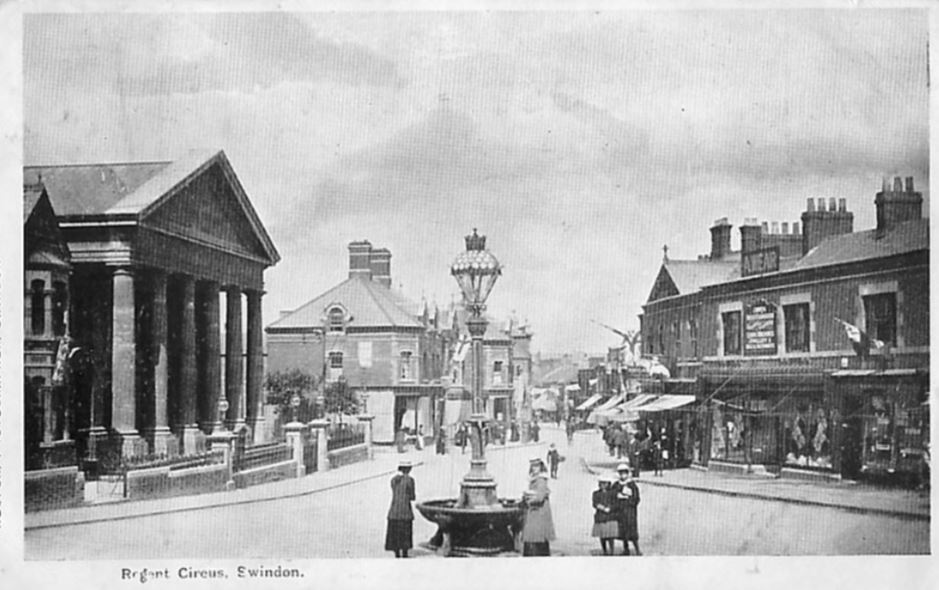
Drinking fountain erected by the Swindon United Temperance Board in Regent Circus 1893

Mary Christianna Dance was born in Stratton, Gloucestershire and baptised on February 4, 1849, the eldest of John and Jane Dance’s eight children. She married Thomas Bailey in 1871 and by 1881 they were living at 11 Henry Street (later renamed Hawkins Street) with their 8 year old son Thomas, and Mary’s brother Charles. Both men worked as carriage fitters in the Works.

So what happened to Mary between 1881 and 1899, or had her problem with alcohol begun long before? Did she try to control her drinking, or was she aided and abetted by her husband Thomas, whose comments at the inquest appear ingenuous when compared with the neighbours observations.

Mary was buried on November 28, 1899 in grave plot C109, a privately purchased grave, which might come as some surprise. In 1908 she was joined by Tryphena Bailey, Thomas’s second wife and then in 1937 by Thomas himself.

Many thanks to David Lewis and his book Between the Bridges – The Early Days of Rodbourne.

Set in stone

This headstone is a victim of weathering. Other deteriorating examples can be found across the cemetery, but this is the end result, when the surface cracks and eventually falls away.

It might seem that the history of those buried here is lost, but it is possible to piece together the family history.

A cemetery marker is propped up against the headstone. These should be treated with caution as many are in the wrong place, but I struck lucky with this one. Using the cemetery maps and grave plot registers I was able to trace the story of not only the people buried in this grave but those in the one next to it as well.

James and Dorah Neate

This is the last resting place of James and Dorah Neate. James was born in Box, Wiltshire and Dorah in Bruton, Somerset. They married at St James Church, Bath on October 30, 1877.

James worked as a railway engine driver and the couple moved about a fair bit. At the time of the 1891 census they were living in St Brides, Bridgend with their two sons. William 10 who had been born in Box, Wilts and Frederick 9 born in Weymouth, Somerset. By 1901 they were living at 7 Park Terrace (Faringdon Road) in Swindon. William and Frederick were both working for the GWR, William as a stoker and Frederick as a fitter. The couples’ last home was at 13 Jennings Street where James died in 1925 and Dorah in 1930.

James was buried in Radnor Street Cemetery on April 27, 1925 in plot D519. Dorah’s funeral took place on July 7, 1930 and she is buried in the same plot.

The collapsed pink granite monument next to James and Dorah’s plot is the grave of their son William.

Like his father William also became a railway engine driver. He married Elsie Maria Tyler at St Paul’s Church, Swindon on June 24, 1907. At the time of the 1911 census William and Elsie were living in Goodwick on the Pembrokeshire coast with their two-year-old daughter Kathleen Dora. They also had a son, Arthur William T. Neate, who was born in Wales in 1915.

William and Elsie eventually returned to Swindon where Kathleen died in 1931 aged 22.  William died at 30 South View Avenue, Walcot, Swindon on September 11, 1948 and Elsie died at 20 Castle View Road, Stratton St Margaret on December 13, 1968.

William, Elsie and Kathleen are buried in plot D520 next to William’s parents.

Elsie Maria Neate 4

The Tyler family photo was shared on Ancestry by Debra Tyler on February 8, 2010. Elsie is standing on the left with her arm resting on her mother’s shoulder.

Elsie Maria Neate nee Tyler

Thomas Mullett – a Gas Work labourer

The last time we find Thomas Mullet on official documents is in the 1901 census. A Gas Work labourer Thomas lived at 146 Morrison Street with his wife Jane and three of their children – George 23, a furnaceman, Rose 19, a dressmaker and Mary 18, a shirt machinist.

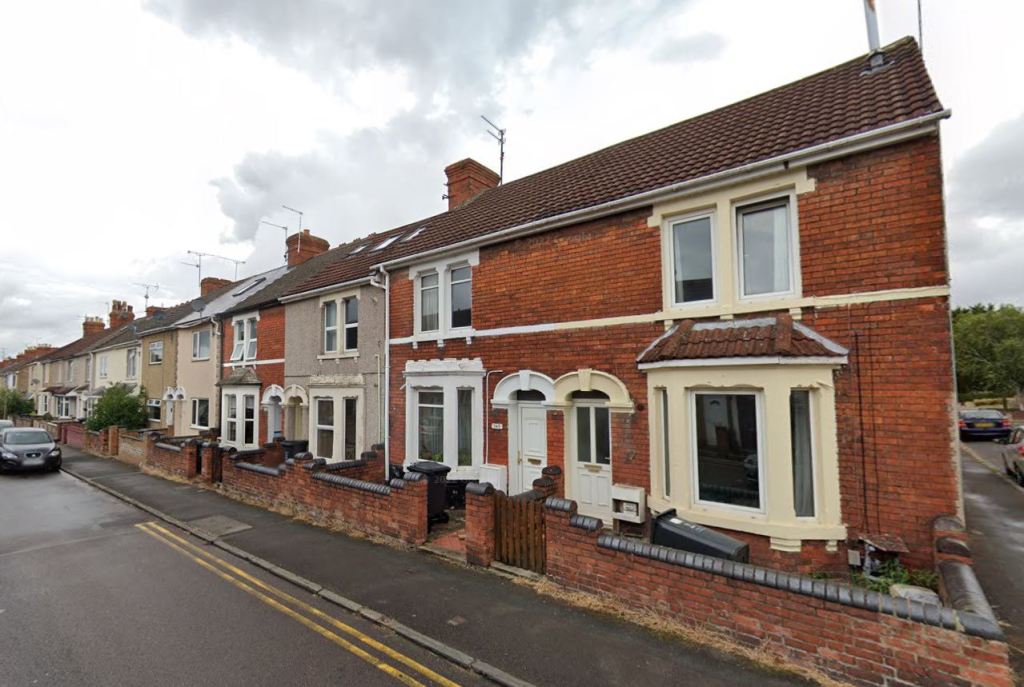
Morrison Street – the Mullett family lived in the end house

Swindon

Thomas Mullett of 146 Morrison Street has succumbed to the effects of injuries sustained in an accident in the GWR Works a fortnight ago.

Deceased mounted a wall for the purpose of lighting a lamp, and fell on a quantity of rough stones his head being cut open. He received attention at the GWR Hospital and subsequently went home. After a while however erysipelas and internal complications supervened and death took place on Wednesday.

Western Daily Press Friday October 5, 1906.

Thomas Mullett aged 56 was buried on October 6, 1906 in grave plot D137 where he lies alone.

After her husband’s death Jane took stock of where her own life was going. Just two years later she had made up her mind and set sail for the USA. In 1920 she was living with her daughter Rose and son-in-law William H. Hobbs in Onondaga County, New York State.

Jane died in 1939 and is buried in Sherrill, NY, a long way away from Morrison Street and Thomas in Radnor Street Cemetery.

Thanks to Between the Bridges – The Early Days of Rodbourne – by David Lewis

Walter George Watts – killed instantaneously

Walter George Watts was known to family and friends as George. The son of Charles and Elizabeth Watts he was born in Horton, Wiltshire and began his working life at 14 years old as a farm labourer in Haydon Wick. Perhaps he was still employed on the land in 1910 – there is little information to be discovered about Walter’s life – only the report on his death.

In 1932 the Prevention of Accidents booklet was published with ‘posed’ photographs of potentially dangerous situations for those working on the railways. But it seems likely George wasn’t a railway employee. The railways were (and continue to be) dangerous places, even if you didn’t work on them.

A recent view of Montagu Street, Rodbourne

Fatality on the GWR near Swindon

A fatal accident occurred on the Great Western Railway between Swindon and Purton, about midnight on Wednesday. Two men were walking along the railway towards Swindon, and after they had passed two trains, which were meeting each other, one of them missed his companion, Walter George Watts, of 119 Montague Street Swindon. He made a search for him and eventually found his dead body by the side of the line. He had been struck by one of the trains and was killed instantaneously. The body was removed on a light engine to Swindon to await an inquest. The unfortunate man was 24 years of age and met his death on his birthday.

Western Daily Press, Friday August 12, 1910.

Walter George Watts was buried on August 15, 1910 in a public, unmarked grave, plot B2401. He was buried with two others; Jacob Fry who died in 1895 and was probably unrelated and Walter’s father Charles Watts who died in 1913.

With thanks to David Lewis – Between the Bridges – The Early Days of Rodbourne.

If you are researching your railway ancestor you may also like to visit the Railway Work, Life & Death website.

Job Richardson – House and Estate Agent

Image of Rodbourne Road published courtesy of Local Studies, Swindon Central Library.

It’s not very often I get the opportunity to visit a house owned by the same family for 100 years (unless they are an aristocratic family) but recently I did. One hundred years of children running up and down the narrow stairs, one hundred years of washing on the line. There was even a saucepan dating back to those days – how many meals had been dished out from that pan and eaten at the kitchen table where I looked at family photographs and letters?

At the end of the 1860s Even Swindon was still mostly farmland but with the Great Western Railway Works on the doorstep it was growing fast. Development began in the 1870s with the sale of Northaines Farm, Edwards Farm and part of Even Swindon Farm and an early speculator was Job Richardson.

Job Richardson was born in 1842 in Somerset, the son of coal miner Elijah Richardson and his wife Eleanor. By 1861 19-year-old Job was also working in the Somerset coal mines.

In 1866 Job married Henrietta Milsom in Radstock.  Sadly, Henrietta died the following year, during or soon after the birth of her daughter Henrietta Milsom Richardson. She is buried in the churchyard at Radstock, most probably with the baby who died. By 1871 Job had moved to Bath, lodging in St James Parade, where he worked as a mason.

In 1872 Job married Sarah Rebecca Tanner at the parish of Widcombe, Somerset and by 1877 they had arrived in Swindon where Job bought land in Even Swindon. In 1881 Job was living at 33 Henry Street (quickly renamed Hawkins Street to avoid confusion with a street in the town centre) and working as a House & Estate Agent.

1884 notice published courtesy of Rodbourne Community History Group.

Job and Rebecca later moved to 133 Clifton Street but continued to rent out their properties in Rodbourne. Job died in 1903 and is buried in grave plot D163 with his father-in-law Henry Tanner who died earlier that same year. Rebecca sold her stake in the Rodbourne properties in 1924 and was buried with her husband and her father on January 4, 1928.

William and Maud Brotheridge

Could this be a wedding photograph of William and Maud? She looks very young; only 20 years old at the time of their marriage in 1893. William was 8 years older and had already seen service in the Warwickshire Regiment.

We find them next on the 1901 census living at Wroughton Road. William is working as a ‘Collector and Salesman for Singer Sewing Machines.’ The family had moved around with the elder children’s birthplaces recorded as Cheltenham and Fairford.

By 1911 they were living in Ashton Keynes with further children born in Swindon, Faringdon, Stanford in the Vale and Ashton Keynes. By then Maud had had 10 children, 9 of whom were still living. At least 3 more sons were born between 1911 and 1915 but only one survived to adulthood.

Another baby, Thomas Reginald Brotheridge, was born in 1915 and died aged just 7 months old when the family were living at 90 Montagu Street. By then war was raging. William and Maud’s eldest son, also named William, had joined his father’s old regiment, the Warwickshires. On May 27, 1918 he was on board the Leasowe Castle, an armed troop transport ship, when it was torpedoed and sank off the coast of Alexandria. A total of 83 officers and men were drowned that day, including 21 year old William. He is remembered on the Chatby Memorial in Egypt. He left a small sum of money, including a War Gratuity of £17, to his mother, as previously agreed with his father.

William and Maud were just one of many Rodbourne couples who lost a loved one during that awful conflict.

Montagu Street, Rodbourne

Maud died in February 1924 at 90 Montagu Street. She was 51 years old – no age to die, we would say now. She had given birth to at least 13 children and along with the babies she lost she also lost a son to war.

She was buried in Section Lower C grave plot C3953 where in 1934 her daughter Elizabeth Maud Mary joined her. Elizabeth was 38 years old and unmarried.

William Brotheridge died at 86 Montagu Street in November 1941. He was laid to rest with his wife and daughter.