The Order of the White Feather was founded at the outbreak of war in August 1914 by Admiral Charles Penrose Fitzgerald. The campaign encouraged women to present white feathers, a potent symbol of cowardice, to men not wearing uniform. The campaign was incredibly successful, even as the details of the death toll and casualties became widely known.
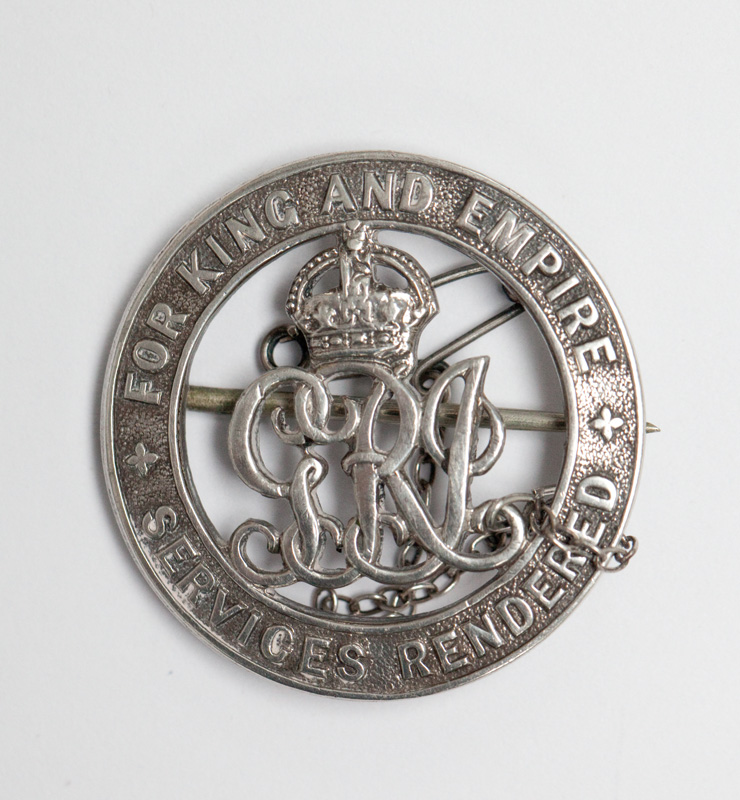
The practice seems to have carried on for the greater part of the war and in September 1916 the Silver War Badge was issued for men to wear who had been honourably discharged due to wounds or sickness.
Why did women subscribe to this propaganda? The writer Compton Mackenzie, who served with British Intelligence in the Eastern Mediterranean, said ‘idiotic young women were using white feathers to get rid of boyfriends of whom they were tired.’
For some it was no doubt misplaced patriotism. For those who had lost husbands and loved ones it might have been a reaction to their grief.
One such young woman who handed out white feathers on the streets of Swindon did so because her four brothers were all serving soldiers.
Alice Elizabeth Godwin grew up at 21 Redcliffe Street, the daughter of Charles Thomas Godwin, a furnaceman in the Works, and his wife Clara Annie. You can imagine the daily dread the family experienced with four sons in service and how a young, impressionable girl might have been coerced into joining the white feather campaign.
But it would be the experiences of one of her brothers which ultimately changed her mind.
She was at the station in Swindon seeing him off back to the front at the end of his leave, when he broke down, weeping and shaking uncontrollably. It was seeing him so terrified that made her cease her practise of handing out white feathers. Thankfully, all four brothers returned home.
Propaganda poster
Charles Thomas Godwin died on November 8, 1914 and was buried in grave plot B3265. His wife Clara Annie died in 1939 and was buried with him. Their son Albert Howell, who had served in WWI, died in 1940 and joined his parents. In 1985 Albert’s wife Clara Agnes was buried with her husband and his parents. In 1993 the ashes of their son Arnold William Godwin were interred in the family grave.
Like so many other town centres, Swindon’s has lost its way. Built on a mid-Victorian industrial new town model, its retail heyday is long past and even the big High Street chain stores that arrived a century later have also gone.
In 2006 the Rodbourne Community History Group published Walk Down the Lane, a celebration of the enduring commercial viability of their neighbourhood where business has continued to survive and thrive for more than 140 years.
Take, for example, 178 Rodbourne Road on the corner of Jennings Street, opposite the Dolphin. In 2006, at the time Walk Down the Lane was published, it was a Tool Hire Centre. By 2009 MotoShop had recently closed and the shop was boarded up, available to rent, but this premise in such a prime location wouldn’t remain closed for long. In 2012 it was operating as The Furniture Box and four years later the Second Skin Tattoo parlour. Today it is the Beauty Base – Salon and Nail Academy.
Number 178 Rodbourne Road was built in 1884 for Mr T. Phipps and by 1891 the grocer’s shop and accommodation above was occupied by Charles Baghurst and his wife and their large family of eight children. On the census returns of that year Charles states his occupation as both carpenter and grocer. His wife Annie is also credited with the job of grocer as it was probably she who did the lion’s share of the work in the shop while Charles was employed full time in the Works. By 1901 the family had moved on and John and Elsie Wise had taken over.
Charles and Annie Baghurst moved first to 1 Milton Road and later to 220 Country Road where Annie died in 1908 aged 56 years. Just five months later her 19 year old son Harold Fawlk Baghurst died. Charles later moved to Euclid Street where he died in 1919 aged 65. Annie, Charles and Harold are buried together in Radnor Street cemetery in grave plot D1466.
178 Rodbourne Road – Beauty Base – Salon & Nail Academy
published courtesy of Rodbourne Community History Group
Private George James Smith pictured with his mother and two sisters published courtesy of an Ancestry public family tree.
Radnor Street Cemetery closed to new burials in the 1970s but the occasional interment (usually cremated remains) does still take place where there is room in a family grave. More unusual is the installation of a new headstone, although in recent weeks this has also taken place.
The new headstone commemorates Frederick Smith and his wife Elizabeth who died in 1917 and 1918 respectively and their son-in-law William “Alf” Penney who died in 1960. The inscription on the headstone also commemorates Frederick and Elizabeth’s son Private George James Smith who was killed in action in Salonika during WWI.
George James Smith was born on March 7, 1895 one of the four surviving children of Frederick and Elizabeth Smith. Frederick worked as an Iron Dresser in the GWR Works and George grew up at 87 Linslade Street, Rodbourne. He too entered the Works and as a 15 year old worked first as a cleaner, then a call boy and by 1913 he was a time and storekeeper. The UK Railway Employment Records 1833-1956 include an added comment to George’s employment record “25 Apl ’17 Reported by War office as missing.”
George was serving in the 7th Battalion of the Wiltshire Regiment in Salonika when he was declared missing presumed dead. He is remembered on the Doiran Memorial, Greece. George has no known grave but this new headstone in the cemetery will be cared for by our team of CWGC Eyes On Hands On volunteers.
A short while ago I mentioned a plaque inserted above the houses on Rodbourne Road inscribed Lucknow Terrace. The naming of this terrace was to commemorate the Siege of Lucknow and published here is the obituary of George Mozley who served in India during the defence of Lucknow.
George Mozley/Mosley was born in Bristol in about 1831 and enlisted with the 32nd (Cornwall) Light Infantry in 1846 serving in India from about 1848 to 1858.
At the time of his death The Swindon Advertiser was given details of his military career which was published along with an account of his funeral in the Saturday, January 22, 1887 edition.
Following his discharge from the army George married Amelia Ann Dann in Plymouth in 1862. By 1870 George and his young family had arrived in Swindon where they lived in Quarry Cottages at the time of the 1871 census. By 1881 they had settled in No 3 Stanley Terrace, Rodbourne where George was working as a Watchman in the GWR Works.
He died at his home 11 Linslade Street, Rodbourne in 1887. After serving his country during a long military career, George was buried in Radnor Street Cemetery in a public grave plot B1314, which he shares with four others.
Military Funeral – An old pensioner, named George Charles Mosley, having died at his residence, Linslade-street, Rodbourne Road, orders were issued to the members of the F and G Co’s (New Swindon) Rifle Volunteers to attend the funeral, which took place on Saturday, at the Cemetery. The volunteers assembled at the Drill Hall at 2.15 and in addition to the two companies mentioned, there were also present a number of the K and M Co’s (Old Swindon). The band of the Battalion under Bandmaster J.H. Lay, were in attendance. The men, under the charge of Sergt. Instr. Holman, having been marched to the late residence of the deceased, the funeral cortege – the mourners being the widow and family – proceeded to St. Mark’s Church, where the first part of the burial service was conducted. The Rev. H.D. Butler (curate) officiated, and he also concluded the service at the cemetery. During the journey from the deceased’s late residence to the church the band played Beethoven’s ‘German Dead March.’ Whilst from the church to the cemetery the ‘Dead March,’ in ‘Saul’ was played. The thoroughfares through which the procession passed were lined with spectators, and hundreds of persons witnessed the interment. The usual three volleys were fired over the grave, the firing party of twelve men being in charge of Sergt. Daniels and Corpl. Bull.
The deceased, who had been a pensioner for many years, and was late of the 32nd Duke of Cornwall’s Light Infantry, had had a remarkable career. He enlisted on Feb 29th, 1846 in the 32nd Regiment Light Infantry under the command of Col. Carmichael. He was present with the Mooltan Field Force, under the command of Major General White, C.B., in the first siege operations in September 1848; at the action at Soori Roond, Nov. 7th, 1848; at the taking of the suburb of Mooltan on 27th December, 1848, the storming of the city, January 2nd, and the surrender of the fortress on January 22nd, 1849. He was present at the surrender of the fort and garrison of Chenote, February 9th, 1849; joined the army of the Punjaub, under the command of General Lord Gough, commander in chief, February 20th, 1849; was present at the battle of Goojerat, February 21st 1849; served against the Othman Kheil tribes in the Ranzee Valley, under Brigadier General Sir Colin Campbell, C.B., in the months of March, April, May and June 1852; and was present at the action of Chinhut, June 30th, 1857. He was at the defence of Lucknow from July 1st to November 22nd; at the battle of Cawnpore on the 6th December; and at the capture of Forts Deigham and Tyrhoole in July, and Dondpore in October, 1858.
He was discharged after 24 years service, with a pension of 1s 2½d per day, having received three war medals, one medal for good conduct and long service, and a gratuity of £5. For 18 years since his discharge deceased had been employed in the GWR Works at Swindon.
We are asked to state that the relatives of deceased desire to return thanks to Major Dean for sanctioning the funeral under military honours, and also to the volunteers for their attendance.
The Swindon Advertiser, Saturday, January 22, 1887.
This image of Linslade Street is published courtesy of Local Studies, Swindon Central Library.
George’s wife Amelia died in 1919 and is buried in grave plot C3516 with her son George Henry, his wife Elizabeth and their daughter Violet.
The national news this weekend has been dominated by the announced closure of the Tata Steelworks in Port Talbot, South Wales with the loss of more than 4,000 jobs, half that number going within the next 18 months. Steel production in Port Talbot dates back more than a century with 20,000 employed there during the peak of production in the 1960s. The people of Port Talbot are fearful for the future of their town and the prospects for their young people.
Does all this sound rather familiar? Here in Swindon, where the railway factory closed in 1986, we now have a whole generation who never knew Swindon when it was a railway town.
For the children of Rodbourne who attend Even Swindon School the history of the railway works is kept alive, but is this the same for other schools in the town where local history has a low priority on the national curriculum.
Once upon a time (and yes, this is beginning to sound like a fairy tale) whole families were employed in the Works. Take the Griffin family for example.
Phillip James Griffin was employed as a clerk in the railway factory and all four of his sons followed him ‘inside.’ Eldest son Frank Aldworth Griffin entered service in the Works as a clerk, passing his probationary period satisfactorily along with the Paddington examination on May 17, 1898. He was followed by Phillip William Griffin who embarked upon a 7 year Fitting and Turning Apprenticeship on his 14th birthday in 1899. Ralph Ernest Griffin was 15 years old when he began a Fitting and Turning Apprenticeship on April 16, 1903 and youngest brother Cyril Arthur started work on September 8, 1908 as an office boy aged 14.
The four brothers never married; Frank, Ralph and Cyril lived with their widowed mother Caroline in Clifton Street. Only Phillip William Griffin moved away, and when the time came he returned home to be buried with the family in Radnor Street Cemetery, the last resting place for so many of the railway men and their families.
Cyril died in 1934 and was buried with his parents in grave plot A742.
Frank, Ralph and Phillip Griffin are buried together in grave plot D440.
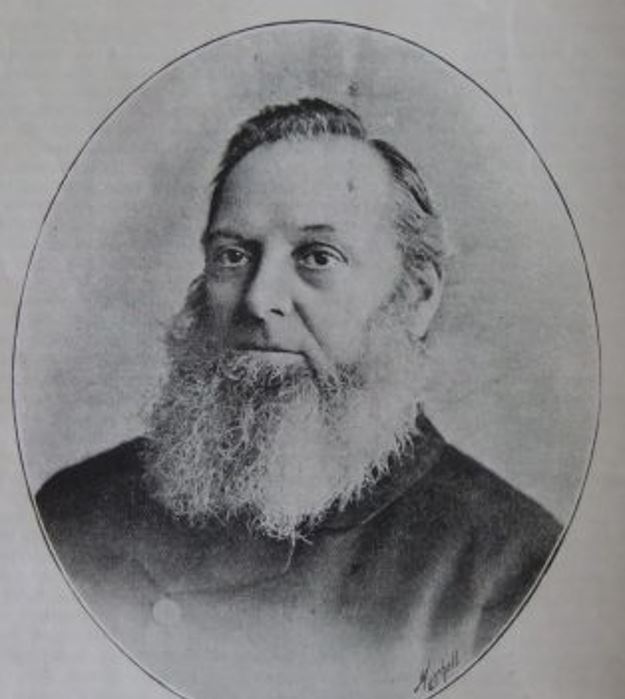
George Hunter was born in 1834 in South Cave, Yorkshire. At just 9 years of age he was working as an agricultural labourer to help support his widowed mother. At the age of 17 he converted to Primitive Methodism and spent the rest of his long life in God’s service.
George was described as ‘a splendid visitor, and a true friend and practical helper in cases of distress’ who ‘in the pulpit was earnest, simple, practical and good. He aimed not at display. He preached not to please the ear and tickle the fancy, but to touch the heart and reach the soul. His sole ambition was to save souls.’
He married Mary Thompson and the couple had two daughters, Rosanna born 1868 and Edith Mary born 1870.
In his retirement he made his home in Swindon with his younger daughter Edith where he continued to assist with the work of the Primitive Methodist church. He lived at 75 Morris Street, Rodbourne, where he died in 1916. A long obituary was published in the North Wilts Herald of which the following is an extract.
George Hunter
Death of the Rev G. Hunter
55 Years in the Primitive Methodist Ministry
The Rev. George Hunter, who was for 55 years a Primitive Methodist minister, died at his home, 75 Morris Street, Swindon, on Sunday. He was born in Yorkshire in 1834 and was 82 years of age. The greater part of his ministry was spent in the South of England, and when he retired from active service five years ago he came to reside at Swindon, and for some time continued to assist in Church work.
The funeral took place on Wednesday afternoon. The first portion of the service was conducted at the Primitive Methodist Church, Regent Street, by the Rev. S.A. Barron, who also committed the body to the earth at the Cemetery.
The Funeral Address was delivered by his old friend the Rev. J.H. Cotton …
As a pastor George Hunter had few equals. He knew his people, sympathised with them in their sorrows, advised them in their difficulties, comforted them in their sickness, and encouraged them as they drew near the eve of the great change. In the sick room nothing was more striking than his beautiful sympathy and tender handling of stricken souls. He could not refuse to help in a case of need, and often had made the widow’s heart dance with joy. Twenty years ago he heard friends talking about Mr Hunter’s kindness to the aged poor. In many circuits he would long be held in affectionate remembrance, though the majority of those who benefited from his ministry preceded him into the Great Beyond.
The great sorrow of Mr Hunter’s life was the passing away of the devoted wife who for over 35 years had lovingly shared his ministry. That was in 1900, during his second term at Stewkley.His elder daughter had to look after an aged aunt at Exeter; but the younger, since her mother’s death, had devoted herself to her father beyond all praise. During the coming years it would give to her deep and abiding satisfaction to know that she gave herself so lovingly to bring joy and comfort into her father’s life during his declining years. To these ladies in their intense bereavement and sorrow their sympathy went that day.
Advancing years ripened and mellowed Mr Hunter’s character, and considerably broadened his views. He was not sure that he was a man of the eventide after all. He often felt while in contact with him that he was a man of the morning. He passed away, after a brief illness, in the full confidence that death would be to him the gateway to a deeper, richer, and fuller life. To him, indeed, there was no death.
The Rev. W.L. Taylor said he knew Mr Hunter for a very long time. He often met him in the Brinkworth District and other circuits in which he laboured. He had that day seen some documents relating to his coming into this part of the country in 1861; and the people who had known Mr Hunter were thankful to the Hull Conference that day for having sent him. His work was a great success in the agricultural districts and his labours were equally successful in the industrial circuit in South Wales in which he spent a short period of his ministry. He asked the daughters of Mr Hunter to accept, in the sorrow which had overtaken them, the sympathy of the circuit he represented.
Extracts from the North Wilts Herald, Friday, June 16, 1916.
Rev George Hunter died aged 82 years at his home, 75 Morris Street. His funeral took place on June 14, 1916 when he was buried in grave plot C2016.
You can read more about the Rev Hunter and his family here:-
John Betjeman (Poet Laureate 1972-1984) wrote an essay for a book entitled Studies in the History of Swindon published in 1950 to celebrate the fiftieth anniversary of the incorporation of the Borough. Betjeman’s ‘short architectural study of Swindon’ provides some examples of architecture (and yes, we still have some) but he also gives credit to the construction of the familiar red brick terraces, describing Swindon as ‘more interesting than many towns which are more beautiful.’
Much of 19th century Swindon, old and new, was built piecemeal in short terraces by individual builders; houses that are different styles and different sizes. Occasionally a terrace name survives in brick work such as Albert Terrace in Dixon Street.
Betjeman talks about ‘artisan buildings’ for ‘mechanics and handicraftsmen built consciously as such’ ‘well built and weatherproof,’ and he mentions Hawkins Street, Thomas Street, Charles Street and Manton Street in Rodbourne.
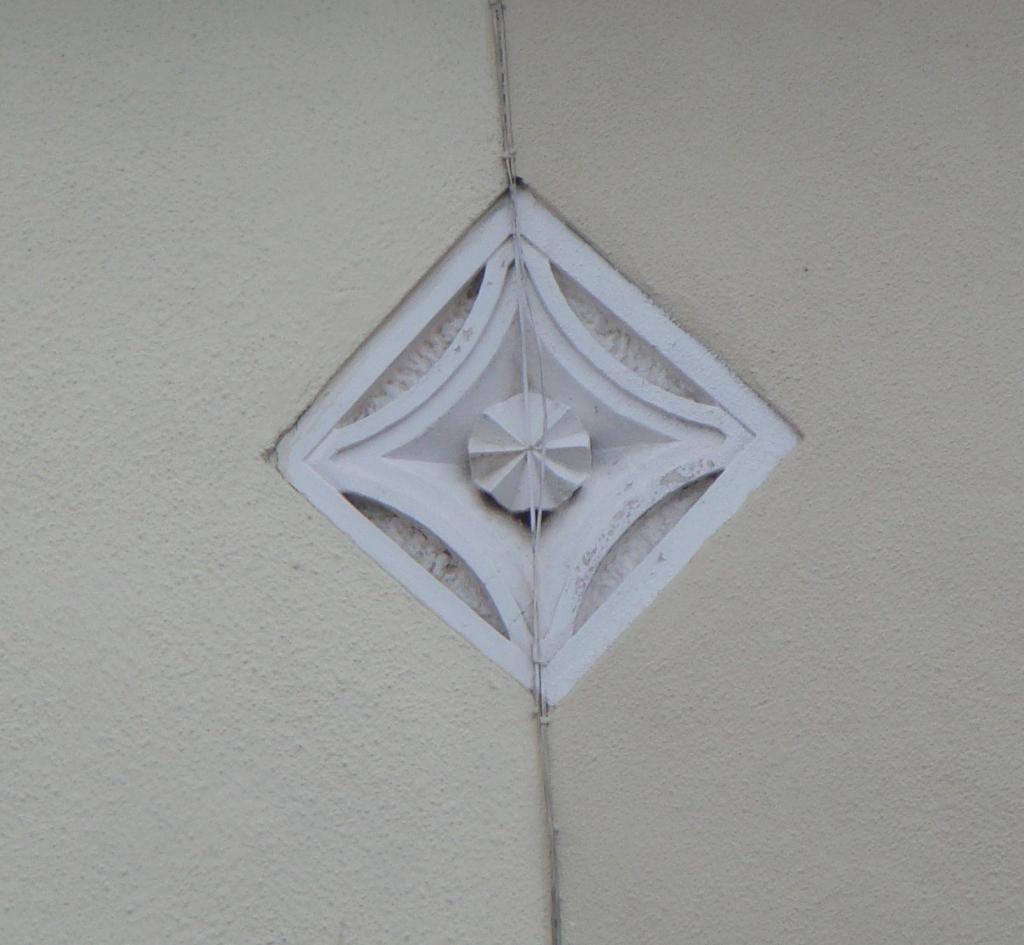
And more than 70 years later there are still interesting features to be found; the trick is to look up! Take a wander down any street in Rodbourne and you will see decorative plaques beneath the eaves. On the terrace between Linslade Street and Jennings Street there is a plaque – Lucknow Terrace 1880 – named to commemorate the Siege of Lucknow in 1857. Perhaps the builder, TP, was a veteran of that war?
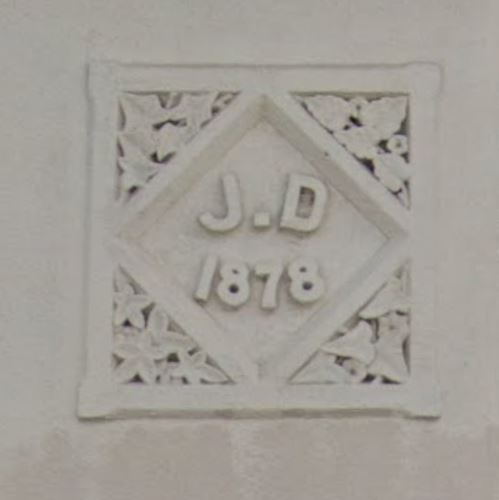
Closer to the cemetery is Albion Street where building dates from 1877. Between house numbers 9 and 10 there is situated a decorative plaque enclosing the initials JD and the date 1878.
Three years later, at the time of the 1881 census, Joseph Deacon, a carpenter and joiner, lived in number 9, (a property he probably built along with number 10) with his wife Eliza and their three young children Sarah Jane 3, Harry 2 and one month old baby William James.
For more than 70 years the Deacon family lived at numbers 9 and/or 10 Albion Street. In 1901 Eliza ran a general shop at number 10 where she later died in 1917 and youngest daughter Julia died at No 9 in 1955.
Joseph died in 1925. He was buried on June 4 and shares grave plot C3415 with his wife Eliza and daughter Julia.
They say every picture tells a story and I love these photos of the Gardner family shared on the Swindon Local Studies Flickr page. Meet James Gardner and his wife Annie pictured in their garden at 5 Montagu Street, Rodbourne taken in about 1935. I’d love to know what was said just before the camera shutter clicked.
Annie was James’s second wife. They married in St. Swithins Church, Walcot, Bath on December 27, 1905. James was 52 and Annie 39. James had several children by his first wife Sarah and presumably Florence Gardner was the daughter of one of these. She appears on the 1911 census aged 3 years old living with James and Annie and Annie’s mother Margaret at 5 Montagu Street.
These two charming photos of Florence appear with those of James and Annie.
James died at his home in Montagu Street in 1939 aged 86 years old. Annie died in 1947 aged 82. Her last address was Ford Street, just a stone’s throw away from Rodbourne. Perhaps she ended her days living with Florence?
James and Annie are buried in grave plot C639, Radnor Street Cemetery.
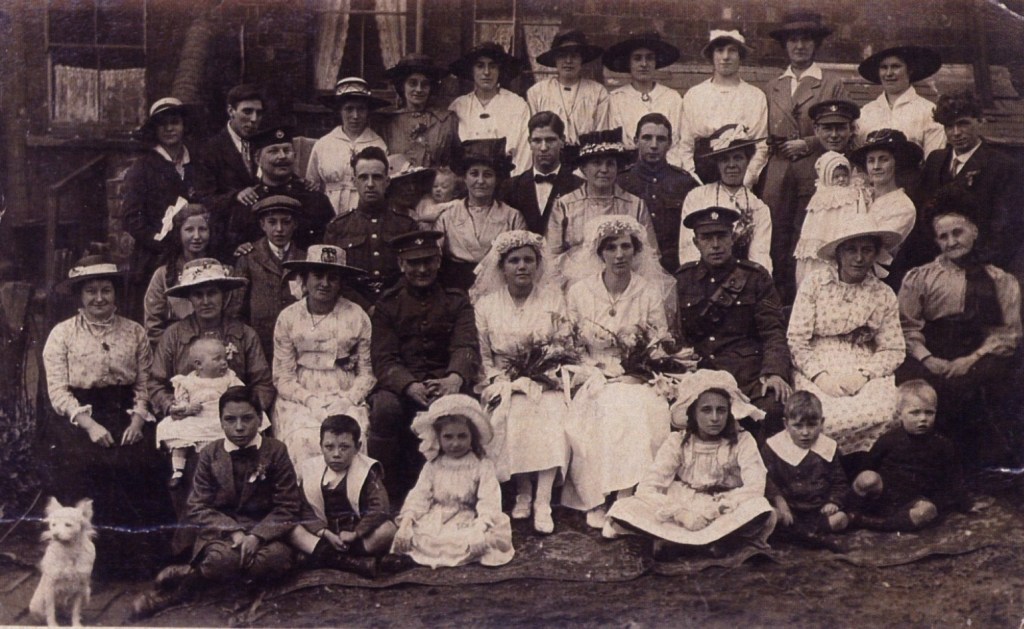
There are two surviving photographs taken that day and in each of them our Elsie looks so sad. You shouldn’t look sad in your wedding photographs – I keep thinking. People say it’s the happiest day of your life. And she looked so beautiful as well.
It was a proper family wedding. All the aunts and uncles were there and three little babies. My was little Joyce noisy, and would she keep her bonnet on? Granny’s dog was better behaved!
Six men in uniform were there that day, including the two grooms. Bert came home, but Elsie lost him anyway. Perhaps she already knew that then, on the happiest day of her life.
The facts …
Herbert Frederick Marfleet, the son of Benjamin James Marfleet a sergeant in the 2nd Dragoon Guards, was born in the Punjab in 1891. By 1901 the family had returned to England and Benjamin was working as a Railway Shop clerk in the GWR Works. On leaving school Herbert followed his father into the railway factory as an apprentice coach finisher.
In 1915 Herbert joined the Royal Army Service Corps serving first in Egypt. In 1917 he briefly returned home to Swindon to marry his sweetheart Elsie Morse. Elsie was the eldest of William and Agnes Morse’s seven children. By 1911 Elsie’s father had died and Elsie, aged 18, was working as a finisher in a clothing factory. This could have been either Cellular Clothing in Rodbourne or John Compton’s in Sheppard Street. The family lived at 4 Albion Street where these wedding photographs were taken in the back garden in 1918 when Elsie and her sister Agnes married in a double wedding. Agnes’ bridegroom was a Canadian by the name of Hooper Gates. Hooper survived the war.
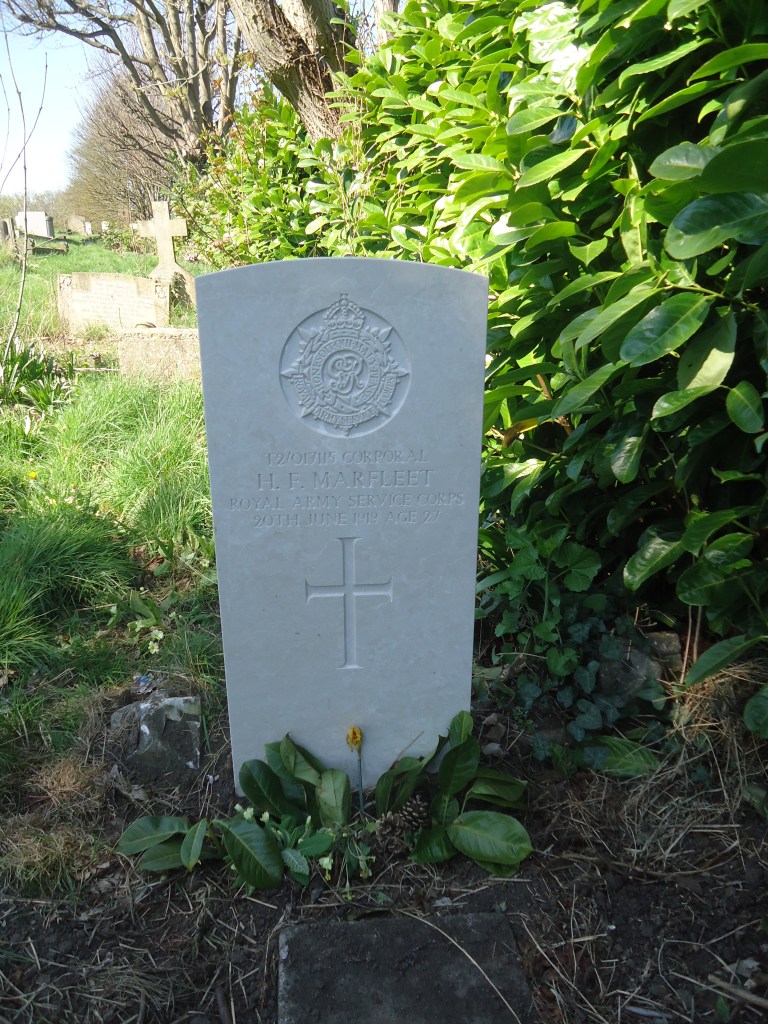
Immediately after the wedding Herbert returned to his regiment in Salonika where he contracted malaria. He was discharged from the army and returned to Swindon in the spring of 1919 but died just a few weeks later.
It was at first thought that he lie in an unmarked grave in the cemetery but it was later discovered that he was buried with his aunt and uncle, Matilda Hammett and Edward Johnson. He was, however, entitled to a Commonwealth War Graves official headstone as his death was a direct cause of his military service. The official application process began in May 2011 and the headstone was erected in June 2015. Guest of honour at the dedication ceremony was 98 year old Joyce Murgatroyd, his only known living relative, who as a baby is pictured in the wedding photograph.
I never knew my two cousins Charles and Walter Hughes. I was born nearly twenty years after they both died in the Great War. In our family it felt as if the war never really ended. My gran lost four grandsons, boys she had helped to raise. Families were close in those days.
After the war, how did the families carry on? How did they pick up their lives with an empty place at the table and unslept beds in the back bedroom? A best suit hanging in the wardrobe; boots in the passage way. Family photographs where a pictured son, sometimes two, are forever missing. How did siblings feel, growing up, growing old, living years of which a brother was robbed?
Gran kept photographs of her boys on the mantelpiece for the rest of her life. I often wonder what happened to them after she died. No doubt one of my aunties took them. One thing I can guarantee, they will still be in one of the family homes, their names remembered once in awhile.
The facts ….
One Rodbourne family lost two sons in the First World War. Albert and Minnie Hughes lived all their married life in the streets alongside the railway factory, raising four sons and a daughter.
Their third son, Charles Normandale Hughes, was a driver with the Royal Field Artillery. He died on December 3, 1918 in Manchester. He was 19 years old. His war records are lost. His grave in plot D192 in Radnor Street Cemetery is marked by an official Commonwealth War Graves headstone.
Charles is buried with his parents and another family member E. Hughes, most probably a cousin. In 1995 the cremated remains of his sister Muriel May were interred in the grave. Muriel was just four years old when war broke out and claimed her elder brothers. She was 84 years old at the time of her death.
Albert and Minnie’s eldest son Walter George David Hughes joined the 97th Field Company Royal Engineers and was killed in action on June 26, 1916. He was 23 years old. He is buried in the Ville Sur Ancre Communal Cemetery.
Charles and Walter’s names appear on the Roll of Honour, now on display in the Civic Offices in Euclid Street. For nearly 100 years it hung in the old Town Hall and for many of those it remained hidden behind curtains after the building became used as a dance studio.
Charles received an official Commonwealth War Graves headstone and the Hughes family remembered their other lost son Walter on their own grave in Radnor Street Cemetery. Sadly, until recently the kerbstone memorial had lay discarded in nearby bushes. Radnor Street Cemetery war graves volunteers Jon, Dave and Brian have recently reunited the kerbstone with the family grave.
Join us today at 2 pm for a Service of Remembrance at the Cross of Sacrifice in Radnor Street Cemetery. During the service a plaque will be unveiled dedicated to Mark Sutton.













 Radnor Street Cemetery