The Ellis family memorial

Sadly, this is all that remains of a once magnificent memorial to the Ellis family in Radnor Street Cemetery.  Thieves armed with cutting equipment removed the ornate metalwork and with it all reference to the family buried there.

William Ellis was one of the first members of the New Swindon Local Board, a director of the Swindon Building Society, Chairman of the New Swindon Gas Company and a director of the Swindon Water Company. A devout Methodist, he was described as being ‘a most acceptable lay preacher widely known in Wiltshire and South Wales.’

Expansion at the GWR Works in 1861 saw the building of new Rolling Mills. Once established the rail mill produced an estimated 19,300 tons of rails a year with the workforce consisting mainly of Welsh iron workers.  

Thomas Ellis was the first manager at the Rolling Mills and was responsible for building the cottages along Cambria Place to house the Welsh workers. 

William came to Swindon with his two young children and took over as manager in 1863.  The family’s first home was at 4 Church Place, before moving to the Woodlands, a GWR manager’s house.

When William died on May 25 1896 the Advertiser published a lengthy obituary in which he was described as having the ‘esteem of the large number of men who were under his control.’

“The first portion of the funeral service was conducted at 8 am on the lawn in front of the Woodlands by Revs A.A. Southerns and G. Osborne.  Portions of Scripture were read, and hymns No. 680 and 940 from the Wesley hymn book were sung at the close of the beautiful and impressive early morning service,” the Advertiser reported.  “The cortege then proceeded to a saloon, which was placed near the house, and the family left by the 9-5 train for Abergavenny where a hearse and carriages were in waiting to convey the remains and family to Lanelly church, where a large number of friends from neighbouring places had assembled.”

William’s son Ernest followed his father into the Rolling Mills where he worked as Assistant Manager.  He and his wife Catherine lived at the old Ellis family home at 4 Church Place. Two of their children who died in infancy were buried in the Radnor Street plot, Olga Louise in 1897 aged 2 years and 2 months and Louis Robert in 1890 aged just six months.

Ernest died in 1915.  The Advertiser published an account of the Memorial Service held in the Wesley Chapel, Faringdon Street during which Ernest was described as a man who ‘hoped for the best, and believed of the best in people,’ ironic considering the vandalism of his family’s memorial.

Ernest’s wife Catherine who died in 1931 aged 78 and his sister Louisa who died in 1944 aged 89 were both buried in the family plot.  The names of William and his wife Emily were included on the family memorial.

Fortunately there are photographs of the distinctive monument preserved on Duncan and Mandy Ball’s website.  Without this record the memory of one family who made such a large contribution to 19th century Swindon would be lost.

Ebenezer Evans – Sunday School Teacher

The re-imagined story …

“Put your feet up Gramps,” we used to tell my grandfather. Always dashing about he was, as if a ten hour shift in the Rolling Mills wasn’t enough to tire him.

Then, of course there was the Chapel. What little spare time he had was spent in the Baptist Chapel just behind the house where he and Nan lived. He might as well have lived there, I used to think. Wonder he hadn’t worn a path from the garden gate to the Chapel door.

One of the founding deacons he was, along with a Sunday School teacher and a dozen other duties he performed.

When he retired they presented him with an armchair.

“There we are Gramps, now you can put your feet up proper.”

He never did, mind.

The facts …

Ebenezer Evans was one of the foundation deacons of the Cambria Baptist Chapel

A Teacher’s Retirement – On Sunday afternoon an interesting ceremony took place at the Cambria Baptist Chapel, New Swindon, in the presentation to Mr Ebenezer Evans of an easy chair as a slight token of the esteem of his fellow teachers on his retiring from the school through advancing years and consequent declining health. Mr Evans has been a teacher in the Sunday School for 20 years, and had spent a similar time in Sunday School work in South Wales before coming to Swindon. The presentation was made by Mr J. Green, superintendent, on behalf of the teachers and scholars, who willingly subscribed towards the gift. Mr Evans, evidently much surprised, thanked the subscribers for their kindness, adding some good advice to those present who were beginning life.

The Faringdon Advertiser, Saturday, August 13, 1898.

Ebenezer Evans moved to Swindon following the opening of the Rolling Mills. By 1868 he was living at 38 Cambria Place and the 1871 census describes him as a 40 year old Rail Straightener born in Beaufort, Brecon. Living with him were his wife Jane and children John L. 14, Elizabeth 12 both born in Ebbw Vale, Monmouthshire and David 8, William 5, Sarah 3 and 1 year old Edith all born in Swindon. Also living with them in the small cottage were two lodgers. The couple would go on to have another two children, Mary Ann and George.

Jane, wife of Ebenezer Evans, died in November 1900 aged 65 and was buried on November 8 in grave plot C1167. Ebenezer died in 1903 aged 72 and was buried with his wife on February 19, 1903.

John Jones – Rolling Mills foreman

The re-imagined story …

When the Rolling Mills opened in the 1860s the large contingent of incoming workers from Wales were housed in a building better known as the Barracks. The story goes that the Welsh women couldn’t get along together and that they used to fight and argue, but my Nana didn’t hold with that.

Wesleyan Chapel

The former GWR lodging house, known as the Barracks, later became a Wesleyan Chapel image published courtesy of Local Studies, Swindon Central Library.

“We had to live in dreadful conditions; if it hadn’t been for the other women, I don’t know how I would have survived. Two years we were there. It felt more like ten.

“We couldn’t keep the place clean, the water closets were permanently blocked and we had nowhere to put our rubbish or the ashes from the fire. There was always someone sick. It was all down to the water see, ‘unfit for drinking purposes,’ the public health inspector said. Two days a week we had water, Wednesday and Saturdays, and then it came from the canal.

Five hundred people there were crammed into that building. I had small children, why we all did, I don’t know how they all survived, many didn’t, I know. My sister Gwen gave birth in that place. I don’t know how they expected people to live like that.

The company cottages were bad enough, but that building. In the early days the men used to call it the Barracks. I don’t know about barracks, more like a prison it was.

When they started building the cottages at Cambria Place I used to go along every day. I used to will that little house along. I loved every square inch of that place. Mind after two years in that hell hole it was like living in heaven.”

Cambria Place

Cambria Place

The facts …

“I consider this building in its present state quite unfit for human habitation and dangerous to the health of the district,” Inspector Henry Haynes wrote to the monthly meeting of the New Swindon Local Board held on 2nd August 1866. What had once been intended as a model lodging house for the single men in the railway village was an unmitigated disaster.

Designed to accommodate young men in single rooms with a variety of communal facilities the lodging house, complete with Gothic turrets, was built to ease overcrowding in the GWR company houses. Unpopular from the outset, the building soon became known as the Barracks. Constrained by GWR rules and regulations the young men moved out, preferring to lodge in the cramped conditions of the railway village cottages instead.

The building stood empty until the construction of the new Rolling Mills in 1861 saw an influx of migrant Welsh workers and their wives and children. The GWR Company responded by converting the Barracks into supposedly family friendly accommodation.

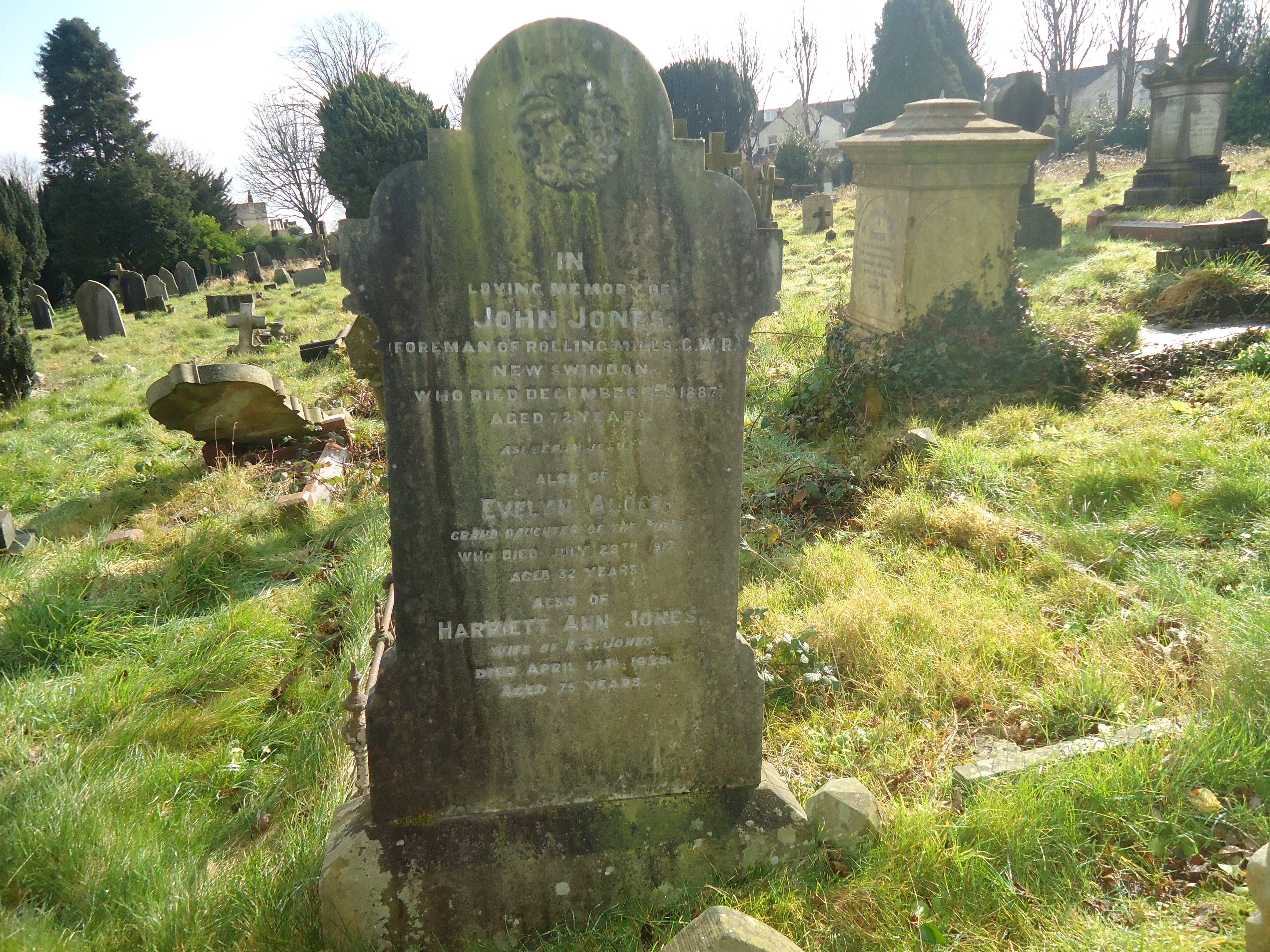
This is the final resting place of John Jones, who as can be seen from the inscription on the headstone, was foreman of the Rolling Mills. John was born in Tredegar, Monmouthshire on March 13, 1815.

In 1851 John was living at Thomas Road, Llanelly with his wife Sarah, and their children. Edwin 14, (already working as a forgeman), Elizabeth 13, Isabella 11, Ephraim 9, Emma 7, Enos 5 and Elijah S. who was 5 months old.

John was a highly experienced worker by the time he entered the GWR service here in Swindon on May 25, 1861. As a Foreman Roller he was paid 7 shillings a day (that’s 35p) although worth considerably more 155 years ago.

The Rolling Mills opened in the 1860s and saw the arrival of a large Welsh community in Swindon. In 1869 the manager Mr Ellis told the Advertiser there were about 310 men employed in the Rolling Mills, divided into a day and a night shift working alternate weeks.

The arrival of so many families placed huge pressure on the available accommodation in New Swindon. The first Welsh families in the Barracks lived in appalling, insanitary conditions, and work soon began on Cambria Place and it was here at No 22 that we find John and his family living in 1871.

John died in December 1887 and is buried in Plot E8296 in Radnor Street Cemetery with his granddaughter Evelyn Alder who died in 1917 aged 32 and his daughter in law Harriett Ann Jones (Evelyn’s mother) who was the wife of Elijah Stockham Jones, John’s youngest son.

John Jones