Meet the Margetts family

When the churchyard at St. Mark’s was forced to close to new burials in 1881 it came as a great sadness to the railway families of New Swindon. During Victorian times death was a large part of life; there were funeral rituals to observe and traditions to be kept and large, municipal cemeteries were not so common outside the big cities. But now Swindon was to have one and the first families to have moved here in the 1840s were to be separated in death.

During my recent walk around the churchyard I came across the grave of George and Susannah Margetts. George was born in Buckingham in 1783 just as the Industrial Revolution was picking up pace and more than 50 years before the birth of New Swindon.

In 1841 George was landlord at The Ship in Wantage, Berkshire where he lived with his second wife Susannah and five of his 10 children. But by the late 1840s he had arrived in Swindon where the family lived in Exeter Street. Aged 67 he was working as a carpenter, presumably in the Works as he lived in one of the company houses. Still living with his parents was youngest son Samuel, an apprentice boilermaker.

Another son, Jesse, had also arrived in Swindon where he married Martha Townsend at St. Margaret’s church in Stratton St. Margaret on Christmas Eve, 1849. In 1851 he was living in Taunton Street with Martha and their 10 month old daughter named Susannah after his mother. Jesse worked as a labourer, again presumably in the Works as he too lived in the railway village. Jesse and Martha went on to have a large family of at least 10, possibly 12, children.

The first person buried in the St Marks grave plot was not George, but that of his six year old granddaughter Ellen, one of Jesse and Martha’s children, who died in 1862. There was obviously money enough to buy this plot and in due course an elegant headstone – not every family could afford this as is evident by the paucity of memorials in the churchyard. George died in 1868 having attained the impressive age of 85. His wife Susannah died in 1871.

When Jesse’s wife Martha died in 1885 she was buried in the new Swindon Cemetery, which later became known as Radnor Street Cemetery. She was buried in grave plot E8294.

Jesse quickly married again and in 1891 is living at 72 Albion Street with his second wife Eliza and his youngest son John who is employed as a boilermaker in the Works.

Eliza Margetts, Jesse’s second wife, died in 1904 and was buried in grave plot E7886.

When Jesse died the following year he had the choice of two wives and two burial spaces. He chose to be buried with his second wife Eliza. The remaining space in this grave was later occupied by his sister Rosa who died in 1920.

Sadly, the inscription on Martha’s headstone had partially disintegrated but the burial registers reveal that she does not lie here alone. Her son, also named Jesse, died in 1916 and was buried here with his mother.

I’m sure further research will discover plenty more members of the Margetts family buried in Radnor Street Cemetery, and maybe some at St. Mark’s before the churchyard was closed in 1881.

A Bench with a View

It was a blustery Monday at the cemetery with a chill in the air and rain on the wind, but it didn’t prevent me from stopping at my favourite bench.

There are four benches (I’m honour bound to keep the 4th one secret) in the cemetery; but this is my favourite one with a view across what was previously known as New Swindon, a railway town.

Here the eye is drawn to the housing development built in the early 2000s on the site of the ‘A’ (Erecting) Shop. A Shop covered more than 11 acres (coincidentally the same size as Radnor Street Cemetery) and was one the largest covered workshops in the world. The red brick apartment blocks, clearly seen from the bench, and the surrounding houses are named in honour of George Jackson Churchward Locomotive Works Manager at the GWR Swindon Works 1902-1916 and Chief Mechanical Engineer from 1916 until his retirement in 1922.

From this bench you can see what remains of the 19th century railway works, more familiar to a younger generation as the McArthur Glen Designer Outlet Village and the railway village, the company houses once home to the early workforce. So many of those railway men and their families moved up the hill to rest in peace in this cemetery.

It was at this bench that I composed the ghostly story of Edie and her soldier son – a tribute to one Swindon family, yet typical of so many others.

This is my favourite bench. Perhaps we’ll meet here one day.

Letter to the Editor

The burial of Swindon’s dead continued to be a controversial subject even after the opening of Radnor Street Cemetery in 1881.

The following letter to the editor of the Swindon Advertiser reveals burial practices that should have been eliminated following legislation passed during the previous 30 years.

To the Editor of the Swindon Advertiser

Sir – Can any of your readers tell me how it is that the inhabitants of that part of the parish of Swindon known as Old Swindon do not use the new cemetery, provided at their cost some five years ago? When it was decided to purchase this cemetery it was generally held out as an inducement to ratepayers to part with their money that the parish church burial ground would be closed, except to owners of vaults. Instead of this being the case, however, the churchyard is not only being crowded with bodies, but some of those interred there are being dug up in a most indecent manner to make room for more.

At the funeral of a pauper this week there was exposed beside the grave the skull, vertebra, and other bones of a corpse which previously occupied the same ground, together with the handles and other portions of the coffin furniture. I do not think this is right, or that it is decent. With the spacious cemetery we have it cannot be necessary. I am told that the reason Swindon paupers are buried in the churchyard instead of the cemetery is that the poor law authorities refuse to pay the cemetery fees. If this is so I do hope the Swindon guardians will bestir themselves and put an end to such a state of things.

Yours respectfully,

Parishioner.

Swindon Advertiser, Saturday, June 27, 1885.

William Nicholson and a lot of words

There were a lot of words written about William Nicholson following his death in 1880.

We are sorry to notice the death, on the 13th instant, at New Swindon, of Mr William Nicholson, who, for the long period of nearly 45 years, was a valued and trusted servant of the Great Western Railway Company, and who at the time of his death was, we believe, the oldest foreman in the employ of that company, having served in that capacity very close upon 40 years.

Leaving his native place, Bolton, in Lancashire, very shortly after serving his time as an apprentice to the engineering business, he went to Liverpool, where he married, and obtained employment in an establishment where Daniel (now Sir Daniel) Gooch and his brother were serving their articles as pupils. He, however, did not stay there long, but removed to Paddington, where the Great Western Railway Company had just opened their first engineering works, and when the Swindon works were opened Mr Nicholson came to Swindon, now 39 years since, and after a very short time was appointed foreman over the turning and fitting department, and in this important position he remained until about 15 years ago, when the whole of the Swindon works were considerably enlarged under the direction of the late Mr Armstrong, and the new gas works were then put under the sole charge of Mr Nicholson, and in this position he remained until his death, which took place on Tuesday week, after a somewhat protracted illness caused by heart disease and dropsy.

During his lengthened connection with Swindon and the Railway Company Mr Nicholson enjoyed the respect and esteem of all who knew him. He was devoted to his duties and the interests of his employers, and was strictly conscientious in all his dealings, whilst to the thousands of men who had been placed under his superintendence he was always kind and courteous.

Having known Mr Nicholson from the time when he first came to Swindon, it affords us some satisfaction to be able to bear our testimony to the sterling character of a strictly honest and upright man, and one who, although never ostentatious in any of his dealings, by his general demeanour set a good example before those under him or who came in contact with him. We have been asked to publish the following, which has been forwarded to us by an old workman under Mr Nicholson:

“Another old servant of the Great Western Railway Company has gone to his long home. Mr William Nicholson, who was one of the earliest arrivals from Paddington to Swindon on the opening of the line, and who for many years occupied the position of foreman in the fitting and turning shops in the local department, but latterly that of superintendent of the gas works recently erected by the GWR Company, he having only survived to witness the completion of the extensive and elaborate works of which he was so proud. He was followed to his last resting place, in St. Mark’s Churchyard, by numerous foremen of the works, and a large number of old hands who served under him, who attended to bear testimony to the respect they bore him while living. His widow, with whom he has lived for upwards of half a century on the most affectionate terms, is left to mourn her loss.”

The Swindon Advertiser, Saturday, January 24, 1880.

And in 1992 railway and local historian Trevor Cockbill wrote a few more in his excellent book A Drift of Steam, describing William Nicholson as a devout Wesleyan Methodist who founded the New Swindon Wesleyan Methodist Society and became the first Superintendent of its Sunday School.

But when it comes to his wife Betsey no one appears to have written about her.

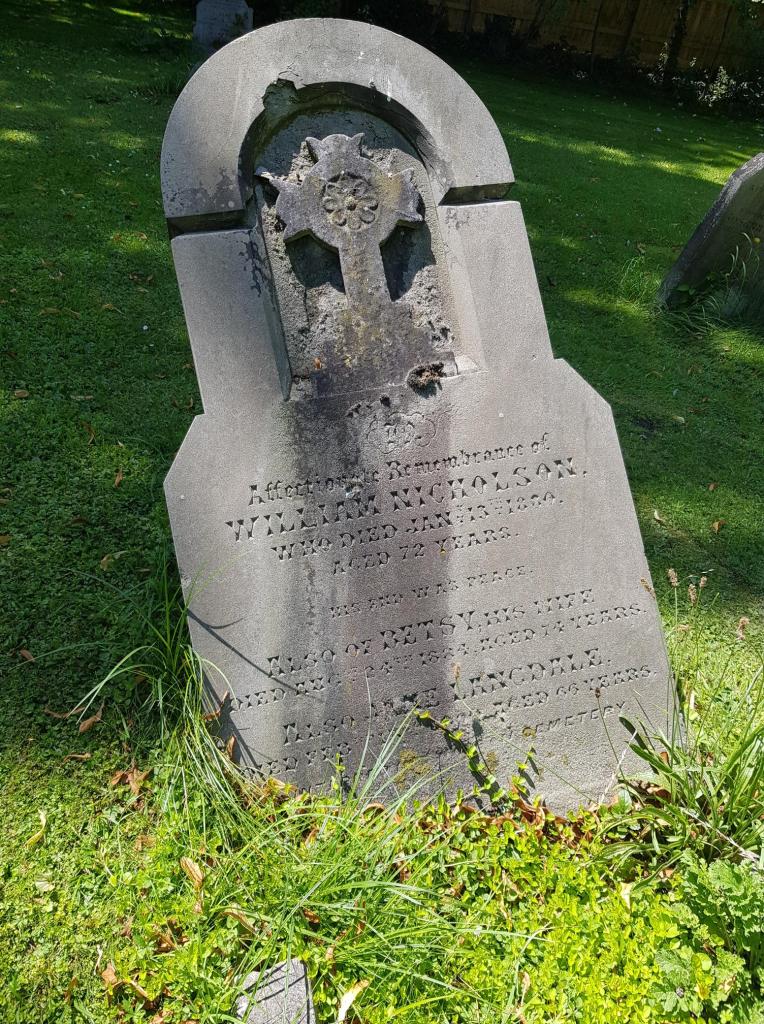
William married Betsey Langdale at St Anne’s Church Liverpool on May 17, 1830. We find them on the 1851 census living at Westcott Place, Swindon with four of their children, Betsey’s sister Jane Langdale, a lodger and a 12 year old servant girl. Apart from the official census records the only words I have discovered about Betsey appear on her headstone – and even this isn’t how things might first appear.

William died in 1880 and was buried in the churchyard at St. Mark’s. Betsey died in 1884 but by then the churchyard at St Mark’s had closed and the new cemetery at Radnor Street had opened, which is where Betsey was buried on August 30, 1884 in grave plot A55. She lies in an unmarked grave where she was later joined by the sister who had lived with her for so many years, Jane Langdale who was buried on February 17, 1890. However, the family had made sure that both Betsey and Jane were remembered by adding their names to William’s headstone – interred in Swindon Cemetery.