Thomas Messenger – Fatal Accident in the GWR Works

On Friday December 14, 1894 Thomas Messenger was involved in a fatal accident in the Timber Yard at the GWR Works. Back home in Linslade Street his wife Emma went into labour. Thomas died two days later. He was 31 years old and according to the report made to the Great Western Railway Board he had been employed in the Company for 5 years and 5 months, his daily rate of pay was 3s 2d.

Fatal Accident in the GWR Works – On Tuesday morning, Mr. Coroner Browne and a jury, of whom Mr W.J. Deavin was foreman, held an inquest at the Cricketers’ Arms, New Swindon, on the body of Thomas Messenger, aged 31 years, a labourer, employed in the Great Western Railway Works timber yard department. Mr T.O. Hogarth and Mr H. Hayward were present to watch the case on behalf of the GWR Company.

From the evidence adduced, it appeared that deceased was on Friday morning employed with other men in stacking timber. A “skid” – a piece of timber weighing some 7 cwt. – was used for sliding the timber on to a stock in order to save labour. Deceased placed the skid too far over the corner and it rebounded and stuck him in the head, causing a fracture of the skull.

A verdict of accidental death was returned. The jury gave their fees to, and also made a subscription on behalf of deceased’s widow, who is left with three children, and was confined on the morning of the accident. The sum handed to the widow was £1.

Wilts and Gloucestershire Standard, Saturday, December 22, 1894.

Thomas was buried on December 19 in a public grave plot B2264. His father, also named Thomas, was buried with him in 1902. They share the grave with a baby and an elderly widow, both unrelated.

Thomas and Emma had been married less than two years. Emma had already been widowed once before, left with two little daughters Martha and Amelia. Now she was on her own again with another child. The baby was baptised at the parish church in Latton on January 27, 1895. She was named Thomasina Polly Strong Messenger. Emma went on to marry for a third time in 1901. She died in 1943, aged 82.

Thomasina married, raised two children and died in High Wycombe in 1973, aged 79.

No 1 Shop, Timber Yard pictured in 1928. Image published courtesy of STEAM Museum.
Granddad’s Museum

The re-imagined story …

As children my brother and I thought our granddad lived in a museum. His house was packed full of stuff; ornaments on every surface, paintings, prints and photographs and books, so many books.

Inside the house we had to manoeuvre our way around, careful not to knock anything over, but fortunately for us there was a long back garden where we played, whatever the weather. We were even allowed inside the shed if it was lashing down with rain.

The shed was a microcosm of the house, but without the china. There were racks and racks of old fashioned tools but no one seemed to worry that we might sever a limb or drive nails into each others eyes.

One day we found a wooden model train in a box under the workbench. I remember how we stared at one another apprehensively. It looked like a toy, but could we play with it or was it another museum piece? We just didn’t know. We decided we would play with it, only very carefully, and if it got broken we would say it was like that when we found it.

It was actually pretty robust. Not big enough to sit on, although we tried that, but sturdy.  The wheels turned and the bell on the front moved, but that was about it really. We sat our Action Men in the cab and created war time scenarios, but there wasn’t a lot you could do with it really.

Clearing granddad’s house after he died was a nightmare. Our poor parents spent weeks and weeks at the job. I would have liked longer to go through it all, but there just wasn’t the time and I couldn’t store anything in my small, one bed flat.

The shed was one of the last things we tackled and this yielded some of the biggest surprises. The tools my brother and I had looked upon as instruments of torture turned out to be real museum pieces, some of them dating back to the 18th century.

When I saw the train for the first time in years I realised it was a model of the famous King George V loco made in the Swindon Works in 1927. Perhaps the owner of the tools, or one of his descendants had made the model. Sadly there was no way of finding out who. The Carriage and Wagon Works employed hundreds of skilled carpenters and throughout its history Swindon had numbered countless building firms, large and small.

As we bagged and boxed and dumped so much of granddad’s treasure I wondered how he had come by it all, especially those tools. And who had made the model of the King George V loco, which now sits on the coffee table in my lounge.

sarah-and-william-leighfield

The facts …

This memorial was revealed several years ago during a major bramble clearance exercise in Radnor Street Cemetery by Swindon Borough Council.

This is the final resting place of Sarah Leighfield, her husband William and their son-in-law James George Plank.

Sarah was born in Swindon in c1851 and married William Leighfield in 1871. William was born in Wootton Bassett in c1851 the eldest son of James and Ann Leighfield.

By the time of the 1911 census William and Sarah were living at 91 Curtis Street with four of their children. William, aged 61, was by then working as a Wood Sawyer in the railway works. His son Robert was a Coach Painter in Motor Works, Alfred and Albert were both House Decorators and Ernest also worked as a Coach Painter.

Curtis Street

1915 Curtis Street photograph published courtesy of Swindon Museum and Art Gallery.

His younger brother Richard James Leighfield established a successful construction business at 1 Witney Street. In 2015 the Royal Wootton Bassett based firm celebrated their 130th anniversary.

Sarah died in April 1911 and was buried on April 13 in plot E7339. William died in June 1915 and was buried with his wife on June 9. The last person to be buried in this plot was their son-in- law James George Plank, their daughter Emily’s husband. J.G. Plank died at St Margaret’s Hospital on July 3, 1955.

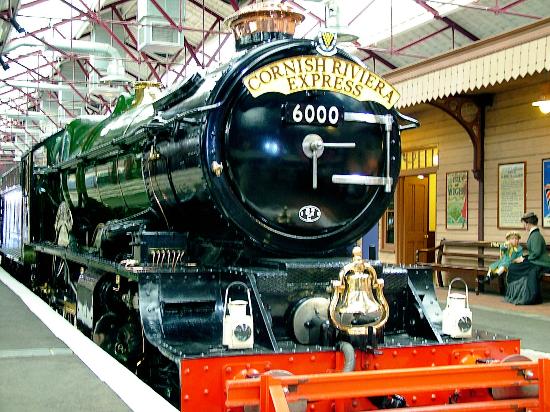
The King George V Loco, designed by Charles B. Collett and built in the Swindon Works in 1927, was the prototype for Great Western Railway’s (GWR) King class. It was the first of a thirty strong fleet built in Swindon from 1927-1930  to meet the demands of rising passenger numbers and heavier carriages.

Photo of King George V published courtesy of STEAM Museum of the Great Western Railway, Swindon.