Can you call yourself a Swindonian? Many an argument has ensued about how long you have to live in Swindon before you’re considered a local; 20 years, 30 years, 2 generations – or more?
Walter Rumble was born in Chieveley, Berkshire in 1864 and began his working life as a Carter Boy (a farm servant). In 1890 he married Annie Caines and by the time of the 1891 census the couple were living at 128 Stafford Street. Walter worked as a general labourer, most probably in the GWR Works where he remained for the rest of his working life.
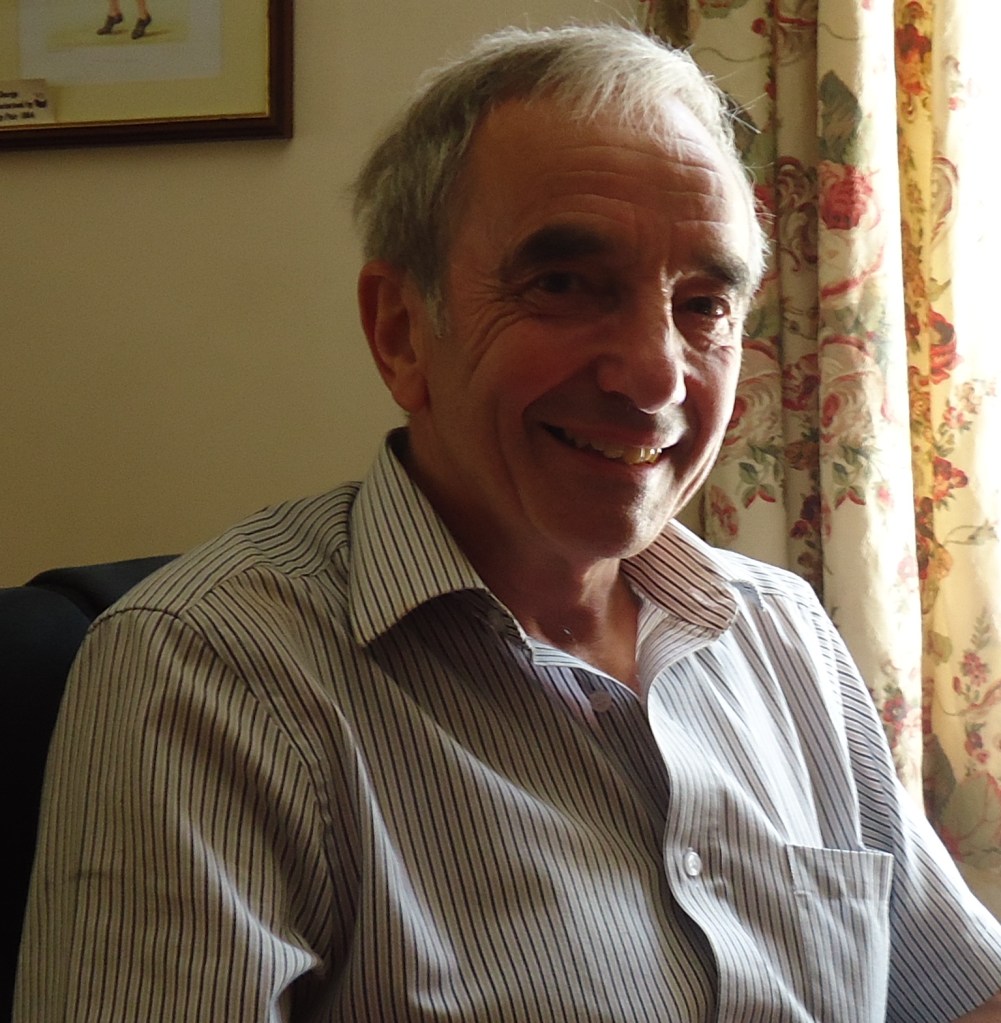
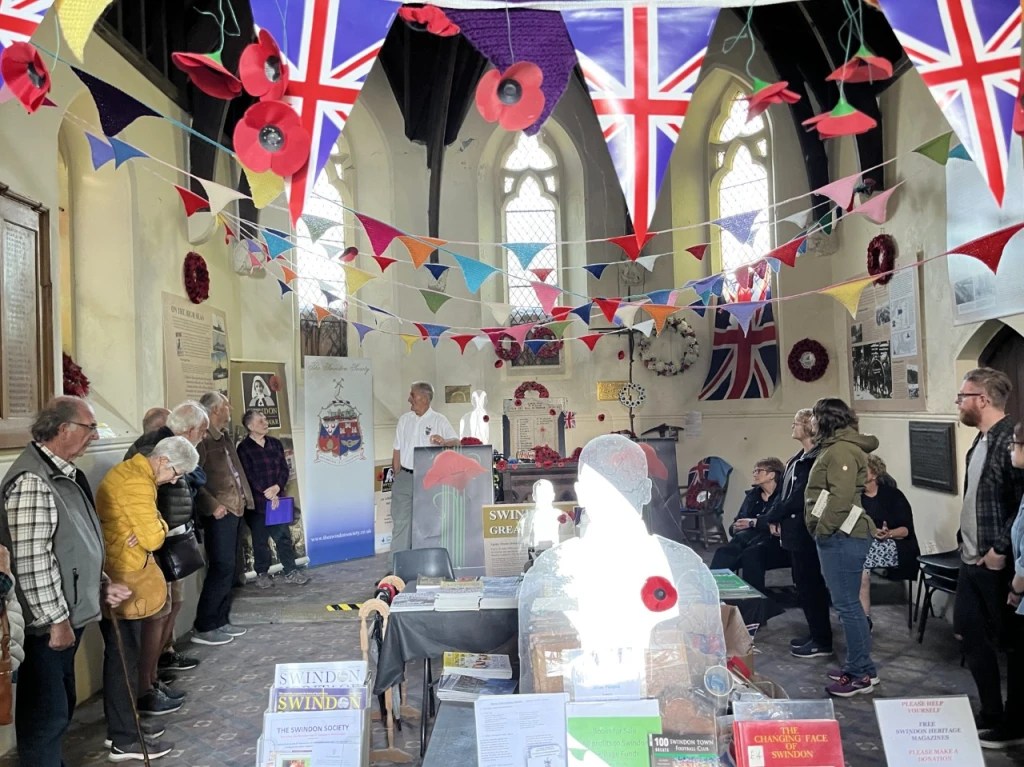
Yesterday I met Walter’s great-grandson at the Swindon Society Open Day held at the Lawn Community Centre, Guildford Avenue. There were displays from the Society’s extensive photographic collection (including the many albums of Beaney photos) talks about Alfred Williams and Radnor Street Cemetery and more local historians on call than you could shake a stick at!
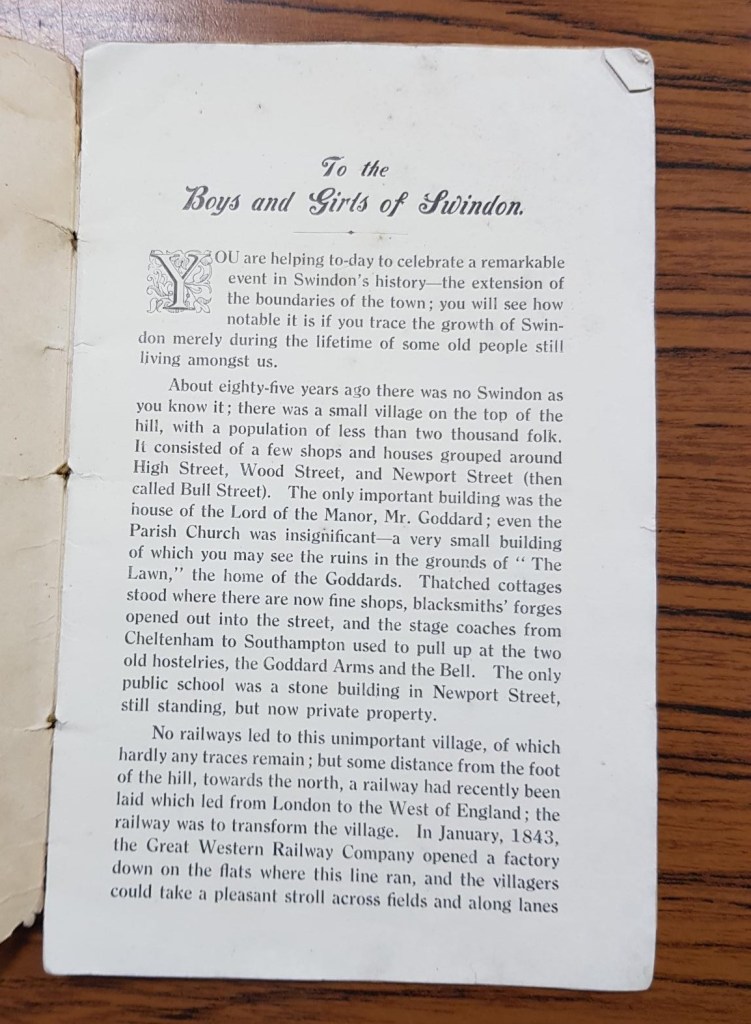
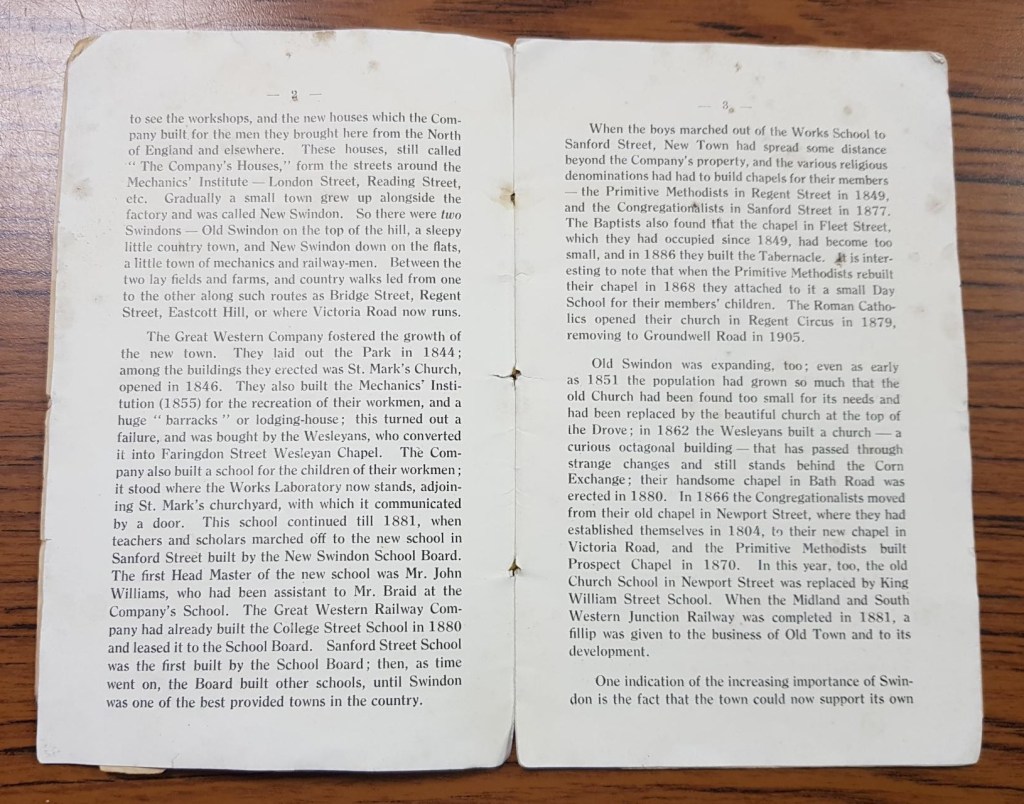
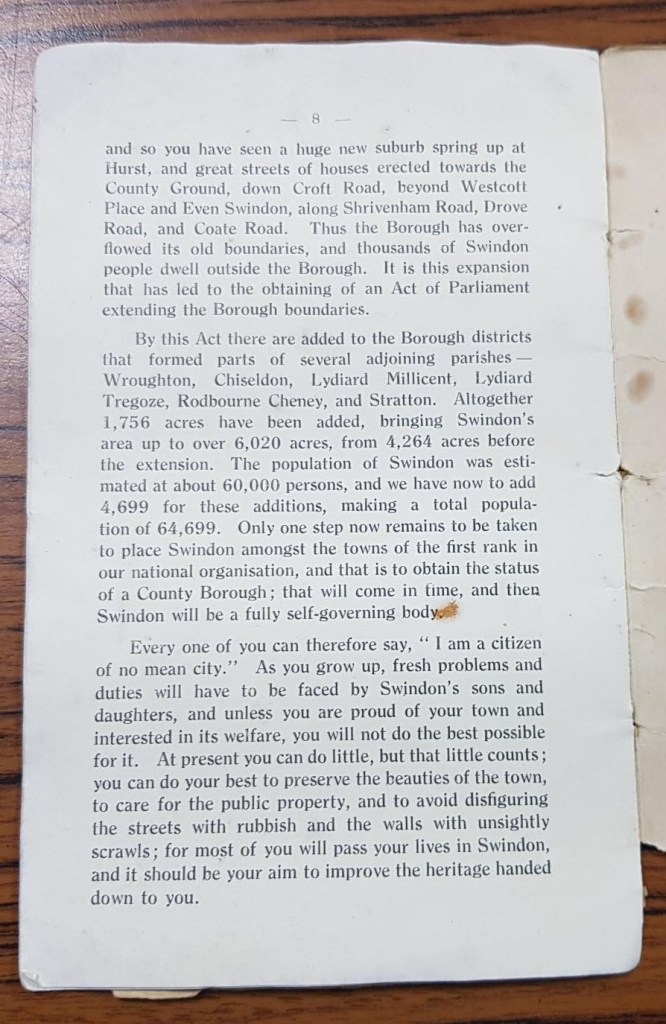
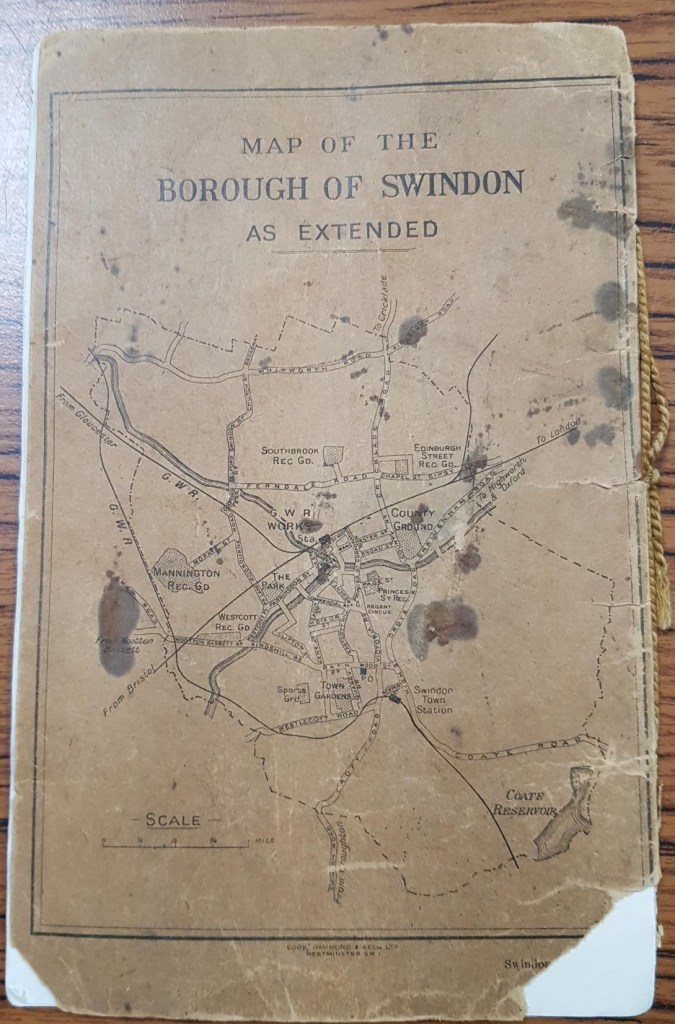
And then Mr Rumble showed me a booklet his father was presented with as a schoolboy in 1928 – Borough of Swindon – Extension of the Borough 1st October 1928.
Walter and Annie lived at various addresses in Stafford Street where Annie died at No. 105 in 1926. She was buried in Radnor Street Cemetery in grave plot D826.
Walter later lived with his son Frank and daughter-in-law Violet at 134 Ferndale Road where he died aged 80 and was buried with his wife in 1944.
I think members of the Rumble family can consider themselves Swindonians – but what about you?
Sunday September 15 saw the last day of the fab Heritage Open Days 2024 event. Apparently Swindon had more events on offer than historic Bristol, so we were well proud. Thank you to the fantastic Karen Phimister for all her hard work.
At Radnor Street Cemetery we welcomed more than 80 people to a guided cemetery walk. Yes, it was a bit crazy and yes, we were concerned that people couldn’t hear us, but we can’t turn people away and Andy and I both have loud voices!
I managed to attend quite a few other events (not as many as I would have liked) including an excellent talk at Swindon Central Library – Electric Wonderland? Women and the 1930s Modern Home by Sarah Yates.
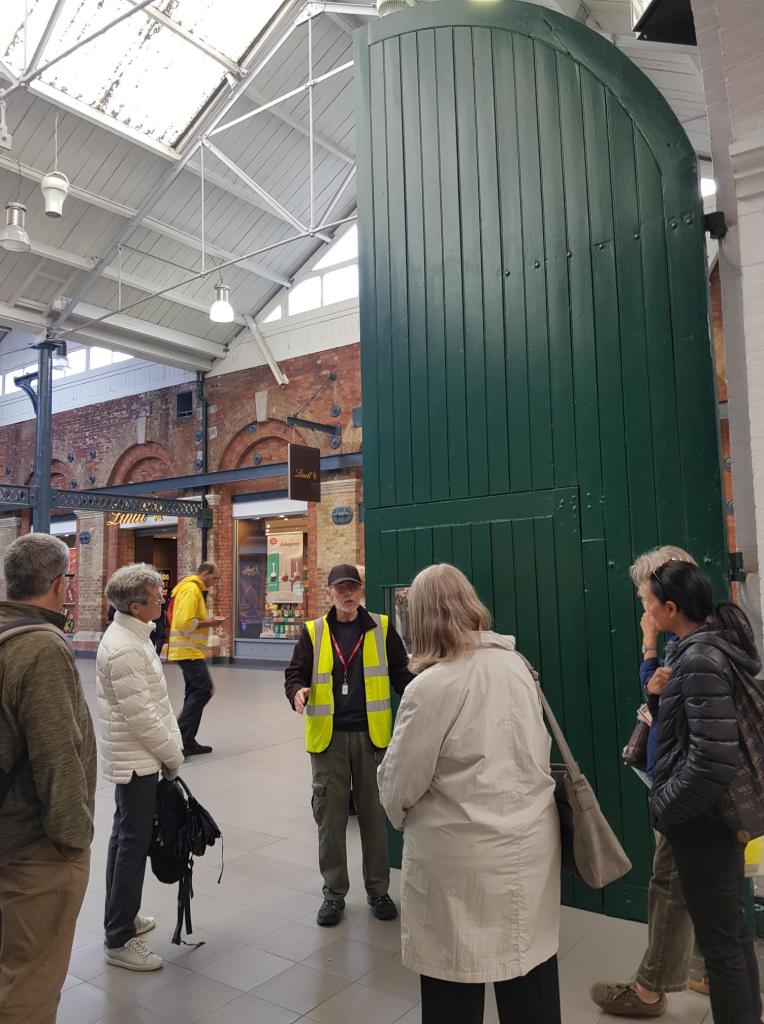
A guided tour of the Railway Village with Karen followed by a GWR Factory Tour with Gordon.
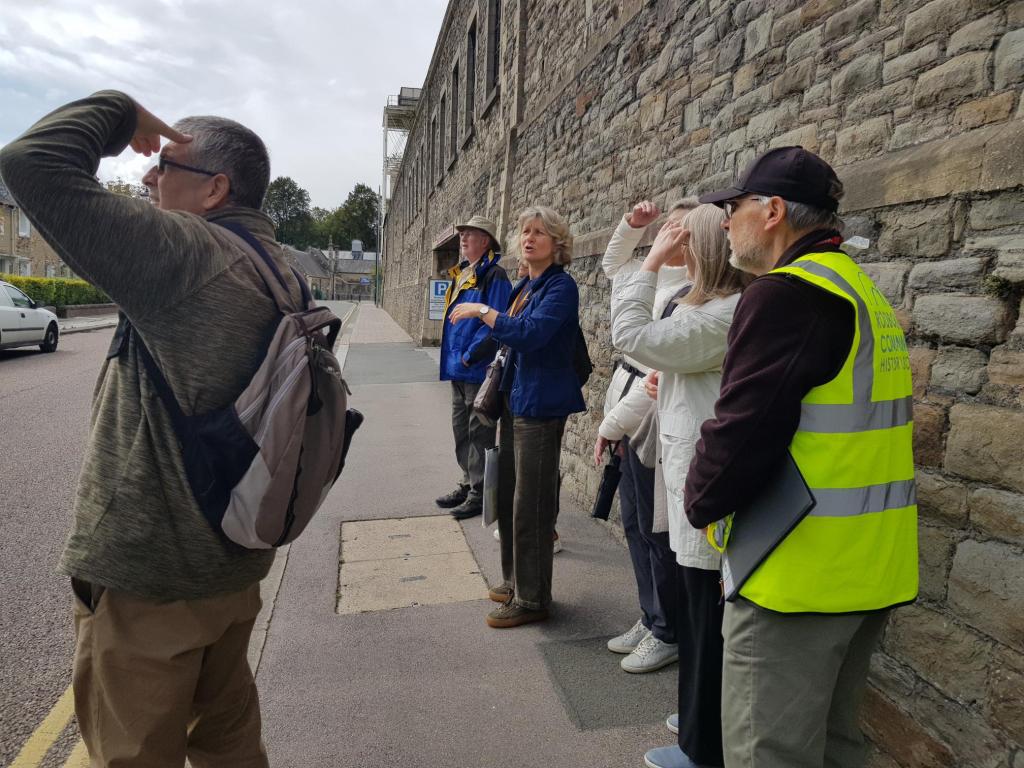
And then a guided tour of the Prospect Place Conservation Area with Michael and Geoff.
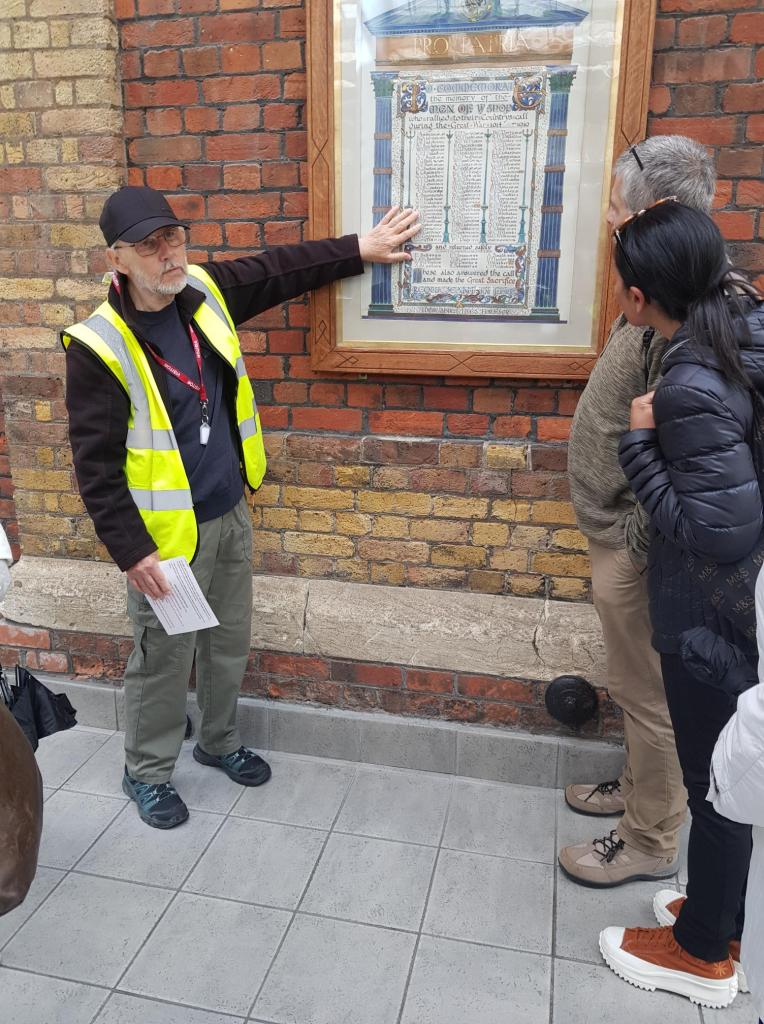
Here are a few photographs.
Radnor Street Cemetery guided walk
Guided tour of the Prospect Place Conservation Area
Railway Village with Karen
GWR Factory Tour with Gordon
And if you’re hungry for still more history join the Swindon Society for an Open Day this Saturday September 21, at the Lawn Community Centre on Guildford Avenue, running between 10.00am and 4.00pm.
In the summer of 2013 I had the privilege of interviewing Bob Townsend at his home in Wroughton. I knew him as a member of the Swindon Society, but he had many more strings to his bow! Here is the article published in the Swindon Heritage Magazine in the 2013 Autumn edition.
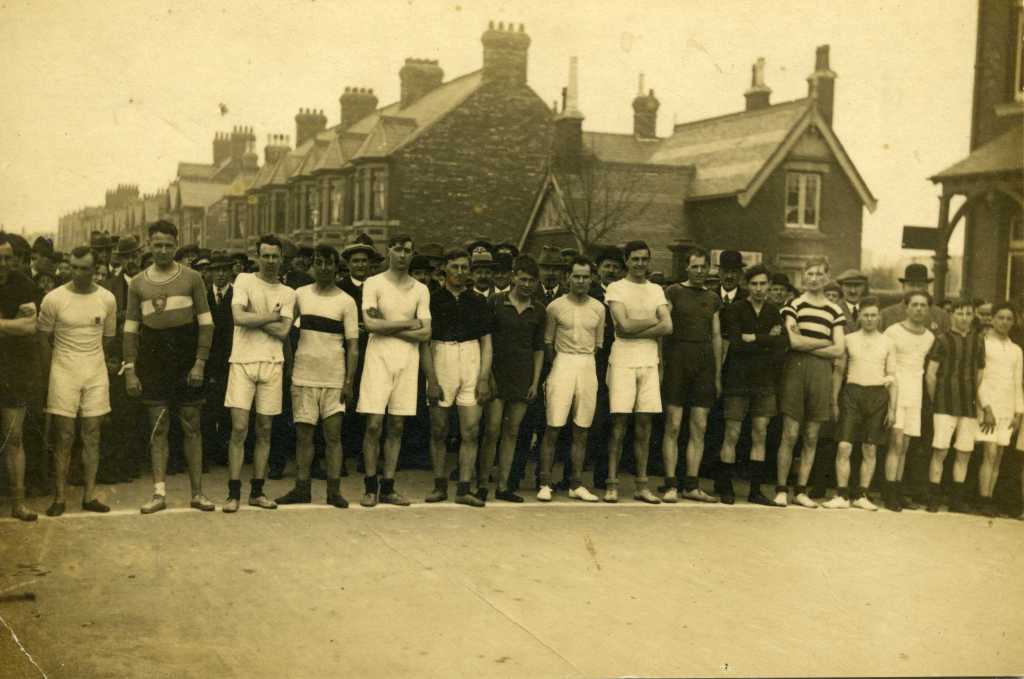
On March 19, 1921, a crowd gathered at the County Ground to see history being made – but this time they weren’t there for the football.
They had come to see the first road race organised by the newly founded Swindon Athletic Club, over three miles.
Swindon historian Bob Townsend’s father William, a 17-year-old novice, not only ran in that historic race, but won it.
And so began a long family association with the club that would last for more than 60 years.
“Some of the lads joked that it might as well have been called the Townsend Athletic Club,” said Bob, who joined the committee in his teens and was chairman for more than 20 years, following in his father’s footsteps as President.
Bob got the running bug when his father organised the Swindon School Championships, held at Ferndale Road School in the mid 1950s. “I was in my last year at school and dad asked if I fancied comming down and having a run,” said Bob, so he and his older brother John joined the Townsend training camp and were soon making headlines on the sports pages of the Evening Advertiser.
In May 1961, at the RAOC Depot Hawthorne, the Adver reported: “Leading all the way, and taking turns to set the pace, the brothers shook of Brooksby (Salisbury Athletic Club) at the halfway mark and increased their lead, eventually to lap two of the competitors.” Both achieved a personal best over three miles, with John finishing first and Bob close behind.
Bob has competed in events all over the country, running in cross country and road races of varying distances.
He set the Wiltshire record for the 3,000m senior steeplechase championship when the Wiltshire Athletic Association held the event at Marlborough College in the 1960s, and twice won the Wiltshire Cross Country Championship.
In 1965 he ran the course in 33.07 minutes, coming in 200 yards ahead of the rest of the field – just one of the many occasions when he “finished before anyone else did” as he modestly puts it.
Bob was selected three times for the British Rail Staff Association (BRSA) team to compete in the prestigious Railwaymen’s International Cross Country Championship. At Leipzig in 1962 the British team came second in both the men’s and women’s overall championship.
In 1981 the club celebrated its 60th anniversary with a jubilee run. Bob is picture wearing number 502 and one of the original 1921 vests.
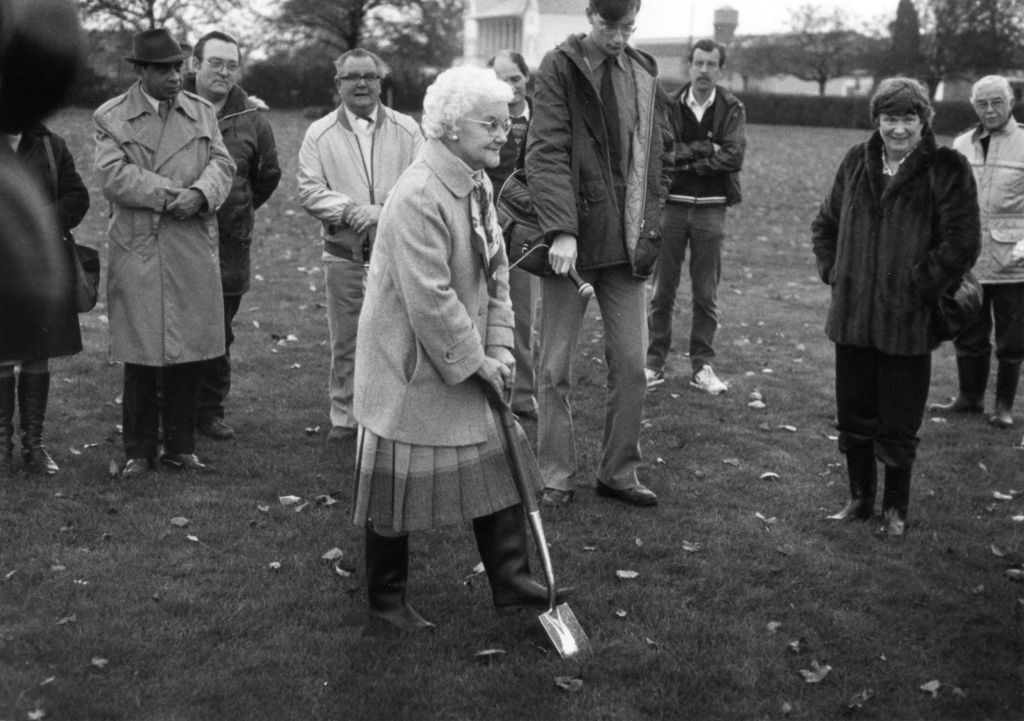
In the early days the club had no running track and their headquarters were on the County Ground car park, so when Swindon finally did get a track, in 1984, it was fitting that Bob’s mother Emily was asked to cut the ceremonial first sod.
Although Bob’s competitive running career began to tail off in the 1980s, his involvement with the sport continued.
He served on the Wiltshire Athletic Association, where he was secretary and team manager of the Cross Country Championships for 27 years. He did everything from finding a course to typing up the race schedule and ordering the medals.
Today he helps organise the Lions Disabled Games, hed every August at the County Ground track – a meeting that attracts teams from all over the country.
“It’s a wonderful afternoon,” he said.
The Swindon AC name has now gone, but the club lives on because it amalgamated with Swindon Road Runners in 1996 to become Swindon Harriers.
And, driven by the ‘marathon mania’ of the 1980s and no doubt the legacy of London 2012, athletics in Swindon goes from strength to strength.
Bob reflects on his early days with Swindon AC when the average entry for a County Champtionship numbered 40-50.
“My dad wouldn’t believe it today to see 500 entries in a Swindon half marathon,” he says.
The Townsend family are at the heart of Swindon athletics history, and although Bob is reluctant to talk about his own achievements, both on and off the track, he does recall when the story came full circle at Babbacombe in Devon in the 1960s.
“I won the mile handicap and an old man came out of the crowd waving his programme at me.
“‘I’ve been coming to his meeting for more than 30 years,’ he said, ‘and about 30 years ago another boke called Townsend from Swindon won this race.’
“That was my dad,” said Bob, proudly.
Bob died in August following a long battle with Alzheimer’s. His funeral took place yesterday at Immanual Church, Upham Road, Swindon where a large congregation of family and friends celebrated his life and said goodbye.
Swindon AC’s first race, in March 1921, with Bob Townsend’s father William, aged 17, second from the right.
Swindon wins South of the Thames Cross Country Championships, Sevenoaks, Kent 1961.
The British Rail Sports Association athletics team bound for Leipzig, East Germany, in 1962 – Bob is pictured seventh from the left.
The club’s 60th anniversary race in 1981. Bob is pictured wearing number 502 and one of the original 1921 vests.
Bob’s mother Emily cutting the first sod at the County Ground athletics track in 1984.
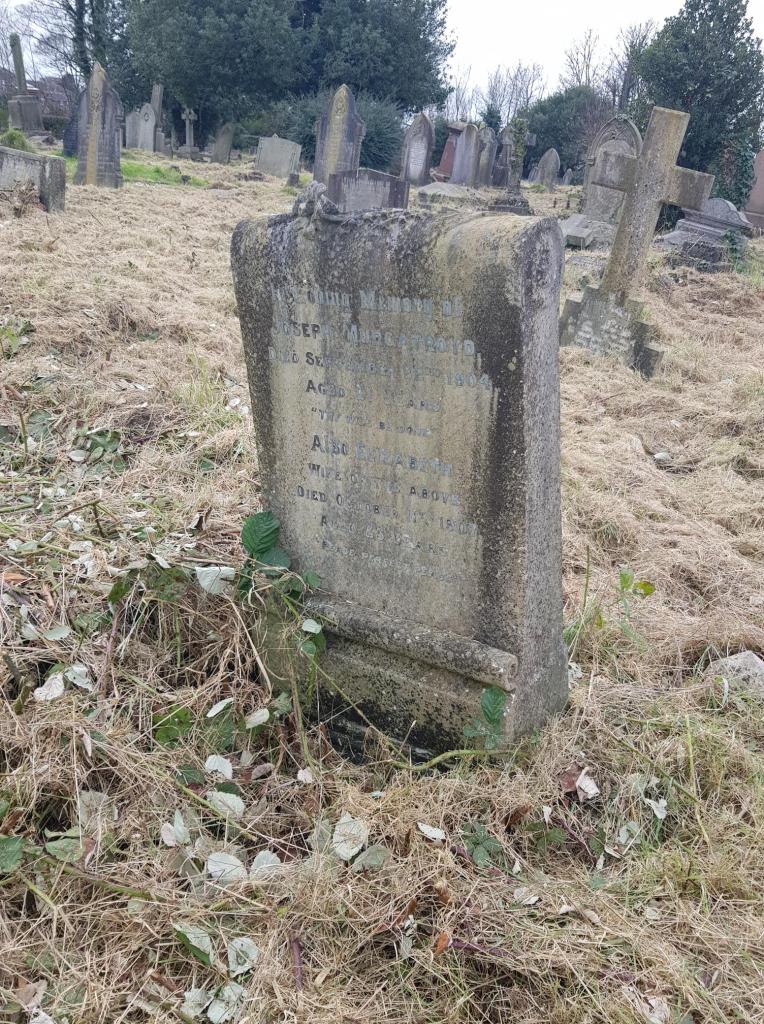
Swindon Borough Council have been busy at Radnor Street Cemetery in recent weeks and have cleared a great swathe of brambles from Section E, a particularly difficult area to navigate. Section E has probably the greatest collection of headstones and memorials in the cemetery and as Noel, Andy and I took a walk, Andy’s eye was drawn to the grave of James and Elizabeth Murgatroyd.
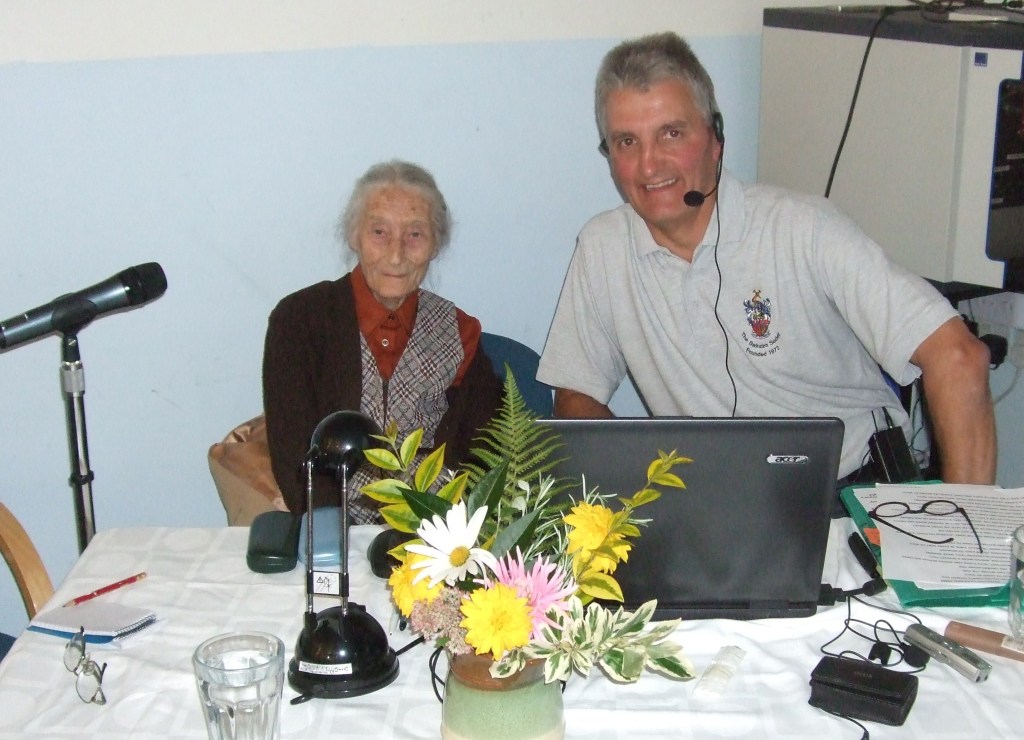
Joyce Murgatroyd was a great friend of Andy’s for many years. Teacher, artist, poet, musician and repository of Swindon’s history, Joyce died in 2017 aged 100 years.
I have written about Joyce’s family, including her great grandmother SarahPeaple and cousin Elsie Morse but have never looked into the history of her husband Henry Murgatroyd’s, family.
The headstone we discovered was that of Joseph Murgatroyd, born in Bradford in 1823. He married Elizabeth Dewhirst at St. Peter’s Church, Bradford on August 26, 1844. At the time of the 1851 census Joseph and Elizabeth were living in Okehampton Street, Exeter where Joseph’s occupation was engineer. They had two children Alfred, 5 and Priscilla, 3. It seems as if they may have already lived in Swindon at some point as this is where Priscilla was born.
By 1861 they were living at No 7, Alliance Terrace, Bridge Road, Swindon where Joseph was a Fitter & Turner at the Engine Factory. Their eldest son had died by that time – now their family comprised three children, Priscilla 13, Alfred Edwin 3 and one year old Sarah.
In 1871 they were living at 8 York Place before moving to 12 Sheppard Street, which would remain Joseph’s home until he died. His funeral took place on September 21, 1904 when he was buried in plot E7809. Elizabeth died in 1907 at her son’s home, 54 Eastcott Hill. Her funeral took place on October 15 when she was buried with Joseph. Their son Alfred Edwin, his wife Ellen and their daughter Annie Irene are buried in E7810, the neighbouring plot.
Joyce and Andy pictured together getting ready for a Swindon Society presentation in 2012.
Sadly, I did not establish a link to Joyce and Henry Murgatroyd, but I have been able to add another account to the Radnor Street Cemetery archives remembering Swindon’s ordinary people.
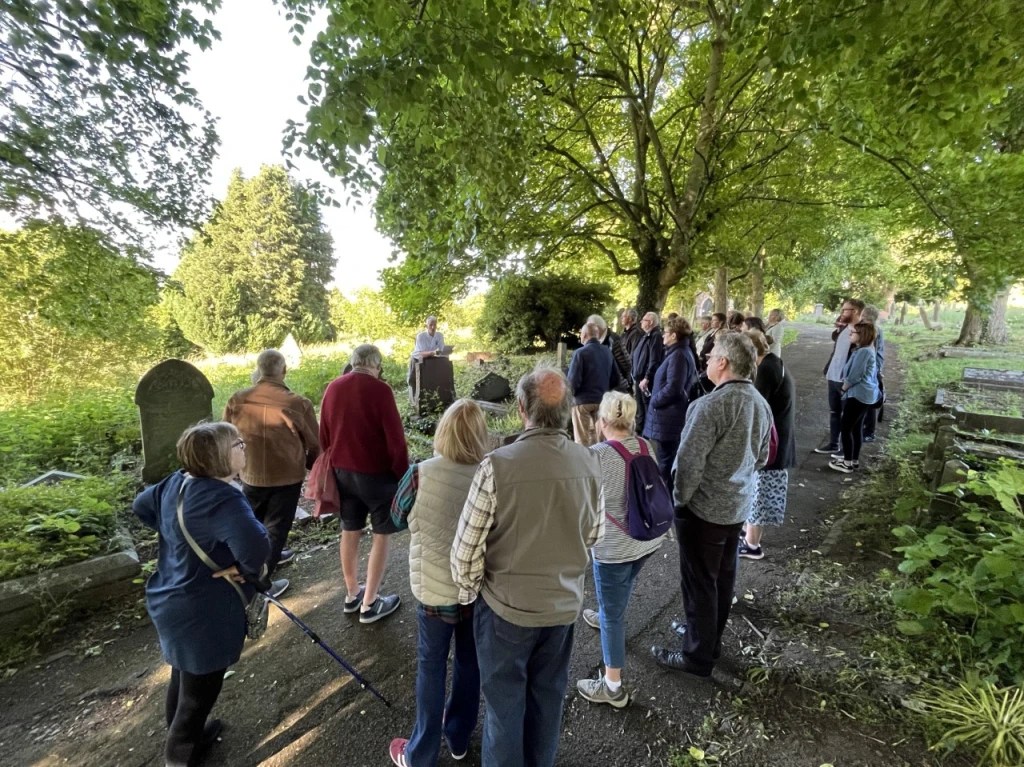
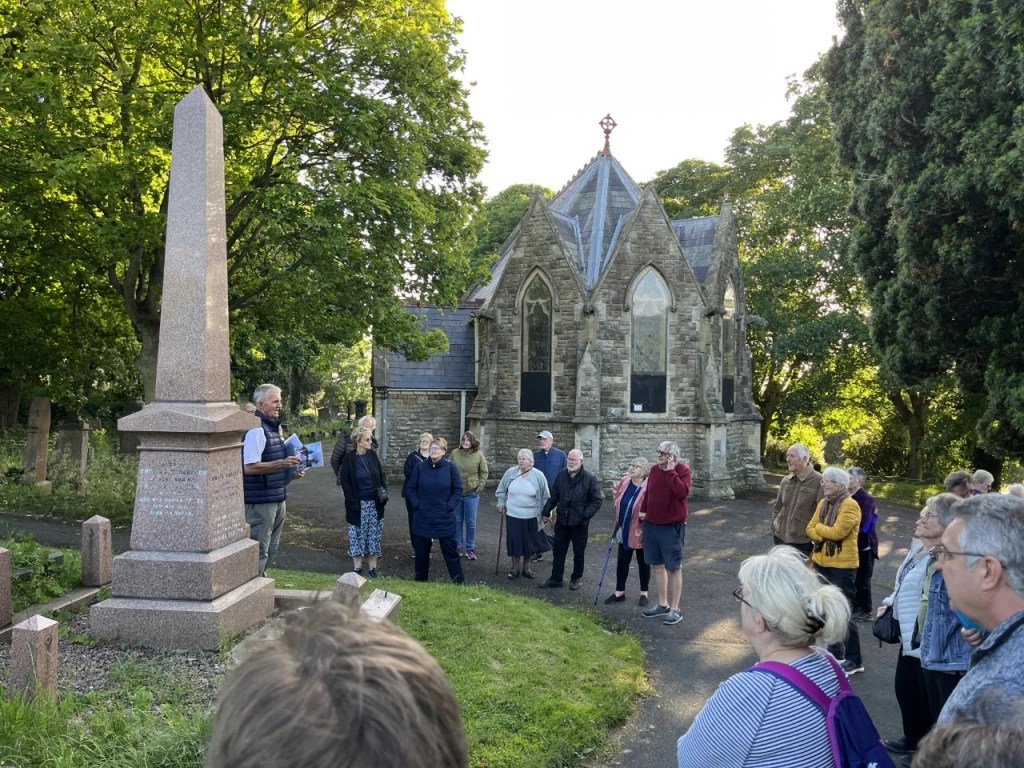
We were delighted to welcome members of the Swindon Society to a guided cemetery walk yesterday evening. And although there was a chill in the air, it was a sunny evening with beautiful views across the cemetery. There is always a different atmosphere during a summer evening cemetery walk, something we have not attempted for several years now. Perhaps it is an event we will consider holding again.
The Swindon Society celebrates its 50th anniversary in September. While other local history groups in Swindon are struggling with falling numbers post Covid restrictions, the Swindon Society is thriving. Yesterday marked the end of their season of talks for a brief summer break before gearing up for their 50th celebrations.
More than 30 members joined us for our walk and heard stories about Emily Peddle,W.J. Nurden (the latest CWG headstone to be erected in the cemetery) and William Harvie inventor of the amazing Multiple Cake Cutting Machine. We later adjourned to the Ashford Road Club who kindly provided tea and biscuits alongside their usual bar facilities.











 Radnor Street Cemetery