Alfred Bult Verrier – dental surgeon

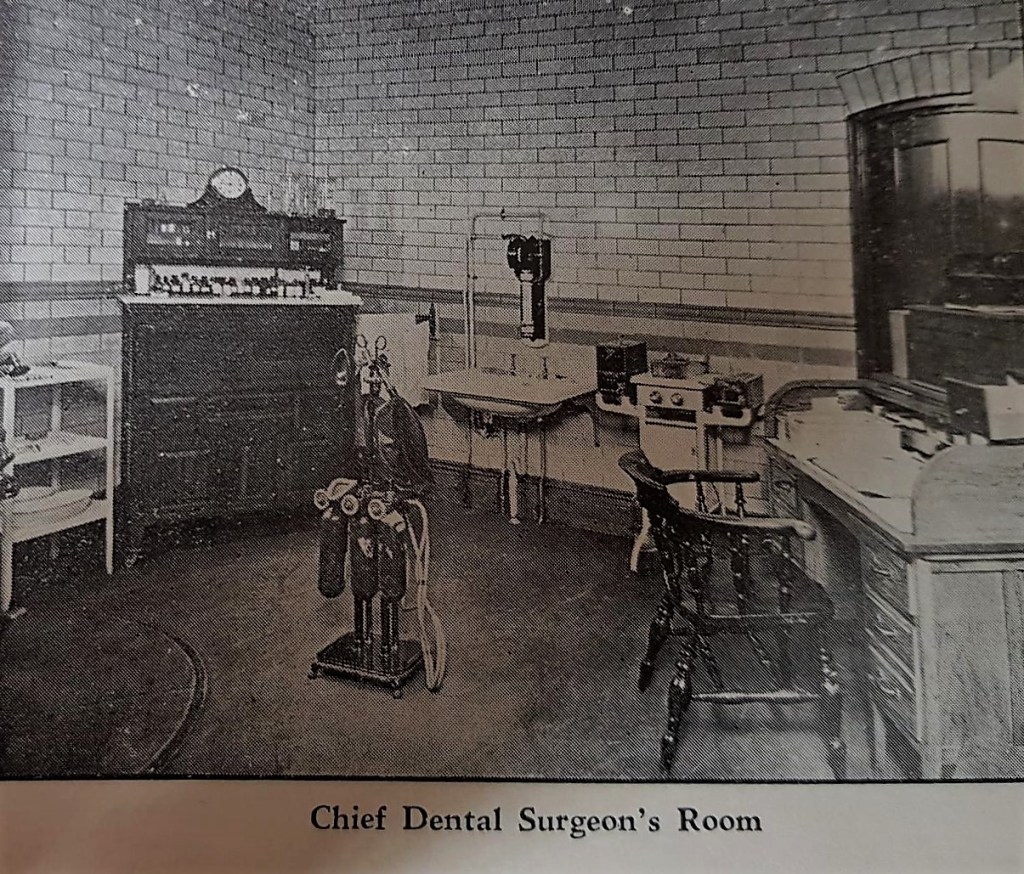
In 1887 the GWR Medical Fund Society appointed a dental surgeon to the newly established dental clinic. Apparently, by the end of that year he had pulled out more than 2,000 teeth.

What happened to those 2,000 teeth!
In 1872 Mr Verrier, a dentist with a practice in Bridport, advertised his new method of adapting artificial teeth. Mr Verrier soon made his way to Swindon where he was employed at the GWR Hospital.

Now I’m not implying that the over zealous tooth puller and Mr Verrier with his artifical gnashers are one and the same person, but did the aforementioned dentist have an ulterior motive for removing so many Swindon teeth? It does make you wonder.

Mr Verrier had a very interesting life and career. For one thing, in 1907 he patented an ‘Improved Protective Shield or Band for Pneumatic Tyres’, which is pretty far removed from dentistry.

Alfred Bult Verrier was born in about 1837 in Taunton, Somerset, the son of George Verrier, a Post Office clerk and his wife Selina. By 1851 he was living in Shoreditch Road, Taunton with his mother and aunt. But at the time of the 1861 census he was missing, most probably because he was living in St. Petersburg. He married Elizabeth Hirschfeld on June 2, 1859 at the British Chaplaincy, St Petersburg, Russia and the couple had two children. Following Elizabeth’s death (presumably) he married Sarah Margaret Blackburn on April 16, 1865 also at the British Chaplaincy, St. Petersburg, Russia.

The couple returned to Britain soon after their marriage and in 1865 Alfred Bult Verrier placed an advertisement in the Dorset County Express and Agricultural Gazette

Mr Alfred Bult Verrier, L.D.S.,

(Royal College of St. Petersburgh,)

Dentist

Informs the Clergy, Gentry, and Public, that he has taken up his residence at Bridport, and solicits the patronage of all who may require his aid.

Mr A.B.V. will be prepared to receive patients on Saturday, December 23rd, at Mr F. Bartlett’s, opposite the Post-office, Bridport.

Mr V. will visit Lyme Regis on Friday, January 5th, at Mrs Davey’s, Confectioner, Broad-street, and Beaminster on Thursday, January 11, at Mrs Meech’s Church-street, continuing his visits at each place fortnightly.

Dorset County Express and Agricultural Gazette – Tuesday 26 December 1865.

At the time of the 1871 census Alfred and Sarah were living at Chards Mead, Bradpole, Bridport with their five children, George Alfred 5, Alide 4, Lillah 3, Walter Ralph 2 and 3 month old Claude Blackburn. In 1881 they were living at Welcombe Regis, Weymouth, now with eight children.

By 1888 Alfred was living in Swindon, where he advertised in the Swindon Advertiser on June 2, 1888.

17, Bath Road, Swindon

Mr Verrier wishes to intimate to his Patients that he maybe consulted professionally on Fridays, at the above address.

And then I lose Alfred at the time of the 1891 census. It may be a transcription error that makes him difficult to find. Although I found Sarah, still married, but ‘living on her own means’ without her husband in Preston, Weymouth with four of her children Adele 23, Zillah 22, Margaret 17 and 10 year old Aldus. Had the marriage broken down?

Two of Alfred’s sons followed him into dentistry and their details, along with Alfred’s, are recorded in The Medical Directory, 1915.

Verrier, Alfred Bult, “Windermere House” Swindon, Wilts. – L.D.S. R.C.S.I. 1879: (Dub.) Dentist GWR Hosp. late Dentist Bridport Cott. Hos. Author, “On Ventilation;” “Continuous Gum Facings,” Dent Jl. 1873; “Mineral Inlay,” Ib. 1879. Inventor of the Continuous Gum Facing Process as applied to Vulcanite; Mineral Inlay & Tooth Crowns; Furnaces for Continuous Gum Work

Verrier, Claude Blackburn, “Windermere House,” Swindon Wilts –                L.D.S. R.C.S.Ed. 1905 (New Sch.Med. & Dent. Hosp. Ed.); Mem. Brit. Dent. Assn.

Verrier, Walter Ralph le, 32 Wood St., Swindon, Wilts. L.D.S. R.C.S. Ed. 1898; (Ed).

The Medical Directory, 1915.

Alfred died at his home 54, Westlecott Road aged 84 years in 1921. He was buried in Radnor Street Cemetery on April 6, 1921 where he lies alone in grave plot E7614.

So many facts about Alfred Bult Verrier’s life remain unknown, including whether he was the dentist who loved pulling teeth in the GWR dental clinic.
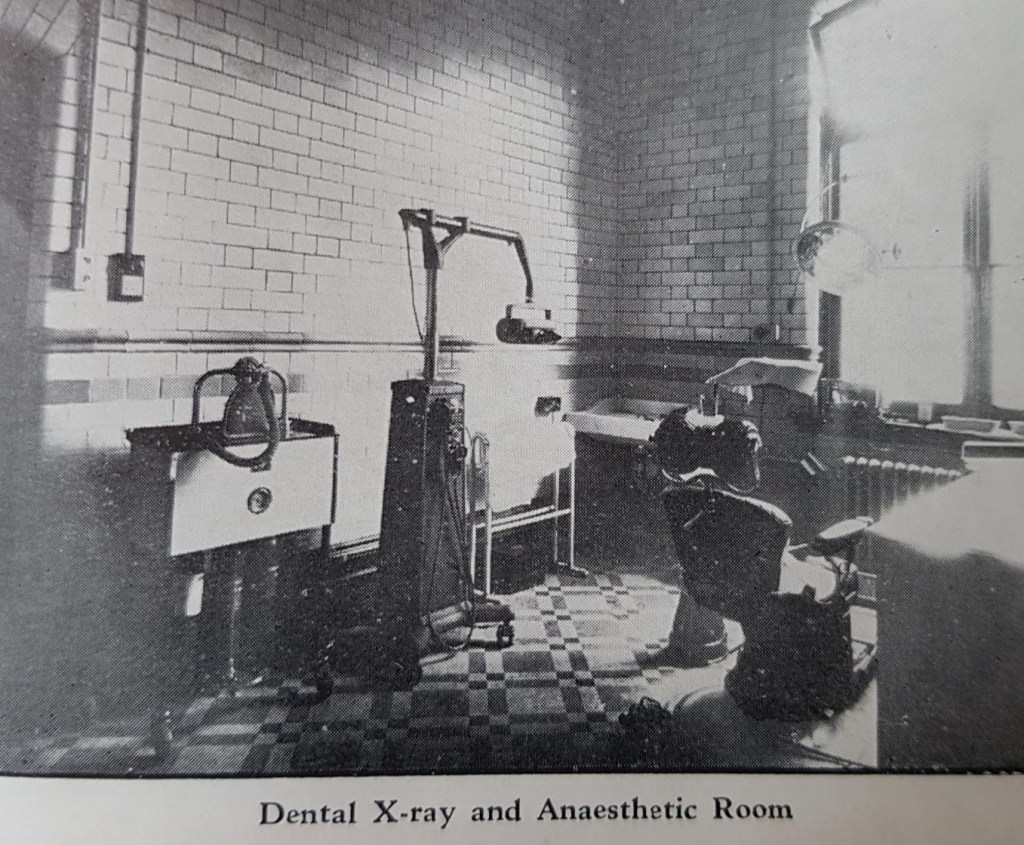
Images published in A Century of Medical Service – The Story of the Great Western Railway Medical Fund Society 1847 to 1947 by Bernard Darwin and published in 1947.
In the footsteps of the Evans family

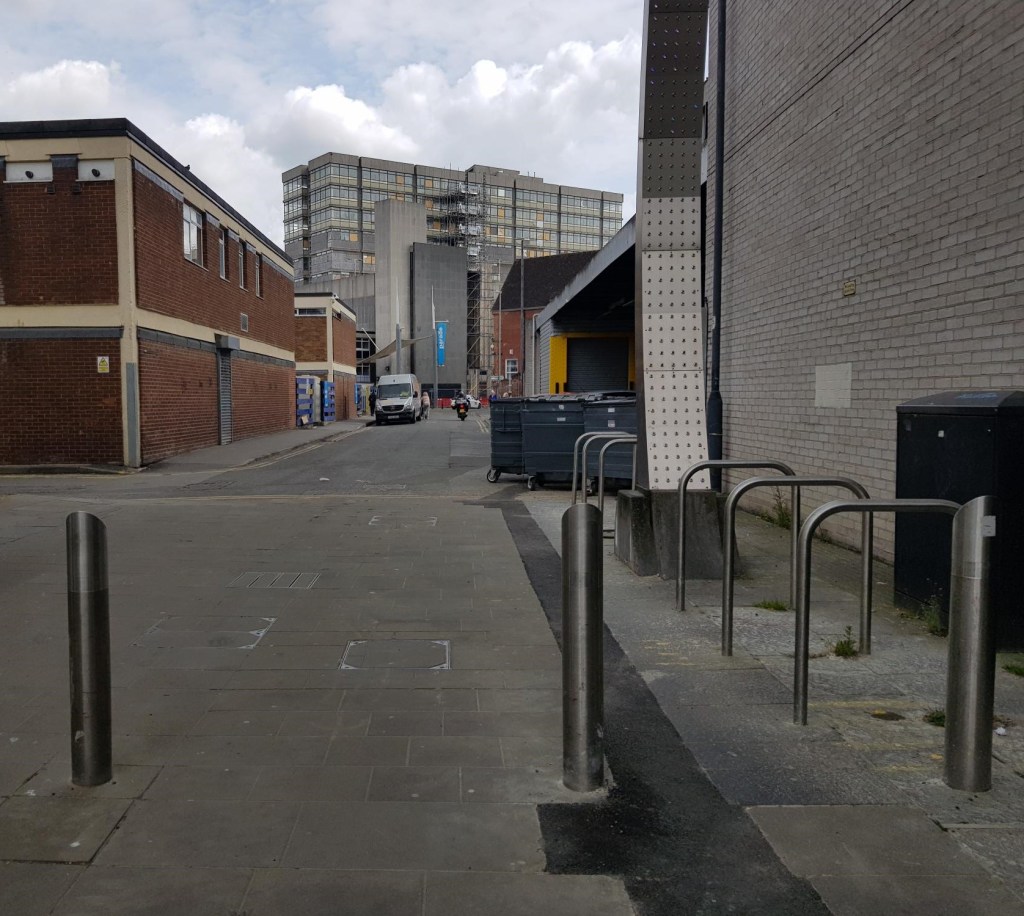
The house in College Street where Alfred Ernest Evans died is gone. The town centre street where the prestigious College Street School once stood is now no more than an access road for shops.

The family home at 23 Commercial Road where William and Salome lived in 1928 looks a little different these days too.

And Princes Street where Salome died in 1936 was redeveloped in the 1970s.

Image published courtesy of Local Studies, Swindon Central Library.

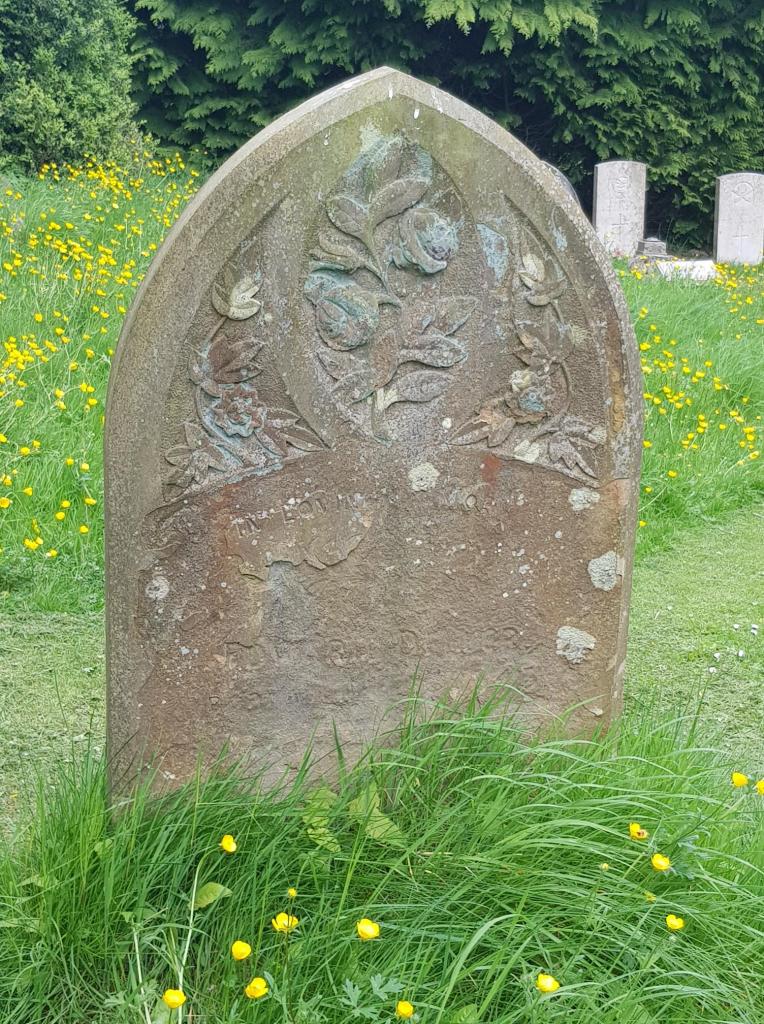
Meanwhile, the inscription on the family’s headstone has all but disappeared.

But it is still possible to piece together the details of the Evans family life.

William Evans and Salome Purnell married in the December quarter of 1879 in Paulton, Somerset. Paulton was a coal mining village where William worked in the iron foundry there. The 1881 census sees the couple living in the Paulton Engine Houses – William aged 26, an iron turner, Salome 25 and their sixth month old daughter Florence with William’s mother Sarah 69, who states that her husband is ‘in asylum’.

By 1891 the family had moved to Swindon and were living at 7 Stafford Street. At the time of the 1901 census they were living in 49 Dixon Street and by 1911 they were at College Street. Salome states that the couple had been married 31 years and that they had 6 children still living (one had already died). Still living at home were Ethel 20 a tailoress, Alfred Ernest 17 a boot repairer and 15 year old Arthur Algernon who was still at school.

Alfred Ernest Evans died in 1916 at 4 College Street. He was 22 years old. He was buried in grave plot C3360 on April 22. William George Evans, a retired fitter, died aged 73 in 1928 when he and Salome were living at 23 Commercial Road. He was buried in grave plot C3360 on August 1. Salome was living at 47 Princes Street at the time of her death in September 1936. She was buried with her son and her husband on September 17.

From this unpromising start with a disintegrating headstone and Swindon streets altered beyond recognition, town centre homes demolished and properties repurposed, it has still been possible to recover the lives of one ordinary Swindon family.

Backswording and the Blackford family

The re-imagined story …

Of course, you are too young to remember Blackford’s the butchers. They used to have a shop on the corner of Wood Street and Cricklade Street, but that’s long gone. I can recall going to the shop in Bridge Street with my mother, although it could be quite a scary experience as old man Blackford was a bit erratic. He’d been a famous backsword player in his day and they said he’d been seriously injured several times during his fighting career.

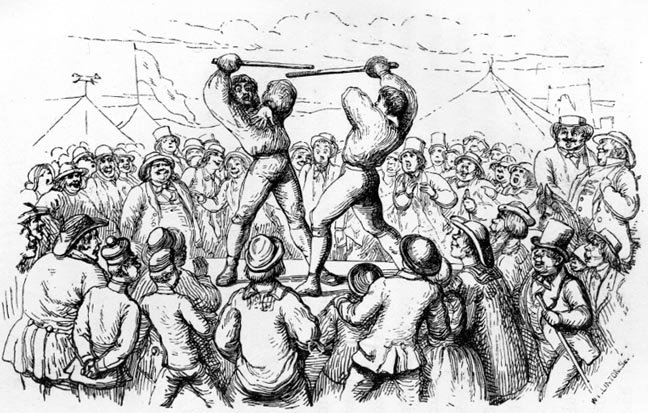
I don’t suppose you know what backswording is either; no one plays it anymore. It was a brutal sport. Players had one arm restrained and with the other they beat their opponent about the head with a wooden stick, the aim to land a blow causing the blood to run for one inch.

There was some decent prize money to be won mind and more if you liked to gamble. Those old gamesters were made of stern stuff but they paid a high price. Joseph’s father Robert suffered from the frequent blows to his head and died from an accidental drug overdose of the laudanum he used to manage the pain.

Joseph concentrated on the butchery business, though and by the time he was raising his family backswording was a thing of the past. Joseph named one of his sons Brave – perhaps he thought he had the makings of a gamester.

Backswording – wood engraving by Richard Doyle (1824-83)

The facts …

Joseph Blackford was baptised at Christ Church, Swindon on March 24, 1830 the younger son of Robert Blackford and his wife Anne. Robert came from a long line of butchers and at the time of the 1841 census the family were living in a property on the corner of Wood Street and Cricklade Street. In 1851 Joseph was running the butcher’s shop on Bridge Street with his sister Mary. He married Mary Ann Holdway and by the time of the 1861 census they were living in the railway village at 10 High Street [later named Emlyn Square] with their two children William and Mary Ann. A third child, Elizabeth, was born in 1864. Mary Ann died in August 1865 and was buried in the churchyard at St. Mark’s.

Robert died in 1867 probably as the result of injuries sustained during his backswording career. The verdict of the coroner’s court was that he had “died from taking an overdose of laudanum, whilst labouring under a fit of temporary insanity.”

On February 27, 1867 Joseph married Rosanna [Rosina] Woolls, a widow who describes herself as a butcher. The couple set up home in Purton where they raised their family.

Joseph died in September 1906 aged 76 and was buried in plot D1447 with his son Harry Bath Blackford who had died just weeks before him. Rosina died in 1923 and their daughter Alda Priscilla Bamford died in 1932 joining her parents and brother Harry in plot D1447.

The Blackford family grave

Newspaper proprietor William Morris was particularly opposed to the sport of backswording, writing in his newspaper The Swindon Advertiser:-

And I recollect that this was particularly the case at the New Swindon sports. The left arm and side and thigh of one of the players was so cut and bruised that it had the appearance of raw meat, and although the man himself kept on, and always came up to time, the spectators became so alarmed at his terrible condition and lacerated appearance that some attempt was made to get him to leave the stage and insisted that a medical man should be requested to attend him …

Shrivenham was one of the places noted for its backsword players, and I have been told that on one occasion a player in that village continued to play after one of his eyes had been cut out and lay on his cheek, and slices of flesh had been cut off his arms. Of course, such a one would receive much encouragement from the spectators as being a “good plucky fellow,” and the flow of pence into his basket at the close of each bout would be most liberal…

The Popular Amusements of our Grandfathers -The Swindon Advertiser, Saturday December 6, 1884.

Mrs Ormond passed away two years ago

William Ormond, a solicitor, and his wife Georgina lived at a property called the Limes for more than 45 years. The road in which it stands has been variously known as Short Hedge, Horse Fair Street, Devizes Road and is now called Croft Road.

In the late 1880s Marion Ormond was at the centre of the scandalous case of the Christ Church vicar Rev. Newton Ebenezer Howe. Marion 23, one of Georgina and William Ormond’s large family (seven daughters and a son) was a Sunday School teacher and a district visitor.

Rev. Howe, a married man with a young son, arrived in Swindon to take up the post of vicar at Christ Church in 1887. Trouble began almost immediately. In 1889 there was a mishandling of money for the various Church and National School charities of which he was a trustee. Then came the accusations of misconduct involving a church volunteer, Marion Ormond.

The accusations against Howe intensified, yet despite all this Marion continued to visit the vicar and his wife, until eventually it was just the Vicar she was seeing. They began to meet in secret but they had been spotted.

On June 21, 1890 a notice of inhibition (an inquiry into the conduct of the vicar) was served on Howe while the matter was investigated.

For three consecutive evenings protesters gathered outside the vicarage, shouting and throwing missiles. Of course, Howe had made sure he was out of town and Marion had also left Swindon and was staying in Reading.

A public inquiry took place at the town hall in Old Swindon on August 15, 1890 where Howe was charged with adultery and improper behaviour. The hearing took place in a packed courtroom and lasted 5 hours. Marion was called to give evidence during which she became very distressed and had to leave the courtroom to compose herself. Her letter to the court defending Howe was read out.

Following the hearing Georgina submitted a letter to the local press in support of her daughter.

The following letter has been addressed to the Editor of the Devizes and Wilts Advertiser by Mrs Georgina Mary Ormond:

Sir, – In the absence of a word in favour of my daughter Marion in Mr Bucknill’s address to the Commission of Friday the 15th inst I hope you will allow me space in your paper to state in justice to her that she is not the immodest girl she may have appeared. Her visits to the Vicarage were always made to Mrs Howe, by whom, against her parents’ expressed wishes, they were deliberately encouraged, as well as her visits to Mr. Howe at the Vestry room, and the girl’s disobedience no doubt paved the way for all that followed. Mr. Howe represented himself as a cruelly persecuted man, and my daughter believed it her duty to cheer and defend him, trusting him entirely, and utterly unsuspicious of evil in his attentions to her.

The letter read in Court was written impulsively in the hope of freeing Mr. and Mrs. Howe from the imputation circulated against him. In order to make some reparation to her family for the disgrace she has brought on them, and to atone in some measure for her deceit and disobedience, she wished to tell all at the enquiry, and did her best, but the sight of Mr. Howe’s face with its agonised expression (which she saw whenever she looked at the counsel addressing her) so unnerved her that it is hardly to be wondered at if at the moment she failed to give the concluding details of her evidence. Moreover, she had good reason to believe that that part of her evidence would be allowed to be given in writing. In the hope that your readers may see in these details some extenuation of my daughter’s fault, I have troubled you with them.

Devizes and Wilts Advertiser, August 28, 1890.

The case was referred to a Consistorial Court at the Chapter House of Bristol Cathedral where on December 12, 1890 Howe pleaded guilty to all the charges. The Bishop suspended Howe from all duties for 3 years and he had to pay the costs of the hearing.

But amazingly this wasn’t the end of the Rev. Howe. In late 1893 he returned to Swindon where he began another affair and moved Miss Mary Roskyll into the vicarage. He was delivered with a second notice of inhibition and eventually served a 12 month prison sentence with hard labour.

Marion’s last address was the Old Haslings Hotel, Warninglid, Sussex. She died on February 25, 1942 at the Haywards Heath Hospital.

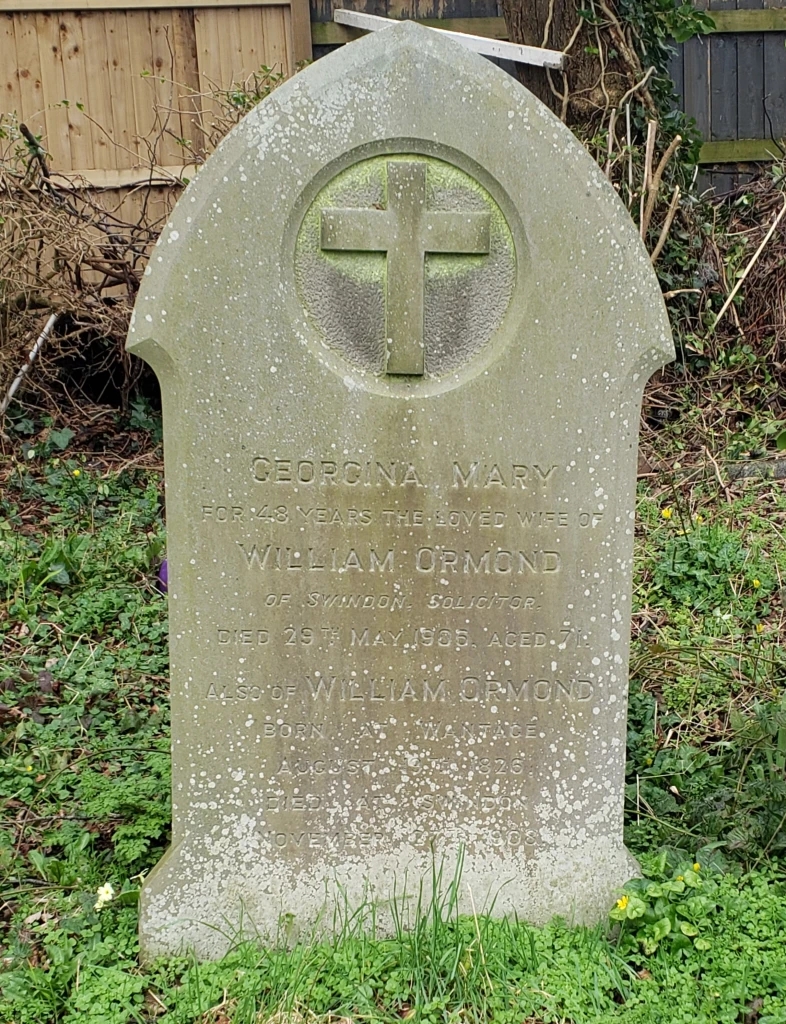
Her mother Georgina died at her home on May 29, 1906 and was buried in Radnor Street Cemetery in plot E8626 on June 1. William Ormond was buried in the same plot following his death two years later.

Crimean War Diary – Part Six

This is the final entry in the Crimean War Diary written by John Harris and published in the Swindon Advertiser after his death in 1902.

Jan. 1 (1856) – Very cold, with much snow. Firing from the north side continues during the day. At night rockets are observed on the heights.

Jan 2. – The troops are comfortable in huts – several of the outpost sentries have been found frozen to death at their posts. The Russians continue to throw shot and shell into the town. The rations are, generally, of a better quality than have been hitherto served out to the troops.

Jan. 3. – Received orders yesterday to hold ourselves in readiness to proceed to Kertch, as the Russians are collecting in force in that district. It will be a difficult march at this time of the year, although the distance is not great. But the mountain passes are covered with snow, and very deep.

Jan. 4. – Marched to-day at 10 a.m. for Kertch and encamped at Bidar for the night, caught a violent cold, which I thought would prove my death. We had to keep our watch fires going the whole of the night, as wolves came down in great numbers. We lost one man during the night, and it was supposed that he was taken away whilst on sentry duty, as his carbine and much blood was found near his outpost.

Jan. 5. – Awoke this morning before daylight. It was bitter cold, and my limbs nearly contracted with the damp and cold. I was nearly ready to give up. We are to remain at Bidar until the river is going down, and we shall be able to ford it to-morrow.

Jan. 7. – Marched over the Bidar bridge this morning and reached Kertch at 9 p.m. much fatigued. Have the damp wet ground and the dreary tent once more.

Jan. 12. – All the Russian outworks round Kertch were destroyed by our men yesterday and to-day. Fresh butter was offered to-day by the Tartans and the country people at 3s per pound.

Jan. 25. – The Russians are very quiet in their batteries, and fresh supplies are coming in great abundance from the out villages. The English and French mail arrived with the intelligence of an armistice between all the powers for the space of six weeks.

Having between Jan. 25th, and Feb. 6th, gone to Balaclava, the writer of the diary continues:

Feb. 7. – The Russians hoisted a flag of truce from the heights, and from the staff fort in Sebastopol. They have received the news of an armistice. The Russian General and the generals of the French, English and Sardinians will meet to-morrow at 11 o’clock, half-way on the traction bridge, to sign the articles of the armistice. No firing or any other warfare to be carried on for six weeks.

Feb. 8. – All hands employed raising the dock gates. Great rejoicing among the Russians on account of the Armistice. Salutes were fired for the occasion.

Feb. 9. – A holiday was given all the troops, and all Government offices closed for the day.

Feb. 10. – Wind bitter cold; several men frost-bitten in their fingers, ears, noses and above the ankles. Others have had their fingers and toes amputated. One man was obliged to have both his feet taken of just above the ankle. Other have had their fingers taken off, and another had his ear off. My nose was frost-bitten, and as white as a lily, but I got it round by rubbing plenty of snow into it.

Feb. 14. – Escorted prisoners to Balaclava. One got away on the road, but was recaptured.

Feb. 16. – Stores and men arriving from England, and in the course of other two months Camp to Balaclava; distance, nine weary miles. We shall be able to take the field with a fine and powerful army.

Feb. 23.- Two Greeks shot on the Heights for killing a French soldier.

Feb. 27. – Snow fell very heavy during the night. A Greek sailor was hanged from the yard-arm of the Black Eagle, for attempting to set fire to an English vessel laden with powder.

Feb. 28. – Wind bitter cold; many cattle found frozen on the plains. Two French soldiers shot for killing and robbing an English soldier on the road from Balaclava to the camp. A Greek spy was caught in the English camp and shot.

Feb. 29.- Two English officers suffocated in their huts by using charcoal to keep them warm.

March 7. – The English mail has arrived with good news. Peace is proclaimed. All men paraded for a field-day. Salutes fired from all the forts, fires lighted on all the hills, and fireworks displayed.

From this date to the 18th July the old soldier records the various incidents which lead up to the close of the war and the return home. On the 18th of July he records as follows:-

Entered the chops of the English Channel, and passed the island of Jersey at 4 p.m. We then caught a glimpse of the white cliffs of old England, and all the crew and the troops gave hearty cheers, which seemed to echo back to the good old ship the news of our welcome home.

July 19. – Landed at Portsmouth at 9 a.m., and marched to the Railway Station with several bands playing “Cheer, Boys, Cheer,” “Auld Lang Syne,” and “See, the Conquering Heroes come.” We are now safely landed in England after twelve months hard toil on the battle field.

The diary is concluded with the following statistics in relation to the death roll:-

English loss                         30,301

French loss                          45,284

Sardinians loss                      9,112

                                             84,697

Russian loss                    174,989

Swindon Advertiser, Friday, August 8, 1902.

John returned to England and in 1859 married Sarah Coleman at St. Mary’s Bathwick. By 1861 they were living in Swindon at the appropriately named 5 Alma Terrace* with their year old son John Frederick Mark. John was employed as an accounts clerk in the GWR Works, a job he would retain until his retirement.

Subsequent census returns record him living at 19 Bridge Street (1871); 2 Queen Street (1881) and finally at 24 Sanford Street (1891 & 1901) where he died in 1902.

He was buried on August 2, 1902 in grave plot E8002, which he shares with his wife Sarah who died in January 1908.

*The Battle of Alma took place in Crimea on September 20, 1854

Crimean War Diary – Part Five

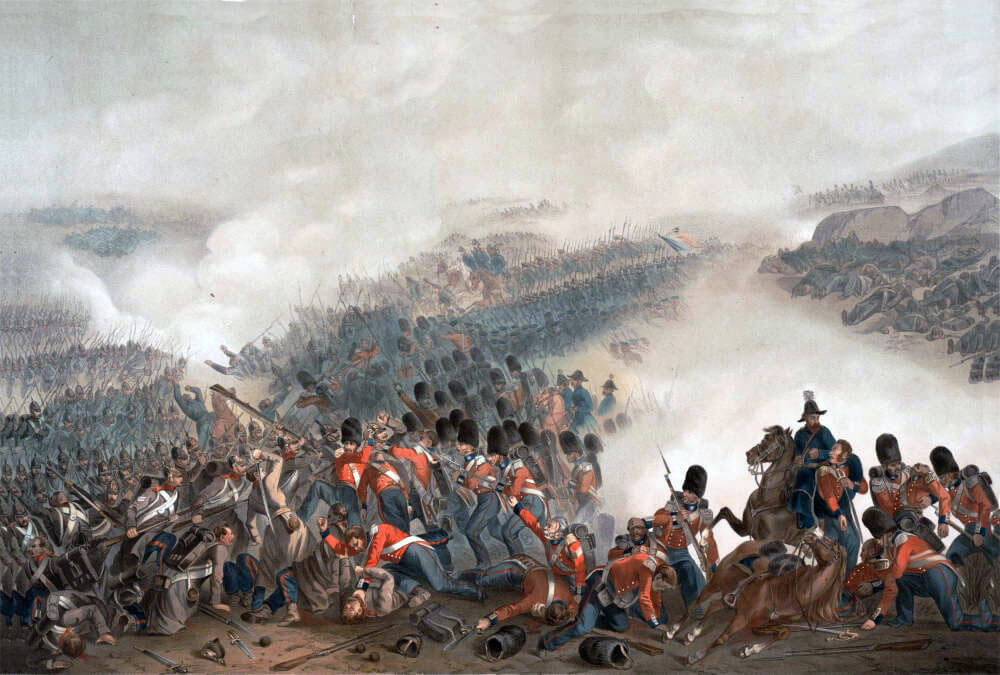
Battle of Inkerman

Continuing …

Extracts from the diary of Crimea War Veteran – John Harris.

Nov. 1. – In Sebastopol on fatigue. The Russians keep up a very heavy fire on the town. A man was riding a donkey after firewood near the dockyard wall when a shell came over and passed right through the donkey without scarring the man in the least.

Nov. 5. – Took a walk over to look at Inkerman, twelve months after the battle. The skulls and bones of the dead are still lying about in thousands. The eagles and the ravens have eaten the flesh. The Russian loss must have been very great that day. It is called Gotha, the place of skulls, to this day.

Nov. 7. – Under orders to march for Balaclava.

Nov. 8. – Arrived at Balaclava yesterday, rained in torrents during the whole of the march, wind cold, no fire, no food, clothes all wet, and had to let them dry on our backs.

Nov. 9. – Fever broke out in the Company. Our Company sergeant died this morning; great many on the sick list.

Nov. 12. – Cold winter wind is approaching. The Russians made a sortie, and were repulsed with heavy loss by the Sardinians.

Nov. 7. – Sickness on the decrease; one gunner died during the night. A tremendous explosion took place on the French Right Attack Gun Park, and spread into our gun park. A large quantity of powder and stores were destroyed, and a large number of English and French killed.

Nov. 18. – An attack expected from the Russians from the heights; firing towards Simperpool.

Nov. 25. – Snow fell heavy during the night. All hands are engaged hutting for the winter.

Nov. 29. – Firing very heavy all day. It is too cold for the Turks to work, but the Armenians are very good workmen.

Dec. 1. – Snow very deep and wind very very cold. The firing from the north side continues frequent during the day. The cattle exposed to the weather drop off; a great many found dead this morning on the plains.

Dec. 3. – The huts are nearly completed, although the men cannot get them brought up to the front on account of the severity of the weather.

Dec. 7. – Marched to Sebastopol to see the explosion of the docks.

Dec. 9. – The fire from the Russians very rapid, but little damage done to the town, excepting to break down the roofs of the of the houses, enabling our men to get wood without the trouble of sawing and cutting.

Dec. 20. – A heavy fall of snow occurred during the night. A Russian magazine blew up.

Dec. 21. – Rations very bad. Men are getting very sick, and scurvey is making its appearance amongst the men. The hospitals are all full, and the winds are still cold, with much rain.

Dec. 23. – The Russians are destroying the brushwood on the heights in order to get clear view of our encampment. Lime juice is being served out to the troops to prevent scurvy.

Dec. 25. – Christmas Day – holiday for most of the troops. Arrival of fresh supplies of warm underclothing. A hut burnt down and eight men of the Army Working Corps suffocated by the smoke.

Dec. 31. – Wrote a letter home to England. Snow fell very thick during the night; wind very cold. This day finishes out the old year, and I hope through the blessing of God, who has hitherto protected us through trials, we will be supported further.

The final instalment of this Crimean War Diary will be published tomorrow, concluding the life and times of John Harris, buried in Radnor Street Cemetery.

Crimean War Diary – Part Four

The death toll from disease rises as John writes in his diary – Oct 8. – Sickness dreadful. Sixty men in hospital; twenty men have to do the work of 100. If we stay here much longer we shall lose all our company. We came here a few days ago 126 strong, and we have only 58 left.

Continuing …

Extracts from the diary of Crimean War Veteran John Harris.

Sebastopol storming of the Great Redan

Oct. 1. – Ordered to march from the Windmill miles after much rain.

Oct. 2. – Arrived last night at the heights and encamped.

Oct. 3. – Went to Balaclava on “fatigue” after rations, but could not get any, biscuits all we have had for two days.

Oct. 4. – Two gunners fell sick and died. This evening one corporal and a bombardier died. Several more men sick.

Oct. 5. – Two more men died this morning.

Oct. 6. – Four men of our company died during the night. Two men died this evening; sickness on the increase.

Oct. 7. – Two sergeants and one lieutenant died this morning.

Oct. 8. – Sickness dreadful. Sixty men in hospital; twenty men have to do the work of 100. If we stay here much longer we shall lose all our company. We came here a few days ago 126 strong, and we have only 58 left.

Oct. 9. Orders came yesterday to remove to Kamara from this valley of death on account of sickness.

Oct. 10. – Marched to Kamara this morning. A great number of men fell out on the way from weakness.

Oct. 15. – Order to march to the right attack, so as to be employed in Sebastopol getting out the stores, and mounting guns.

Oct. 16. – Arrived at the Windmill Camp, right attack, yesterday evening, very much fatigued.

Oct. 17. – Employed in Sebastopol in raising the iron lock gates of the docks. The Russians fire at us from the Staff Fort, but very little damage, as all their shot and shell fired at short range.

Oct. 21. – In Sebastopol raising the ribs of the dock gate. Two of our men injured by a shell from the enemy.

Oct. 22. – The Russians are throwing up Battery on the left of the Staff Fort so as to prevent our men working.

Oct. 22. – The English destroyed the new battery yesterday by shelling the men out of it.

Oct. 24. – The Russians continued to fire all over the town with very little damage to anyone.

Oct. 25. – Two men blown up by a shell near the Creek battery.

Oct. 26. – The sappers are at work at the docks, sinking shafts in order to blow them up.

Oct. 27. – Rain fell in torrents the whole night; our tent nearly blown away. Heavy fire from the left.

Oct. 28. – Sun very warm; washed our dirty linen, which was very verminous.

Oct. 30. – Mounting guns in the Redan to be forwarded home to England.

Continued tomorrow …

Crimean War Diary – Part 5

Crimean War Diary – Part Three

This week I am publishing seven daily blog posts dedicated to John Harris – Crimean War Veteran, who is buried in Radnor Street Cemetery.

Florence Nightingale

Continuing …

Extracts from the diary of Crimean War Veteran – John Harris.

Sept. 13. – Wrote a letter to England. Cholera has made its appearance in our camp.

Sept. 14. – Heavy firing heard from the rear of General Tuder’s army.

Sept. 15. – Sickness very prevalent in the camp, and deaths numerous. The Russians fire at anything they see in Sebastopol; firing from the north side.

Sept. 16. – The French and English are constructing a battery for mortars and heavy metal to shell the north side.

Sept. 17. – Very warm; obliged to keep out of the sun during the day.

Sept. 18. – Several French and English killed in Sebastopol by the shot and shell from the north side.

Sept. 19. – Sickness on the increase. One of our sergeants and a gunner died, and were buried to-day. Several of our men very sick.

Sept. 20. – The Russians are making an inward journey towards the fortified camp at Simpherpool.

Sept. 21. – Very wet; the rain is coming in torrents.

Sept. 22. – Not a gun has been heard during the whole night or day.

Sept. 23. – Heavy thunder and lightning; accompanied by violent storms.

Sept. 24. – The Russians opened a tremendous fire on the town at daybreak to-day.

Sept. 25. – The fire yesterday did little or no damage. Two French sappers killed by the ruins of an old Russian house falling in on them.

Sept. 26. – The English opened a mortar battery opposite Fort Constantine – greatly to the annoyance of John O’Rush.

Sept. 27. – The Russians are occupied erecting a new battery on Sugar Loaf Hill.

Sept. 28. – Firing very heavy during the night from the Mackensie’s heights. Expecting an assault on our right from the traction bridge.

Sept. 29. – The whole army under arms ready for an attack.

Sept. 30. – Very heavy rain during the night; my kit is wet through, and my clothes have not been changed for the last 14 days.

Continued tomorrow …

Crimean War Diary Part Four

Crimean War Diary Part Two

This week I am publishing seven daily blog posts dedicated to John Harris – Crimean War Veteran, who is buried in Radnor Street Cemetery.

Embarkation of the Sick at Balaklava

Continuing …

Extracts from the diary of Crimean War Veteran – John Harris.

Fire!

The recorder, in his account of the voyage out to the Crimea, has a startling incident to note under date August 11, 1855. It is as follows:-

Sea very high, wind the same. Ship caught fire below, fire bell rang, boats were lowered, men looked wild and pale. Water in being poured in by tons, and about 2,000 blankets wetted and thrown on the fire. The men begin to look for a watery grave – there is no ship in sight, no land. The fire is gaining upon us.

Then after a break he goes on:-

We got the fire under by night. The damage done is considerable.

In The Trenches

And now we come to the campaign proper. The men reached the scene of action on August 31, for the record in the diary is as follows:-

August 31 – Arrived at Balaclava harbour, and for the first time heard the guns from Sebastopol. One man fell overboard and was drowned. Disembarked. On shore many curious sights, Jews, Turks, Greeks, Armenians, Tartars, Maltese, Spaniards, French. All ordered to march to the right attack, distance about nine miles. Dreadful sights on the way. Men exhausted, and worn out by fatigue. Pitch our tens. All hands for the trenches at 10 o’clock that night. Only had my clothes off once since I left England – that is 37 days. I laid down and went to sleep. Sun next day very warm, and I fell sick; two days without eating or drinking. Several men taken with the cramp and two died from the cholera. The firing is very heavy on our right. Several wounded brought up from the trenches. A powder magazine exploded in the French works.

Sept. 1. – Went into the trenches last night. Lost two men of our company. Firing was very heavy, and shot and shell thrown into the town in a great quantity. The town on fire in several parts, but extinguished towards morning.

Sept. 2 – Firing continues very heavy. A Russian man-of-war on fire. She went down at day break this morning.

Sept. 3 -Paraded for the trenches at 9 p.m. Lost two men and one sergeant in the advance trench on the right attack.

Sept. 4 – Firing continues to be very rapid. It must be impossible for them to withstand our fire which is from right to left.

Sept. 5. – Rapid firing night and day. Several explosions in Sebastopol, but cannot hear much for the thundering of our guns.

Sept. 6 – Paraded for the trenches at 9 a.m. Tremendous firing from our right and left. The Russians feebly reply to our fire.

Sept. 7. – The firing from our right is dreadful, also from the mortar battery in the quarries. The whole heavens illuminated by our fire.

Sept. 8. – Firing heavy. The very heavens and earth seem coming together. Explosions seen in Sebastopol; they reply to our fire but feebly; our loss was rather heavy yesterday.

Sept. 9. – Paraded last night at 10 p.m. for the trenches. Lost four men going in the advance trench, eight men wounded during the night, one corporal, one bombardier, and five gunners killed in our company. At 12-30 last night the Russians could not reply to our fire, when Capt. Vernon ordered us to cease firing as Sebastopol was in flames and the enemy retreating. We went on the parapet of the Battery, and saw our men going in over the Redan works. All firing ceased for a time, when a most dreadful explosion was heard. It was St. Nicholas which had been blown into the air by the Russians as they retreated. Just before daylight a shell was thrown from the staff fort on the north side into our battery, and exploding, killed four men, one lieutenant, one bombardier. Three men, one sergeant, wounded. A piece of the shell struck me on the right leg, below the knee, cutting my thigh. I was taken away to the front to have my wound dressed, and sent into camp to rest as the hospitals were full.

Sept. 10. – I attended hospital at 9 a.m. and had to wait there some time to have my wound dressed. I saw nearly a wagon load of arms and legs which had been taken off that morning by the doctors. The groans of the dying were dreadful, and I was very glad to get away from the place. Towards the afternoon I went down into Sebastopol by the Redan. The sight of the Redan ditch was awful to relate, for it was filled with our poor English dead bodies. I went further down into the town and met with several dreadful sights. Russian, men, women, children, horses, dogs, cats, cattle, were all lying in the streets in all directions, dead and dying. Hundreds of Russian soldiers were lying dead in all parts of the town. God forbid that I should witness such a dreadful view again.

Sept. 11. – My wound is better to-day. I rambled into Sebastopol, and brought out a cat and dog. The town is still burning in parts, and forts and magazines are occasionally being blown up. At night the burning town illuminates the heavens. The French and English fired rockets to two Russian steamers that have run ashore. They burnt with great fury all day. The Russians hoisted a flag to come over and bury their dead. They buried hundreds, and thousands were thrown into the water. Many corpses were floating in the harbour for weeks after.

Sept. 12. – Heavy firing from the north side of the town. The Russians do not appear satisfied at our being in the town.

Sept. 13. – Wrote a letter to England. Cholera has made its appearance in our camp.

Continued tomorrow …

Crimean War Diary Part Three

Crimean War Diary – Part One

Read the first installment of the Crimean War Diary written by John Harris and published in the Swindon Advertiser following his death in 1902.

Veterans of the Royal Artillery

The Crimean War Day by Day

(Special to the “Swindon Advertiser.”)

The death took place last week, as we have already announced, of a Crimean Veteran, in the person of Mr John Harris, of Sanford Street, Swindon, who passed away on Tuesday, July 29, at the age of 74 years.

As we announced the other day, we have, through the kindness of the deceased Mr Harris’ son, been granted a perusal of a diary kept by the veteran during the Crimean war, and from the diary we take the following, feeling confident that this unique history of that arduous campaign will contain records abounding with interest to the majority of our readers.

The writer opens his account with some very sentimental passages provoked by the scenes of farewell he witnessed when, as a sergeant in the K Battery of the Royal Artillery, he took leave of England for the seat of war. He opens as follows:-

Sailed 26th. – It was on one of those beautiful summer mornings very often seen on our shores in the latter end of July, 1855, at about 4 o’clock a.m., that her Majesty’s steamship, “the Atlanta,” weighed anchor, and steamed out of the harbour of Sheerness, with about 800 of the Royal Artillery, 185 horses, 60 officers and a crew of 150 men, bound for the Crimea. And there was many a sad and heavy heart partook of the hard and scanty meal of a breakfast, whilst others of a more noble mind were singing and whistling away as the vessel parted the foaming sea from her stately bows. I was on deck with several others pacing to and fro, smoking my pipe, whilst others were lounging and talking in various parts of the ships. Several of them were talking of home, and wondering whether they would ever behold their dear native place again. How many of those brave men left those shores on that bright sunny morning never to behold them again, and now rest on those ironbound and snowy hills of the Crimean shore, where there is no mark of respect to denote to the passer by or the stranger that beneath lie sons of England waiting to receive their Heavenly reward; those who went forth in the hour of need to share in the toils and hardships of a campaign, leaving those who were dear to them at home.

Continued tomorrow …

Crimean War Diary – Part Two