Edwin Gordon White – Military Cross

On our guided cemetery walks I frequently speak about the wartime work of Swindon’s women, in particular Elsie Wootten White, a Swindon school teacher who was a member of the Swindon Prisoners of War Committee during the First World War. However, this was only part of the White family’s war story.

Edwin Gordon White was born in Swindon in 1892 and baptised at St. Mark’s Church on March 12. He was the son of Frank James, a machineman in the Works, and Susan White and with his parents and sister Elsie lived at 29 Guppy Street, Rodbourne.

By the time of the 1911 census Susan was widowed and living with Elsie and Edwin at 61 Graham Street, the last home Edwin would know. Aged 19 Edwin worked as Laboratory Assistant and part time student in Swindon’s secondary school.

Unfortunately Edwin’s military records do not survive, but we do know that he was awarded the Military Cross, a medal granted in recognition of an act or acts of exemplary gallantry during active operations against the enemy on land.

The citation was published in the Wiltshire Times on Saturday October 5, 1918 – five months after his death.

Conspicuous Gallantry

Wiltshire Officers Decorated

The King has been pleased to approve the Military Cross to the undermentioned in recognition of their gallantry and devotion to duty in the field:-

T./Lt. (A./Capt.) Edwin Gordon White Wilts Regt.

For conspicuous gallantry and devotion to duty during a raid. Though badly wounded, he continued to direct operations as long as possible, thus greatly adding to the spirit and moral of his platoon. His personal reconnaissance work, carried out for five days before the raid with the greatest keenness and untiring energy, greatly added to the success of the operation.

The Wiltshire Times, Saturday, October 5, 1918.

Edwin died of wounds on May 7, 1918. He was 26 years old and is buried at Montecchio Precalcino Communal Cemetery Extension in Italy. The inscription on his headstone reads:

Only son of Mrs S. White

Ever in the thoughts of those who loved him RIP

He is also remembered on his mother and sister’s headstone in Radnor Street Cemetery.

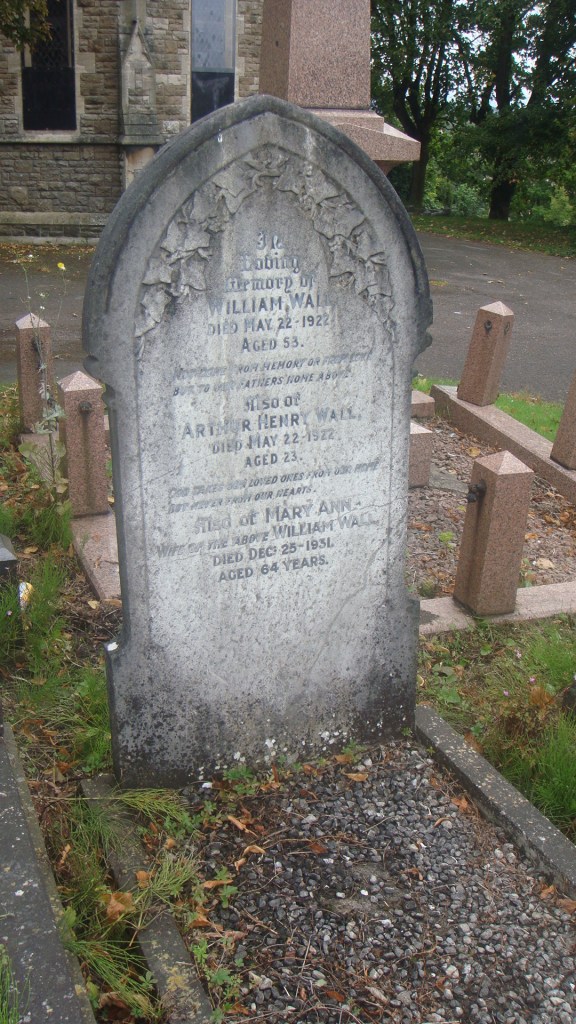
William and Arthur Henry Wall – died on the same day

The newspaper article provides a pretty comprehensive account of William’s service. His military records reveal that he enlisted in the 4th Wilts on September 14, 1914 aged 46 and served at home until January 2, 1916. On January 3, 1916, having transferred to the 22nd Wessex & Welsh Btn the Rifle Brigade, he was sent to the Western Front where he served for 325 days. On November 24, 1916, he was posted to Salonika where he served for 1 year and 215 days before being posted home on June 27, 1918, having previously transferred to the Royal Engineers.

William was discharged on August 10, 1918 as being no longer physically fit for War Service. He was 49 years and 11 months old and suffering from valvular disease of the heart (VDH).

He was awarded a weekly pension of 27 shillings for four weeks after which it dropped to just over 13 shillings, to be renewed after 48 weeks.

William had previously worked for more than twenty years as a Rivetter’s Holder Up in the GWR Works, a physically demanding job that he was now no longer strong enough to do.

William died on May 22, 1922 just hours before his son Arthur also died.

When Arthur Henry Wall enlisted at the Devizes recruitment office he stated that he was 19 years old and worked as a boilermaker. In fact he was only 16 years old and two years below the minimum age for enlistment.

He served a period of 140 days from January 12, 1915 to May 31, 1915 at home but on June 1, 1916 was posted to France, aged 17. However, on July 10 Arthur’s true age was detected and he was sent back to England as ‘underage and physically unfit for service.’

He spent the next year posted in England but on June 28, 1916 he returned to France and served more than 300 days. By now serving with the Bedfordshires, Arthur was gassed on May 12, 1918 and ten days later returned to England.

On November 23, 1918, he was discharged suffering from Defective Vision, Dyspnoea (a symptom of aortic insufficiency) and headache.

He was awarded a pension of 11 shillings a week from November 24, 1918 to be reviewed in 26 weeks’ time. In 1920, by now a married man, Arthur wrote to the Record Officer of the Bedfordshire Regiment asking if he could apply for further money under the Army Order 325/19 but was informed that only soldiers serving from the date of the pay increase on September 13, 1919 were entitled.

Like his father, Arthur also died of heart disease, a direct result of his military service.

United in Death

Father and Son Buried at the Same Time

The burial of a father and a son who died on the same day took place at Radnor Street Cemetery, Swindon. The deceased were Mr William Wall, 35 Linslade Street, Swindon, and his son, Mr Arthur Henry Wall, 36 Jennings Street. Both had served in the war, and their death was directly attributable to the hardships endured on active service. The father, who was 53 years of age, served in the Army for 12 years, and during the war he was in Egypt, Greece, Serbia and Italy – first with the Wilts Regiment then the Rifle Brigade and was later attached to the Royal Engineers. In August, 1918 he was discharged as unfit for further service. His death occurred on May 22nd, just a few hours before his son passed away.

The latter was 23 years of age. When only 16 he joined the Wilts Regiment, and was later transferred to the Bedfords, and then to the 1st Herts. He saw service in France and Belgium, and was badly gassed in May, 1918. In November of the same year he was discharged.

It is a pathetic fact that although he did not know his father was so ill he had a sort of premonition that they would die at the same time, and expressed a wish that they might be buried together.

Wiltshire Times and Trowbridge Advertiser June 17, 1922.

Father and son were buried in plot E8206 where Mary Ann, William’s wife and Arthur’s mother, joined them following her death in 1931.

If you are wondering why they do not have a Commonwealth War Graves Commission headstone it is because their deaths occurred after August 31, 1921 the date on which the First World War officially ended.

First published on October 9, 2021.

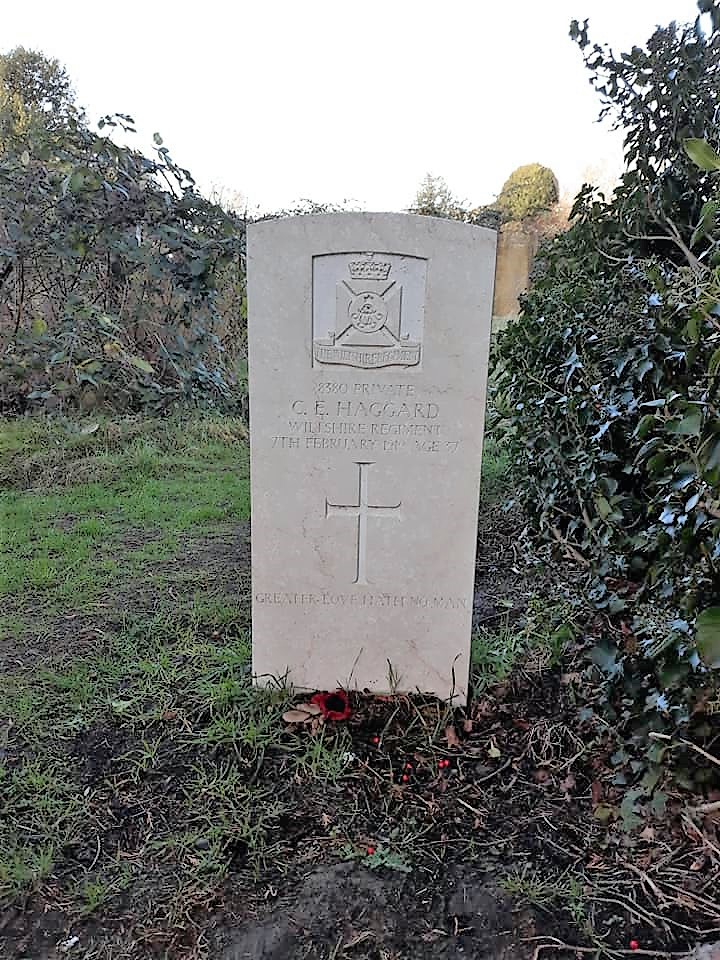
Charles Haggard – Prisoner of War

Charles Haggard - Copy

The re-imagined story…

‘He woke up gently, sliding smoothly into a new day.  It wasn’t usually like this.  Sometimes he woke up with a jolt, ready to jump out of bed, as if he could.  Sometimes he suddenly found himself awake, his heart beating rapidly, his breath coming in gasps.  Sometimes he just lay there, eyes open, awake, absent.  But today felt different.  Today he turned over in bed and snuggled down beneath the blankets.

The bedroom was cold.  He’d known colder.  He’d known bone aching cold when every joint was immobilised, every muscle mortified.  But he liked this cold.  It reminded him of childhood.  Ice on the inside of the window; a house full of noise, children getting ready for school, his father already at work.

“Charlie are you up yet?” he was always the last one, reluctant to leave his bed.

Today his mother tapped softly on the bedroom door; checking if he was awake, checking if he was alive.  He understood her dilemma.  Should she wake him or should she let him sleep on?

“Morning Ma,” he called.

The door opened.

“Cuppa tea boy.”

Nearly 37 years old but he would always be her boy.  When he was a child he had to share her, but now she was his alone; making up for lost time.

His father hadn’t recognised him when he opened the door of 60 Stafford Street.  Four years as a prisoner of war had altered him immeasurably.  But as the cold January air swept around him and into the house she knew it was her boy returned.  She had never given up hope.

Today he felt a little better, a little stronger.  Today he would take a slow walk into town.  He would call in at the Town Hall and sign the register of returning soldiers.  He hoped Miss Handley might be there.  He would so like to see her, say thank you for the food parcels that had kept the prisoners of war alive’.

The facts …

Charles Haggard was born April 30, 1882 at the Old Red Lion Inn in Minety where his father Samuel was the innkeeper.  His parents were in their early 20s and already had four children, George, Alice, Kate and Thomas.

By 1901 the family had moved to 60 Stafford Street, Swindon and on the census returns for that year 18-year-old Charles described himself as a Steam Engine Tender Maker, Fitter & Turner – of course he still had two years left to serve of his apprenticeship.

By 1911 he had left a life ‘inside’ (which is how everyone referred to working in the railway factory) and joined the army where he served as a Private in the 1st Wiltshire Regiment.  Charles was taken prisoner on October 24, 1914 at the Battle of Mons and was held prisoner at Krossen-on-Order for the duration of the war.

On February 7, 1919 Charles spent the day in Shrivenham visiting friends. He arrived back in Swindon sometime between 9 and 10 pm where he met his father in Manchester Road.

At the inquest Charles’s father said his son seemed very cheerful as they began the walk home to Stafford Street.

When they reached Deacon Street Charles called out “Wait a minute, dad,” and went to catch hold of the palisading, but fell backwards. His father knew he was dead.

Mr A.L.  Forrester, Coroner for North Wilts, held an inquest at St Saviour’s Schools, Ashford Road, Swindon where Dr Beatty testified that he had made a post mortem examination of the body and found athroma of the valves of the heart.  The cause of death was aortic disease of the heart, a condition worsened by starvation and exposure during his time as a prisoner of war.  Charles had been home less than three weeks.

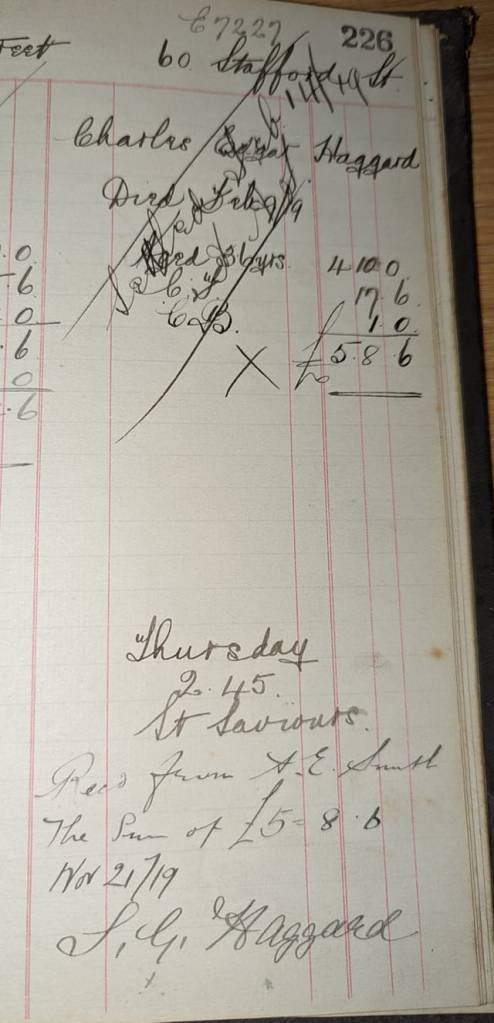
He is buried in plot E7227 with his brothers George and Thomas.

Image of funeral account provided by A.E. Smith & Son, Funeral Directors

Cyril Gordon Webb – Tell Them of Us

How terrifying must it have been to be the parents of five adult sons on the eve of war in 1914?

James George Webb and his wife Bertha lived a comfortable life at 117 Bath Road where in 1911 they stated on the census returns that they had been married for 25 years. They answered the questions– how many children born alive 5; children still living 5; children who have died nil. Not every family in this period was so fortunate.

Four of James and Bertha’s sons still lived at home with them in 1911. Their eldest son Vere was employed as a draughtsman in the Loco, Carr & Wagon Dept at the Wolverhampton railway works.

Then in 1914 second son Algernon Ewart Webb enlisted in the Army Service Corps, eight months before the outbreak of war. However, his military service was brief as he was found to be medically unfit when mobilization took place on August 6, 1914.

How relieved his parents must have been to welcome him home. Algernon and three of his brothers went on to live long lives. It would be their youngest son Cyril Gordon Webb who went away to war. 

A former student at the North Wilts Technical College in Victoria Road, Cyril is remembered on the college’s stained-glass window war memorial. The window, restored and renovated by stained glass window craftsman Richard Thorne, was moved to Swindon College at the North Star campus in 2010.

Pte C.G. Webb of the 52nd Battalion Bedfordshire Regiment died on June 7, 1918 at his home 37 Okus Road. His cause of death was Pulmonary Tuberculosis contracted during his military service.

Cyril’s father James died in October that same year, a few months after his son. Bertha died in 1934. They are both buried with their boy in Plot D402.

#TellThemofUs

#MarkSutton

Tell Them of Us – Pte. R.A. Cook – promoted for gallantry

Continuing a series remembering Swindon’s sons who served in the First and Second World Wars.

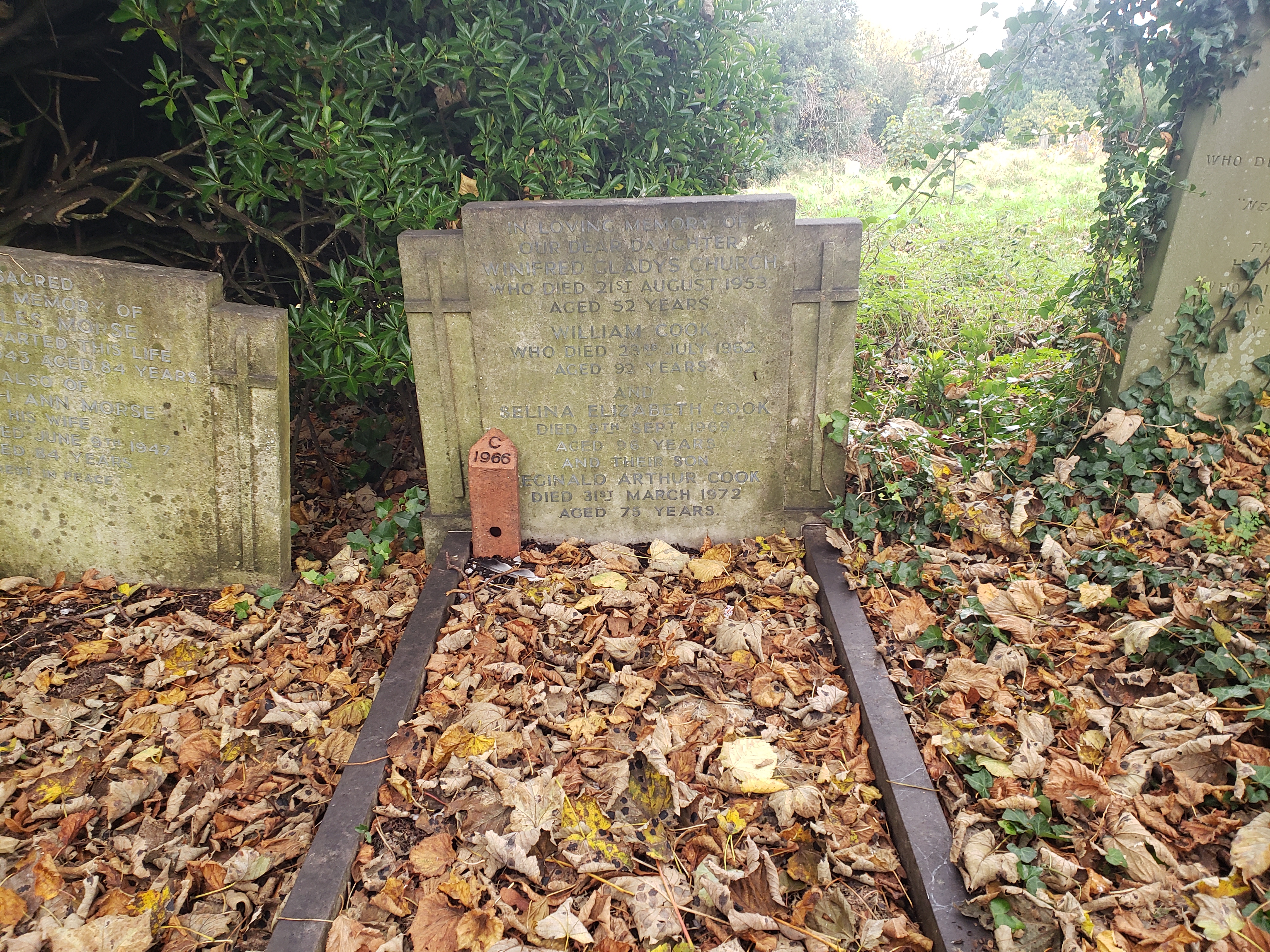
Reginald Arthur Cook was born in Swindon on September 8, 1896 the son of William and Selina Cook. Reginald entered the employment of the GWR shortly after his 14th birthday and stayed with the company until his retirement. His only absence was during the First World War when he served on the Western Front and was promoted for an act of gallantry.

Swindon Soldier Promoted for Gallantry

Pte. R.A. Cook, the only son of Mr. W. Cook, Cemetery Superintendent, Radnor Street, Swindon, has been promoted to the rank of lance-corporal for gallant conduct.

Major-General H.D.E. Parsons, Director of Ordnance Services, British Armies in France, has written to Pte. Cook, dated October 19th, as follows: “Your name has been brought to my notice by your Commanding Officer for ‘gallant conduct in snatching an enemy stick-grenade, that had become ignited, from another man, and throwing it into a shell hole some ten yards away, thus saving the man’s life at grave risk of your own. The report reflects credit on yourself and the Army Ordnance Corps.”

Lce. Copl. Cook is 21 years of age, and is a native of Swindon. On leaving school he entered the GWR Works as a clerk. He joined the Army on October 6th, 1915, and proceeded to Woolwich for training, but after being there three weeks he was transferred to France, where he has been ever since. He is now home on leave, and will return to France on December 21st.

North Wilts Herald, Friday, December 14, 1917.

Reginald returned home to Swindon at the end of the war and lived with his parents at 63 Kent Road where he died on March 31, 1972. Reginald never married and was buried with his parents and his only sister Winifred Gladys, in the cemetery where his father once worked as Cemetery Superintendent.

Tell Them of Us – Arthur North

Mark Sutton had a life long interest in the Swindon men who served in the Great War, researching, writing and recording their service and sacrifice in his book – Tell Them of Us.

Mark made numerous visits to the battlefield cemeteries in France and Belgium, laying wreaths on the graves of Swindon men on behalf of their families back home. Mark also worked with Swindon’s schools, showing items from his vast military collection. He knew instinctively how to talk to children about a war that was beyond living memory but intrinsic to our town’s history. For many years he conducted guided walks at Radnor Street Cemetery, visiting the Commonwealth War Graves and remembering the men buried there. He was a popular speaker on the Swindon history circuit, his talks selling out immediately they were announced. He was also co-founder of Swindon Heritage, a quarterly history magazine published between 2013 and 2017. Sadly, Mark died in 2022 but his memory and his legacy will live on, in the same way he made the story of Swindon’s sons who served in the Great War endure.

I begin with the story of Arthur North who is mentioned in Mark’s book Tell Them of Us and is told here in the words of Kevin Leakey, local historian researching the history of Queenstown and Broadgreen.

Gorse Hill Memorial rescued by Mark Sutton and displayed in the Radnor Street Cemetery chapel.

Arthur was a younger brother of one of my Great Grandmothers – Kate Leakey.

He was 7 months old and living with his family at 62 Bright St. on the
1891 census, so I would guess he was probably born at that address.

By the 1901 census the North family were living at 69 Cricklade Rd and
by 1911, were at 139 Cricklade Rd, where Arthur’s parents lived until
they passed away.

The 1934 funeral of his Mother, Mary Ann, took place at Trinity
Methodist Church (139 Cricklade Rd being a few doors away from the
church), which I think was the church the WW1 memorial came from.

Arthur emigrated to Australia in 1909 and worked as a farmer, living
with his Uncle Samuel North and his family at a small place called
Batchica near Warracknabeal, Victoria.

He joined the Australian Army in January 1915, and after going to
Gallipoli in Sept. 1915, he seems to have been ill from the end of
October until June 1916, then spending the next 7 months in the UK,
before being sent to France in Feb. 1917.

He was killed on the 3rd May 1917 on first day of the second battle of
Bullecourt. As far as I can tell his body was never recovered.

The Red Cross files give info about his death from other soldiers that
saw him on the day it happened. I don’t suppose it was at all unusual, with the men being in the middle of a battle at the time of his death, but their reports as to his
whereabouts etc. seem to contradict each other.

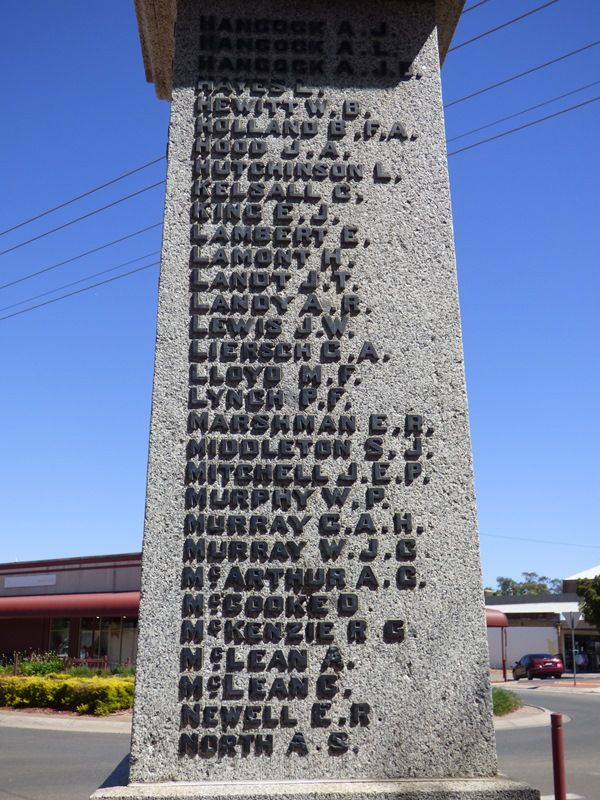
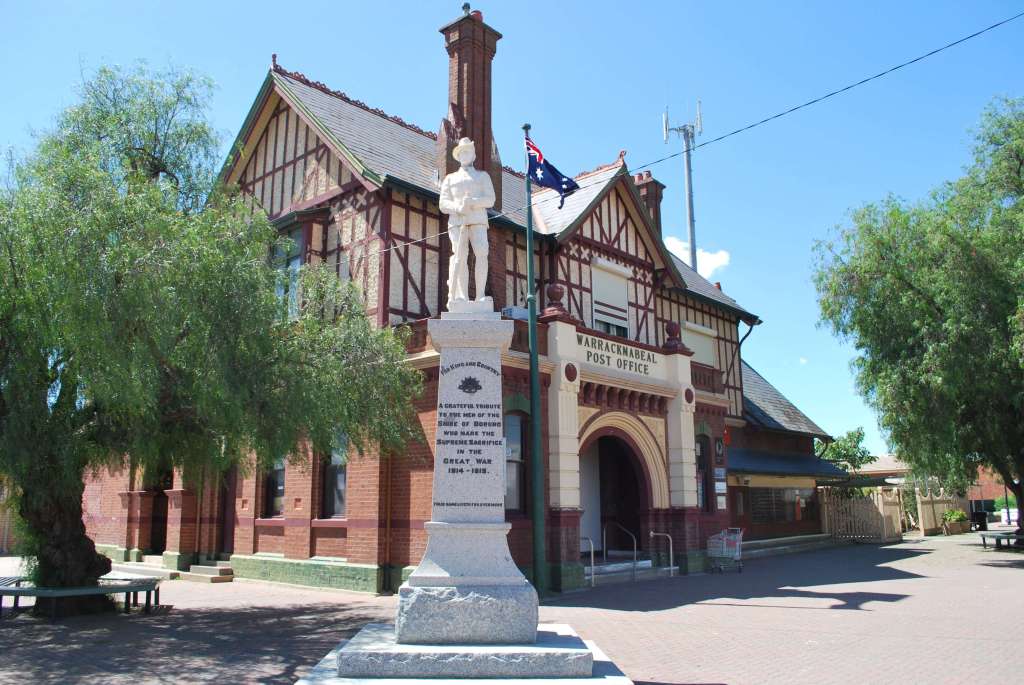
Apart from his name being on the Gorse Hill memorial, it is also on the
Warracknabeal war memorial in Australia.

Sadly, we have no photos of Arthur and aren’t in contact with any of his
brothers and sisters families, but I always put a cross down at the
cenotaph every year in remembrance.

Cross of Sacrifice

The sheer number of bodies left lying on the battlefields of the Great War is today beyond belief and by 1915 the situation was already becoming reprehensible. Burials were frequently made without any planning or organisation with graves marked by a simple wooden cross, sometimes with the name scratched on in pencil.

Major General Fabian Ware, who commanded a mobile ambulance unit during the First World War, quickly recognised that this could not continue. Ware believed that the war dead should all be treated alike with no distinction between wealth and status. The headstones should all be uniform, displaying name, rank and regimental badge with an inscription chosen by the family.

It was Reginald Blomfield who designed the memorial, the Cross of Sacrifice, which is now familiar worldwide. The design was delegated to a team of architects and when disagreements occurred among the team Blomfield had the final say. Blomfield’s design became so popular it was adopted everywhere from battlefield cemeteries to churchyards where there were more than 40 war graves.

Messrs B. Turvey and Sons, of Bath, have been successful in securing contracts for headstones at the British Military Hospital, at Ovillers, France, and also at Swindon. They have also been commissioned to supply the War memorials at Swindon (Radnor Street Cemetery), and at Arnos Vale (RC) Cemetery Bristol. The former will take the form of a Cross of Sacrifice, with a bronze sword* on the face of it, and the latter will be a Screen Wall, with moulded panels bearing the names of the soldiers who were interred in the cemetery.

Bath Chronicle and Weekly Gazette Saturday 22 August 1925

*the sword is now a resin replacement

Join us tomorrow, Sunday November 10, 2024 for a Service of Remembrance. Meet at the Cross of Sacrifice for 2 pm.

Private G.H. Wilkinson – Tell Them of Us

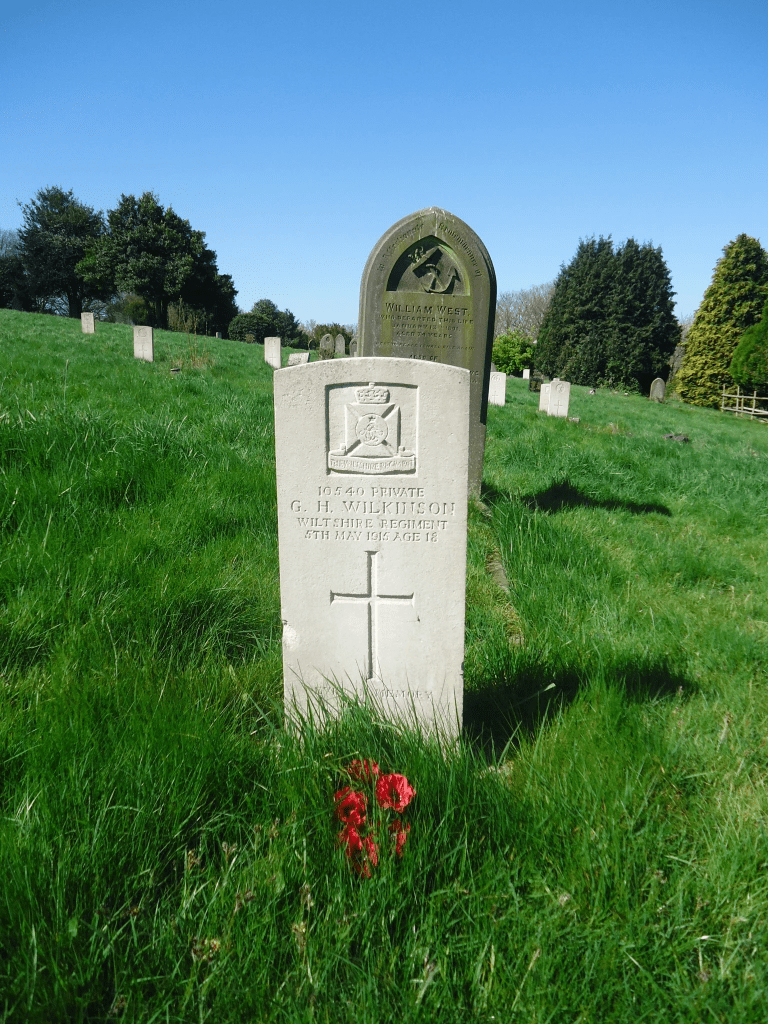
In the Spring of 1915, a new disease was observed on the battlefield. It would cause 35,000 British casualties and many hundreds of deaths. Symptoms included breathlessness (leading to bronchitis), a swelling of the face or legs, high blood pressure, headache and sore throat along with albuminuria (abnormal levels of the protein albumin in the urine). When the disease was first observed in 1915 doctors were at a loss as to know the cause. It was first thought it was caused by infection, exposure and diet (including poisons) although it was later suggested it may have been caused by hantavirus, a virus carried by rodents. This disease was named trench nephritis* and it killed 18-year-old George Henry Wilkinson on May 5, 1915.

George was born in Milton, Berkshire the second of John and Emma Wilkinson’s large family of ten children. He enlisted with the Duke of Edinburgh’s (Wiltshire) Regiment in Swindon where his mother had grown up and where his grandfather worked in the GWR Works.

George died on May 5, 1915 in the Weymouth Sydney Hall Hospital. He was buried in Radnor Street Cemetery on May 11 in grave plot B1599, a public grave. The burial registers record that his last address was 28 Butterworth Street. The Commonwealth War Graves Headstone includes an inscription chosen by his grieving father – Ever in Memory.

His mother Emma had died the previous year and was buried in another public grave, number B1559, close to where her son would eventually lie.

*nephritis – inflammation of the kidneys

Image of funeral account kindly supplied by A.E. Smith & Son, Funeral Directors.

Private John James Kendall – Tell Them of Us

John James Kendall was born in Bromsgrove in about 1884, the son of John Kendall, a nail maker, and his wife Ellen.

He married Agnes Winifred Jasper in the December quarter of 1906. At the time of the 1911 census they were living at 61 Hillfield Road, Sparkhill, Birmingham. They had been married for four years and during that time three children had been born, however, sadly two had died. John’s brother Bertie lodged with the couple and he and John both worked as ‘bread deliverer’s.’

Again the loss of military records hide the full story of the tragic death of John James Kendall. What action had he already seen, if any? Was it the fear of what lie ahead that caused his mental breakdown, or was it due to the recent seizure he had suffered and a lack of treatment for his epilepsy? Perhaps the death of his two young children years previously had led to undiagnosed depression.

Soldier’s Suicide

Followed Epileptic Fit

“Death from haemorrhage through cutting his throat while insane” was the verdict of a Swindon jury on Wednesday respecting the suicide of John James Kendall (34), a private in the Worcester Regiment, billeted at 24, Winifred Street, and whose wife and children live at Sparkhill, Birmingham.

Mr G.H. Russell was foreman of the jury. Evidence of identification was given by a brother, Lance-Corporal Bertie Walter Kendall, Machine Gun Corps, who had the “wounded” stripe and leaned heavily on a stick. In reply to the Coroner he said there was no strain of insanity in the family.

Frank Arthur Jackson, another private in the same battalion as deceased in the Worcester Regt., said he was billeted at 24, Winifred Street. On Monday Kendall was going on leave, and he went from the house to catch the 4.15 p.m. train. At 9.55 he returned to the house, and surprised to see him, the landlady asked how it was that he had not gone home. He said “I don’t know: I’ve lost my mind. I’ll think in a minute.” He sat down and had supper and asked witness for a cigarette. About a quarter to eleven he went out into the garden. Ten minutes later witness went out to look for him. He called, and at the second call of “Jack, where are you?” he heard a murmur. He went down to the end of the garden and found Kendall lying on the ground, smothered in blood and with a razor by his side.

“No one could get into the yard except through the house?” asked the Coroner.

“Not so far as I know,” replied the witness.

Lieut. Francis William Hartley, RAMC said he was called to the house close on midnight and found Kendall in a precarious condition, with his throat badly cut. First aid had been rendered. He died as the ambulance from the camp hospital arrived at the door. Death was due to the haemorrhage.

“Had you attended the man?” asked the Coroner?

“Yes, frequently,” said the doctor. “He was often complaining of illness – rheumatism, pains in the head, indigestion, and other small ailments. On Saturday, after he had been on light duty, he came to me and said that he felt a lot better and would I put him on full duty. I asked him if he thought he could stand it, and he replied “Yes.”

“There was no symptom of insanity, then?” the Coroner asked.

“Not at the moment,” the doctor replied. “He had an epileptic fit on August 8th, and his brain was affected for some time afterwards.”

You saw him in the fit? – Yes.

The jury returned the verdict, as stated, that the man cut his throat while insane.

North Wilts Herald, Friday, August 24, 1917.

John was buried in a public grave, plot B1883 on August 25, 1917. The interment was conducted by an army chaplain.

Two years after this tragic event Agnes and her two daughters, Hilda May aged 9 and Winifred aged 2, born just months before her father’s death, left Britain for a new life in the USA. On October 8, 1919 they boarded the White Star Liner, the Adriatic and set sail for New York. Agnes died in Monmouth County, New Jersey in 1941.

Nash family – confectioners

The re-imagined story …

I used to love to go shopping. And do you know what my favourite shop was – Nash the confectioners, and not only when I was a child either. Sometimes I would call in when I was a grown up too, a young clerk in the Works, before I married and had children of my own. You don’t see sweet shops like that anymore, you don’t see sweets like that either, jars and jars of handmade confectionery.

It was a sad day when the last of the Nash family shops closed. Perhaps they couldn’t compete with the big manufacturers, the producers of those bags of gummy, plastic tasting sweets that tempt the children at the supermarket checkouts. Soulless places, those supermarkets. My granddaughter offered to take me to Asda Walmart on a shopping trip. Bah – that’s not a shopping trip, that’s a descent into Hades, I told her.

What I would give to take a walk down Regent Street again? Not the Regent Street of today but the old one, when ladies got dressed up to go down town. My first stop would be a wander around McIlroys and then a visit to Nash’s and a quarter of – now what would I choose, aniseed balls or pear drops, or maybe a bag of toffee, although my teeth are probably not up to that now. Happy days.

Regent Street

The facts …

William Nash was born on April 23, 1840 at Badbury the son of William and Jane Nash. His father died two months before William’s birth, leaving Jane to raise four young boys alone until she remarried in 1844. At the time of the 1851 census 11 year old William is living in Badbury with his mother, step-father William Jordan, his two brothers Thomas and George Nash and three half sisters Sarah, Ann and Emma Jordan.

William married at St. Mark’s Church on December 25, 1863. He was 23 and working as a labourer, his bride was 21 year old Elizabeth Hunt. The couple began their married life in London where their first child, Edmund William Nash was born. It seems likely that this is also where William saw the prospects of a career in the confectionery trade. Elizabeth’s brother and sister had both married into the Leach family, headed by Thomas Leach who had a confectionery business in Southwark.

On his return to Swindon William worked as a labourer in the railway works and Elizabeth as a mangler. In 1871 the couple lived at 2 Havelock Street with their growing family – Edmund 5, Clara 4, Thomas E. 2 and 8 month old Elizabeth M. It appears that the Nash couple were both prudent and focused, both working and saving to fulfil their ambition to open their confectionery business.

By the time of the 1881 census William had achieved this ambition. The family lived over their first shop at 32 Bridge Street. By then there were seven children, the youngest 4 month old Lily. Elizabeth’s sister Martha Hunt lived with the family working as an assistant in the shop.

And so the Nash empire expanded with shops at 64 and 65 Regent Street and 17 Regent Street as well as the original premises at 32 Bridge Street. Other family run shops opened at 104 Cricklade Road, 10 Wood Street, 32 Regent Circus and 167 Rodbourne Road, the last of the shops which eventually closed in the 1970s. The Nash family were famous for their award winning ice cream and also their bargain pack of assorted sweets – Penny Big Lots.

Death of Mr W. Nash – Mr W. Nash of Lypeatt House, Goddard Avenue, Swindon, died on October 29th after a long and painful illness. He will be remembered by many, having been formerly in business as a sweet manufacturer. He married a daughter of the late Mr Thomas Hunt, of Broad Town, who was well known in Primitive Methodist circles. He leaves a widow, six daughters and two sons. The funeral took place on Monday November 4th the cortege leaving Goddard Avenue at 3 o’clock for the Primitive Methodist Chapel, Prospect Place. The Rev. H. Pope Officiated at the chapel and also at the Cemetery.

Extracts from the North Wilts Herald, Friday, November 15, 1918.

William and Elizabeth Nash are buried together in plot E7604

Grateful thanks to Katie Brammer for sharing her family history research. Katie has been discovering the graves of her Nash family ancestors with the help of Radnor Street Cemetery volunteer Jon. This is the grave of William and Elizabeth Nash.

WANTED, a respectable GENERAL SERVANT, about 18, able to do plain cooking; sleeping out preferred; good character – Apply, Nash, Confectioner, Bridge Street, Swindon.

The Swindon Advertiser, Friday, September 2, 1904.