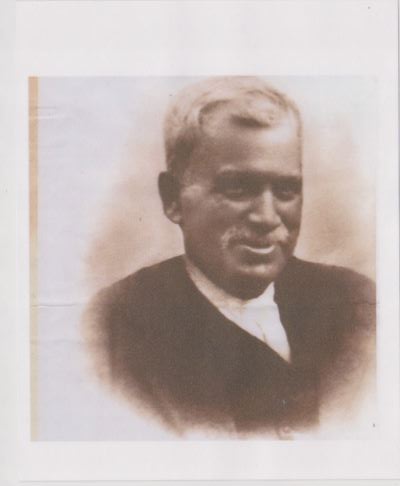
Bob Menham – a larger than life character

“He is active and decides what to do quickly, is a good punter, fists out well, and kicks cleanly and surely. – Sporting Life April 10, 1897.

Measuring 6ft 1ins tall, Bob Menham certainly stood out in a crowd!

Robert William Menham was born in North Shields in 1871, the son of cabinet maker Henry Menham and his wife Annie and grew up in Burley, Leeds. In 1891 he enlisted with the 3rd Battalion Grenadier Guards and in 1894 he married Bessie McKay.

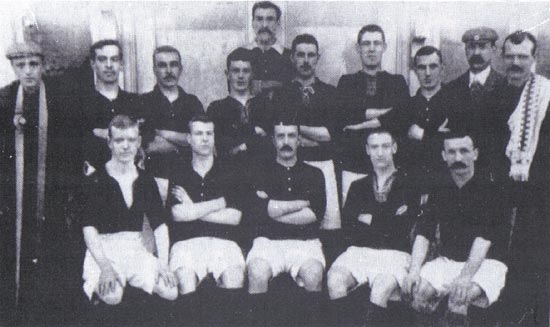
Meanwhile, his football career quickly took off seeing him play for Luton Town, Everton and Wigan County before being transfered to Swindon Town where he is still considered to be one of the most talented goalkeepers the club has ever had. During the 4th round FA Cup replay against Staple Hill FC he even managed to score a goal, electing to take a penalty securing a 6-0 win for the Town.

And when Swindon Town F.C. found itself in dire financial straits in 1901, Bob joined a money saving initiative, which ultimately rescued the club.

Swindon Town F.C.

Players’ Wages Fund Subscription List

The following subscription list showing the amount received up-to-date has been opened on behalf of the Swindon Town F.C. Players, who a short time ago, when the financial condition of the club was in a very critical state, agreed to accept a greatly reduced wage in order that the club might exist, at least, till the end of the present season. As a matter of fact, the wage bill was reduced to practically half the former amount, and it is on that account that the players have been compelled to appeal to the public to assist them in carrying out their resolve. It is hoped that all lovers of sport will respond to the appeal, and all subscriptions and donations will be thankfully received, and duly acknowledged on behalf of the players by Mr R.W. Menham (capt.) Radnor Street, Swindon.

The Evening Swindon Advertiser, Saturday, March 16, 1901.

The Swindon Town FC 1902/3 squad

Bob retired in 1903, taking up a role on the team’s Board of Directors, while the family moved to the Castle Hotel, Prospect where he was licenced victualler for many years and was the president of the Swindon and District Licensed Victuallers Association. He served on the Swindon Town Council from 1907-1920 representing the East Ward.

Old-time Everton followers will regret to hear of the death of Bob Menham former Everton and Swindon goalkeeper, later a director of Swindon, and a well-known licensee there. He is still regarded at Swindon as the best goalkeeper the Wiltshire club ever had. His nephew Gordon, was also associated with Everton about twenty years ago.

The Liverpool Echo, Wednesday, January 31, 1945.

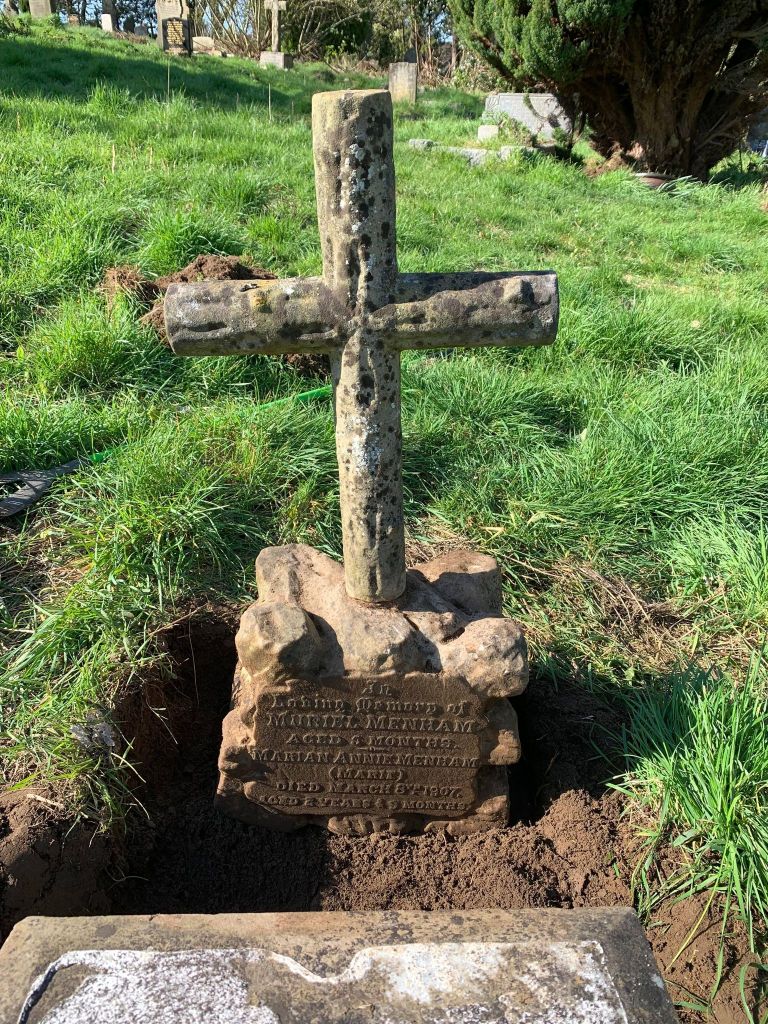
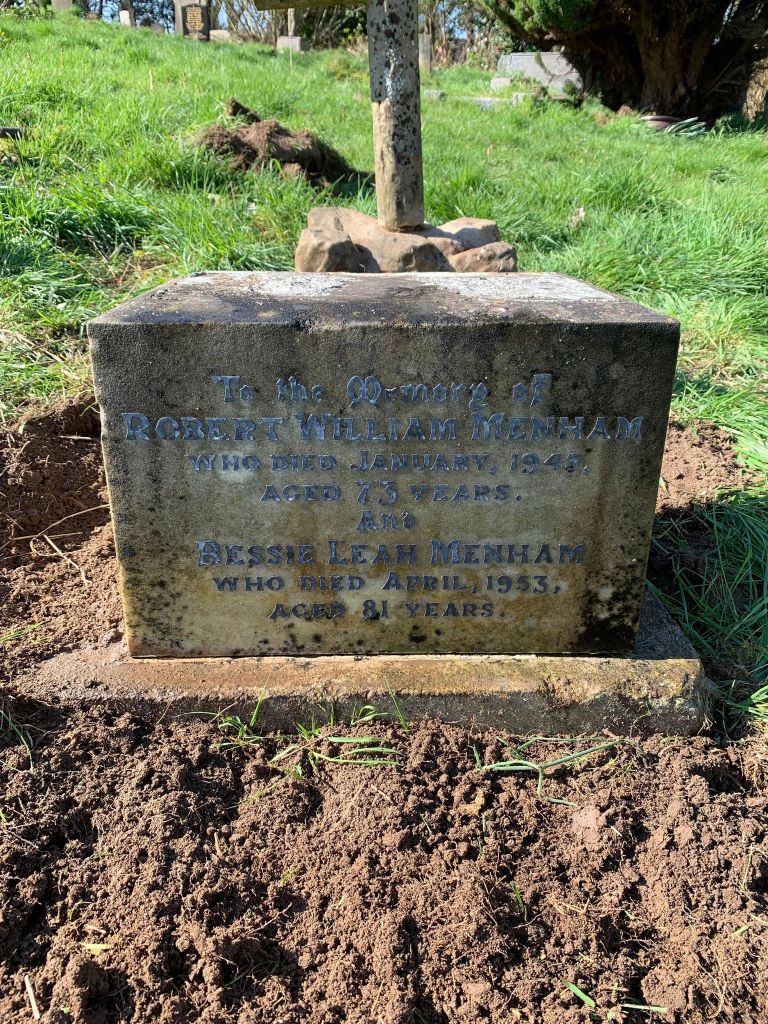
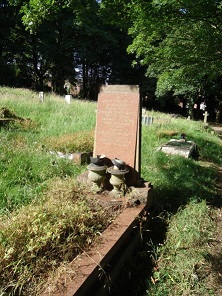
Robert William Menham died at his home, 67 Eastcott Hill, on January 30, 1945 aged 73 years old. His funeral took place on February 1, when he was buried in Radnor Street Cemetery in grave plot C1057 with his two little daughters, Muriel who died in 1900 and Marian Annie who died in 1907. Bessie Leah, his wife, died in April 1953 and is buried in the same plot.

Bob Menham’s memorial cleared and cleaned today by Kevin.

Rev P. Maddocks – Funeral of Swindon’s Oldest Vicar

Philip Maddocks was born in St. Helier, Jersey in 1850, the son of Primitive Methodist minister Philip Maddocks and his wife Lucinda Beck. In fact, Philip junior would begin his own clerical career as a Primitive Methodist minister serving between 1868-1873 on circuits at Chippenham and Stroud (among others) before becoming an Anglican vicar.

In 1880 Philip married Florence Jane Sherrat at St Mary’s, Birkenhead and at the time of the 1881 census he was working as curate at St Peter’s Church, Burnley. He arrived at St Barnabas, Gorse Hill in 1883 and at the time of the 1891 census he is recorded as living at St Barnabas Vicarage, 268 Cricklade Road with his wife Florence and their ten year old daughter Florence Ida Louise. A son, Cyril, was born the following year but died in 1895 aged three years old. A second daughter, Philippa, was born in 1897. Florence died in 1902 and Philip married Blanche McGovern in 1918.

Philip served at St Barnabas’ for 48 years and at his funeral was described as Swindon’s oldest vicar.

Rev. P. Maddocks,

Funeral of Swindon’s Oldest Vicar

The high esteem in which the late Rev. Phillip Maddocks, the first and only Vicar of St. Barnabas’ Church, Gorse Hill, Swindon, who had held the curacy of souls in that parish from its formation in 1890 – he was curate from 1883 – was held, was shown by the large congregation at the funeral, which took place on Saturday morning.

A crowded congregation attended at St. Barnabas’ Church at 10 a.m., when there was Requiem Mass. The celebrant was Canon A.G.G. Ross (vicar of St. Mark’s) and the Bishop of Malmesbury also took part in the service. Canon Ross also officiated at the graveside in the Radnor street cemetery.

Choral Service

The choir were in attendance, and special hymns were sung, Mr. J. Padgett presiding at the organ.

The Young Men’s Guild, of which the Rev. P. Maddocks was president, was largely represented.

The funeral arrangements were carried out by Mr. A.E. Smith, of Gordon road.

Extracts from the North Wilts Herald, Friday, March 20, 1931

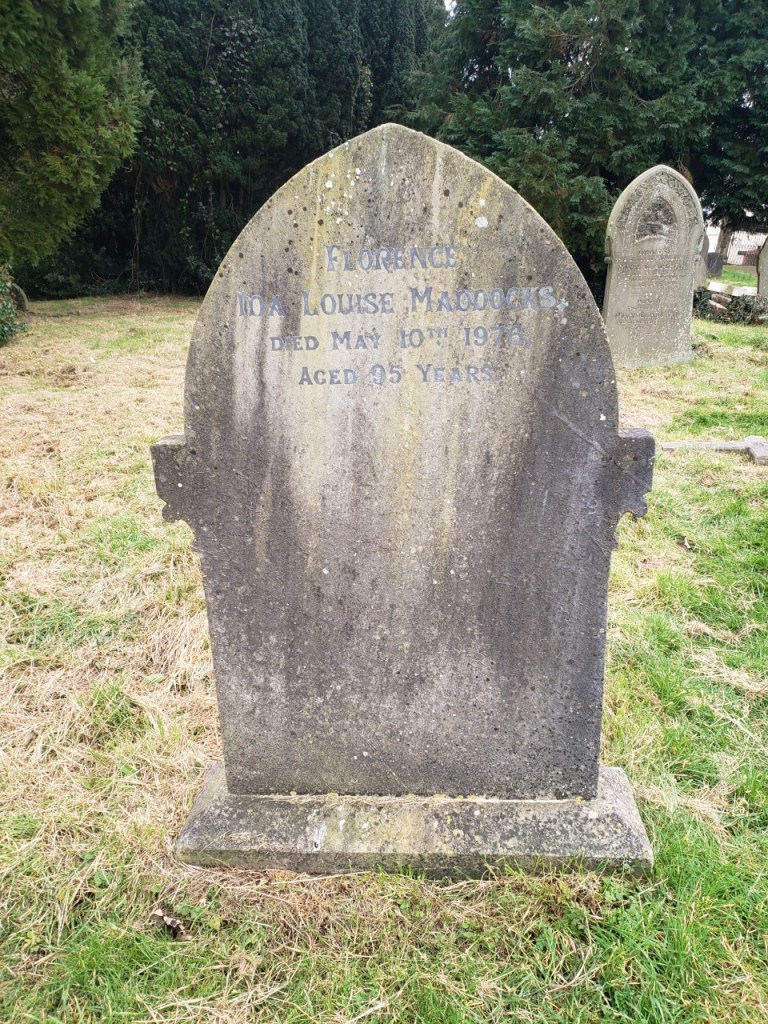
Rev Philip Maddocks two daughters both died in Roundway Psychiatric Hospital in Devizes. Florence Ida Louise was first admitted for a short stay in April-September 1912. She died there in 1976 aged 95. Younger daughter Philippa died in Roundway Hospital in 1926 aged 29. Both women are remembered on the headstone.

Philip was buried in Radnor Street Cemetery in a double grave plot A882/3 with his first wife Florence, their two daughters and their young son.

You may also like to read:

Florence Jane Maddocks – Vicar’s Wife

Charles and Millicent Blackford of Poulton Street, Gorse Hill

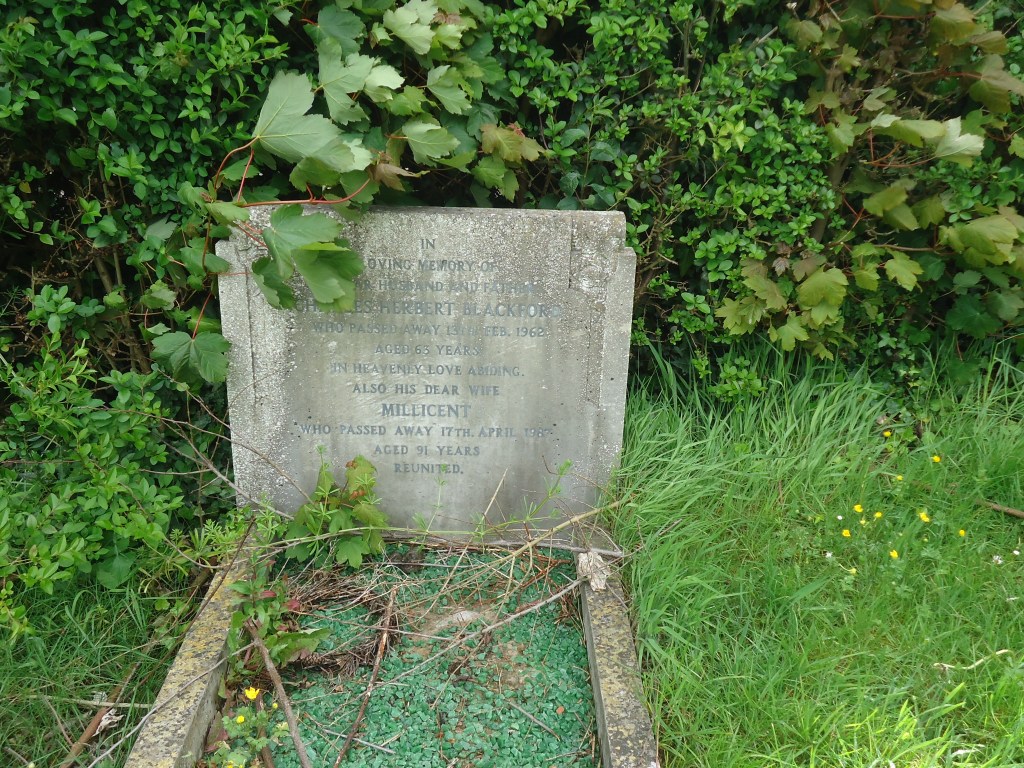
This is the last resting place of Charles and Millicent Blackford.

Charles Herbert Blackford was born on August 8, 1898 in Malmesbury, one of wheelwright and carpenter Daniel Blackford, and his wife Kate’s four children. Millicent was born in Polperro, Cornwall on January 5, 1897, the daughter of fisherman Richard Libby and his wife Ellen.

Charles enlisted with the Royal Naval Reserve in 1916 and served for three years during the First World War. Upon demobilisation Charles joined the GWR. Using the UK Railway Employment Records it is possible to follow Charles’ career on the railways.

He began work as an engine cleaner in January 1919 before quickly becoming a fireman. An entry dated December 14 1920 records that he was making the fire upon engine 3412 when his hand was pinned against a piece of coal. Top of middle finger on his right hand was crushed.

By 1939 Charles was working as a temporary Acting Driver at Didcot, after which he worked as a driver in Swindon. During the Second World War he was working as a temporary Relief Supervisor.

Charles married Millicent Libby in the June quarter of 1923 and the couple had two children, Vilonia and Royston. Vilonia died in infancy. Royston followed his father into the railway works as a coach finisher. Charles and Millicent lived at 23 Poulton Street, Gorse Hill until the time of Charles’ death in 1962. (Millicent may have remained at that address after his death.)

Charles died in February 1962. Millicent survived him by 25 years. She died in 1987 at the age of 91. They are buried together in grave plot C3351-0. This area of the cemetery has experienced some renumbering of the plots, but Charles and Millicent’s grave has an elegant headstone and is easy to find.

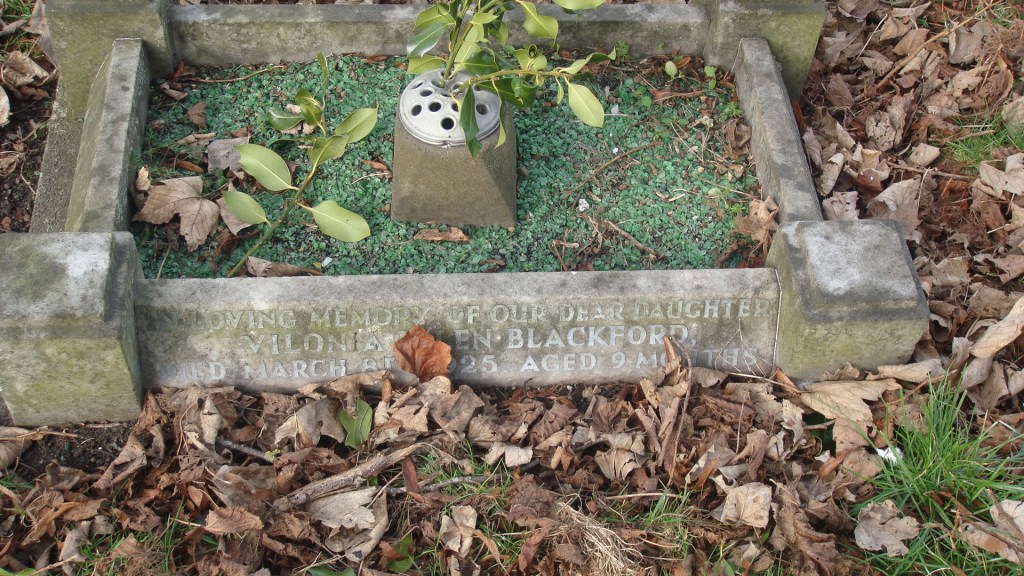
The burial of infants depended very much on the parent’s financial situation.  In the past some babies were buried in a family plot, their names added to the memorial at a later date. Others were placed in a communal grave with other babies. Vilonia is buried in this beautiful little grave, close to the path leading to the cemetery chapel.

Florence May Vivash – school teacher

The Swindon School Board formed in response to a growing demand for school places in the rapidly expanding towns of New and Old Swindon. In 1881 the Board began an impressive programme of school building. By 1892 11 schools with 26 departments were up and running with 2 more due to open at Westcott and Gorse Hill increasing the available accommodation to 6,500 children.

In 1894 Swindon Schools were all graded “excellent.” A report delivered by H.M. Inspector on the examinations of Board Schools for 1895 stated that “Queenstown – The infants are in very good order. They have been taught with great care throughout the year, and have made excellent progress.” At Even Swindon School, where extensive building work had taken place throughout the year, the report stated that teaching had been “carried on with considerable difficulty. But the teachers have worked very hard, and, under the circumstances, the infants may be considered to have made excellent progress.”

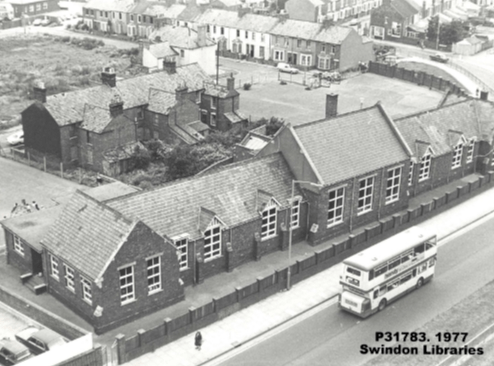
Photo of Queenstown School taken in 1977 and published courtesy of Local Studies, Swindon Central Library

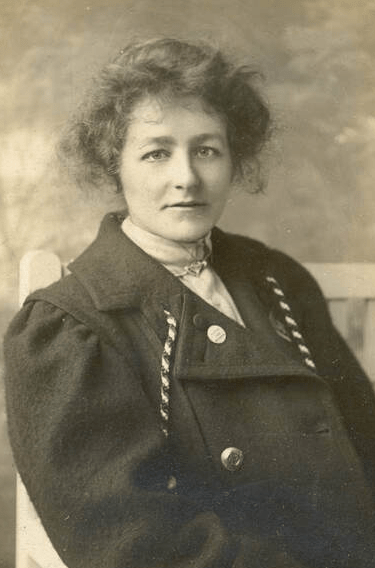
By 1897 there were more than 100 pupil teachers in Swindon Schools, a traditional route into teaching for bright children. Swindon Suffragette Edith New began her teaching career as a 14-year-old. This story is about Florence May Vivash, but there is a serendipitous connection to Swindon’s suffragette.

Florence May Vivash was the daughter of Jacob and Alethea Vivash. She was baptised at St. Mark’s Church on January 7, 1883. By 1891 the family were living at 9 Park Lane – Jacob, Alethea and their three children along with Alethea’s mother, Sarah Ann Bunce.

Florence began her teaching career as a pupil teacher at Even Swindon School. (The original building in Rodbourne was demolished in 2013. A new school with that name opened in 2007). In 1897 Florence passed an exam for Elementary School Teachers at the Swindon & North Wilts Technical School in Geometrical Drawing (Art). She later moved to Queenstown Infant School where she remained until her death in 1909.

Edith New was Assistant mistress at Queenstown Infant School from 1899-1901. Did their paths cross? Edith left Swindon for London in 1901 to teach in the deprived areas of Deptford and Lewisham. She resigned from teaching in 1908 to join the Women’s Social and Political Union and the campaign for Votes for Women. She returned to teaching in 1911, eventually retiring to Polperro, Cornwall where she died in 1951.

I’d like to think that Edith’s work and her involvement in the suffrage campaign were known to Florence. Sadly, Florence was unable to achieve her full potential. She died in 1909 as Edith was about to earn a place in history.

A Young Lady’s Death. – After a brief illness of a month Miss Florence May Vivash, of 9 Park Lane, Swindon, passed peacefully away in the early hours of Tuesday morning at the age of 26 years. The deceased was for some time a pupil teacher at Even Swindon School, and afterwards received two years’ training at the Home and Colonial College. She then became a teacher at Queenstown Schools, where she had been engaged for nearly six years. The funeral took place to-day.

Swindon Advertiser, Friday, May 28, 1909.

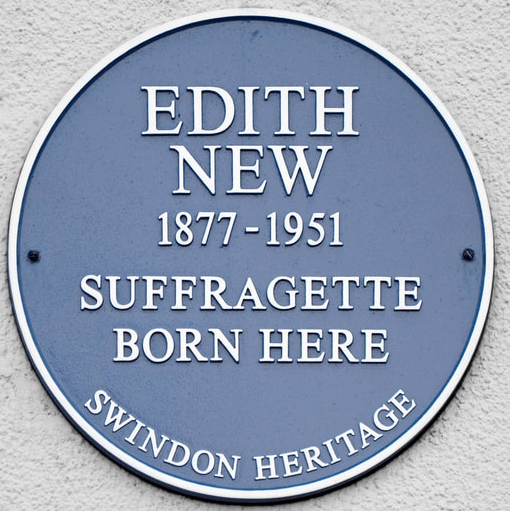
Swindon Heritage Blue Plaque installed at Edith New’s birthplace, 24 North Street, Swindon.

Florence May Vivash, School Teacher, 26 years, was buried on May 28, 1909 in grave plot C1326. She is buried with her grandmother, Sarah Ann Bunce, who died in 1903, her mother, Alethea who died in 1913 and her father Jacob who died in 1917. A baby sister Alice, who died in April 1881 aged 8 months old, is buried in the churchyard at St. Mark’s.

Gabriel Morrell – well known licensed victualler

New Year’s Eve 1915 and a ferocious fire swept through an out building in Eastcott Hill. A local businessman, Gabriel Morrell lost his life. Neighbours and six police officers fought the blaze, passing buckets of water hand to hand. Despite numerous calls to the Fire Station in Cromwell Street, no help arrived. The newspaper account stated that “the system of fire calls in the borough appears to be antiquated.”

Eastcott Hill

Tragedy

Swindon Tradesman Burnt to Death

A Mass of Fire

Fire Brigade Hear Nothing of Calls

New Year’s Eve in Swindon was marked by a shocking tragedy in which a well-known licensed victualler lost his life, and in connection with which the public will demand an enquiry into the system of Fire Brigade calls in vogue in the borough.

The victim of the tragedy was Gabriel Morrell, living in Eastcott Hill, where he had carried on a grocery and off-licensed business for four and twenty years. At half-past ten on Friday night the police were informed that Mr Morrell’s premises were on fire whereupon P.S. Molden, with P.C.’s Harris, Cowley, Mitchell and Stoper, at once hurried to the scene, where they were quickly joined by other members of the force. They were taken to the back of the premises, where they found a shed, used for storing lumber, on fire. The seat of the outbreak was evidently inside the building, and P.C. Harris proceeded to force open the door. The moment he succeeded a huge mass of flames burst forth, forcing him and the other officers standing near to retire for some distance. The policemen, setting to work with a will, seized buckets and such other vessels as they could lay hands upon, and began to dash the water they found in the soft water butts upon the flames. When that supply was exhausted they turned to the slower method of filling the pails from the taps on the premises and in the adjoining houses,  work in which, under the guidance of Supt. Moore, who had now arrived, they were energetically assisted by a number of civilians.

A Shocking Discovery

Nearly half an hour passed by before they got the fire under control, and could venture into the shed. Then a shocking sight met their eyes. On the ground in the middle of the structure was a huddled up mass, which in spite of the dreadful manner in which it had been charred, was recognised as that of a human body. At once it was concluded that it was that of Mr. Morrell, who during this period of excitement not been seen, and further enquiries and search elicited the fact that he was nowhere to be found. A closer scrutiny showed that all the clothing had been burnt from the body except a belt which went round the waist. The body was lying on its back with the knees and arms tucked up over the trunk. The remains were carefully lifted on to sheets and blankets and removed by the police to the mortuary.

Calls for the Fire Brigade fail

In the meantime calls were made from the fire signal posts to the Fire Brigade, who, however, never arrived, but even if the Brigade had come upon the scene they would have been too late to save Mr. Morrell’s life, as there is little doubt that he was in a dead or dying condition at the time the police broke open the door of the burning shed.

After the removal of the body the shed, which was built of wood and had a slated roof, continued to burn until its existence became a source of danger. The remaining supports were then pushed away, and it collapsed. The building was 12ft long by 9ft wide, and 7ft or 7ft high at the eaves. It was not used for storing any of Mr Morrell’s stock-in-trade, but was employed for the storage of empty boxes, old newspapers, account books and rough lumber.

The Deceased Missing

It seems that at ten minutes past ten Mr Morrell took a candlestick to go out, as the family thought, to the lavatory – and thinking that his wife and two daughters, who were the only other occupants of the house, were going to bed, he wished them “Good night.” To this Miss Morrell replied. “We are not going to bed yet, dad; we are going to watch the old year out.” While Mr Morrell was out they had a light supper, after which they went upstairs to prepare for bed while witing for the passing of the old year. They noticed a slight odour of burning, but it was not until Miss Frances Morrell drew up the blind and saw smoke issuing from the shed that they were aware that anything was amiss. Mrs Morrell then called her husband, but got no answer. She and her daughters thereupon rushed out of the house seeking help, which promptly arrived. Some neighbours went to alarm the Fire Brigade, while others fetched the police.

Failing Health

The deceased, who was 57 years of age and a native of Chippenham, before coming to Swindon 25 or 26 years ago, was canteen steward to the Wiltshire Regiment, in which he enlisted many years ago at Swindon Fair. Having decided to settle in Swindon he went to work at the factory until he was able to secure a business suited to his taste. After a time he secured the license of the Railway Hotel; but he and Mrs Morrell did not care for the business and three months later removed to Eastcott Hill. Until recent years the deceased enjoyed good health, but latterly had complained of feeling unwell, and of pains in the region of the heart, telling his daughter on one occasion that no-one knew what he had suffered. He refused to see a doctor, saying that he could best doctor himself.

In addition to the widow and daughters living at home, there are two sons, both of whom are married and reside in distant towns.

The Brigade’s failure explained

With regard to the failure of the Fire Brigade to respond to the calls made by P.S. Pickard and others, our representative had an interview with Chief Officer J.N. Jefferies today. He said that he heard nothing of the matter until he reached the Town Hall this morning, and until he had made further enquiries could say nothing definite on the subject.

Other enquiries, however, have elicited the fact that the electrical call arrangements are in a condition far from satisfactory. Although calls were made from several stations the only one which proved to be in working order was that in Cromwell Street, which commenced to ring at 11 o’clock. The horse was got into the hose cart at the Fire Station and was ready to start, when an intimation was received that the fire was under control.

It is said that in process of time some of the wires of the alarm posts have become unreliable and that the recent storms have damaged overhead lines. The system of fire calls in use in the borough appears to be antiquated, and, judging by last night’s experience, and that of a previous occasion, when two motor-cars were destroyed, is unreliable and should give place to a better one.

Civilian Helpers

Amongst those who rendered valuable assistance were Mr. Walter Gregory, 7, Stafford Street, Mr Bernard Woodbridge, 129, Stafford Street, Mr William Gillett, 17 Dowling Street, Mr Johnson of the George Hotel, Eastcott Hill, Mr F.W. Trineman, greengrocer, Eastcott Hill, Mr William Rich, 10, Eastcott Hill, Mr Frederick Eagleton, 16 Eastcott Hill, Mr George Smith 42 Pembroke Street, and Mr Porter, hairdresser, Swindon Road.

Funeral of Mr Morrell

The remains of Mr Gabriel Morrell of Eastcott Hill, Swindon, who was burned to death in a shed on New Year’s Eve (as reported on page 2), were quietly laid to rest in Swindon Cemetery on Wednesday afternoon. The mourners – Mr Gabriel Morrell, Mr B.G. Morrell, Miss Morrell and Miss Frances Morrell (sons and daughters) Mr T.C. Boxall, Mr W. Boxall and Mr H.W. Coale (representing the Lamb Brewery, Ltd) – left the house at half past two, and met the hearse, which conveyed the coffin from the Mortuary to St. Saviour’s Church, where the service was conducted by the Rev. J.H. Kemmis, who also read the committal sentences at the graveside. Flowers were sent by the widow, the sons and daughters, Mr. and Mrs J. Franklin and family (Chippenham), Mr and Mrs A. Seale and family (London), Mr and Mrs Winchcombe and family, Mr T.C. Boxall and family, Mr J. Hill and family, Miss May Fowler, Mrs Smith and Miss Dolly Smith.

Since the sad occurrence it has become known that, at the time of his death, Mr. Morrell was wearing a coat in the pockets of which he carried recently-issued Treasury notes representing a considerable amount. These were, of course, completely destroyed, and it unfortunately happens that Mr. Morrell kept no record of them.

In November 1911, Mr and Mrs Morrell’s house was burglarously entered, and money and a quantity of goods stolen. It was after this that Mr Morrell, who had eccentric ideas concerning the banking of money, procured a revolver for self protection.

We understand that the question of the failure to get into communication with the Fire Brigade is being investigated and that a report will be presented to the Town Council in due course.

North Wilts Herald, Friday, January 7, 1916.

The Fire Brigade pictured outside the Cromwell Street Fire Station in about 1910. Published courtesy of P.A. Williams and Local Studies, Swindon Central Library.

Gabriel Morrell, aged 57, was buried in grave plot E7596 on January 1916. Frances, his daughter, married Percy William Martin later that same year. Percy died aged 25 and was buried with Gabriel on November 5, 1918.

George Eatwell – Primitive Methodist

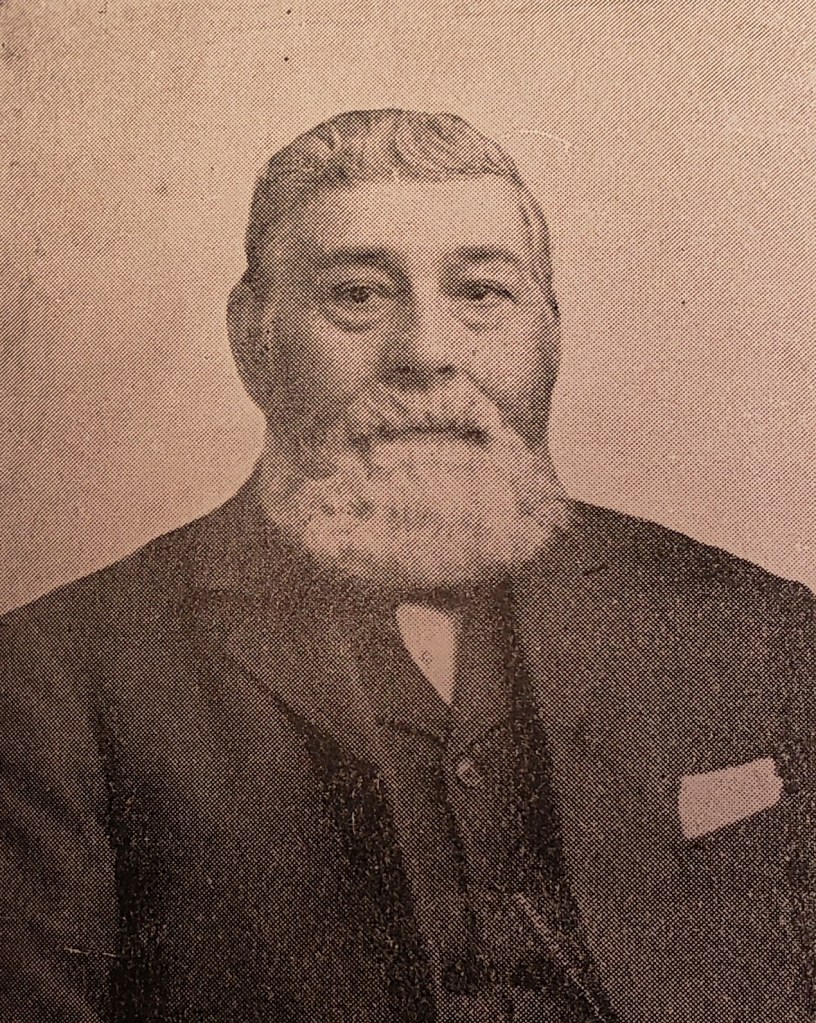
George Eatwell was born in Winterbourne Bassett in about 1841, the fifth son of William Eatwell and his wife Mary. He was the youngest of the brothers actively involved with the Primitive Methodist Church. He first appears in Swindon on the 1861 census lodging with the Pressey family in Old Town and working as an agricultural labourer. In 1863 he married Fanny Vivash.

George had a number of occupations during his working life. In 1869 he was working as a Tea Dealer and in 1871 he ran a boarding house at 5 Station Road where a whole clutch of Vivash relatives were staying on census night. In 1881 he was the proprietor of the Temperance Hotel at 2 Station Road where he lived with Fanny and their six children plus a servant and three boarders. By 1891 he was living at 32 Gloster [Gloucester] Street and still running his cab business.

Cab Stand. – Application was received from George Eatwell, of Station-road, for permission to stand a cab near the large lamp in front of the GWR Station. It appeared that one side of the lamp is railway property, and the other public. On this latter permission is already given to one cab proprietor, and it was decided to give the same to the present applicant.

The Swindon Advertiser, Saturday, October 3 1885.

But throughout it all ran his faith and his work within the Primitive Methodist Church.

George was appointed along with Rev. T. Powell to secure a room in Clifton Street for Sunday afternoon meetings. In 1880 cottage services took place in the home of J. Deacon and later in Horatio Westmacott’s house. There were also open air meetings. In 1882 a chapel was built on land gifted by James Hinton at the Clifton Street cemetery gates. In 1900 a larger chapel was built next to the first one, which was then used as a schoolroom.

In 1887 both George and his brother Maurice are mentioned in the following report:

Regent Street Primitive Methodist Chapel

Presentation to the Chapel Secretary

During the week ended Saturday last a most successful evangelical mission was conducted at the above place of worship by Miss Plowman, of Uffington. On Saturday evening there was a tea meeting in the School-room, as which about 90 persons sat down. The ladies who presided at the tables were: Mrs Herridge, Mrs Morse, Mrs Elliot, Mrs M. Eatwell, Mrs Sheppard, Mrs Neale, Mrs Green, and Mrs Franklin.

A public meeting was afterwards held in the chapel, at which there was a large attendance. This meeting was made the occasion of presenting Mr C. Hill, the energetic secretary of the Regent street Chapel, with a marble time piece and an illuminated address, in recognition of services rendered by him during many years.

The chair was occupied by Mr Maurice Eastwell, who was supported by Miss Plowman, the Rev. J. Herridge, the Rev. Richards, and Messrs L.L. Morse, Geo. Eatwell and C. Hill.

The Chairman, in the course of a few opening remarks, observed that they had been holding special and protracted services at that chapel for some time past, all of which had proved successful. He alluded to the great success which they experienced some six years ago, and said he trusted that a similar prosperity would accompany their labours at the present time.

Mr George Eatwell next addressed the meeting. He said what a blessing it was that they were enabled to put forth some efforts to reclaim the outcast. He feared that when they did not put forth strong efforts to bring about the saving of souls it was because they did not themselves partake of the blessings which God provided for them.

Extracts The Swindon Advertiser, Saturday, November 26, 1887.

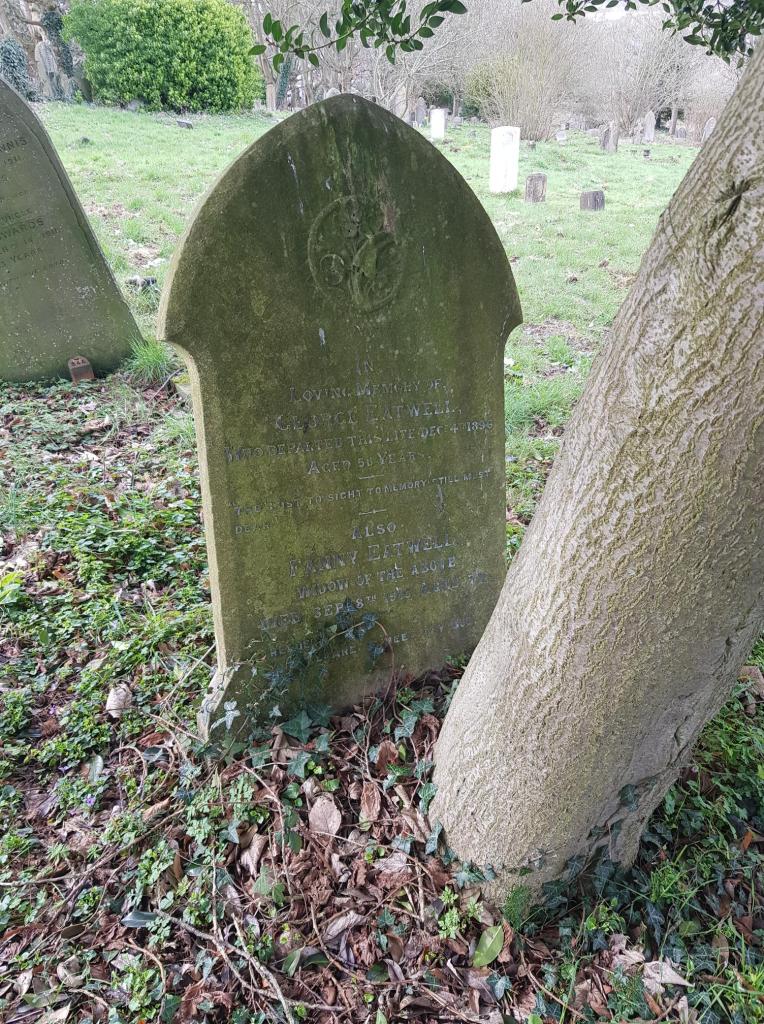
George died at his home in Gloucester Street on December 4, 1896. He was buried in grave plot C780 where Fanny was later to join him following her death in 1910.

You may also like to read:

Maurice Eatwell – well known Swindon Methodist

Maurice Eatwell – well known Swindon Methodist

There can be no denying the contribution and the influence of members of the non-conformist congregations to the development and prosperity of Swindon.

The necessity for a new burial ground in Swindon in the last quarter of the 19th century was driven by two factors. The continuing expansion of the Great Western Railway Works and the growth of the town had created a dire need for more burial space. Furthermore, the growth of non-conformity in Swindon saw a demand for a burial ground where members could bury their loved ones independent of the rites of the Church of England.

The Primitive Methodist movement began in Swindon with the establishment of ‘the Wiltshire Mission’ in 1824. The Primitive Methodists were a breakaway group from the main Methodist Church. Led by a preacher called Hugh Bourne, members stressed simplicity in their chapels and their form of worship and gave new focus to the role of lay people in their church. Among those mentioned in the Official Handbook of the Brinkworth & Swindon Centenary District Synod 1910 were the Eatwell brothers.

Maurice Eatwell was born in 1830 in Winterbourne Bassett, the second of five sons. His parents William and Mary both worked as agricultural labours, as did all five boys.

Maurice married Ameilia Hibberd in Melksham in 1851 and the couple had six daughters (Emily born in 1859 died in 1860). By 1871 the family had moved to Swindon and were living at 20 Havelock Street. In 1881 Maurice, Amelia and their two youngest daughters were living at 12 Brunel Street where Maurice, then aged 50, is described as Railway Labourer Prim[itive] Methodist Local Preacher.

The couple’s home at the time of the 1901 census was 7 Ashford Terrace where they lived with their married daughter Elizabeth, her husband James Hart and their 6 year old granddaughter Madeline Hart.

The Radnor Street Cemetery burial registers record that Maurice Eatwell Retired Insurance Agent aged 74 years living at 79 Ashford Road, was buried on October 8, 1904 in grave plot D26, a public grave. He is buried with his wife Amelia who died in 1906.

Death of Mr Maurice Eatwell

A well known Swindon Methodist

On Tuesday last, after a long and painful illness, Mr Maurice Eatwell, of 79 Ashford Road, Swindon, quietly passed to his rest. Until a few years ago, when he had a physical breakdown, his life had been a strenuous one. Although denied even the rudiments of an education during his boyhood, yet later he succeeded in acquiring sufficient information to qualify him for much acceptable service in the Primitive Methodist Church, of which he was for 56 years an enthusiastic member and official.

He was also greatly interested in politics, and for many years gave much time to canvassing, and in various ways sought the promulgation of the principles of Liberalism.

Mr Eatwell was born on May 3, 1830, at Winterbourne Bassett. At the age of 18 years he was converted, and soon after authorised to accompany Mr George James to his preaching appointments. In 1851 Mr Eatwell married Amelia Hibberd, who survives him. After a residence of eight years at Clack, he removed to Swindon, where he remained until his death.

He has represented the Brinkworth District of Primitive Methodist Churches in the annual Conference once, and his Circuit in the District Assembly three times. He has also filled the office of Circuit Steward, [succeeding Charles Morse, head of the influential Primitive Methodist Morse family] and has been a class leader for more than 50 years.

Mr and Mrs Eatwell celebrated their golden wedding three years ago.

The interment takes place at the Swindon Cemetery to-morrow (Saturday) at 2.30 p.m.

Swindon Advertiser, Friday, October 7, 1904.

You may also like to read:

George Eatwell – Primitive Methodist

William Hulbert and the lost headstone

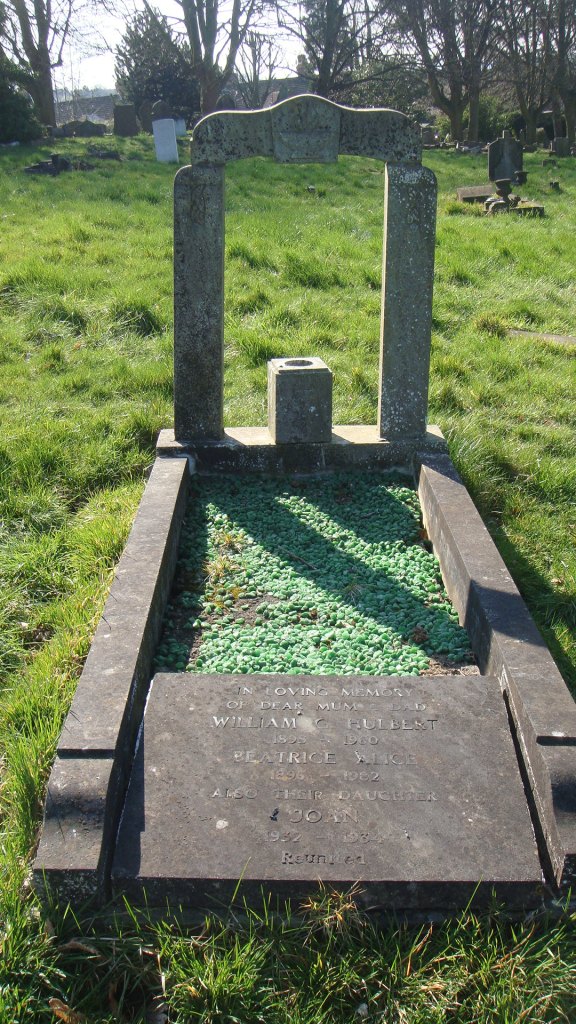
How is it possible to lose a headstone, especially such a striking one as this?

I took this photograph about fifteen years ago, but when I recently decided to update my records, I couldn’t find it. It once stood proud and very obvious in a area of Section C where there are few other headstones. How was it that I just couldn’t find it anymore?

This headstone, with it’s symbolic entrance to eternity, has a very interesting history. The plot was first established as a public grave for the burial of infants. The first child buried here was Ethel Louisa Marsh, just three months old when she was buried on October 18, 1897. All that can be discovered about this baby (without purchasing her death certificate) is the address her death was registered at in the burial registers – 34 Avenue Road. Just five days later Edith May Burgess, aged one month old was buried here. Again, all that can be discovered (without a death certificate) is the address in the burial registers at which her death was registered – 11 Carfax Road.

The two babies lay undisturbed for more than thirty years until Joan Edna Hulbert was buried here on January 9, 1934 and just days later Molly Gwendolen Dodson on January 25, 1934. Molly was eight months old, the daughter of Edwin and Ivy Dodson who in 1934 were living at 48 Percy Street, Rodbourne.

There are still a few gaps in my reasearch and it is not known at what point the Hulbert’s decided to purchase the grave.

Both William George Hulbert and his wife Beatrice Alice Shepherd would appear to have been born and raised in London. They married in the Lambeth registration district in the June quarter of 1921. By 1934 they were living at 54 Exmouth Street, Swindon where little Joan Edna died that year aged 2 years old. William died in 1960 aged 65. His last home address was 27 Beckhampton Street. Beatrice died more than 20 years later at St Margaret’s Hospital, Ridgeway House, Wootton Bassett.

But, thankfully, this distinctive headstone has not disappeared completely, as I discovered when armed with a cemetery I went exploring. A seedling has sprouted through the opening and toppled the whole thing over while grass has grown up and covered the kerbstone. If there are any family members still living in Swindon who would like to help restore the headstone, we’d love to hear from you.

A private, close knit family


The re-imagined story …

I’d walked past 10 Bath Road many times before. It was a pretty little house with a charming wrought iron porch, but it was very neglected. The woodwork badly needed a coat of paint and moss grew in the guttering and obviously hadn’t been cleared out in years. I never saw anyone go in or out, but then I don’t suppose you very often see the people who live in the houses you walk past.

I began training as a district nurse at the Victoria Hospital in 1956 under the supervision of the formidable Nurse Morris. Our first call that Monday morning was at 10 Bath Road.

“This is the home of Miss Mary and Miss Frances Wilton,” Nurse Morris explained. “Miss Frances had a fall several weeks ago and I’ve been dressing an ulcer on her leg.” She paused to look at me. “You’re not squeamish, I hope.”

I thought she was making a reference to the wound I was about to see.

“I’ll not make a very good nurse if I am,” I laughed, full of youthful audacity.

Nurse Morris raised her eyebrows. She wasn’t impressed. She said nothing.

We leant our bicycles against the garden wall and Nurse Morris knocked on the front door. We waited for what seemed like a very long time.

“No one in?”

“Miss Mary is over 80 years old,” she snapped back. I wasn’t making a very good impression. I pulled a face at Nurse Morris, behind her back, obviously.

Eventually the front door with the chipped paintwork opened a crack.

“Nurse, welcome, welcome. Do come in,” a soft voice greeted us.

“Good morning Miss Mary. I’ve brought a student with me today, hope that’s alright with you?” She turned back to me with such a glare, I wasn’t quite sure what I had done wrong this time. “Miss Mary, this is Linda.” I held out my hand and in the dark hallway the smallest, little wizen hand grasped mine.

“How nice to meet you, my dear. My sister and I seldom receive visitors these days.”

Miss Mary, when I could eventually see her in the murky hall, was as neat as a pin; until I looked again more closely. The little bird like figure was dressed in a long, dark dress, stained and stiff with dirt. Her long, white hair was tied up in a neat bun on top of her head but her wrinkled face was engrained with dirt. She had the twinkliest blue eyes and an engaging smile. She must have been a lovely looking young woman.

Now the smell inside the house hit me. It was indescribable. A cocktail of human excrement and cat wee and unemptied bins and something I couldn’t even put a name to.

I looked at Nurse Morris for some kind of explanation, but she clearly wasn’t disposed to give me one.

Miss Mary led us into what had once been an elegant dining room overlooking the front garden, but which now served as a bedroom for our patient.

“Good morning Miss Frances. How is the leg?”

At first I could barely see the old lady lying in the bed, so small was she. If Miss Mary was tiny, Miss Frances was skeletal, her face cadaverous. I tried not to stare, but I couldn’t help myself. I was shocked by the physical condition of these two sisters who were malnourished and filthy, their home dirty, unhygienic and neglected. A cat that had been sitting on the bottom of the bed suddenly sprang into the dark corner of the room where there was a sudden scurrying and a squeaking.

“This is looking much better, Miss Frances,” said Nurse Morris as she began to clean the ulcer on the lady’s shin.

“Would you two nurses like a cup of tea?” asked Miss Mary.

I dare hardly imagine the state of the kitchen, but before I could reply Nurse Morris shot me another warning glance.

“Thank you, Miss Mary, but we had a cuppa with our last lady. I’m fine, how about you Linda?”

“Yes, I mean no, no thank you,” I stuttered.

Nurse Morris maintained an easy conversation with the two women as she worked and soon our patient was settled back against the grubby pillows on the bed.

“Well I think that’s us done for today,” she said. “Is there anything we can help you with while we’re here? Shall we empty this commode?”

Please, please don’t ask me to do that, I thought. And where would we begin. They both needed a bath, the bedclothes needed changing, their clothes need washing and that’s before any attempt was made on the filthy house.

“No thank you nurse,” said Miss Mary with the sweetest, gentlest smile. “We’re just ticketyboo, aren’t we Fan?” She rested her claw like hand on her sister’s skinny shoulder.

The front door had barely closed on us when Nurse Morris laid into me.

“Before you say one word, young lady you must learn to disguise your emotions, especially your disgust. Those two ladies are perfectly aware of the conditions they are living in. They are old, not stupid.”

“But why would you put up with that?” The smell of the house clung to my clothes.

“Because they are proud and they don’t want to ask for help.”

“Someone should sort them out.”

“Have you got grandparents?”

I had and they lived in a tidy little terrace house in Gorse Hill. Was she going to make some kind of comparison?

“And would they appreciate someone barging in and telling them what to do, touching their things and clearing up and throwing things away?”

“No, but …”

“If you are going to be a good district nurse you must quickly learn compassion and empathy.” We pushed our bicycles side by side, back to the hospital.

“They value their independence. Would you take that away?”

“No, but …”

I could not argue with Nurse Morris, but I knew there must be some solution to the ladies’s predicament, some way of providing them with help without robbing them of their dignity. I learnt a valuable lesson that day and have Nurse Morris to thank for my long career in nursing. And of course the Misses Wilton.


The facts …

The imposing monument pictured below marks the grave of the Wilton family. The burial registers record that it covers plots D5a and D6a with six graves reserved in a brick built vault.

Elizabeth was the first to die and the dedication on the prominent face of the memorial is to her. What is interesting is the name of the property that was the Wilton home in 1905 – ‘Old Croft’ Bath Road. Research has revealed that Old Croft, 10 Bath Road was the family home for more than sixty years. In 1901 10 Bath Road was the home of Swindon architect William Henry Read, so unless some renumbering took place in the early 20th century it is possible to trace the house history of this property for almost 100 years.

George Wilton was a butcher by trade and for more than 30 years the family lived over the shop at 58 Fleet Street. He married Elizabeth Townsend at St Leonard’s Church, Broad Blunsdon on October 25, 1870. She was 37 years old and he was 49 so quite a mature couple for a first marriage. Their first daughter Mercy Joanna was born on October 31, 1871, followed by Ruth Edith on November 19, 1872, Frances Elizabeth on March 25, 1874 and finally Mary Townsend on March 15, 1875.

The Wilton family were a very private, close knit unit. The four daughters didn’t marry, didn’t have any children, or nephews and nieces to tell their story. How did they end their days? Mercy and Ruth both died in the 1940s but Frances and Mary lived on into the 1960s and extreme old age. Were they comfortably off, well provided for, well cared for? Were they fit and vital in their last years? Did they belong to clubs and societies? Did they have a wide circle of friends? Is my re-imagined story way off the mark?

George died in 1908 and the Faringdon Advertiser and Vale of the White Horse Gazette published the following obituary.

‘Death of Mr George Wilton – General regret will be felt at the news of the death of Mr George Wilton, which took place at his residence, Old Croft, Bath Road, Swindon on Tuesday morning. Deceased, who was in his 87th year, was born at Oaksey. He was the oldest butcher in the town, and in an unbroken period of about 35 years he conducted a successful business in Fleet Street, retiring a little less than three years ago. Mr Wilton was a purveyor of the old fashioned type, and his excellent judgment and the dependable character of his stock established for him the reputation of being the leading butcher in New Swindon for many years. Apart from his business, to which he was most devoted, Mr Wilton was in no sense a public man, and was, in fact, of a retiring disposition. His wife pre-deceased him about three years ago, but there remain four daughters to mourn a heavy loss. Although burdened by the weight of years, Mr Wilton was in his usual health until Boxing Day from which time the fatal illness really dated.’

All four sisters lived on a private income with Mary appearing to be the only one to have paid employment when in 1939 she was working as a Brewery Cashier.

When Mercy died in 1944 she left £2,611 6s to her sister Mary. Ruth, who died two years later, left more than £3,800, also to Mary. However, when Mary died in 1961 her effects were valued at just £411 19s which she left to the last surviving sister Frances.

All four sisters are buried with their parents.

Charles and Susannah Witts

This is the last resting place of Susannah and Charles Henry Witts. Susannah died first, in 1936 and Charles outlived her by more than 20 years.

Susannah was born in Stratford, East London, but grew up in West Ham where her father worked as a paperhanger and painter. In the 1901 census Susannah, then aged 20, was recorded as working with her father, also as a paperhanger and painter.

Charles Henry Witts was born at Stratton Green and was baptised at St Margaret’s Church. He was the son of Charles Neville Witts and his wife Caroline.

By 1891 the Witts family had moved to 68 Medgbury Road. Charles Snr had a job in the Works as a Boilermaker’s Assistant, but guess what I found 12-year-old Charles Henry doing? He was working as a paperhanger’s boy.

Charles Henry married Susannah Cleminson in 1905 in her home parish of West Ham, but they obviously decided they didn’t want to carry on the paperhanging and painting business. By this time Charles Henry was working as a stationer and the couple lived at 35 Curtis Street from the time of their marriage to Charles Henry’s death in 1958.

Susannah died on January 11, 1936 at Queen Mary’s Hospital in Stratford.

Now while I was researching this family on the Ancestry website I had a bit of luck. I found a family tree with photographs but unfortunately it was a private tree with the information withheld but I emailed the person who had set up the tree asking her if she could let me have a scan of the photo of Charles Henry and Susannah. Well she did better than that – she let me have access to the tree and permission to copy all the photos!

So here we have Charles Henry and Susannah with their two children, Winifred and George, and Susannah’s father (the paperhanger and painter). The second photo is of Charles Henry and Susannah in later life with a baby who is thought to be one of their grandchildren,

Look how women’s fashions changed during Susannah’s lifetime.

So, then I started searching the cemetery registers for other members of the family who might be buried here in Radnor Street. Charles and Susannah’s daughter Winifred died in 1988 aged 80 and she is buried here with her husband Victor in plot C1684. Then we have Charles Henry’s brother Ernest, he died in 1962 and is buried with his wife Ivy and two members of her family in E7909. Ernest also worked as a stationer. Here’s a charming photo of them with their baby son Peter.

This is Julia Crook nee Witts, Ernest and Charles Henry’s sister. Here she is with her husband Sidney Crook and two of their daughters. Their eldest daughter, Lilian Florence Crook, died aged just 4 months old and is buried in a public or pauper’s grave with seven others in C263. The second photo is of Sidney and Julia Crook in later life.

Sidney died in November 1967 and Julia in March 1968 and they are buried in plot C1685.

But that’s not the end.

This is Caroline and Charles Witts, the parents of Charles Henry, Ernest and Julia (plus at least three other children). Charles died in 1927 and is buried with Caroline who died in 1940 in grave plot D341 with another woman (possibly their daughter Annie Maria who died in 1935).