It can only be wondered what life was like for the Schmitz family during the anti-German feeling of two world wars. It is to be hoped that Swindon, where most people were incomers, was a tolerant town in which to live.
Martha Sarah Potter was the daughter of Jasper and Mary Ann Potter and married Vincent Joseph Schmitz in the March quarter of 1898. Vincent was the son of John Henry Schmidt, a watch maker born in Prussia in about 1832.
Little can be discovered about John Henry Schmitz before he married Mary Ann Phillips in 1869 but by the time of the 1871 census he was living and working at a property at 47 Regent Street. Mary Ann and their 8 month old son Vincent Joseph were living with him along with a 14 year old domestic servant Ann Tuck. Also at the same premises was John Corbishley, a Roman Catholic Priest and Ellen Bennett housekeeper, who was probably working just for the priest and not the Schmitz family.
John Henry Schmitz remained in business in various addresses at Regent Street. In retirement he moved to Boscombe where he lived with his daughter Annie Markley and her husband John. He died in Boscombe on March 24, 1925 aged 93 years old. His body was returned to Swindon where he was buried in grave plot E7511 with his wife Mary Ann who died in 1905 and his son Bernard Francis who died in 1921
At the time of the 1901 census Vincent and Martha Schmitz were living with their baby daughter Dorothea at the High Street, Wroughton where Vincent worked as a hairdresser. However, ten years later the family had moved to 56 Princes Street where Vincent was a firewood producer and dealer and Martha a shopkeeper. They had been married for 13 years and had just the one daughter. Living with them was Martha’s widowed father Jasper Potter.
Martha died in 1920. Vincent outlived her by more than 20 years and died in the Victoria Hospital in 1943. He is buried in Radnor Street Cemetery but in the Schmitz family plot. Interestingly he is recorded as Joseph Smith.
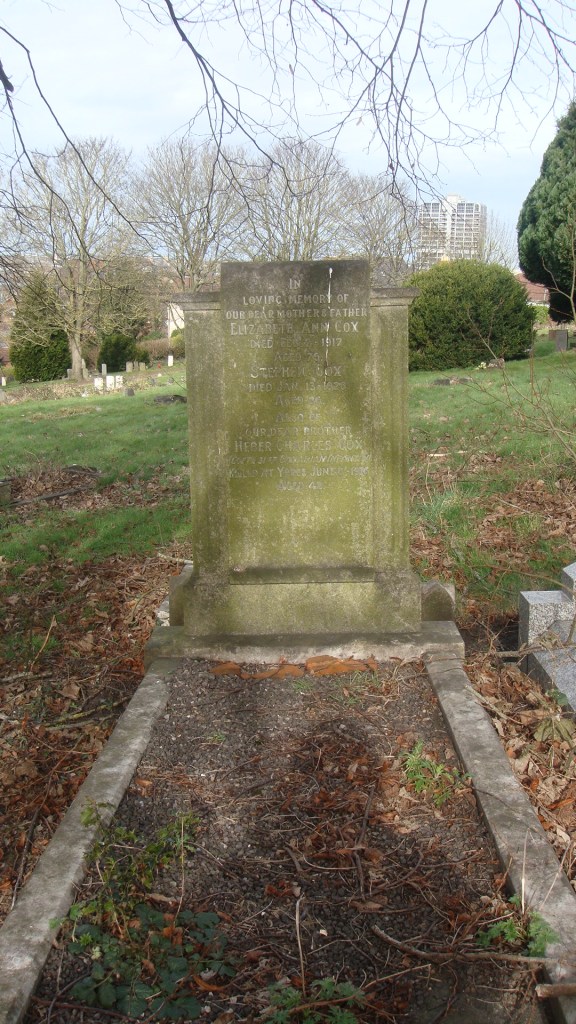
This is the final resting place of Stephen and Elizabeth Cox. Elizabeth died in 1917 and Stephen in 1926.
Stephen was born in Aldbourne and Elizabeth in Marlborough but by 1871 they had moved to Swindon and between the years 1871 to at least 1881 they managed a beer house in Queen Street.
At the time of the 1891 census Stephen was farming at The Wharf in Stratton with the help of his son Heber. When Stephen retired the couple moved to 32 Guppy Street in Rodbourne where they were living in 1901.
In 1908 Heber set sail upon the Sardinia, bound for Canada. On the ships schedule Heber, then aged 34, describes himself as a farmer and states his ultimate destination as Calgary, all set, no doubt for a new life of opportunity.
But on November 14, 1914 and by then aged 40 and still single, Heber enlisted with the Canadian Overseas Expeditionary Force. He served in the 31st Canadian Infantry and was killed in action at Ypres on June 6, 1916. His name is mentioned on the Menin Gate memorial and here in Radnor Street on his parents’ headstone.
Over the past three days I have been publishing the memories of Miss Lorna Dawes. Lorna was born on March 23, 1931, the daughter of Albert Dawes, an iron moulder, and his wife Mona Fanny Pinnock. Lorna lived in Tydeman Street all her life. I wished I had taken the opportunity to collect her memories of Gorse Hill.
Lorna’s maternal family originally came from Gloucestershire. Her grandparents, Emily Scales and Joseph Pinnock, married in St Mary’s Church, Tetbury on August 5, 1899. Joseph was a bricklayer, the son of Peter Pinnock, also a bricklayer. Emily was a dressmaker, the daughter of William and Anne Scales.
The couple began married life at 4 Haydon Terrace, Poulton Street where their first child was born. Victor Eric Pinnock was baptised at St. Barnabas Church, Gorse Hill. Their second son, Graham Joseph was baptised at St Mark’s on January 21, 1904. Mona Fanny (Lorna’s mother) was baptised at St John the Evangelist, Aylesbury Street (demolished in the 1950s). 111 Beatrice Street, Gorse Hill would be the Pinnock family home for more than 60 years.
Image of Beatrice Street taken around the time the Pinnock family moved into No. 111. Published courtesy of P.A. Williams and Local Studies, Swindon Central Library.
Emily Pinnock died in November 1918 and is buried in Radnor Street Cemetery in grave plot C3541. In 1920 Joseph married Emily’s elder sister Mary Scales. The family continued to live at 111 Beatrice Street – Joseph, Mary, Anne Scales (Mary and Emily’s widowed mother) and the three children Victor, Graham and Mona. Anne Scales died in December 1926 and was buried with her daughter in grave plot C3541.
Joseph Pinnock died in 1959 and was buried on March 3 in grave plot C3541 with his first wife Emily and his mother-in-law. Mary Pinnock died in the Princess Margaret Hospital May 1965. She was 93 years old. Her personal estate was valued at £1,102 and probate was awarded to her two stepsons/nephews Victor and Graham. She was buried in the family plot with her husband, mother and sister. Sadly, there is no headstone to mark the spot.
Today’s blogpost concludes a series of articles written by Miss Lorna Dawes about her time working ‘Inside’ the GWR Works. These pieces first appeared in the Wiltshire Family History Society newsletter and are published here with the kind consent of Yvonne Neal.
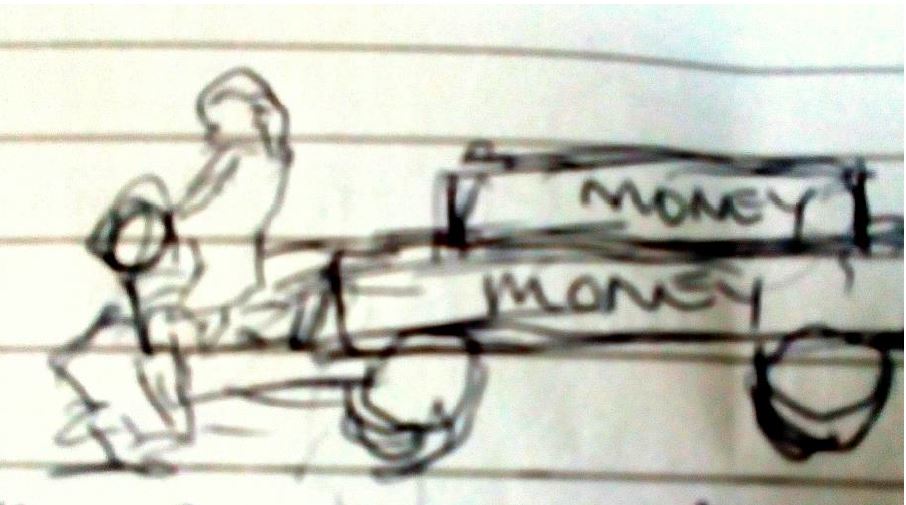
In later years wages were brought from the bank by a man on an open bogie pulling two large boxes contained the cash.
I never heard an attempt to rob.
Lorna’s own sketch
The workmen queued up to be paid but the foremen were paid individually, and I used to go one week to the Loco Works, one week to the Carriage Works, accompanied by a man carrying the box of envelopes and money. We had to go to every shop office and many were upstairs above the workshop. In one workshop on the Loco side the noise almost took your breath away, and had the effect of freezing movement. So much so that you almost couldn’t put one foot in front of the other. In fact, deafness affected quite a few of the workers there. On a wet day, we hated it being the Loco side because of the oil and water hazard. This also applied to the tunnel on a wet day.
Disciplinary hearings were held with all the legal representatives and full reports. I typed some myself.
Long service awards, laid down by years: various items to choose e.g. camera, watch etc. Can’t tell you when this began, but was another of my involvements. I do know there were sometimes upsets because ‘one day out’ meant no award. Large ceremonies took place in the Training School with the Works Manager present.
There was a team of office cleaners. Many were elderly women and some came through the Works from Rodbourne. There was quite a lot of brass to clean! These cleaners did two shifts, early morning, possibly starting at 6.00 a.m., and again in the evening. Seemed a lot – 2 shifts.
There were quite a few cats in the workshops and offices. Unbelievably, a cat had a little of kittens behind a moulding box in the Foundry. The men were really concerned and told everyone to be careful. My Dad was there at the time. When the Works were closed for Trip, it wasn’t unknown for men to gain access to fee the cats.
When the library at the Mechanics closed, the books were sold off and I bought three – about Tibet and Nepal.
In my early days I travelled to work by bus and there were special buses laid on at the Works entrance.
My Dad had no ‘fixed’ bathroom at home and went to ‘the Baths’ after working in the Foundry.
In later years air conditioning fans were introduced in the Foundry but, when my Dad worked there, the only aid, especially on a hot summer’s day, was buckets of water – with something added – BRAN.
Another job I had on Welfare consisted of finding lodgings for men attending Diesel Training School in Emlyn Square. At that time Swindon didn’t have much call for accommodation, apart from hotels, but we found nice places and two were in Beatrice Street.
I guess it was turpentine in those days as we dreaded the window cleaners (rail gang) coming. The smell hung on.
A man from Bristol came to service the typewriters but we had to do our own temporary repairs. One was to tie loose ‘type’ arms with cotton and it did work until the engineer came.
Spring was heralded when an older man messenger, who travelled the Works on a bicycle (such were the distances) came to us in the offices with bunches of pussy willows picked in the concentration yard.
Workers played all sports at the GWR Sports Ground in Shrivenham Road. Teams of clerks and workers against one another. Snooker and billiards were played in the Mechanics.
Weekly repertory meetings were also held in the Mechanics. One group did long spells of different plays each week.
Other activities included:
GWR Male Voice Choir
National Savings Group – a large silver cup was fought over
First Aid Classes and competitions – all lines competed.
Arts and Crafts (Mechanics) from all over the GWR.
GWR Music Festival
Mass x-rays
Blood donations
As for stationery – masses of ‘scrap pads’ were produced and available.
Women were employed in the sewing room, laundry, canteens, casualty centres as well as clerks.
I had to accompany new entrants, and female illness cases, to Park House and ‘sat in’. I also collected water samples and remember one ‘donation’ was in a large-sized HP sauce bottle – full up!
‘At times there were items for sale at the General Stores and I purchased a cycle cape. I missed out on a GWR platform seat from Reading, which sold for £50.’ Read more about Lorna’s life working ‘Inside.’
GWR Memories Part 2
Carol concerts were held in many areas around the Works, including in the Drawing Office. A local band always attended and many office staff joined in.
The main tunnel was white-washed during ‘Trip’ week. Normally there would have been hundreds of people coming and going.
There would be weeks of overtime for Staff Office Typists, as well as clerks, when passes were written for ‘Trip’ trains. When trains departed, there was always a male clerk in attendance to check things, and sort tickets if there was someone without theirs. It did happen.
Long distance ‘Trip’ trains left overnight. We went to Tenby, arriving at 6.00 a.m. at our Lodge where the family would be up and waiting for us, and I still have contacts even after 80 years.
As the train proceeded west and people alighted at earlier stations, we all waved them off and wished them well. It was lovely.
I had nine years on accident reports and claims for compensation. A friend was shocked to see me staggering to my desk with huge piles of paperwork. Such was the volume of cases. As well as Park House and at least two doctors, there were casualty centres each side of the Works, ambulance boxes all over the Works and an Ambulance Inspector checking things as well as running exams. There were also ‘all line’ competitions with mock accidents and wounds.
There was a lovely well-equipped rest room for women in the Main Offices and we had a choice of colours for cloakrooms.
I was among clerks seconded from No. 13 Office to duties at the Works Book Office. There were three serving windows and women were put on the busiest … Bath, Cardiff, Weston, Bristol, Paddington and others.
The photo below was taken c. 1960, of the Works Booking Office Staff and their partners, on an outing to London. The staff were on regular duties at the Booking Office in between normal work in the Staff Office. Regular shifts of a week (?) at a time, but only certain hours.
To be there at the time the hooter blew was really terrifying. One minute it was absolute silence and then hundreds of men rushing out. The noise was over-whelming.
So many tickets issued that the racks ran out, but we had back-up from the men and they also cashed up. One penny out at 8.00 p.m. on a Friday night, and we had to check all again.
At times there were items for sale at the General Stores and I purchased a cycle cape. I missed out on a GWR platform seat from Reading, which sold for £50.
There were coal sales to staff, and also wood which consisted of off-cuts and old timber. It would be delivered, although you didn’t know what would come.
There were tales of a ghost in the tiled corridor of the Main Offices, near to the old part and close to the engine plaque on the outside wall.
Whilst on a welfare job I was partly involved with setting up a trolley service. It had always been dangerous for young girls carrying tea pots up the stairs (there were no lifts) and the hot water urn was also a hazard under one lot of stairs.
In one office we had ‘weigh day’ on Thursdays. All the girls went to a platform weigher used for goods and checked out the large pad.
Office staff were granted a day off and free pass for an outing. In January there would be suggestions for the venue, meals etc. and then the vote. Usually men and women separately. I’ve been to most places on the southwest coasts. If we went to eastern resorts, we went to a show in London afterwards. The men had barrels of beer on the train from Paddington and we travelled home by ‘Mails’ trains 10.00 – midnight, arriving home at 2.00 a.m. One time, two groups were caught at Westbury due to a problem, and I walked up the street at 5.00 a.m.
A group of office staff once did publicity shots of the Blue Pullman train, taken at Shaw sidings. I still have one of the pamphlets with photographs. We even had an actual tea laid on.
Fred Ferris, the Head Messenger, organised an evening trip on the Thames for all the office messengers. I think around 20 of us.
Just about everything had the GWR logo printed on it or moulded for identification, including pencils, paper, punches etc.
There was a ‘Helping Hand Fund’ raised by voluntary donations. At Christmas anyone with children received new toys via the Welfare Office at Paddington, and I delivered locally. One parcel I had to put on a different train, on a very snowy day, and I waited by the open fire in a station office.
The ‘Railway Benevolent Fund’ was raised by members’ contributions. The girls were asked to volunteer for flag days in the town and given sites for two at a time. In return for this couple of hours, we were allowed an extra half-day off.
No 13 Office was on the first floor over the Main Tunnel, so we could se the Wednesday groups of visitors. Also the ambulance, fire engine etc.
to be continued …
with grateful thanks to Lorna’s brother Ken and Yvonne Neal of the Swindon branch of the Wiltshire Family History Society.
Last year I published on this blog an article about Miss Lorna Dawes and her memories of working ‘inside’ (that is inside the GWR Works). Yvonne Neal, of the Swindon branch of the Wiltshire Family History Society, has managed to collate the articles Lorna wrote for that Society’s newsletter and has kindly given me permission to print them here. Yvonne also contacted Lorna’s brother Ken who has supplied this photograph of his sister. So, published here in three instalments is a piece of Swindon’s history – Lorna’s story – in her own words.
GWR Memories – Lorna Dawes
Swindon Railway Works grew over many years and became the site of a fantastic organisation, with many sub-sections and with everything needed to support and organise the volume of work, i.e. possibly more than one locomotive a week. Even had its own window cleaners, clock man and master clocks connection to Greenwich time, ambulance, fire engine etc. all in situ.
As a shy 14 year old, I came for interview with my mother, but really wanted to work in a flower nursery, not that there was any work experience in those days.
I joined an army of boy and girl office messengers, some in the main offices and others in workshop offices, dealing with immediate personnel. I ended up in No. 13 Staff Office (see further information below); the hub of the Works and in control of quite a few events all over the West and Wales. One small element was the letting of railway houses and cottages, which included a crossing cottage in the west, which carried the comment ‘water in churns’. It set me wondering at the possible difficulties.
I’ve realised lately that, whilst someone must have introduced me to my job, I actually ended up running it all myself as regards programming. It was extremely busy and most of it physical as I went to so many areas and hardly stopped. It was a job I loved and led on to all kinds of interests, so I never regretted it and I’ve always had friends.
The whole background was a pride-based one and it wasn’t unusual for new engines to bring an admiring crowd along the lines.
The messengers went on to apprenticeships for the boys and office jobs for some of them also, as well as clerical posts for the girls.
I had already started shorthand and typing privately, and it became a condition of work to proceed so I went to night school three nights a week 7.00 pm to 9.00 pm at the college in Sanford Street, which included Commerce, English and Arithmetic. The work-related ones were sometimes taught by men (Clerks) from the Works. I managed 130 wpm shorthand and really loved it.
The only way I was ever given ‘instructions’ was as part of a bell system for individuals, and I was about four or five rings to go to an officer at post time. For instance:
Early morning: sorted copies of last night’s post and distributed
Every morning: Bank bags to Railway Bank on London Street
Sometimes called into the Railway Union Group in next street, or Railway Club, Bridge Street.
On return every day, collected Time Book at main entrance. This contained information on anyone leaving/returning from outside the Works.
Then round the offices obtaining signatures to cover reasons given i.e. dentist, surgery, etc.
Then made coffee, individual cups for about 25, and washed up downstairs.
I was responsible for obtaining and distributing dusters, towels, soap, string etc. to ‘my’ office, around 25, and sometimes to General Stores, which was between the Main Offices and the Station. It was a large building with three floors and I had to find the correct location.
The Stationery Office and another office was accessed by crossing all the lines in front of the Engine Shed where engines were being shunted and men cleaning. (Graded – cleaner, fireman and then driver.) The Stationery Office had typing paper, some water-marked, ink pens and also confetti from punch cards!
The Duplicating Office was in the wall of the Body Shop. Here there was the traverser hazard and I quite often had to divert. I had to go there a lot and quite often in a rush with special or urgent notices. Printing was slow and with a hand roller, one at a time, which meant I had to wait around.
At Park House I saw drivers with piles of coloured wool which were used to give vital eyesight checks. Yes!! Also went into the cellar for old files, some were accident originals.
At the Mechanics Institute, I had to transport books to and fro between ‘Officers’ who read and vetted books before they were put on display in the Mechanics Library (may be something no one knew).
I took ‘travellers’ to the Loco or Carriage Works and also interviewees to the Carriage Canteen.
Sometimes I was sent to the Loco Canteen, for clerks who needed sandwiches because they had unexpectedly to work overtime. The Loco Canteen was underground and in electric light.
The Works had its own Telephone Exchange – push/pull units.
The Head Messenger’s office, Mr Bill Ferris, was where the postal boxes were kept.
The Storehouse consisted of three floors and was to the rear of the offices. Very creepy there as it was quite often empty except for files.
I also had to go to the Laboratory at Church Place.
The Drawing Offices were on the third floor, main building – you could see Purton from the landings.
The above were my duties, and places I had to go in the mornings. In the afternoons:
Make tea and wash-up.
Get post signed and despatched – that was very busy
Works Cash Office
Visit to the fourth floor – no lift, exhausting!
Mileage Office – SPL, toilet for older women in this office!
Extra jobs would include advertisers and lardies
A little story: I was sent in search of saccharines (sweeteners) for a desperate officer one day after Bank duty!
These are all rough memories but my work seemed to get more and more interesting all the time.
I spoke before about No. 13 Office. The layout in 1945 was:
Boss of Staff Office – Percy Mills
Deputy – Ted Click – in the corner was my bit of desk and a cupboard
Four typists – I was one here, later. One of the typists was a big fan of WEA Hikers and I joined. Another was the daughter of Louis Page, Football Manager. She took me to the Isle of Man, with two others, when I was around 14½.
Then there were row of Clerks.
More than once I passed F.W. Hawksworth, Chief Mechanical and Electrical Engineer, in the tunnel. My wages in 1945 were 18/- a week. (approx. 90p).
I probably have enough to fill my own book with my very wide GWR experiences and, in fact, Rosa Matheson has used a lot of my information. I once gave an hour’s talk to the Railway Lounge Group.
In 2005 Radnor Street Cemetery was designated a Nature Reserve. A team of Rangers worked to promote the benefits to Swindon residents of having a green oasis on their doorstep. With an earlier band of volunteers they worked on a Garden of Remembrance close to the Radnor Street entrance. They plotted an area in which to grow meadow flowers. They organised events, installed bat and bird boxes and led guided walks. Then came the financial crisis of 2007-8 and subsequent cuts in council budgets and soon Swindon was relying on the work of volunteer rangers, and Radnor Street Cemetery became a casualty of those cuts.
For me, Radnor Street Cemetery is all about the people and the history of Swindon but Spring is most definitely in the air and every good cemetery guidebook (or website) has a section on flora and fauna. As a townie and non-gardener I’m probably not the best person to write this and there are many in our little band of volunteers who would make a much better job of it, but it will be selective, brief and beautifully researched. Please feel free to add your own more knowledgeable comments.
I’ll begin with the snowdrop – everyone knows the humble little Galanthus Nivalis that flowers in late winter and heralds the coming of spring. The snowdrop has inspired stories and poetry, music by Johann Straus II and Tchaikovsky and was a nickname for the US Military Police stationed in the UK during WWII.
The daffodil belongs to the Narcissus genus and is recognisable to even a horticultural ignoramus such as myself. The daffodil has migrated from North Africa and Southern Europe and was adopted by the Welsh as their national flower, although when and why seems largely unknown. The leek has a much older association with Wales, but to the best of my knowledge, we don’t have any in the Cemetery.
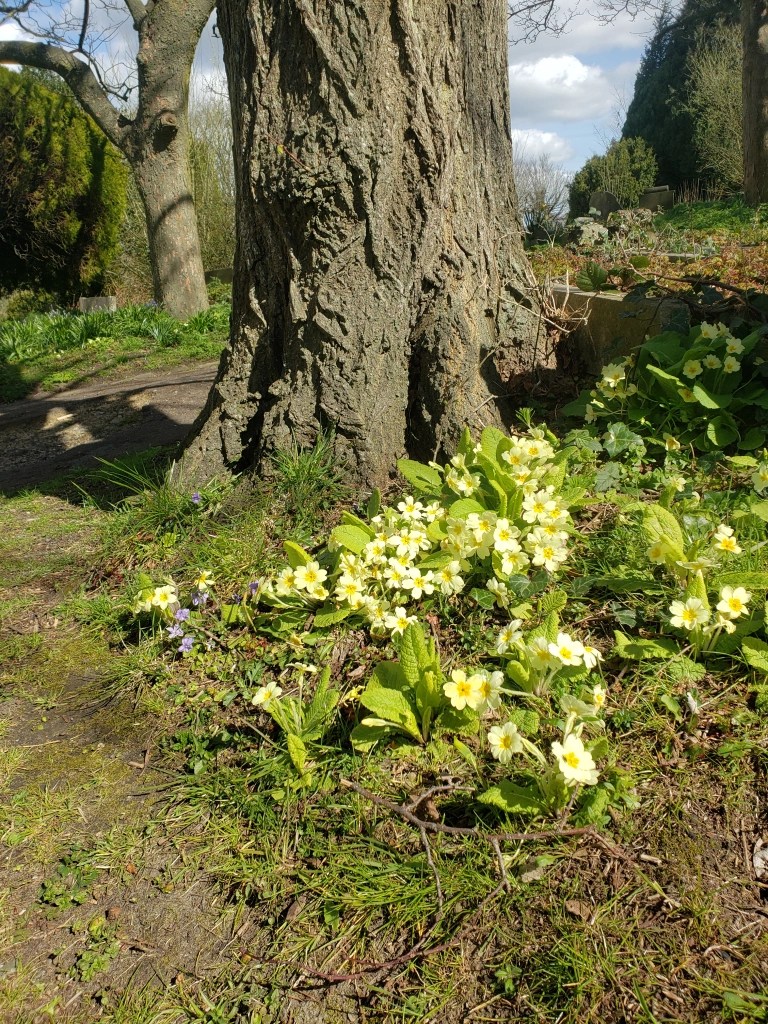
The Common Primrose, Primula Vulgaris, is to be found by streams, in orchards and woodland and grows in profusion in Radnor Street Cemetery. Edible, drinkable (primrose wine and tea) and the roots are considered to have an analgesic property – but don’t take my word for it. Apparently the primrose was Benjamin Disraeli’s favourite flower (Conservative Prime Minister in 1868 and 1874 to 1880).
And what about the Muscari Grape Hyacinth (are you impressed – I had to look it up?) The Wikipedia description is of a plant that produces “spikes of dense, most commonly blue, urn shaped flowers” so very appropriate for a cemetery. The Grape Hyacinth is one of the earliest garden flowers to bloom in the spring.
So that is probably the sum total of my flora and fauna knowledge. Is it too early for bluebells – probably? I’ll let you know when I see them. What else should I be looking out for? What are the names of the trees and shrubs – come on cemetery followers, help me out here.
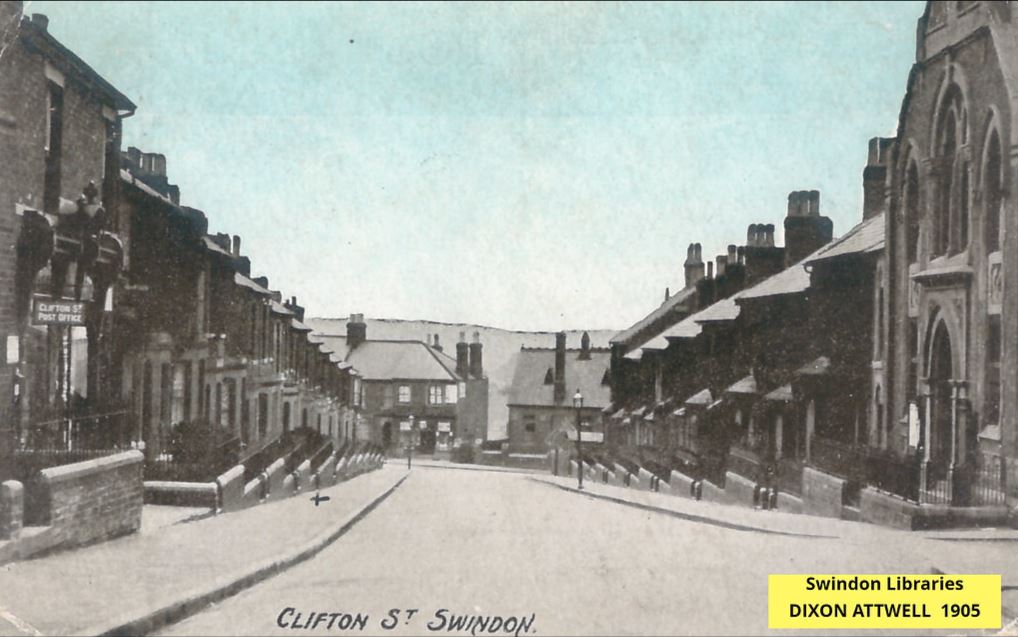
The shop in Clifton Street has had many different owners and many different shop fronts. In 1905 when Sarah Jane Wall was the Grocer and Subpostmistress it looked like this.
Swindon streets built in the 19th century grew piecemeal with each terrace built by a different builder. In 1883 E. Harvey was busy constructing eleven houses and a cottage in Clifton Street. James Hinton was also busy in this area of Swindon and in 1884 father and son firm, C. & G. Pettifer built a house and shop in Clifton Street. Could this be the premises the Wall family were living in at the time of the 1891 census?
Across the road once stood the Clifton Street Primitive Methodist Chapel. The original chapel was built in 1882 on land given by James Hinton. A much larger chapel was built in front of this in 1900, which can be seen in this photo. The chapel was still open in 1970 but was demolished soon after. Next to this are the Clifton Street gates to the cemetery.
Published courtesy of Local Studies, Swindon Central Library.
John Wall, Grocer and Dairyman moved to Swindon to run the General Shop in Clifton Street with his wife Sarah Jane and four of their six children. He died in 1899 and was buried in the cemetery just across the road from his shop. Sarah Jane carried on running the business with her two sons George and Charles and her daughter Beatrice.
Beatrice died in 1914 and was buried with her father in grave plot E8596. Sarah Jane died in 1935 and was buried with John and Beatrice.
The late Miss Wall – Residents in that district will miss the familiar figure of Miss Wall, of the Clifton Street Post Office, who has passed away after a long and painful illness.
The deceased lady was the daughter of the late Mr John Wall, who came to Swindon 30 years ago, and for a very considerable period she has been prominently identified with the business connected with the oldest sub-office in the town.
The funeral took place on Monday, the service at St. Saviour’s Church and the last rites at the Cemetery being conducted by the Rev. H.C. Brocklehurst.
A large number of friends assembled, and the principal mourners were: Mr and Mrs Loxwell Wall (Exmouth), Mr and Mrs Frank Wall (Swindon), Mr and Mrs Charles Wall (Swindon), Mr and Mrs Arthur Wall (London), Mr George Wall (Swindon), Mr W. Davis (Stonehouse), Mr V. Broadsmith (Cirencester), Miss E.J. Wall (Exmouth), Miss H.G. Wall (Swindon), Nurse Butcher and Mr. E. Higgins (Swindon).
Mrs Wall and family are very grateful for the loving sympathy extended during Miss Wall’s long and painful illness, and the kindness of neighbours is especially recognised.
Extracts from the North Wilts Herald, Friday, February 27, 1914.
It’s years since I’ve been to the Bowls Club. As a nipper I used to go regularly, most summer Sunday afternoons, with my dad. I used to enjoy the escape from my Granny’s house. Granny was a devout Primitive Methodist, which I didn’t object to – except on a Sunday. Then it was all prayers and meetings and no hot dinner. I don’t know how we managed to escape – my dad and me.
Dad was one of the first members when the bowls club was formed in 1912 – before the Great War. He was one of the many men who never came home and afterwards I had no desire to see the place where we had enjoyed so many summer Sunday afternoons. All those prayers Granny offered up came to nothing after all.
These days people tend to think of bowls as a game for old men, but my dad wasn’t an old man. He didn’t get to enjoy that luxury.
Perhaps I should get myself down there – to the bowls club – just for old times sake.
Death of Mr F. Morris
A Former Town Gardens Bowls Captain
Mr Frank Morris at one time a popular member of the Swindon Town Gardens Bowling Club, died on Saturday after a long illness at the home of his wife’s parents, 15 Prospect, Swindon.
He came to Swindon 16 years ago as manager of Pearks Stores and was associated with the Town Gardens club for many years, being captain in 1924.
Seven years ago he left Swindon for Redruth to take up a managerial position and after a year or so was transferred to Torquay.
Ill health overtook him and he returned to Swindon at the beginning of this year and was confined to his bed for most of that time. He leaves a widow.
A large congregation attended the funeral service at the Swindon Parish Church on Wednesday afternoon.
The first portion of the service was conducted by the Rev. H. Spence. The interment took place in Radnor street cemetery. The grave was lined with mauve and white chrysanthemums.
The chief mourners were Mrs F.J. Morris (widow), Mrs E. Ackerman, Mrs A. Tanner and Mrs A. Walker (sisters), Mr Alf Morris (brother), Mrs E. Morris and Mrs L. Morris (sisters-in-law), Mr and Mrs John Caudle (father-in-law and mother in-in-law) Mr and Mrs C Hope (brother-in-law and sister-in-law) Mr and Mrs Len Caudle (brother-in-law and sister-in-law) Mr and Mrs Fred Jones (brother-in-law and sister-in-law) Mrs W. Caudle (aunt), Mr and Mrs J.J. Carey (uncle and aunt), Mr Tom Neville and Mr Will Neville (uncles) Mr Geo. Neville and Miss D. Bennett (cousins), Mr A.H. Paget, chief inspector (representing Messrs Pearks Ltd.) Mr Swan (branch manager), Miss M. Hope, Mr G. Hope, Mr. Geo Heath and Mr T. Vallance.
North Wilts Herald, Friday December 16, 1932.
Francis Josiah Morris, aged 42, was buried on December 14, 1932 in grave plot D1081 which he shares with his first wife, Alice Maud Morris, who died in 1918.
William Henry Gladwin (known as Bill) was born in Malmesbury in 1883, the eldest of three children. His father died when Bill was a child and his mother married two years later. Her second husband was Albert Lea and they went on to have a further six children.
Bill was well known for playing his accordion, even taking it with him to the trenches of the First World War. One of the family stories is that along with entertaining his fellow soldiers, the German soldiers could also be heard singing along to his accordion.
Bill never married or had children, but was much loved by his large family, close to brothers and sisters, nephews and nieces, which makes the circumstance of his burial so surprising and still the cause of a deep family sadness to this day.
Bill was struck by a bus and killed after coming out of Bright Street Club in Gorse Hill on February 19, 1954. His burial took place a few days later, attended by members of his family.
Bill was buried in a public grave. This burial is when a person has insufficient funds to pay for the cost of the funeral and the expense is met by the local authority.
Bill’s surviving family members still find the circumstances of his burial upsetting and surprising and have numerous questions that sadly remain unanswered. They wonder why the large extended family didn’t club together to cover the cost.
Bill left a will in which his effects were valued at £32 14s 9d.
Many thanks to Mandy who told this story on one of our cemetery walks.








 Radnor Street Cemetery