Charles Robert Thompson – a carpenter’s suicide

Below you will read the awful story of Charles Robert Thompson. A story of a broken marriage, a runaway wife and a tragic suicide. It makes for dreadful reading. And in the middle of all this are two girls – the couple’s twelve year old daughter, Mabel Annie Thompson and a young servant girl, Beatrice Ferris.

Mabel was called as a witness at the inquest where she gave evidence about the events that had led up to her mother’s departure and her father’s state of mind and Beatrice told how she found the body of her employer.

It is impossible to imagine how these two girls were affected by the events of that terrible time and whether they ever truly recovered. There would have been no talking therapies available to them then nor probably any other form of help.

Mabel was born in Cirencester on January 11, 1891. In 1901 the family were living at 1 Stafford Street, although Charles’ name does not appear on the census as living with Emily and their three children. Was the marriage already in crisis?

In 1915 Mabel married George Woodward, a butcher with a shop at 107 Cricklade Road, Gorse Hill. At the time of her marriage she was living at Swindon House, The Square, Old Town. In 1939 Mabel was living at 220 Ferndale Road with her husband, three children and her father-in-law. She died in the June quarter of 1972, aged 81. She is not buried in Radnor Street cemetery.

A summer view across the cemetery

A Carpenter’s Suicide

Deserted by his Wife

A Pathetic Story

A further inquest was conducted by Mr W.E. Nicolson Browne at the Ship Hotel, Swindon this afternoon, touching the death of Charles Robert Thompson, carpenter in the employ of the GWR Co., residing at No. 12 Cambria Place, Swindon, who was found with his throat cut on Saturday morning.

Mabel Thompson, aged 12, daughter of the deceased, who gave her evidence admirably, said her father was 39. Her mother went away nine weeks ago with a Joe Barratt, and nothing had been heard of her. Joe Barratt was a lodger at deceased’s house, and was employed in the factory.

The Coroner: Was your father cut up about your mother going away?

Witness: Yes, sir. He mentioned it every day, and went to Cirencester and Glo’ster to try and find her.

Witness further said that Barratt was introduced as a lodger by her mother. One night her father had repeatedly to ask her mother and Joe Barratt to go to bed. They said they would go when they thought they would. A bill had recently arrived for her father who said on receiving it, he could not face it.

Beatrice Ferris, servant at deceased’s house, said she had been with deceased for six weeks. He had not in her presence or to her knowledge stated or hinted that he intended to take his life. He never drank to any extent. On Friday she bought him some brandy.

He frequently exclaimed, “Oh my poor head.” On Thursday he expressed a wish to be let alone when she went to rouse him she could not wake him. A bottle (produced) was found near him by his daughter Mabel. He woke eventually and went to bed. There was no disturbance during the night. On Saturday morning she saw a light in the w.c. She called to ask who was there, and receiving no reply, she pushed the door open and found Mr Thompson dead, with his throat cut. There was a chair there.

Hubert Knew, said he was living in deceased’s house at the time of the death. On Saturday morning he got up before six o’clock. He heard Mr Thompson shout from his room. “Who’s about?” He (witness) replied: “It’s only me,” and Mr Thompson said. “All right.” Deceased had appeared very much depressed lately. He knew that deceased and his wife had had a few words at times. Mrs Thompson had been away nine weeks.

Dr H. Brown, assistant to Dr Swinhoe, said he was called at 7.30 on Saturday morning to the deceased. He found the man dead with his throat cut, and a razor beside him. Death was due to haemorrhage, arising from the wound in the throat.

At this point a letter, which the deceased had left was handed to the Coroner. On the envelope was written: “My purse is on the shelf with all I have.” On looking at the letter enclosed in the envelope the Coroner said that there was no doubt the man had himself cut his throat, and he did not think it necessary that the letter should be read.

The jury returned a verdict of suicide during temporary insanity.

Swindon Advertiser Monday November 23, 1903

Charles Robert Thompson was buried on November 27, 1903 in grave plot C1395. He is buried with his wife Emily who died just three years later in November 1906. Also in the same grave are William S. Stone who died in 1929 and Charlotte Rose Wearing who died in 1933.

Henry Chatten – verdict ’caused his own death’

The jury delivered a verdict of ‘Accidental death’ while the Coroner added that Chatten had evidently been too zealous in attempting to unload the wagon himself, and thus caused his own death. Behind this tragic story is a further one of sorrow and loss.

Fatal Accident in the GWR Works, Swindon

A Labourer Killed

Inquest and Verdict

A fatal accident occurred on Tuesday morning last to a man named Henry Chatten, widower, aged 36 years and recently employed in the GWR Works. Deceased was killed by the falling of a log of wood, weight 16 cwt from a truck on which it was stacked. The log in its fall dashed Chatten against the sleepers of the line, breaking both his legs and killing him on the spot.

The Inquest was held on Thursday morning, in the Lecture Hall of the Mechanics’ Institute, New Swindon, before Mr W.E.N. Browne, County Coroner, and a jury of whom Mr Thomas Pearse was chosen foreman. The following evidence was taken:-

George Keen said deceased lodged with him at Dean-street, New Swindon. He was a sober, steady man and appeared in the best of health when he went to work at six o’clock on Tuesday morning. Witness heard no more of him until he was informed that he was dead.

William Mason, steam crane driver, then, stated that he was on duty on Tuesday morning, and whilst passing the truck of timber in question, he saw deceased laid down by the truck. He stopped his engine and cried out to some men of the staff, but when they reached Chatten he was dead. In answer to the Coroner, witness said he did not see the timber fall. He was about forty yards away when he first saw the deceased. There was no indication as to how the timber fell off the truck.

William Yeo, foreman of the timber gang, said there were 17 men working under him, and on Tuesday morning they were unloading the timber trucks. Deceased’s duty was to sweep up the yard and clear away the ropes, etc. He had no need to touch the trucks at all. In his opinion deceased had loosened the ropes of the truck and thus let the timber fall on him. The weight of the log was 16 cwt. Cross examined by the Inspector: The timber would not fall off the truck without a little jerk.

Dr. Grant, assistant to Dr. Swinhoe and Howse, stated that he was called about half-past seven o’clock on Tuesday morning. He saw deceased lying upon his back, and evidently a log had fallen from the truck and dashed the man against the sleepers, breaking both legs and fracturing the skull. He was quite dead. This was about twelve minutes after the accident, and death must have been instantaneous. A verdict of “Accidental death,” was returned by the jury, the coroner remarking that Chatten had evidently been too zealous in attempting to unload the wagon himself, and thus caused his own death.

Mr T.O. Hogarth watched the case on behalf of the GWR Company, whilst Mr. J.S. Maitland, of Bristol, Inspector of Factories and Workshops, was also in attendance.

Swindon Advertiser, Saturday, June 12, 1897.

Henry Chatten was born in Norwich, Norfolk in 1862, the son of John and Rachel Chatten.

By 1891 he had moved to Swindon and was working as a labourer in the GWR Works. At that time he was boarding with George Keen (the witness at the inquest) in Iffley Road.

The intervening years between 1891 and his death in 1897 are difficult to navigate.* There is a marriage of a Henry Chatten to Elizabeth Siney at St Stephen’s Church, Norwich in 1894 but this Henry Chatten describes himself as a greengrocer living at 73 King Street, Crooks Place, Norwich.

The details given at the inquest indicate that Henry was a widower and I have discovered the death of Elizabeth Chatten during the March quarter of 1897 – was this Henry’s wife? She does not appear to have been buried in Radnor Street Cemetery.

Henry was buried on June 12, 1897 in grave plot C853. He is buried in a public grave with four others. His address at the time of his death was 37 Dean Street.

And then another entry in the registers caught my eye. John E. Chatton, a 7 week old baby, was buried in plot C721 on February 20, 1897. The baby’s address was 37 Dean Street.

It would seem, therefore, that Henry lost both his wife and baby within a period of three months.

*spelling of name in transcriptions vary from Chatten to Chatton and Challen

Frank Chandler – draper and outfitter

The Chandler family was a large one and for many years the business of Chandler Brothers dominated the corner of Wood Street and Devizes Road.

Frank was born in 1860, one of John and Susannah Chandler’s large family and was running the business alongside his widowed father at the time of the 1881 census. He married farmer’s daughter Ada Keziah Edmonds at St Paul’s Church on June 10, 1890. He was 30 years of age and she was 23.

The couple’s first home was above the shop in Wood Street where a staff of eight boarded with them including three draper’s assistants, 2 dressmakers and a milliner.

Their only child, a daughter Ada, was baptised on April 21, 1891, at the church where the couple had married but sadly she died around the time of her first birthday.

At the time of the 1901 census Frank and Ada lived at South View, a house on the Sands in Old Swindon, just a short walk from the family business.

Death of Mr Frank Chandler

We regret to announce the death, which has taken place under painfully sudden circumstances, of Mr Frank Chandler, of South View, The Sands, Swindon, and a member of the firm of Messrs Chandler Bros., drapers and outfitters, 35, Wood Street, and Devizes Road.

The deceased gentleman, who was 46 years of age, and who leaves a wife, but no children, was recovering from a long attack of acute rheumatism. He went to Bournemouth, where he caught a chill, and he was compelled to return home. Unhappily, the chill was followed by complications which necessitated an operation being performed. Accordingly, on Saturday afternoon his medical attendant, Dr J. Campbell Maclean, accompanied him to London, where, at a surgical home, he was attended to. The operation took place on Saturday evening, but Mr Chandler, without recovering consciousness from the anaesthetic, died suddenly from syncope.

Mrs Chandler, who also accompanied her husband to London, and whose own health is by no means satisfactory, returned to Swindon soon after Mr Chandler’s demise.

Mr John Chandler proceeded to London very soon after hearing of his brother’s death.

The painful news was announced to a large congregation yesterday morning by Canon Estcourt before the sermon at the Parish Church, of which the deceased gentleman was a member, and the intelligence came as a severe shock to the many by whom Mr Chandler was intimately known.

The body will be brought to Swindon for interment.

By the death of Mr Frank Chandler, the town has lost an inhabitant who was held in the highest esteem. He was the youngest son of the late Mr John Chandler, and his long connection with the well known business in Wood Street brought him into contact with very many people. His gentlemanly and courteous bearing, his kindly disposition won for him a large circle of devoted friends to whom his sudden loss will occasion keen sorrow. What lends a further degree of painfulness to the event is the fact that, as stated by Canon Estcourt, the deceased gentleman was about to take over control of the whole of the important Wood Street business. Mr Frank Chandler never took any active part in the town’s affairs, though as a sterling business man he was warmly respected by all with whom he came into business contact.

At Swindon Parish Church on Sunday morning, the Vicar, Canon Estcourt, before commencing his sermon, referred to the sad death of Mr. Chandler. He said: As I was on my way to Church this morning I heard the distressing news of the death of Mr Frank Chandler, which took place after an operation which he underwent in London. He was, as you know, just about to take over the management of one of the large business establishments in the town. But God has seen fit to order things otherwise for him. I am sure today our sympathy and our prayers will go forth to his many relations, and to his wife especially.

The Evening Swindon Advertiser, Monday, November 19, 1906.

The Late Mr Frank Chandler

The Funeral

Amid every manifestation of deep sympathy and regret the funeral took place on Wednesday of the late Mr Frank Chandler, of the well known firm of Chandler Bros., Wood Street, Swindon whose sad death in London we announced last Monday.

The body was conveyed from Paddington by the train leaving there at 11.40, and arrived at Swindon GWR Station at 1.20 p.m. Thence it was removed to the Parish Church, where the first part of the funeral service was conducted by the Vicar (Canon E.W. Estcourt), who also officiated at the graveside.

The cortege, headed by a carriage laden with floral tributes, left the Church at 2.30, and proceeded to the Cemetery via Cricklade Street, Wood Street, Bath Road, Lansdown Road, and Kent Road.

Extract from the funeral report published in the Evening Swindon Advertiser Thursday, November 22, 1906.

The funeral took place on November 21, 1906 when Frank was buried in Radnor Street Cemetery in grave plot E8327. He is buried alone.

Stoker Tom Pictor

Tom Pictor was the eldest of John and Emma Pictor’s seven children. He was baptised at St. Mark’s Church on September 1, 1878 and grew up in the Westcott Place/Rushey Platt area where his father worked variously as a timber yard labourer, a railway labourer and a railway watchman.

Tom joined the navy on January 1, 1895 for a period of 12 years. By 1901 22 year old Tom was working as a steamship stoker. His naval records state that his date of birth was July 26, 1876, although his baptismal records and the census returns suggest he might have been two years younger than this. A physical description states Tom was 5ft 5½ ins tall with dark hair and a dark complexion, hazel eyes and tattooed rings on his fingers. In 1907 he joined the Royal Fleet Reserve from which he was discharged on January 8, 1912, declared medically unfit. However, he re-joined the RFR twelve months later.

Tom served on a number of ships including Vivid II, the Stokers and Engine Room Artificers School based at Devonport. The last ship on which Tom served was HMS Teutonic. Built for the White Star Line in Belfast in 1887 and launched in 1889, the Teutonic was one of the first armed merchant cruisers. The Teutonic served as an ocean liner travelling between Liverpool and New York City but reverted back to military use during times of war. During the Boer War, HMS Teutonic served as a troop transport ship and in 1914 it served as a convoy escort and troop transport ship. It was while the ship was berthed in Liverpool dock in December 1915 that Tom’s fatal accident occurred. His records indicate that during 1915 Tom served three periods of detention for being absent without leave.

Drowning Coincidence

Under somewhat similar circumstances two men employed on Government vessels whilst lying in the Canada Dock fell into the water on different dates and died from the effects of immersion. Inquests were held today.

In the first case the deceased man was Tom Pictor (44), a stoker, whose mother resides at Swindon. On Saturday night Pictor, when stepping from the gangway on to the ship slipped backwards and fell into the water and was drowned.

The second case was that concerning Thomas Henry Evans, aged 47, greaser in the Royal Navy, who belonged to Southampton. On the night of the 18th he was going on board his ship when he fell into the Canada Dock. He was rescued, and taken to hospital, where he died on Saturday from pneumonia.

“Death from drowning” was the verdict in each case.

The Liverpool Echo, Monday, December 6, 1915.

Tom Pictor was buried on December 9, 1915 in grave plot B1812, a public grave, which he shares with two others. The burial registers indicate he was 37 years old.

Pte. William Henry Thomas – art student

What did the future have in store for William Henry Thomas? It could have been so different. His mother Amy died in 1903. She at least was spared the horror of the First World War. The last time Henry saw his son he was an art student.

William Henry Thomas was born in 1888, the only son of Henry William and Amy Thomas and baptised at St Paul’s Church on March 25. He grew up at The Eagle Hotel where his father was licensed victualler. The Eagle stood on the corner of Regent Street and College Street and was demolished during the redevelopment of the area.

Read more about the Eagle here.

A Swindon Soldier’s Death

The distressing news is to hand of the death – killed in action on May 25th – of Pte. William Henry Thomas, of the H.A.C. He was the only son of Mr H.W. Thomas, of 63 Bath Road, Swindon, and was 29 years of age. Previous to joining the Army, about 18 months ago, Pte. Thomas had been studying art in London. He had been at the front since November last.

North Wilts Herald, Friday, June 1, 1917.

Until 9 April 1917, the Allied front line ran practically through the village of St. Laurent-Blangy. The trench (known to the Germans as Mindel Trench and called in 1918 McLaren Trench) was taken by the 9th (Scottish) Division on 9 April 1917, and the cemetery was made by the side of the trench after the battle. It was used by fighting units and field ambulances until September 1918, and was at times called Stirling Camp and St. Laurent-Blangy Forward Cemetery. Mindel Trench British Cemetery contains 191 burials of the First World War, nine of which are unidentified. The cemetery was designed by N A Rew.

From the Commonwealth War Graves website.

Thomas W.H. William Henry

Private 5116 A Company 1st Battalion

Honourable Artillery Company

Died of Wounds 25 May 1917 29 years old

Son of H.W. and Amy Thomas of 63 Bath Road

C24 Midel Trench British Cemetery St Laurent Blangy

One of the bells in Christ Church was bought by his father in memory of him in 1923.

Tell Them of Us by Mark Sutton

Mr J.C. Westmacott – Primitive Methodist Preacher

When John Christopher Westmacott died in 1931 the North Wilts Herald published a lengthy obituary. I visited his grave in Radnor Street Cemetery where I discovered an elegant headstone, which included an inscription dedicated to his wife who died twenty years later. When I saw that his wife included the name Morse in her name I presumed that he had married into the prominent Primitive Methodist Morse family.

Elizabeth Jane Morse Trotman was born in Stratton St. Margaret and her baptism was performed by Charles Morse. Elizabeth was the daughter of Jane Morse Austin who married Cornelius Trotman. Jane was the daughter of Robert Austin and his wife Elizabeth Morse who was the daughter of William and Elizabeth Morse of Purton, but as yet I have been unable to make that all important link with the mighty Morse family (and I bet you’re glad I’ve stopped trying!)*

John Christopher Westmacott married Elizabeth Jane Morse Trotman in 1898. The marriage was registered in the Hungerford area of Berkshire. By 1901 they were living in Kingshill before eventually moving to 133 Goddard Avenue. They had no children.

When Elizabeth died there was no fulsome obituary, just a brief death notice published in The Reading Standard on Friday March 16, 1951.

Westmacott – on March 9, 1951, at Prince of Wales Avenue, Reading, Elisabeth Jane Morse Westmacott, aged 81 years, widow of John Christopher Westmacott, formerly of Swindon, passed peacefully away. – Sadly missed.

Mr J.C. Westmacott

Death of a Swindon Local Preacher

Funeral Tributes

The funeral took place on Friday afternoon of Mr J.C. Westmacott, of 133, Goddard Avenue, Swindon.

Mr Westmacott, who was 60 years of age, was a member of an old Swindon family, and had been in the service of the GWR Company for many years. He was well known in Primitive Methodist circles, having been a local preacher for nearly 40 years. He leaves a widow, and is also survived by his widowed mother, who is now 87 years of age.

The first portion of the service was conducted at the Regent Street Primitive Methodist Church, by the Rev G. S. Hooson (supt. Minister), the Rev F.W. Harper (a former supt. minister at Regent Street Church and now at Wootton Bassett), the Rev. T. Sutcliffe, the Rev. F. Sellers, and Mr G.P. Pickard. Special hymns were sung, and the organist (Mr. A. Barrett) played the “Dead March.”

38 Years as a Preacher

The Rev. G.S. Hooson paid tribute to the good work Mr Westmacott had done as a lay preacher. He had been a faithful and loyal member of the Regent Street church and his chosen sphere of work was preaching. For 38 years he was a lay preacher, and during that period he rendered a true and complete ministry in the Methodist Church.

The interment took place in the Radnor street cemetery.

The family mourners were: Mrs J.C. Westmacott (widow), Mr. and Mrs. C.H. Westmacott, Mr and Mrs J.A. Westmacott (Stroud), Mr Wm. E. Westmacott, Mr and Mrs H.G. Westmacott (brother and sister in law), Miss F.A. Trotman (sister in law), Mr F.T. Trotman (brother in law) Mr H.C. Trotman (brother in law, of Reading), Mr R.R. Trotman (nephew, of Oxford), Miss Freda Parsons (niece), Mrs W.H. Watts, Mrs E. Austin (cousin, Highworth), Mrs T. Austin (cousin), Mr and Mrs Uzzell, Mr and Mrs Pockett, Nurse Booth.

The bearers were Messrs C. Hands, H.T. Budgell, W. Robinson, Gingell, Deaman and M. York (local preachers).

GWR Works Representatives

The representatives of the GWR Works were Messrs. F. Hyde (chief foreman), J. Bond, and B. Thorne (of J. Shop) E. Thomas (retired foreman), J. Summerhayes, R.W. Newport and F. Dennis (of the chair foundry).

Amongst the representatives of the Primitive Methodist Connexion were Messrs. W. Webb, J. Haydon. J.T. Robins, H. Martin, J.P., T. Minchin, W. Bayliss, Wheeler, Uzzell, G.H. Hunt, C.J. Iles, J.P. (Purton) H.J. Franklin, H.J. Hancock, W.T. Harding, and H. Thatcher.

The funeral arrangements were carried out by Messrs. Smith and Son, Gordon road, under the personal supervision of Mr. A.E. Smith.

North Wilts Herald, Friday, January 23, 1931.

*So, I returned to my research and managed to find the connection between Elizabeth Jane Morse Trotman and the prominent Primitive Baptist family by the name of Morse. Elizabeth traces her ancestry back three generations to William and Mary Morse of Purton. These were the parents of Charles Morse, leading figure in the Primitive Methodist Church in Swindon.

You might like to read:

Mr Levi Lapper Morse – the end of an era

Robert Affleck

I think this gravestone is a particularly attractive one.  Quite modest. It’s made from pink granite and the entwined ivy is a symbol of friendship, fidelity and immortality.

This is the grave of Thomas J. Stewart, a former blacksmith who was born in Scotland.  But the person I’d like to draw your attention to is Robert Affleck, his son-in -law, who is buried with him.

This is a photograph of Robert Affleck published with a report in the Adver at the time of his death, which described him as tall and upright and that up until his death he was still often seen walking in Swindon and the surrounding countryside.

The Affleck family left their mark on the streets of Swindon.  I’m sure you’ve all stepped over this type of drain cover (see below). Larger manhole covers also survive.

Robert Affleck was the eldest of William and Maria Affleck’s five sons, all of whom, I believe, joined the family firm.

William was born in Gateshead and served his engineering apprenticeship at Hawkes & Son before joining the prestigious Lambeth based engineering firm of Maudsley and Field.  This then led to a job with the GWR in Paddington and in around 1843 William moved to 33 Exeter Street and a job in the GWR Works.

By 1853 William had struck out on his own, establishing a foundry and engineering works in Prospect.  The 1861 census describes William as a machinist and coal merchant employing 17 men and 3 boys.

In accordance with William’s will his executors, who included Robert, put the business up for sale.  It was bought for £3,000 by two of the sons Frederick and Theodore Affleck.  There is an advertisement published in 1908 where they describe themselves as Millwrights & Machinists, Iron and Brass Founders – sole agents in the district for the “Vollmar” washing machine.

William and his wife are both buried in the churchyard at Christ Church, but Robert chose to be buried in Radnor Street with his father in law.

The Affleck sons all lived to a ripe old age.  Robert was 94 when he died in 1940. 

When Robert died in 1940 he left £11,541 2s 2d worth today about one and a half million.

Raymond George Cripps – first Mayor to be invested in new Civic Offices

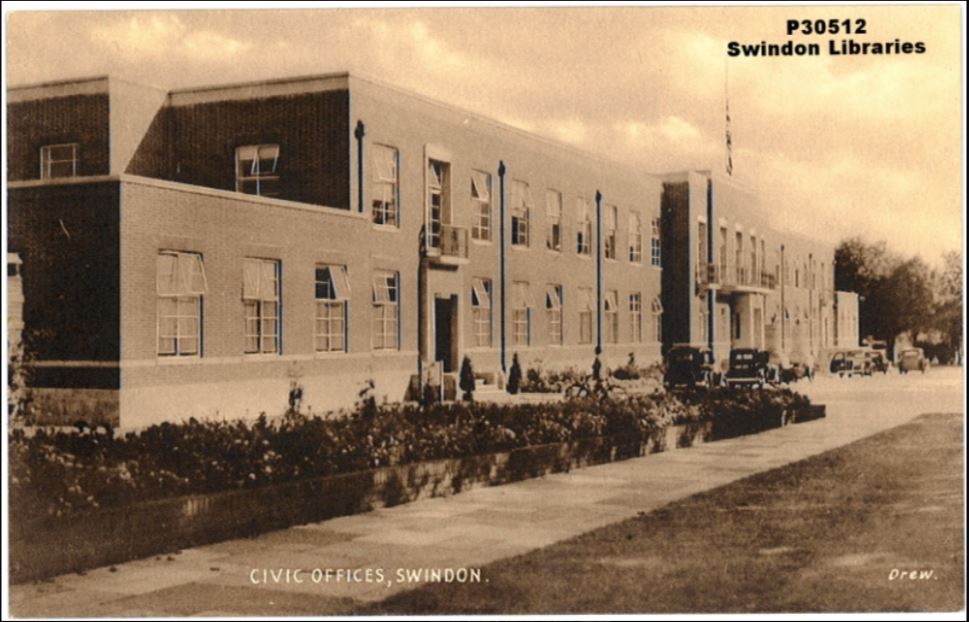
As Swindon residents eagerly await the opening of the temporary museum and art gallery space in the Civic Offices, let’s visit the opening of the building in 1938 and the first Mayor to be invested there.

The Civic Offices in Euclid Street were designed in a Moderne style by Oxford architects Bertram, Bertram and Rice and officially opened on July 5, 1938 by the Duke of Gloucester. The North Wilts Herald reported that ‘one of the highlights of the tour was when the Duke, with the Mayor, appeared on the balcony. His Highness was loudly cheered, and he waved an acknowledgement.’

The building was given a Grade II listing in 2020 when Historic England described it in the designation details ‘as a symbolic expression of Swindon’s civic identity during the interwar period.’

Image published courtesy of Local Studies, Swindon Central Library

Raymond George Cripps was born on December 18, 1877 in Kings Lynn, the son of Primitive Methodist Minister George Cripps and his wife Ursula Ellen. The family moved around the country following George’s ministry, but by 1901 George had retired and the family were living at 134 Goddard Avenue. Raymond was 23 years old and working as a railway clerk.

In 1906 Raymond married Beatrice Maud Raggett, the daughter of another prominent Primitive Methodist Henry Raggett and granddaughter of Charles Morse, one of the founders of the church in Swindon. The couple had two children, Cyril and Marjorie.

Raymond George Cripps first stood for office in the local elections of 1924 but was disqualified owing to his nomination papers not been filled in properly. He sought election the following year and continued to represent the King’s Ward.

Raymond George Cripps died aged 82 years at his home, 85 Croft Road. He was buried on January 25, 1960 in grave plot D85A which he shares with his wife Beatrice Maud who died in 1954.

Swindon’s New Mayor

Unanimous Election of Councillor R.G. Cripps

Labour’s Support

Just an ordinary man, unpretentious, not a Swindonian, but very proud of the town, in which he has lived for 40 years.

That was how Councillor Raymond George Cripps described himself on Wednesday when he was elected Mayor Swindon.

With the usual ceremonial his election was approved by the full Council, in the presence of members of his family and friends and representatives of the public life of the town.

Thirty-ninth in the list of Swindon Mayors, Mr Cripps, a retired GWR clerk, is the first Mayor to be invested in the new Civic Offices.

This year, for the first time in Swindon civic history, the members of the Council and visitors were deprived of the ceremony of robing and investiture with chain of office. This took place in an ante-room during a brief adjournment of the special Council meeting.

Mr Cripps made the customary reference to the work which lay ahead of the Council. He thought the dispute with the Wilts Standing Joint Committee over the police strength in Swindon would be settled on advantageous terms to the Council. The cattle market scheme would call for all the resources possessed by the Council in the way of financial judgment and wise planning. Mr Cripps described Swindon’s educational facilities as unequalled in the country, and he appealed for greater civic pride in the town.

Among those occupying reserved seats at the rear of the Council Chamber were the new Mayoress and members of her family the retiring Mayoress, Mrs Niblett, and Mrs L.J. Newman, a former Mayoress, the Rev. E. Banks and the Rev C.H. Cleal.

Mr Cripps election was proposed by Councillor A.E. Harding, and seconded by Ald. T.C. Newman.

In proposing Councillor Cripps as a ‘qualified person’ to be Mayor, Councillor A.E. Harding described Swindon as one of the best governed towns in the country. ‘Our offices and officials are second to none; we are proud of them.’

Then as an aside he made the suggestion to the Transport Committee that ‘bus conductors should be supplied with spectacles ‘so they might see people hurrying to catch the bus.’

Mr Harding spoke of the new Mayor’s church and Council work as providing excellent training for the exalted position he was to fill.

Tribute to Mrs Cripps and her ability to fulfil her duties was added by Mr. Harding.

Ald T.C. Newman seconded, and referred to his long association with Mr Cripps.

Labour’s Support

On behalf of the Labour group Coun. W.R. Robins supported the nomination and said the Mayor could rely on the support of his colleagues.

‘We differ in political allegiance but we are as desirous of doing the best for the town and people as any other members of the Council.’ Coun Mrs May George and Coun A.H. Wheeler also supported the nomination.

Coun. H.R. Hustings protested against the discordant note brought into the proceedings by the insult to the ‘bus conductors. He was very surprised at the remark being made on such an occasion of dignity. It was a very inopportune time.

The election of the Mayor was then approved unanimously, and the Council adjourned for a few moments while the new Mayor robed and was invested with chain of office.

When the new Mayor returned robed and took his place in the Mayoral chair he was loudly applauded.

The Mayor, speaking of Council work, said he was afraid that Swindon people did not appreciate the educational advantages of the town. He questioned whether any other town of its size could equal them.

Promising to do his work to the best of his ability he confessed that he had been tempted to withdraw after being proposed as Mayor-elect. He realised the responsibility he was assuming.

Referring to a reference in the Press in which it was suggested that he would need good humour, he said he could still see the funny side of things. ‘God help the man in public life who cannot,’ he said. He hoped to serve impartially and he knew the Mayoress would do all in her power to render service and forward any good cause in the town.

Provision had been made in current estimates for erection of a cubicle block at the isolation hospital. It was anticipated that during the coming year the Victoria road improvement would be completed, or at least substantial progress made.

The programme of educational development would, in the main, be completed and proposals for a central education and health clinic were approaching realisation.

North Wilts Herald, Friday, 11 November, 1938

You may also like to read:

Henry Raggett – a humble God fearing Christian

Levi Lapper Morse – the end of an era

Regent Street Primitive Methodist Chapel

Ada Ellen McHardy – always happy, always in a hurry.

A fatal road traffic accident and a mysterious ‘dark shadow’ on the road made front page news in the North Wilts Herald, Friday January 15, 1937.

Ada Ellen McHardy died of her injuries following the accident at the Bath Road and Goddard Avenue junction when she was struck by a car driven by Mr Edwin Bradley. Witnesses at the inquest referred to a ‘large black shadow’ seen on the road when wet, although it was not explained whether this shadow contributed to Mr Bradley’s driving or Mrs McHardy’s ability to safely navigate the road.

Ada Ellen Cave was born in Bath in 1860 the eldest of ten children. Her father Isaac W. Cave was an engine fitter and turner who moved to Swindon from Wolverton. In 1882 Ada married Robert S. McHardy, a clerk in the railway works. The couple and their two children lived at 24 Sheppard Street before moving to 53 Newhall Street, Ada’s home for many years.

Ada was a member of the Baptist Tabernacle and heavily involved with the work of the church (see newspaper report below). At her funeral the Rev. C.H. Cleal quoted – “As a writer in the Swindon Press rightly said of her. ‘She was always happy, always in a hurry, seemingly, to be about her Master’s business, possessing the helping hands of Martha, and the loving heart of Mary. She has left Swindon the poorer by her death.’”

Ada’s funeral took place on January 16, 1937. She is buried in grave plot D166 which she shares with her husband who died in 1902.

Swindon Resident Killed in Road Accident

Motor Car Driver Exonerated from Blame at the Inquest

Mrs Ada Ellen McHardy, president of the Swindon Women’s Free Church Council, was knocked down by a motor-car on Tuesday night and received injuries from which she died early on Wednesday.

The accident took place on Tuesday at about 7.45 at the junction of Bath-road and Goddard-avenue.

The car, which was driven by Mr Edwin Bradley, of 55, Okus-road, Swindon, was going along the Bath-road. Mrs McHardy was taken to the Victoria Hospital with head and leg injuries and died at 6.30 on Wednesday morning without regaining consciousness. She lived at 151 Goddard-avenue, and was 77 years of age.

For about 60 years Mrs McHardy had been a keen member and worker for the Baptist Church in Swindon, and it was only a month ago that she had a presentation made to her on her resignation of the post of secretary of the Baptist Women’s League of the church after 28 years’ service. In the year 1920 she was appointed a Deacon of the church, and for a few years occupied the office of Elder.

For 12 years she has represented the Church on the Wilts and East Somerset Association Executive Committee and was called to the presidency of the association for the year 1929. Always keenly interested in the young people, she was for many years a Sunday school teacher and was with her class last Sunday morning. She was a great help to the church in visiting the sick, while the Sewing Circle claimed her services since its formation nearly 50 years ago.

During Carnival week she was always a hard-working collector for the hospital, working for the council, and also at the stall run by the Free Church Council.

Loyal Worker

When Mrs J.F. Marquis, secretary of the Swindon Women’s Free Church Council, was informed by a “Swindon Advertiser” reporter of Mrs McHardy’s death, she expressed considerable concern. “I always found her a most conscientious and loyal worker,” said Mrs Marquis. “She was a woman of very high Christian character. She conducted our executive and general meetings most ably, and she will be greatly missed. I think I shall be expressing the general view of all the Free Church women of the town, especially those connected with the Baptist Church, when I say how sorry I am to hear the news.”

Mrs Marquis pointed out that this is the second loss that the Women’s Free Church Council has sustained during the past few months, Mrs Harrison, the vice-president, having died a short while ago. On Monday Mrs McHardy presided at a meeting of the council, when the question of filling the vacancy created by Mrs Harrison’s death was discussed.

The daughter of an engineer in the Great Western Railway Swindon Works, Mr Isaac William Cave, Mrs McHardy had lived in Swindon all her life. She was one of a family of ten, five girls and five boys, of whom two sisters and three brothers are living. She married Mr Robert Stewart McHardy, who was employed as a draughtsman in the Swindon Works of the railway and was a well-known figure in the town. Her husband died some years ago. For many years he was choirmaster at the Tabernacle. She had two children, a son and a daughter.

Before her marriage, Mrs McHardy was employed as a teacher at a College-street school. Her son is the Rev. Robert McHardy, B.Sc., of Chorley Wood, a Baptist minister, who received his education at Swindon College, and later at Aberystwyth University. Her daughter, Ethel, was also in the scholastic profession before her marriage to Mr Ernest Hughes, of Trowbridge. Her brother-in-law, Mr J. Ballinger, of 20, Goddard-avenue, is senior master at Even Swindon school.

The Inquest

A large black shadow which only appears on the road after rain, at the Bath-road and Goddard-avenue junction, in Swindon, was referred to by witnesses at the inquest at Old Town Police Station yesterday afternoon.

A verdict of “Accidental death” was returned, and the jury exonerated the driver of the car from blame.

Police Constable Worth, who was called to the scene of the accident, said he took up a position in Bath-road, over which a vehicle might normally be expected to travel. At the spot were three lights – a large green overhead lamp and two ordinary street lamps.

“Between two of the lights – the green one and a yellow,” he said, “was a large black shadow extending to Goddard-avenue in a triangular shape.

Witness went on to say that when he visited the scene on Wednesday night, the shadow was not there. Apparently it was only caused when the roads were wet.

In advising the jury, the Deputy-Coroner (Mr Harold Dale) said they should consider the question of a black patch which was caused by the green lights and the smaller ones.

Evidence of identification was given by Rev. R.S. McHardy, a son, who said his mother’s hearing was good but not perfect, while her eyesight was good.

Dr Christina Alexandra Gunn said Mrs McHardy was admitted to hospital about 8 o’clock. She was semi-conscious, and had a depressed fracture of the skull above the left eye and a fracture of the left leg. She died at 6.30 a.m. from hemorrhage of the brain as a result of the fracture of the skull.

Driver’s Story

The driver of the car. Edwin Bradley, 55 Okus-road, Swindon, said that on 12 January about 7.55 p.m. he was driving his car along Bath-road towards Okus-road.

“I passed Goddard-avenue,” witness went on “And the only person I saw was someone who stepped right in front of my car. There was no traffic about and I saw no other pedestrians.”

Answering the Deputy-Coroner, Mr Bradley said he did not see Mrs McHardy at all until she was directly in front of his car on the offside. She was then hardly more than a foot away from the front of the car.

“I pulled up as soon as I could – in the length of my car – and immediately jumped out.” The offside headlamp struck the woman and she was thrown forward.

It was a dark night and raining at the time. He had his side lights and a spot light on.

Asked by Mr Lemon if he had since visited the scene of the accident and noticed anything peculiar, witness said that in between the streets lamps was a black shadow, just where the accident happened. His speed was between 15 and 20 m.p.h.

“A Black Spot.”

Mr W.J. Colman, 77, Goddard-avenue, Swindon, said he was walking down the avenue towards Bath-road. “On reaching the junction I saw a car approaching from Bath-road. I stood on the zero (sic) to let it pass and it had gone 10 to 12 yards towards Okus-road when it pulled up with a sudden jerk.

“I walked along and found a woman on the ground lying about two feet directly in front of the car.”

Mr Colman said he noticed particularly a black spot in the road where the rays of overhead lights ended.

Mrs McHardy was lying seven or eight feet out from the kerb.

Mr Anthony Snow, foreman of the jury, expressed sympathy with the relatives, while similar sentiments were expressed by Mr H. Lemon, solicitor, Swindon, on behalf of Mr Bradley.

Mr D.C.A. Morrison, solicitor, Swindon, appeared on behalf of relatives of Mrs McHardy.

North Wilts Herald, Friday, 15 January, 1937.

Thomas Baker – Watercress seller and umbrella mender

My first impressions on reading the newspaper article regarding the death of Thomas Baker was that he was an elderly gentleman. It was not until I checked the burial registers that I realised he was just 33 years old.

His wife said he had never been a healthy man and his occupation as ‘watercress seller and umbrella maker’ suggested (to me) that he was an older man, possibly retired.

This newspaper report continues that Dr LeWarren checked for ‘marks of violence’ and decided that ‘the immediate cause of death was heart disease’.

Corner of Belle Vue Road looking down towards Christ Church

Sudden Death – On Tuesday, Mr W.E.N. Browne, County Coroner, held an inquest at the Bellevue Inn, Victoria Street, Swindon, on the body of Thomas Baker, a watercress vendor and umbrella mender, lately residing in Bellevue Road, and who died suddenly early that morning. Mr Job Day was chosen foreman of the jury.

Emily Baker, wife of deceased, was called and said her husband had never been a healthy man. He had often complained of pains in his chest. He earned a livelihood by mending umbrellas and selling watercress.

The previous day (Monday) deceased went out and came home to dinner at one o’clock. He then went out again and returned to tea at five o’clock. Afterwards he went to the Old Town Station to see if some watercress had arrived which he was expecting. At 9 p.m. he came home. He was quite sober, and had a half pint of stout and went to bed about ten o’clock. At a quarter past five in the morning he awoke her and said “Emily, I’m going to die.” She thought he had a fit, and she called to James Major, who was lodging in the house, and he came and said deceased was in a fit. They then sent for a doctor and also called in P.C. Crook, who was on his beat in that neighbourhood.

James Major, a watercress vendor, the man referred to by the previous witness, said Mrs Baker called him up, saying that her husband was dying. When he saw deceased he said, “Mrs Baker I think he’s dead.” He then went for a doctor, but on his return Baker was dead. He (witness) went to the Old Town Station with deceased the previous evening; they were expecting some watercress from Marlborough. Deceased had two glasses of stout whilst in his company Deceased was on good terms with his wife. Witness had heard him complain of pains in his side and chest.

Dr Frank LeWarne, assistant to Dr J.C. Maclean, said he was called to deceased about twenty minutes past seven that morning, and he went immediately, but found the man was dead. He examined the body, but found no external marks of violence. In his opinion the immediate cause of death was heart disease. He knew nothing of deceased, but had heard that he was medically attended about a year ago for influenza. The jury returned a verdict in accordance with the medical evidence.

The Swindon Advertiser, Saturday, February 29, 1896.

Thomas Baker of 21 Belle Vue Road was buried on February 29, 1896 in grave plot E7245. He was 33 years old.