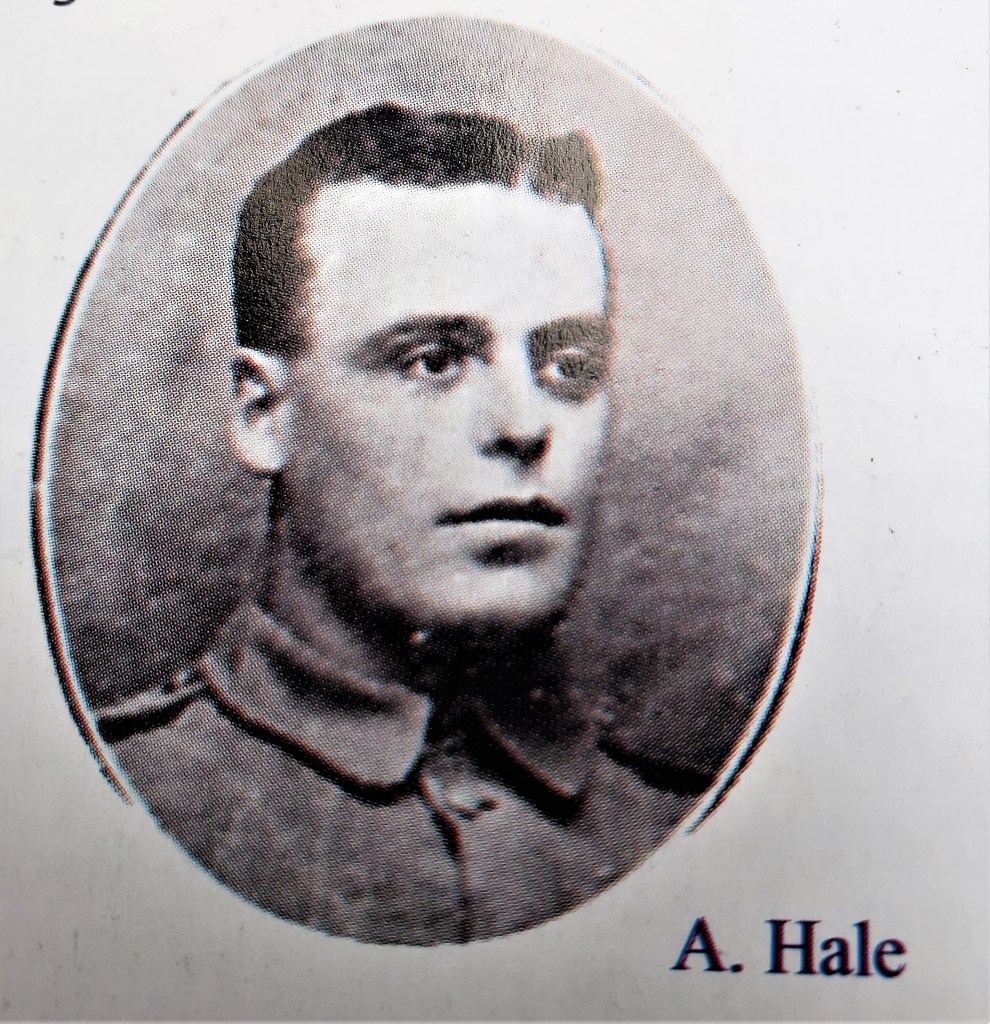
Jesse John Preater – brothers in arms

Three brothers died in the First World War, another returned with his health compromised. But what was it like for the two brothers who never went to war but stayed at home?

At the beginning of the 20th century the busy Preater family were running two businesses. Charles Preater ran first a haulage business before becoming licensee at the New Inn in Cromwell Street with his wife Mary Jane.

Harry Charles Preater was born on April 25, 1880 and baptised at St. Mark’s Church on May 27. He was the eldest of Charles and Mary Jane Preater’s nine children. In old photographs of Swindon you will see H.C. Preater’s garage at the Whale Bridge close to where the Leonardo Hotel now stands. Harry became a prominent business man and a Freemason. During the Second World War Harry was Secretary of the Swindon Penny a Week Fund, which raised £16,500 towards supporting prisoners of war. Harry died in 1968 and is buried in grave plot D65A.

Second son Jesse John Preater was born on April 2, 1882 and baptised at St Paul’s Church on May 14. By 1901 Jesse, then aged 18, was working alongside his father in the haulage firm. Ten years later his younger brothers Charles and John had joined him in that side of the family business.

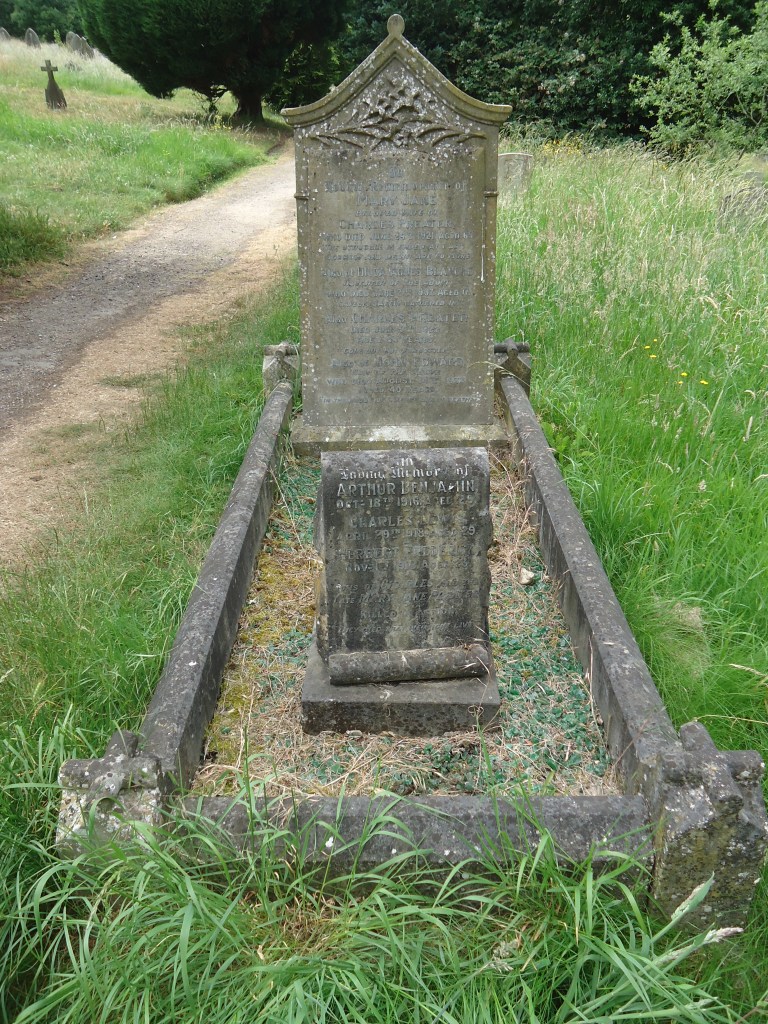
Arthur Benjamin Preater, Charles Lewis Preater and Herbert Frederick Preater were all killed in action, Arthur in 1916 and Charles and Herbert in 1918.  John Edward Preater served and returned home.

Why did neither Harry nor Jesse go to war? I’m sure their parents were relieved to save these two sons, but what was life like for them during and in the aftermath of the war. They shared their fate with many other men, but that couldn’t have made it any easier. Today we have a name for this condition ‘survivor guilt.’

Jesse married May Wallis at St Mark’s Church on October 4, 1915. Their son Charles Wallis Jesse was born in 1922. They are buried together in grave plot B2693 close to the grave where Jesse’s parents, his sister Hilda and John Edward, the brother who survived the war, are buried. A separate memorial commemorates the three brothers who were killed in action.
You may also like to read

Comrades of the Great War

Harry C. Preater and the Red Cross Penny a Week Fund

Lance Corporal Thomas Neate Harding – Tell Them of Us

The First World War was all about loss; loss of life and loss of prospects. Landed property was lost with the death of an heir; local businesses were lost when sons did not return, and in this case, families fell on hardship with the loss of a breadwinner.

Within the records of the UK World War I Pension Ledgers and Index Cards 1914-1923 published on Ancestry are claims mostly made by service personnel incapacitated by their military service, and war widows. However, Thomas Henry Harding, the father of Lance Cpl. T.N. Harding, made an application declaring he was a dependant of his son.

Thomas Neate Harding was baptised on July 15, 1888 in the parish of Holy Trinity, Slad. He was the only child of Thomas Henry Harding, a labourer, and his wife Caroline.

The family moved to Argyle Street, Gorse Hill, Swindon three years after Thomas’s birth. By the time of the 1911 census both father and son were employed in the GWR Works. Thomas Henry Harding worked as a wood sawyer and 23 year old Thomas Neate Harding as a Blacksmith’s Striker.

Caroline Harding died in March 1913 and is buried in a public grave in Radnor Street Cemetery. So now father and son carried on alone at home.

At the outbreak of war in 1914 Thomas Henry Harding was about 54 years old, his son 26. Thomas Neate Harding was not one of the early volunteers to join the army. Perhaps his responsibilities at home were too great. But with the introduction of conscription in 1916 he would eventually be called up, enlisting in July 1917 with the Royal Engineers and serving with the Inland Waterways and Docks.

Thomas Neate Harding died on February 12, 1920 at the Northern Hospital, Liverpool. He was 32 years old. His father made an application to the War Office for the cost of his son’s funeral expenses.

Administration of Thomas Neate Harding’s will was granted to his father in April 1920. His effects were valued at £173 7s 1d.

Thomas Neate Harding was buried in a public grave plot number B1271. The same grave in which his mother Caroline was buried.

Lance Corporal Thomas N. Harding is commemorated on plaque in St. Barnabas Church, Gorse Hill.

First published November 3, 2022.

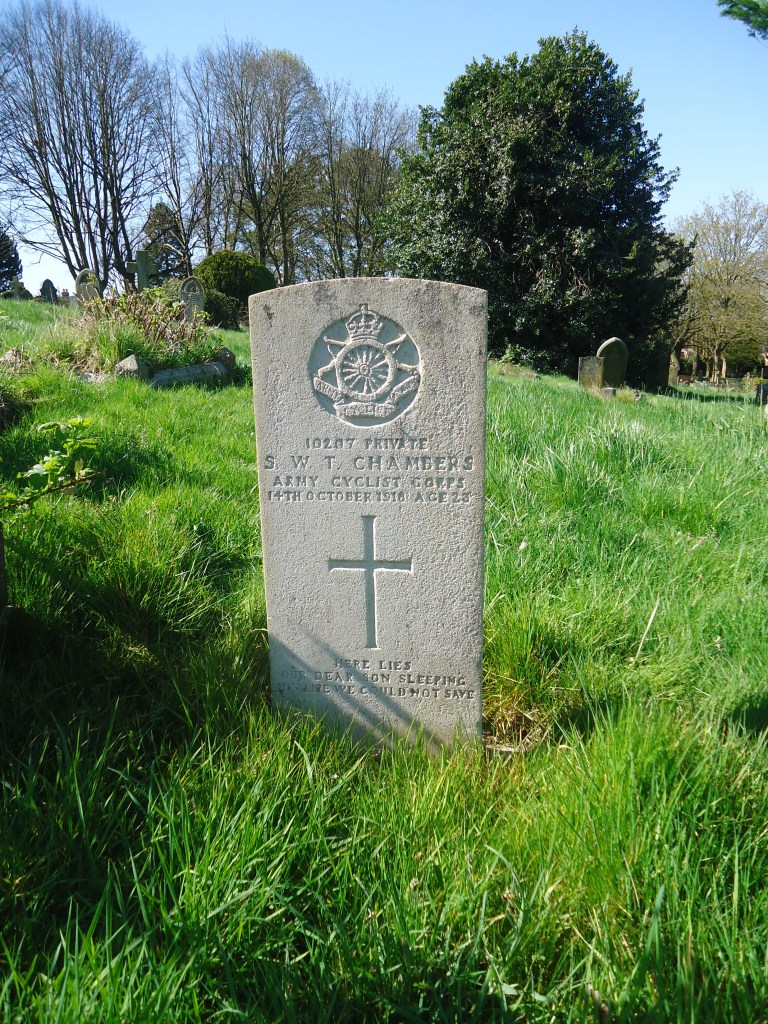
Sidney William T. Chambers – Army Cycle Corps

The re-imagined story …

In 1911 three of the Chambers uncles lived in Stafford Street; people used to jokingly call it Chambers Street. Actually, there is no Chambers Street in Swindon. Funny that really when you think how many other builders had streets named after them.

William Chambers lived and worked as builder and funeral director in the end house in Ashford Road, the one with the Calvary cross in the brickwork. You can still see it now, and the silhouette of the shop sign.

Sam, William’s youngest son took over the business when his father died. I suppose that’s pretty unusual when you think about it. You’d expect the eldest son to take over usually. After the war there were few elder sons left to carry on the family businesses.

Sidney was working in the business as a 15-year-old polisher. We all ended up working for one of the uncles. As kids there were always errands to run, materials to move, digging, sweeping. Uncle Sam could always find you a job to do although none of us liked helping in the funeral parlour.

My dad talked a lot about Sidney. They had grown up together, worked together, served together. They both came home. Dad unscathed, that is if you didn’t count the nightmares and the terrifying rages that so frightened us kids. Sidney only got as far as Devonport Hospital where he died on October 14, 1918.

Uncle Robert and Aunt Kate never got over his death. Some parents blamed the Hun, some blamed the government. Others blamed themselves.

It’s barely ten years since the war ended and sometimes it seems like yesterday. Some scars never heal. But those who died will always be remembered, well by my generation at least they will. It remains to be seen if those that follow will. Will anyone remember Sidney a hundred years from now?

The facts …

Sidney William T. Chambers was born in Swindon in 1895, the eldest of Robert and Kate Chambers’ four children.

He served first in the Cyclist Corps, later transferring to the Labour Corps. His military records do not survive.

Sidney died at Devonport Hospital on October 14, 1918. He was 23 years old. His funeral took place at Radnor Street Cemetery on October 19 and he is buried with his father and three other family members in plot C1052.

The inscription on the Commonwealth War Graves headstone reads:

Here lies our dear son sleeping

His life we could not save

First published January 15, 2022.

Air Mechanic Frederick Clarence Whatley

Continuing a series of articles in remembrance of Swindon’s sons who served in two world wars.

Frederick Clarence Whatley was buried in Radnor Street Cemetery on October 16, 1918 but when I discovered his cause of death it raised many questions.

Frederick was born on February 8, 1899, the second son of William George Whatley, a cost clerk in the GWR Works, and his wife Emily, and grew up in the Broad Green area of Swindon. Frederick started work as a Machine Operator in the Locomotive Department of the Works on April 30, 1913, transferring to the Carriage and Wagon Works on February 21, 1914.

Frederick joined the Royal Navy in July 1917 and was assigned to HMS Campania, a seaplane training and balloon depot ship. In March 1918 he was transferred to the RAF and served at No 1 School of Navigation and Bomb Dropping (Stonehenge) as a 3rd Class Air Mechanic.

Frederick died in a diabetic coma on October 12, 1918 at the Fargo Military Hospital. He was 19 years old.

Although diabetes was identified in the 17th century, no effective form of treatment was available until the discovery of insulin in the 1920s. Two Canadian scientists, Frederick Banting and John Macleod, were awarded the Nobel Prize in 1923 and there were many others experimenting on a treatment around the same date. Diabetes is a condition that remains a bar to military service today.

Did Frederick know he had diabetes? Was his condition recognised in 1917 and if so how did he pass a medical? Unfortunately his military records do not survive. The CWGC records state that he died from a chill and family history researchers once believed he died in a flying accident, however, his death certificate tells the true story.

Frederick is remembered on a memorial plaque that was once displayed in the Carriage and Wagon Works and now hangs in Steam Museum.

He is buried in a family grave in Radnor Street Cemetery.

#TellThemofUs

#MarkSutton

First published on July 27, 2022.

Mark Sutton

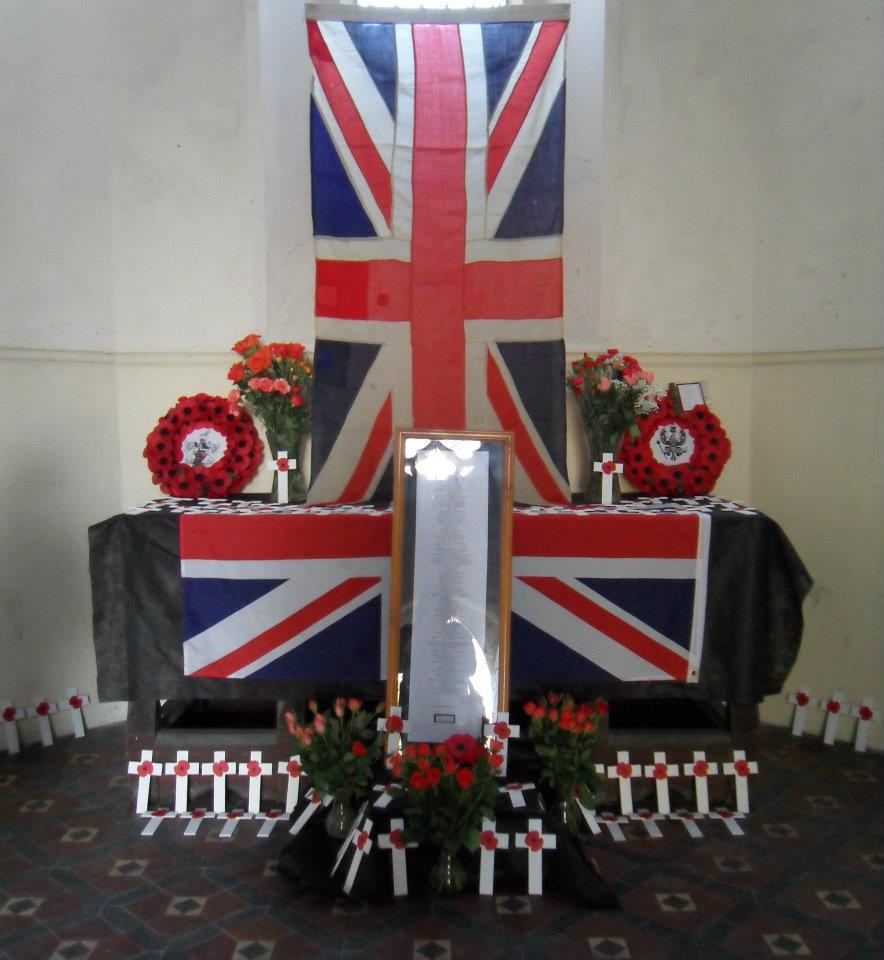
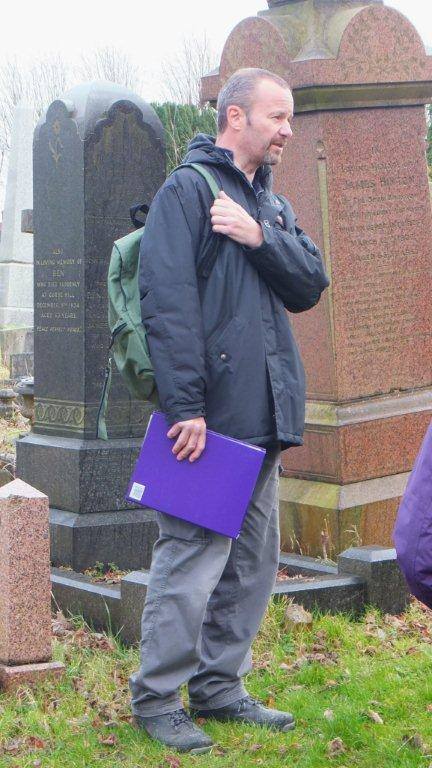
Join us tomorrow (Sunday November 12 at 2 pm) for a Service of Remembrance in Radnor Street Cemetery when we will commemorate all those who have died in war and as a result of their military service. We will also be unveiling a plaque dedicated to Mark Sutton.

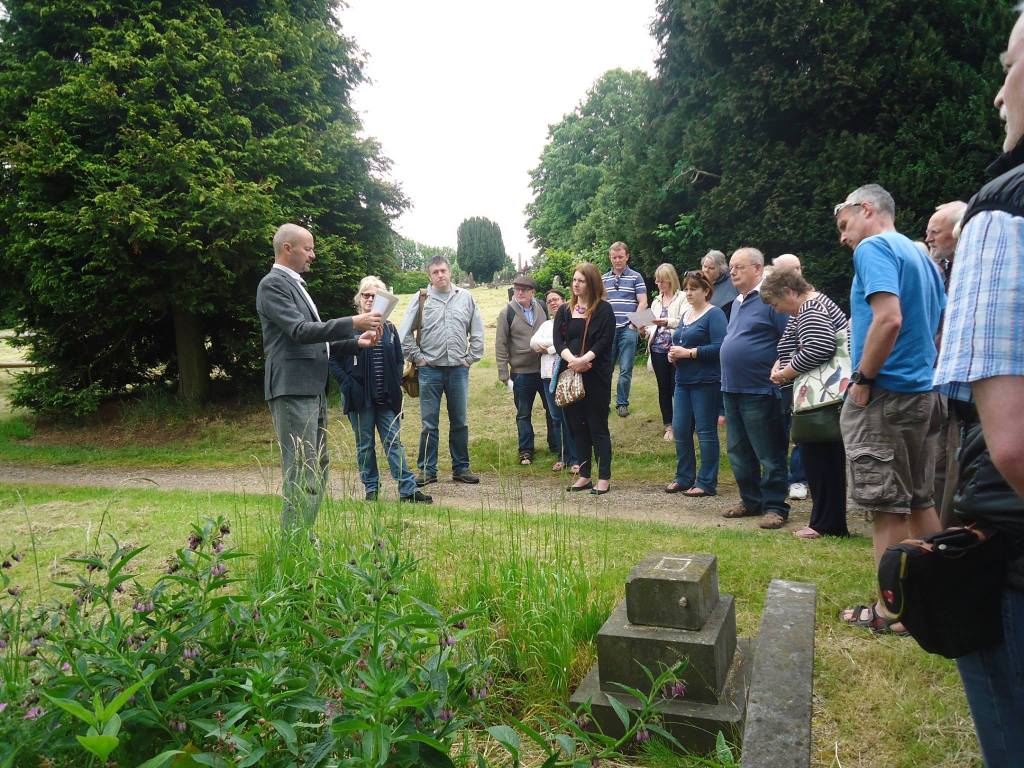
Radnor Street Cemetery was a very special place to Mark. For many years he conducted guided walks around the war graves, remembering the Swindon men who served in the Great War.

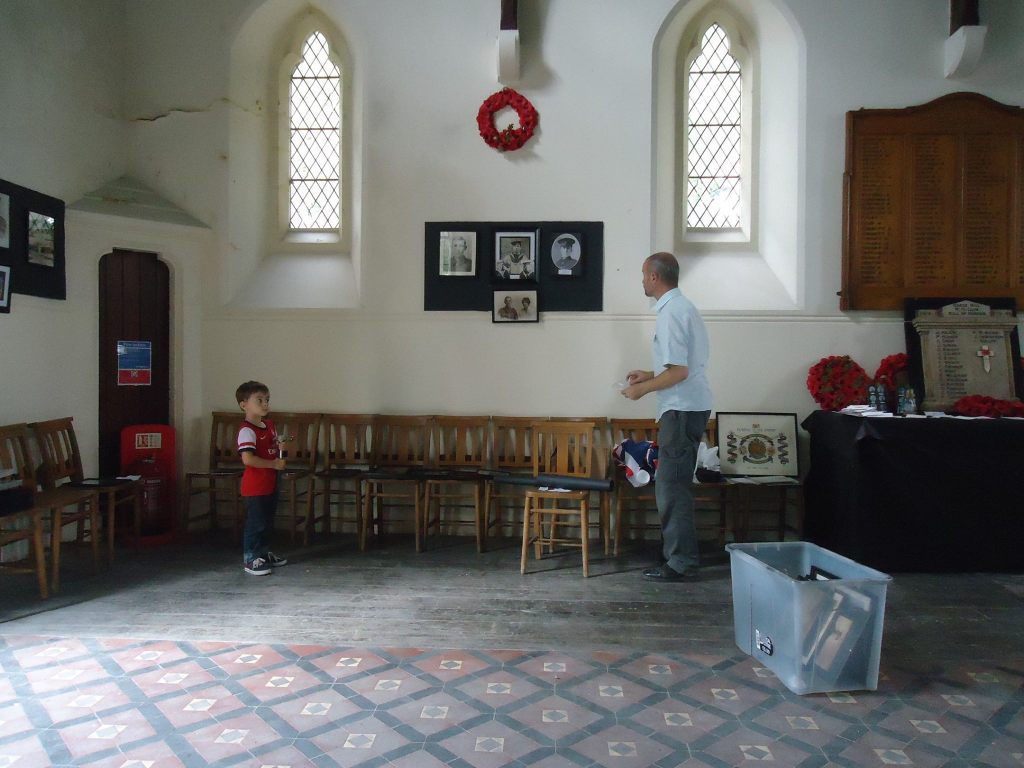
He organised the Remembrance Day Service at the cemetery conducted first by his father Dennis and later by the clergy from St. Marks, and he maintained the cemetery chapel where he saw the installation of several memorial plaques.

Mark was an inspiration and a friend and will always be remembered here at Radnor Street Cemetery.

William Jasper Hall – DSM

The re-imagined story …

Mr King held a whole school assembly the day the news was published. William Hall had been awarded the DSM, the Distinguished Service Medal for Honours for Services in Action with Enemy Submarines.

William Hall hadn’t been a pupil at Jennings Street School. By the time the school opened he was working as an Engine Fitter ‘inside.’ It was this job that made him ideally suited for the role of Engine Room Artificer.

We all knew the Hall family. They lived at 77 Jennings Street. My auntie lived opposite them at number 4. Everyone knew everyone in Rodbourne in those days. We all shared in the glory of one of our own being so honoured.

Less than a year later we all mourned his death as well. He wasn’t killed in battle. To expect another act of heroism from one man would be too much. William Hall died of pneumonia and pleurisy – another form of drowning, only not at sea.

Perhaps Mr King held another assembly. I don’t know, I had left school by then and was waiting to start my own apprenticeship in the Works. I was too young to serve, much to the relief of my mother.

By 1918 everyone knew of someone who had died in the war. It was like that in Rodbourne. But not everyone knew someone who had won the DSM.

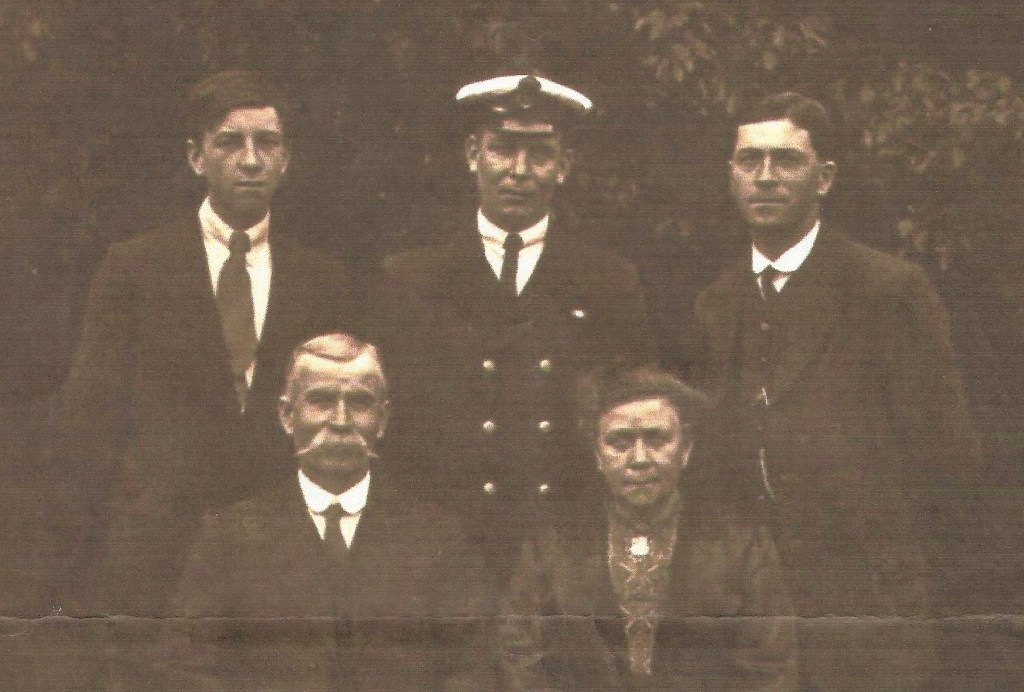
L to r Thomas Redvers Hall, William Jasper Hall and Frederick Charles Hall. Seated are their parents William Charles and Sarah (nee Kingdon) Hall.

The facts …

William Jasper Hall was born on November 6, 1888, the third child and second son of William Charles Hall and his wife Sarah. At the time of the 1891 census the family were living a 30 Jennings Street, Rodbourne on the very doorstep of the Great Western Railway Works. The family continued to live at various houses in Jennings Street.

William Jasper followed his father into the Works, entering the GWR Employment and a 7 year Fitters apprenticeship on his 14th birthday, November 6, 1902.

He enlisted in the Royal Navy on March 20, 1916 and completed his training period on the Victory II as an ERA (Engine Room Artificer) on April 28, 1916. His character and his ability were both described as Very Good.

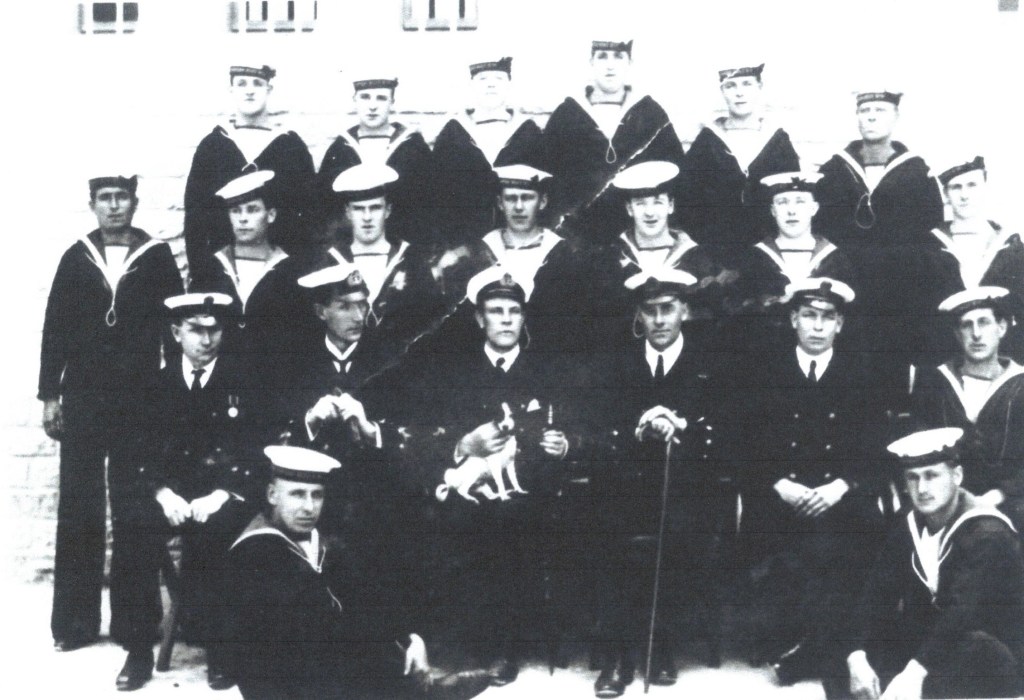
William Jasper Hall seated second on right

His naval records reveal that he served on HMS Cormorant, a receiving ship at Gibraltar where he joined the Freemasons at the Masonic United Grand Lodge in 1916.

In September 1917 William was awarded the DSM (Distinguished Service Medal) for Honours for Services in Action with Enemy Submarines.

By 1918 he was back on Victory II, a shorebased depot for Royal Navy Divisions at Crystal Palace and Sydenham. From here he was admitted to the Royal Haslar Hospital in Gosport where he died on September 14, his cause of death pneumonia & pleurisy.

Family recollections are that William caught the Spanish Influenza with a poignant postscript to the story. His mother Sarah visited the hospital where she was able to care for her son during his final days. Sadly, Sarah contracted the ‘flu and died two weeks after her son.

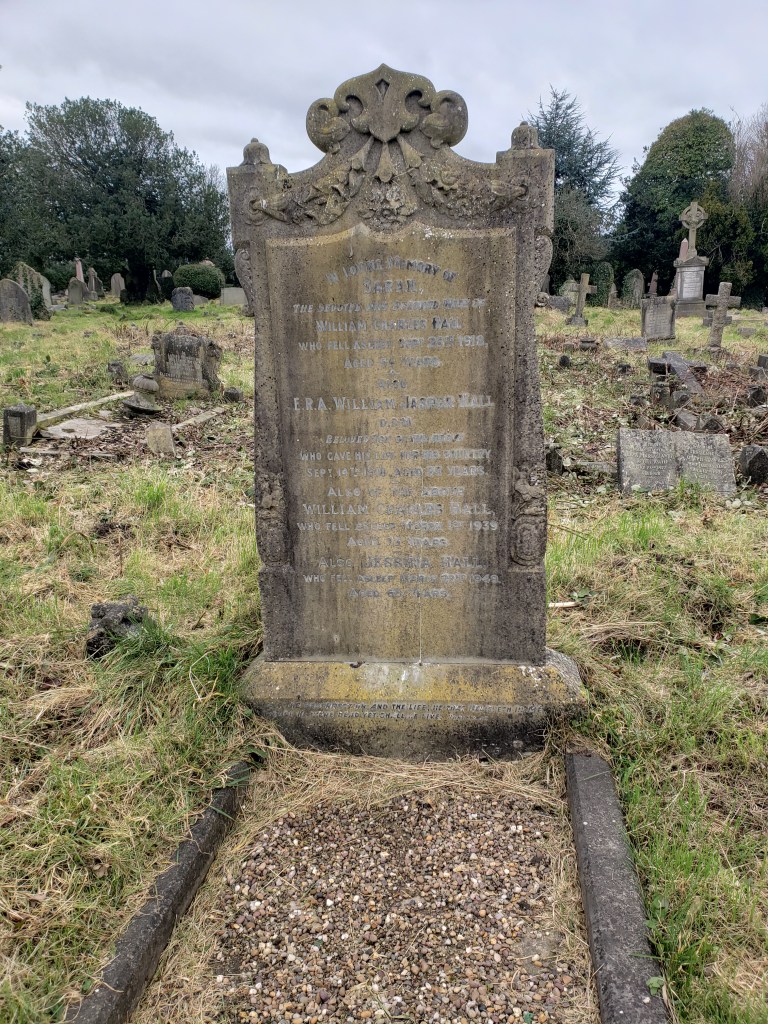
William was buried in plot E7464 on September 19. His mother Sarah was buried in the same plot on September 28. William Charles Hall died in 1939 and joined his son and wife. Jessina, William Jasper’s elder sister, died in 1949 and was buried in the plot with her brother and her parents.

Family photographs are published courtesy of the Hall family.

Originally published February 21, 2022.

L. Cpl. William John Nurden

Remembering …

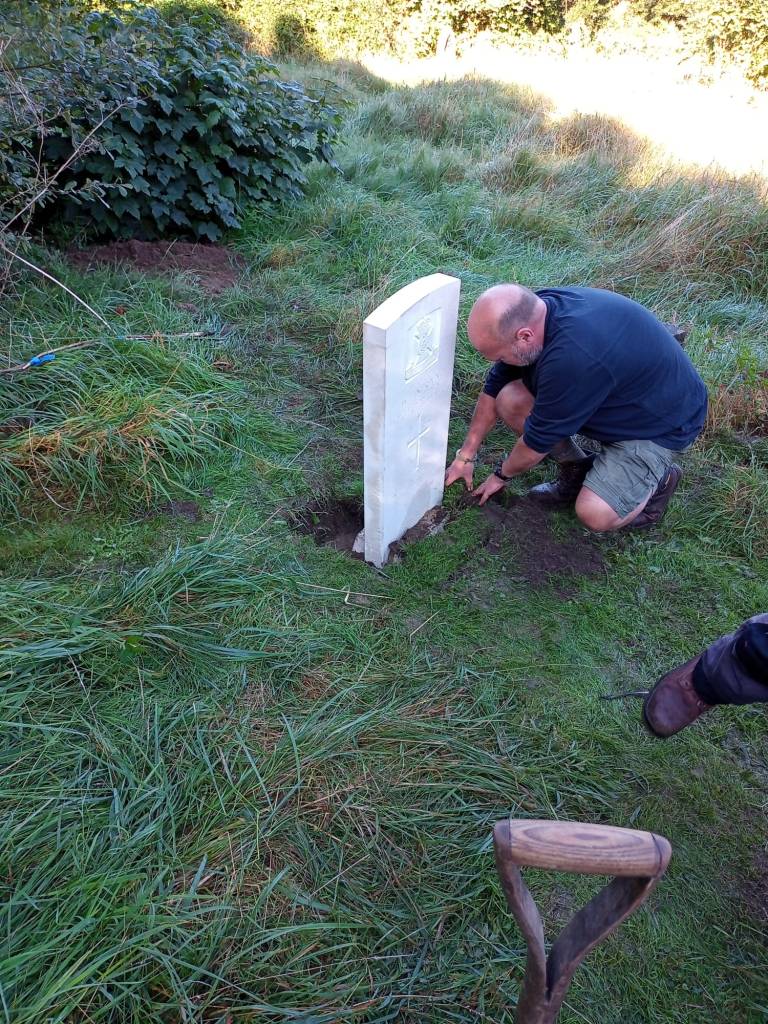
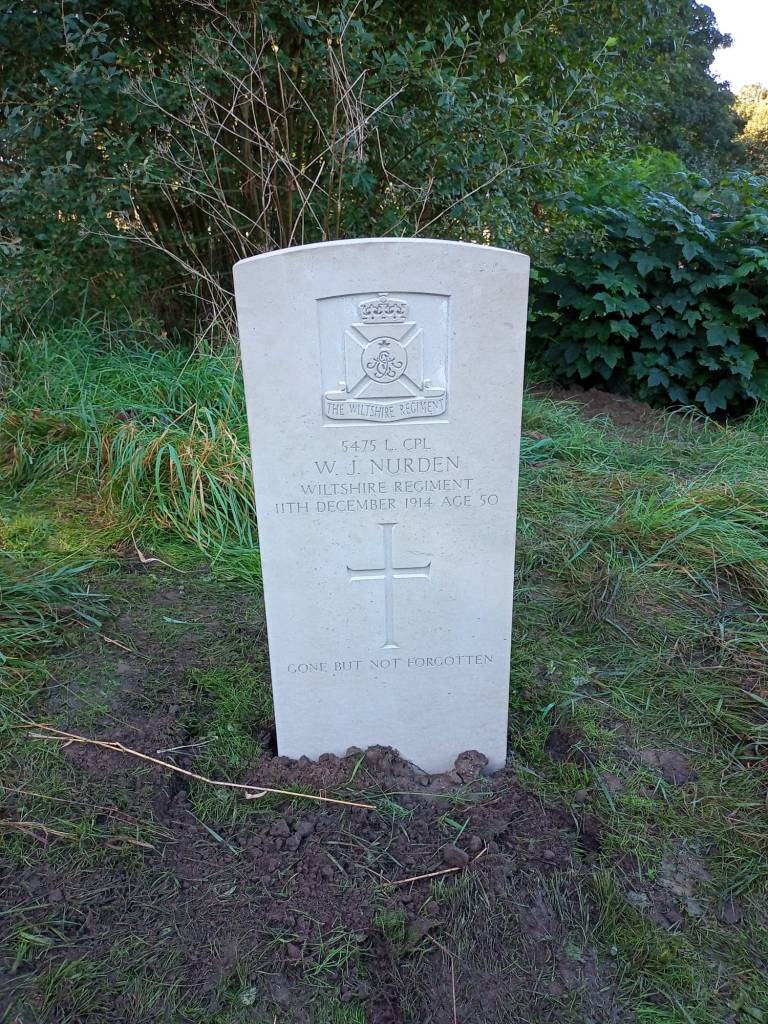
It was our pride and pleasure to mark the installation of the 104th CWGC official headstone in Radnor Street Cemetery in September 2021.

The headstone marks the grave of William John Nurden, a former blacksmith’s striker in the Great Western Railway Works, Swindon. On December 11, 1914 he was killed whilst serving as a Lance Corporal in the Wiltshire Regiment. He was working on the Amesbury and Military Camp Light Railway (also known as the Bulford Camp Railway) at Newton Tony when he was killed crossing the railway line whilst on duty.

A team from the Commonwealth War Graves Commission installed an official headstone on the unmarked grave of William John Nurden, more than 105 years after his death.

Members of his extended family joined us at the Service of Remembrance in November 2021. We hope you will join us for the Remembrance Service this year during which a plaque dedicated to Mark Sutton will be unveiled. The service takes place around the Cross of Sacrifice at 2 pm Sunday November 12.

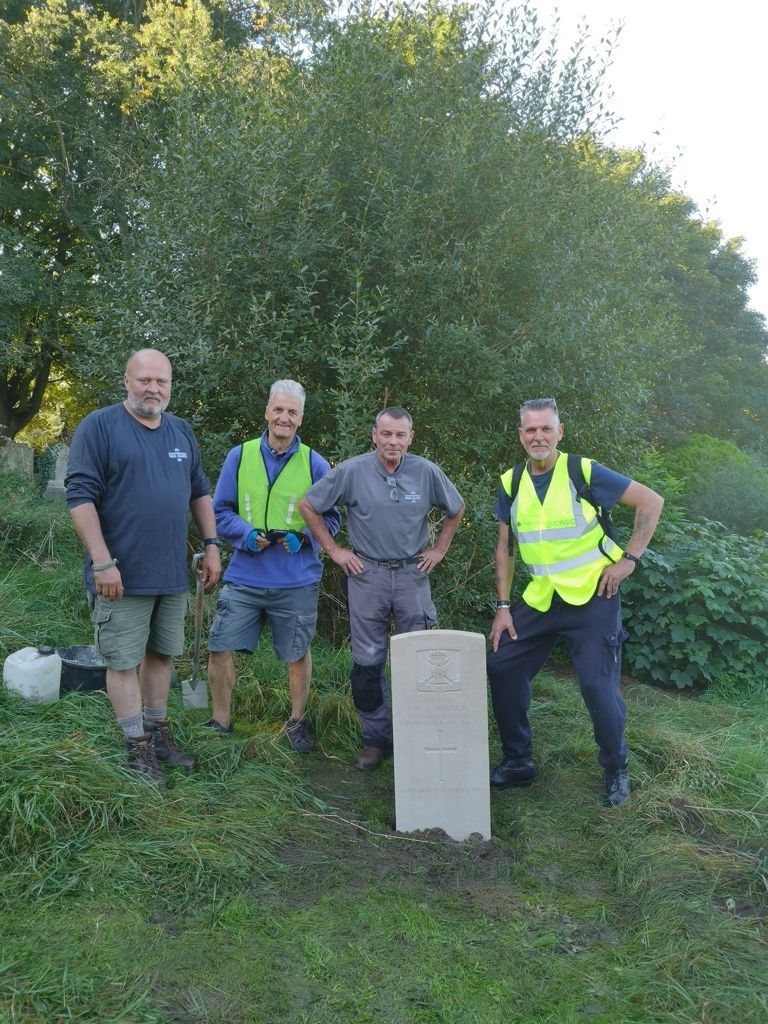
Radnor Street Cemetery volunteers with the CWGC team and the newly installed official headstone

First published September 20, 2021.

#MarkSutton #TellThemofUs

Lance Corporal Fred Jones

Fred and Emily’s boy didn’t have a grave, so they made a memorial for him in Radnor Street Cemetery.

Fred and Emily married in middle age. He was 45 and she was 41. They had both been previously widowed. Emily had a daughter Elsie Louise, Fred doesn’t appear to have had any children by his first wife. And then along came little Fred. Was he the apple of their eye? Was he their pride and joy?

Fred was a Lance Corporal in the 2nd Battalion of the Wiltshire Regiment when he was killed in action on May 30, 1918. He was 19 years old. He has no known grave and is remembered on the Soissons Memorial.

Emily died in December 1926 and is buried with her first husband John Williams in plot number A2494. Fred died in February 1932 and is buried with his first wife in plot number B2331.

The memorial to their son stands on Emily’s grave.

The original British Expeditionary Force crossed the Aisne in August 1914 a few kilometres west of Soissons, and re-crossed it in September a few kilometres east. For the next three and a half years, this part of the front was held by French forces and the city remained within the range of German artillery.

At the end of April 1918, five divisions of Commonwealth forces (IX Corps) were posted to the French 6th Army in this sector to rest and refit following the German offensives on the Somme and Lys. Here, at the end of May, they found themselves facing the overwhelming German attack which, despite fierce opposition, pushed the Allies back across the Aisne to the Marne. Having suffered 15,000 fatal casualties, IX Corps was withdrawn from this front in early July, but was replaced by XXII Corps, who took part in the Allied counter attack that had driven back the Germans by early August and recovered the lost ground.

The Soissons Memorial commemorates almost 4,000 officers and men of the United Kingdom forces who died during the Battles of the Aisne and the Marne in 1918 and who have no known grave.

The memorial was designed by G.H. Holt and V.O. Rees, with sculpture by Eric Kennington. It was unveiled by Sir Alexander Hamilton-Gordon on 22 July 1928.

published courtesy of the Commonwealth War Graves Commission website.

Post originally published on May 28, 2022.

No Victory without Sacrifice

Remembering …

Originally published on October 10, 2019.

The re-imagined story …

I was coming out of my apprenticeship in August 1914 and I knew I would soon be out of a job. They were laying men off at the Works and wouldn’t be taking on any newly qualified boilermakers.

Then England declared war on Germany and I enlisted with the Wiltshire Regiment the following week.

That was my reason for joining up. Other men had other reasons. Many enlisted because it was the right thing to do, God was on our side. Some joined up to be with friends and family. Others saw it as an opportunity to travel beyond the confines of Swindon and see a bit of the world and anyway, it would all be over by Christmas, that’s what everyone believed.

My mate Norman Lynes didn’t have an option. He had previously served with the Middlesex Regiment and was on the reserve list. Perhaps he had a different attitude to warfare, having already experienced it. I doubt whether he had a different attitude to being killed. We all wanted to come home. He wouldn’t have been any different.

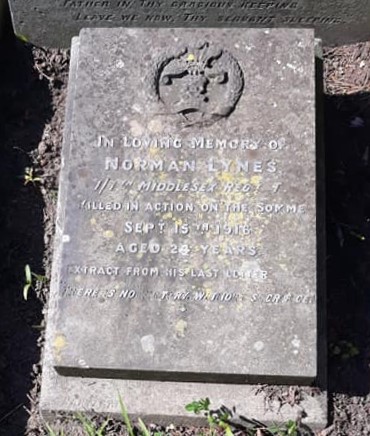
Norman was reported missing following the attack on ‘Bully Wood’ during the Somme offensive in September 1916. Everyone knew what that meant; he had been killed in action, yet his death wasn’t confirmed until a year later – a year later! Then his mother placed a plaque on his father’s grave. It’s quite worn now; you can still read the words taken from his last letter home.

There’s no victory without sacrifice.

I didn’t want to make that sacrifice and I bet Norman didn’t want to either.


Norman Lynes (2)


The facts …

Frederick Jesse Lynes married Ann Glover at St Mary de Lode, Gloucester on August 23, 1877. By the time of the 1881 census Frederick and Annie were living at 34 Catherine Street, Swindon with their daughter Maud aged 2 and five months old Frederick John.

Frederick was employed as a Steam Engine Maker and Turner at the GWR Works and by 1891 the family was living at 23 Carr Street, their home for more than twenty years. Their youngest child Norman was born there in 1892 and baptised at St Mark’s Church on February 22, 1892.

Frederick died in December 1904 and was buried on December 15 in grave E7187, a plot he shared with his mother Caroline who had died eleven years earlier. On his headstone is inscribed ‘for 25 years a member of St Mark’s Church choir.’

Frederick and Ann’s son Norman enlisted with the British Army at Hornsey on September 11, 1914. His attestation papers reveal that he had previously served in the 10th Middlesex and that his time had expired. He was 23 years and 11 months and a tall man, standing 6ft 2 and a half inches. With a chest measurement of 36 inches his physical development was described as good.

Norman served in Gibraltar and Egypt for seventeen months before being posted to France where he served for four months. On October 22 he was officially declared missing and on July 26, 1917 it was accepted that he was dead, his death assumed on or since September 1, 1916.

TF/200776 Private Lynes (1/7th Middlesex Regiment) name appears on the Thiepval Memorial Pier and Face 12D and 13B.

On September 20, 1921 Annie took receipt of her son’s medals – the 1914-15 Star and the British War & Victory Medals.


The 1/7th Battalion Middlesex Regiment served with the 167th Brigade, 56th (London) Division. They were on the Somme before the battle and helped dig assembly trenches near Hebuterne. On 1st July 1916 they were in reserve for the attack on Gommecourt. They trained with tanks in August 1916 near Abbeville and fought in the battles for Leuze Wood and Bouleaux Wood in September 1916. In one attack with the tanks on 15th September 1916 they lost over 300 men out of 500 who took part in the attack on ‘Bully Wood’. In October 1916 they fought at Spectrum Trench near Lesboeufs suffering nearly 200 casualties.

Thiepval Memorial published courtesy of CWGC

Frederick Jesse Lynes (2)

Pte. Alfred Hale – father and son

During this month of remembrance I will be telling the stories of those buried in Radnor Street Cemetery who died as a result of their military service.

The Commonwealth War Graves headstone on grave plot C3653 commemorates two military heroes who served in not only the Great War but in the South African campaign as well.

Alfred Hale born in c1869 in Enford, Wiltshire was about 17 years old when he enlisted with the Wiltshire Regiment in 1886. Having served for 7 years he was transferred to the Reservist List. In 1894 he married Mary Jane Paradise at the church of St. Mary the Virgin, Devizes. He was recalled to serve in 1898 and again in 1900. (A son born that same year was named Frederick William Mafeking). He was discharged and added to the Reservist List in 1902. Having received the Queen’s South African Medal with clasps he might have expected that this was the end of his military career. However, in September 1914 he was recalled to serve yet again, by then he was 44 years old.

Perhaps Mary Jane was used to being a soldier’s wife. Perhaps she never expected her husband would return from that terrible war in South Africa. But the outbreak of the Great War in 1914 must have brought a whole new level of worry when her eldest son Alfred enlisted and her husband was recalled.

3655 Pte Alfred Hale was discharged unfit to serve on September 25, 1916. He had cataracts in both eyes. His medical records state that his condition was not the result of and not aggravated by his military service and that an operation was advised. Alfred returned to his home at 163 Beatrice Street, Gorse Hill. He died at the London Hospital on November 7, 1919 aged 49. He was buried in grave plot C3653 on November 13, 1919.

200214 Pte Alfred Hale, aged 24 was serving in Israel and Palestine when he died from pneumonia on February 21, 1919. He was buried in Ramleh War Cemetery. He left £30 11s 11d to his mother, which included a War Gratuity of £26 10s.

Father and son are both remembered on a CWG headstone. The inscription reads:

3655 Private A. Hale

Wiltshire Regiment

7th November 1919 Aged 49

Also in memory of his son

200214 Pte A. Hale

Wiltshire Regiment

21.2.1919

Sharing the grave with Alfred is Mary Jane, his wife, who died in 1958 aged 85 years old. The inscription reads ‘Rest After Weariness.’ Buried with them is their son Frederick William Mafeking who died in 1953 and George Saloway, their daughter’s husband, who died in 1954.

Tell them of Us by Mark Sutton