Ernest Abraham Rivers and a home fit for heroes – Tell Them of Us

And then there were those who came back – to a home fit for heroes.

Ernest Abraham Rivers was born in 1882 the second youngest child of James and Elizabeth Rivers’ large family. Ernest worked as a bricklayer and builder and married Eliza Painter on August 5, 1903. Eliza was born in 1882, the middle child of John Painter and his wife Hannah. Ernest and Eliza went on to have their own large family; their eldest son George Rivers (sometimes known as Painter) was born on October 13 1902, ten months before they married.

The family lived at 23 Prospect Hill when the 1911 census reveals they had five children, George 8, Raymond 7, Lancelot 5, Avis 3 and six months old Edna. They would go on to have another four children – Eileen born in 1913, Myrtle in 1915, Winifred in 1916 and Eric who was born in the summer of 1918.

On August 4, 1914 Britain declared war on Germany and at the end of 1915 Ernest joined the Royal Engineers leaving a wife and seven children behind in Swindon. Unfortunately, his service records are incomplete but it seems unlikely that he ever saw service overseas. Following his attestation he was sent to the army reserve before being mobilised to the Royal Engineers Depot W. Lancs. It was here that he served for 1 year 108 days before being discharged as no longer physically fit for War Service, suffering from a prolapse rectum, apparently a pre-existing condition that dated back to 1913.

Ernest returned to Swindon and his job as a bricklayer but in 1918 tragedy hit the family with the death of Eliza aged just 37. She left behind nine children including a baby just a few months old.  There was no money for a private grave plot and Eliza was buried on November 13 in a public grave in Radnor Street Cemetery with four other unrelated people.

In 1939 war loomed large again. Ernest was living at 23 Prospect Hill with his two unmarried daughters. He had never remarried. That same year, youngest son Eric married Emily F. Gadd but sadly they would not have a happy ever after ending either. Gunner Eric Rivers, a member of the Field Rgt Royal Artillery, was killed on February 21, 1945. He was buried in Jonkerbos War Cemetery, Nijmegen Part 2, Belgium.

Ernest Abraham Rivers died in February 1951 aged 68. His last address was 23 Prospect Hill, the home he had shared with Eliza all those years ago. He was buried on February 24, 1951 in a public grave plot B1940, with four other unrelated people.

We continue to gather around the Cross of Sacrifice in Radnor Street Cemetery each Remembrance Day to remember those who sacrificed their lives in two world wars and those who died in more recent conflicts. And we remember those who returned but whose lives were never the same again – Tell Them of Us.

William Dorling Bavin – Swindon’s War Record

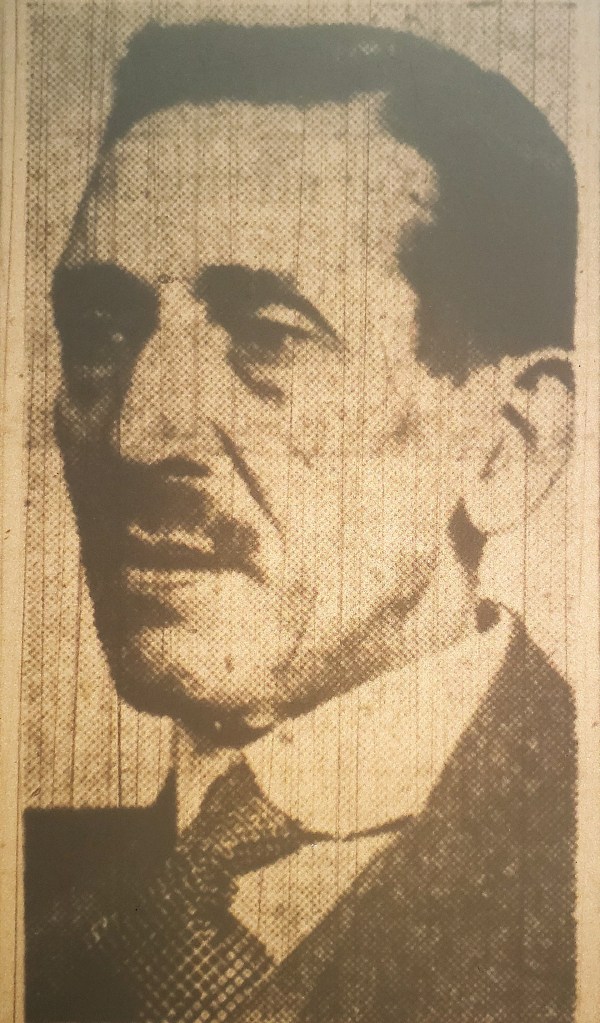
William Dorling Bavin wrote the definitive book recording the story of Swindon during the First World War. Commissioned by Swindon Borough Council and published in 1922 Bavin compiled a complete record of local activities, charitable and otherwise, in connection with the war. It is a book which has been the source material for so many others and to mark the centenary of the First World War a facsimile copy was published by Local Studies, Swindon Central Library and is available from the Library Shop.

W.D. Bavin was born in Lincoln in 1871 and spent his early career as an assistant tutor at Westminster Training College, London and later as an instructor of pupil teachers at Bath Technical College. In 1897 he was appointed the first head of the Swindon Pupil Teacher Centre for teachers at Swindon Board Schools.

His other appointments included head of Swindon Higher Grade Elementary School and headmaster of Sanford Street Boys School.

William D. Bavin married twice. His first wife Jessie died in 1915 and his second wife Helen in 1959. Bavin died in 1948 and is buried with both his wives.

Swindon J.P.

Death of Mr W.D. Bavin

After a short illness the death occurred in the Victoria Hospital this morning of Mr W.D. Bavin, aged 76, of 160 Goddard-avenue, Swindon a retired headmaster of Sanford-street Boys’ School.

Starting his career as a pupil teacher in 1889 at Lincoln he completed his training at Westminster Training College and was then engaged as a resident tutor.

Two and a half years later he took up an appointment at Bath Technical College as head of the pupil teachers’ centre department and was then appointed head of the Pupil Teachers’ Centre which opened in Swindon in 1897.

In 1903 he became head of the Swindon Higher Elementary School and in 1919 was transferred to the headmastership of Sanford-street Boys’ School when his elementary school was converted into a secondary school.

For some years he was the National Union of Teachers’ representative on the Education Committee and was vice-chairman of the Swindon Juvenile Employment Sub-Committee. He was also founder and chairman of the After-Care Committee.

His activities for youth had not been confined to school service however. He was founder and treasurer of the Swindon Triangle Boys’ Club, and for many years was the president of the local Sunday School Union.

Mr Bavin was also the author of various works on mathematics and local history and his record of Swindon’s part in the 1914-1918 war received compliments from universities in America, France, Scotland and Wales. He wrote two volumes on teaching for Sunday School teachers and since 1918 had written the annual Sunday School Union handbook.

He was a Borough magistrate

Swindon Advertiser January, 1948.

W.D. Bavin

The Richman brothers – Tell Them of Us

The re-imagined story …

The late Autumn sunshine glances across the cemetery. Everyone says how unseasonably warm it is this year. The Scouts who stood around the Cross of Sacrifice on Remembrance Day struggled in their uniforms. One little chap fainted. He hit the ground with such a thud. Never seen that happen before. November is usually a bleak month; the weather bitter, the memories more so.

I’ve walked past this grave so many times over the years, but do you know what, I can’t remember what once stood atop the memorial. Perhaps they placed an angel here after Isabel died. I wonder if her father ever got to meet his little daughter. Most probably it would have been a cross though, I think. What happened to it? Did it topple over during a winter storm?

The cemetery volunteers will be around in a little while. I see them most Thursdays. They do a fantastic job keeping the war graves clear. And not only the official ones but the monuments like this one, too. Today the distinctive feature about the dilapidated memorial is the inscription:

In Loving Memory of Private Alfred George Richman 5th Wilts Rgt Husband of F.E. Richman Died in Mesopotamia Feb 19, 1917 Aged 32.

Private Archibald David Richman Machine Gun Corps Died in France Feb 4th 1918 Aged 21 sons of D. & S.J. Richman.

I remember the Richman family like it was only yesterday. But can I remember what stood on the top of this monument? Perhaps it will come to me later.

The facts …

When David Richman completed the 1911 census returns he recorded that he and his wife Sarah Jane had been married 28 years. They had five children, all of whom were living. By the time of the next census in 1921 they had lost two sons.

In 1911 Alfred George Richman lived at 18 Plymouth Street. He was 26 years old and worked as a branch manager in a grocery store. He had been married to Frances Edith just under a year. They would go on to have three children, Kenneth and Raymond and little Isabel who was born in 1916 and died in 1917. In 1911 Archibald David was just 14 years old. He lived with his parents and his elder brother and younger sister at 10 St Margarets Road, working as a grocery apprentice alongside his father. Another elder brother Frank was also married. He worked as a railway clerk in the GWR Works and was married to Annie Mary. They lived at 86 Kent Road with their baby daughter Phyllis Irene.

Archibald David Richman is buried in the Hazebrouck Communal Cemetery, one of 877 Commonwealth burials of the First World War (17 of them unidentified).

Alfred George Richman is buried in Amara War Cemetery in modern day Iraq where his name is recorded on Panel No. 39 XXVII E.

Those buried in grave C1575E are Fanny Withey, Sarah Jane Richman’s sister. She died in January 1910 and her burial took place in Radnor Street Cemetery on January 31, 1910. Isabel Annie Richman is buried in the same plot. She was buried on March 14, 1917 the daughter of Alfred George and Frances Edith Richman. She was just 15 months old.

Walter William Palmer – Tell Them of Us

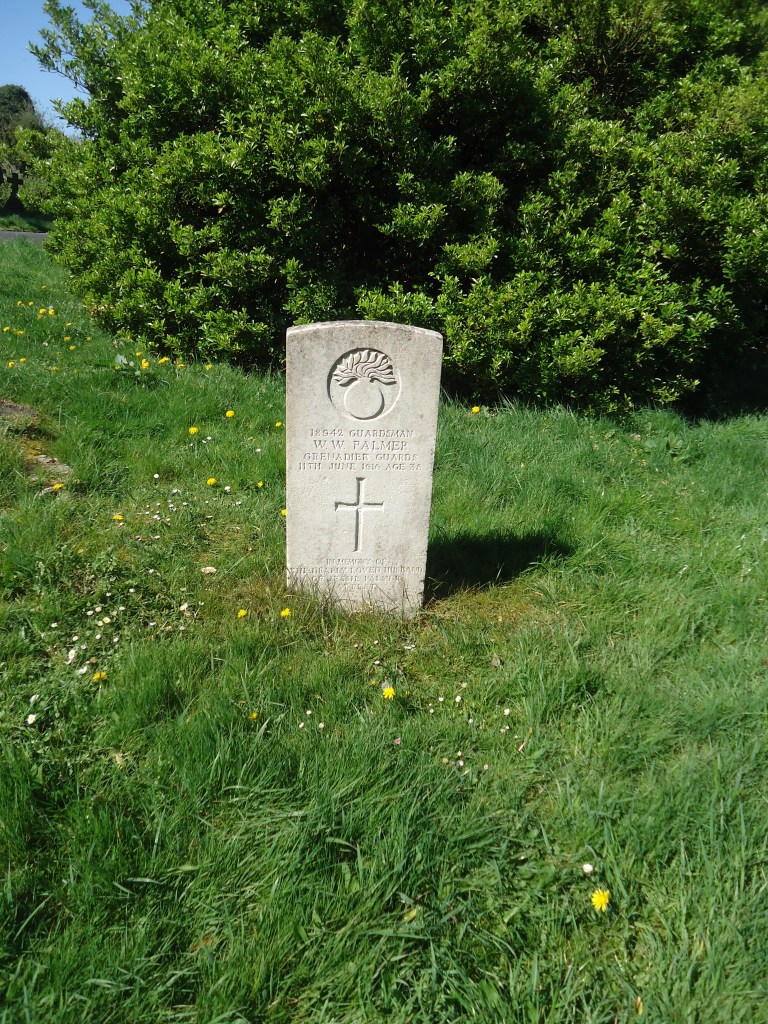
Walter William Palmer was born in 1878, the son of Stephen Palmer, a general labourer, and his wife Selena, and he grew up at 70 Gooch Street.

He first enlisted with the Coldstream Guards, later transferring to the Grenadier Guards, on September 4, 1894 as an 18 year old when he gave his occupation as an engine cleaner. His height is recorded as 5ft 11¼ inches.

His military records remain largely intact and we can learn all about his service and his medical history.

He served for 12 years and along with periods at home he served in Gibraltar, Egypt and South Africa. He was awarded the Queen’s Soudan Medal for service in the Soudan Campaign 1896-1897 and the Khedives Sudan Medal with Khartoum clasp for action in the Mahdist War in Sudan in 1897. He also received the South Africa Medal with Cape Colony clasp for service in the Second Boer War 1902.

He married Jessie Duprey at St. Mark’s Church on December 21, 1901 and they had one son, Frederick Walter Palmer. On the 1911 census Walter, Jessie and their 7-year-old son were living at 24 Deburgh Street, Rodbourne. Walter was employed as a boilerman in the GWR Works.

As a former soldier Walter was called up as a reservist at the outbreak of the Great War. He enlisted with his old regiment on September 12, 1914 and left for France as part of the Expeditionary Force on November 11.

His medical record is long and detailed. He was treated for a wound to his leg, which is described as an accident but by February 1916 his medical records reveal that he was suffering from Tubercle of lung (tuberculosis). His appearance was described as very wasted and that he was a tired and depressed looking man who was always hungry and thirsty. He was so ill that not only was he declared unfit for military service it was thought he would be unable to get any kind of job. He was discharged with a pension of 25/- (£1.25) a week with an additional 2/6 (12½p) as he had a child to support.

He was home for less than three months when he died. He was 38 years old. His cause of death was attributable to his military service as recognised by the Commonwealth War Graves Commission and he was entitled to an official headstone.  

#TellThemofUs

#MarkSutton

Sapper William Arman – Tell Them of Us

When Alice Fairclough married Thomas Arman in 1896 the couple joined together two families. Alice had two children by her first husband William Fairclough – William and Mary while Thomas had five children by his first wife Elizabeth Jane Webb – Elizabeth, William Thomas, Alfred Richard, Mabel Alice and Rose Mary.

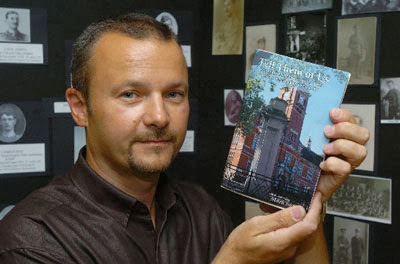
In his definitive book ‘Tell Them of Us’ about the Swindon men who served in the Great War, Mark Sutton records that Sapper W. Arman served with ‘B’ Coy 6th Batn Royal Berkshire Regiment, attached to the Royal Engineers.

Mark reproduces a letter written by William Arman in France dated September 1915, to his father and stepmother at 15 Lowestoft Street, Swindon.

‘Dear Father and Mother,

I am writing you a few lines hoping you are in the best of health. It is grand weather out here at present, though rather cold nights and mornings. We have been in action. Last Wednesday night, our battalion, the Royal Berks had it pretty warm for a lot of the Germans started shelling us in all directions for about an hour. The Germans, thinking we were all done in, started to advance towards our trenches in massed formation. They came within 20 yards of our trenches and they had it hot from our rifles, machine guns and artillery. You ought to have seen them falling down like chaff before the wind. There were not many that escaped. It was like hell for a short time. We had a few casualties, but the Germans lost nearly a battalion of men. We called them the Saxons. They were half German and half English. They have been very quiet since that night. They thought they had a soft job on, but they were mistaken for once.

I am getting used to bully beef and biscuits now. I am getting short of a razor. I can’t get one for love or money. You ought to see my face! I have not had a shave for three weeks. We get a pay this week – 15 francs, that is about 4s 2d to a franc. If God spares me, I will send it home because I can’t spend it out here. Could you send me a razor out? It looks so bad asking everyone for the loan of a razor. It would not cost much for postage.

We are sleeping in old dug-outs what the French used to sleep in. We never have our clothes off, but always sleep in them. I have not much more to say at present. I wish you all good luck and good-bye for the present.

Remember me to *Will and tell him I wish him a safe and speedy passage across the water.’

*Will is William Fairclough, his stepbrother.

William Thomas Arman survived the war. He died in 1943 in the Bridgend district of Wales in 1943. You can read more about Alice Arman here.

Archibald Edward Knee – Tell Them of Us

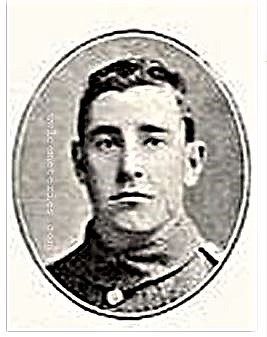
Archibald Edward Knee was born in Stroud in 1892, the son of Francis and Rose Knee. The family later moved to 123 Albion Street where Francis worked as a railway carriage painter in the GWR Works and Rose cared for their seven young children. Archibald joined his father in the GWR Works on leaving school, working as a railway carriage painter and sign writer; a job he could safely expect to hold for life.

Archibald enlisted in the Wiltshire Regiment in July 1915, when a war initially anticipated to be over by Christmas 1914 approached its first anniversary. He embarked for France on New Year’s Eve 1915, part of desperately needed reinforcements at the front.

Archibald Edward Knee

The British army began preparing for the ‘big push,’ in the Spring of 1916. It was believed this allied offensive would finish the war. The Battle of the Somme, in which more than 57,000 British soldiers were killed, wounded or reported missing during the first 24 hours of action, was yet to come.

The 1st Battalion of the Wiltshire Regiment was at Pylones, three kilometres north of the German held Vimy Ridge. The German army bombarded this section of the Western Front on May 21, firing everything at their disposal, including gas and lachrymatory (tear gas) shells.

The men of D Company were in battle by day and making running repairs to fencing and trenches throughout the night.

Lt Col W.S. Brown recorded the events of May 24 in the regimental war diary:

“In the trenches. The enemy were able to reach the Birkin Crater post with Cylinder stick bombs and some casualties were caused.

Many rifle grenades were fired at the outpost line of P73: those fired in retaliation appeared to do considerable damage. After 5 p.m. the enemy fired several heavy trench mortars at P74 and P75 and also at the head of Grange C.T. Snipers claimed three Germans. Repairs to the P line were carried out and a large amount of wire was put out along the whole front during the night of 24th/25th.”

Private F. Daniels of A Company was killed outright. Lance Corporal Knee was among 10 other casualties that night.

Archibald was taken to the 22nd General Hospital at Etaples where he received emergency treatment. He had suffered a gunshot wound to his left thigh, which in itself would probably not have proved life threatening. It was the effect of the German gas attack that proved fatal. Archibald developed gas gangrene and died at 11.20 on the morning of May 29. He is buried in the Etaples Military Cemetery.

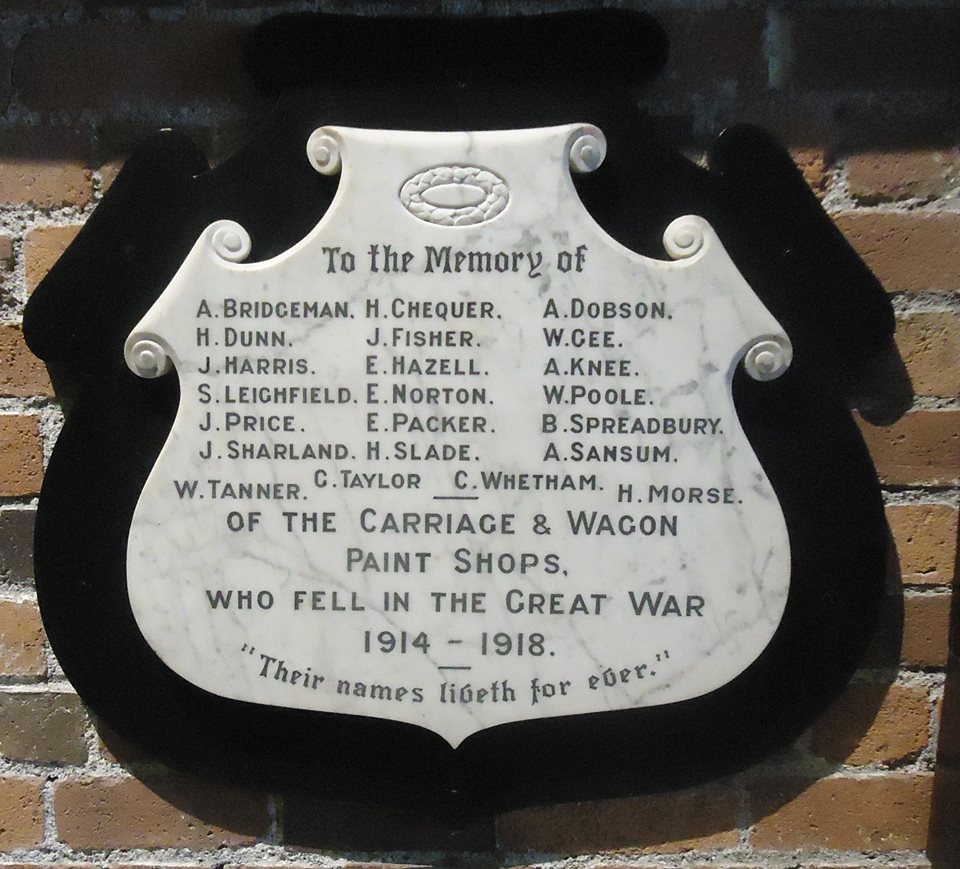
Archibald’s name appears on the memorial dedicated to the memory of those from the Carriage & Wagon Paint Shops who gave their lives in the Great War. This plaque can now be seen in the STEAM Museum.

#TellThemofUs

#MarkSutton

Sapper Archibald Walter Sheppard – Tell Them of Us

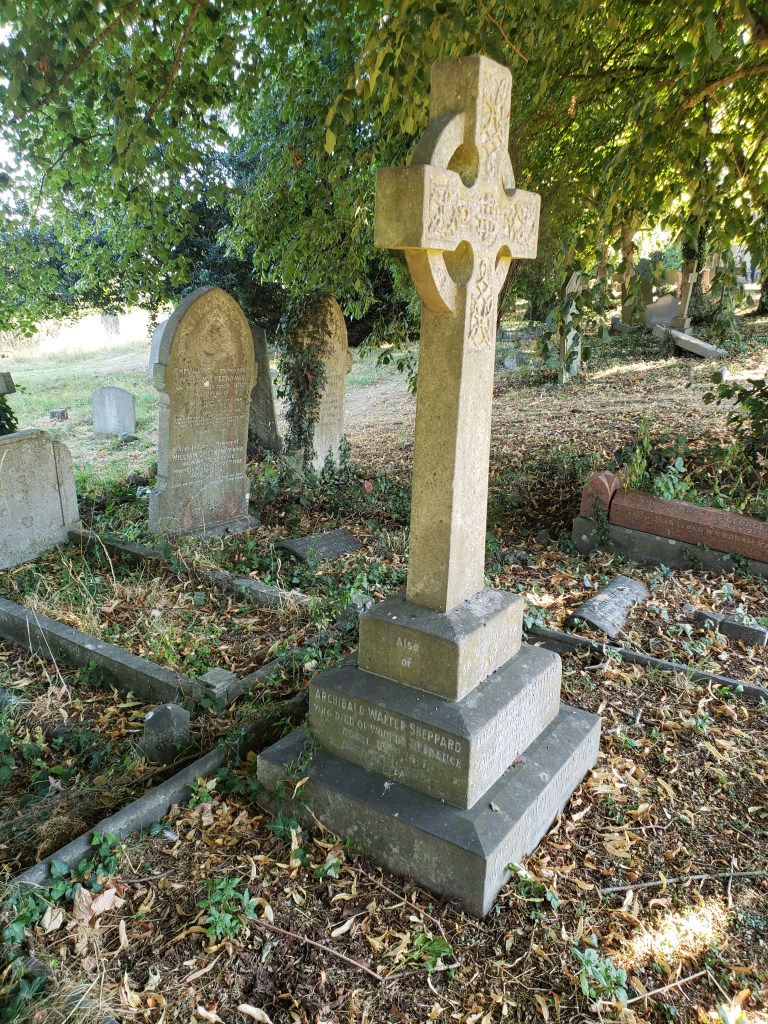
The Commonwealth War Graves headstones stand out proud across Radnor Street Cemetery, the area around them kept clear and accessible by our dedicated team of volunteers. But these are not the only war dead commemorated by Swindon families. Many family memorials carry the name of a lost loved one buried on the First World War battlefields. Were those grieving families able to visit their graves; probably not. So they came to their local cemetery and remembered them here.

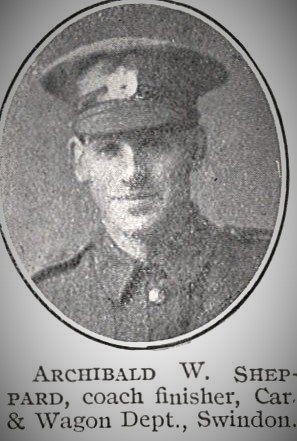
Archibald Walter Sheppard was born on May 4, 1888, the youngest of William and Eliza’s seven children, and grew up in the busy family home in Clifton Street. He began work aged 14 years old as an office boy in the GWR Works and then completed a 6½ year apprenticeship in the Pattern Making Shop, receiving his certificate on May 20, 1909.

Sadly, his military records have not all survived, so we do not know when he enlisted. We do know that Sapper Archibald Sheppard was serving with the Royal Engineers 455th Field Company at the Battle of Arras in April 1917. It is believed he was wounded during fierce fighting at Monchy le Preux. He died of his wounds on April 18 at the 19th Casualty Clearing Station at the village of Agnez le Duisans and is buried in the Duisans British Cemetery Extension.

His parents William and Eliza both died in 1931. They are buried in this large double plot C1999 and C2000 with their sons William Henry who died in 1908, and Albert Leonard Sheppard who died in 1963 and his wife Ellen Gertrude who died in 1935.

And remembered on this fine memorial is the name of their youngest son Archibald who is buried in a grave far from home.

Lance Sergeant John Wilfred Goodwin – Tell Them of Us

Following yesterday’s Remembrance Day service in Radnor Street Cemetery we continue with our series of stories – Tell Them of Us.

Sometimes it can be frustratingly difficult to find out much information about the soldiers buried beneath the Commonwealth War Graves headstones in Radnor Street Cemetery.

Local and military historian Mark Sutton had a vast knowledge of all aspects of the Great War and during our guided cemetery walks was able to describe details about the action in which the soldiers had been involved. Quoting from his book Tell Them of Us Mark tells us that John Wilfred Goodwin was a Lance Sergeant in the Welsh Horse Yeomanry and that he died on January 5, 1918 aged 35 years.

John Wilfred Goodwin was baptised at St John the Evangelist, Farnworth, Lancashire on February 12, 1882, the eldest of James and Elizabeth’s five sons. James worked as a grocer and in 1891 he was Manager at the Co-operative Stores in Bisley, Gloucestershire.

In 1899 John Wilfred enlisted with the Royal Artillery. He was 18 years old. However, by the time of the 1911 census, twelve years later, he had left the army and was lodging at 68 Curtis Street and working as a grocery assistant.

As a former member of the regular army he would have been on the reservist list and recalled for service when war broke out in 1914. Unfortunately his military records have not survived, but we do know that he was discharged on Jul 21, 1916 due to a disability.

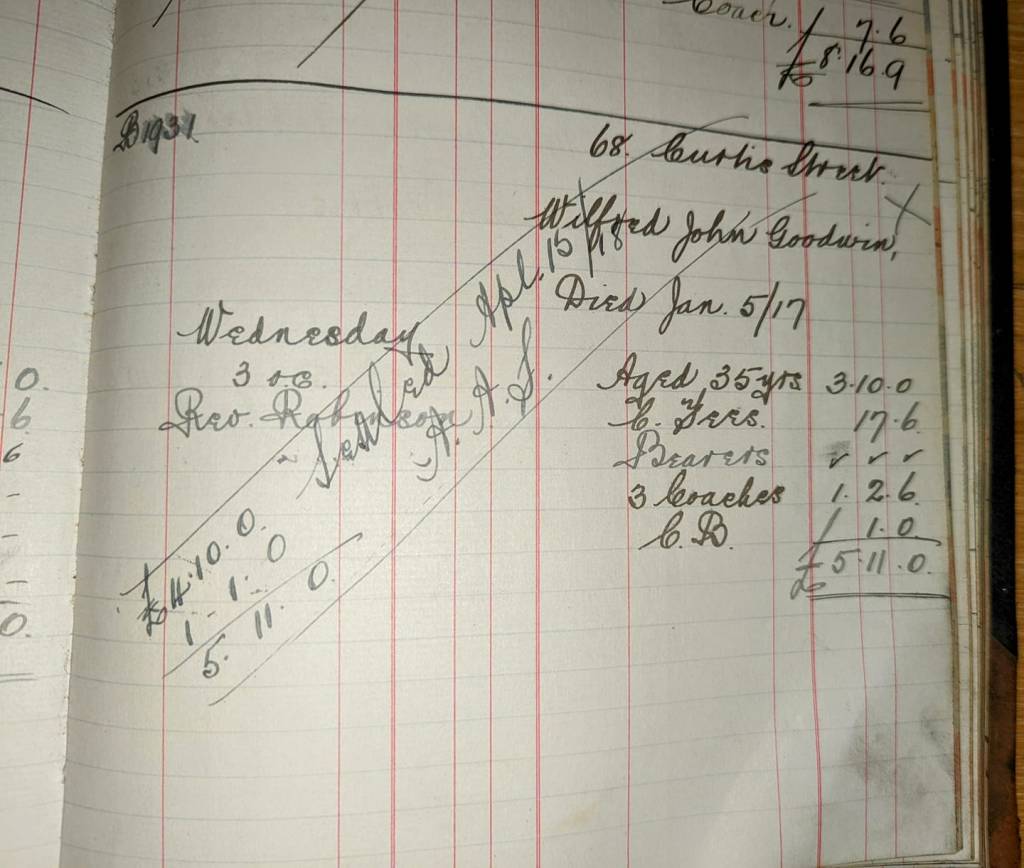
John’s last address in January 1918 was at his former lodgings 68 Curtis Street. The funeral took place on January 9 when John was buried in grave plot B1931. His initials were incorrectly recorded as W.J. Goodwin in the burial registers, but even a search under this name does not reveal any further information.

We would like to purchase the death certificate of the people we research, but sadly with the amount of research we conduct this is impossible.

John’s youngest brother, Samuel Colin Roy Goodwin, served with the Somerset Light Infantry and survived the war. He later emigrated to Australia following elder brother Josiah, and served as a Leading Aircraftman with the 13 Aircraft Depot, Melbourne during WWII.

Image kindly provided from the funeral records of A.E. Smith & Son, Funeral Directors

#TellThemofUs

#Mark Sutton