James George Merricks has already appeared on our radar, thanks to Rhonda and her Astill family history research.
She tells us that Amy Maud Astill’s husband Arthur Mills was assistant to Mr Merricks of Gilbert’s Furniture shop in Newport Street, Swindon in 1900, becoming a partner in the business in 1923 and moved the shop to Bridge Street, Swindon and renamed it Mills and Merricks – of course Gilberts is still trading in Newport Street to this day, perhaps Arthur and James became partners in an independent venture.
Now I need someone to fill in a few more gaps, such as how did James end up in South Africa in 1891 and what was Alice doing there?
In 1881 Alice was working as a governess for farmer Walter G. Cloke at Wiltshire Farm in Wokingham. Meanwhile James was working as a draper’s assistant in Bath. But by 1891 they were getting married in South Africa where three of their four sons were born, Eric George in 1892, Edward Alfred in 1893 and Lionel Marten in 1896. A fourth son, John Gordon was born in Swindon on June 14, 1900.
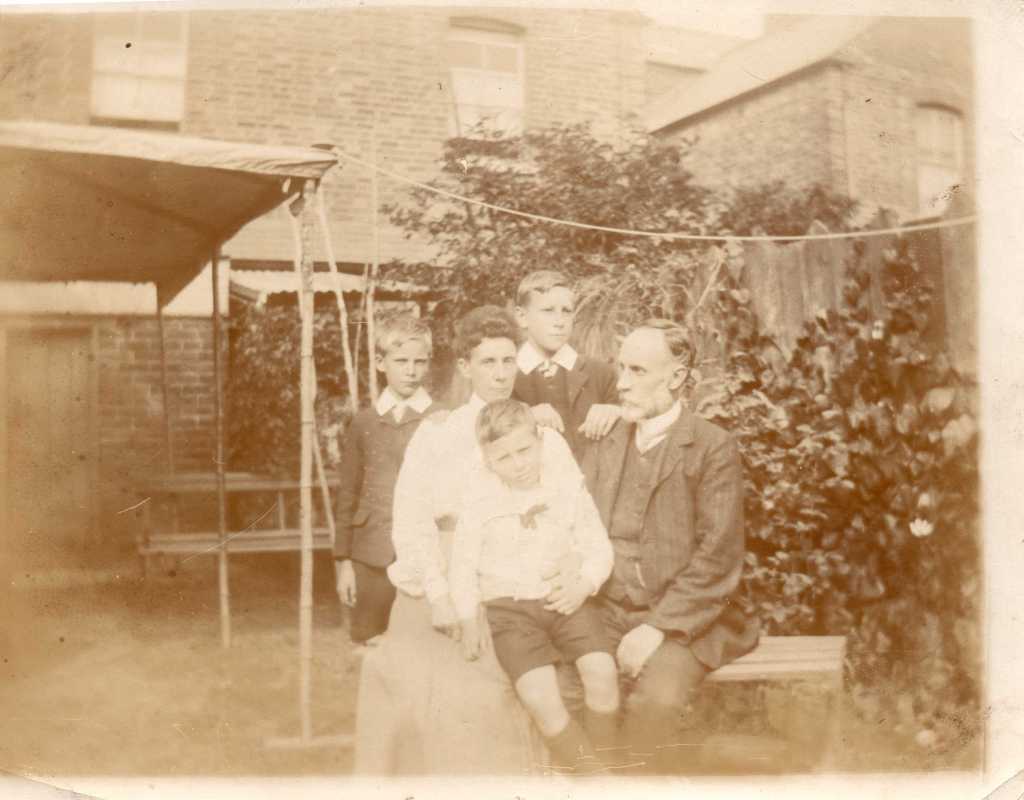
James George Merricks
By the time of the 1901 census James and Alice were living at 42 St. Margarets Road, possibly where this photograph was taken in the back garden.
James George Merricks was a member of the Baptist Tabernacle, acting as Treasurer for 21 years. In 1934 shortly before his death, Mr J.G. Merricks presented a complete set of individual Communion bread plates to fit the cups previously given by his great friend and associate Mr. E.J. Lay. The two men are pictured together here.
There is still more to be learnt about this man. Especially how he came to spend such a lengthy spell in South Africa. Could this have been to do with the Baptist Tabernacle, I wonder?
James George Merricks died aged 75 years at his home 38 Devizes Road. He was buried on April 20, 1935 in grave plot E7574, joining his wife Alice who died in November 1923.
When Joseph Horne returned from South Africa for a visit in 1931 the North Wilts Herald reported:
‘It has often been said that Swindonians can be found in almost every part of the globe.’
In 1894 Joseph Horne embarked for South Africa where he first worked as a carpenter in a goldmine and later lived in Johannesburg and the Transvaal. He was the eldest of five brothers who had at various times joined him in South Africa. At the time of his visit he was in business with his brother George in a general printing press they had established in 1914. Youngest brother William, a builder, was still living in Maritzburg in 1931. David had spent just three years in South Africa before returning to Swindon and a job in the GWR.
The adventurous Horne brothers were the sons of Herbert and Sarah Ann Horne who married at St. Martin’s Church in Birmingham on Boxing Day 1865. By 1881 they had moved to Swindon and were living at 14 Gooch Street.
How difficult must it have been to wave those sons off to South Africa? Did Herbert and Sarah Ann suspect they might never see them again? Perhaps they hoped their boys would eventually return home, and of course David did.
Herbert died in 1927 but Sarah Ann lived to see her eldest son Joseph on his return to Swindon in 1931. She died in 1934 aged 95 when the North Wilts Herald published another instalment in the Horne family history.
Believed to be Swindon’s oldest inhabitant, and certainly the oldest follower in the Borough of the Baptist faith, Mrs Sarah Ann Horne died on Friday at 26 Cheney Manor Road, the residence of her son, Mr. David Horne.
Mrs Horne, was 95 years of age, having celebrated her 95th birthday on 5 September last.
Death has given the finishing blow to her hopes of living longer thanher grandfather, who, having served in the Battle of Waterloo, lived to within five days of his 100th birthday.
Mrs Horne was active to the last and in full possession of all her faculties. In fact, she did her own mending without the aid of glasses.
Married in Birmingham
She was a native of Frome, and in December 1865, at Birmingham, she married Mr. HerbertHorne, who died at the age of 87, seven years ago. He was, in his time, the oldest railway guard in Swindon, being a link with the old days when, before the introduction of sandboxes, the guards had to be on the footplates and throw sand under the wheels of the engines.
They were married on a wage of 13s a week, and came to Swindon to live first in Gooch Street.
Mr Horne was a prominent official, and at one time the president of the Amalgamated Railway Servants’ Union, now the NUR.
On his retirement, they lived for 20 years at Lower Stratton, until nine years ago, when both cameto live with their son in Cheney Manor Road.
Mrs Horne prided herself on a wonderful memory, and used to recall an incident which occurred when she was a girl in Bath.
For a wager, a man sailed down the Avon in a tub drawn by swans. As he passed under Bath Bridge, the crowd rushed to the opposite parapet to see him. The strain was too great and the parapet gave way, resulting in several spectators being drowned in the river.
Old Age Pensioner
A recipient of the old age pension since its introduction, she saved all of it up until she had sufficient to buy the land in Radnor Street Cemetery for her grave.
She always protested that she would not “liecomfortable” at Stratton Cemetery which she claimed was damp, but that in the sand of Radnor Street Cemetery she would rest peacefully.
She was buried there, with her husband, in the grave she purchased for them both.
Therewere five children of the marriage – all sons and four of them today are in Africa. Mrs Horne also had 14 grandchildren, and 19 great grandchildren.
Her final illness lasted only a few days.
North Wilts Herald, Friday, 19 January, 1934.
Sarah is buried with Herbert in grave plot E8676 where they were later joined by their son David who died in 1954 and his wife Emily who died in 1956.
I wouldn’t wish to question the redoubtable Mrs Horne, but I don’t think the soil is ‘sandy’ in Radnor Street Cemetery.



 Radnor Street Cemetery