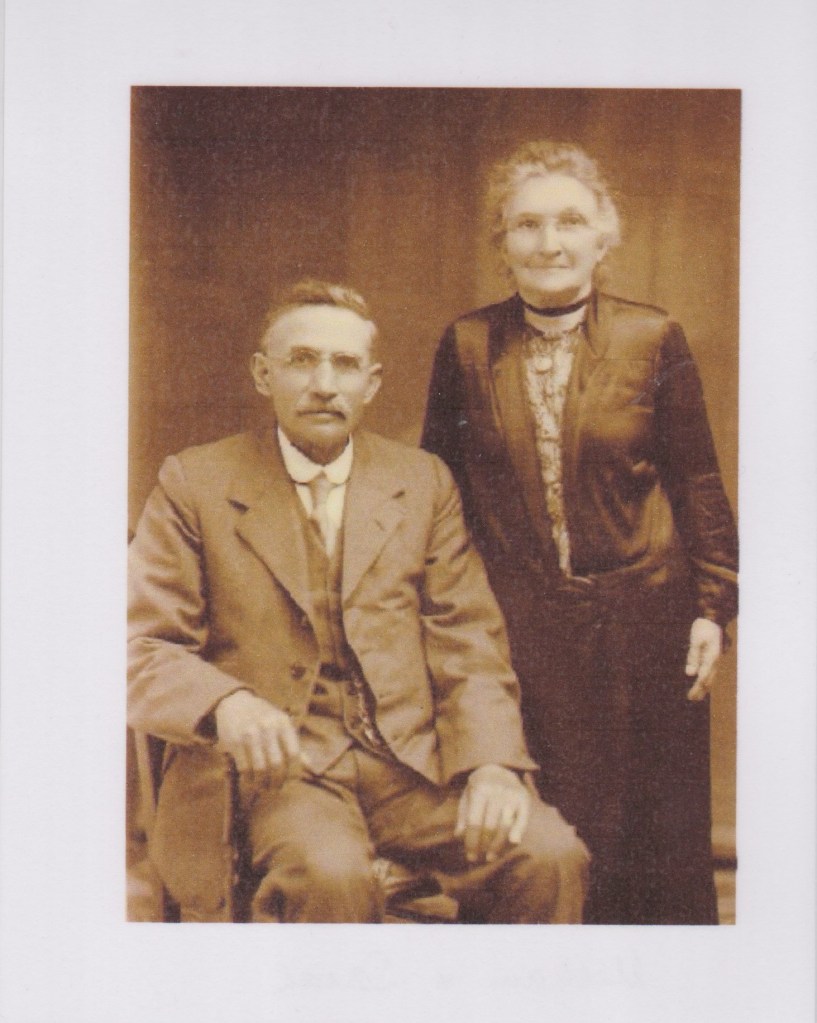
Joseph Wilkinson – a link with Swindon’s Past

Sometimes an obituary is written so evocatively that there is little I could possibly add. This is the story of Joseph Wilkinson who moved to Swindon in the 1870s and worked in the new Carriage and Wagon Works under Joseph Armstrong.

Death of Mr Joseph Wilkinson

A Highworth Octogenarian

Link with Swindon’s Past

By all the older generation of Swindonians, and especially by those who have been connected with the GWR Works, the news will be received with unfeigned regret that Mr Joseph Wilkinson, formerly a foreman over the Wagon Works, has passed away at Highworth, at the ripe age of 83 years.

Mr Wilkinson was an interesting link with Swindon’s past. Born at Marshe (Yorkshire), in 1828 he migrated at an early age to Chester where he followed his occupation as a coach builder. Thirty-five years ago he came to Swindon with the late Mr. Holden, and took up the position of foreman over the new wagon works, under Mr. Armstrong. Mr Wilkinson held the foremanship continuously for many years. Until 13 years ago he enjoyed capital health, even for his advanced age, and then, acting under medical advice, he retired at the age of 70 years. It is interesting to note that Mr. Wilkinson is believed to be the first foreman who received a pension under the superannuation scheme, which was initiated shortly before his retirement.

Upon his retirement the old gentleman went to live at Highworth, where he was liked and respected by all with whom he came in contact. Since this time Mr Wilkinson’s health had been gradually failing. He had been ailing off and on every since; and a couple of months ago he was taken ill with heart disease. Dr. Powell and Dr Lewty did all that medical skill could devise but inspite of their attentions Mr Wilkinson passed away on Saturday evening.

While he was in Swindon, Mr. Wilkinson took an active interest in the affairs of the Faringdon Street Wesley Church, where he was an assistant class leader but since his removal to Highworth failing health prevented him from participating in this branch of public service. His first wife predeceased him by 28 years, and it was while in Swindon that Mr Wilkinson married his second wife. Thirteen years ago Mr. Wilkinson’s second wife also died; but a family of one son and three daughters are left to mourn their loss.

The Swindon Advertiser, Friday, May 19, 1911.
Joseph Wilkinson was buried on May 17, 1911 in grave plot A641 where he joined his first wife Eliza who died in 1883

Henry Clifton Bassett – Superintendent of the Swindon Wesleyan Circuit

Non conformity had a small presence in Swindon until the arrival of a large industrial workforce who came from across the country to work in the Great Western Railway. In fact the large number of nonconformists who wished to bury their loved ones without the rites of the Church of England was a contributing factor to the building of Radnor Street Cemetery.

This is the grave of Wesleyan Minister, Henry Clifton Bassett. Born in St. Stephens, Launceston, Henry was the son of agricultural labourer John Bassett. John must have been ambitious for his son as the 1871 census reveals that 12 year old Henry was a boarder at a school in Launceston.

By 1881 Henry, then aged 22, was a Wesleyan Minister lodging in Paignton with William Anderson, a joiner and carpenter, and his family. In 1884 he was employed at Lerwick with John H. Hooper, working on the Shetland Isles circuit.

He married Mary Ann Read in 1887 and the couple had three children – a daughter Hilda Constance and two sons, Clifton Read and Henry Norman.

Death of the Rev. H.C. Bassett

Swindon Circuit Wesleyan Supt. Minister

We regret to record the death of the Rev. Henry Clifton Bassett Supt. of the Swindon Wesleyan Circuit, which took place at his residence, Eastcott House, Regent circus, Swindon, last Saturday afternoon, at the age of 60 years.

The rev. gentleman was born at St. Stephens, Launceston, Cornwall, and had been in the Wesleyan Ministry for 36 years, holding important appointments in a large number of Circuits, more recently as Superintendent. Among the town in which he laboured were Newton Abbot, Lostwithiel, Northampton, Barton-on-Humber, Accrington, Sheffield, Darleston, Willenhall, Whitby, Selby, and latterly at Swindon.

The term of a minister’s tenure in a Circuit is three years. It speaks much for the popularity of Mr Bassett that after serving his full term in most of the Centres in which he has ministered he has been invited to remain for a longer period, so acceptable has his preaching and his work generally been to the people.

He came to Swindon from Selby in September 1917, as Supt. of the Circuit. His principal reason for coming South was the health of his wife, who had been in indifferent health for some years, Mrs Bassett being unable to withstand the rigours of the northern climate.

Mr Bassett had always enjoyed good health. He was an extremely hard and conscientious worker, a circumstance which in point of fact brought about the illness which ended in his death. He overtaxed his strength in visiting and preaching during the prevailing epidemic of influenza with the result that after preaching on Sunday, December 8th at the Wesleyan Central Mission, he arrived home from the evening service utterly exhausted. Dr. Lavery was summoned, and Mr Bassett was ordered to bed, from which he was never able to rise. His case was diagnosed at first as influenza. His heart became affected and pneumonia supervened. On Christmas Eve Dr. J. Campbell Maclean was called in in consultation, and his report as to Mr Bassett’s condition was grave.

Death took place on Saturday afternoon, in the presence of his wife and daughter and a trained nurse who had been in attendance.

Deceased leaves a widow, two sons, and a daughter. One of the sons is engineer to the Sunderland Corporation and the other is serving as an apprentice in the Great Western Works at Swindon.

Sympathetic references were made in all the Wesleyan Churches in the Circuit on Sunday to the great loss the Church had sustained in the Connexion by the death of the Rev. Clifton Bassett.

The funeral took place on Wednesday. There was a service at Wesley Chapel at 2.30, conducted by the Rev. H.W. Perkins, assisted by the Ministers of the Circuit and neighbourhood, and an address was delivered by the Chairman of the District, the Rev. Grainer Hargreaves of Oxford.

The Faringdon Advertiser, Saturday, January 25, 1919.

Henry Clifton Bassett was buried on January 22, 1919 in grave plot D1304 where he was joined by his wife Mary Anne in 1923. The cremated remains of their daughter Hilda Constance was buried with them in 1975 and their son Henry Norman in 1986.

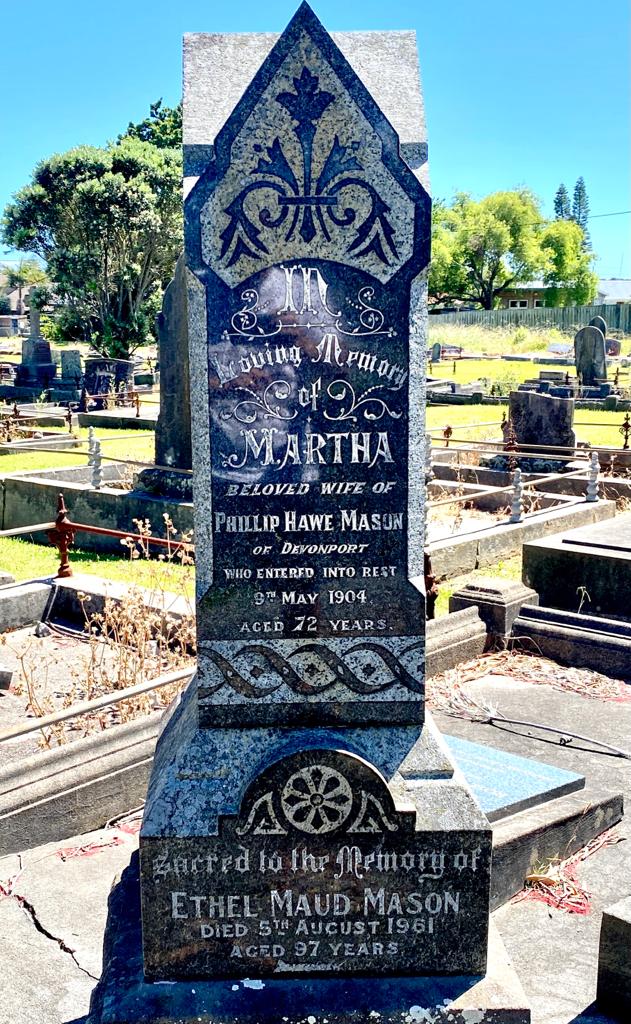
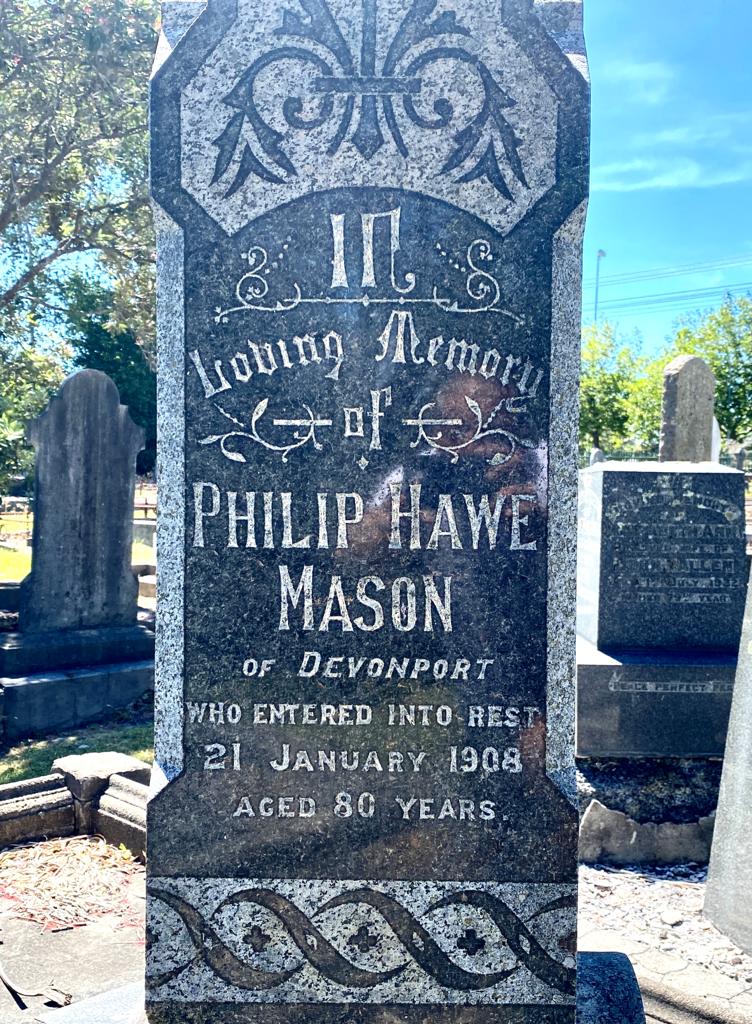
Philip Hawe Mason – businessman

In which our roving researcher Noel goes to great lengths to follow a Swindon story.

Philip Hawe Mason was born on December 5, 1827, the son of Wesleyan Minister John Mason and his wife Anne. His baptism appears in the Methodist Register of Births & Baptisms as having taken place on February 1, 1828 at his father’s house in Saint Luke’s Parish, London, performed by John Stephens.

An enterprising young man, Philip had arrived in Swindon by 1851 when he has his own grocer’s shop in the High Street. He later opened a second shop in Regent Street and by 1871 he is no longer living over his business premise but at Sanford House, a sizeable property on the corner of what is now Springfield Road and Croft Road. In 1871 he describes himself as a Grocer and Provision Merchant employing 15 men and 5 boys. Philip was an active member of Swindon’s society serving as Chairman of the Swindon School Board and heavily involved with the Wesleyan Church in Swindon, when tragedy struck.

His wife Martha, whom he had married in 1853, took ill (possibly worn down by 10 pregnancies). Medical advice was to move to a warmer climate so in the 1880s Philip, Martha and several of their children, moved to Devonport, Auckland, New Zealand.

Here too Philip took an active part in the local community, serving as an elected Councillor of the Borough of Devonport.

Martha died in 1904 aged 72 and Philip in 1908 aged 80.

Death of Mrs P.H. Mason

The news of the death of Mrs P.H. Mason, at Devonport, Auckland, New Zealand, will be received with undisguised feelings of regret in Swindon by those who were acquainted with that lady and her family during their residence in the old town.

According to a cablegram received by the deceased lady’s daughter, who resides at Bristol, Mrs Mason’s demise took place last Monday, May 9th. The first intimation of the sad event was conveyed to Swindon in a letter addressed to the Mayor (Ald. James Hinton), by Miss Mason. The letter supplies a pathetic fact as to the suddenness of the news, for Miss Mason states that a letter intimating that Mrs Mason was quite well arrived simultaneously with the cablegram announcing her death.

Some little time must necessarily elapse before a further letter explaining the cause of Mrs Mason’s sudden demise can be expected.

The deceased lady, who was 72 years of age, was highly esteemed during her residence in Swindon. She was a prominent Wesleyan, and took an active interest in the welfare of that body. Mr Philip Hawe Mason was also held in high esteem. He held the position of Chairman of the School Board, and was Circuit Steward in connection with the Wesleyan body for many years.

Mr and Mrs Mason left Swindon in 1881 and such was Mrs Mason’s state of health that she had to be carried on to the boat.

During the time she was abroad, Mrs Mason enjoyed excellent health. It is only recently that Mr and Mrs Mason celebrated their golden wedding.

The Swindon Advertiser, Friday, May 20, 1904.

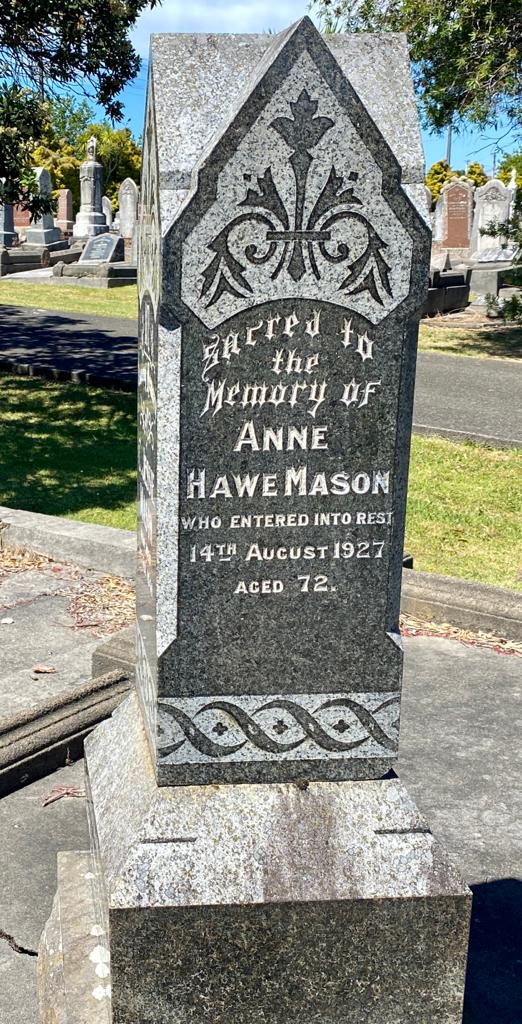
Their daughters Anne Hawe Mason died in 1927, Catherine Jessie Mason in 1940 and Agnes Martha Mason in 1944.

Thank you Noel – you can come home now.

The Jefferies family – Wesleyan Methodists

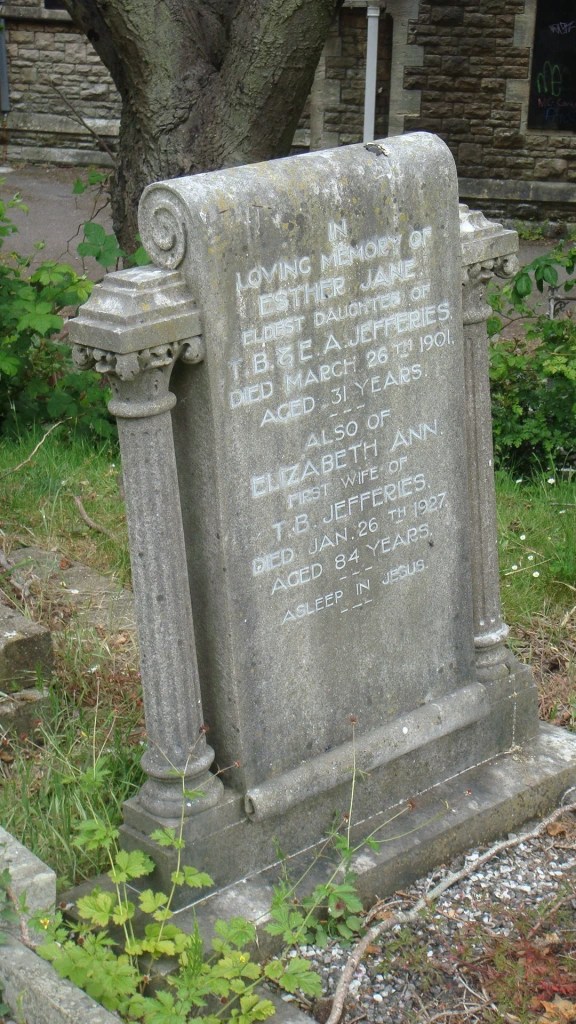
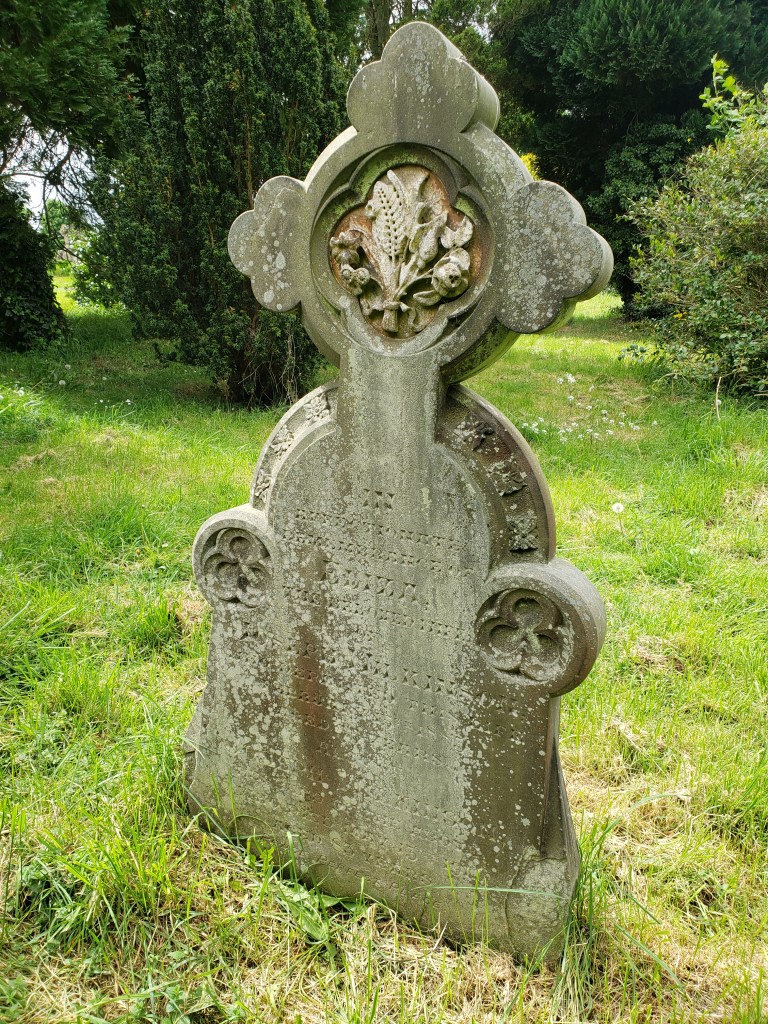
I chose to research this grave because I liked the typeface and all the funeral symbolism on the headstone.

A scroll can mean a number of things in headstone iconography including a love of learning and a religious belief, which is very appropriate for this family. It can also mean a life cut short with the past rolled up and the future yet to unfurl. This would make sense when you note that Esther J. Jefferies, the first person buried in this grave, was only 31 when she died. The pillars either side suggest an entrance and this symbolises an entry into heaven. At the top of the pillars are acanthus leaves, which have several interpretations symbolising the prickly journey of life to death and also enduring life. So, there’s a lot going on with this headstone.

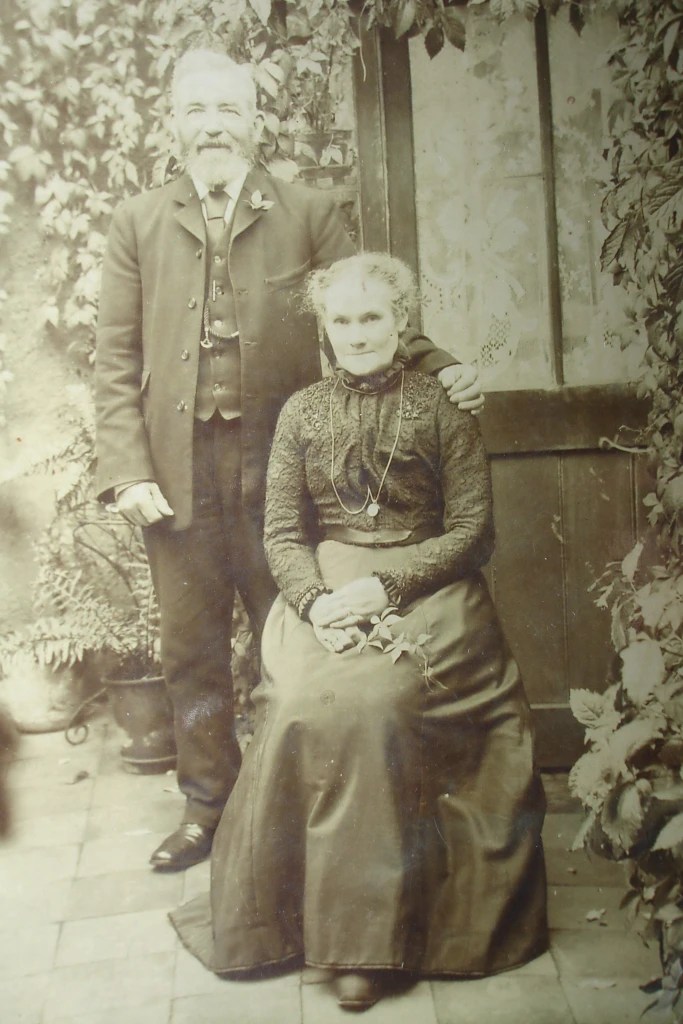
Elizabeth Ann was born in Cricklade in 1843. She worked in service as a young woman before marrying Thomas Bennett Jefferies, a slater and plasterer. Their first home was in Wootton Bassett where Thomas was born. By 1891 they had moved to 18 Union Street, Swindon where the elder sons were now apprentice plasterers.

The 1911 census finds them at 165 Victoria Road and on this census we get some more details about the family. Thomas and Elizabeth had been married 42 years during which time they had 10 children, four of whom had already sadly died. And then I found a fantastic photo of the couple’s five sons, thought to have been taken at the wedding of their sister Ellen to Harry Frederick Keene in 1906. They are pictured in order of seniority left to right – Joseph, Thomas, John, Winfrith Frederick (usually referred to as Fred) and Charles Wesley.

Eldest son Joseph Page Jefferies emigrated to Australia with his family in around 1913. Following his wife’s death, he married for a second time in 1936 in Sydney, where he died in 1939. The couple’s third son, John Nelson became the assistant borough surveyor here in Swindon and in 1903 lived at 2 Hunt Street.

Death of Mrs T.B. Jefferies

With the death of Mrs Elizabeth Ann Jefferies, of 1 Durham Street, there has passed away one of the best known figures in Wesleyan Methodism in the town. Mrs Jefferies, who was 84 years of age, was a native of Cricklade, being the daughter of Mr and Mrs Joseph Page. She married Mr Thomas Bennett Jefferies at Purton Parish Church on September 26th, 1868, and the couple came to live in Swindon 46 years ago. Mr Jefferies is the oldest local preacher on the local Wesleyan plan, and although he has been preaching for over 60 years he continues to take appointments.

Mrs Jefferies was taken ill with influenza, and pneumonia supervened with fatal results. The funeral took place at the Central Mission Church on Monday, and was conducted by Pastor A.E. Stocking, assisted by the Rev. W. Kelson and the Rev. H.B. Turner. The committal rites at the Cemetery were performed by Pastor Stocking. Among the mourners were Mr T.B. Jefferies (widower), Messrs. Thomas Henry, John Nelson and Charles Wesley Jefferies (sons), Mrs Ellen Elizabeth Keene (daughter) Mrs Eliza Priscilla Jefferies (daughter-in-law), Mr Joseph Jefferies (son-in-law), Mrs Cottrill (half-sister), Mr Jesse Jefferies and Mr E. Jones (representing the local preachers of the Circuit).

North Wilts Herald, Friday, February 4, 1927.

Thomas Bennett and Elizabeth Ann Jefferies

Esther Jane Jefferies (Thomas and Elizabeth’s eldest daughter) was the first person to be buried in grave plot D109. She died in 1901 aged 31 years old. Elizabeth Ann Jefferies (Thomas’s first wife) was buried with her daughter on January 31, 1927. Next came Ellen Jefferies (Thomas’s second wife) who died in 1931 and finally Thomas Bennett Jefferies who was buried on April 18, 1932.

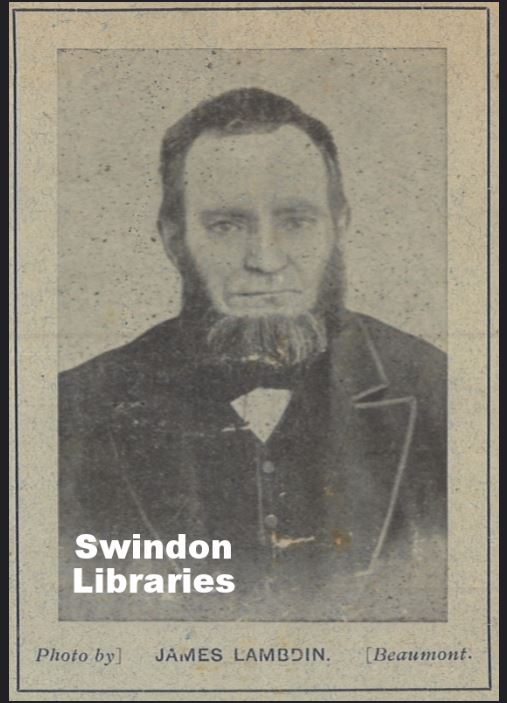
James Lambdin – The Singing Ploughboy

Image published courtesy of Local Studies, Swindon Central Library

James Lambdin died suddenly and, it would appear, without making a will. Perhaps he had no worldly goods to leave. His life had been spent spreading the word of God.

James was born in Aldbourne in 1850, the son of Joseph and Sarah Lambdin. By the age of 10 years old he was working as an agricultural labourer. He later moved to Swindon and a job in the railway works, but it is his service in the Wesleyan Methodist Church that he is remembered for.

James married twice. His first wife, Faithfull Maria Dew, whom he married in 1874, died two years later aged just 22 years old. She was buried in the churchyard at St. Mark’s.

In 1878 he married Eliza Burt. The couple made their home first in Stratton St. Margaret (1881) and then in Gorse Hill living at 24 Hinton Street (1891) and 21 Avening Street (1901). They had one child, a daughter Beatrice, born in 1886.

A pamphlet produced after his death was entitled – Memoirs of James Lambdin – The Singing Ploughboy who became a Great Preacher and 30 years a Class Leader at Gorse Hill, Swindon.

The Angel Reaper has passed over the Bath Road Wesleyan Circuit, and taken away one of the staunchest adherents, Mr James Lambdin, of Gorse Hill. Mr Lambdin was a highly respected member of the Wesleyan body and looked up to throughout the whole circuit and was widely known for his wise exposition of the Scriptures.

He was a native of Aldbourne, and only the Sunday previous to his lamented death, he went to his birthplace to fulfil a preaching engagement. The day before that he had called upon one of his class members who was almost at the point of death, and the following day week, he himself had taken that journey from whence no traveller returns.

His illness was very short but painful, and his last words were a benediction for his fellow class members and workers. The loss is being felt very keenly throughout the circuit. Last Sunday morning, the preacher at Cricklade Road, a very old and devoted layman, was completely overcome with grief, and the evening congregation were greatly impressed by an impromptu memorial service.

I hear a whisper that a short memoir with a photograph will be prepared shortly.

The Swindon Advertiser, Friday, February 28, 1908.

James Lambdin was buried in Radnor Street Cemetery on February 27, 1908 in grave plot B2912. His wife Eliza survived him by more 19 years and was buried with him on February 3, 1927. The inscription on the modest headstone reads ‘To the revered memory of James Lambdin – Promoted Feb 23, 1908’

John Whitehead Spargo – a popular pastor


Central Hall, Clarence Street published courtesy of Local Studies, Swindon Central Library.

Rev John Whitehead Spargo was born in 1875, the eldest son of Samuel Spargo, a joiner, and his wife Maria Ann. He married Isabella Maud Walford in 1904 and the couple had three children, one of whom died in infancy. At the time of the 1911 census Pastor Spargo was working as a Wesleyan Methodist Missioner in Reading. By 1917 he had moved to a post at the Central Mission Hall in Clarence Street, Swindon.

Pastor Spargo’s name appears frequently in the Radnor Street Cemetery burial registers during his seven year ministry in Swindon. In 1919 he conducted the funeral of Frederick Cosway 14, Frederick Rawlinson 14 and Stanley Palmer 13, three boys killed in an explosion at the Chiseldon Military Camp.

A Popular Pastor

Mr Spargo Leaves Swindon Brotherhood

After seven years’ work in Swindon as missioner to the Central Mission, Pastor Spargo has left to take up his duties in a new sphere of work at Finsbury Park, London. He gave his farewell address at the Brotherhood on Sunday.

Speaking to a large audience, Pastor Spargo said he was sorry that his long connection with the Swindon Brotherhood was coming to an end. He was grateful to have had the opportunity of being connected with the various societies and organisations identified with the Swindon Brotherhood. If there had ever been a cry for help and need in Swindon, the Brotherhood always heard and responded to that cry.

The Pastor took as the subject of his address, “God’s Fellow Workers.” He remarked that as members of the Brotherhood it was their high privilege to labour for Jesus Christ and to promote the principles laid down by Him. It was a mistake to think that everlasting happiness meant contentment and rest, for there could be no happiness without work.

In his opinion, lasting happiness would be having a vocation, and understand work in the right spirit. All the great men of the past had been people with great tasks, and the glorious heroes of the faith had been men and women with something to do.

But before the Brotherhood as a movement could get to work, the individual member must himself work, and before they could bring repentant sinners to Jesus Christ they themselves must first come repentant to God. He (the speaker) believed that Christ came into the world to pardon sin, but that belief was not one iota of good to him or to any-one else unless he possessed a practical experience of that belief.

Brotherhood’s Work

Continuing, Pastor Spargo said that he did not believe the world of to-day was in the state which God meant it to be, for He could not be satisfied with a world in which there was so much sin abounding. There was, then, a glorious work before the Brotherhood, although it might not be a romantic work. But every man in the Brotherhood could help to make Swindon a better town with the help of God, for if God made a man, then surely He could use him, although he might possess but one single talent. The speaker concluded by saying that if they of the Brotherhood could but appreciate the height, the depth, the strength and the glory of God, then they could make this world a place in which it would be more difficult to do evil, and more easy to follow the right.

Pastor Spargo was then presented with a cheque for £5 on behalf of the Brotherhood Committee by Mr Cotsell, and with a further £5 which had been given by private subscription as tokens of the great esteem in which the missioner was held by all members of the Brotherhood.

In presenting the gifts, Mr. Cotsell said that Pastor Spargo’s presence created an atmosphere, and he always felt that something was missing when the pastor was not on the platform. He expressed his heartfelt gratitude to the retiring missioner for all the work which he had done for the Swindon Brotherhood.

There was a crowded congregation at the evening meeting at the Mission, when Pastor Spargo delivered his farewell address on “God’s way of working” to a company numbering over a thousand.

North Wilts Herald, Friday, August 22, 1924.

William and Sarah Tydeman

Although Rev Spargo left Swindon in 1924, he retained his connection with the congregation at the Central Mission Hall, particularly with the Tydeman family and in 1935 he returned to conduct the funeral of Sarah Tydeman.

Rev John Whitehead Spargo died in 1960 in Ware, Hertfordshire.