Elderly Man Expires in the Cemetery

The re-imagined story …

I leaned back on the bench and closed my eyes, my face turned towards the sun. Bird song filled the air on this glorious summer’s day. But how could there ever be a glorious summer’s day again? All I could think about were the days so many had been robbed of, and yet here was I in my 60th year, an old woman, enjoying the bird song and the sunshine.

I often come to sit in the cemetery. There is usually someone here, tending a grave. We exchange a few words, pleasantries. Sometimes we even talk about our boys.

The guns have been silent for many months, the servicemen returned home. Even those who were prisoners of war are back, aimlessly walking the streets of Swindon. They stop and speak. Everyone knew my boy.

I wish I could have brought his body home and buried him here in the cemetery. I’ve seen photographs of the battlefield cemeteries, row upon row of crosses. My boy has no known grave.

A parent shouldn’t out live their child. Will this be a country full of old people now? Parents mourning sons.

I open my eyes, ahead of me there is an old man, walking slowly up the hill. I think I recognise him. Another old man. This world is full of old people, all the young ones are dead.

He stops and lays the flowers he holds on a grave. I watch as he appears to stumble. I stand up and begin to walk towards the Dixon Street gate. I’ve had enough now, watching other old people. I shouldn’t be here, none of us old people should be here.

DSC07141

The facts …

Elderly Man Expires in the Cemetery

The death of a well known Swindonian, Mr Donald Macdonald Andrew, a retired GWR foreman, occurred under tragic circumstances in Swindon Cemetery on Saturday last. It appears that Mr Andrew, who was 72 years of age, and resided at 142 William Street, went on Saturday morning to the Cemetery, with the intention of placing some flowers on his wife’s grave. When walking along the pathway towards the grave he was seen by Mrs Amy Haynes, wife of Ald. A.W. Haynes, ex Mayor of the Borough, to fall. She ran to his assistance, and also a gravedigger, named Sidney Iles, who was working nearby. But deceased expired in a few minutes.

The Faringdon Advertiser Saturday June 21 1919.

The Andrew family lived at 142 William Street for more than sixty years. Donald Macdonald Andrew, an engine fitter in the Works, and his wife Emily Jane had six children, a seventh had died before the 1911 census – Samuel Henry, George Edward, Ralph Macdonald, Florence K and twins Adelaide Mary and Margaret Elizabeth.

Donald’s funeral took place on June 17, 1919. He is buried in a double grave plot E8347/8 with his wife, son Ralph and daughters Adelaide and Margaret.
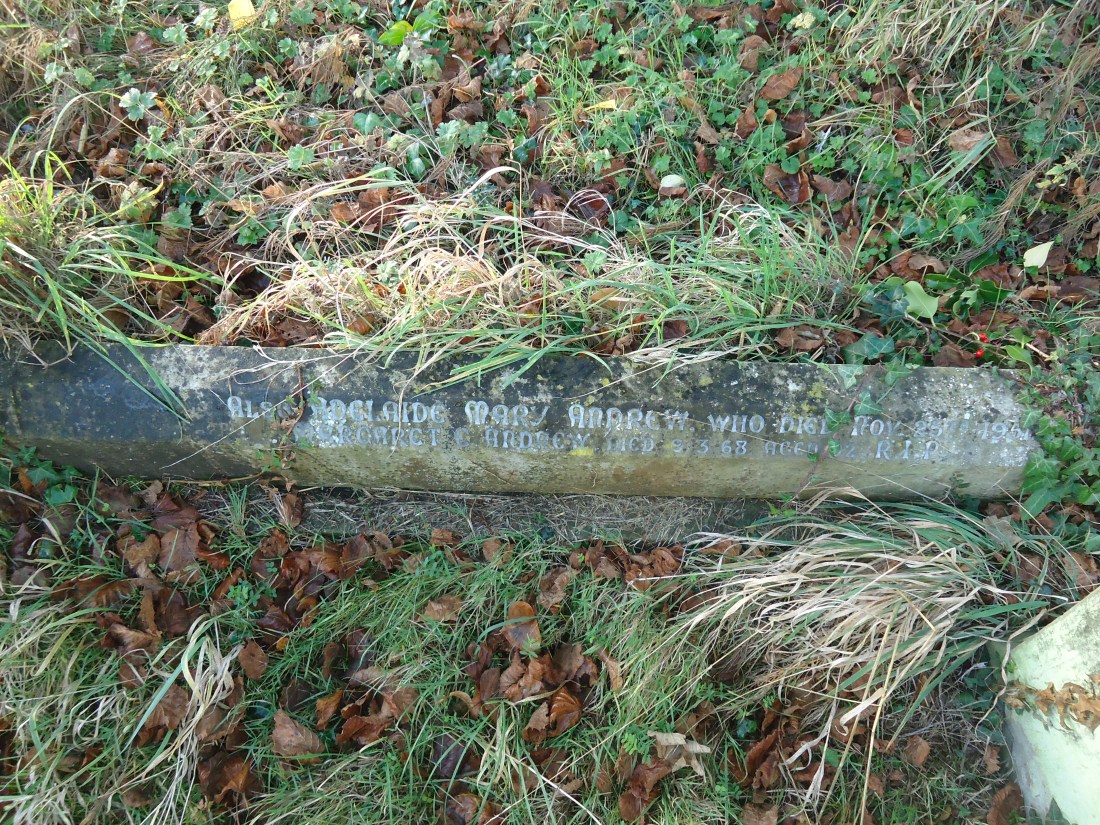
Adelaide Mary and Margaret Andrew

Family dynamics and a rediscovered grave

One winter several years ago before public spending cuts became so constrained, Swindon Borough Council cleared a large area of the cemetery swamped by brambles, revealing many hidden graves. One of the rediscovered plots was that of the Barnes family.

This double plot E8410/E8411 is surrounded by an elegant, black marble kerbstone memorial. Although still partially concealed, two names can be detected. From these slim pickings it was possible to trace much of the history of this family, using a combination of sources beginning with the Radnor Street Cemetery burial registers.

On October 15, 1878 John Barnes and Elizabeth Jane (also known as Jane Elizabeth) Farmer married at St Mark’s, the church in the railway village. John worked as a plumber, most probably with his father Richard who was also described as a plumber on the marriage certificate. Elizabeth Jane was the daughter of Thomas Farmer, a mason.

At the time of the 1881 census John, Jane and their daughters Edith Ellen aged 1 and three-month-old Florence Beatrice, lived at 9 William Street. By 1891 they were still living in William Street where their family had increased by four sons – Harold E 6 years old, Ernest A 5, Herbert H J 3, and one-year old Frederick W.

By 1901 they were living at 5 Tennyson Street, their family complete with the birth of Edgar A in 1897. Their elder sons Harold aged 16 and Ernest 15 were both working in the building trade, Harold as an apprentice house carpenter and Ernest as an apprentice house painter. At a time when the railway works dominated the town, this large Swindon family worked independently and within the building trade. Maybe the family would look back on these times as the good years.

On September 4, 1907 18-year-old Frederick set sail for Australia. Perhaps the building trade had taken a temporary down turn, although that seems unlikely in fast growing Swindon. Was his departure a shock for his parents, or perhaps he had always been a daring, adventurous type?

But worse was to come. The first real tragedy struck on November 26, 1907 when 21-year-old Harold Ernest died, the first of the family to be buried in the large, double plot in Radnor Street Cemetery and whose name is visible on the re-discovered grave. It was Harold’s death that gave me an entry into this family’s history.

The 1911 census confirms some details. Jane states that she and John have been married for 34 years and that they had eight children, 7 of whom were living and one who had died. The couple’s four sons were listed at home in Tennyson Street, including Frederick returned from Australia.

On Boxing Day 1911 eldest son Herbert Horace John married Kate Gray Hill at St Mark’s, the church where his parents had married.

The following year Frederick and his younger brother Lionel set sail on the Orvieto bound for Sydney, Australia. John and Jane would never see Frederick again. He died in Drummoyne, New South Wales in 1913. His name is remembered on the family memorial.

Lionel remained in Australia where he married Lucy Amelia Hunt, a girl from Wootton Bassett, in 1913. They came back to England at some point, but returned to Australia in 1951 where Lionel died in Drummoyne, New South Wales in 1963 aged 71.

On September 23, 1914 Herbert’s wife Kate gave birth to a baby girl called Freda but sadly they both died the following day. Kate and her baby daughter were the first of the family to be buried in the adjoining plot E8411.

With the declaration of war, the parents must have feared for their sons, especially when their widowed son Herbert enlisted with the Royal Marines Divisional Engineers. He later transferred to the Royal Air Force.

Herbert returned safely from the war to marry Mabel Homer in 1919. He died in 1959 and was buried with his first wife and their baby daughter in plot E8411. They share the grave with Herbert’s sister Edith Ellen Lucas who died in 1962 and her husband Ernest Lucas.

Another son served in and survived the First World War. Edgar Arthur Thomas Barnes, a motor engineer, joined the army at the beginning of the war and served in the Royal Army Service Corps. He was awarded the Military Medal for repairing a motor under fire and bringing three wounded soldiers safely to hospital. Edgar died in Lincoln in 1961.

Jane died in 1922 and John in 1924. They were buried in plot E8410 with their son Herbert and daughter-in-law Mabel Barnes.

Eight family members and a day-old baby were buried in that newly discovered double grave plot. Thanks to the hard work of the Swindon Borough Council team it has been possible to trace the events of the Barnes family history.

Edwin Harvey – builder

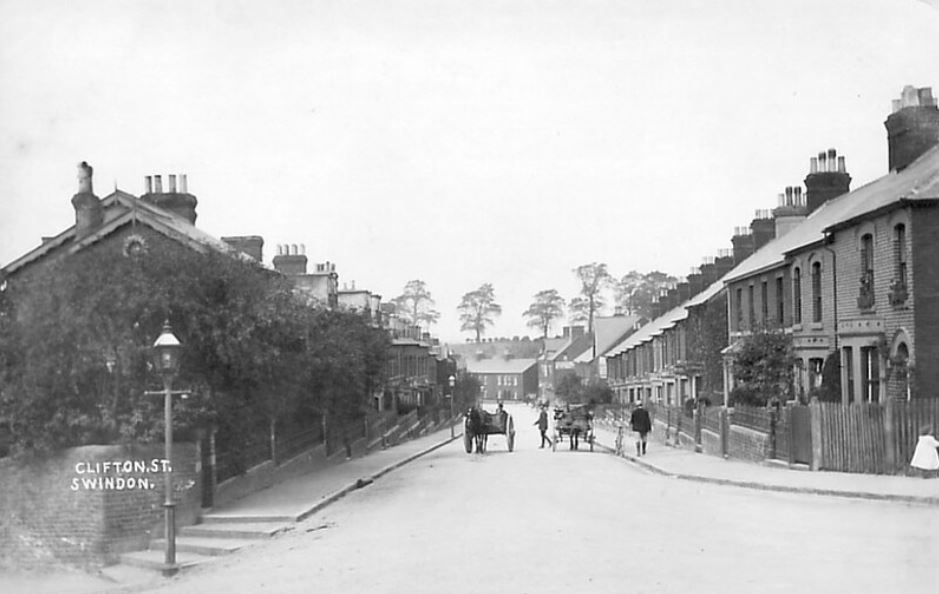
Clifton Street published courtesy of Mr P. Williams and Local Studies, Swindon Central Library.

It’s surprising that there is no road named after the entrepreneurial Edwin Harvey.

Edwin Harvey was born in Keynsham in 1843 one of William and Mary’s large family of 12 children. Edwin began his apprenticeship in the building trade working as a plasterer, most probably alongside his father, a plasterer journeyman. By 1871 aged 28 Edwin describes himself as a painter.

He married Alice Elizabeth Baker at St. Paul’s Church, Bath on November 26, 1878. Edwin, aged 36, then described his profession as Builder and his place of residence as New Swindon where he had already begun to make his mark!

In 1877 he was building a hotel and cottages on the Kingshill estate and in 1878 he built 4 houses and shops on Cambria Bridge Road with business partner William Crombey.

In 1879 he describes himself as builder and beerseller when he makes an application for a license to “Sell by Retail Beer and Cider, to be consumed on the House and Premises thereunto belonging, situate at William Street.” This beerhouse was most probably built by Edwin and occupied the corner plot of William Street and Cambria Bridge Road. It was owned by his deceased brother William and in 1879 by his widow Ann.

William Street and Park Hotel

Edwin was a busy man during the 1880s building houses in Albion Street, William Street, Clifton Street and Exmouth Street where he would eventually make his home. In addition to his building work he was elected a member of the New Swindon Local Board in 1885 and in 1887 a member of the Swindon Hospital Committee, acting on behalf of the Building Committee.

In 1881 he lived at William Street with his wife Alice and their baby daughter Ethel. By 1891 they had moved to 50 Exmouth Street where the family had grown considerably and then numbered 6 children. Edwin’s brother John lodged with them. By 1911 No 50 Exmouth Street (now named Glenthorne) was still a busy household with 4 twenty something children still living at home with Alice and Edwin, now aged 68 and retired.

Edwin Harvey died at his home in 50 Exmouth Street on October 21, 1925. He was 82 years old. The funeral took place on October 24 when he was buried in grave plot D1525 with his wife Alice who died in 1917.

With no street named in his honour, I’m hoping there will be a headstone on his grave when I find it.

You may also like to read:

William Crombey – builder

Ann Harvey – Inn Keeper

*Harvey Grove off Cheney Manor Road, was built in 1936 and named after Albert Harvey who once farmed at Manor Farm, but so far I haven’t come across a road named in honour of Edwin Harvey.

George Kilminster – neighbourhood builder

William Street published courtesy of P.A. Williams and Local Studies, Swindon Central Library.

In 1950 Sir John Betjeman, Poet Laureate 1972-84, described Swindon as a town with very little architecture and a great deal of building – and you’ve got to take his point. There has never been a time when Swindon was not desperate for housing and the basic red brick, utilitarian terrace house is a feature of our town.

There were a lot of builders in 19th century Swindon, all buying up pieces of land for development. Some bought great swathes of land such as James Hinton who laid out Dixon, Stafford, and Clifton Streets in 1879 and the Gorse Hill housing estate in 1889. Others worked on a smaller, though no less productive scale, sometimes entering into short term partnerships, later creating what would become a family firm employing more than one generation.

George Kilminster was one such builder, working with a Mr Ball on several properties in Swindon Road before establishing his own family business. And between 1893 and 1921 George Kilminster worked close to home – very close.

George Kilminster was born into the building trade in 1857, the son of Cricklade slater and plasterer Robert Kilminster and his wife Maria. By 1871 fourteen year old George was working with his brothers Joseph 18 and Alfred 12 as slaters alongside their father.

George married Mary Ann Hart in Cricklade St Sampson in 1880 and by the time of the census the following year they were living in Upper Stratton. In 1891 the census records the family living in William Street, which became their permanent home and George’s workplace. Between 1893 and 1921 George built in William Street a toolhouse and store; 2 cottages; a schoolroom at the Wesleyan Chapel; seven houses and a villa.

In Roadways – The History of Swindon’s Street Names, authors Peter Sheldon and Richard Tomkins list William Street as being named after builder William Crombey with work beginning in 1878. Street numbering begins and ends at Cambria Bridge Road with more than 160 properties extending to the Kingshill Road. Today there is some new building half way along and alterations to properties at either end of the street, most especially the demolition of the Wesleyan Methodist Chapel. But to stand in the street on a quiet day when there aren’t so many cars parked there, well it could look quite similar to the street George would have known.

George died in 1941, leaving his business in the hands of his sons Arthur and Harry. He was buried on February 15 in Radnor Street Cemetery in plot D1037 which he shares with his wife Mary Ann who died in 1946 and their daughter Iris who died in 1978.

Wesleyan Mission Hall

William Street, New Swindon

Such has been the growth of the cause of Wesleyan Methodism in West Swindon that it was found necessary to contemplate the erection of a hall in which to hold the services. A suitable piece of land having been procured at the west end of William Street situated immediately on the south side of the Wilts and Berks Canal and close to the Wootton Bassett road, the erection of a mission hall was very soon commenced. The erection of the building is being accomplished by Messrs J and C Williams, builders, of Swindon, to the specified plans of Mr Davis, architect. The dimensions of the hall will be 35 feet in length by 24 feet breadth, and 13 feet in height. In addition, there will be the necessary out-offices. The building will be of brick, with freestone dressings to windows and piers. Inside, the roof will be match boarded, with worked principals. So far has the erection of the building proceeded that the ceremony of laying the foundation stones was gone through on Wednesday last.

Extract from the Swindon Advertiser, Saturday, October 8, 1887.

William Street published courtesy of P.A. Williams and Local Studies, Swindon Central Library.