Luke Higgs – a first class engineman

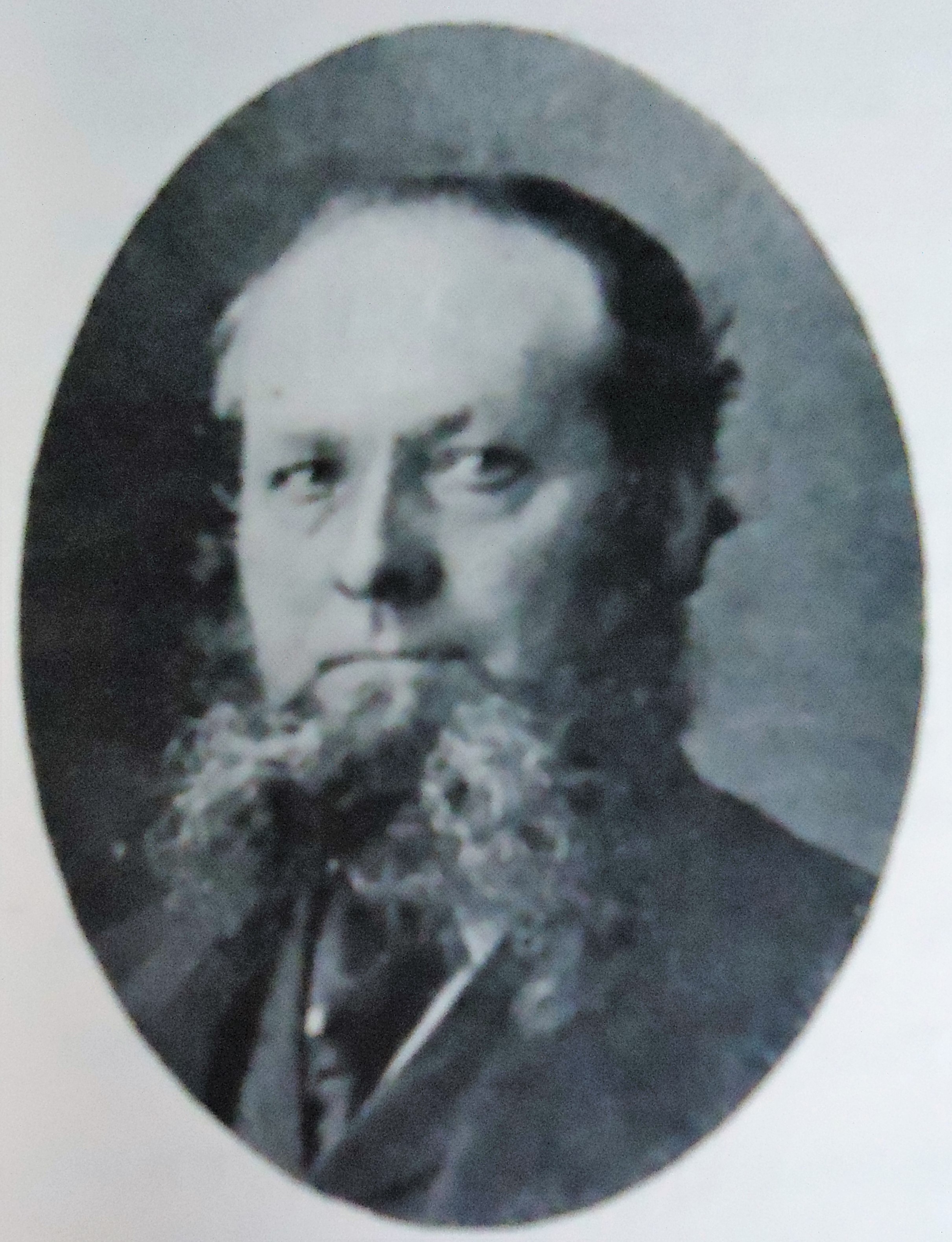
Luke Higgs

I could see Mr Higgs next door, standing at the bottom of his garden, looking out over the old canal. He was there most mornings, just standing and staring.

I picked up my basket of laundry and opened the back door. I could spare a few minutes chatting to him while I hung out the washing.

“Morning Mr Higgs,” I called. “Bit breezy! This washing should dry quickly enough.”

He was dressed in shirt sleeves even though it was a chilly January morning. I suppose he was used to being out in all weathers. He once told me that the old locos were open to the elements; no cab over the engineman then. Life for the drivers was hard in those early days.

It was all he talked about – the old days. The journeys he had done with the Royal family, how much the job had changed over the years.

He was hungry for news from the Works, but he had few visitors. Everyone was too busy, but I tried to find a few minutes in the day to talk to him, although I couldn’t bring him the conversation he wanted.

“Fifty-two years and two months, I worked for the Company,” he proudly told me, “and an unblemished career. I’m still fit and able to work but these new rules meant I had to retire.”

I’d read the newspaper reports published when he retired at Christmas. My husband Jack told me how Mr Higgs had fought the retirement ruling, but there was nothing the Company could do.

“I think he’d have taken any job going, but it just couldn’t be.”

I wasn’t so sure about that. Mr Higgs believed he was still fit enough to drive locos and that’s what he wanted to do. I don’t think a caretaker’s job would have suited him.

He turned his back on me as I started to peg out my washing. He didn’t seem to want to chat today.

“Everything alright Mr Higgs?”

He looked across towards the railway line.

“The wind must have changed direction,” he said. “I can’t hear the trains today.” He turned around and walked slowly back up the garden path.

“I think we might have some rain. Your washing won’t dry after all.”
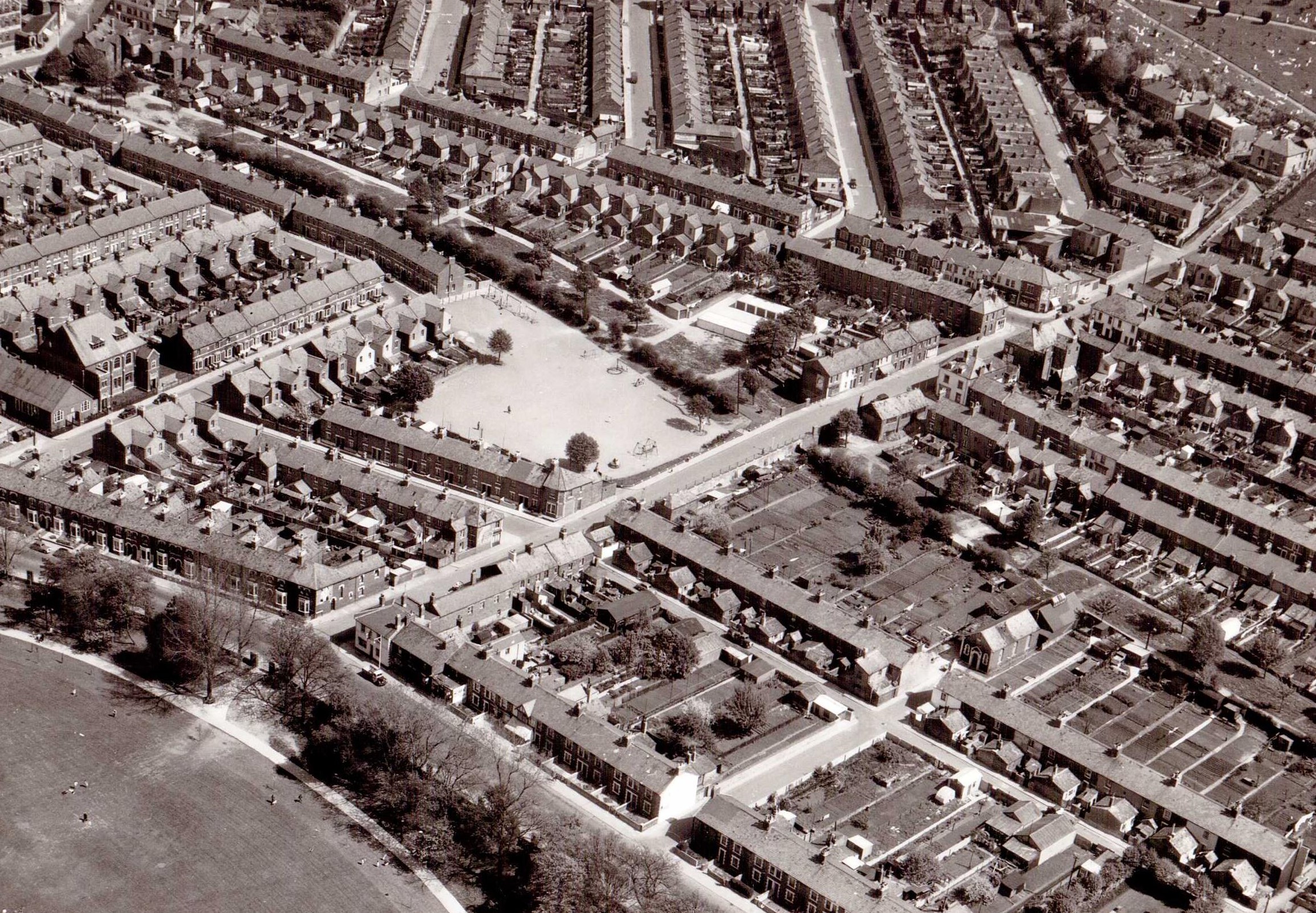
canal route

1950s photograph of Faringdon Road and the route of the old Wilts and Berks Canal

The facts …

Luke Higgs was born on December 3, 1834 and consistently gave his place of birth as London, Tower on census returns.

He married Margaret Beaupre in Bourne, Lincolnshire in October 1859. At the time of the 1861 census the couple were living at 20 Bath Street (now known as Bathampton Street) in the railway village, however their first child, a daughter Annie Agnes, was baptised at Holy Trinity Church, Paddington when they were living at 16 Waverley Road. The couple went on to have four more children and by 1871 the family was living at 19 Brunel Street. They soon moved to 8 College Street, their home for more than 40 years.

Luke entered the employment of the Great Western Railway in October 1852 just a few weeks before his 18th birthday. He worked first as an engine cleaner and lighter up before become a fireman in 1855. By 1861 he was working as an engineman and in a career that spanned more than 50 years.

Luke Higgs died at his home, 8 College Street, on March 12, 1913 aged 78. He left effects valued at £707 11s 3d (later resworn £642 11s 3d) to his wife. Margaret outlived him by a further twelve years. She died at 8 College Street on October 29, 1925 aged 90. They are buried together in plot D950 where they were later joined by their daughter Margaret Easley who died in 1953 and their grandson Elliott Tuckwell who died in 1967.


Retirement of a Railway Veteran

Over 50 Years’ Service

Mr Luke Higgs, of Swindon, who has just retired from his duties as driver on the Great Western Railway through the operation of the age limit of 70 years, has probably achieved a record of service, having been no less than 52 years and 2 months in the employ of the Company. It is remarkable that notwithstanding his great age he enjoys the best of health and looks a robust, able bodied man. He passed the eye sight and health test of the GWR doctor on 13 occasions, and when he passed last time his sight was exceptionally good.

Mr Higgs was born in London on December 3, 1834, his father being a noncommission officer in the Scots Fusilier Guards. Early in life he joined the service of the GWR and has grown in age with the railway, seeing many different systems in vogue during the half century. Improvements in the working of locomotives have of course come under his notice more particularly than any other, and he speaks of the time when there was no protection on the engines beyond the fire box, and no leg plates or cab, no steam pressure gauges, and no dry sand boxes. Those were hard times for enginemen, and great judgement was required to work the trains in safety.

He was fireman on the engine which took the late Prince Consort from Windsor to open Saltash Bridge in June 1857, and also filled a similar capacity on the train which conveyed the present King to Oxford, to open his college education, on Monday, Oct. 17, 1859. Not only that, but he has been fireman several times on the Royal train between Paddington and Windsor.

It is interesting to note that he was made a permanent engine driver the same day as the late Prince Consort died – December 14, 1861 – and ever since he has held a good reputation, so that when he retired there was not a black mark against his name. We are given to understand that he has the cleanest record on the Great Western line. In his career he has never lost an increase in wages or a premium, and has received from the Company £325 for good conduct whilst in their employ.

His varied experiences are of more than ordinary interest, and he modestly tells of incidents which would have turned but disastrously had it not been for his prompt actions. His advice in working trains has been frequently sought after by younger men, and many a good driver have been turned out of his engine. He was most economical in his work and studied the Company’s materials as though they were his own.

He is held in the highest esteem by all the officials with whom he came in contact, and all regret his retirement. The doctor who signed the last certificate said that Mr Higgs was well able to work for another five years, but of course the age limit had to be observed.

North Wilts Herald January 28th 1905

Luke and Margaret Higgs
Luke and Margaret Higgs with one of their daughters. Published courtesy of philstree18 from a public family tree on Ancestry.


George Palphramand

George Bellwood Palphramand retired in 1913 after 41 years in the service of the Great Western Railway.

George was born in Wolverton, Buckinghamshire on June 17, 1851, the son of George, an engine driver and his wife Isabella. Following the death of Isabella in 1861 the family moved to Rugby where George jnr served his apprenticeship with the London and North Western Railway. In 1872 he moved to Swindon where he married Mary Ellen Strong in 1876.

In 1884 George and Mary were hit by tragedy when their three year old son Ernest drowned in the canal near their home at 24 Read Street. In an age when child mortality was high they could not have expected to lose one of theirs in such traumatic circumstances. How do parents recover from such a loss? George had to go to work, Mary had to cook, clean and care for her surviving three children. In time they would have another son, Reginald born in 1887. Three siblings that had no memory of their little brother and one who never knew him.

In time Reginald followed his father into the railway works and having completed his fitting and turning apprenticeship moved to Coventry where he worked as a fitter in the aviation industry.

Following his retirement George and Mary moved to 69 Broadway, Earlsdon, Coventry. Mary died there in 1926. George died 11 years later on December 7, 1937.

Both Ellen and George were buried back in Swindon in Radnor Street Cemetery grave plot E8469 where they joined their little son who had died so many years before.

The site of the former Wilts & Berks Canal

Presentation to Mr. G. Palphramand – An interesting affair took place in the G Shop Office, Loco. Dept., GWR Works, Swindon, on Saturday morning last, the occasion being a presentation to the Foreman, Mr G. Palphramand, on his retirement from the Company’s service. The presentation took the form of a handsome silver-mounted ebony walking stick and a pipe, given by the assistants and Office Staff of the G. Shop. Mr A. Beer, in making the presentation, said he was expressing the sentiments of all those present in wishing Mr Palphramand the best of health to enable him to enjoy his retirement. He asked him to accept the gifts as a small token of respect and esteem of the members of his Staff. He would carry away with him the best wishes of all whom he had been associated with during his long service, and no doubt the walking stick and pipe would bring back pleasant recollections of bygone days.

Mr Palphramand thanked his colleagues for their kindness, and said he should appreciate the gifts very much indeed, as coming from his Staff, with whom he had always had harmonious dealings during the whole of his service as Foreman; and he thanked them all for the support they had at all times given him in carrying on the work of the Shop, at times under very trying circumstances. He felt very sorry to leave them all, and he had not thought of retiring quite so soon, but he found his health was not good enough now to enable him to carry on the work, and he thought it wise to give up in time.

Mr Palphramand served his apprenticeship with the L. and N.W. Railway at Rugby, and entered the service of the GWR in June 1872, thus completing 41 years with the Company. He was appointed Assistant Foreman in May, 1884, and took over the G (Millwrights) Shop as Foreman on Jan 1st, 1891. He has served under five different Managers, and was for many years Captain of the GWR Works Fire Brigade. He was also for some years a member of the Council of the GWR Mechanics’ Institution, and also served in the old Volunteer Force in connection with the Wilts Regiment.

Swindon Advertiser, Wednesday, October 15, 1913.

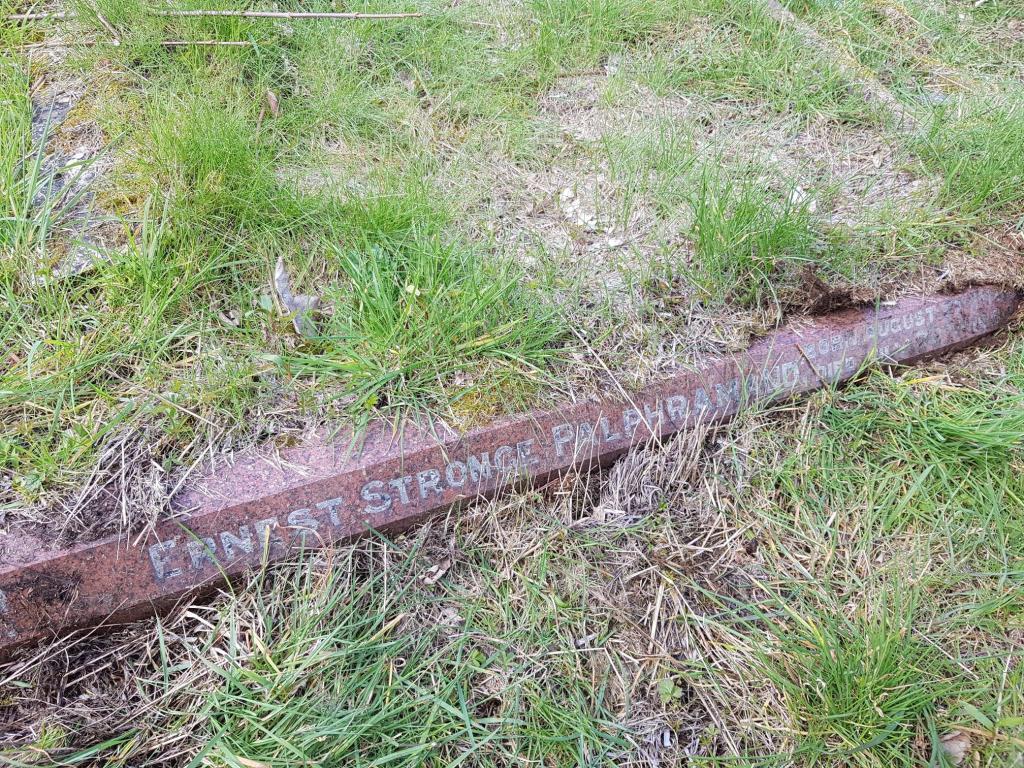
The large Palphramand and Strong family grave

You may also like to read:

The Palphramand family

Thomas Page – brickmaker

In 2013 Graham Carter, Mark Sutton and I began our great magazine publishing adventure. During five years of publication we produced twenty editions of Swindon Heritage, including one special publication to mark the 75th anniversary of the Battle of Britain.

One of the first people we interviewed was Janet Flanagan. Jan is a well known figure on the local history circuit with her legendary knowledge of the Wilts & Berks Canal but we didn’t know that she was also researching the brickmaking industry of Swindon.

Jan told us how in the 1870s the Swindon Brick and Tile Company’s yard in Spring Gardens was the largest brickworks in Wiltshire with a Hoffman kiln (beneath where the Range stands today) capable of firing 25,000 bricks a day.

Jan’s ongoing research revealed 19 brickworks in the town and district, including the well known Thomas Turner works in Drove Road, now the site of Queens Park.

And of course the brickmaking industry employed a lot of people.

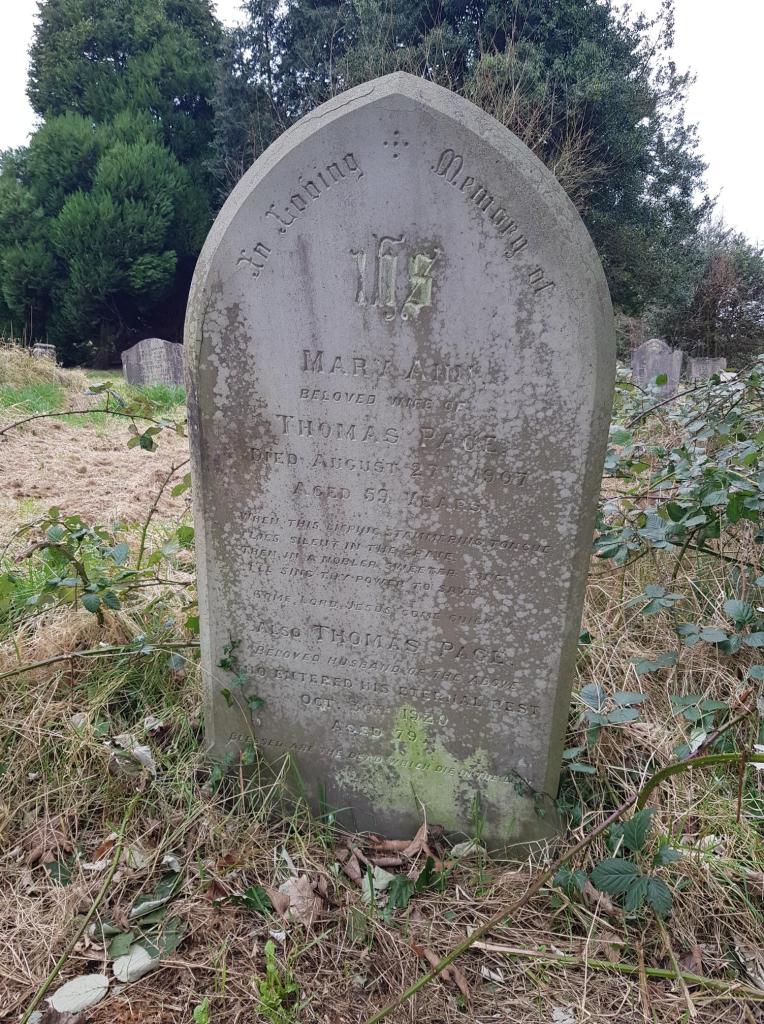
This is the last resting place of Thomas Page, born in Stratton in c1842, the son of a brickmaker, who spent a lifetime working in the industry.

In 1867 he married Mary Ann Painter, the daughter of another brickmaker, William Painter. In 1871 the couple lived at Brick Kiln Cottages in Wroughton. In 1881 they lived in Stratton Green where they also ran a General Shop & Outdoor Beerhouse. This was probably Mary Ann’s concern as Thomas was still working as a brickmaker.

They later moved to Trowbridge and in 1901 they were living and working at the Cockhill Brickyard. Their 15 year old son Moses also worked as a brickmaker and Thomas’ widowed brother-in-law William Weller, another brickmaker, lived with them.

By 1907 Thomas and Mary Ann had returned to Swindon where Mary Ann died at 80 Chapel Street, Gorse Hill on August 27. Thomas died 13 years later. The couple are buried together in grave plot B2708.

Hubert Cyril Littleton Haggard – a promising career cut short

Hubert Cyril Littleton Haggard was born on May 23, 1889, the second of William and Sarah Haggard’s two sons. He began work with the Great Western Railway aged 15 as a ‘lad clerk on probation’ in the stores department before transferring to the laboratory as an assistant analysist on the junior staff then progressing to the senior staff. Hubert was a conscientious and meticulous student; sadly, it was this attitude to work, which contributed to his fragile mental health. In 1908 Hubert was signed off work and ‘on the club’‘required to be indoors at half past five in the evening.’ Today we have a better understanding of mental health but even now young people like Hubert are failed by an overburdened system.

Swindon Lad’s Sad End

Chemical Student’s Body found in the Canal

Promising career cut short

An exceptionally sad affair has occurred near Swindon. Last (Wednesday) evening a boy walking along the path by the side of the canal in the neighbourhood of Hay Lane, near Swindon, noticed a body in the water. He at once gave the alarm, and a man succeeded in getting the body out. It was apparent that life was extinct. Enquiries proved that deceased was Hubert Cyril Littleton Haggard, of 29 Chester Street, Swindon.

Our reporter made enquiries at the deceased’s home, where the news of the discovery of the body had come as a terrible shock.

Hubert, who was 19 years of age, was one of the brightest and best liked lads in the chemical laboratory in the GWR Factory. He was a lad full of promise, and most attentive to his work. He had been in the GWR laboratory as an analyst for between three or four years, and his exceptional progress and general aptitude for difficult and delicate work impressed those under whose directions he laboured. He held several certificates, and had won scholarships for efficiency in chemical science, being one of the foremost pupils when at the Swindon and North Wilts Technical School. Latterly he had exhibited signs of suffering from debility, which was attributed somewhat to an over application to his duties, for the father stated to our reporter that “Hubert was an extremely sensitive lad; he was conscientious to a degree, and once he applied himself to any piece of work he would stick at it until it was done to his best satisfaction.” The debility was not by any means acute, but it was decided that Hubert should take up no subjects this season, and he was himself agreeable to this. He placed himself under medical care, and being “on the club,” as the saying goes, he was required to be indoors at half past five in the evening. Before then, however, he generally managed to get in a little stroll.

On Tuesday afternoon he went for his usual stroll. He appeared quite fresh and happy when he went out. When he did not return at the usual time, some anxiety was felt, and as the night came on and he still did not return, the police were informed, and all night a search was kept up without avail, until the news came late on Wednesday afternoon that his body had been found in the canal. The deceased, apart from his work, was a cheerful, pleasant lad. He was a member of St. Mark’s Church, and was well liked and warmly respected by all who knew him. Much sympathy is felt with the relatives in their bereavement.

The inquest was held this afternoon and a verdict of “Found drowned” was returned.

Swindon Advertiser, Thursday, November 26, 1908.

Hubert was buried on November 30, 1908 in grave plot E7727. The burial registers include the comment – Found in Wilts & Berks Canal. His mother Sarah died in 1923 and was buried with him. William Haggard died in 1938 aged 85 years and was buried with his son and wife.

The Palphramand family

This large family plot has many stories to tell. From Joseph Strong, a pattern maker, who moved to Swindon from Bolton in Lancashire in the 1850s to his son-in-law George Palphramand, who in retirement moved to Coventry and in death returned to Swindon to be buried with his family.

But I am beginning the story of the Strong and Palphramand’s with a family tragedy and the death of a little boy.

George Palphramand and Mary Ellen Strong married in St. Mark’s Church on April 13, 1876. Their first child Isabel was baptised on November 4, 1877 in the church where they were married. At the time of the 1881 census George and Mary were living at 24 Read Street with their three children Isabel 3, George 2 and 7½ month old baby Ernest. Mary’s brother Joseph Strong and his family lived next door at number 25. In the 1880s Read, Marlborough and Andover streets abutted the Wilts & Berks Canal.

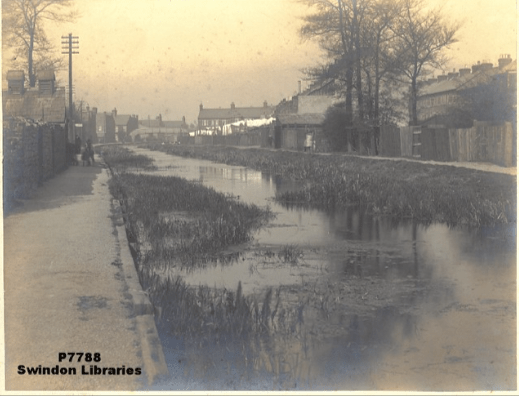
Work began on the Wilts & Berks Canal at Semington in 1795 expressly for the transportation of Somerset coal to the towns in Wiltshire and Berkshire. However, with the completion of the Great Western Railway line from London to Bristol, trade on the canal diminished. It was closed by an act of parliament in 1914 and eventually filled in from about the 1930s. Today the short stretch of the former canal provides a route into Swindon town centre from the bottom of Kingshill.

At the inquest into the death of Ernest, a witness drew attention to the fact that there was really no fence there to keep little children from getting on the canal side, and ‘it was a great inducement for children to play there.’ Returning a verdict of accidental death the jury ‘expressed a wish that the Canal Company should endeavour to carry out such improvements to their fences that would hinder the occurrence of similar fatalities.’

Was this recommendation acted upon? Would this have been any consolation to the Palphramand family?

The Wilts & Berks canal looking east towards Marlborough Street footbridge c1914 published courtesy of Local Studies, Swindon Central Library.

Another Death From Drowning – On Tuesday afternoon, Mr Baker held an inquest at the Ship Inn, New Swindon, on the body of Ernest Strong Palphramand, aged three years and eleven months, son of George Palphramand assistant foreman in the P Shop, G.W.R. Works, of 24, Read street, who was drowned in the canal at the end of Read street, on Sunday afternoon. Mr George Thomas was foreman. The father of the deceased deposed that he last saw his son alive at about half past four o’clock on Sunday afternoon. The deceased was then playing with his brother in the backyard. The two children then went out at the back-gate, down the yard, and round by the front. The deceased went on to the path, and must then have fallen into the water. The other brother did not go on the path, but saw the deceased in the water, and gave the alarm. Witness ran up the street and jumped in, but could not find the child. His wife called the children back when they first went out of the gate, but they did not come; the elder of the children was five years old. When his older son came back from the water he seemed confused and could not tell where his brother was. No one really saw the child fall in the canal; and he must have been in the water for quite a quarter of an hour. Every effort was used to restore animation by those on the bank before the doctor arrived. Witness wished to call the attention of the jury to the bad state of the fences, and the path; there was really no fence there to keep little children from getting on the canal side, and it was a great inducement for children to play there. Henry Fraine, carpenter, of 44, Albion street, who helped to get the child out of the water, and Dr. Swinhoe also gave evidence. The jury returned a verdict of accidental death, but expressed a wish that the Canal Company should endeavour to carry out such improvements to their fences that would hinder the occurrence of similar fatalities. The jury also expressed their deep sympathy with the bereaved parents.

Wilts and Gloucestershire Standard, Saturday, July 26 1884.

Ernest Strong Palphramand was buried on July 23, 1884 in grave plot E8469. The burial registers record that he was 3 years old and that his place of death was ‘The Canal near Read Street’.