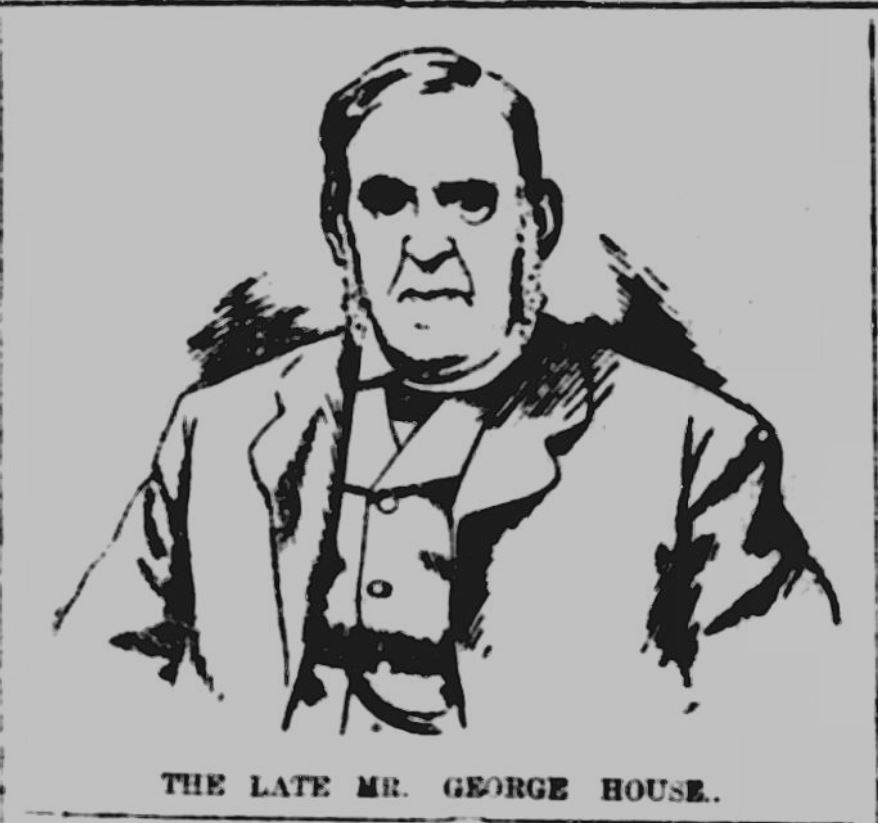
It is seldom we have the opportunity to read the words of an ordinary railwayman. When George House died in 1903 the Advertiser republished extracts from an earlier interview made in 1899.
The facts …
The Oldest GWR Employee
Reminiscences of Early Days in Swindon
As showing what a contrast there is between Swindon of today and of Mr House’s youth, we cannot do better than reproduce an interview with Mr House, which was published in the “Advertiser” in April 1899. A representative of this paper called upon Mr House in the latter part of April of that year, and found him reading his “Evening Advertiser,” and quite delighted to have a chat about his early days in Swindon. The interviewer commenced the conversation:-
“Good evening, Mr House; and is it true that I behold in you the oldest railway servant in the United Kingdom? A correspondent, in answer to a request in the ‘Advertiser’ so informs me?” I said when Mr House had assured himself that I was comfortably seated in his cosy room.
“Yes; I think so,” was his ready response. “I have a record of over 60 years’ service with the GWR Company. I started work with them in the construction of the line there under the supervision of Brunel.”
“When did you come to Swindon?” I queried.
“In 1838” was the reply, “there was no railway station here then, and no factory. When the coaches began to run from Bristol to Swindon the only place where passengers could alight was at Hay Lane.”
“You almost remember the open carriages then?”
“Yes, very well. And the coaches used to leave here at eight o’clock at night, and get to London some time in the morning. It was travelling in those days and no mistake. The ladies’ dresses used to be entirely spoilt by the smoke and dirt in one journey.”
“Now as to the GWR Works at Swindon, which was the first shop built?”
“Well, when I came here there was no factory at all. Not a stick nor stone. I assisted to fix up the first machinery. The D Shop, F Shop, and G Shop were the first shops that were erected.”
“How many men were employed here when you first came to Swindon?”
“Well, there were practically no men employed here till I and others came from Maidenhead, and Messrs Whitworth, of Manchester, fitted up some machinery. Then, for a start, there were not so many men employed as there are clerks now.”
“What a number of dead and gone faces such remembrances must bring before you. The chiefs of the Works, foremen and others, for instance.”
“Yes, I think I have a record in that direction, for I have worked under no less than five managers and eight foremen at the Swindon Works. I can tell you their names in a moment.”
“Who were the managers?”
“Well, first, there was Mr Sturrock, then Mr Rae, and Mr William Gooch (brother to Sir Daniel Gooch). And in more recent times the late Mr Samuel Carlton, and Mr G.J. Churchward.”
“You say you have worked under eight different foremen: who were they?”
Yes, there was Charles Hurt, Alf. Cootes, Peter Bremner, Dodson, Robinson, E. Dingley, William Booth, and A. Nash.”
“Of course, in those early days there was no Mechanics’ Institute. What recreation was provided for the workmen?”
“Oh, there used to be a small theatre in the Works – in the O Shop. Here a dancing class was held, and amateur theatricals were performed there. The Mechanics’ Institute was not built till several years later. Lord Methuen came down and laid the first stone, and a fete was held to celebrate the event. I remember well the Great Exhibition of 1851. All of us workmen who had joined the Mechanics’ Institution – in fact, every one of the employees of the Company who were working here then – were given an free railway pass to London to go and see the Exhibition. On another occasion when we were give a free trip to London, I took my wife and family of ten children. And when we arrived at Paddington, I hailed a cabby, who stared at my family, and remarked, “What’s this, sir, a whole school!”
The Late Mr George House
Funeral Last Saturday
The funeral of the late Mr George House, of Taunton street, took place on Saturday afternoon amidst every sign of mourning. The cortege left deceased’s late residence shortly after 2.30 pm for St. Mark’s Church, where the first part of the sad service was impressively read by Canon, the Hon Maurice Ponsonby, vicar and rural dean, who also officiated at the graveside in the Cemetery, where a goodly number of persons had assembled to pay their last mark of respect to one who chief aim in life was the care of his less fortunate brethren. The body was enclosed in a beautiful casket of polished elm, with heavy brass furniture, the breast plate bearing the following inscription:-
George House
Died January, 1903,
The funeral arrangements were carried out by Mr H. Smith, of Gordon Road.
Extracts from The Swindon Advertiser, Friday, January 16, 1903


A fascinating insight from a workers perspective of the start of GWR Railway Factory. I won’t call Works because some bright spark bright spark has called the ‘Railway Village the ‘Works’.
What a find Frances you’ve done it again.
The reference to the social entertainment by him before the Mechanics Institute certainly confirmed that the drive behind the establishment of the Mechanics was not from the management but from the workers.
I wonder if he travelled from Maidenhead or did he settle in Swindon?
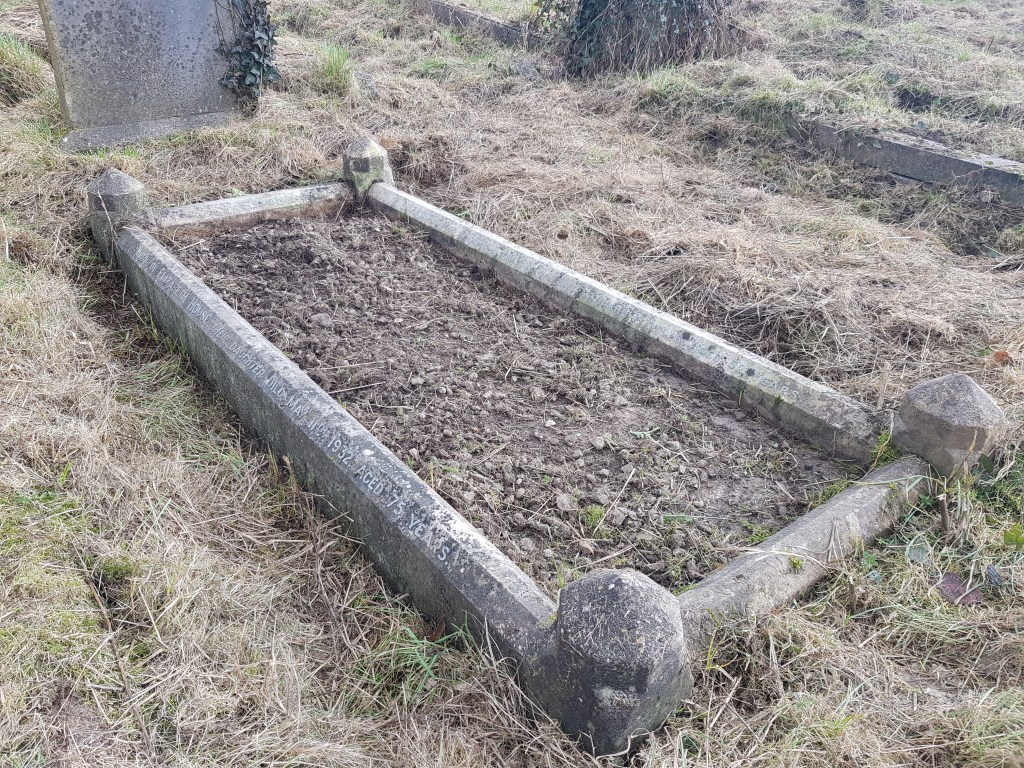
Such a shame his grave is not more prominent. Did it originally have a headstone?
If I may I’d like to include a snippet from this on my GWR Factory History Tours of the Designer Outlet.
Secretary Rodbourne Community History Group
secretary@rodbournehistory.org
LikeLike
Thank you Gordon. Please use whatever is of use on your tours. George did eventually settle in Swindon and a home in Taunton Street but of course none of the company houses were built when he first came here. This is rather an old photo of his grave, which is now cared for by our volunteers. The grave has a kerbstone surround with his name and that of his daughter on it. It is unlikely there was ever an upright headstone.
LikeLike
I loved reading his very words and I’m very glad my recent rail journeys between Swindon and Paddington were not in an open carriage
LikeLike