We tend to think that back in the day people remained pretty much where they were born, growing up, marrying and dying in the same village or somewhere very close. But it has always been a fact of life that people went where the work was and Swindon is a perfect example. Take William Henry Bennett and his wife Edith, buried in Radnor Street Cemetery.
William and Edith married at St Michael’s Church, Wood Green on April, 8, 1888. William was a 32-year-old widower and Edith was just 20 years old. At the time of their marriage they both lived in Wood Green. William worked as a Press Reader and the couple lived at various addresses in Kentish Town and Camden for most of their married life.
But by the time of her death in 1931 Edith was living at 43 Stafford Street, Swindon. William died less than three years later when he was also living at 43 Stafford Street. Their eldest daughter Elizabeth Mary Sophia is buried with them and at the time of her death in 1952 she was living at 14 Prospect Hill.
So, what had brought the family to Swindon? Not a job in the Works, which is what invariably was once the attraction. The clue comes with Elizabeth Mary Sophia’s home in Prospect Hill in 1952.
Prospect Hill begins at the Beehive pub on the corner of Western Street with the Rehoboth Chapel opposite and climbs up to the junction with North Street. Prospect Hill doesn’t appear to come within any of the Swindon Borough Council’s Conservation Areas, which is a bit of a shame as it is one of the streets that links the history of the two towns, Old and New Swindon.
When the railway settlement at the bottom of the hill was first built in the 1840s the amenities were pretty poor. The only shops were in Old Swindon, which constituted a long, muddy walk for the housewives across fields and up Prospect Hill. Development of this area began in 1869 when the Berkshire Estates Company laid out Dover Street, Western Street, North Street and Prospect Hill with part of Cross Street, although building was not completed until after 1885.
The 1911 census records George Smith living at No. 14 Prospect Hill with his son Arthur. George worked as a groom, most probably for one of the wealthy Old Swindon families, while Arthur was an Engine Fitter’s labourer in the GWR Works; a family embracing both halves of Swindon’s history. But George and Arthur were only tenants at No 14, the house belonged to our William Henry Bennett. In 1881, twenty years earlier, William was working as a jobbing printer and lived at No. 14 with his first wife Margaret Elizabeth.
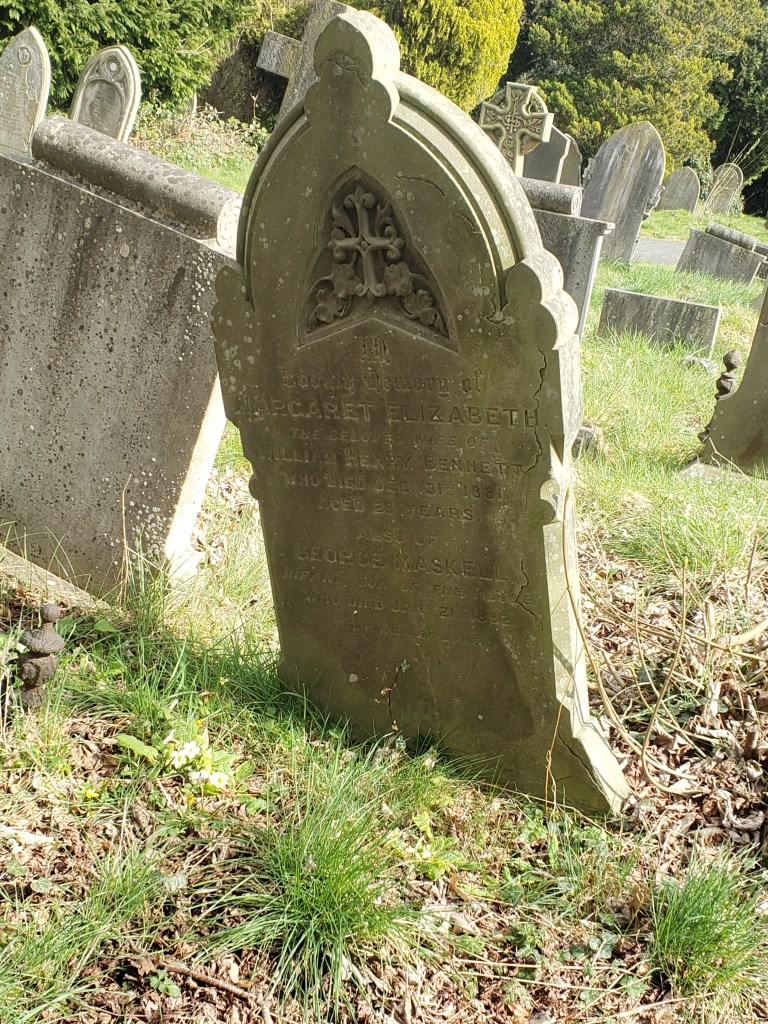
Sadly, Margaret died in January 1882 aged just 29 years old, shortly after giving birth to a baby boy. Her son, George Maskell Bennett, died later that same month. They are buried together in Radnor Street Cemetery in plot E8212.
When did William decide to move to London? Perhaps he could not face living at No. 14 where he and Margaret had excitedly prepared to welcome their baby?
When he eventually returned to Swindon with his second wife Edith, more than 20 years later, they made their home in Stafford Street. However, he had obviously held on to the house in Prospect Hill during the time he lived in London as this is where his daughter Elizabeth Mary Sophia ended her days in 1952.
Edith died on September 10, 1931 at 43 Stafford Street. William died on May 2, 1934 at the Stratton Infirmary and was buried with Edith in plot C2A close to the cemetery chapel. Their daughter Elizabeth Mary Sophia was buried with them in 1952.
Margaret and her baby are buried not too far away.
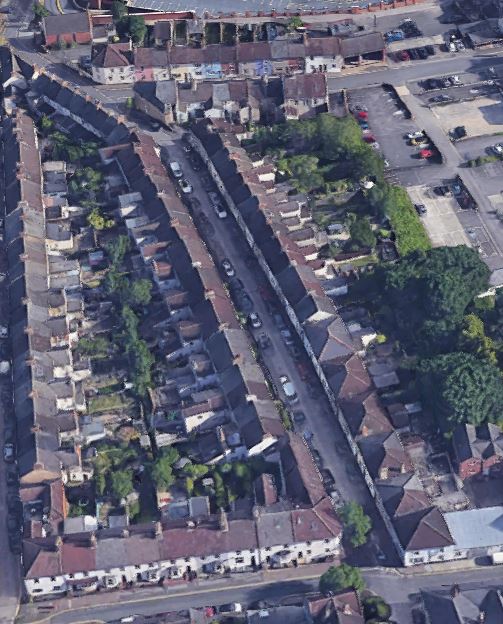
Prospect Hill

The grave of William, Edith and Elizabeth Bennett

 Radnor Street Cemetery
Skilled engineering workers were often highly mobile. Rural/Southern railway towns such as Swindon saw a large influx of skilled workers from beyond Wilts borders. During 1840-60s under 10% of employees in GWR works originated from Wilts. Workers especially from northern England, Scotland & Wales. During the first railway recession of 1847-8 up to 1/3 of workforce was made redundant, especially single men, and many of these moved on to other areas.
Alfred Williams chronicles the many regional accents to be heard in the Works around 1900s.
LikeLike
Thank you for commenting.
LikeLike