What you will read published below is a shocking story told in brutal and stark language. This is a newspaper report unlike anything we would read today. Yet it might sound a very modern story, violent and tragic, and at the heart of it a little girl, much loved by both parents.
The Swindon Tragedy
The Inquest
Eyewitnesses Stories
Verdict of Felo de Se
On Saturday, the Deputy Coroner (Mr J. W. Pridham) held an inquest in the Boardroom at the Stratton Workhouse on the body of John Page Smith, who died at the Workhouse Infirmary on Friday morning, as the result of a shot wound self-inflicted, after shooting his wife, in Bridge Street on Thursday afternoon, as already reported in our columns.
Mr W.H. Kinneir was present to watch the proceedings on behalf of Mrs Smith and her relations.
Mr G.M. Butterworth was present representing the police and members of the deceased’s family.
Mr H. Scotton, of Highworth, brother of Mrs Smith, Dr. Du Cane, and Dr. Muir, were present, and Supt. Robinson and Inspector Miller also attended the enquiry.
Mr Charles W. Barnes was the foreman of the jury, who viewed the body, which was lying in the mortuary.
The Coroner’s Statement
The Coroner, in opening the inquiry, briefly and lucidly explained the facts of the case. He said the deceased man was a solicitor’s clerk, and was formerly employed in Swindon. He was married to the young woman who was now lying in the Victoria Hospital, Swindon, seven years ago, and there was one child of the marriage. For some time past the couple had lived apart, he at Bristol and his wife in the neighbourhood of Swindon. Deceased had recently had the custody of the child. He (the Coroner) understood that Smith returned to Swindon from Bristol for the Easter Holidays. On Thursday afternoon last, Smith and his wife and child were seen outside the GWR Station, Swindon, about four o’clock. They walked along Station Road to the corner of Bridge Street, and were heard to be quarrelling. At the corner of Bridge Street, the man left his wife, but quickly returned, fired at her with a revolver, and then fired upon himself. These were briefly the facts.
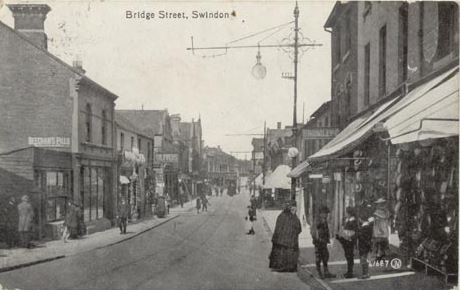
old image of Bridge Street
Evidence of Identification
The first witness called was Wm. Hodges Smith, of 56 North Street Swindon, builder’s assistant. He was very much affected.
The Coroner: You had the bringing up of the deceased? – Yes.
What was his age? – Thirty-two.
He has been living at Bristol? – Yes.
At what address? – Small Street Court.
When did he come to see you last? – On Friday.
Were you aware that he had any firearms or weapons in his possession? – I had not the least idea.
How long had he been living apart from his wife? – I could not say. It might be three years, it might be four years.
A Juror: Did he often come and see you at Swindon? – Not very often.
The Coroner: Did he have the custody of the child? – During the past fortnight. The child was much attached to him.
Medical Evidence
Dr. Du Cane was next called. He said on Thursday afternoon at four o’clock I went to the Great Western Station at Swindon. I passed the deceased, his wife, and the little child, on Bullen’s Bridge, Station Road. The man was speaking in an excited manner to his wife. The child was crying. I returned within five minutes, and saw that deceased had his wife by the arm. On seeing me he let go. I went to my house, which was within a few hundred yards, and told my wife I was going again up the street as I was certain something serious was going to happen. I saw from my window the wife leave her husband and go round the corner into Bridge Street. The child then left her father, and went round the corner after her mother. The deceased immediately after also followed. I at once followed and the next moment four or five shots rang out. I ran quickly up the street and found deceased lying on his back bleeding from a wound in the right temple. I judged from his condition that he was beyond medical skill. I then gave my attention to the wife, and conveyed her to the Victoria Hospital. The woman was shot in the neck, and the left temple. After attending to Mrs Smith, I attended the deceased at Stratton Infirmary. There was a wound above the right temple penetrating at least four inches into the brain. Blood and brain matter were coming out of the wound. I attended to the wound and requested Inspector Miller to have pen and paper in readiness in case the man should recover consciousness and make a statement. I attended the man up to his death on Friday morning.
A juror: Did you see the shot fired? – No.

old image of Bullen’s Bridge
Evidence of Eyewitnesses of the Tragedy
Florence Tegg, 78 Bridge Street, Swindon, domestic servant in the employ of Mr Vincent, Bridge Street, was the next witness called. She said I was dusting the shelf in the kitchen on Thursday afternoon. My companion Louisa Hawkins was with me. I saw a man and a woman and a child outside, and I thought they were quarrelling.
What made you think they were quarrelling? – She wanted to go one way and he wanted her to go another. He put his arm round her and pushed her up against the window at No. 2 Bridge Street.
What next did you see? – I saw him hit her about three times with his fist. He struck her in the chest.
What else? I was getting from one chair to another to get a better view when I saw the man pull the woman’s head towards him and then I heard a shot, though I did not see the pistol. I heard four reports, and I saw the man fall down. I did not see any more as I was told to get down.
Louisa Hawkins, another servant in Mr. Vincent’s employ, gave corroborative evidence. She was with Tegg in the kitchen and saw the man and woman quarrelling.
She added: I saw the man fire at the woman with a revolver, and then turn the revolver upon himself. I didn’t stop to see any more from the kitchen but ran into the street. The man was then lying down.
The Deputy Coroner: How many reports did you hear altogether? Four.
A juror: Did you hear deceased threaten his wife in any way? – No.
Police Inspector’s Evidence
Inspector Geo. Miller next gave evidence. He said: On Thursday afternoon last just before 4 p.m., I received information and went into Bridge Street. I found the deceased lying on his back on the pavement opposite No. 2 Bridge Street. He was bleeding very much from a wound in the right temple. Between his legs and near his right hand was a revolver, which I took possession of, and produce. I found five empty cartridges. I got a horse and trap, under Dr. Du Cane’s instructions, and took the deceased to the Victoria Hospital, and then to Stratton. On searching deceased’s clothing I found a packed of oxalic acid and a number of cartridges in his right hand pocket. The cartridges were similar to the empty ones found. I also found a letter written on foolscap and addressed to Mr. Scotton. It had been returned unopened and unread.
The Coroner: Does the jury want the letter read?
The Foreman: No, I think not.
A juror: Does it supply a motive for the crime?
The Coroner: In my opinion it does, but we are here only to ascertain the cause of death.
It was decided that it was not necessary for the letter to be read.
Inspector Miller continuing said: There was also on him a gun license dated 15th April, 1905, taken out at Bristol.
The Coroner: It would be necessary for him to take out a gun licence in order to enable him to carry a revolver.
Mr. Butterworth: It would be, under the new Act.
Inspector Miller added that he found 13 5d in money on deceased. He added that deceased never recovered consciousness, but his wife did.
A juror: Did you hear either of them speak? – I only heard the woman speak.
Dr. David Muir, of Stratton, Medical Officer at the Workhouse, was the next witness. He said: I called at the Infirmary on Thursday night and saw deceased. He was suffering from a gun-shot wound in the right temple. He was in a moribund condition. He died on Friday morning at two o’clock. He never regained consciousness.
The Summing Up
This was all the evidence, and the Coroner briefly summed up. He said it was shown in the evidence that deceased and his wife had been living apart for some little time. On Thursday afternoon about four o’clock they met outside the GWR Station, and, according to Dr. Du Cane’s evidence, they were quarrelling. This was continued in Bridge Street according to the evidence of the witnesses Tegg and Hawkins. It was also clear that Smith shot at his wife two or three times, and then turned the revolver upon himself.
Without further remarks, the Deputy Coroner asked the jury to consider their verdict.
The Verdict
After a minute’s consultation the jury returned a verdict: That the deceased met his death as the result of a self inflicted wound and also found the deceased wilfully and maliciously shot himself. This, of course, is a verdict of felo de se.
The Deputy Coroner in reading the formal verdict, described the deceased as a solicitor’s clerk.
Mr G.M. Butterworth intimated that the deceased had been erroneously described as a solicitor’s clerk. He had for years been acting as a general agent.
The Deputy Coroner accordingly altered the description.
Before the Court closed Supt. Robinson addressing the Coroner said: Perhaps you will allow me to make a statement. When the Inspector took the deceased to the Victoria Hospital, he was told the man could not be admitted. It appeared in one of the local papers that there had been some unpleasantness between the police and the Hospital officials and that that was the reason the man was not admitted. I wish to say that that has no reference to myself whatever. The most amicable relations exist between myself and the Hospital officials.
Mr W.H. Kinneir: I may say on Supt. Robinson’s behalf, that the matter in question a matter that occurred some time ago – happened before Supt. Robinson came to Swindon.
We may point out that the statement complained of as appearing in a local paper was not made in the “Swindon Advertiser.”
With regard to the verdict returned by the jury we might point out that in criminal law, to constitute a felo de se – that is, a felon as regards one’s self, the suicide must be of years of discretion and in his right senses.
Funeral of Smith
The funeral of deceased took place on Tuesday in Swindon Cemetery. The utmost secrecy had been kept regarding the hour of interment, but, of course, it became known to a few, particularly those resident near the Cemetery, and a crowd of some 100 or 150 persons, chiefly women, assembled. Superintendent Robinson was present, together with Detective Sergt. Moore, P.S. Buchanan, and a few Constables, and perfect order was maintained.
The coffin was conveyed from the Stratton Infirmary between nine and ten o’clock, reaching the Cemetery at half-past ten. The mourners were a few of deceased’s relatives. The special service was conducted at the graveside by the Rev. Arthur T. Tasker, curate at St. Paul’s Church, Swindon.
The coffin, on which was placed a few wreaths, was of polished elm, with massive registered fittings. The inscription on the breastplate was as follows:- “John Page Smith, died April 28th, 1905, aged 32 years.” Immediately after the service, the grave was covered in, and the crowd quietly dispersed.
The funeral arrangements were satisfactorily carried out by Mr Fred J. Williams, acting for his father, Mr Joseph Williams, of Bath Road.
Mrs Smith Progressing Favourably
On enquiry at the Victoria Hospital at three o’clock this afternoon, our representative was informed that Mrs Smith has made excellent progress, and there is little doubt that she will completely recover. She is able to take plenty of nourishment.
It is stated that Mrs Smith has repeatedly enquired as to her little daughter, and has been informed that she is well and cared for. Mrs Smith has also been deemed sufficiently recovered to be informed of her husband’s death.
Swindon Advertiser, Friday, May 5, 1905
John Page Smith died on April 28 and was buried in Radnor Street Cemetery on May 2 in grave plot B1689. He is buried with four others in a public plot.

 Radnor Street Cemetery
I would like to see if there is an obituary for Mrs Anne Sharman buried at Radnor can you tell me which paper it might be in and where I could find it. Thanks
LikeLike
Hi Mrs Garland – depending on when/if Anne Sharman died in Swindon I would suggest the Swindon Advertiser and/or the North Wilts Herald. Both newspapers are available to research on the British Newspaper Archive website. Alternatively, contact Local Studies at Swindon Central Library who will be happy to help.
LikeLike