In the 1880s and 90s it was not unusual to find men like Robert Laxon still employed in Swindon’s GWR Works into their 80s. However, by the 1930s there was a state pension and an official retirement age. In December 1930 more than 200 men retired from the Great Western Railway Works, an event of such importance to warrant a detailed article in the first January edition of the North Wilts Herald published in 1931.
The names and address of those men forced to retire under the introduction of the 66 years age limit were recorded in appreciation of their long years employed in the Works. Men who had joined the company in the 1880s and 90s; men like Tom Solven who had completed 52½ years’ service and George Edge, of 39, Medgbury Road, 43 years a chargeman wagon builder. Chargemen in the Locomotive Department such as E.P. Cave, a fitter who lived in Pleydell Road, G.A. Hallard, turner, 70 Jennings Street and G.F. Randell, fitter, 19 William Street.
Mr William George Woodward, 43, Havelock street, retires after 50 years’ service in the GWR works, and he has spent the whole of that time in one shop – No 7 Finishing Shop, Carriage Department.
A native of Oaksey, Mr Woodward came to Swindon on 11 October, 1880, and started work as a machineman in the factory. He was made chargeman 32 years ago last July.
He has served under three Chief Mechanical Engineers, the late Major William Dean, Mr. G.J. Churchward and Mr. C.B. Collett. His first foreman was Mr. Thomas Rose. He has seen the number of employees in his particular shop grow from 50 to between 300 and 400.
Mr. Woodward has a vivid recollection of a bit of the first work he did during his initial year in Swindon. It was to help clear the line between the railway station and the transfer sheds during the great snowstorm in January, 1881. Greatly interested in Friendly Society work, Mr. Woodward has been a member of the Oddfellows Society for many years. He has been for 19 years secretary of the juvenile branch, and 17 years secretary of the Stratton St. Margaret lodge.
Last Saturday he was appointed secretary to the Widows’ Hope lodge – one of the oldest and largest in the Swindon district – to fill the vacancy caused by the death of Mr. A.C. Nethercot. He is Past Grand Master of the Swindon District, and was one of the delegates who attended the Centenary A.M.C. of the Order at Southampton in 1910.
Perhaps for many of the men it was a relief to no longer have to work. But no doubt for others it was more akin to a bereavement. What would they do with their time?
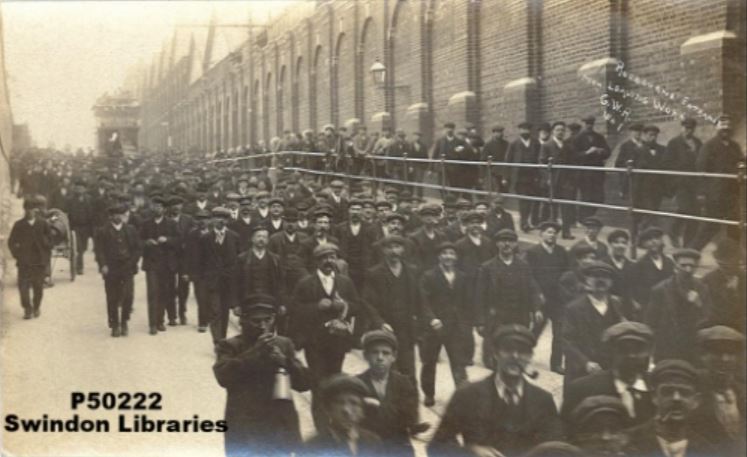
Home time – men leaving the Works. Image published courtesy of Local Studies, Swindon Central Library.
William George Woodward’s retirement was not a long one. He died in December 1939 and was buried in grave plot D573 with his father-in-law Harry Ball who died in 1928 aged 96. William’s wife Hannah died in 1960 and was buried with them both.

 Radnor Street Cemetery
Congratulations on your detailed and fascinating work. Long may you continue.
LikeLike
Thank you so much.
LikeLike