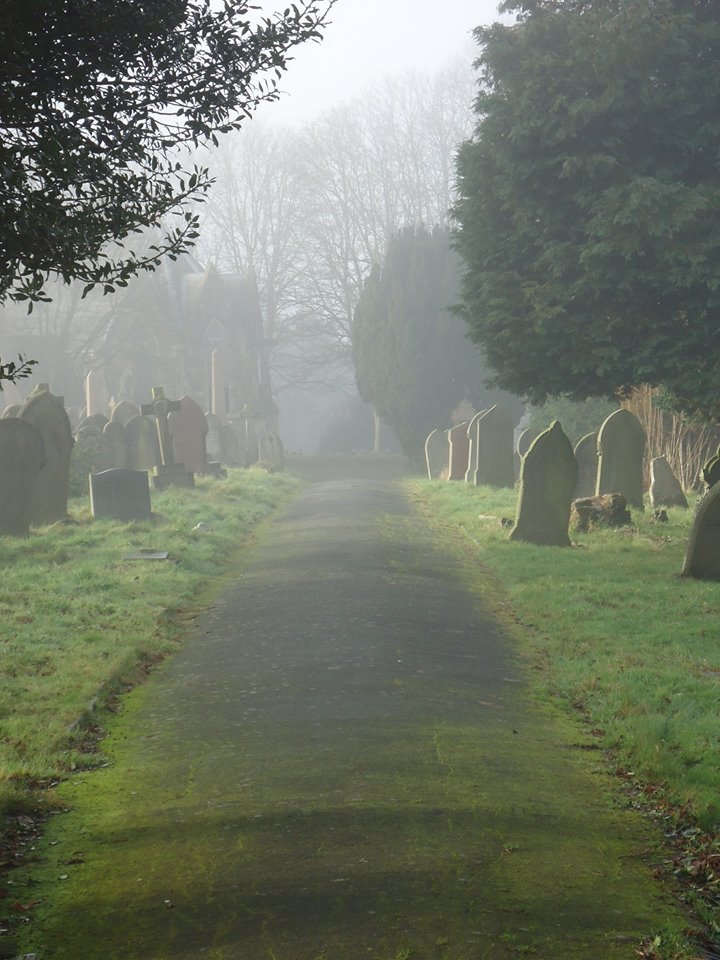
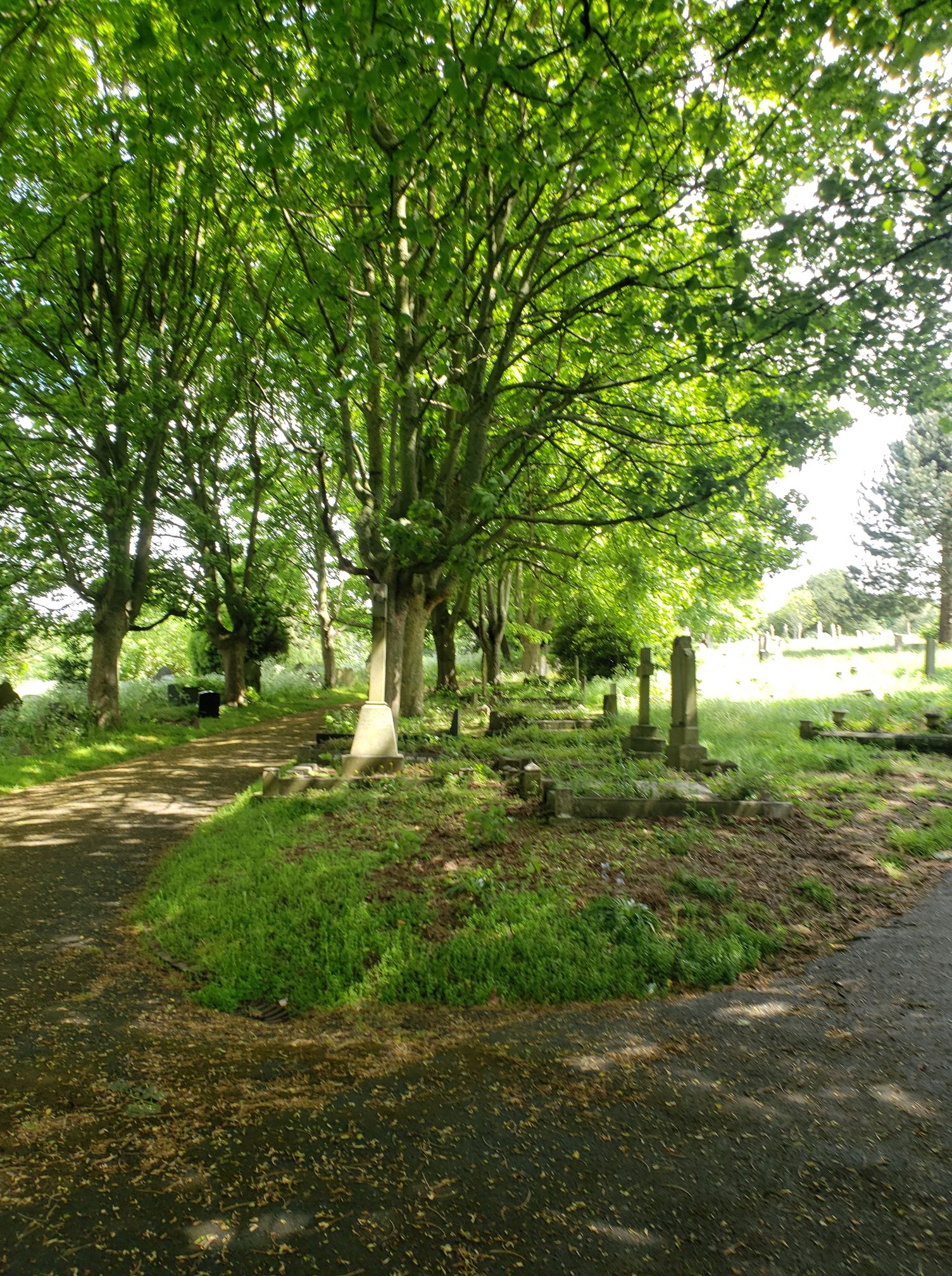
I am frequently asked if I have ever seen a ghost in the cemetery and have been told by others of their own paranormal experiences, but I don’t tend to go in for ghostly graveyard stories. For me Radnor Street Cemetery is a place of beauty and serenity and it’s the life and times of those buried there that interest me.
As a team of volunteers it is our mission to remember. We remember those who served in war; those who served in the industry of our town; those ordinary men and women, some of whom devoted their lives to good works, and those who had such short lives they are in danger of being forgotten.
On Remembrance Day November 12 we will be honouring Mark Sutton who spent all his life remembering others and doing good works. We hope you will join us for a Service at the Cross of Sacrifice at 2 pm followed by the unveiling of a plaque dedicated to Mark.
A big thank you to everyone who joined us for the last guided cemetery walk this season. We next meet on Sunday November 12 for the Remembrance Sunday service during which a plaque dedicated to Mark Sutton will be unveiled. Meet at the chapel for 2 pm.
Here is one of the stories I told yesterday (with thanks to Kevin Leakey for his information and research).
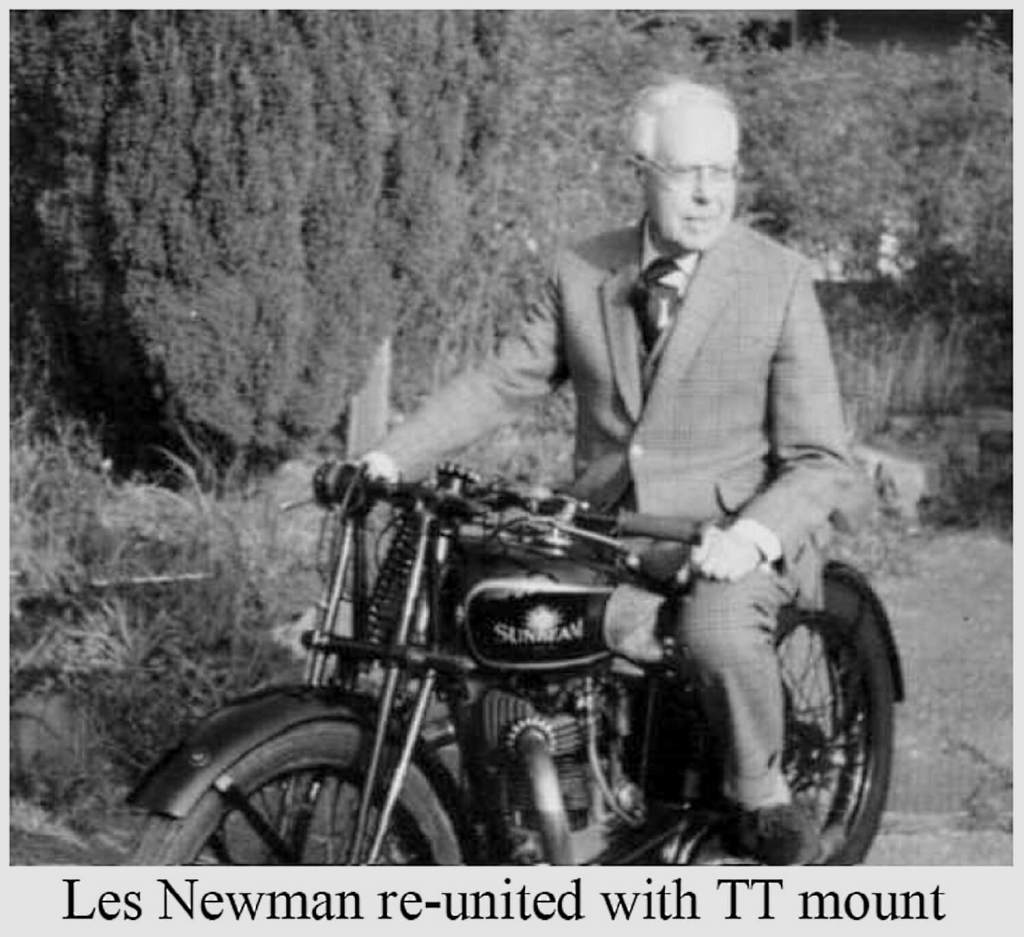
Leslie Charles Newman was born on October 17, 1907, the son of Thomas Charles Newman (Alderman and Mayor of Swindon 1923-24) and his wife Frederica.
In 1921/2 Leslie, then aged 14, began an apprenticeship at his father’s printing works, the Borough Press. He took over the business following the death of his father in 1941, but it is probably fair to say his first love was motorcycle racing.
Kevin Leakey writes:
Having purchased his first motorcycle as a 17 year old in 1924, Leslie Newman quickly took to participating in many different forms of motorcycle racing and competition, including trials, grass track racing and hill climbs.
Leslie also raced at the first dirt track (speedway) meeting at the Gorse Hill Autodrome in 1928.
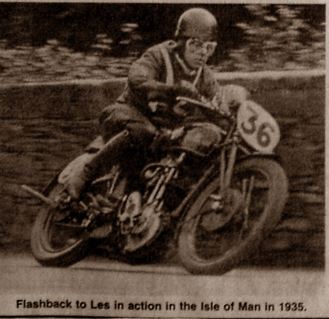
As well as competing in and organising many local motorcycle competitions through his connections with the Swindon based North Wilts Motorcycle & light car Club, Les also found time to compete in the Isle of Man Grand Prix, the amateur races held on the T.T. circuit.
Although he had considered retiring from motorcycle competition in 1933, having never competed in road racing events, the call of the famed Manx race was too much for Leslie, so he scraped together the £35 needed to purchase a four year old T.T. Sunbeam motorcycle and had it race prepared by the factory for an additional £10.
In order to prepare for the gruelling race he devised a 21 mile training circuit similar in shape to the TT track. Taking in many of the villages on the Downs, Leslie would set out at dawn from Swindon, and be back for breakfast followed by a 2 mile walk to start work at 8am.
Leslie competed in four Grand Prix races between 1934 and 1937. His most successful performance was in the 1934 Senior race. Despite crashing at one point, he still managed to finish a highly creditable 12th place out of 57 starters, averaging almost 70 mph over 6 laps of the 37 ¾ mile circuit. Quite a feat considering some of his fellow competitors were either professional racers, or would eventually turn professional.
It’s also interesting to note that, unlike today, where the whole circuit is on tarmac roads, back in the 1930’s it was often narrow, had loose surfaces in parts and had many dangerous blind corners.
In recent years, his Isle of Man efforts have been remembered by the Marston Sunbeam Club by holding an annual ‘Les Newman memorial run’. They follow the route across the Downs that Leslie used for his practice runs.
Post war Leslie was involved in the early speedway meetings at the Abbey Stadium as Starting Line Marshal, and his business, the Borough Press (Eastcott Hill) printed the meeting programmes. He also continued to organise vintage bike runs and rallies for many years.
Leslie died at the Princess Margaret Hospital on October 13, 1989, aged 81. His ashes were later placed in this large family grave with his parents, sister, his wife Doris and their son John Charles Newman who died in 2005.
Les pictured in his heyday and reunited with his motorcycle in later life.
Some photos taken at our guided cemetery walk yesterday.
This pristine art deco gravestone proudly boasts the achievements of Thomas Charles Newman, Alderman and Mayor of Swindon in 1923.
Mr Newman served on the council for 32 years and during his Mayoral year welcomed King George V and Queen Mary on their first visit to Swindon.
Other less glamorous duties he performed that same year including opening the sewage works at Rodbourne and the hard tennis courts at Town Gardens.
Thomas Charles Newman was born in Swindon in 1878 and was educated at Sanford Street Schools.
He began his career in the printing trade as a printer’s devil (an apprentice who runs errands in a printing office) and went on to become a master printer and proprietor of the Borough Press Ltd.
He was chairman of the committee in charge of the new Civic Offices built close to his old home in Euclid Street and he had many interests outside of politics. He was involved with Swindon Town Football Club and the Wiltshire Football Association along with many other local organisations. He enjoyed gardening, singing and various sports, in particular angling.
Thomas Charles Newman died on October 14, 1941 and an obituary published in the Advertiser described him as an extremely popular and generous man who assisted in every way the town’s many causes, and took a special interest in housing and unemployment questions.
His funeral took place at Sanford Street Congregational Church on Saturday, October 18. A prominent freemason, Masonic honours were accorded at his funeral and 60 Freemasons headed the funeral cortege from Sanford Street up here to Radnor Street Cemetery.
Thomas was buried with his daughter Sybil who had died ten years previously aged 15. They were later joined by his wife Frederica who died in 1963, their son Leslie who died in 1989 and his wife Doris who died in 1983. The last member of the family to be buried here was grandson John Charles Newman who died in 2005.
Charles Edward Stroud was born on March 8, 1894 the son of William Henry Stroud, a storekeeper in the railway factory, and his wife Elizabeth Mary. William and Elizabeth had a large family of nine children but by the time of the 1911 census only four were still living.
We can find out a lot about Charles’ working life thanks to the UK Railway Employment Records 1833-1956 available on Ancestry.
Charles began work in the railway factory on June 1, 1908 as a 14 year old office boy. On December 6, 1909 he transferred to R shop to begin a five year fitting and turning apprenticeship. These records were meticulously updated and the last entry referring to Charles reads: War – Military duty, last at work 29/8/1914. Apprenticeship terminated.
Sadly, we know little about Corporal Stroud’s military career. You may wonder why so many of the WWI servicemen’s’ records are lost. In September 1940 the War Office repository in Arnside Street, London was hit during a bombing raid, destroying more than half the military records stored there. What remains of these records (referred to as the ‘burnt documents’) are available to view on microfilm at the National Archives and also online at Ancestry and Find My Past. There is roughly a 40% chance of finding the service record of a WWI soldier. But before you get started on your research why not visit Local Studies at Central Library, Swindon where the staff will be able to help you.
The go-to-book for information on Swindon men who served is Tell Them of Us by Mark Sutton. We have a few copies for sale, available during our cemetery walks. (Our next walk is Sunday October 29, meet at the chapel for 2 pm).
Corporal Charles Edward Stroud served with the 2nd Battalion of the Wiltshire Regiment. He died of wounds on March 6, 1916 at the General Hospital Cambridge. His body was returned to 41 Stanier Street, Swindon and the funeral took place on March 11. He is buried in plot D1501 with his parents. He was 21 years old.
The burial of Swindon’s dead continued to be a controversial subject even after the opening of Radnor Street Cemetery in 1881.
The following letter to the editor of the Swindon Advertiser reveals burial practices that should have been eliminated following legislation passed during the previous 30 years.
To the Editor of the Swindon Advertiser
Sir – Can any of your readers tell me how it is that the inhabitants of that part of the parish of Swindon known as Old Swindon do not use the new cemetery, provided at their cost some five years ago? When it was decided to purchase this cemetery it was generally held out as an inducement to ratepayers to part with their money that the parish church burial ground would be closed, except to owners of vaults. Instead of this being the case, however, the churchyard is not only being crowded with bodies, but some of those interred there are being dug up in a most indecent manner to make room for more.
At the funeral of a pauper this week there was exposed beside the grave the skull, vertebra, and other bones of a corpse which previously occupied the same ground, together with the handles and other portions of the coffin furniture. I do not think this is right, or that it is decent. With the spacious cemetery we have it cannot be necessary. I am told that the reason Swindon paupers are buried in the churchyard instead of the cemetery is that the poor law authorities refuse to pay the cemetery fees. If this is so I do hope the Swindon guardians will bestir themselves and put an end to such a state of things.
Today’s story has been revealed by an enquiry through the Radnor Street Cemetery Facebook page and two newspaper articles.
When Hilda Lawes was interviewed by the Swindon Advertiser in 1995 she spoke with affection about her childhood, living in Faringdon Road above her parents’ fish shop.
It had taken Ada and Richard Jones a long time to get to Swindon.
Ada was born in 1879 in Canton, Cardiff the daughter of Edward Barrow, a stonemason, and his wife Mary. She married Richard William Amhurst Jones in Cardiff in 1897. Their daughter Ada was born that same year in Cardiff. In 1899 a second daughter Emma was born followed by son Richard William in 1902 when the family lived in Tilehurst, Reading where Richard worked as a Ferryman. The family were soon on the move again and Edna was born in 1905 and Hilda in 1907 in Southampton. They eventually arrived in Swindon where Matilda was born in 1910. By 1911 the family were living at 26 Commercial Road where Richard worked as a fish dealer. The census of that year informs us that they have been married for 14 years and have 6 children who are all living. Their last child, Freda, was born in Stratton St. Margaret in 1912.
Their family complete, their business established, Richard and Ada might have thought they were settled.
The Great War was raging when Richard enlisted in Swindon in November 1915. He was 41 years of age with a family of seven children to support. His military records reveal that he served in the RAMC as a Motor Driver and Mechanic from 1916 to 1919 in what was then known as German East Africa. During 1916 he was injured in a bomb explosion suffering wounds to his left leg. That year he also contracted malaria. He remained in East Africa until the end of the war, returned to England in January 1919 when he was declared 30% disabled, but still transferred to the Reservists List.
Hilda, then aged 12, remembers him returning from the war and how the family moved to new premises at Faringdon Road.
Despite his injuries, work carried on apace for Richard, but family life sounds as if it was rather fun.
In June 1931 Richard and Ada’s youngest daughter Freda entered the Carnival Queen competition organised by the Evening Advertiser. She was crowned by popular actress Evelyn Laye (who had a Swindon connection) and was presented with a silver rose bowl.
The Swindon Advertiser report includes a fantastic photograph of Richard riding his motorbike with Ada sitting in a wicker sidecar. The second photograph is a grainy picture taken from the North Wilts Herald of their youngest daughter Freda crowned Carnival Queen in 1931.
Ada died aged 63 at 39 Faringdon Road. Her funeral took place on October 13, 1937 when she was buried in Radnor Street Cemetery in grave plot C4490. Richard died aged 65 at 176 Pinehurst Road, the home of his youngest daughter Freda, and was buried with Ada on November 24, 1939.
Local farmer Elliot Woolford kept a daily diary for more than 50 years and I’m transcribing it for the Friends of Lydiard Park online Lydiard Archives project.
The diaries in which Elliot records life in the small rural parish of Lydiard Tregoze constitute an important social document. Here he discusses everything from the vagaries of the weather to crop failures; from church festivals to village goings-on; the death of Queen Victoria and the end of the war in South Africa. His writing is unaffected and his voice colloquial, the diary was written for his reference only.
In 1911 Elliot brought his produce to Swindon market and delivered to shops in the town centre. One of his regular customers was George Watson who ran a greengrocers and florists at 21 Cromwell Street. In his diary Elliot records their transactions.
Friday April 7: Received 10/6 of Mr G. Watson for rhubarb delivered last week.
Monday May 15: 1 doz Pea sticks to Swindon for Mr G. Watson.
On Friday September 22 it was Mrs Watson who greeted Elliot, paying him £1 10/- for 20 dozen cabbage.
On Saturday September 23 Elliot writes in his diary: Mr G. Watson died last night after a short illness.
George Watson was buried in Radnor Street Cemetery in grave plot E7394. Two days later Elliot writes: Received 43/- of Mrs Watson for cabbage & turnips delivered.
Annie Watson continued to run the shop after the death of her husband.
Saturday October 28: 7/6 worth of cabbage to Mrs Watson and 9 old hens @ 1/3 each.
Annie and George were both in their 40s when they married; there were no children to carry on the business.
In time Annie moved in with her sister and brother-in-law, Susan and George Fowler at 23 Salisbury Street. When George Fowler died in 1929 he was buried in grave plot E7394 with Annie’s husband. Annie died in 1945 aged 80. She was buried with both the Georges.
George Watson’s shop pictured during flooding in Swindon July 25, 1909 published courtesy of Local Studies, Swindon Central Library.
Death of Mr. G. Watson, – At his residence, 21, Cromwell Street, on Friday night, Mr. G. Watson suddenly passed away. Deceased, who was 52 years of age, was a florist, and he had recently been under medical attention for heart trouble, though the end came quite unexpectedly. Mr Watson had lived in Swindon during the last nine years, and was on the executive of the local Horticultural Society. He was also a member of the Ancient Order of Foresters. He leaves a widow, but no children.
The funeral took place on Wednesday afternoon. The procession left the house at 3 o’clock and wended its way to St Paul’s Church where the first portion of the service was conducted by the Vicar (the Rev. H.H. Rackham). The cortege then proceeded to the Cemetery, where the Rev. T.L. Mackesy read the concluding portions of the service.
The floral tributes were numerous and handsome and included two artificial wreath inscribed “A token of respect to George Watson from stallholders, shopkeepers, friends and neighbours RIP” and “a tribute of respect from members of the Queenstown Club.”
Extracts from the North Wilts Herald, Friday, September 29, 1911.
During September I frequently travelled by train from Swindon to Gloucester. It is a relatively short journey, some 45 minutes, through attractive Gloucestershire countryside stopping off at the small stations of Kemble, Stroud and Stonehouse and passing through the Sapperton tunnel.
Sapperton tunnel is, in fact, two tunnels separated by a short gap. Work began in 1839, a difficult building project not finished until 1845. Maintenance work was (and continues to be) ongoing. Back in the day a terrifying place in which to work with poor visibility on a busy rail route.
In 1896 an accident occurred resulting in four fatalities. Was this the accident William Beames witnessed, the effects of which caused his own tragic death later that same year?
This newspaper report contains some disturbing descriptions.
A Suicide’s Death – Tired of Life
Shortly after the above, Mr Browne held an inquest at the Carpenter’s Arms, Gorse Hill Swindon, on the body of William Beames, aged 48 years, a platelayer on the GWR Works, of 86 Bright Street, Gorse Hill. Deceased, it may be remembered, attempted to commit suicide by cutting his throat with a pocket knife at Wootton Bassett, in August last, and although the wound healed up he died on Saturday last from other complaints, after lingering for upwards of three months, his death being accelerated by his own rash act. Mr A. Bowker was chosen foreman of the jury, and the following evidence was taken:
P.S. Goddard, stationed at Wootton Basset, said that on the 17th August last, at about a quarter to seven o’clock in the morning, deceased came to his house and made motions to go into his house. He could not speak. Witness removed an handkerchief he was wearing, and then saw a tremendous gash in his throat. Dr Wride happened to be passing at the time, and witness called him in. The doctor dressed the wound, and gave him some warm milk with a little whisky in it, afterwards telling witness to take the man to the hospital. He (witness) obtained a brougham, and conveyed Beames to Swindon Victoria Hospital, where he was refused admission. Witness then took the sufferer to his home at Gorse Hill. He had previously asked him where he lived, but Beames could not speak, and therefore wrote his name and address on a piece of paper. Witness asked him why he did such a foolish thing, and Beames replied, “Because I am tired of this world.” Afterwards deceased was taken to the hospital at Stratton Workhouse. Witness went the next day to a field where Beames said he had been when he cut his throat, and there saw a large quantity of congealed blood. Witness found a pocket knife in his pocket, which he now produced.
Sarah Beames, wife of deceased, who appeared to be very ill, said her husband had been in a low depressed state since his father’s death in June last. Deceased was a platelayer in the GWR Works. Deceased was also troubled about a platelayer who was killed on the line at Stroud some time ago; he worked in the same gang. Deceased left home on Friday, the 14th August, and she heard no more of him until he was brought home on the following Tuesday. He was in the Workhouse Hospital eleven weeks, and then he was brought home where he was attended by a doctor.
Mr Thomas Hartigan, assistant to Dr Rattray, said he attended deceased up to the time of his death. Previous to that he had been attended by Drs. Wride, Pearmen, and Muir, alternately. He was suffering from a wound in the throat, and bronchitis. He died of dilated heart caused by the bronchitis, accelerated by the injury to his throat. The wound in the throat had quite healed up. The immediate cause of death was heart disease.
The jury returned a verdict accordingly.
Swindon Advertiser Saturday December 19, 1896.
William Beames was 48 years old. He was buried on December 17, 1896 in grave plot C199. This is a public grave. He was buried with five other unrelated persons.
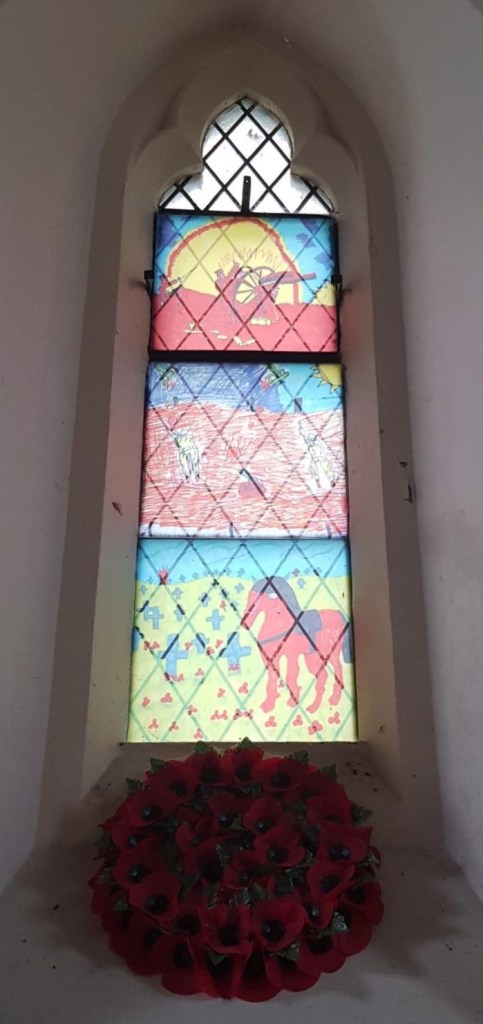
When the cemetery chapel was built in 1881 there were few adornments. The non-denominational chapel was designed with elegant simplicity and this extended to the windows. Above the door is situated a rose window, which continues to cast a serene shadow during the sun’s afternoon trajectory. Sadly, this window was damaged by vandals some years ago. The three windows at the east end contain a few panes of subtly coloured glass, and these were also smashed. The four remaining windows are plain.
In 2015 we commemorated the 75th Anniversary of the Battle of Britain along with Swindon Heritage, Paul R. Gentleman Associates and Green Rook. Swindon Remembers was a series of events held across the town, and most especially in Radnor Street Cemetery. We involved primary schools in the area who designed a montage for each of the five windows. We talked to the children about the people buried in the cemetery; the war graves and the two world wars; the GWR and the role of women in the 19th and 20th centuries. We talked about nature in the cemetery, this green oasis in the middle of town, and they encapsulated it all in their designs.
The childrens’ work is still in place eight years later and can be viewed when the chapel is open during our guided cemetery walks.
Join us for the last walk this season on Sunday October 29. Meet at the chapel for 2 pm.
The Second World War by Lethbridge Primary School
Nature of Radnor Street Cemetery by St. Mary’s Primary School
Famous Women by Robert Le Kyng Primary School
The First World War by Goddard Park Primary School
If there was a memorial to Peter Bremner, this is where it would be
The common belief is that the early railwaymen who arrived in Swindon in the 1840s are mostly buried in the churchyard at St. Mark’s.
There are a great many burials in that small churchyard; so many that by the 1870s there were extreme concerns that burial space was fast running out. Drainage of the churchyard was also a problem, restricting usage of a large area. All this contributed to the long, ongoing debate about the need for a new burial ground. Eventually resolved in 1880, Radnor Street Cemetery opened in 1881 and soon became the last resting place of many of the old railwaymen.
There are many of their stories told here on the Radnor Street Cemetery blog; this is that of Peter Bremner.
Peter Bremner was born in Dundee in about 1819 and arrived in Swindon around 1848. It is possible the family came straight from France where a daughter Erskine was born in 1847. For more than 35 years Peter lived at 5 Taunton Street at the very centre of life in New Swindon.
Death of a railway official – Our readers, especially the old hands of the GWR Works, will hear with regret of the death of Mr Peter Bremner, who has occupied the position of foreman for many years past, he being one of the earliest arrivals on the establishment of the works. His kindly disposition made him many friends. The funeral will take place this (Saturday) afternoon, at 2-45, and will no doubt be largely attended.
The Swindon Advertiser, Saturday, September 18, 1886.
Funeral of Mr Peter Bremner – The funeral of the late Mr. Peter Bremner, of 5, Taunton Street, New Swindon, took place on Saturday afternoon, admidst many manifestations of the respect and esteem in which deceased was held. For 40 years Mr. Bremner, who had reached the age of 67 years, had been in the service of the GWR Company, and during a great part of that time as foreman, he, at the time of his death, being foreman of the G (Millwrights’) Shop, GWR Works, New Swindon. As a foreman, the deceased was respected by all above and below him, those under his charge especially valuing his good qualities, and he had also obtained the esteem of a large circle of friends. That this was the case was evidenced by the fact that nearly 400 persons joined in the funeral procession on Saturday, and the route was lined with spectators. Mr. F. Hemmings, of Fleet Street, New Swindon, was the undertaker, and he carried out the funeral arrangements in the most satisfactory manner. The coffin was of polished oak, with black furniture, and bore the following inscription:- “Peter Bremner, died September 15th, 1886, aged 67 years. Through the Cross to the Crown.” On the handleplates were the words “Praise the Lord.” A number of beautiful wreaths were contributed, including one from Mrs. Swinhoe, one from Mr. S. Carton and Mr. J. Haydon as “a tribute of respect and esteem from the managers for an old and valued servant,” from Mr. and Mrs McCulloch, Mr and Mrs Batchelor; from the fellow foreman of deceased in the Locomotive Department of the GWR Works; and amagnificent artificial wreath supplied by Mr. Hemmings, from the workmen employed under the deceased. On a card attached to this wreath was the following inscription:- “In affectionate remembrance of Peter Bremner, the much respected foreman of the G Shop, GWR Works, Swindon, this wreath is placed by the workmen formerly employed under him as a mark of the general respect he merited.”
The chief mourners were:- Mr. J. Bremner (son of the deceased), Mr W.D. James (grandson in law) and Mr. E.C. Riley. In the procession were included many of the deceased’s fellow foremen, about 160 of the employes in the G Shop, and many friends. The procession included three carriages in addition to the hearse. The funeral cortege left disceased’s residence at about three o’clock, and proceeded to St. Mark’s Church, where the first portion of the burial service was conducted by the Rev. H.W. Boustead. By way of Church Place, and Cambria Bridge, the procession marched to the cemetery. There was a large number present. The remainder of the burial service having been read, the body was lowered to its last resting place, and after a final look at the coffin the procession returned to Taunton Street, where its members dispersed.
Extracts fromthe North Wilts Herald, Friday, September 24, 1886.
Peter Bremner died aged 67 years at 5 Taunton Street. His funeral took place on September 18 when he was buried in grave plot A1057 with his wife Annie who had died in February of that same year.










 Radnor Street Cemetery