Edward George Guley was born on January 25, 1895 and baptised at St. Paul’s Church, Swindon on July 7. He was the second son of railway carriage fitter Charles Guley and his wife Annie. In 1911, the last census taken before the outbreak of war in 1914, the family lived at 8 Beatrice Street, Gorse Hill. All three men in the family worked in the railway factory. Charles as a Railway Carriage Fitter, his eldest son Harold Charles Guley was 19 and employed as an Engine Fitter apprentice and part time student and Edward George Guley was 16 and a machine boy and part time student.
Both Charles and Annie’s boys enlisted – possibly together, and both served in Basra. Harold was nearly 24 years old, Edward was 20. Harold’s service records have survived but unfortunately Edward’s haven’t. Harold served in the Royal Army Service Corps and Edward in the 5th (Service) Battalion. Harold returned home to Swindon at the end of the war; Edward didn’t.
The First World War campaign in Mesopotamia (modern day Iraq) cost 85,000 British casualties, one of whom was Edward George Gulley, killed in action on March 29, 1917.
The 5th (Service) battalion were in action on the 25th January 1917 when they assaulted the Turkish front line, one flank of which rested on the Hai River which they had crossed only a month before. They took heavy casualties in this action. On the 25th of February they crossed the River Tigris and by the end of the month after hard marching they were 40 miles short of Baghdad. On the 10th March they made a night river crossing over the Diala River establishing a bridgehead and taking 120 prisoners in the process. The way to Baghdad was open and the battalion was the first to enter the city. At the end of March the battalion advanced on Turkish positions 35 miles north of Baghdad near Daltawa. They sustained heavy casualties in this attack. In April and May they continued the advance up the line of the River Adhaim with contact being made with the Russians operating from the Caspian Sea. They then took up defensive positions between the rivers Tigris and Adhaim, East of Samara. In early December they advanced towards Kara Tepe, with the battalion pursuing the Turks through Sakaltutan Pass. They paused at this point and ended the year reorganizing and training.
The Rifles Berkshire and Wiltshire Museum
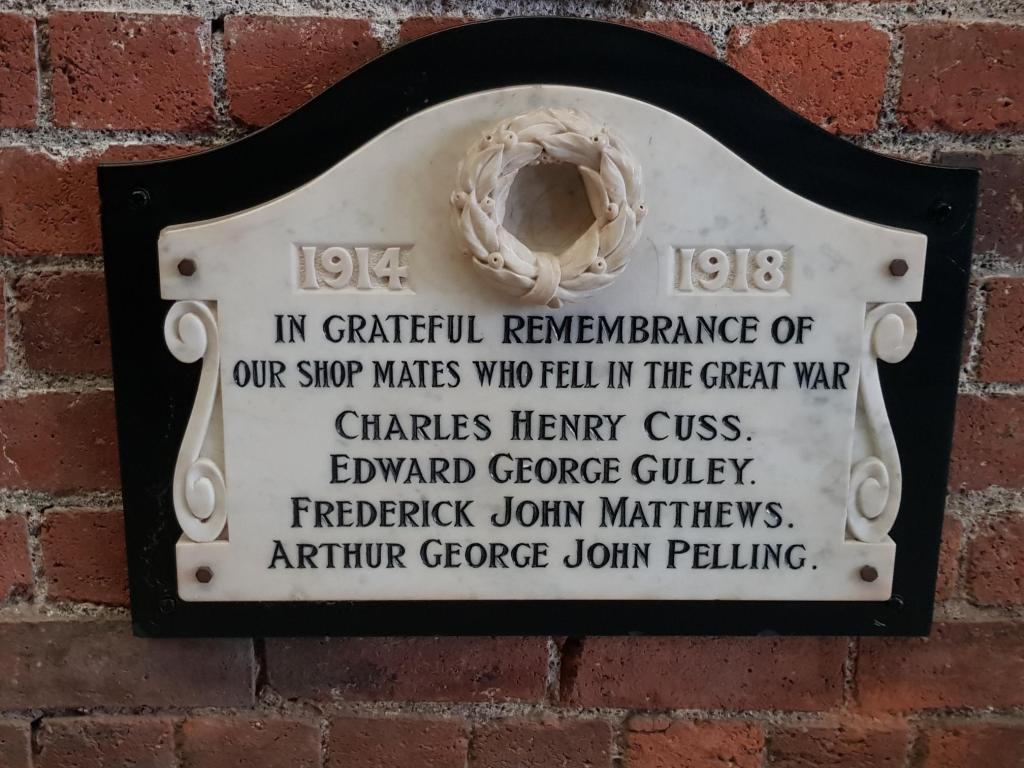
Edward has no known grave and is remembered on the Basra Memorial. He is also remembered on a plaque raised by his colleagues in the GWR Works, which now hangs in the STEAM – Museum of the Great Western Railway
Annie survived the war and the loss of her son, but what was survival like for her? Did parents ever recover from the loss of their boys? I doubt it. Her husband Charles was buried in Radnor Street Cemetery on January 5, 1928 in plot D245 where Annie joined him on June 20, 1933.

 Radnor Street Cemetery
We have Guly or Guley in our tree. They were in North Bradley. Betty 1752 -1798 was my 3x great grandmother.
LikeLiked by 1 person
Hi Di – well what a coincidence. I wonder if there’s a connection.
LikeLiked by 1 person
I wondered that too!
LikeLike
She married Henry Alley in 1770
LikeLike