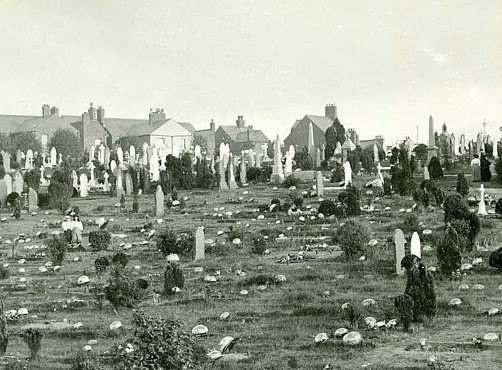
Back in the day there were flowers everywhere, right across the cemetery, displayed beneath glass domes; cultivated in the greenhouses. In 1907 the groundsmen were so busy that planning permission was sought for additional glasshouses to be built behind the caretakers lodge (see above illustration).
For those families who could not afford a headstone the flowers were a monument among the graves so densely arranged with barely a foot’s breadth between each plot.
Every grave was identified by a terracotta marker, sadly an unsatisfactory method. The system had worked well when a caretaker and gravediggers were employed in the busy cemetery but today they lie broken and scattered about. Some graves sport several of the brick like markers, others have none, and when searching for a grave they should be used with caution and only as a rough guide.

So what about the marker pictured here, found on a mound of earth. Is there a fallen headstone buried somewhere beneath? There are no clues, but it is possible to trace who was buried in plot D1083…

The facts …
The Radnor Street Cemetery burial registers reveal that there is only one person buried in plot D1083. His name was William John Molden, a boilermaker at the Works, who died on March 3, 1919 at his home, 145 Clifton Street. He was 44 years old and his funeral took place on March 8. Administration of William’s estate was awarded to his widow, Emily and his effects were valued at £179 5s.
Without applying for William’s death certificate we cannot ascertain his cause of death. Unfortunately we do not have a budget to pay for all the death certificates we need when researching the cemetery.
William was born on February 23, 1875 in Purton, the son of Eli and Hannah Molden. He began a six year boilermaking apprenticeship in the Works on February 23, 1890 aged 15. The 1891 census lists William as a 16 year old GWR Boiler Maker Apprentice living with his parents and older brother Sidney at Battle Well, Purton.
William married Emily Painter in 1898 and at the time of the 1901 census they were living at 65 Redcliffe Street, Rodbourne with their four month old daughter Dorothy.
The family appears on the 1911 census living at 122 Clifton Street where William lists his occupation as Boilermaker Rivetter. The couple have three children, Dorothy Maud aged 10, Muriel Louise Hetty, 8 and Harold Sydney John 2. Another son, Raymond Edward Joseph was born in 1917.
William was a relatively young man when he died. Perhaps he died as a result of the post-war ‘flu epidemic which raged through Swindon as it did everywhere else.

 Radnor Street Cemetery
Thank you Good Gentlewoman, excellent investigative work and story – I was shocked at some of the young ages on the headstones remaining to the rear of St Marks on a recent visit over the Easter. Feeling lucky!
LikeLike
Thank you for taking the time to comment. Conditions in the railway works were extremely dangerous and sanitary conditions in the overcrowded railway village were appalling. In the 1850s life expectancy fell to 29 years. As you say – feeling lucky.
LikeLike
Hi there I want to pass on our utmost thanks to the researchers of Radnor St Cemetary,
My husband is the grandson of Raymond Edward Joseph Molden. And he is the Great Grandson of William John Molden. Aka Plot D1083.
We have told William Johns Grandaughter that we finally know where he is buried.
We knew he was a boilermaker and he passed away in 1919. We will now be ordering his death certificate to ascertain what his cause of death was.
His son was only 2 when he was born. His son went on to join the RAF and was a rear gunner in coastal command. He met and married a lady in Barry wales and had one child. He had no recollection of his father.
LikeLike
You are most welcome. Glad to be able to help.
LikeLike