The GWR Works was a dangerous place in which to work and until the construction of the main entrance tunnel it was even a dangerous place to get inside.
The original Workmen’s East Gate Works entrance was a route that involved crossing the mainline track and was the scene of numerous fatal accidents. There were 3 deaths in a single month in 1869, the year before the tunnel opened.
Joseph Armstrong, the first Locomotive, Carriage and Wagon Superintendent ushered in a period of rapid expansion during the 1870s which included the construction of the Carriage Works and a new, safer route into the railway factory. The main entrance into the Works was built on Bristol Street, opposite the Mechanics’ Institution and consisted of a tunnel measuring approximately 100 yards [91.4m] that ran northwards beneath the mainline track.
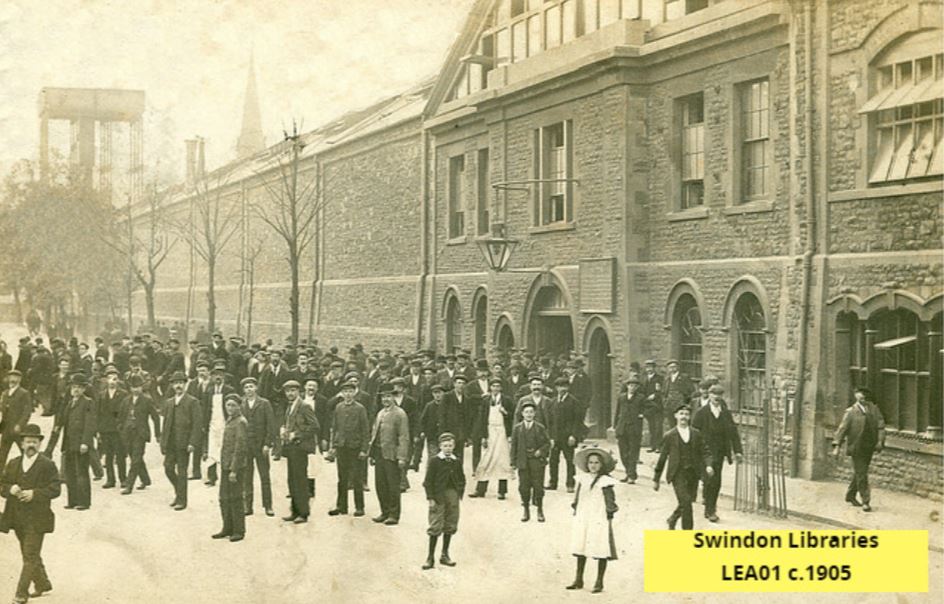
Contemporary photographs record the hundreds of men streaming out of the tunnel at the end of the working day, however, even after the tunnel opened on February 5, 1870 accidents continued to occur as men still cut across the railway line to work.
In 1905 William Dicks was struck down and killed going back to work on Saturday January 14. The report of the inquest published in the Wiltshire Times makes for gruesome reading.
Fatal Accident
Man Killed at the Works
A shocking fatality occurred on the Great Western Railway at Swindon on Saturday. William Dicks, an employe in the locomotive works had just returned from breakfast and crossed the rails in order to reach the check office. He failed to notice the approach of an engine which was out on its trial trip, and though his workmates tried to warn him of his danger, it was without avail, and he was knocked down by the locomotive and injured so terribly that he died on his removal to the hospital. Both his legs were severed, and his head was frightfully battered. Deceased, who was 52 years of age, was well known as a clarionist. [clarinetist].
At the inquest on Monday it was stated that deceased had no business to cross the line, a tunnel being provided for the men. – Dr Swinhoe said the man was practically cut in half.
The Coroner said he thought they could only return a verdict of “Accidental death” but they might add a rider to the effect that notice boards should be fixed in prominent places to warn the men not to cross the line. The Company certainly took every precaution in protecting employes, and the men should use the tunnels which had been provided for their express use.
The jury concurred, and returned a verdict accordingly.
The Wiltshire Times, Saturday January 21, 1905.
William Dicks was buried on January 18, 1905 in grave plot C1445, a public grave, which he shares with his wife Jane who died in 1909, and one other person
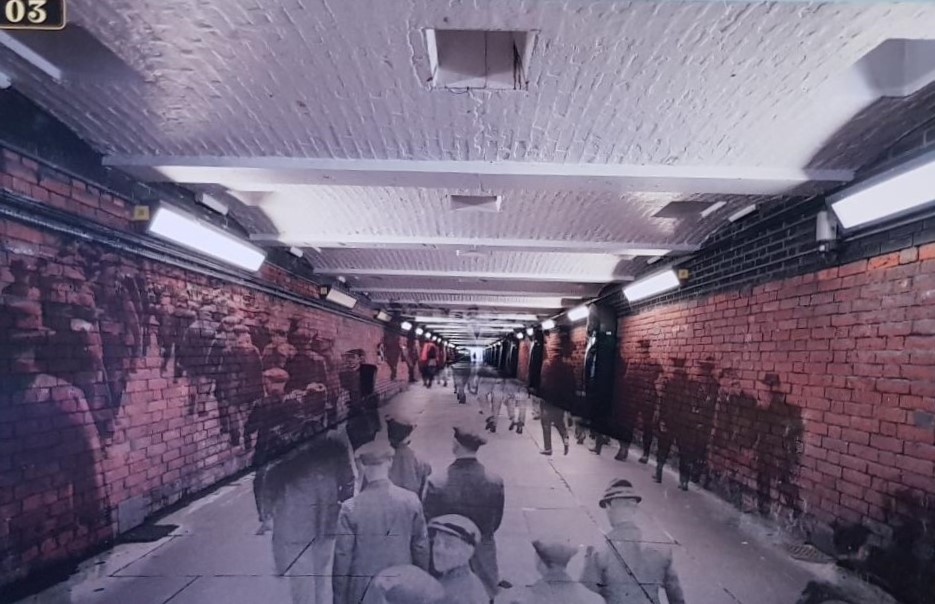
Today the Grade II listed former Carriage Works is the subject of a Heritage Action Zone project. Work has included improvements to the Sheppard Street underpass, London Street and the Bristol Street tunnel has also received a makeover. New interpretation boards at the entrance tell the story of the railway factory and the railway families who made New Swindon.
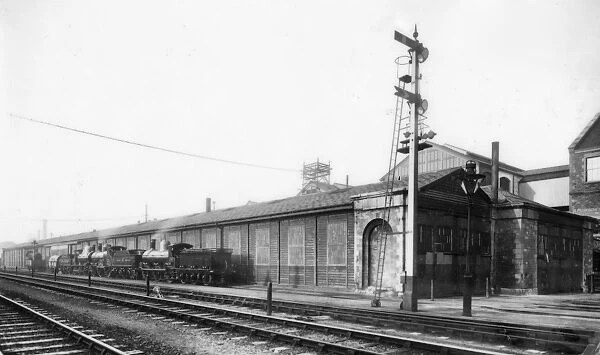
Image dated c1905 published courtesy of Kevin Leakey
Image dated c1950 published courtesy of Local Studies, Swindon Central Library.
Ghostly railway workers superimposed on a photo of the tunnel – see new interpretation boards at the tunnel entrance
This is the story of two boys born 20 years apart – William Batley Pitts, the natural son of Robert and Elizabeth Pitts, the other Archibald Kenneth Poulton, their adopted son.
Today railway safety is heavily promoted and Network Rail has a series of safety campaign videos on their website aimed at everyone from the very young to the distracted commuter.
You might expect railway safety to have been a priority in Swindon of all places, but perhaps it wasn’t so in 1893.
On September 1, 1893, a group of boys were playing on the level foot crossing close to the residence of William Dean, Chief Locomotive Superintendent at the GWR Works. The horrific accident was described in great detail during the inquest held at the Cricketer’s Arms the following day.
Shocking Accident on the GWR at New Swindon – On Friday evening, the 1st inst., about six o’clock, a shocking accident occurred on the GWR at the level foot crossing near the subway close to Major Dean’s house. The victim was a lad 12 years of age, name William Batley Pitts, son of Robert Pitts, of 19 Clifton Street, Swindon. It appears that the lad had been at play with others near the foot crossing close to the residence of Mr Dean, the chief locomotive superintendent. A goods train passed on the down line, and as soon as he thought the line was clear the boy attempted to run his hoop across the line when he was struck by the up Cornish express, of the approach of which he was not apparently aware. The poor lad was cut to pieces and the train carried his body 23 yards before throwing it off the line. When picked up the boy was terribly mutilated. A lad named Smith witnessed the sad occurrence, and rushed to Major Dean’s house, close by, for assistance. Dr. Pearman and PC Pinchen were soon on the spot, and had the scattered portions of the poor child’s body collected and conveyed to the GWR Medical Fund Hospital. The Coroner was communicated with, and the inquest was held this morning at the Cricketer’s Arms, a verdict of accidental death being returned by the jury.
Swindon Advertiser Saturday, September 2, 1893.
William was buried on September 5, 1893 in plot B2193, a privately purchased grave. Thirty years later he was joined by Archibald Kenneth Poulton, the boy his parents adopted long after William’s death.
At the beginning of the 20th century adoption was frequently an informal affair. Perhaps he was related in some way, a nephew, maybe a grandson. It is now not possible to trace how little Archibald ended up with the Pitts family. He died in 1924 and was buried with William in grave plot B2193 on April 22.
George Bellwood Palphramand retired in 1913 after 41 years in the service of the Great Western Railway.
George was born in Wolverton, Buckinghamshire on June 17, 1851, the son of George, an engine driver and his wife Isabella. Following the death of Isabella in 1861 the family moved to Rugby where George jnr served his apprenticeship with the London and North Western Railway. In 1872 he moved to Swindon where he married Mary Ellen Strong in 1876.
In 1884 George and Mary were hit by tragedy when their three year old son Ernest drowned in the canal near their home at 24 Read Street. In an age when child mortality was high they could not have expected to lose one of theirs in such traumatic circumstances. How do parents recover from such a loss? George had to go to work, Mary had to cook, clean and care for her surviving three children. In time they would have another son, Reginald born in 1887. Three siblings that had no memory of their little brother and one who never knew him.
In time Reginald followed his father into the railway works and having completed his fitting and turning apprenticeship moved to Coventry where he worked as a fitter in the aviation industry.
Following his retirement George and Mary moved to 69 Broadway, Earlsdon, Coventry. Mary died there in 1926. George died 11 years later on December 7, 1937.
Both Ellen and George were buried back in Swindon in Radnor Street Cemetery grave plot E8469 where they joined their little son who had died so many years before.
The site of the former Wilts & Berks Canal
Presentation to Mr. G. Palphramand – An interesting affair took place in the G Shop Office, Loco. Dept., GWR Works, Swindon, on Saturday morning last, the occasion being a presentation to the Foreman, Mr G. Palphramand, on his retirement from the Company’s service. The presentation took the form of a handsome silver-mounted ebony walking stick and a pipe, given by the assistants and Office Staff of the G. Shop. Mr A. Beer, in making the presentation, said he was expressing the sentiments of all those present in wishing Mr Palphramand the best of health to enable him to enjoy his retirement. He asked him to accept the gifts as a small token of respect and esteem of the members of his Staff. He would carry away with him the best wishes of all whom he had been associated with during his long service, and no doubt the walking stick and pipe would bring back pleasant recollections of bygone days.
Mr Palphramand thanked his colleagues for their kindness, and said he should appreciate the gifts very much indeed, as coming from his Staff, with whom he had always had harmonious dealings during the whole of his service as Foreman; and he thanked them all for the support they had at all times given him in carrying on the work of the Shop, at times under very trying circumstances. He felt very sorry to leave them all, and he had not thought of retiring quite so soon, but he found his health was not good enough now to enable him to carry on the work, and he thought it wise to give up in time.
Mr Palphramand served his apprenticeship with the L. and N.W. Railway at Rugby, and entered the service of the GWR in June 1872, thus completing 41 years with the Company. He was appointed Assistant Foreman in May, 1884, and took over the G (Millwrights) Shop as Foreman on Jan 1st, 1891. He has served under five different Managers, and was for many years Captain of the GWR Works Fire Brigade. He was also for some years a member of the Council of the GWR Mechanics’ Institution, and also served in the old Volunteer Force in connection with the Wilts Regiment.
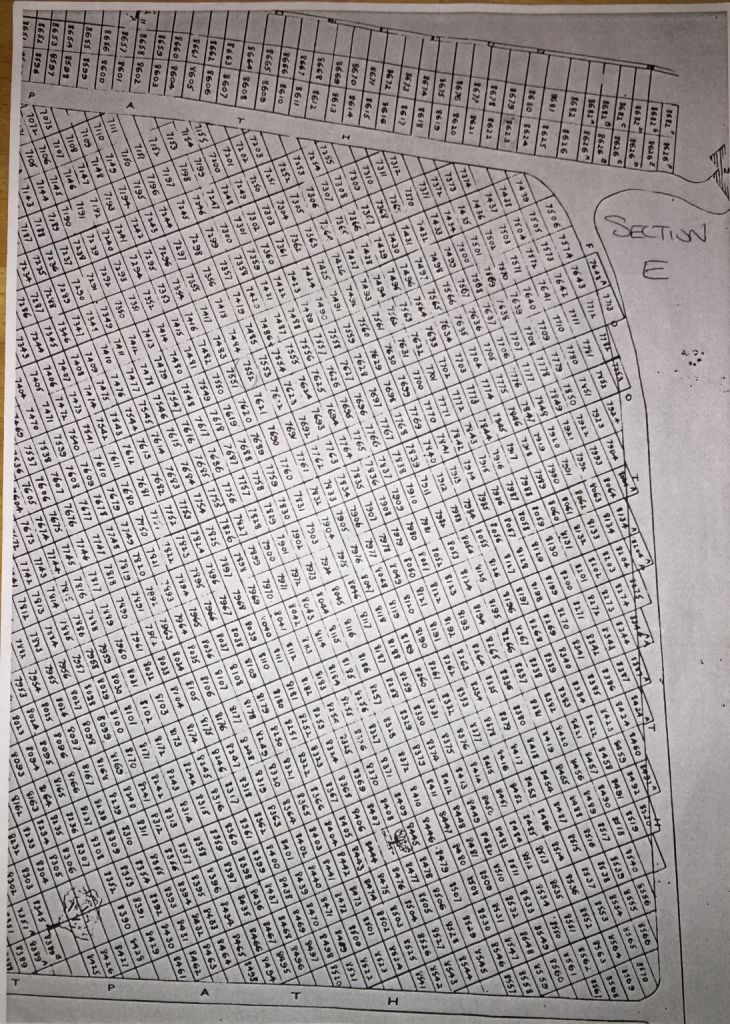
Sometimes the cemetery map can be a little misleading. When I researched the Holbrow family a year or so ago it appeared that the family grave might be beneath a path. There was no evidence to suggest that sections of the cemetery had been re-configured and as it turned out the Holbrow family plot was on the periphery of Section E but with plenty of room for a fine headstone.
Samuel Edward Holbrow was born on November 5, 1871 the son of Joseph and Mary Holbrow. At the time of the 1881 census Samuel, his five brothers and sisters and his parents were living at 10 Reading Street, sharing a property with Elijah Jones and his daughter Sarah, evidence of the overcrowded situation in the railway village that continued into the 1880s.
He began his 7 year apprenticeship in the Tender & Fitting Shop in the Works on his 14th birthday on a daily rate of 10d rising to 2/- in his 7th year. His record of employment shows that he received his certificate signed on November 19, 1892 by H. Birch (accountant at the GWR Works after whom Birch Street was named) and that he left in April 1893. A completed apprenticeship did not guarantee a permanent job in the Swindon Works as so many of the newly qualified apprentices discovered.
During his absence from Swindon Samuel married Minnie Florence Louise Bishop at St. Andrew’s Church, Cardiff. By 1896 the couple had returned to Swindon and their elder daughter Elsie (born in Devonport on August 24, 1896) was baptised at Christchurch in 1897 when the family lived at 60 Dixon Street.
Their second daughter Hilda May was baptised at St. Mark’s Church on June 19, 1898 when the family lived at 9 Dean Street. Soon after Hilda’s birth the family moved to 47 Deacon Street where Samuel died in 1941 and Minnie in 1965. This would remain Hilda’s home until her death in 1995.
Her sister Elsie, however, had a much more adventurous life – you can read more by following the link below.
Samuel Edward Holbrow
Samuel, Minnie and their daughter Hilda are all buried in grave plot E7643A. Interred with them are the cremated remains of 9 year old Peter Scott, Samuel and Minnie’s great grandson who was born in Peru. His death was registered in Lothingland, East Anglia, however the address recorded in the Burial Register is Hotel Junin, Oraya, Peru. Another mystery to solve!
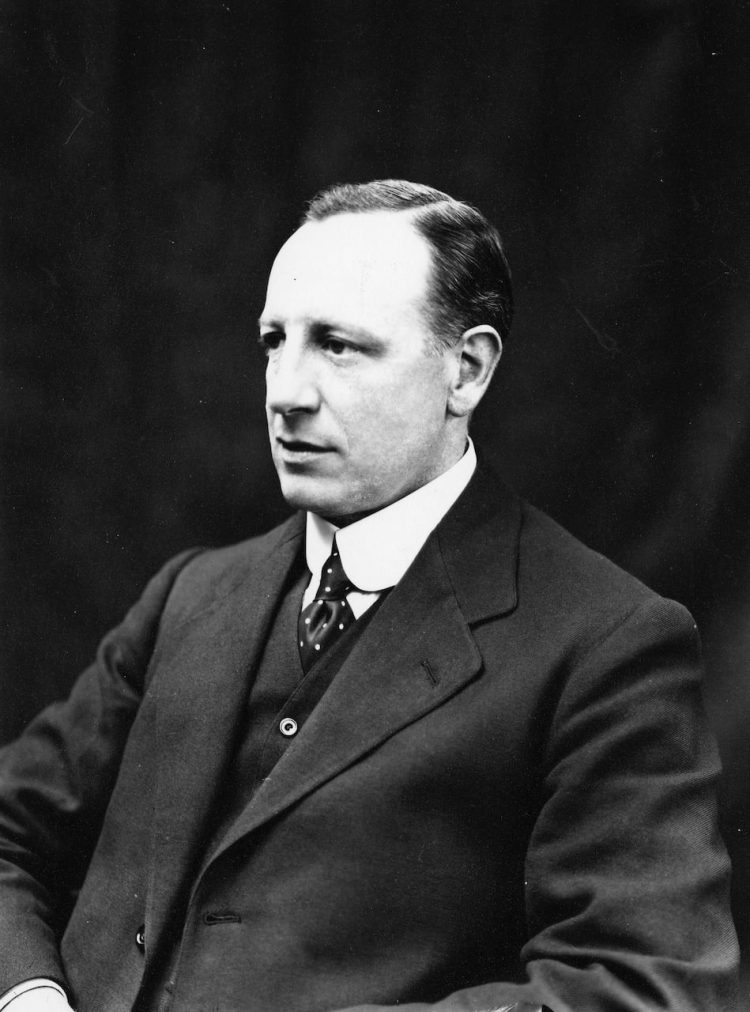
Charles Benjamin Collett – GWR Chief Mechanical Engineer 1922-1941
It is relatively easy to find out a great deal about Charles Benjamin Collett, OBE, Chief Mechanical Engineer at the Great Western Railway.
He has gone down in history as a well-respected, modest man who designed the iconic fleet of “Castle” and “King” Locomotives yet lived an unassuming lifestyle alongside the railwaymen and their families in the railway village.
Charles and Ethelwyn Collett’s home in the railway village
He was born on September 10, 1871 the son of journalist William Collett and his wife Mary. He was educated at the Merchant Taylors School Charterhouse Square and later studied at the City and Guilds College of London University. He was articled as a pupil to Mr Joshua Field, of Maudslay, Sons & Fields Ltd., London before joining the GWR in 1893 as a junior draughtsman. He then became assistant to the Chief Draughtsman and in 1900 Technical Inspector and later Assistant Manager. By 1919 he was Deputy Chief Mechanical Engineer before succeeding George J. Churchward as Chief Mechanical Engineer.
Rather less is known about his wife.
Ethelwyn May Simon was born in 1876 the daughter of Henry Simon, a Congregational Minister who served as Pastor at Westminster Chapel from 1876-87, and his wife Annie.
Charles and Ethelwyn married at St. George’s Church, Bloomsbury on November 4, 1896. It is said that the couple were very devoted and that Charles was greatly affected when Ethelwyn died in 1923, the year in which he launched the record breaking Caerphilly Castle Locomotive.
Ethelwyn was buried in Radnor Street Cemetery on March 23, 1923. Charles purchased two grave plots numbered Section A2517 and A2518. However, it seems unlikely that his intention was to be buried with his wife when the time came as a note in the burial registers reveal that Ethelwyn was buried in the centre of both graves.
Radnor Street Cemetery Jon stands at Ethelwyn’s unmarked grave
Ethelwyn lies in an unmarked grave, which is probably what Collett wanted. He lies in an unmarked grave in Gap Road Cemetery, Wimbledon, which he shares with two other unrelated persons. Apparently, he requested that his grave should also go unmarked.
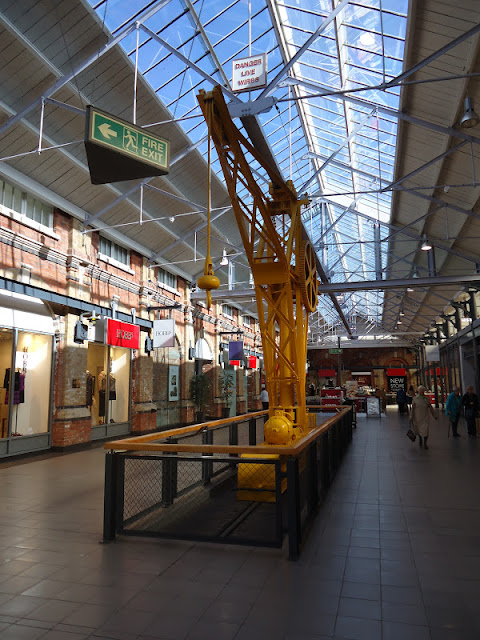
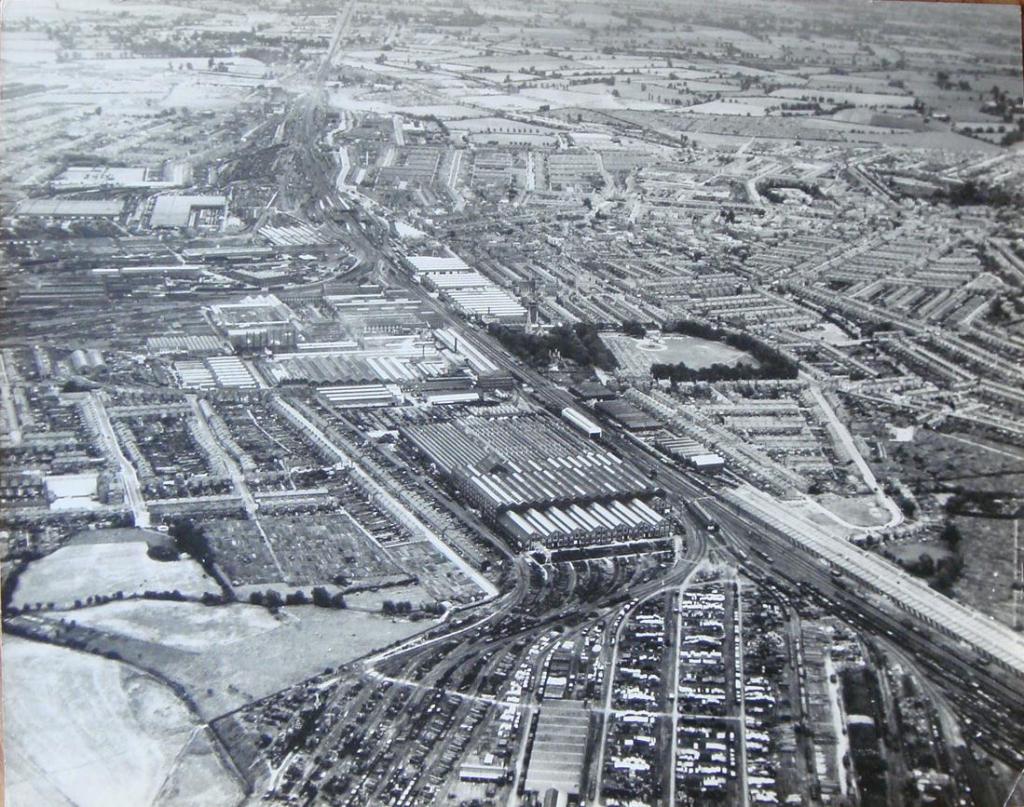
I’m having a rather expensive sandwich and a cup of tea (not many people drink tea now, I find it’s become an ‘old persons’ beverage) in a coffee bar which proudly boasts on the signage that it was ‘established 1999.’ It is situated in the former railway factory established slightly earlier – in 1843!
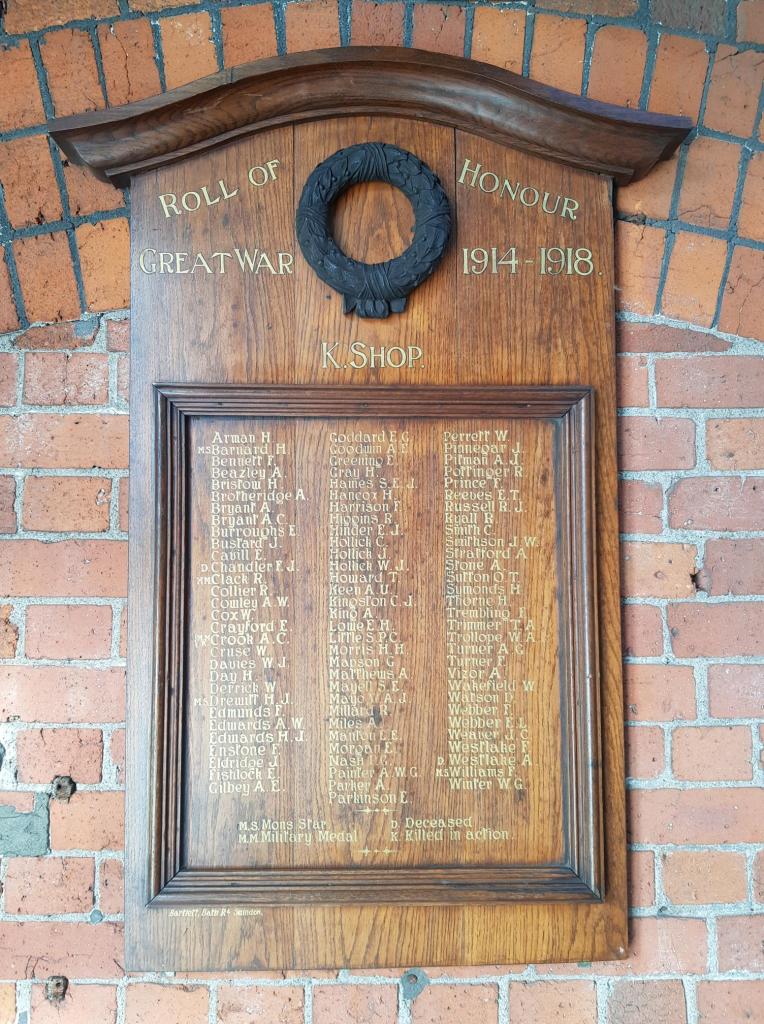
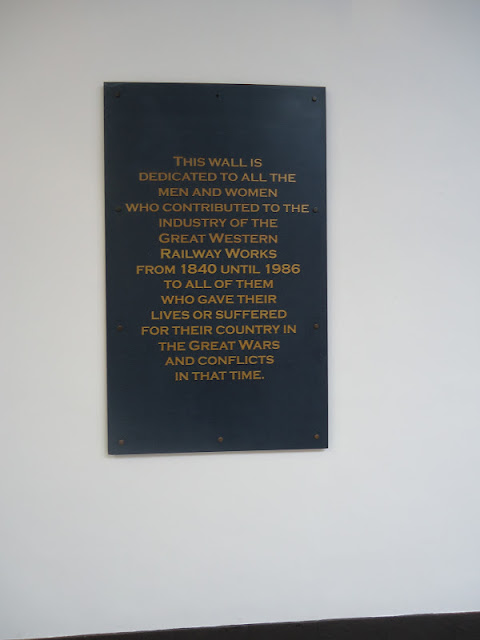
The model train has just done a circuit – a nod to the railway history of the McArthur Glen Designer Outlet Village. In all fairness there are plenty of reminders – machinery, overhead cranes and the war memorials to the railwaymen who gave their lives in two world wars.
There is still a generation of railwaymen around who can remember the Works when it closed in 1986 making 1,100 redundant. A far cry from the glory days of the 1920s when there were more than 14,000 on the payroll.
As I sit here enjoying my sandwich and (generous) mug of tea, listening to the hum of conversation around me, I think of all those men who spent a lifetime grafting within these walls.
You may like to read the stories of some of them – see below.
This Saturday you’ll find Rodbourne a busy place, as it is most Saturdays. The big attraction is the McArthur Glen Designer Outlet Village housed in the former railway works building. Rodbourne was a busy place back in the day as well and in this account of a fatal accident on the railway line you get a glimpse of the area as it was nearly 100 years ago.
Mr G. Brown, district organiser for the NUR, tried to establish if a shortage of manpower had contributed to the accident, but David Wirrell did not grasp this lifeline. You can’t help but wonder how the poor man coped in the aftermath of the accident.
Knocked Down By An Engine.
Swindon Man Dies From His Injuries.
Leg Severed
A verdict of accidental death was returned at the inquest on Tuesday attending the death of Stephen Amor, 63 of 101 Linslade Street, Swindon, a GWR employee, who was knocked down by an engine near the Rodbourne Road siding, and who died shortly afterwards in the Medical Fund Hospital.
The jury returned a rider that David Wirrell, who was with deceased at the time of the accident and who was acting as “look-out” man, committed an error of judgment in using his brook instead of devoting all his time to “looking out.”
Mr G. Brown, district organiser for the NUR watched the proceedings on behalf of the local branch of the Union, and Mr A.T. Tyrrell was present with Mr Hannington representing the GWR Co.
Mrs Isabella Amor widow of the deceased, said he had been in good health during the past 39 years.
Henry Harold Greenwood, chief surgeon at the GWR Medical Hospital at Swindon, said when admitted he found deceased was suffering from haemorrhage and compound fracture of the right ankle. Amor was taken to the hospital immediately after the accident.
In the course of his evidence, Mr Greenwood paid a very warm tribute to the St. John Ambulance Association for their valuable assistance in rendering first aid.
A Marvellous Escape
David Wirrell, switch cleaner, living at Devonshire Villas, Rodbourne Cheney, said that on Saturday morning he started work at 7.30 with Amor. He first got his tools and started cleaning switches.
“I was the look-out,” he continued, “and proceeded as far as the third compound, which is nearly opposite Rodbourne Road Signal Cabin. We were proceeding from one point to the other, and I looked up to see if anything was coming from the factory, from where most of the traffic comes in the morning.
“There was nothing close to us in that direction, and so I stepped over into the road and gave a few strokes with the broom looking out at the same time.
“When I looked round in the opposite direction to the factor I saw an engine was close upon us, within about four feet. I tried to give the alarm, but the engine pushed me down and ran over me, without causing injury.
“I got up, ran to my mate Amor and found him badly injured. I spoke to him, but he never answered.”
Witness said that he had been about 20 years in his occupation, and always worked towards Swindon Station.
The Coroner: Are you always the look-out man? – No. Every other day. It is my turn on Saturdays.
Don’t you look out both ways? Yes, I do.
Witness explained that Saturday’s incident occurred in a minute or so, and he was not quick enough in looking behind.
There were always two men on the job and sometimes three, but the third man had been ill for some weeks.
Heard No Whistle
Replying to the Coroner, he said that he heard no whistle.
The Coroner: Was a train passing? I believe one had previously passed along the main side.
As a general rule witness looked one way first, but the engine came from another and it all happened in a minute or two.
Mr Brown (who was representing the NUR): As a look-out man, shouldn’t you confine yourself to looking-out? – Yes.
Mr Brown: Is there a signal at that point? – Yes.
Did you observe the signal? No. I can’t say whether it was on or not.
Witness added that the points in question were worked by a lever, and the signals were not of much use to them.
Mr Brown: Did the fact that there were only two men cause you to do additional work?
Witness: No, that made not a bit of difference to looking out.
He heard no warning from the driver of the train.
Mr Brown: Had there been three men would the look out man have to do more work? No.
John Thomas Thorpe of 5, Deacon Street said that at about 8.15 he was standing on the engine line at the siding opposite the Rodbourne Road cabin when he saw an engine approaching the compound or double-switch. He then saw two men either knocked down or fall under the engine.
He ran to where Amor lay and found his leg severed. Hen then went to the AE Shop for the ambulance men.
In answer to the coroner, witness said the men had their backs to the engine.
A Slow Speed
Edward Price, 15 Beatrice Street, locomotive driver, said he was driving a crane engine from the subway to the loco yard in the factory sidings. About 8.15 he was informed that he had run over two men in the compound near Rodbourne Road signal box. There was a signal post with a loop signal, and that was off for him to proceed. He was going at two miles an hour, and at that pace he could have stopped instantly if he had seen anyone on the line.
The Coroner: When shunting, who gives you orders to proceed?
Witness said that he was given orders at the subway. He was also guided by the signal. He touched his whistle just before or as he passed the signals. He was in charge of the engine. When shunting he was given orders by the shunter, but in the present case he was not shunting.
There was a fireman and a shunter in the engine besides himself, but he went across the footplate and looked at the signal.
The Coroner: You did not see anybody on the line?
Witness: No, I saw no sign. He could see nothing from his side, he added.
The Coroner: When people are cleaning points you know that they are guarded – I know they are supposed to be guarded.
Mr. Brown. You were working round a curve? Yes.
Was there anything on the next set of rails? Yes, a number of tenders.
Heard People Shouting.
Herbert Arthur Nash, 173 Rodbourne Road, fireman to Driver Price, said that when they were approaching Rodbourne Road signal box they were keeping a sharp look-out for signals in case they were put at danger against them. Traffic was clear as far as he could see. The driver blew his whistle and went on to the compound. He saw no-one, and was not aware anyone had been knocked down until he heard someone shouting to them to stop. They stopped immediately.
The Coroner: Were you going slowly? – About 2 miles an hour – we were going at a slow walking pace.
Albert William Dew, 6 Spring Gardens, a shunter, said he was in charge of shunting on an engine and crane. He was riding on the left-hand footplate, and was looking out, but saw no-one in the road, as they came round the left-hand curve.
Summing up, the Coroner said that the man who had been killed was working with another man whom they had had as a witness. The man who was not run over was supposed to have been on the look-out for his mate, who was cleaning points. According to his own evidence he was not carrying a flag or horn as he should have done. The cleaners were supposed to be guarded by “look-outs” and the jury would have to determine whether the man was guilty of criminal negligence. His duty was to obey the rules.
Mr R.G. Hannington, manager of the locomotive department, expressed, on behalf of the GWR Company, his very deep sympathy with Mrs. Amor and relatives and his very great regret at the occurrence.
North Wilts Herald Friday April 30, 1926
Rodbourne and the Swindon railway works
Stephen Amor, aged 63 years, of 101 Linslade Street and killed on the GWR Line, was buried on April 29, 1926 in grave plot D819. Isabella Amor died 10 years later. She was buried with her husband on April 25, 1936.
Back in the day people worked until they couldn’t work any longer. Engine Maker and Fitter George House continued to work into his 80s and Robert Laxon was working as a foreman in the Copper Smith Shop into his late 70s. By 1930 the GWR introduced the compulsory retirement age of 66 years but William John Culley Plaister was forced to retire in 1932 aged 61 years. It would be good to think he had a nice little nest egg that made this possible but unfortunately it was ill health that forced him to retire early.
Sadly, William didn’t have long to enjoy his retirement or to indulge his hobbies of cricket and football.
Running Shed Foreman
Mr W.J.C. Plaister Retires After 18 Years’ Service
Mr W.J.C. Plaister, of 24 Exmouth street, Swindon, who for the past 18 years has been mechanical foreman of the GWR Running Sheds, was the recipient of a barometer, presented to him by his colleagues, on his retirement.
The presentation was made in the Running Shed mess room by Mr A. Tyrell, Mr W.N. Pellows, superintendent of the division, was to have made the presentation, but was unable to attend.
Mr. Plaister has been forced by ill health to retire earlier than he should have done. He was very popular with his staff, and during his 18 years’ service has taken a keen interest in the social side.
He was president of the cricket and football clubs, and had taken an active interest in these two branches of the Running Shed’s sports activities.
As trustee of the N.G. Sick and Benevolent Fund, he has given valuable assistance in many ways.
North Wilts Herald, Friday, September 2, 1932.
William John Culley Plaister died on May 11, 1940 aged 69 years. He was buried in grave plot E7254. His brother John Cyprus Plaister and his wife Florence Louisa are buried in the neighbouring plot E7253.
Today I am continuing the Uzzell family story with Thomas Henry Uzzell the son of that ‘country rogue’ David Uzzell and his wife Fanny.
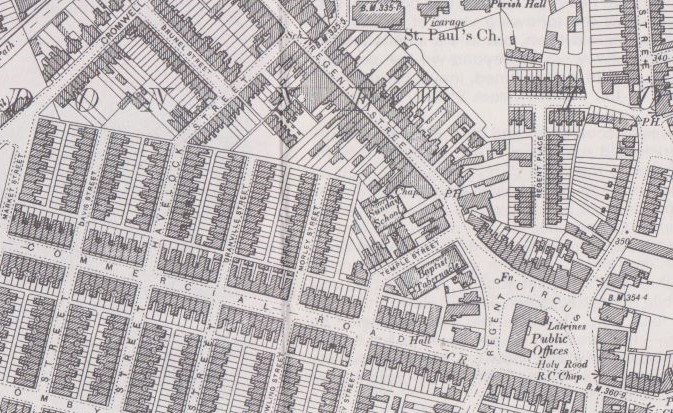
By 1901 both David and Fanny and their son Thomas Henry were living in Swindon. Thomas had been here since 1897 when he married Eliza Pamela Fisher. The couple lived first at 23 Turner Street and then at Cambria Bridge Road before moving to 6 Morley Street. In 1911 Morley Street comprised more than 35 red brick terrace houses, home to railwaymen and their families and looked a little different then to now.
Their first child, Thomas Frederick Emmanuel died aged 15 months old at 23 Turner Street. He was buried in grave plot C814, a babies grave; one month old Charles Adams had been buried there just two days earlier. But, although this grave was never purchased by the Uzzell family it did end up the burial place of not only Thomas Henry but three more of their children.
Youngest daughter Mary May Doreen Uzzell was buried there on May 23, 1912 aged 11 months. The following year Thomas Henry himself died aged 39 years and was buried on April 12, 1913.
In 1919 David Henry Uzzell aged 20 was buried on October 22 with his father and two infant siblings. The last burial took place in 1938, that of Joseph Eli Uzzell, Thomas and Eliza’s 4th child. Just two of their children survived to old age. George William died in 1977 in his 70s and Lizzie Kathleen who married Arthur Ponting and died in 1987 in her 80s.
In 1919 Eliza went on to marry again. Her second husband was Thomas Choules but her home remained at 6 Morley Street until the end of her life. Eliza died in 1943 and was buried in grave plot B1966 in Radnor Street Cemetery where she lies with Thomas Choules.
Turner Street
Cambria Place cottages
You may like to catch up with some other Uzzell family stories:
Sometimes it feels as if Radnor Street Cemetery is one big family reunion.
Yesterday’s blogpost Maurice Uzzell, Louisa and little Lily proved popular with readers. Shane messaged to say he’d hit a brick wall with his Uzzell research while Duncan confirmed the Scott/Uzzell family connection.
Mary Ann Scott was the daughter of Henry and Hannah Uzzell and featured in yesterday’s blogpost, living at 67 Jennings Street in 1891 with her husband Jesse Scott and where her three brothers Charles, Maurice and Fred Uzzell were boarding.
Jesse Scott, like Mary Ann Uzzell, was born in Christian Malford. The couple married at the Wesleyan Chapel Baptist Mills, Barton Regis on October 2, 1881 when Jesse was working as a railway signalman at the Stapleton Road Station. The UK Railway Employment Records 1833-1963 state that Jesse entered the Great Western Railway employment in October 1878 shortly before his 19th birthday working as a Policeman (railway guard) at Stapleton Road. In 1881 he became a signalman, also at Stapleton Road before moving to Swindon a year later where he worked as a switchman. In 1891 he was working as a passenger guard at Swindon and in 1907 he was a platform inspector.
In 1901 the family were still living at 67 Jennings Street. At the time of the census that year Mary was there with five of her children while Jesse can be found at the Railway Mission Convalescent Home in St. Leonards on Sea, Sussex.
By 1911 the family had moved to 73 County Road where Mary states on the census returns that they had been married 29 years and had 7 children but that sadly one had died. In 1911 Jesse and Mary had three adult children living at home and two that were still at school. Mary’s widowed mother Hannah Uzzell also lived with them – oh, and they had a boarder as well!
Mary Ann Scott died the following year and was buried in grave plot D1322 on June 26, 1912. By the 1930s Jesse was living at 60 Eastcott Hill where he died on January 23, 1935. Probate of his will was granted to his brother-in-law Maurice Uzzell and his son William Scott.
The couple’s two daughters are buried with them. Violet Lillian Mary Whitworth who died in the December quarter of 1936 aged 35 and Elsie Hannah Scott who died on November 29, 1939 at 61 Clifton Street, the home of her uncle Maurice Uzzell.
I feel this could be a continuing family history story – I’m sure to find little Lily at some point.








 Radnor Street Cemetery