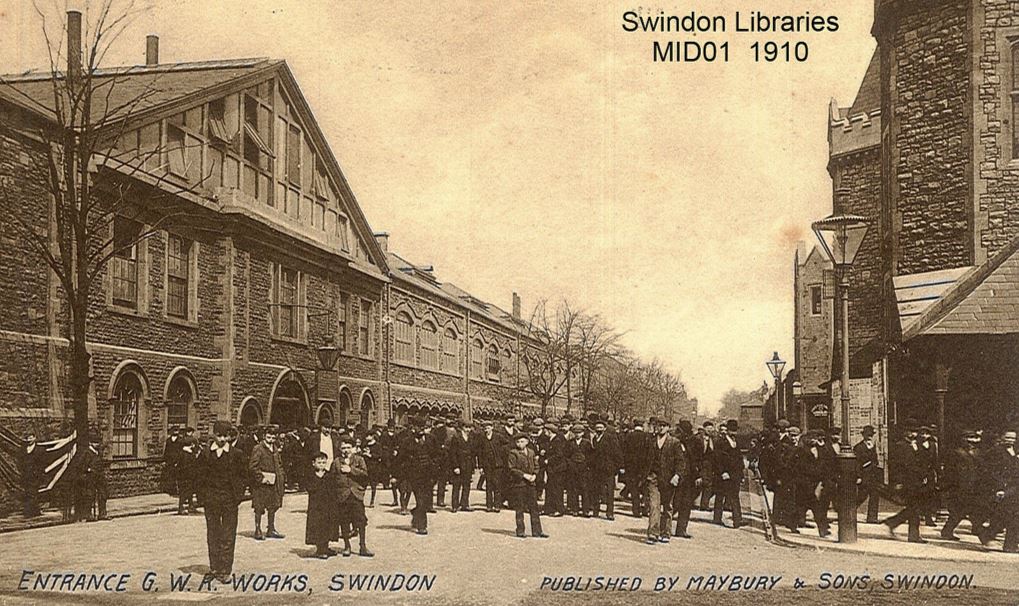
George Barefoot – an investor in people

The re-imagined story …

I’ve lived in New Swindon all my life. I was born in my gran’s bedroom in Bristol Street and I’ve never known anywhere else. But I’m tired of the close-knit railway community where everyone knows everyone else’s business, and a life confined to the Works and the railway village. I’m weary of seeing the same faces day in, day out, I don’t want to marry a boilermaker or a fitter and live the same life my mum and my Gran have.

“But that’s the strength of this place,” said Gran. “It’s knowing Mrs so and so’s baby is poorly or that Mr whatsit needs help with his shopping.” Gran was settling in for a long session, I could sense it. I offered her a piece of cake.

“When me and your Gramps moved here, I thought we had made the biggest mistake of our lives. All that was here was the Works and the company houses and that was it. No market, no shops, no church even, nothing.”

She took a sip of her tea.

“Is there any sugar in this?”

“Two spoons, Gran.”

“Your Gramps wanted to move out of London. He thought the kids would have a better future here. He thought living in the country would be healthy.” She shook her head sadly.

“The company houses looked nice enough from the outside but the railway village was worse than any East End slum. That first winter we lived here there was an outbreak of typhus. Six children died in Bristol Street. We were fortunate.”

She twisted the wedding ring on her gnarled finger, worn thin by hard toil.

“Did you ever consider moving back to London?”

“It wasn’t that easy and your Gramps had a good job in the Works here. He kept telling me we’d stick it out a bit longer, give it a chance, he’d say.”

“So, what persuaded you to stick it out?”

“Your grandfather and the men he worked with, they made the difference. Men like George Barefoot, elected on to the Mechanics’ Institute Council. Those men were investors; investors in people, they weren’t interested in share prices and profit. They wanted to protect their families and improve their standard of living. They wanted health care in a time when people didn’t call out the doctor because they couldn’t afford to. They were good men and they made the difference.”

“I’m glad your Gramps and George Barefoot gave New Swindon a chance.”

Gran spooned out the sugar from the bottom of her cup.

“Is there anymore tea in that pot? And make sure you put some sugar in this time.”

The facts …

George Barefoot was born in Maidenhead in 1828. He married Margaret Elizabeth Williams, a dressmaker, at Holy Rood on December 23, 1848. George was transferred to Gloucester where on November 12, 1865 three of the couple’s children, John James, William Alfred and Mary Ellen, were christened at St James’s Church, Gloucester. The family’s address is given as Front Terrace. By 1869 the family had returned to Swindon.

That same year George Barefoot was elected on to the Mechanics’ Institute Council with 166 votes. The following year he was re-elected with an increased number of votes, topping the poll with 281. Election results continue to show his presence on the Council and in 1873 he is recorded as ‘George Barefoot Locomotive Department K shop 296 votes.

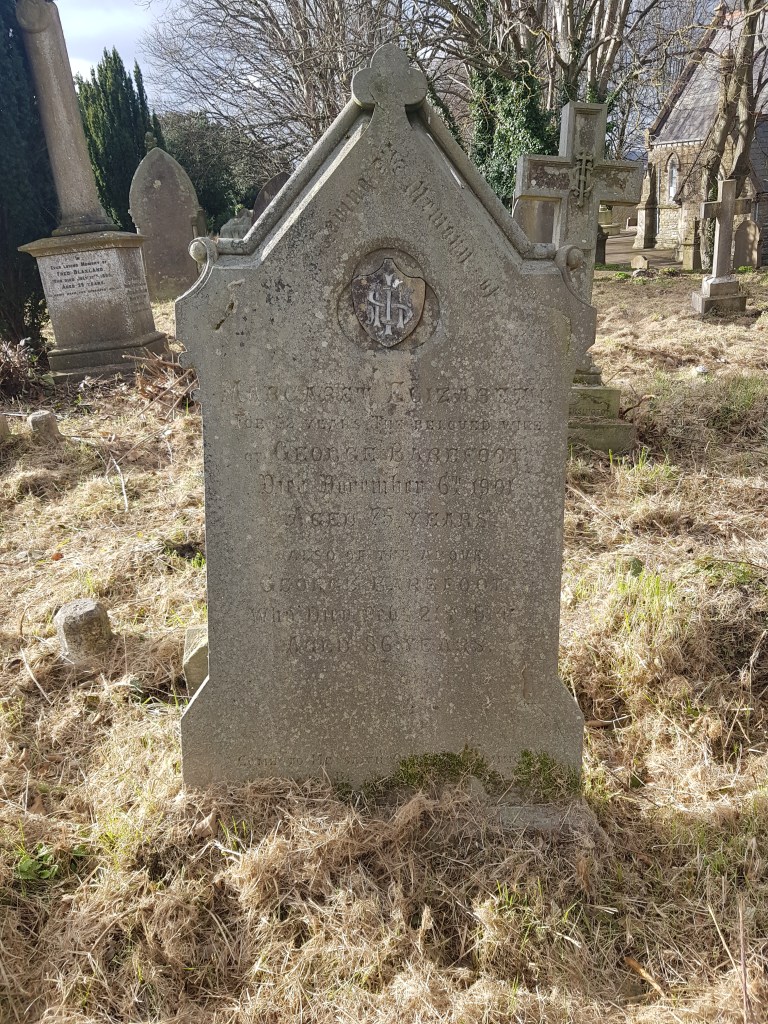
George Barefoot died at the age of 86 years. He was buried on February 26, 1914 in Radnor Street Cemetery in plot E7936

Death of Mr George Barefoot

The death took place on Saturday, at the residence of his son-in-law, Mr F. Edge, “Inglewood,” Deacon Street, Swindon, of Mr George Barefoot. The deceased gentleman who was very well known in Swindon, was born at Maidenhead in 1828, and commenced his working career as an office boy at Paddington Station. In 1847 he came to Swindon, being then at the age of 19, and was transferred for a few years to Gloucester, and finally returned to Swindon.

It is interesting to note that he was married at the old Parish Church by the then Vicar (the Rev. H.G. Baily), and he has, therefore, watched Swindon grow from what were practically two large villages into the large and enterprising town it is to-day.

He was a chargeman in the GWR Works for over 30 years, and he won the esteem and respect of all who knew him. In recognition of his faithful services the company granted him a pension on his retirement, and he went to live with his son-in-law and daughter.

He was always a prominent Conservative, and the late Sir Daniel Gooch used to speak of George Barefoot as his staunchest supporter in the Works. He had been a regular attendant at St. Mark’s Church.

A few weeks ago Mr. Barefoot had a stroke, and took to his bed, the end coming peacefully on Saturday. He leaves five children to mourn his death.

North Wilts Herald, Friday, February 27, 1914.
The Ellis family memorial

Sadly, this is all that remains of a once magnificent memorial to the Ellis family in Radnor Street Cemetery.  Thieves armed with cutting equipment removed the ornate metalwork and with it all reference to the family buried there.

William Ellis was one of the first members of the New Swindon Local Board, a director of the Swindon Building Society, Chairman of the New Swindon Gas Company and a director of the Swindon Water Company. A devout Methodist, he was described as being ‘a most acceptable lay preacher widely known in Wiltshire and South Wales.’

Expansion at the GWR Works in 1861 saw the building of new Rolling Mills. Once established the rail mill produced an estimated 19,300 tons of rails a year with the workforce consisting mainly of Welsh iron workers.  

Thomas Ellis was the first manager at the Rolling Mills and was responsible for building the cottages along Cambria Place to house the Welsh workers. 

William came to Swindon with his two young children and took over as manager in 1863.  The family’s first home was at 4 Church Place, before moving to the Woodlands, a GWR manager’s house.

When William died on May 25 1896 the Advertiser published a lengthy obituary in which he was described as having the ‘esteem of the large number of men who were under his control.’

“The first portion of the funeral service was conducted at 8 am on the lawn in front of the Woodlands by Revs A.A. Southerns and G. Osborne.  Portions of Scripture were read, and hymns No. 680 and 940 from the Wesley hymn book were sung at the close of the beautiful and impressive early morning service,” the Advertiser reported.  “The cortege then proceeded to a saloon, which was placed near the house, and the family left by the 9-5 train for Abergavenny where a hearse and carriages were in waiting to convey the remains and family to Lanelly church, where a large number of friends from neighbouring places had assembled.”

William’s son Ernest followed his father into the Rolling Mills where he worked as Assistant Manager.  He and his wife Catherine lived at the old Ellis family home at 4 Church Place. Two of their children who died in infancy were buried in the Radnor Street plot, Olga Louise in 1897 aged 2 years and 2 months and Louis Robert in 1890 aged just six months.

Ernest died in 1915.  The Advertiser published an account of the Memorial Service held in the Wesley Chapel, Faringdon Street during which Ernest was described as a man who ‘hoped for the best, and believed of the best in people,’ ironic considering the vandalism of his family’s memorial.

Ernest’s wife Catherine who died in 1931 aged 78 and his sister Louisa who died in 1944 aged 89 were both buried in the family plot.  The names of William and his wife Emily were included on the family memorial.

Fortunately there are photographs of the distinctive monument preserved on Duncan and Mandy Ball’s website.  Without this record the memory of one family who made such a large contribution to 19th century Swindon would be lost.

34 Faringdon Road

The re-imagined story …

I quite like what they’ve done to the place, especially the wallpaper in the front parlour. I could never have afforded that when we lived there.

The thing I notice most is how clean everywhere is. In my day it was a constant battle against the filth pumped out of the Works and the coal smuts from the trains. If the wind changed direction the washing would be covered in grime when I took it off the line.

I preferred our home in Box, but it was only a small village in those days. There were more opportunities for the boys in Swindon, so we moved here. It was a dirty, noisy place back in the 60s but the people were good and kind. When John died more than two hundred people lined the roads from Faringdon Street to St Mark’s.

I like to pop back to the house occasionally. It’s open to the public now, you know. Who would have thought it?

DSC01085

The facts …

Jane Bennet married John Hall at New Monkland, Lanarkshire in June 1840 when John was working as an engine driver with the Wishaw and Coltness Railway in Scotland.

At the time of the 1851 census the family were living in Box, Wiltshire but by the next census ten years later they were at 1 Faringdon Street.

John died on Tuesday, February 29, 1876 as the result of a grisly accident on the railways. At the inquest his son James gave the following evidence:

‘James Hall, son of deceased, said:- My father was 65 years  of age last August. On Tuesday morning, about 25 minutes after two, I was at the station with him as his stoker to pilot the up rails out. We were there in case of the other engine breaking down. There were four coaches in front of our engine, which we were going to push on to the rails. Whilst waiting, the gauge lamp went out, and my father went to the front of the engine to light it by the other lamp. As he was returning along the side of the engine the signalman signalled us to come on, and I blew the whistle and started just as my father had another step to take to get back, and, in fact, had his hand on the weather board. He was walking along the side of the engine. As he was about to step on the foot plate his foot slipped and he fell, his right leg going between the outside connecting rod and the wheel. I had only moved about a yard. The rod brought him up again against the splasher, causing his leg to be jammed and the flesh torn off. The first I knew of his position was my father calling out, ”Stop Jim,” and I stopped immediately. I got down and found he was fixed inside the rod, and he was terribly torn about. It took a considerable time to get him out. He was taken to the hospital at once.’

John died from the shock about four o’clock the same day.  As the report said: ‘The injuries were sufficient to kill anyone, the flesh being taken off to the bone.’

The funeral at St Mark’s took place on the following Sunday, a wet and windy dayattended by  ‘a large number of the inhabitants, many engine drivers and stokers from various parts of the Great Western Railway. We understand that free passes were issued to all such drivers and stokers as desired to attend the funeral, and in this way over ninety of deceased’s fellow workmen were enabled to attend his funeral to pay their last respects to his memory, according to the Swindon Advertiser.

DSC01082

Jane outlived her husband by ten years. She died on January 22, 1886 at the home in Faringdon Street where she had lived for more than twenty five years. She was buried in Radnor Street Cemetery in plot A1047, a public grave, with Jane Humphreys, the wife of Alfred Augustus Humphreys of 9 Bangor Terrace, Jennings Street, who had died the previous year.

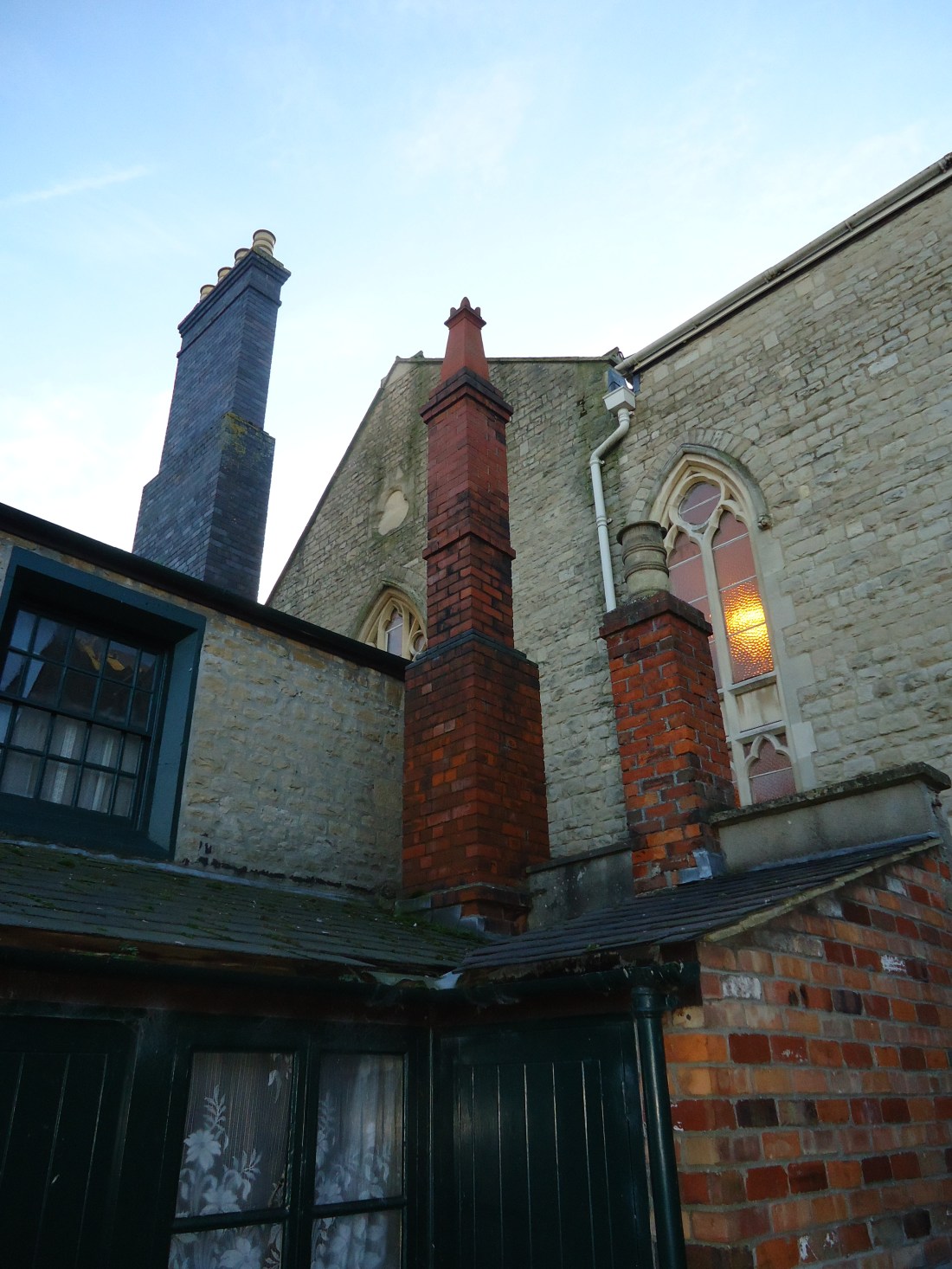
Faringdon Street was later renumbered and renamed Faringdon Road. Today the Hall’s former home is 34 Faringdon Road, the Railway Village Museum.

Down Your Way – Taunton Street

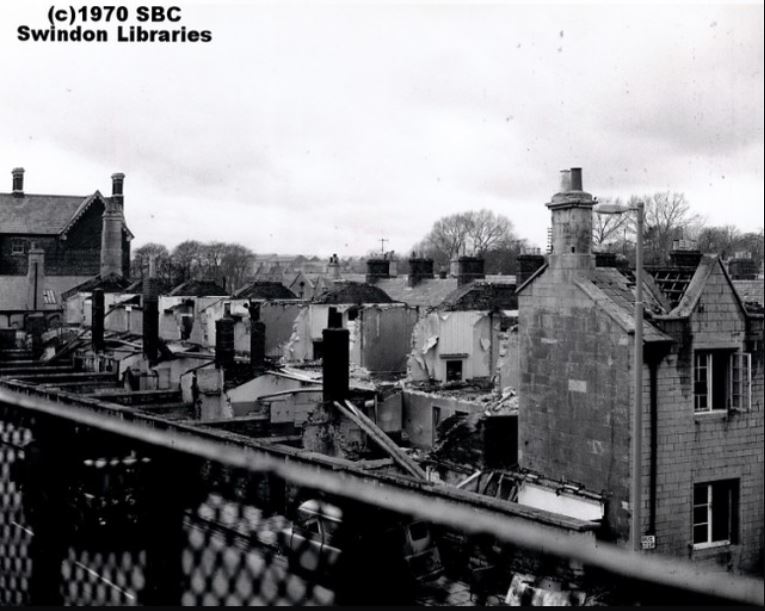
We are extremely lucky to still have the Railway Village for in the 1960s it was under threat of demolition. Purchased by the local authority in 1966 the 19th century cottages were in a state of dilapidation and Swindon Borough Council was intent upon a project of demolition and rebuilding. However, a passionate local campaign and the vocal support of Sir John Betjeman, Poet Laureate, rescued the village and a programme of renovation began.

Without these properties it would be difficult to imagine the lives of the first railway families who arrived in Swindon in the 1840s. But today you can still walk down the backsies and hear the distant echoes of children at play; hear the tramp of the men’s feet as they return home after a hard day’s work and re-imagine life in Swindon 180 years ago.

Green, G. Peter M.; Swindon Railway Village, c.1935; STEAM – Museum of the Great Western Railway; http://www.artuk.org/artworks/swindon-railway-village-c-1935-65327

If you lived in Taunton Street you rubbed shoulders with royalty – railway royalty, that is. The first members of the Mechanics’ Institute Council Mr Grandison and Mr Fairbairn, lived in Taunton Street. Even old Mr Hurst, the first locomotive driver on the GWR, lived there although that was much later. Read more …

Thomas Oswald Hogarth – Howzat!

Peter Bremner was born in Dundee in about 1819 and arrived in Swindon around 1848. It is possible the family came straight from France where a daughter Erskine was born in 1847. For more than 35 years Peter lived at 5 Taunton Street at the very centre of life in New Swindon. Read more …

Peter Bremner – railway pioneer

It is seldom we have the opportunity to read the words of an ordinary railwayman. When George House died in 1903 the Advertiser republished extracts from an earlier interview made in 1899. Read more …

George House – a Swindon veteran

John Ham – 29 Reading Street

In the 1960s Swindon’s iconic railway village was under threat of demolition. Purchased by the local authority in 1966 the 19th century cottages were in a state of dilapidation and Swindon Borough Council were intent upon a project of demolition and rebuilding. However, a passionate local campaign and the vocal support of Sir John Betjeman, Poet Laureate, rescued the village and a programme of renovation began.

John Ham was born in 1860 in Pontnewyndd, Pontypool. His parents moved to Swindon soon after John’s birth and he spent the rest of his life living in the railway village. He appears on the 1871 census, a schoolboy aged 11, living at 29 Reading Street with his widowed mother Ann, his uncle and aunt, and his elder brother 13 year old William. William was already working as an office boy in the GWR Works and as soon as he was able to John joined him.

In 1881 John was head of the household at 29 Reading Street where he lived with his mother Ann and three engine fitting apprentices.

On September 10, 1885 John married near neighbour Emily Solven who lived at 21 Reading Street. John and Emily began married life at 29 Reading Street where they were living at the time of the 1891 census with their young son William, and John’s cousin George Rushton.

By 1901 the family had moved to 15 Faringdon Street where John died in May 1905 aged 44 years. Despite his premature death John had contributed considerably to life in Swindon as can be seen from the brief obituary published in the Wiltshire Times. He was buried in grave plot D80 on May 19, 1905 where he was joined by Emily following her death in 1926.

Death of Mr J. Ham – The death is announced of Mr John Ham, a well known member of the Council of the GWR Mechanics’ Institute, Swindon. Deceased, who was only 47 [44] years of age, had been a clerk in the GWR Works for the past 33 years, going there immediately on leaving school. He had been an active member of the Council of the Institute for the past 12 years. He was a prominent Oddfellow, being a member of the “Widow’s Hope” Lodge, and also a good cricketer. He leaves a widow and two little children – a son and daughter.

The Wiltshire Times, Saturday, May 20, 1905.

Corner of Reading Street

Images published courtesy of Local Studies, Swindon Central Library.

Peter Bremner – railway pioneer

If there was a memorial to Peter Bremner, this is where it would be

The common belief is that the early railwaymen who arrived in Swindon in the 1840s are mostly buried in the churchyard at St. Mark’s.

There are a great many burials in that small churchyard; so many that by the 1870s there were extreme concerns that burial space was fast running out. Drainage of the churchyard was also a problem, restricting usage of a large area. All this contributed to the long, ongoing debate about the need for a new burial ground. Eventually resolved in 1880, Radnor Street Cemetery opened in 1881 and soon became the last resting place of many of the old railwaymen.

There are many of their stories told here on the Radnor Street Cemetery blog; this is that of Peter Bremner.

Peter Bremner was born in Dundee in about 1819 and arrived in Swindon around 1848. It is possible the family came straight from France where a daughter Erskine was born in 1847. For more than 35 years Peter lived at 5 Taunton Street at the very centre of life in New Swindon.

Death of a railway official – Our readers, especially the old hands of the GWR Works, will hear with regret of the death of Mr Peter Bremner, who has occupied the position of foreman for many years past, he being one of the earliest arrivals on the establishment of the works. His kindly disposition made him many friends. The funeral will take place this (Saturday) afternoon, at 2-45, and will no doubt be largely attended.

The Swindon Advertiser, Saturday, September 18, 1886.

Funeral of Mr Peter Bremner – The funeral of the late Mr. Peter Bremner, of 5, Taunton Street, New Swindon, took place on Saturday afternoon, admidst many manifestations of the respect and esteem in which deceased was held. For 40 years Mr. Bremner, who had reached the age of 67 years, had been in the service of the GWR Company, and during a great part of that time as foreman, he, at the time of his death, being foreman of the G (Millwrights’) Shop, GWR Works, New Swindon. As a foreman, the deceased was respected by all above and below him, those under his charge especially valuing his good qualities, and he had also obtained the esteem of a large circle of friends. That this was the case was evidenced by the fact that nearly 400 persons joined in the funeral procession on Saturday, and the route was lined with spectators. Mr. F. Hemmings, of Fleet Street, New Swindon, was the undertaker, and he carried out the funeral arrangements in the most satisfactory manner. The coffin was of polished oak, with black furniture, and bore the following inscription:- “Peter Bremner, died September 15th, 1886, aged 67 years. Through the Cross to the Crown.” On the handleplates were the words “Praise the Lord.” A number of beautiful wreaths were contributed, including one from Mrs. Swinhoe, one from Mr. S. Carton and Mr. J. Haydon as “a tribute of respect and esteem from the managers for an old and valued servant,” from Mr. and Mrs McCulloch, Mr and Mrs Batchelor; from the fellow foreman of deceased in the Locomotive Department of the GWR Works; and a magnificent artificial wreath supplied by Mr. Hemmings, from the workmen employed under the deceased. On a card attached to this wreath was the following inscription:- “In affectionate remembrance of Peter Bremner, the much respected foreman of the G Shop, GWR Works, Swindon, this wreath is placed by the workmen formerly employed under him as a mark of the general respect he merited.”

The chief mourners were:- Mr. J. Bremner (son of the deceased), Mr W.D. James (grandson in law) and Mr. E.C. Riley. In the procession were included many of the deceased’s fellow foremen, about 160 of the employes in the G Shop, and many friends. The procession included three carriages in addition to the hearse. The funeral cortege left disceased’s residence at about three o’clock, and proceeded to St. Mark’s Church, where the first portion of the burial service was conducted by the Rev. H.W. Boustead. By way of Church Place, and Cambria Bridge, the procession marched to the cemetery. There was a large number present. The remainder of the burial service having been read, the body was lowered to its last resting place, and after a final look at the coffin the procession returned to Taunton Street, where its members dispersed.

Extracts from the North Wilts Herald, Friday, September 24, 1886.

Peter Bremner died aged 67 years at 5 Taunton Street. His funeral took place on September 18 when he was buried in grave plot A1057 with his wife Annie who had died in February of that same year.

You may also like to read:

James Fairbairn – pioneer railwayman

Robert Laxon – First Secretary of the Medical Fund

Jason Johnson – a homegrown railwayman

George House – a Swindon veteran

George Hemsley – co-founder of the New Swindon Co-operative Society

Robert and Margaret Patterson

During a period when we might have thought people stayed in the area in which they were born, railwaymen and their families were frequently on the move.

Born in about 1805 in Lamesley, Durham, Robert had already moved about a fair bit by the time he arrived in Swindon. His route can be traced by the birth place of his children in Penshaw and Shields in Durham, Paddington and then Swindon.  

Engine driver Robert Patterson appears on the 1851 census in Swindon when street numbering was still to be established. He lived in No. 2 or 5 Farringdon Street with neighbours Robert Laxon at No. 1 or 4 and William Laverick at No. 3 or 6, although that was not the end of his travels. Between 1871 and 1881 (when he was 78 years of age) he was still working as an engine driver and living in Milford Haven, Pembrokeshire, which is a bit of a coincidence as I lived there as well exactly a hundred years later.

The couple had seven children – two sons Thomas and Michael, who sadly died aged 20 in 1856, and five daughters, two of who died aged 22 and 24. Hannah and Barbara Patterson died in identical circumstances in 1862 within just five weeks of each other, their tragic deaths reported in the local press.

New Swindon

Singular Circumstance – Four weeks ago to-day we recorded the death of Miss Barbara Patterson, of New Swindon, in a peculiarly sudden and lamentable manner, and we have to-day to announce the death of her elder sister, Miss Hannah Patterson, under similar circumstances.

It was be remembered that Miss Barbara Patterson was taken ill on the Sunday evening after having been about as usual during the day, and after lingering until about the same hour on the following day she expired. A post mortem examination of the body subsequently disclosed the cause of death to have been the rupture of an internal abscess, the discharge from which had flooded the heart.

On Sunday week, Miss Hannah Patterson was apparently in her usual state of health, and was out walking both in the afternoon and evening. Some time after she had returned home in the evening she complained of sudden illness; medical aid was at once procured, and, notwithstanding that Mr. Swinhoe was in almost constant attendance upon her, she, after being ill to within half an hour of the period of her sister’s illness, expired; and from the symptoms under which she laboured, there appears to be no doubt whatever but that the cause of death in both instances was precisely the same.

The death of two young women – the one 22 and the other 24 years of age – in so sudden and peculiar a manner, has produced quite a sensation in New Swindon.

Wiltshire Independent, Thursday, November 6, 1862.

The late Trevor Cockbill, railway and local historian, writes in his book A Drift of Steam that the Choral Society arranged a Sacred Concert, conducted by Mr Albert Sykes, which included Mozart’s Twelfth Mass to be held in the Mechanics’ Institution. The proceeds were donated to provide a memorial for Miss Hannah Patterson’s grave in St. Mark’s churchyard. Trevor writes that the programme included a tribute to Miss Patterson “who for so many years past contributed, by the aid of her great vocal talent to the edification and pleasure of this and the surrounding neighbourhood. Her services were at all times cheerfully and gratuitously rendered.”

Robert Patterson died in December 1884 aged 82 at 2 Gloucester Terrace, Swindon. He was buried in grave plot A1093. Margaret died in August 1887 aged 77. Her last address was in Brigstock Road, Bristol. She was buried with her husband on September 1, 1887.

The cost of a burial in 1894

Yesterday I published the story of William Barnes Keylock who died in 1955. Today I am sharing the documents concerning the burial of his father in 1894.

One of the most poignant revelations of reading the Keylock family burial documents was the cost of a basic burial in 1894, yet so many Swindon families were unable to afford even that.

The two accounts published here were issued by the Swindon Burial Board for Charges and Fees, for Interment at the Cemetery.

The first invoice is dated April 28, 1894, the day following William John White Keylock’s death (the burial board didn’t hang around!) and was addressed to his son Mr W.B. Keylock of 11 College Street.

The costs include 5s for a burial in grave plot A856. An additional charge of 2s 6d was for the services of the officiating minister and 3s for the Sexton. There was a 6d charge for a grave space indicator (presumably the terracotta markers seen about the cemetery today) and finally 1s to toll the bell. The cost of a burial (not the funeral itself) amounted to 12s, little more than 50p in today’s money, but so much more in 1894 – more than many Swindon residents could afford. But the Keylock family had not been such a family.

William John White Keylock was born in 1853 the son of John, a painter and glazier, and his wife Ann. He grew up in Albert Street and began work with his father. He married Susannah Ponting on July 20, 1872 at the Wesleyan Methodist Chapel, The Planks and by 1889 he was working as a beer retailer at 12 High Street, later known as the Baker’s Arms.

The second invoice addressed to Mrs S. Keylock was issued on January 31, 1895, some nine months after her husband’s death. Susannah has paid for the Purchase of Grant of Right or Burial in Grave Space No 855 & 856 Section A at a cost of £2 2s. She paid a further 2s 6d to have her husband’s details entered in the Burial Register. These are the registers vital to our research and it had never occurred to me that some names might be missing due to an inability of the family to pay. Finally, Susannah paid 2s 6d for a burial certificate. There is no entry for erecting a monumental stone so maybe there never was one. Susannah paid £2 7s (less than £2.50 today) but a big expense in 1895 and of course the funeral costs would be in addition to this.

William John White Keylock, retired publican, died on April 27, 1894 at 11 College Street. He left effects valued at £74 (worth around £9,000 today) to his wife Susannah.

Susannah remarried. She died aged 72 in March 1925 at the house she had shared with William. She was buried on March 21 in grave A856 with William and in the plot next to her son and daughter-in-law.

Finding these records that Rose so very kindly provided several years ago has been a thought provoking experience.

To be continued …

William Barnes Keylock – Railway Clerk and Licenced Victualler

After some 15 years of research the Radnor Street Cemetery archives are becoming quite extensive. Between us Andy, Noel and I have many hundreds of photos and items of ephemera and it was while looking through one of my boxes that I came across this cache of documents.

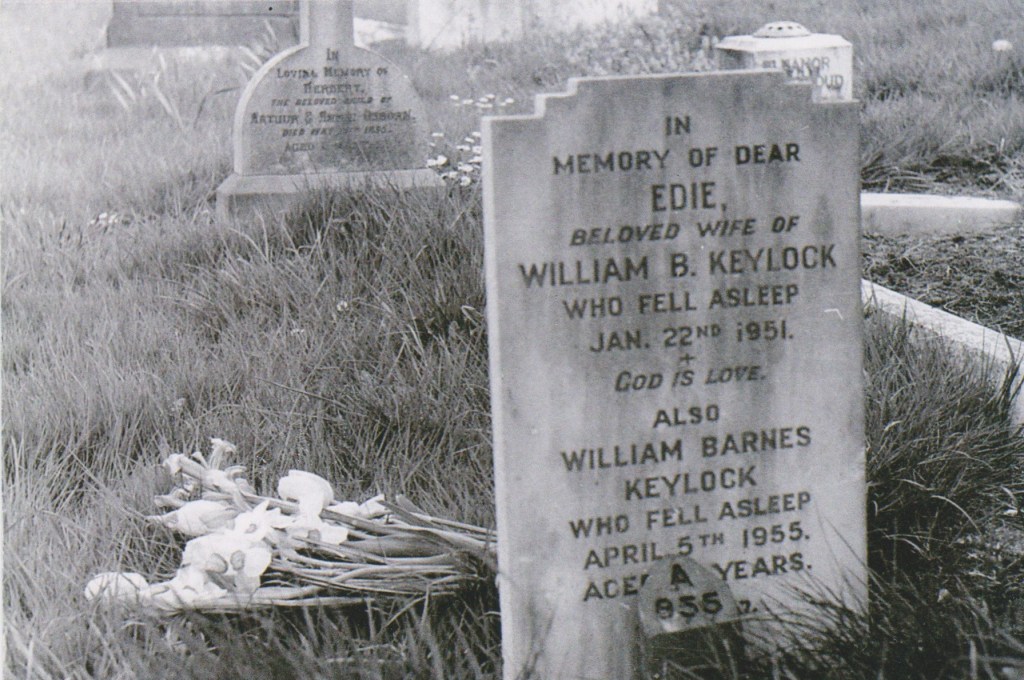
Rose contacted me some years ago as she feared her family headstones had been removed from the cemetery. The passage of time had seen the memorials sink and tilt and become very discoloured and almost unrecognisable, but I was able to confirm they were still there. At the time Rose provided me with family documents regarding graves and burials and several photographs including one of the grave of William Barnes Keylock and his wife Edie.

William was born on December 2, 1872 and baptised at Christ Church on December 10. He was the only surviving child of William John White Keylock and his wife Susanna. In 1881 William J.W., a pattern maker, Susanna and William B. were living at 9 Read Street. William B. started work as a Railway Clerk on April 2, 1888 and at the time of the 1891 census he was living with his parents at the Bakers Arms in the Railway Village where his father was the inn keeper.

William Barnes Keylock married Edith Prideaux Dymond on July 27, 1895 at the parish church in Porlock. The couple had two children, William Harold and Dorothea Edith May. Sometime after Dorothea’s birth in 1901 the family moved to London where William was licenced Victualler at the White Hart, Clerkenwell and later The Eagle in Woolwich.

By 1939 the family had returned to Swindon and William, Edie and Dorothea were living at 11 College Street.

Edie died aged 77 at the Victoria Hospital. She was buried in plot A855 on January 26, 1951. William died aged 82 on April 5, 1955 at St Margaret’s Hospital. He was buried here with Edie on April 9, 1955.

My thanks to Rose for providing so much information and my apologies for taking so long to publish her family story.

To be continued …

Photograph believed to be William Barnes Keylock as a boy – published courtesy of Ancestry

He’d been gone a long time – Arthur Jeffreys Lewis White

The re-imagined story …

You saw it happen so often in those days, a mother or father would die suddenly, but to lose both parents within a matter of three years was heart-breaking for those poor children. Little Arthur was just four years old when his mother died and only seven when he lost his father.

I would have happily taken that little boy into our home. It would have been what his mother would have wanted. We were close, the two of us. But his father had obviously made provision for his family.

It would have been hard on those children had their father not been a Freemason. The girls received a good education and Walter, the brother just a couple of years older than Arthur, went into the railway factory before moving to Wolverhampton and a job as a fitter in the GWR Stafford Road works. But I never knew what had happened to that little boy.

I often thought about young Arthur then one day there was a knock on my door and who do you think was standing there but him. My, he had grown into a handsome young man – I could see something of his mother in him. He came in for a cup of tea and a piece of my sponge cake and he told me he was about to start work as a clerk in the Works, following in his father’s footsteps.

He had been to the burial ground at St. Mark’s to visit his parents’ grave, but things looked very different to how he remembered them and he came away without paying his respects. Perhaps someone could help him find the grave? He’s been gone a long time.

This image has an empty alt attribute; its file name is london-street.jpg

The facts …

When Arthur White’s father Richard Lewis White died in 1879 it seems likely it was members of Swindon’s Freemasonry who provided for the young boy and his family of siblings. 

Richard Lewis White, secretary and chief accountant for the GWR locomotive and carriage department, was a member of The Gooch Lodge when he died in 1879, leaving behind six orphaned children from his first marriage. 

The first clue to what happened to the children comes in a newspaper article published in the Western Daily Press, Bristol on Wednesday, September 17, 1879:-

Somerset and Wilts Freemasonry – The balloting papers for the election of daughters of Freemasons to the Royal Masonic Institution for Girls have just been issued. The election will take place at the Freemasons’ Tavern, London, on Saturday October 11th. There are 48 candidates on the list, and 18 vacancies in the school. Among the candidates are one from Somerset and one from Wilts. The Somerset candidate is Mabel Jane Sampson, whose father, Thos. Sampson, nurseryman and farmer, was initiated, in the Lodge of Brotherly Love, No. 329, Yeovil, on the 16th March, 1859. The Wiltshire candidate is Adelaide Louisa White, ten years of age, whose father, Richard Lewis White, a clerk on the Great Western Railway, died on the 6th of February last. He was initiated in the Gooch Lodge, No. 1,395, New Swindon, on the 4th of April, 1870, of which he became Worshipful Master. He was also Past Provincial Grand Sword Bearer of Wilts.’

Adelaide was one of the successful candidates, polling 1,118 votes and at the time of the 1881 census she is recorded as a pupil at the Royal Masonic Institution for Girls, Battersea. In the same census Eleanor, aged 17, is recorded as a pupil at Queen’s College, a private school in Islington and 12-year-old Walter is a pupil at The College, Beach Road, Weston Super Mare.

Arthur’s eldest brother Richard Corbett White died in 1877 aged 15 while his sister Frances worked first as a domestic servant and then a dressmaker at the time of her marriage in 1893. 

Arthur J L White and Emily White

And what of little Arthur who was just four when his mother died and seven when his father died. 

The first definite sighting of Arthur is on January 4, 1887 when he enters the GWR employment as a Lad Clerk and it is possible to track his employment record in the Swindon Works. By 1902 he is Assistant Chief Clerk and in 1918 he is promoted to Chief Clerk. His annual salary rose from £45 in 1889 to £1,000 in 1924, so the boy orphaned as a seven-year-old did well. And like his father he also became a Freemason, joining the Royal Sussex Lodge of Emulation in 1919.

Arthur married Emily Sendell in October 1917. He was 45 and she was 41. They did not have any children.

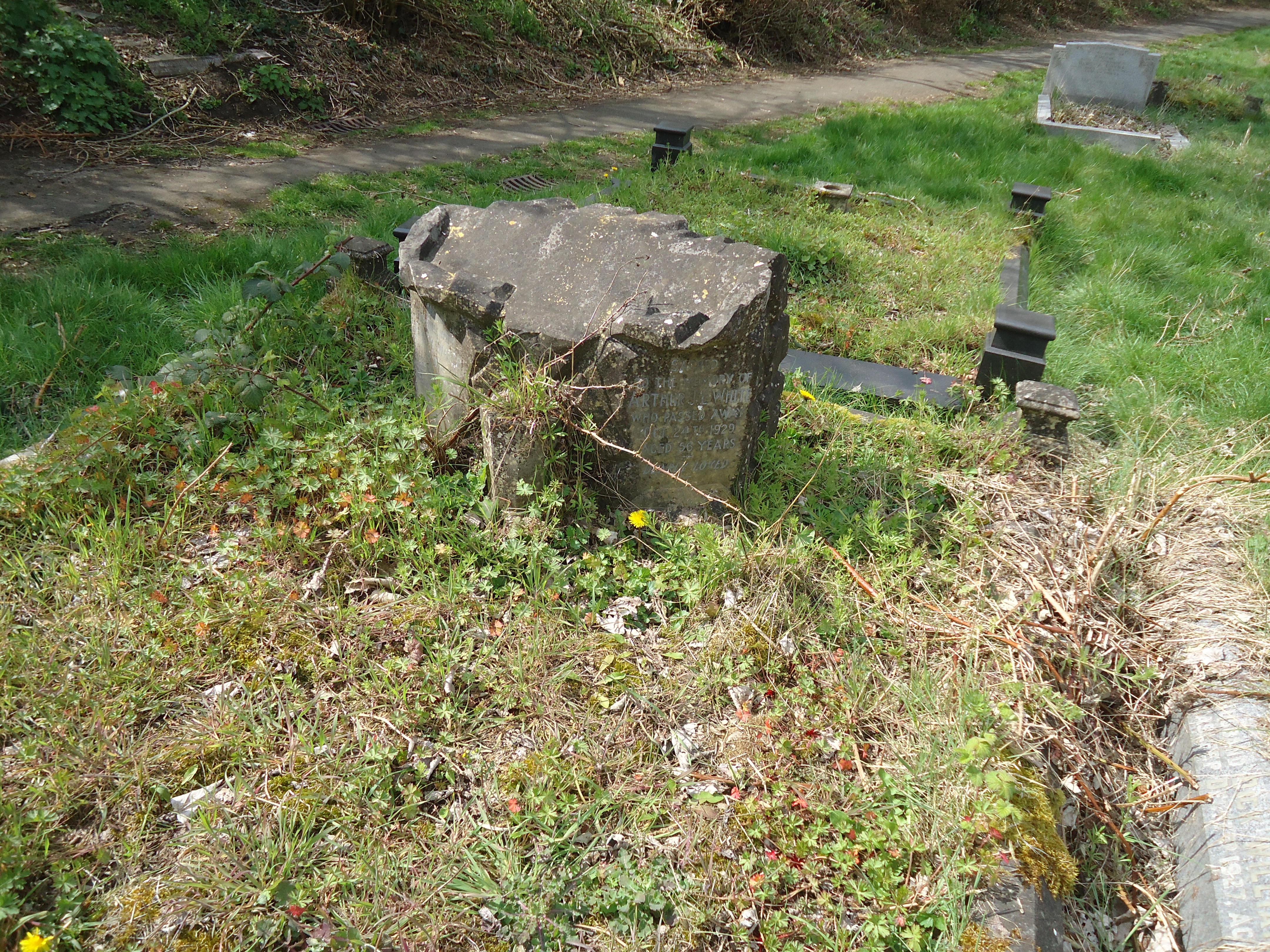
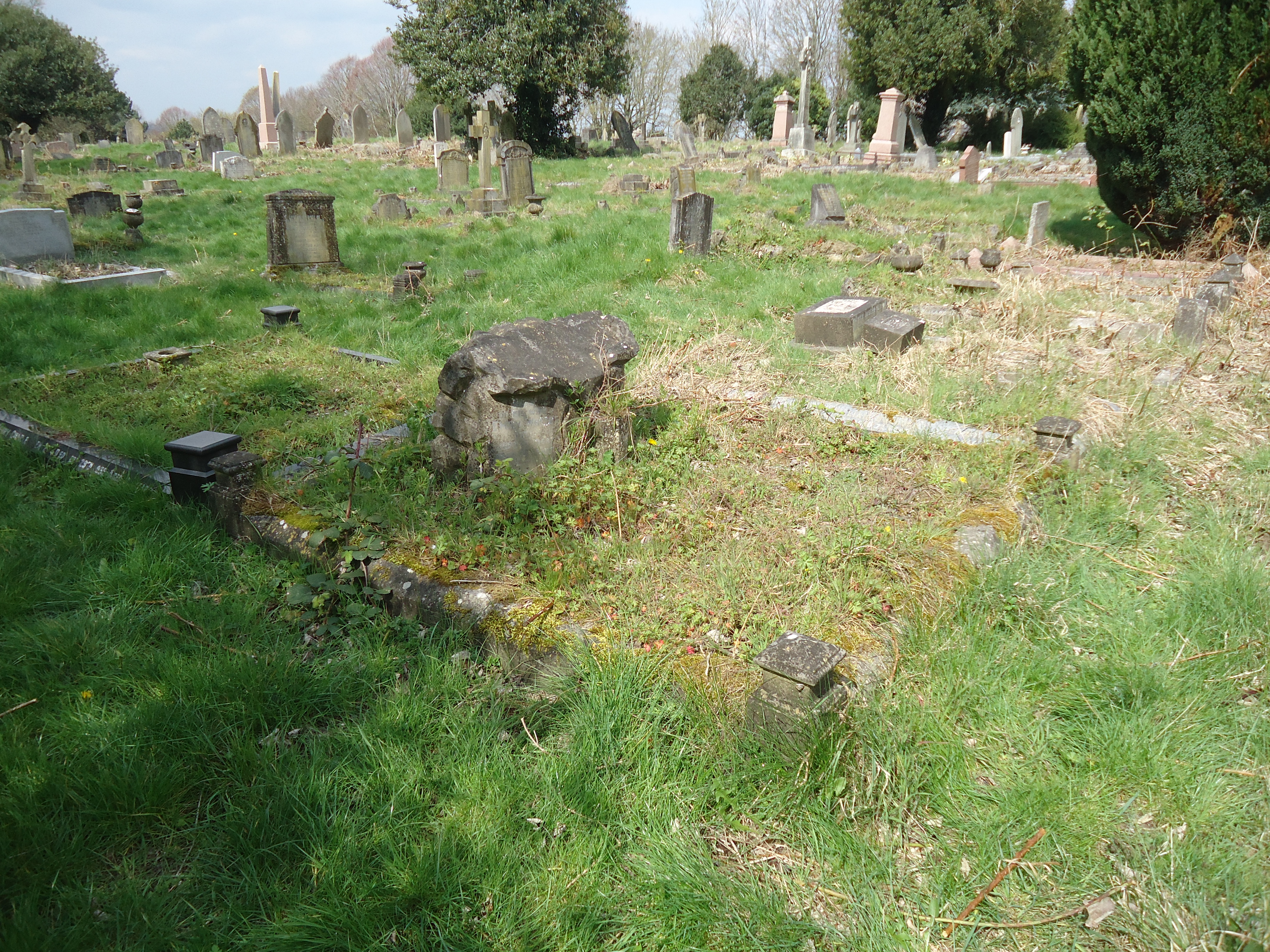
Arthur died on October 24, 1929 at his home in Okus Road. He left effects valued at more than £4,000 to his widow Emily. He was buried in plot E8134 in Radnor Street Cemetery on October 29, 1929, where Emily joined him when she died in 1968 aged 92.

Arthur J L White and Emily White (2)

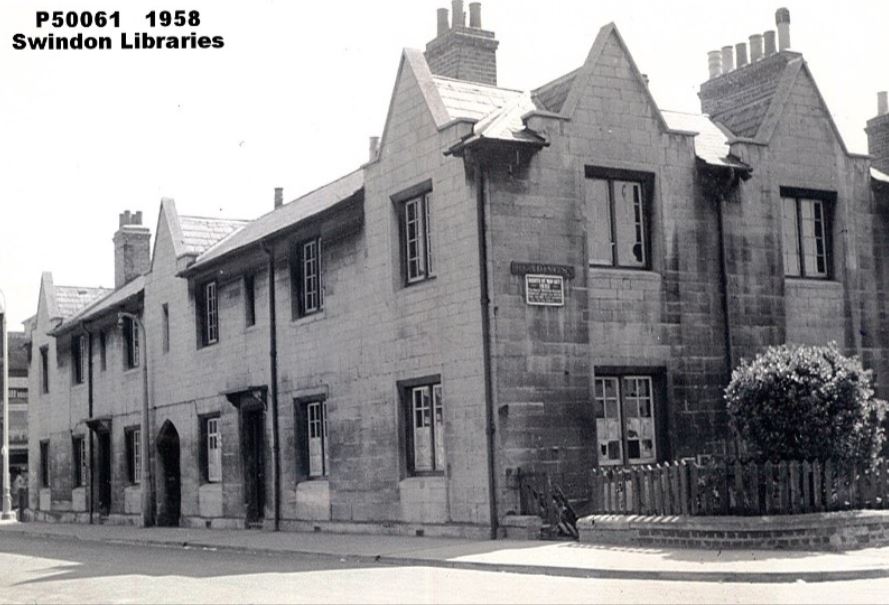
Images of London Street published courtesy of Local Studies, Swindon Central Library.