Ernest Hayball – dairyman

One of our regular cemetery followers has a wealth of family history knowledge, a vast archive of photographs and ephemera, more than one family grave in Radnor Street Cemetery plus a photograph taken at the time of his grandmother’s funeral in 1937. How lucky are we to be given access to all this material and the story of Ernest Hayball!

Ernest Edwin Hayball was baptised on April 1, 1872 in the parish church of Donyatt, Somerset, the son of Mathias Hayball, a tailor and his wife Emma.

By 1891 he had moved to Swindon and was living in Commercial Road and working as a dairyman with his brother-in-law George Parkhouse.

Ernest Edwin Hayball married Theresa Georgina Meads at St. Mark’s Church on July 19, 1899. Paul has a copy of the wedding photograph with an index of the pictured guests compiled by his mother (see below). The couple went on to have five children, Leonard, Ernest, George, Doris and Gladys (Paul’s mother).

Ernest established his own dairy business in Hythe Road, later moving to 32 Bath Terrace, which became 71 Faringdon Road after renumbering and renaming in the early 1920s.

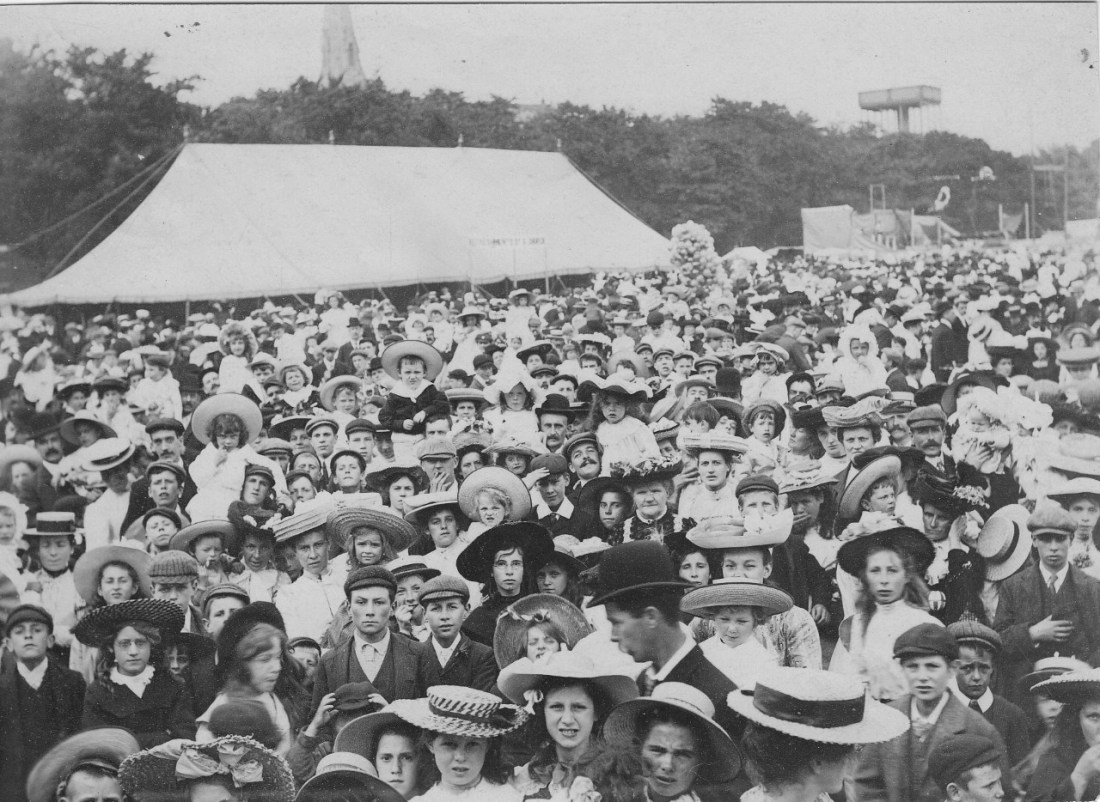
In 1932 the local press reported on yet another successful Children’s Fete where 35,000 people had celebrated in the GWR Park opposite the Hayball business. Organised by the Mechanics’ Institute, catering for the thousands of adults in attendance was undertaken by the Swindon Town F.C. Supporters’ Club with “40lbs of tea, nearly 4 cwt of sugar, and 40 gallons of milk, the latter being supplied by Messrs E. Hayball and Sons, of Faringdon road, Swindon.”

A brief obituary in the local press following Ernest’s death in 1952 encapsulated his busy life.

Was dairyman for 50 years

Swindon Death

A former member of the committee of the Swindon Town F.C. Supporters’ Club, Mr E.E. Hayball (79), 71 Faringdon Road, Swindon, has died.

He had been in business as a dairyman for 50 years. Starting at 1 Hythe Road, he bought Mr H.J. Hulme’s business, and after staying there for nine years went into partnership with the late Mr G. Parkhouse in Commercial Road.

In 1914 he started on his own account at 71 Faringdon Road, where he continued until his death.

At one time he played skittles for Ashford Road and the Central Clubs.

He leaves three sons and two daughters.

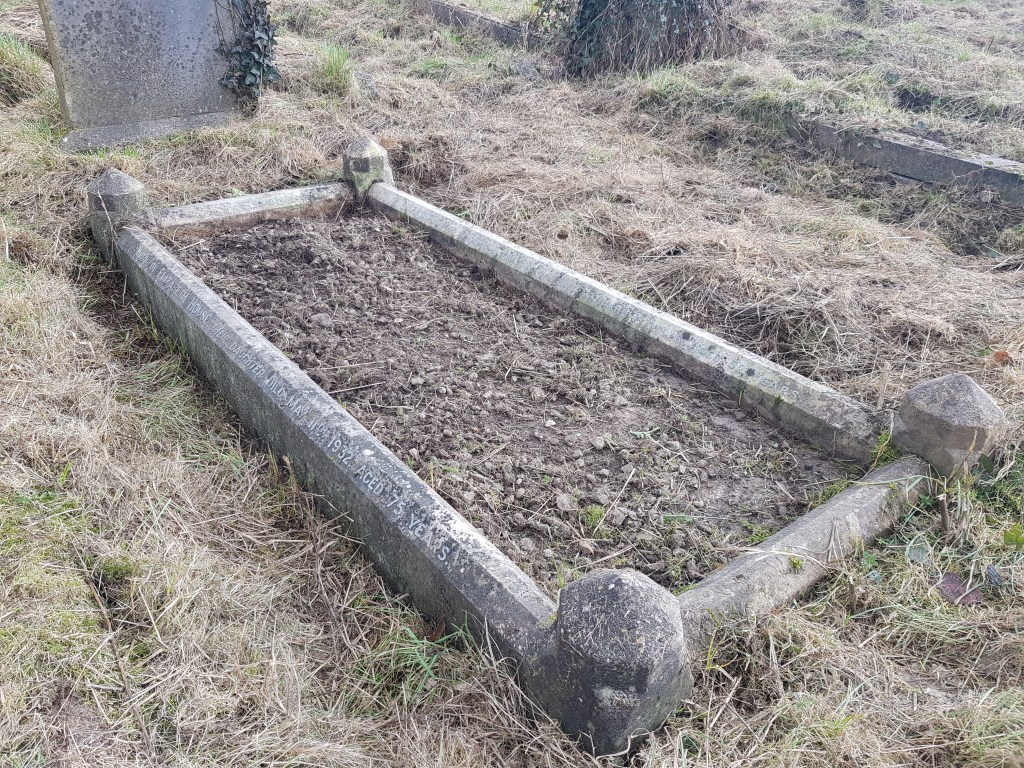
Ernest died at his home on January 13, 1952. He was buried in grave plot E7749 with his mother Emma who was living with them at 32 Bath Terrace at the time of her death in 1918; his wife Theresa who died in 1937 and his daughter Gladys and son-in-law (Paul’s parents).

Here is a selection of Hayball family photographs published courtesy of Paul.
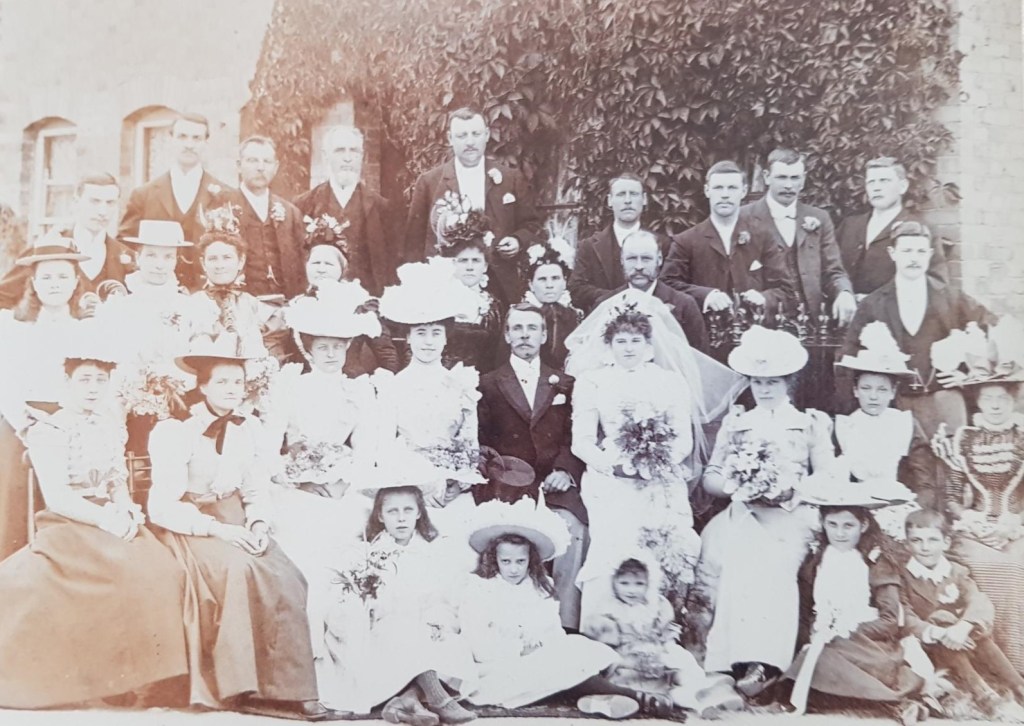
Ernest and Theresa’s wedding photo.

Back row 4th from left is Mathias William Beazley Hayball (father of the groom).

Middle row 6th from left standing behind the bride and groom is Emma Hayball (mother of the groom).

A family photograph celebrating Ernest and Theresa’s Silver Wedding Anniversary.

Left to right standing:- Doris, Leonard, Ernest and George

Gladys stands between her seated parents Theresa and Ernest
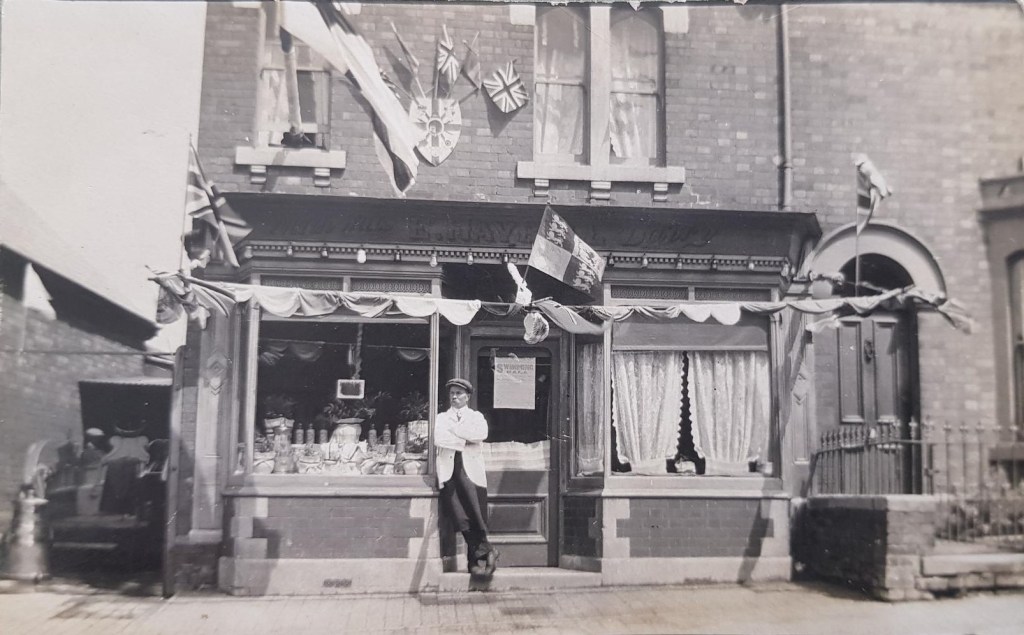
Ernest standing outside the shop in Hythe Road.
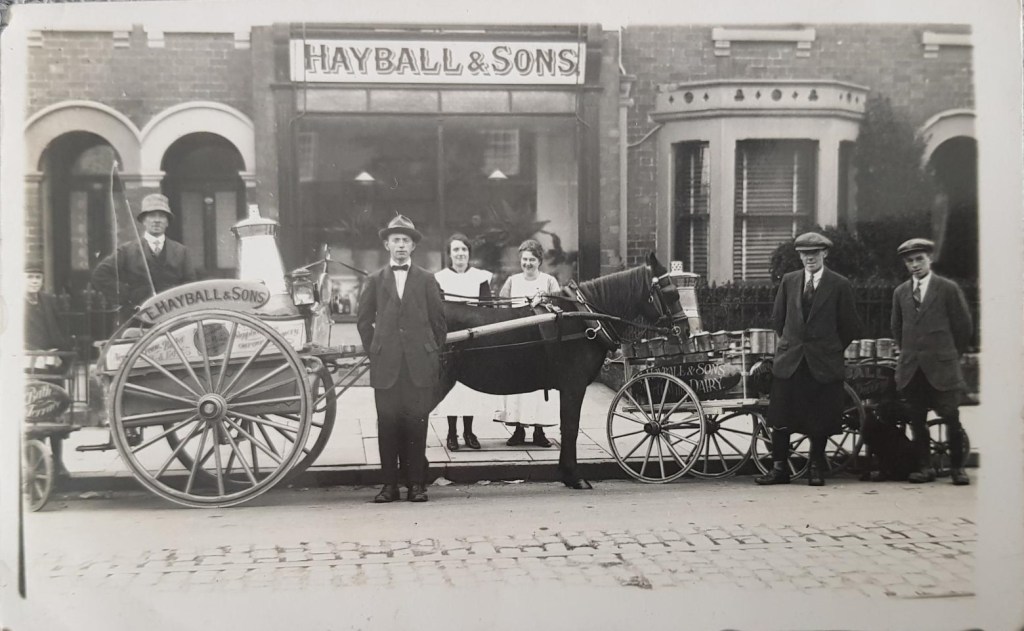
71 Faringdon Road

Ernest and Theresa Hayball

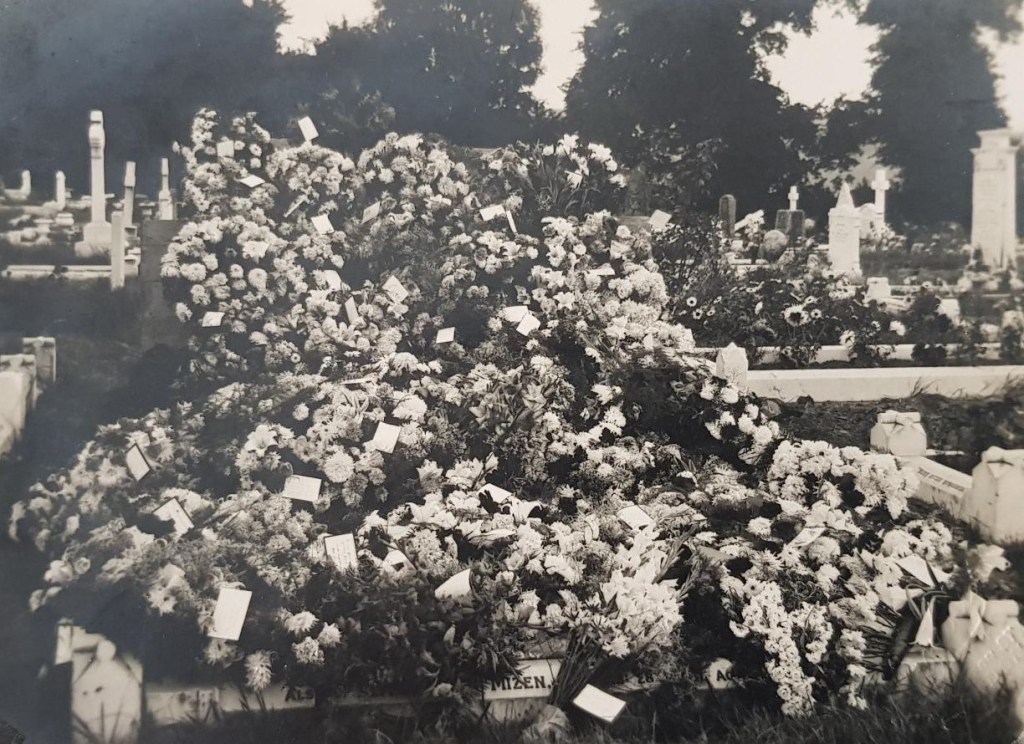
The Hayball family grave in Radnor Street Cemetery following the funeral of Theresa Georgina Hayball in 1937.
William Harvie and the amazing Multiple Cake Cutting Machine

The re-imagined story …

There are two highlights in the Swindon calendar for the children – Trip, when the Works shut down for the annual holiday and we go to the seaside, and the Children’s Fete, and I can never sleep the night before either of them.

Preparations for the Children’s Fete begins well in advance and I have first-hand knowledge of this as my father is on the Mechanics’ Institute Council and our whole family is involved.

The fete takes place in the GWR Park, the gates open at half past one. Tickets cost 3d for adults and 2d for children. The children receive two free rides on the steam roundabouts, a drink of either tea or oatmeal water and a piece of cake.

For weeks beforehand we save every penny, ha’penny and farthing we can; never have so many errands been run, so many jobs done about the home.

The familiar GWR Park becomes kaleidoscopic with rides and stalls and fairy lamps festooned around the Cricket Pavilion and the bandstand. Entertainments on the central stage take place throughout the afternoon; comedy acrobats and trapeze artistes and trick cyclists and one year there was even a troop of performing dogs. Mr Harvie is the chairman of the fete committee and director of amusements but this isn’t what he became best remembered for.

The event runs like a well-oiled machine, which is hardly surprising as it is organised by some of the most well qualified and experienced engineers in the railway works. And perhaps the greatest feat of organisation is the cake.

The quantity of cake required was enormous, amounting to no less than 2 tons 13 cwts. The job of baking it went to Mr E.P. Monk of Old Swindon who produces annually approximately 1,200 cakes weighing 5lbs each. Next comes the task of cutting the cakes into half pound slices, a job which had previously fallen to a handful of volunteers. It used to take 12 people approximately six hours to cut up and bag the cake. And then Mr Harvie invented the Multiple Cake Cutting Machine.

At this year’s event Mr Harvie’s new improved machine will be used for the first time. The machine, a dangerous looking contraption, is composed of crossed knives, balanced on spiral springs, which hover above each cake. The average speed of this new machine being no less than 6 cakes, or 60 half pounds per minute. The cakes are fed into the machine on 12 wooden trays by an endless band on rollers worked by the handle at the end of the machine, and here Mr Harvie has introduced another novelty in the shape of an electric bell, which is so adjusted that when the tray reaches the exact centre of the knife it strikes two levers and forms an electric communication with the bell, which commences ringing, and continues to do so until the cake is cut. The tray then passes on with the cake to make room for the next. When the tray on which the cake is cut reaches the end of the machine, it runs on an inclined board which carries it to the packers.

So exciting is the whole process that I think it should form part of the entertainments on the fete stage. Perhaps I’ll suggest that to Mr Harvie for next year.

My fete dress hangs on the back of the bedroom door. My hat, decorated with ribbons and flowers, sits on the dresser. I open the curtains a crack, it is not quite dark yet. Early tomorrow morning my father will join the others assembling the stage. I squeeze my eyes tightly shut. I must go to sleep, I must go to sleep.

children's fete cake cutting

The facts …

William Harvie was born in Islington, London in c1849. He began his career as a coach trimmer in Birmingham where he met and married his first wife, Susan Newman, at St Peter and St Paul’s Church, Aston. Susan was a widow with a young son. By 1871 the couple were living at Rushey Platt with Susan’s son Edward and two children of their own, Henry and Louisa. They would have a third child George William. The family lived at 15 Faringdon Street for a number of years and by 1891 William had been promoted to foreman.

He served as foreman over the women in the polishing shop, and during the 1890s he was responsible for organising the entertainment for the ‘annual tea of the female staff employed in the Carriage Department.’ He even performed a couple of humorous songs, said to have contributed to the event.

By the time of Susan’s death in 1906 they were living at 6 Park Lane. Two years later William married again. His second wife was Alice Elizabeth Turner. She died in 1921 at their home 92 Bath Road but does not appear to be buried in Radnor Street Cemetery.

William died in 1930. Details of his estate were published in various newspapers, including the Daily Express.

‘A Black Country working lad who, in his spare time, played in a theatre orchestra, became a railway foreman, and dabbled in stocks and shares during fifty years’ service, has died worth nearly £44,000. The workers of this great railway centre used to dub William Harvie of Bath road, Swindon, “the wealthiest workman in England,” but even they were surprised when his estate was announced, and the sole topic of conversation in the town was the large sum he left. He was 84 when he died last October, a widower, and intestate.’

A notice in the Western Morning News reported that he was instrumental in building the first saloon railway coach for Queen Victoria but there is no mention of his famous invention, the Multiple Cake Cutting Machine.

William is buried in plot D14a with his first wife Susan. They were later joined by their elder son Henry.

Susan and William Harvie

George House – a Swindon veteran

It is seldom we have the opportunity to read the words of an ordinary railwayman. When George House died in 1903 the Advertiser republished extracts from an earlier interview made in 1899.

The facts …

The Oldest GWR Employee

Reminiscences of Early Days in Swindon

As showing what a contrast there is between Swindon of today and of Mr House’s youth, we cannot do better than reproduce an interview with Mr House, which was published in the “Advertiser” in April 1899. A representative of this paper called upon Mr House in the latter part of April of that year, and found him reading his “Evening Advertiser,” and quite delighted to have a chat about his early days in Swindon. The interviewer commenced the conversation:-

“Good evening, Mr House; and is it true that I behold in you the oldest railway servant in the United Kingdom? A correspondent, in answer to a request in the ‘Advertiser’ so informs me?” I said when Mr House had assured himself that I was comfortably seated in his cosy room.

“Yes; I think so,” was his ready response. “I have a record of over 60 years’ service with the GWR Company. I started work with them in the construction of the line there under the supervision of Brunel.”

“When did you come to Swindon?” I queried.

“In 1838” was the reply, “there was no railway station here then, and no factory. When the coaches began to run from Bristol to Swindon the only place where passengers could alight was at Hay Lane.”

“You almost remember the open carriages then?”

“Yes, very well. And the coaches used to leave here at eight o’clock at night, and get to London some time in the morning. It was travelling in those days and no mistake. The ladies’ dresses used to be entirely spoilt by the smoke and dirt in one journey.”

“Now as to the GWR Works at Swindon, which was the first shop built?”

“Well, when I came here there was no factory at all. Not a stick nor stone. I assisted to fix up the first machinery. The D Shop, F Shop, and G Shop were the first shops that were erected.”

“How many men were employed here when you first came to Swindon?”

“Well, there were practically no men employed here till I and others came from Maidenhead, and Messrs Whitworth, of Manchester, fitted up some machinery. Then, for a start, there were not so many men employed as there are clerks now.”

“What a number of dead and gone faces such remembrances must bring before you. The chiefs of the Works, foremen and others, for instance.”

“Yes, I think I have a record in that direction, for I have worked under no less than five managers and eight foremen at the Swindon Works. I can tell you their names in a moment.”

“Who were the managers?”

“Well, first, there was Mr Sturrock, then Mr Rae, and Mr William Gooch (brother to Sir Daniel Gooch). And in more recent times the late Mr Samuel Carlton, and Mr G.J. Churchward.”

“You say you have worked under eight different foremen: who were they?”

Yes, there was Charles Hurt, Alf. Cootes, Peter Bremner, Dodson, Robinson, E. Dingley, William Booth, and A. Nash.”

“Of course, in those early days there was no Mechanics’ Institute. What recreation was provided for the workmen?”

“Oh, there used to be a small theatre in the Works – in the O Shop. Here a dancing class was held, and amateur theatricals were performed there. The Mechanics’ Institute was not built till several years later. Lord Methuen came down and laid the first stone, and a fete was held to celebrate the event. I remember well the Great Exhibition of 1851. All of us workmen who had joined the Mechanics’ Institution – in fact, every one of the employees of the Company who were working here then – were given an free railway pass to London to go and see the Exhibition. On another occasion when we were give a free trip to London, I took my wife and family of ten children. And when we arrived at Paddington, I hailed a cabby, who stared at my family, and remarked, “What’s this, sir, a whole school!”

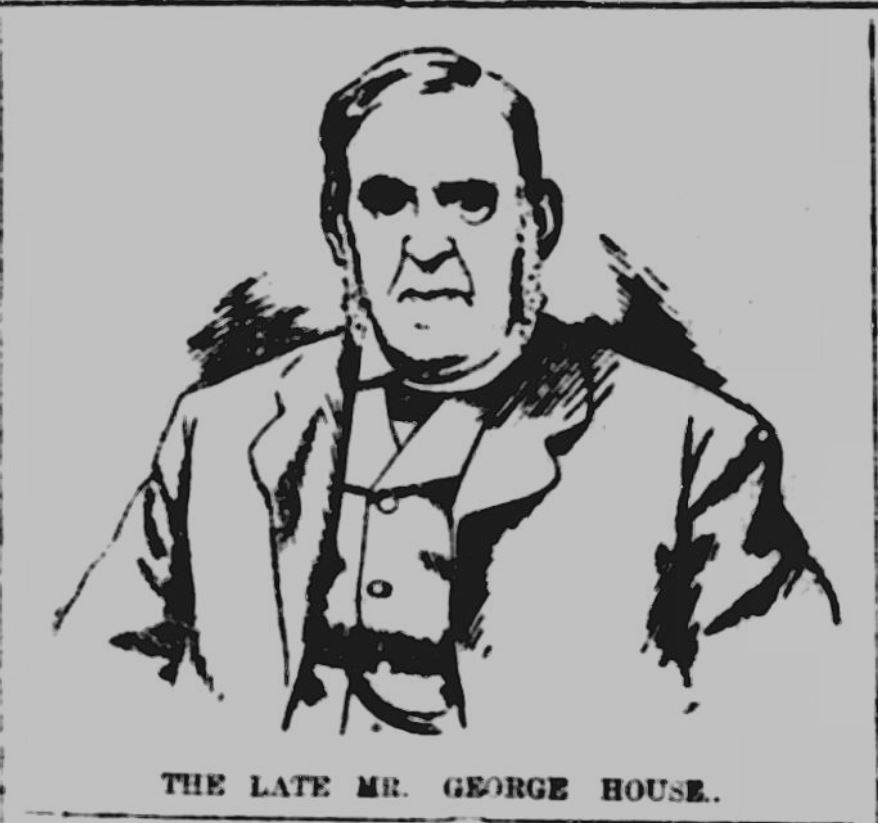
The Late Mr George House

Funeral Last Saturday

The funeral of the late Mr George House, of Taunton street, took place on Saturday afternoon amidst every sign of mourning. The cortege left deceased’s late residence shortly after 2.30 pm for St. Mark’s Church, where the first part of the sad service was impressively read by Canon, the Hon Maurice Ponsonby, vicar and rural dean, who also officiated at the graveside in the Cemetery, where a goodly number of persons had assembled to pay their last mark of respect to one who chief aim in life was the care of his less fortunate brethren. The body was enclosed in a beautiful casket of polished elm, with heavy brass furniture, the breast plate bearing the following inscription:-

George House

Died January, 1903,

The funeral arrangements were carried out by Mr H. Smith, of Gordon Road.

Extracts from The Swindon Advertiser, Friday, January 16, 1903