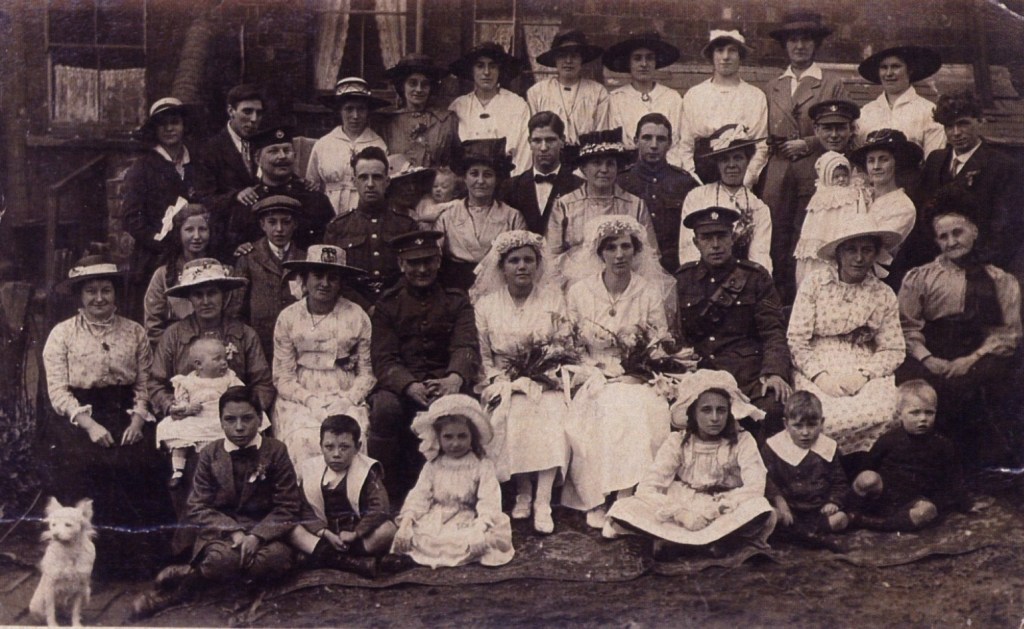
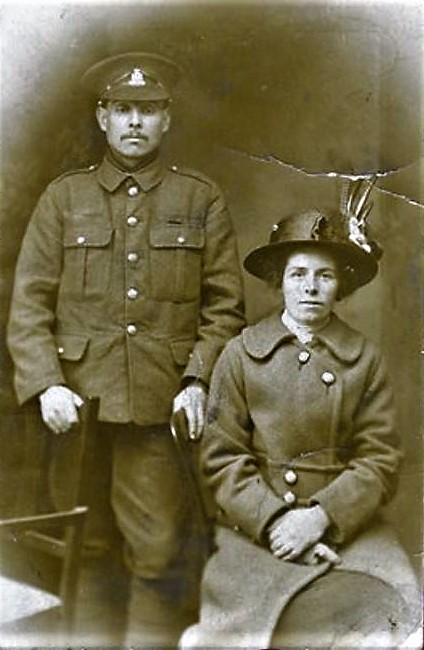
There are two surviving photographs taken that day and in each of them our Elsie looks so sad. You shouldn’t look sad in your wedding photographs – I keep thinking. People say it’s the happiest day of your life. And she looked so beautiful as well.
It was a proper family wedding. All the aunts and uncles were there and three little babies. My was little Joyce noisy, and would she keep her bonnet on? Granny’s dog was better behaved!
Six men in uniform were there that day, including the two grooms. Bert came home, but Elsie lost him anyway. Perhaps she already knew that then, on the happiest day of her life.
The facts …
Herbert Frederick Marfleet, the son of Benjamin James Marfleet a sergeant in the 2nd Dragoon Guards, was born in the Punjab in 1891. By 1901 the family had returned to England and Benjamin was working as a Railway Shop clerk in the GWR Works. On leaving school Herbert followed his father into the railway factory as an apprentice coach finisher.
In 1915 Herbert joined the Royal Army Service Corps serving first in Egypt. In 1917 he briefly returned home to Swindon to marry his sweetheart Elsie Morse. Elsie was the eldest of William and Agnes Morse’s seven children. By 1911 Elsie’s father had died and Elsie, aged 18, was working as a finisher in a clothing factory. This could have been either Cellular Clothing in Rodbourne or John Compton’s in Sheppard Street. The family lived at 4 Albion Street where these wedding photographs were taken in the back garden in 1918 when Elsie and her sister Agnes married in a double wedding. Agnes’ bridegroom was a Canadian by the name of Hooper Gates. Hooper survived the war.
Immediately after the wedding Herbert returned to his regiment in Salonika where he contracted malaria. He was discharged from the army and returned to Swindon in the spring of 1919 but died just a few weeks later.
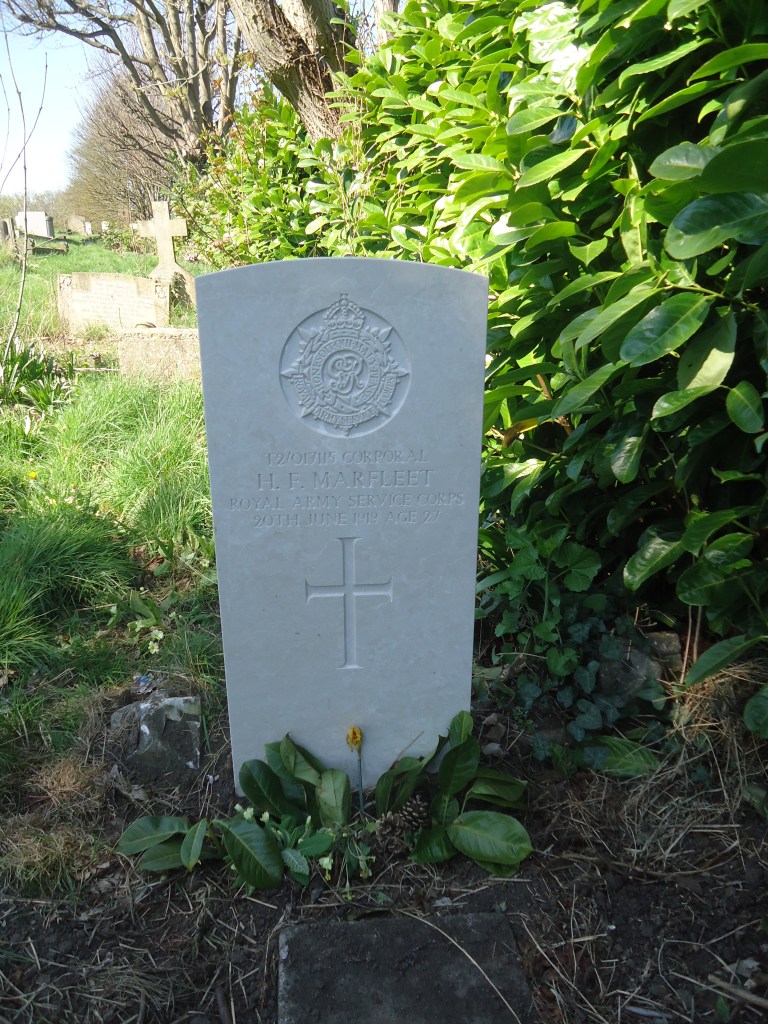
It was at first thought that he lie in an unmarked grave in the cemetery but it was later discovered that he was buried with his aunt and uncle, Matilda Hammett and Edward Johnson. He was, however, entitled to a Commonwealth War Graves official headstone as his death was a direct cause of his military service. The official application process began in May 2011 and the headstone was erected in June 2015. Guest of honour at the dedication ceremony was 98 year old Joyce Murgatroyd, his only known living relative, who as a baby is pictured in the wedding photograph.
When William ‘Wally’ Richardson died suddenly in 1911 he was known to have a collection of football memorabilia including his own medals and team photographs of Swindon Town FC. Wally’s football career as left back with Swindon Town began in 1890/1 and spanned the teams’ transition from an amateur club to a professional one in 1894/5.
William ‘Wally’ Richardson was born in Edinburgh in 1869 and came to Swindon in around August 1889 – not as a professional footballer but as an engine fitter and a job in the GWR Works. At the time of the 1891 census he was lodging with Charles E. Chappell and his family at 17 Marlborough Street and was already playing with the Swindon team.
The 1911 census taken shortly before Wally’s death records him living at 8 Marlborough Street with his wife Kate. The couple had been married for 20 years. Sadly, two of their three children had died in childhood.
On Wednesday afternoon the mortal remains of the late Mr William Richardson, who was a popular member pf the Swindon Town F.C. in the old amateur days, and for the first few seasons after the Club embraced professionalism, were interred at the Swindon Cemetery amidst many tokens of sympathy and respect.
“Wally” Richardson, as he was known to his intimates, was by birth a Scotsman, and it was in his native City of Edinburgh that he served his apprenticeship as a fitter. Twenty two years ago last May he came South, and after working for the GWR Co. at Newton Abbot, until August of the same year, he was transferred to Swindon. As soon as he came to the railway town, Mr Richardson commenced playing for the Town Football Club, and very soon made himself indispensable to the team in the left full-back position. Wally Richardson’s first season with the Club commenced in 1890, and when the Club became a professional Club, he signed forms for them and continued playing for several seasons. It was exactly 19 years ago, last Easter that “Wally” went down to Warminster to play in a six-a-side contest for a silver shield. The Swindon party won the shield, and, if we remember rightly, the trophy was given to the Swindon Schools’ League to be played for annually by the boys. Mr. Richardson had a most interesting collection of photographs of Swindon football teams for various seasons, and the medals won in his favourite pastime. Everybody regarded “Wally” as an excellent sportsman in the best sense of the word, and his rather sudden death on Saturday, after an attack of dropsy, will be regretted by a large following of friends.
Extracts from the Swindon Advertiser Friday July 7, 1911.
William ‘Wally’ Richardson was buried on July 5, 1911 in plot E7317, a grave he shares with his daughter Daisy who died in 1903.
Continuing a series of articles in remembrance of Swindon’s sons who served in two world wars.
Frederick Clarence Whatley was buried in Radnor Street Cemetery on October 16, 1918 but when I discovered his cause of death it raised many questions.
Frederick was born on February 8, 1899, the second son of William George Whatley, a cost clerk in the GWR Works, and his wife Emily, and grew up in the Broad Green area of Swindon. Frederick started work as a Machine Operator in the Locomotive Department of the Works on April 30, 1913, transferring to the Carriage and Wagon Works on February 21, 1914.
Frederick joined the Royal Navy in July 1917 and was assigned to HMS Campania, a seaplane training and balloon depot ship. In March 1918 he was transferred to the RAF and served at No 1 School of Navigation and Bomb Dropping (Stonehenge) as a 3rd Class Air Mechanic.
Frederick died in a diabetic coma on October 12, 1918 at the Fargo Military Hospital. He was 19 years old.
Although diabetes was identified in the 17th century, no effective form of treatment was available until the discovery of insulin in the 1920s. Two Canadian scientists, Frederick Banting and John Macleod, were awarded the Nobel Prize in 1923 and there were many others experimenting on a treatment around the same date. Diabetes is a condition that remains a bar to military service today.
Did Frederick know he had diabetes? Was his condition recognised in 1917 and if so how did he pass a medical? Unfortunately his military records do not survive. The CWGC records state that he died from a chill and family history researchers once believed he died in a flying accident, however, his death certificate tells the true story.
Frederick is remembered on a memorial plaque that was once displayed in the Carriage and Wagon Works and now hangs in Steam Museum.
He is buried in a family grave in Radnor Street Cemetery.
Mr King held a whole school assembly the day the news was published. William Hall had been awarded the DSM, the Distinguished Service Medal for Honours for Services in Action with Enemy Submarines.
William Hall hadn’t been a pupil at Jennings Street School. By the time the school opened he was working as an Engine Fitter ‘inside.’ It was this job that made him ideally suited for the role of Engine Room Artificer.
We all knew the Hall family. They lived at 77 Jennings Street. My auntie lived opposite them at number 4. Everyone knew everyone in Rodbourne in those days. We all shared in the glory of one of our own being so honoured.
Less than a year later we all mourned his death as well. He wasn’t killed in battle. To expect another act of heroism from one man would be too much. William Hall died of pneumonia and pleurisy – another form of drowning, only not at sea.
Perhaps Mr King held another assembly. I don’t know, I had left school by then and was waiting to start my own apprenticeship in the Works. I was too young to serve, much to the relief of my mother.
By 1918 everyone knew of someone who had died in the war. It was like that in Rodbourne. But not everyone knew someone who had won the DSM.
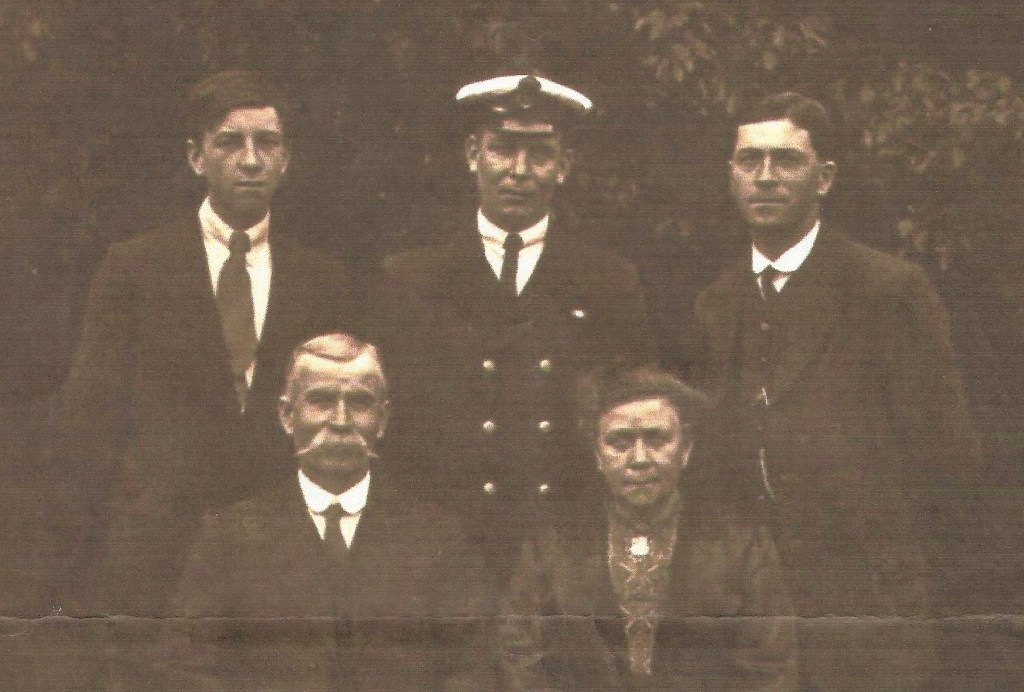
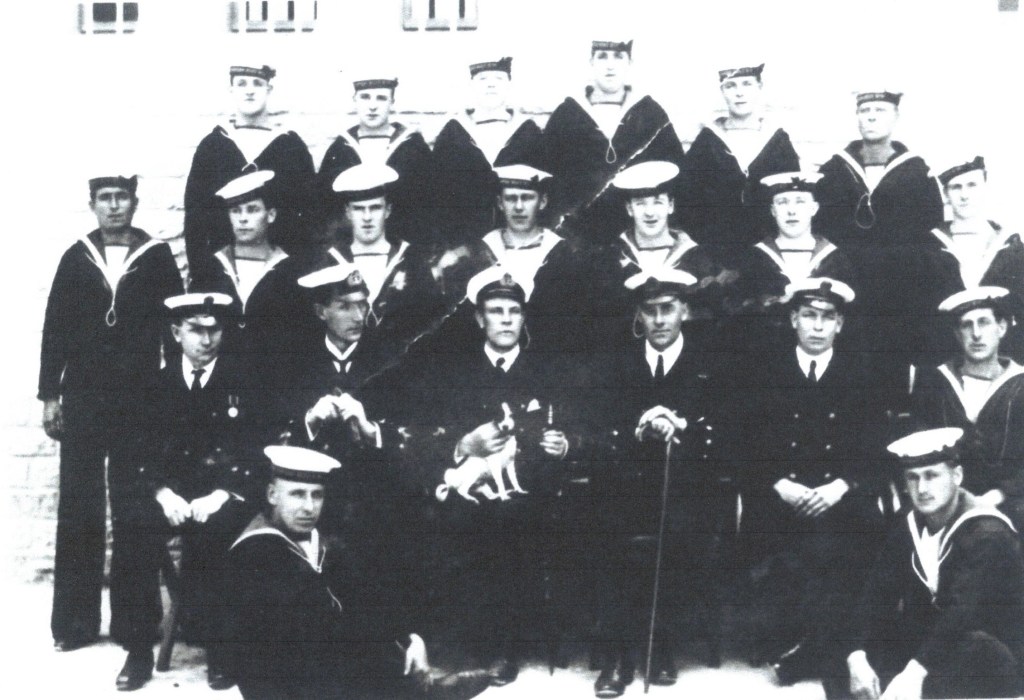
L to r Thomas Redvers Hall, William Jasper Hall and Frederick Charles Hall. Seated are their parents William Charles and Sarah (nee Kingdon) Hall.
The facts …
William Jasper Hall was born on November 6, 1888, the third child and second son of William Charles Hall and his wife Sarah. At the time of the 1891 census the family were living a 30 Jennings Street, Rodbourne on the very doorstep of the Great Western Railway Works.The family continued to live at various houses in Jennings Street.
William Jasper followed his father into the Works, entering the GWR Employment and a 7 year Fitters apprenticeship on his 14th birthday, November 6, 1902.
He enlisted in the Royal Navy on March 20, 1916 and completed his training period on the Victory II as an ERA (Engine Room Artificer) on April 28, 1916. His character and his ability were both described as Very Good.
William Jasper Hall seated second on right
His naval records reveal that he served on HMS Cormorant, a receiving ship at Gibraltar where he joined the Freemasons at the Masonic United Grand Lodge in 1916.
In September 1917 William was awarded the DSM (Distinguished Service Medal) for Honours for Services in Action with Enemy Submarines.
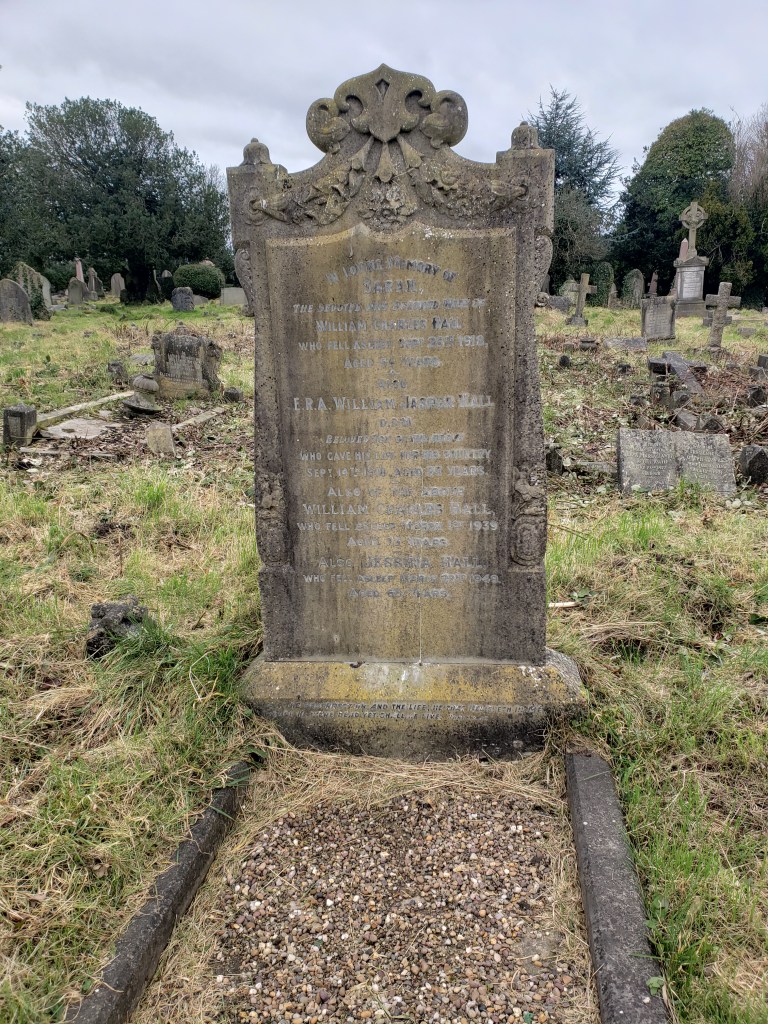
By 1918 he was back on Victory II, a shorebased depot for Royal Navy Divisions at Crystal Palace and Sydenham. From here he was admitted to the Royal Haslar Hospital in Gosportwhere he died on September 14, his cause of death pneumonia & pleurisy.
Family recollections are that William caught the Spanish Influenza with a poignant postscript to the story. His mother Sarah visited the hospital where she was able to care for her son during his final days. Sadly, Sarah contracted the ‘flu and died two weeks after her son.
William was buried in plot E7464 on September 19. His mother Sarah was buried in the same plot on September 28. William Charles Hall died in 1939 and joined his son and wife. Jessina, William Jasper’s elder sister, died in 1949 and was buried in the plot with her brother and her parents.
Family photographs are published courtesy of the Hall family.
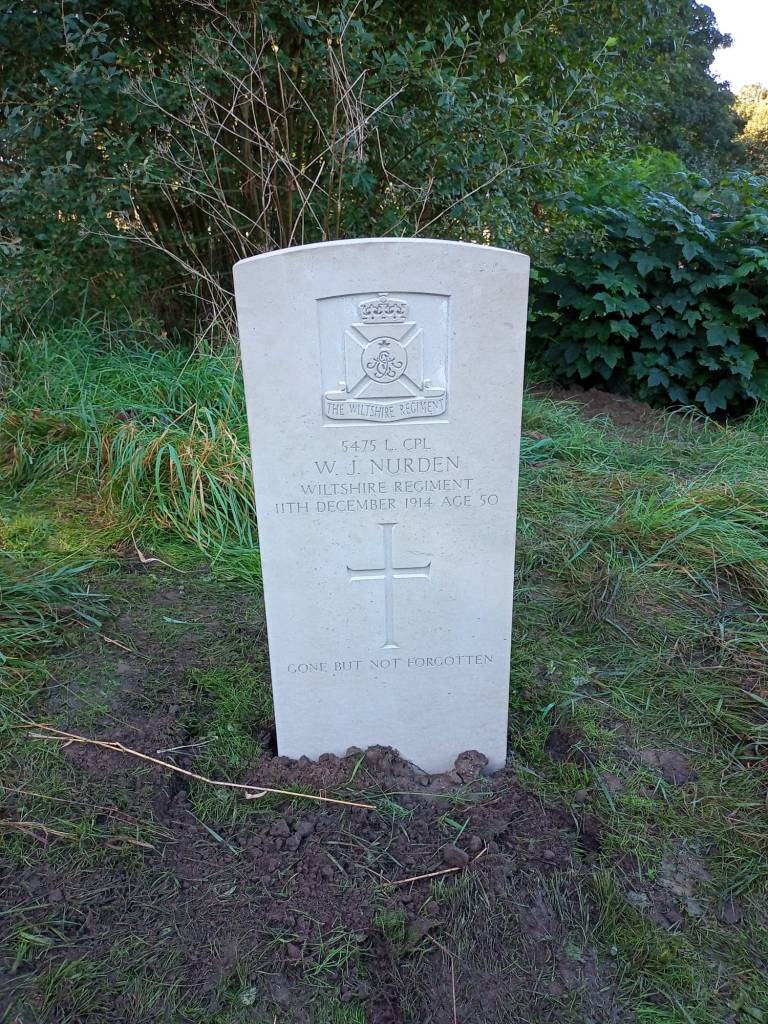
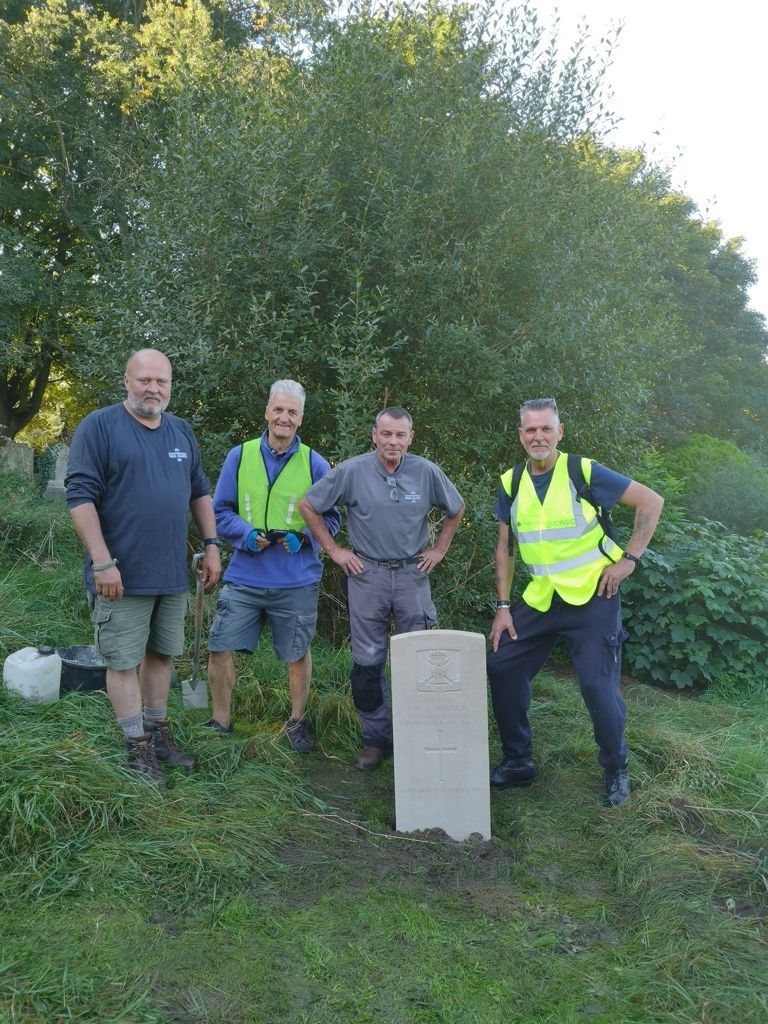
It was our pride and pleasure to mark the installation of the 104th CWGC official headstone in Radnor Street Cemetery in September 2021.
The headstone marks the grave of William John Nurden, a former blacksmith’s striker in the Great Western Railway Works, Swindon. On December 11, 1914 he was killed whilst serving as a Lance Corporal in the Wiltshire Regiment. He was working on the Amesbury and Military Camp Light Railway (also known as the Bulford Camp Railway) at Newton Tony when he was killed crossing the railway line whilst on duty.
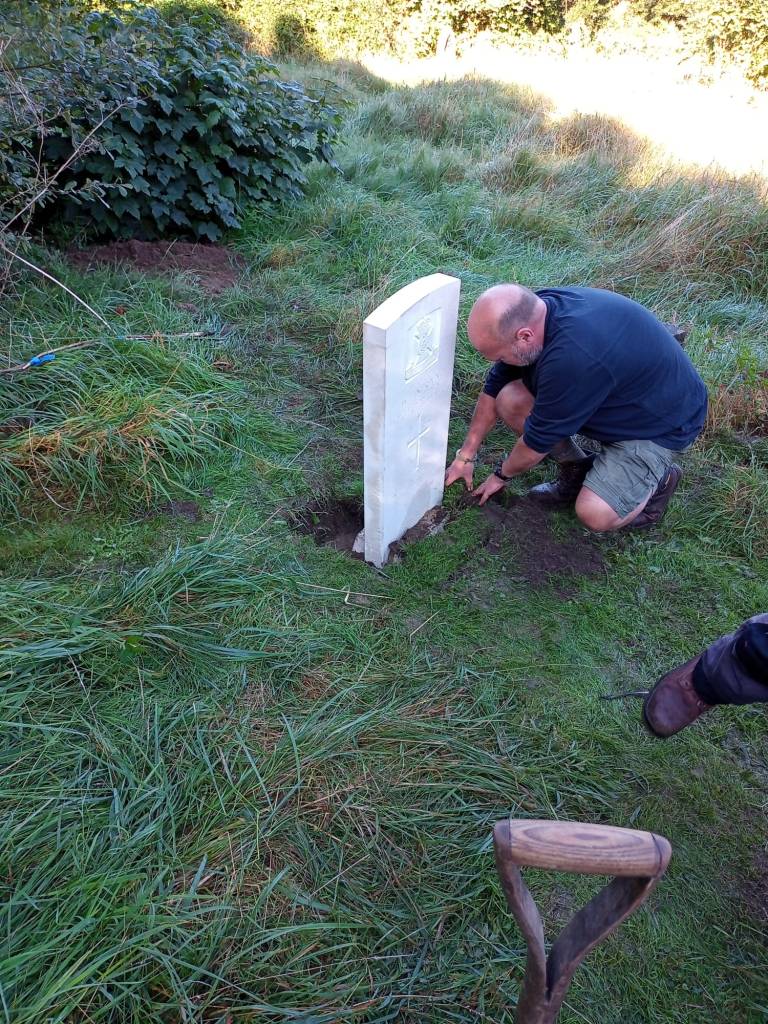
A team from the Commonwealth War Graves Commission installed an official headstone on the unmarked grave of William John Nurden, more than 105 years after his death.
Members of his extended family joined us at the Service of Remembrance in November 2021. We hope you will join us for the Remembrance Service this year during which a plaque dedicated to Mark Sutton will be unveiled. The service takes place around the Cross of Sacrifice at 2 pm Sunday November 12.
Radnor Street Cemetery volunteers with the CWGC team and the newly installed official headstone
During this month of remembrance I will be telling the stories of those buried in the cemetery who died as a result of their military service.
Originally published on January 30, 2022.
The re-imagined story …
Who would have thought the country could be so excited at the prospect of going to war? Perhaps it was the heat – it was unseasonably hot, that second week in August 1914.
Thousands of soldiers, some said more than 17,000, arrived in Swindon with as many as five or six soldiers billeted in one house. Even the school buildings were temporarily used as barracks, delaying the return after the summer holiday, much to the excitement of the children. Common sense did eventually prevail and they were soon returned to the classroom.
The normally quiet streets of Swindon were transformed by military movements – soldiers on route marches and long columns of motor lorries and ambulances.
The excitement was palpable – after all, it would all be over by Christmas. What an opportunity to travel for the young men who only ever expected to see the inside of the Works. No one could have ever imagined how it would all play out, the crippling injuries, the dreadful death toll, the loss.
The shops were busy, even though tradesmen were encouraged to supply their regular customers with no more than their usual requirements. Panic buying was discouraged but those who had the wherewithal stocked up on essentials.
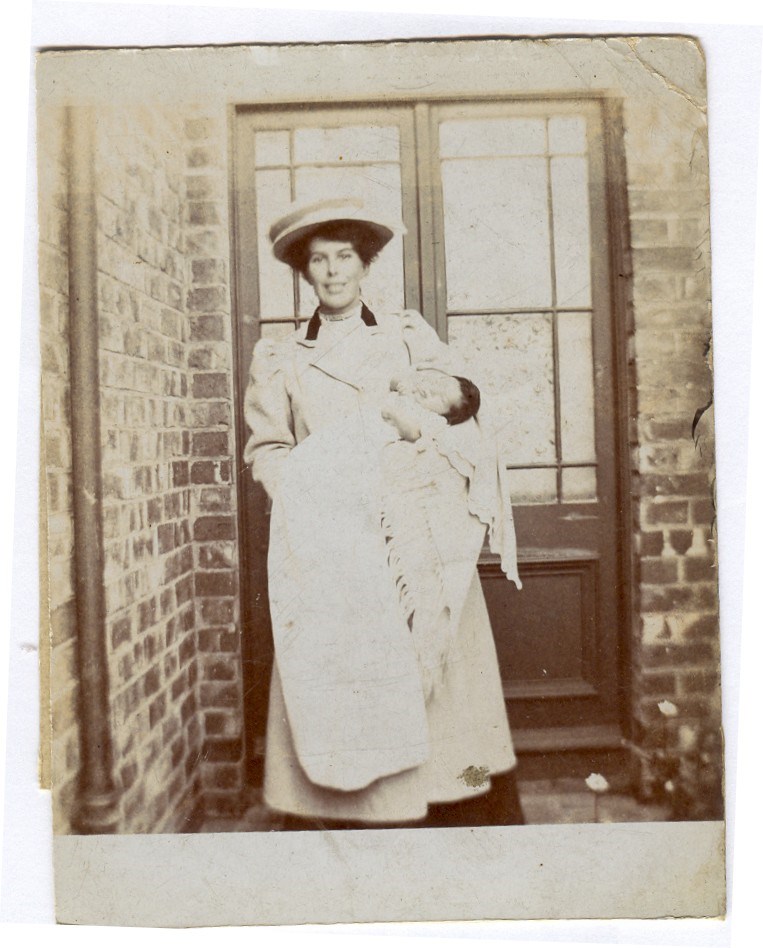
And even the photographic studios were busy, the appointment books full day after day. Young lads having their photographs taken with friends as they went on their way to enlist at the Recruitment Office. Sweethearts photographed to mark a hastily announced engagement and the promise of a wedding. A young mother and baby whose photograph would nestle in a father’s top pocket, gazed on in some filthy trench on the Western Front.
But William Pitt was different. He had already seen war at first hand. He had served in India and South Africa. A look in his eyes said he wanted no more of it.
Celia wore her best coat, the one with the big buttons, and her hat with the feathers and the bow. They both stared into the camera. After all, it would all be over by Christmas.
The facts …
When William James Pitt died in 1917 he had served his country well, but of course that didn’t mean he had a fine funeral and a headstone on his grave – not then. But a hundred years later his record of service was rediscovered and the Commonwealth War Graves Commission added him to their records and erected a headstone to commemorate his sacrifice.
William James Pitt was born in 1871 in Newport, Monmouthshire. He married Celia Sarah Davis on November 25, 1905 at the Register Office here in Swindon. William worked as a Boiler Maker and Labourer in the Loco Works and the 1911 census shows the couple living at 12 Hawkins Street, Rodbourne with their four young children. They went on to have another two children.
William enlisted in Swindon on October 20, 1914. He was a member of the National Reserve having previously served in the Royal Warwick Regiment. He had served in India for 5 years and 4 months; South Africa 1 year and 9 months and Bermuda 11 months.
He took ill while serving as a railway guard. His medical records include the following report:
‘Originated at Newton Tony April 1915 History of repeated colds during past winter, April 1915 16 days in Hosp: with so called ‘influenza’ after this kept losing flesh, cough did not leave him July 11th again reported sick, admitted to Hosp: with pleurisy, tuberculosis of lung developed caused by ordinary military service exposure whilst on duty. Has cough, pains in chest, rapid pulse, loss of weight & night sweats.‘
He was suffering from Tuberculosis (lung) & Pleuritic adhesions and was declared unfit for militaryservice. The cause of his illness was exposure & getting constantly wet and not caused by active service or climate, but by ordinary military service (exposure whilst on duty). He was discharged in September 1915 in consequence of being no longer physically fit, having served 346 days.
Celia and baby
The family history information on the Ancestry website tells how William’s daughter Violet remembered playing round her father’s feet in the kitchen, making dens under the blanket that covered his knees. She remembered that when he came back from the war he was ill and had to live in a special shed in the garden of 21 Hawkins Street.
William died on July 17, 1917 at 21 Hawkins Street. He was 45 years old. The cause of death was Pulmonary Tuberculosis. He was buried in Radnor Street Cemetery on July 21 in plot B1854, a public or pauper’s grave, which he shares with three other unrelated persons. Their names are inscribed at the bottom of the Commonwealth War Graves headstone.
Celia later worked as a cleaner at the Civic Offices in Euclid Street but how she managed in those early post war years with six children to raise alone has passed out of family memory. She later lived at 142 County Road, opposite the football ground. She died there in 1947 having survived yet another world war.
Charles Edward Stroud was born on March 8, 1894 the son of William Henry Stroud, a storekeeper in the railway factory, and his wife Elizabeth Mary. William and Elizabeth had a large family of nine children but by the time of the 1911 census only four were still living.
We can find out a lot about Charles’ working life thanks to the UK Railway Employment Records 1833-1956 available on Ancestry.
Charles began work in the railway factory on June 1, 1908 as a 14 year old office boy. On December 6, 1909 he transferred to R shop to begin a five year fitting and turning apprenticeship. These records were meticulously updated and the last entry referring to Charles reads: War – Military duty, last at work 29/8/1914. Apprenticeship terminated.
Sadly, we know little about Corporal Stroud’s military career. You may wonder why so many of the WWI servicemen’s’ records are lost. In September 1940 the War Office repository in Arnside Street, London was hit during a bombing raid, destroying more than half the military records stored there. What remains of these records (referred to as the ‘burnt documents’) are available to view on microfilm at the National Archives and also online at Ancestry and Find My Past. There is roughly a 40% chance of finding the service record of a WWI soldier. But before you get started on your research why not visit Local Studies at Central Library, Swindon where the staff will be able to help you.
The go-to-book for information on Swindon men who served is Tell Them of Us by Mark Sutton. We have a few copies for sale, available during our cemetery walks. (Our next walk is Sunday October 29, meet at the chapel for 2 pm).
Corporal Charles Edward Stroud served with the 2nd Battalion of the Wiltshire Regiment. He died of wounds on March 6, 1916 at the General Hospital Cambridge. His body was returned to 41 Stanier Street, Swindon and the funeral took place on March 11. He is buried in plot D1501 with his parents. He was 21 years old.
During September I frequently travelled by train from Swindon to Gloucester. It is a relatively short journey, some 45 minutes, through attractive Gloucestershire countryside stopping off at the small stations of Kemble, Stroud and Stonehouse and passing through the Sapperton tunnel.
Sapperton tunnel is, in fact, two tunnels separated by a short gap. Work began in 1839, a difficult building project not finished until 1845. Maintenance work was (and continues to be) ongoing. Back in the day a terrifying place in which to work with poor visibility on a busy rail route.
In 1896 an accident occurred resulting in four fatalities. Was this the accident William Beames witnessed, the effects of which caused his own tragic death later that same year?
This newspaper report contains some disturbing descriptions.
A Suicide’s Death – Tired of Life
Shortly after the above, Mr Browne held an inquest at the Carpenter’s Arms, Gorse Hill Swindon, on the body of William Beames, aged 48 years, a platelayer on the GWR Works, of 86 Bright Street, Gorse Hill. Deceased, it may be remembered, attempted to commit suicide by cutting his throat with a pocket knife at Wootton Bassett, in August last, and although the wound healed up he died on Saturday last from other complaints, after lingering for upwards of three months, his death being accelerated by his own rash act. Mr A. Bowker was chosen foreman of the jury, and the following evidence was taken:
P.S. Goddard, stationed at Wootton Basset, said that on the 17th August last, at about a quarter to seven o’clock in the morning, deceased came to his house and made motions to go into his house. He could not speak. Witness removed an handkerchief he was wearing, and then saw a tremendous gash in his throat. Dr Wride happened to be passing at the time, and witness called him in. The doctor dressed the wound, and gave him some warm milk with a little whisky in it, afterwards telling witness to take the man to the hospital. He (witness) obtained a brougham, and conveyed Beames to Swindon Victoria Hospital, where he was refused admission. Witness then took the sufferer to his home at Gorse Hill. He had previously asked him where he lived, but Beames could not speak, and therefore wrote his name and address on a piece of paper. Witness asked him why he did such a foolish thing, and Beames replied, “Because I am tired of this world.” Afterwards deceased was taken to the hospital at Stratton Workhouse. Witness went the next day to a field where Beames said he had been when he cut his throat, and there saw a large quantity of congealed blood. Witness found a pocket knife in his pocket, which he now produced.
Sarah Beames, wife of deceased, who appeared to be very ill, said her husband had been in a low depressed state since his father’s death in June last. Deceased was a platelayer in the GWR Works. Deceased was also troubled about a platelayer who was killed on the line at Stroud some time ago; he worked in the same gang. Deceased left home on Friday, the 14th August, and she heard no more of him until he was brought home on the following Tuesday. He was in the Workhouse Hospital eleven weeks, and then he was brought home where he was attended by a doctor.
Mr Thomas Hartigan, assistant to Dr Rattray, said he attended deceased up to the time of his death. Previous to that he had been attended by Drs. Wride, Pearmen, and Muir, alternately. He was suffering from a wound in the throat, and bronchitis. He died of dilated heart caused by the bronchitis, accelerated by the injury to his throat. The wound in the throat had quite healed up. The immediate cause of death was heart disease.
The jury returned a verdict accordingly.
Swindon Advertiser Saturday December 19, 1896.
William Beames was 48 years old. He was buried on December 17, 1896 in grave plot C199. This is a public grave. He was buried with five other unrelated persons.
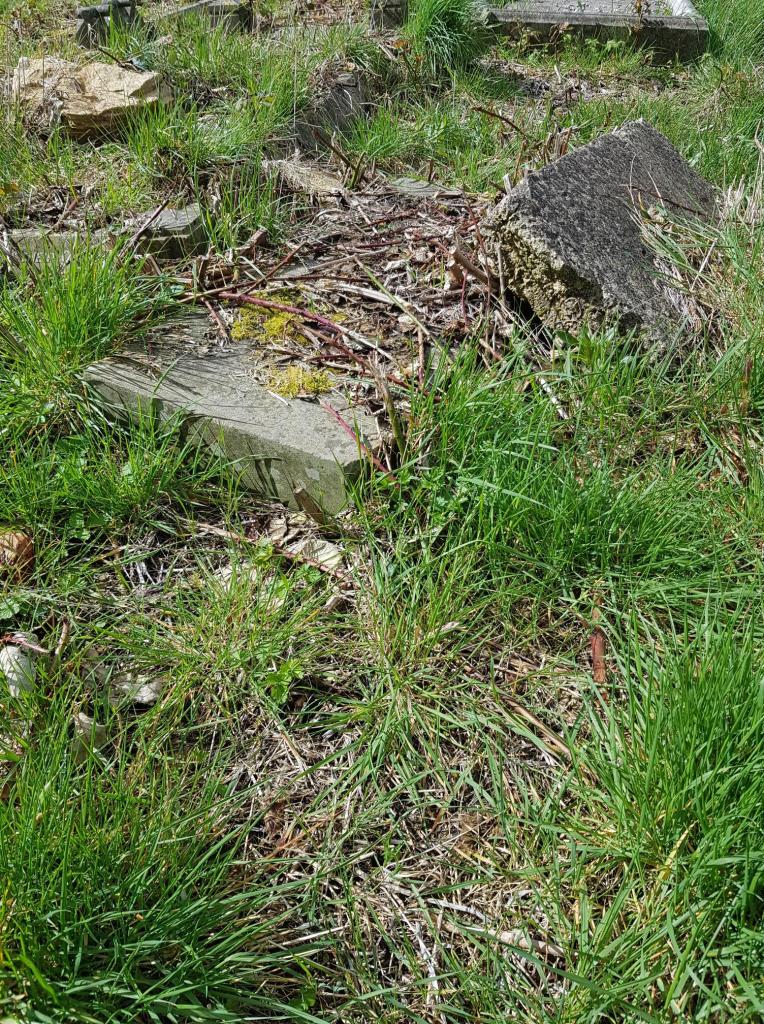
If there was a memorial to Peter Bremner, this is where it would be
The common belief is that the early railwaymen who arrived in Swindon in the 1840s are mostly buried in the churchyard at St. Mark’s.
There are a great many burials in that small churchyard; so many that by the 1870s there were extreme concerns that burial space was fast running out. Drainage of the churchyard was also a problem, restricting usage of a large area. All this contributed to the long, ongoing debate about the need for a new burial ground. Eventually resolved in 1880, Radnor Street Cemetery opened in 1881 and soon became the last resting place of many of the old railwaymen.
There are many of their stories told here on the Radnor Street Cemetery blog; this is that of Peter Bremner.
Peter Bremner was born in Dundee in about 1819 and arrived in Swindon around 1848. It is possible the family came straight from France where a daughter Erskine was born in 1847. For more than 35 years Peter lived at 5 Taunton Street at the very centre of life in New Swindon.
Death of a railway official – Our readers, especially the old hands of the GWR Works, will hear with regret of the death of Mr Peter Bremner, who has occupied the position of foreman for many years past, he being one of the earliest arrivals on the establishment of the works. His kindly disposition made him many friends. The funeral will take place this (Saturday) afternoon, at 2-45, and will no doubt be largely attended.
The Swindon Advertiser, Saturday, September 18, 1886.
Funeral of Mr Peter Bremner – The funeral of the late Mr. Peter Bremner, of 5, Taunton Street, New Swindon, took place on Saturday afternoon, admidst many manifestations of the respect and esteem in which deceased was held. For 40 years Mr. Bremner, who had reached the age of 67 years, had been in the service of the GWR Company, and during a great part of that time as foreman, he, at the time of his death, being foreman of the G (Millwrights’) Shop, GWR Works, New Swindon. As a foreman, the deceased was respected by all above and below him, those under his charge especially valuing his good qualities, and he had also obtained the esteem of a large circle of friends. That this was the case was evidenced by the fact that nearly 400 persons joined in the funeral procession on Saturday, and the route was lined with spectators. Mr. F. Hemmings, of Fleet Street, New Swindon, was the undertaker, and he carried out the funeral arrangements in the most satisfactory manner. The coffin was of polished oak, with black furniture, and bore the following inscription:- “Peter Bremner, died September 15th, 1886, aged 67 years. Through the Cross to the Crown.” On the handleplates were the words “Praise the Lord.” A number of beautiful wreaths were contributed, including one from Mrs. Swinhoe, one from Mr. S. Carton and Mr. J. Haydon as “a tribute of respect and esteem from the managers for an old and valued servant,” from Mr. and Mrs McCulloch, Mr and Mrs Batchelor; from the fellow foreman of deceased in the Locomotive Department of the GWR Works; and amagnificent artificial wreath supplied by Mr. Hemmings, from the workmen employed under the deceased. On a card attached to this wreath was the following inscription:- “In affectionate remembrance of Peter Bremner, the much respected foreman of the G Shop, GWR Works, Swindon, this wreath is placed by the workmen formerly employed under him as a mark of the general respect he merited.”
The chief mourners were:- Mr. J. Bremner (son of the deceased), Mr W.D. James (grandson in law) and Mr. E.C. Riley. In the procession were included many of the deceased’s fellow foremen, about 160 of the employes in the G Shop, and many friends. The procession included three carriages in addition to the hearse. The funeral cortege left disceased’s residence at about three o’clock, and proceeded to St. Mark’s Church, where the first portion of the burial service was conducted by the Rev. H.W. Boustead. By way of Church Place, and Cambria Bridge, the procession marched to the cemetery. There was a large number present. The remainder of the burial service having been read, the body was lowered to its last resting place, and after a final look at the coffin the procession returned to Taunton Street, where its members dispersed.
Extracts fromthe North Wilts Herald, Friday, September 24, 1886.
Peter Bremner died aged 67 years at 5 Taunton Street. His funeral took place on September 18 when he was buried in grave plot A1057 with his wife Annie who had died in February of that same year.
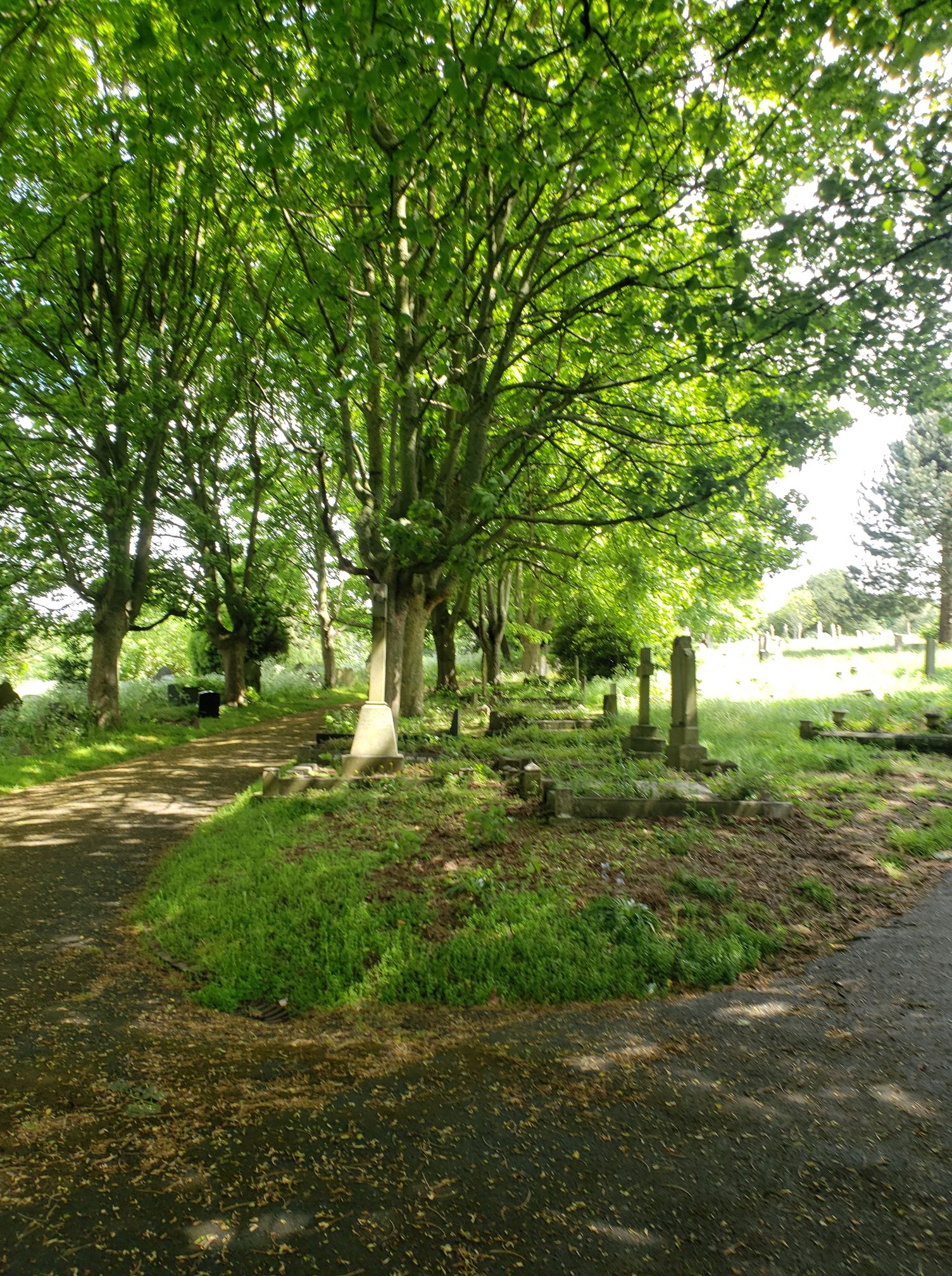
Did Emily stand at this spot? Did she watch the dappled sunlight dance across the headstone? But of course the tree may have been a mere sapling then, like her son who died aged 17. Perhaps she had no time to stand and stare, what is there to ponder on when a son is taken before his time. The headstone may have been a later addition, raised after both she and her husband Fred had gone. There were a lot of words written about Fred (a well-known Swindonian) when he died.
What is there to say when a 17 year old son has been taken. Nothing that is of any comfort.
Death of Mr Fred Tegg
A Well known Swindonian
We sincerely regret to announce the death of Mr Fred Tegg, which took place quite suddenly at his residence, Lyndhurst, Clifton Street, Swindon, on Sunday.
Deceased was in his usual health and attending to his duties last week, and the end came quite suddenly. He was apparently quite well on Christmas Day and on Sunday morning, but in the afternoon of the latter day he was taken suddenly ill, and passed away about half-past two
Mr Fred Tegg was a typical self-made man. Born at Bucklebury, in Berkshire, he came to Swindon some forty years ago, and started work as a carpenter in the GWR Works. By his indomitable courage, he rose to a higher post, and then, coming under the eye of the late Mr Samuel Carlton, then Manager of the GWR Works, he made further headway, being a good shorthand writer. In those days shorthand was little known, and it may be here recalled that the present Mayor of Swindon (Ald. W.H. Lawson) and Mr W. H. Stanier, an ex-Mayor, in addition to Mr. Fred Tegg, were the only shorthand writers connected with the GWR Works at that time. Mr. Tegg was taught shorthand by Miss Wreford, and in after years he did a great deal of reporting for the Swindon Advertiser.
Owing to his great abilities as a stenographer, Mr Fred Tegg made great progress and at the time of his demise he was Chief Clerk to Mr. H.C. King, Manager of the Locomotive Dept. He had completed his term of service, and was about to retire, when the sudden call came.
Mr Tegg was for 12- or 13-years Secretary to the GWR Medical Fund Society, in the work of which he was deeply interested. He was also a prominent Oddfellow being a member of the “Mackie’s Good Intent” Lodge and he was present at a meeting recently. He had held all the high offices, and was a Trustee of the Lodge at the time of his death. He was most popular among all classes, and his death will be deeply mourned by a very large circle.
The Inquest
On Monday last the Deputy Coroner for North Wilts, Mr J.W. Pridham, held an inquest on the body of deceased at the Clifton Hotel. Mr J. Stafford being chosen foreman of the jury.
Evidence was given by Mr. E. Tegg (son of deceased) and Dr. Haddon, and the jury returned a verdict of death from cardiac failure.
Dr Haddon stated that life was extinct when he was called to deceased. Death was probably due to cardiac failure, caused by indigestion.
Impressive Funeral
Amidst many tokens which spoke eloquently of the respect and high esteem in which the late Mr. Tegg was held by all associated with him, the mortal remains of the deceased gentleman were laid to rest in the Swindon Cemetery, at three o’clock on Thursday afternoon. The funeral was an impressive one. Four carriages conveyed the family mourners, and no fewer than 90 gentlemen walked behind. Preceded by a hand bier bearing the many beautiful floral tributes, the cortege proceeded from Mr. Tegg’s late residence “Lyndhurst,” Clifton Street, to the Cemetery Chapel, where the Rev. J.T. Evans (Primitive Methodist minister), assisted by the Rev. H.W. Smith, conducted the first portion of the solemn rites. Later, the Rev. J.T. Evans also officiated at the graveside.
The remains were enclosed in a polished elm coffin with brass furnishings, and the breast-plate born the inscription: Frederick Tegg, died December 26, 1909. Aged 61 years.
Extracts from the Swindon Advertiser, Friday, December 31, 1909
Harry Frederick Hamilton Jerome Tegg was buried in grave plot B1695 on July 10, 1890. Fred Tegg was buried in the neighbouring plot B1694 where Emily joined him when she died in April 1932.











 Radnor Street Cemetery