Henry Alfred Stanier – railway royalty

The Stanier family were railway royalty in Swindon.

William Henry Stanier entered the services of the Great Western Railway on November 7, 1864 in the Managers Office, Loco Works, Wolverhampton. He moved to Swindon in 1871 at the insistence of William Dean, Chief Locomotive Engineer and became Dean’s clerk and personal assistant, and became his right hand man. In 1879 he was appointed Chief Clerk Loco & Carriage Department and in June 1892 he was made Stores Superintendent. His son, William Arthur Stanier had a prestigious railway career. He became Assistant Works Manager at Swindon in 1912 and then Works Manager in 1920 before being head hunted by the London Midland and Scottish Railway where he became the Chief Mechanical Engineer. He was knighted on February 4, 1943.

But did you know that William Henry’s brother, Henry Alfred Stanier, also left Wolverhampton and moved to Swindon?

Photograph of Henry dated 1873

The third of Thomas and Ann’s four sons (they also had a daughter), Henry grew up in Wolverhampton. By 1871 the two elder sons, Thomas and William, were working as railway clerks while 18 year old Henry was a Canal Carriers clerk.

He married Caroline Annie North on January 21, 1879 and soon after moved down to Swindon. His employment records state that he re-entered the Great Western Railway employment on May 4, 1882 as a clerk in the Wagon Department, Manager’s Office. By 1901 the family were living at 12 London Street where Henry remained until his death in 1930.

Caroline Anne Stanier nee North – Henry Alfred’s wife

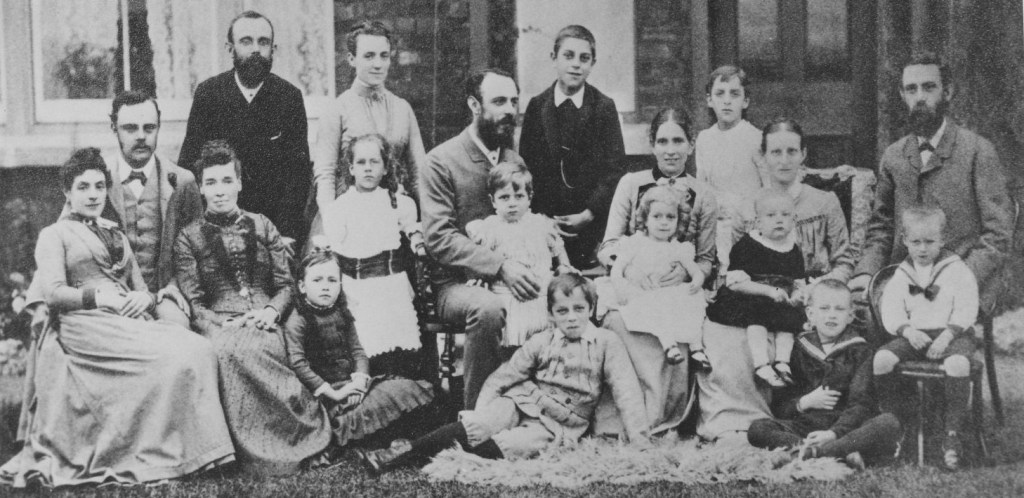
And I made a lucky find on Rootsweb – a photograph taken of the Stanier family outside William Henry’s home, Oakfield, Bath Road, Swindon, dated 1888. The four Stanier brothers are pictured as follows: seated left – Charles Frederick, standing – Henry Alfred, seated middle – William Henry and seated right – Thomas William.

Henry died on February 7, 1930 was buried in grave plot C1886A. His wife Caroline joined him there when she died just six months later.

The death occurred at Swindon, on February 7, at the age of 77, of Mr. H.A. Stanier, who, at the time of his retirement from the Company’s service, in May, 1917, was chief clerk in the carriage and wagon department. Mr Stanier took a keen interest in local affairs, and especially concerned himself with Poor Law administration. He will be remembered for much devoted work for the welfare of the inmates at the Stratton Institution. Mr. Stanier also took an active part in the work of the Mechanics’ Institution and the adult school movement.

Great Western Railway Magazine March 1930.

Henry and Caroline’s grave before our volunteers got to work

Walter Perkins – one of the ordinary people of Swindon

The purpose of this blog is to record the lives of the ordinary people of Swindon, and that is exactly what Walter was.

Born in 1884 Walter makes an appearance on the 1891 census when he lived at 20 Vilett Street. His father Joseph, born in Banbury, was an Iron Moulder in the Works. His mother Elizabeth, born in Stratton, was busy having babies – five by 1891. She had 9 in total with 7 surviving childhood.

By 1901 the family were living at 21 Farnsby Street. Walter 17, and his younger brother Hubert 14, had already begun their Fitting apprenticeships in the Works.

In 1911 Walter was one of 6 children still living at home with Joseph and Elizabeth at 63 Curtis Street. He was the eldest at 27, William John Perkins, his youngest brother, was 9.

Walter married Florence M. Farr in the June quarter of 1919. He died on May 18, 1933 aged just 49 years. He was buried in grave plot C88 where he was later joined by his sister-in-law Frances Annie Hardiman who died in 1959.

There are so many facts about Walter’s life that remain unknown. Did he serve in WWI? Did he and Florence have any children?

Walter Perkins, one of the ordinary people of Swindon.

In Cherished Memory of

My dear Husband

Walter Perkins

Who passed within the veil

May 18th 1933

Resting where no shadows fall

Peacefully sleeping he waits us all

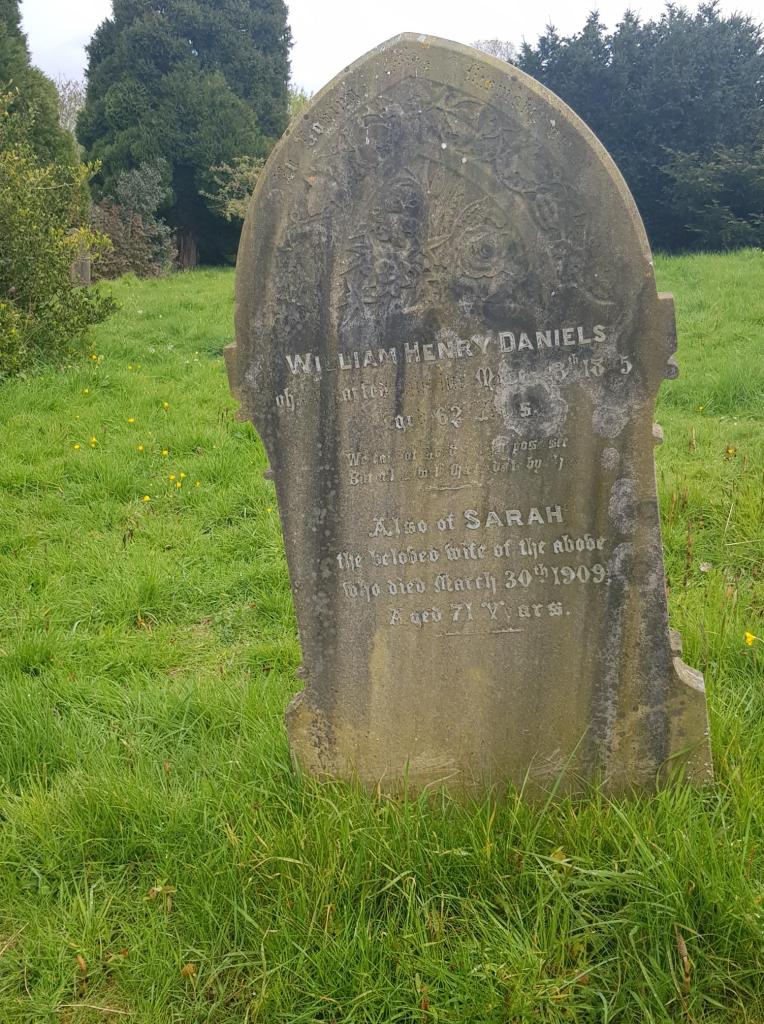
William Henry and Sarah Daniels

Most of us would extend a helping hand to a family member on hard times. Make sure they had food in the cupboard, perhaps lend them some money, maybe even put them up for awhile until they get back on their feet, but Sarah Daniels went way beyond this.

Sarah Bull married William Henry Daniels in 1855. By the time of the 1861 census they were living at 42 Westcott Place. William worked as an Engine Driver. They had a 4 year old daughter Dianah and living with them were Sarah’s elderly mother and William’s brother Samuel, an Iron Factory Labourer.

Ten years later Sarah and William had 3 children. Sarah’s mother died in 1867 but Samuel Daniels, now an Engine Driver, continued to live with them. Perhaps Samuel wasn’t down on his luck, perhaps he just liked living with his brother and enjoyed the home comforts.

In 1881 William and Sarah were living in Merton Street with their daughter Diana, now 24 years old and sons Mathew 19 and Frederick 16, both employed in the Carriage Works. Oh yes, and Samuel as well.

In 1891 the family were living just round the corner from the cemetery at 5 Clifton Street – they even employed a young servant girl to help Sarah with the housework. Only younger son Frederick continued to live with William and Sarah – and Samuel of course.

William Henry Daniels, Engine Driver, died aged 62 years old at 55 Farnsby Street in March 1895. In 1901 Sarah is living with Samuel at 22 Reading Street, where he is recorded as head of the household.

Sarah died in 1909 at Boxbush House, Brinkworth. She was buried on April 3 in grave plot B2414 with her husband William – but without Samuel!

Job Richardson – House and Estate Agent

Image of Rodbourne Road published courtesy of Local Studies, Swindon Central Library.

It’s not very often I get the opportunity to visit a house owned by the same family for 100 years (unless they are an aristocratic family) but recently I did. One hundred years of children running up and down the narrow stairs, one hundred years of washing on the line. There was even a saucepan dating back to those days – how many meals had been dished out from that pan and eaten at the kitchen table where I looked at family photographs and letters?

At the end of the 1860s Even Swindon was still mostly farmland but with the Great Western Railway Works on the doorstep it was growing fast. Development began in the 1870s with the sale of Northaines Farm, Edwards Farm and part of Even Swindon Farm and an early speculator was Job Richardson.

Job Richardson was born in 1842 in Somerset, the son of coal miner Elijah Richardson and his wife Eleanor. By 1861 19-year-old Job was also working in the Somerset coal mines.

In 1866 Job married Henrietta Milsom in Radstock.  Sadly, Henrietta died the following year, during or soon after the birth of her daughter Henrietta Milsom Richardson. She is buried in the churchyard at Radstock, most probably with the baby who died. By 1871 Job had moved to Bath, lodging in St James Parade, where he worked as a mason.

In 1872 Job married Sarah Rebecca Tanner at the parish of Widcombe, Somerset and by 1877 they had arrived in Swindon where Job bought land in Even Swindon. In 1881 Job was living at 33 Henry Street (quickly renamed Hawkins Street to avoid confusion with a street in the town centre) and working as a House & Estate Agent.

1884 notice published courtesy of Rodbourne Community History Group.

Job and Rebecca later moved to 133 Clifton Street but continued to rent out their properties in Rodbourne. Job died in 1903 and is buried in grave plot D163 with his father-in-law Henry Tanner who died earlier that same year. Rebecca sold her stake in the Rodbourne properties in 1924 and was buried with her husband and her father on January 4, 1928.

Locked out!

So, what do you do when you go up to the cemetery with a long list of graves to find and photograph to discover the cemetery gates are locked. Well you go to another churchyard instead!

There are few remaining headstones in the churchyard at St. Mark’s. It is unlikely there were ever many more as this was the burial place of the early residents of the railway village, most of whom were young with large families and little money.

By the end of the 1870s burial space at St Mark’s was running out and a new burial ground was urgently needed. This and the increasing demands of the large non-conformist congregations for an independent burial ground saw the establishment of Radnor Street Cemetery in 1881.

Robert Hanks was born in Bristol, the son of Thomas and Elisabeth Hanks, and baptised at St. Phillip and St Jacobs, Bristol on October 16, 1796. He married Elizabeth Phillips at St Paul’s, Portland Square, Bristol on September 10, 1820 and the couple had six surviving children.

The 1841 census finds the family living at an address at the Viaduct Foundry, Newton in Mackerfield, (Newton le Willow) Lancashire, where both Robert and his eldest son, also named Robert, are working as mechanics.

By 1851 the family had arrived in New Swindon where they lived at 13 High Street (later renamed Emlyn Square).

In 1866 Robert was killed in an accident in the Works when an iron truck on which he was working toppled over, crushing him. He was 71 years old.

It is said that after this fatal accident, Joseph Armstrong, Locomotive, Carriage and Wagon Superintendent, began a series of measures designed to improve safety in the railway factory.

Thomas George – Wanborough farmer

Thomas George had three very different occupations during his lifetime – that of Engine Fitter and Turner; Beerhouse keeper and finally farmer!

Thomas was born in about 1848 in Pencombe, Herefordshire, the son of Timothy and Martha George. By 1871 he was living in Swindon at 43 Taunton Street lodging with George Miggens and his family and working as a Turner. The following year he married Lucena Rathbone at St John’s Church, Bedminster.

By 1881 Thomas was a beer house keeper and green grocer living at Bridge House, 34 Fleet Street with Lucena and their four sons. Lucena died in 1889 aged 42. She was buried on February 27 in grave plot E8225.

In 1890 Thomas married Mary Smith Thomson and in 1891 the couple are recorded on the census as living in Park Lane in a property called Rathbone Villa, presumably named after his first wife. Lucena’s seven sons still lived at home with Thomas and their stepmother Mary. The elder three, William, Henry and Albert were all Engine Turner apprentices.

And then in his fifties Thomas decided to try his hand at farming. As a child growing up in Herefordshire there had been periods when he had lived with both his grandfather and his uncle on farms in Yarpole and Lucton. So, at around the turn of the 20th century, Thomas moved to Kite Hill, Wanborough where he remained until his death in 1930.

Mary, his second wife, died in 1920 and was buried in grave plot E8086 with her parents George and Mary Smith Thomson and her sister Agnes Cooper Thomson.

In 1922, in his mid 70s, Thomas married again. His third wife was Catherine Burns Thomson, his second wife’s sister.

Thomas died in 1930 and was buried on November 12 in grave plot E8087. Catherine died just six months later and was buried with him.

The late Mr T. George – The funeral of Mr T. George, who died at his residence, “Blenheim,” Kite Hill, Wanborough, took place at Swindon Cemetery on Wednesday, the first part of the service being at St. Mark’s Church. The family mourners were: Mr W.T. George (New Cross, London), Mr H. George (Swindon), Mr S. George (Wanborough), Mr P. George (Clydach, Swansea), (sons), and Mr S. Mills (Swindon). (cousin)

Others present were: Messrs. A.W. Norris, G. Turner and G. Gibbs. Floral tokens were received from Mrs George (widow), Mr and Mrs W.T. George, Mr and Mrs S. George and son, Mr and Mrs P. George, Ernest and Olive George, Mr and Mrs Allen (Bristol), Mr S. Mills and family, Mr and Mrs G. Turner and Mrs Bray, Mr and Mrs H. Stratford, Mr and Mrs Cook, Mr and Mrs Norris and Mr and Mrs G. Gibbs.

The coffin was inscribed, “Thomas George, fell asleep Nov. 7th, 1930, aged 83 years.”

The deceased was an old member of the ASE, and formerly a well-known Swindonian, having being employed in the GWR Works. He was a member of the 2nd Wilts Battalion Volunteers, and was the last surviving non-commissioned officer. Subsequently he held an off-licence in Fleet Street and the Volunteer Inn. Leaving urban pursuits behind 34 years ago, he started farming at Wanborough, and continued until a short while ago. His local friends and neighbours came to regard him as a very straightforward man, who took much interest in national affairs.

North Wilts Herald, Friday, November 14, 1930

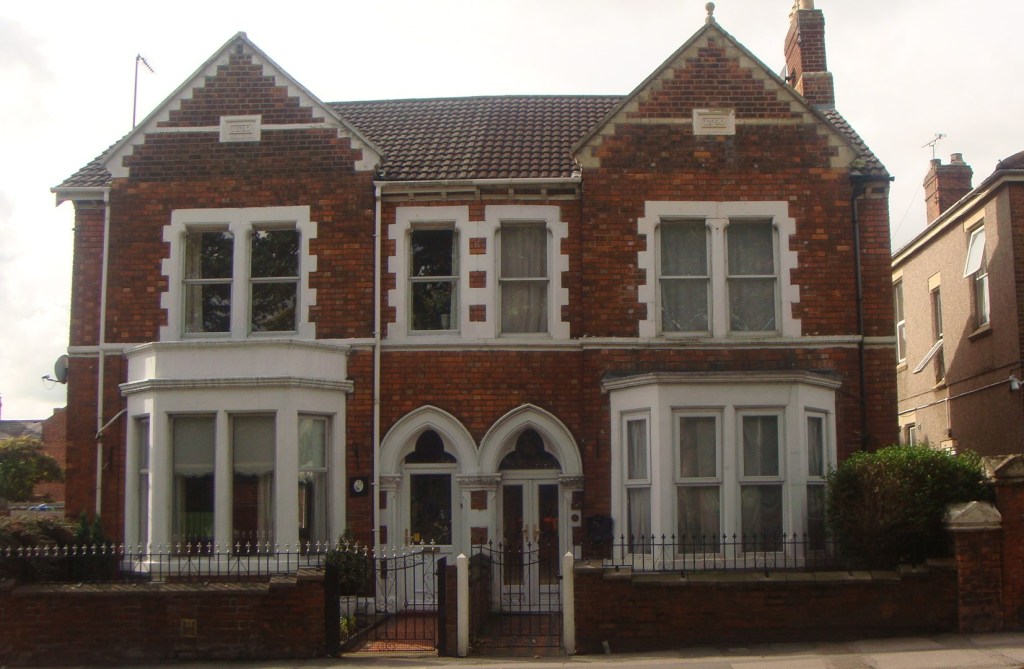
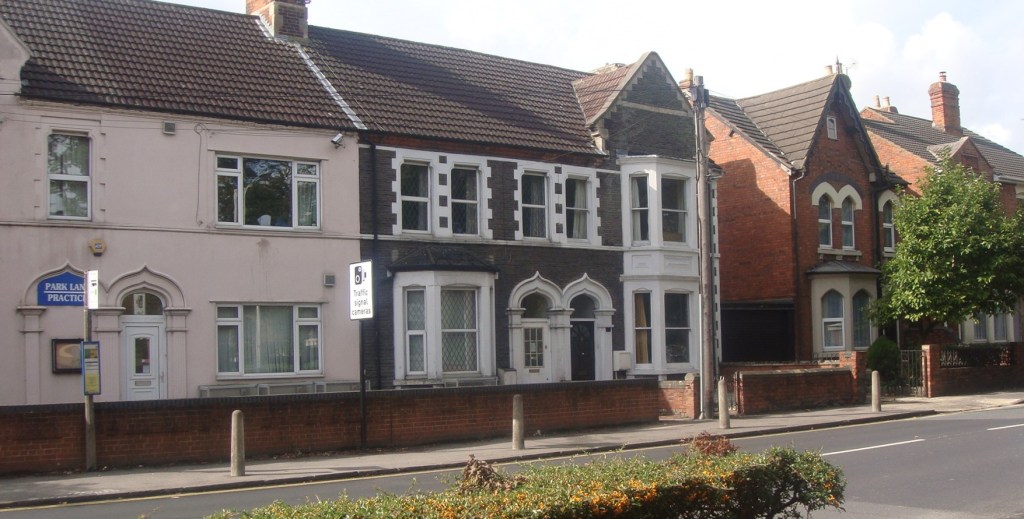
Recent views of houses in Park Lane. Could one of these be Rathbone Villa? We’d love to hear from you if it is.

Down Your Way – Taunton Street

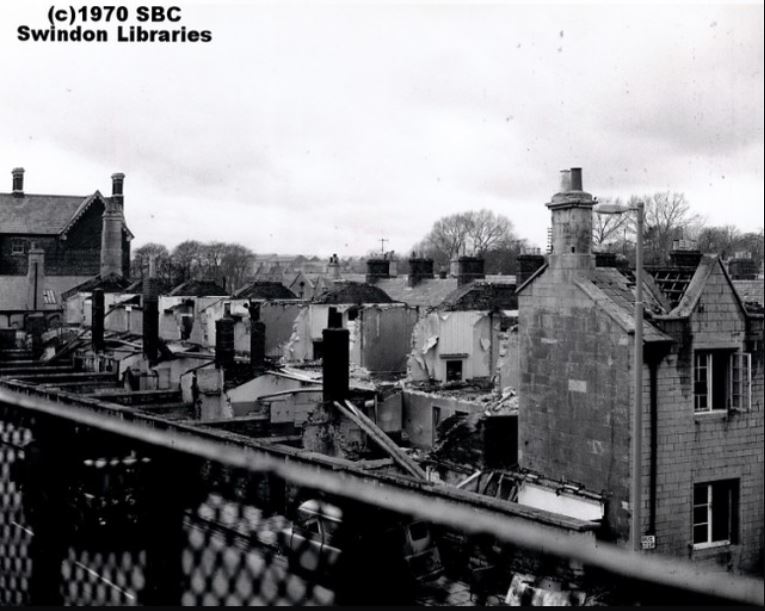
We are extremely lucky to still have the Railway Village for in the 1960s it was under threat of demolition. Purchased by the local authority in 1966 the 19th century cottages were in a state of dilapidation and Swindon Borough Council was intent upon a project of demolition and rebuilding. However, a passionate local campaign and the vocal support of Sir John Betjeman, Poet Laureate, rescued the village and a programme of renovation began.

Without these properties it would be difficult to imagine the lives of the first railway families who arrived in Swindon in the 1840s. But today you can still walk down the backsies and hear the distant echoes of children at play; hear the tramp of the men’s feet as they return home after a hard day’s work and re-imagine life in Swindon 180 years ago.

Green, G. Peter M.; Swindon Railway Village, c.1935; STEAM – Museum of the Great Western Railway; http://www.artuk.org/artworks/swindon-railway-village-c-1935-65327

If you lived in Taunton Street you rubbed shoulders with royalty – railway royalty, that is. The first members of the Mechanics’ Institute Council Mr Grandison and Mr Fairbairn, lived in Taunton Street. Even old Mr Hurst, the first locomotive driver on the GWR, lived there although that was much later. Read more …

Thomas Oswald Hogarth – Howzat!

Peter Bremner was born in Dundee in about 1819 and arrived in Swindon around 1848. It is possible the family came straight from France where a daughter Erskine was born in 1847. For more than 35 years Peter lived at 5 Taunton Street at the very centre of life in New Swindon. Read more …

Peter Bremner – railway pioneer

It is seldom we have the opportunity to read the words of an ordinary railwayman. When George House died in 1903 the Advertiser republished extracts from an earlier interview made in 1899. Read more …

George House – a Swindon veteran

Remembering Henry John Hatter

What impression can a 20 year old make on history? Unmarried and without children, once his parents and his sister died, who would remember Henry John Hatter. He didn’t die on a battlefield as so many young men would during two World Wars. Unless we order his death certificate we will not know what killed him.

More than 100 years after his death, we can remember him.

Henry John Hatter was born on June 4, 1884 in Swindon. His father Henry was a Sawyer and Machine Man in the Works. His mother Selina was a housewife. The following year a daughter was born. The family was complete.

Henry John began work as an office boy in the GWR Works on July 18, 1897 aged 14. Just after his birthday in June 1904 he transferred to the General Manager’s Office at Paddington. He proved to be a popular member of staff.

By special request we give a portrait of Mr. H.J. Hatter, who death occurred at the end of February. Mr Hatter, who was only 20 years of age, was a member of the staff of the General Manager’s office, having come to London from the Locomotive Engineer’s office, Swindon, as recently as July last. In this short time he had established himself a favourite with his office colleagues and with the Athletic Association, of which he was regarded as a promising member. His early death caused much sympathy and regret both at Paddington and Swindon.

Great Western Railway Magazine 1905

Henry John Hatter of 31 Granville Street died aged 20. He was buried on March 3, 1905 in grave plot E8612.

Selina Hatter died in 1915 at her home in Granville Street. Henry died a year later. They are buried with their son. Mabel Louise became a teacher. She never married. She died on March 26, 1948. Who would remember Henry John now, or her come to that. We can.

Minnie Louisa Day – a soldier’s wife

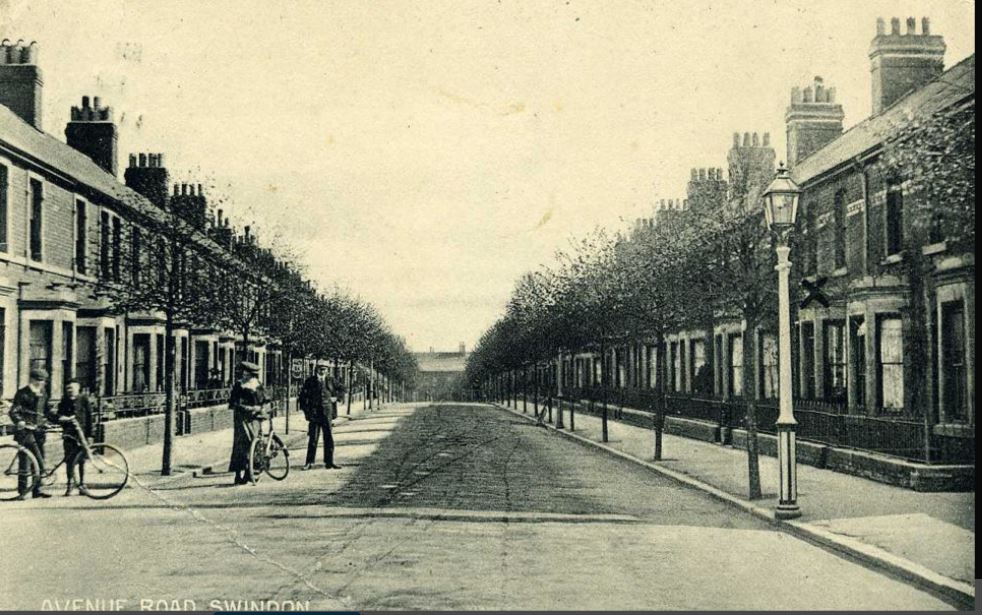
Every cemetery story is a recognition, a celebration of a life, but sometimes that story is one so sad it is difficult to write and to read. Such is the story of Minnie Louisa Roach whose future looked promising when she was born in 1874. Her father John Roach was an erector employed in the Works, her mother was Louisa Roach and she had a brother William born in 1873. By the turn of the new century the family were living in Avenue Road.

Image published courtesy of Swindon Museum and Art Gallery

Minnie married Frederick William Gilchrist, a railway clerk, at the Wesleyan Chapel Bath Road on March 23, 1901. He was 38 years old and she was 26. They began married life at 39 Dean Street, but sadly less than 3 years later Frederick died.

A Well Known Volunteer

For 7 Years Bugle-Major

The death took place on Thursday, Dec. 31st at his residence, 4 Lethbridge-road, Swindon, of Mr F.W. Gilchrist, a well-known Swindonian, who has been a great sufferer for the past two years or more, his illness being induced by the after effects of influenza. He has been taken in
the prime of life – he was only 40 years of age, – and leaves a sorrowing widow, but no children. Deceased, who was the son of Capt. G. Gilchrist, of the Royal Artillery, was for many years employed in the Drawing Office, GWR Works, Swindon. But he was best known to the public as a prominent member of the Wilts Rifle Volunteers. He was a man of fine physique and good soldierly bearing. He was a member of the F and G Companies for 27 years, during 7 of which he held the position of bugle-major.

Extracts from The Swindon Advertiser, Friday, January 8, 1904.

Minnie moved back into 45 Avenue Road where she lived with her widowed mother. In 1913 she married again. Her second husband was Frederick Charles James Perry Day, the illegitimate son of Kate Day. Frederick was a coach body maker in the GWR Works and had spent most of his life living with Charles and Elizabeth Davies, presumably relatives, at 101 Stafford Street. At the time of her second marriage Minnie was 39 and Frederick 34. They should have been looking forward to a long and financially secure marriage, but of course a war was just around the corner and Frederick enlisted.

Perhaps the fear and anxiety proved too much for Minnie. She died in 1917, a patient in the Devizes Asylum.

A Soldier’s Wife’s Death – The death took place on Tuesday, at the age of 42 years, of Minnie Louisa Day, wife of Corporal Day, RFA now on active service at Salonika.

Deceased was the only daughter of the late Mr John Roach, of 45, Avenue Road, Swindon, and leaves her husband, an only brother, and a widowed mother to mourn a heavy loss.

The funeral took place on Saturday at Swindon Cemetery amid many tokens of respect on the part of friends and neighbours.

Amongst the beautiful wreaths was the following – “With deep sympathy and in grateful remembrance of much kindness shown in 1907 – from Mrs L.A. Baugh – ‘Thy will be done.’”

The relatives of deceased desire to return sincere thanks for the many kind expressions of sympathy received in their sad bereavement.

North Wilts Herald, Friday, May 25, 1917.

Stafford Street

Minnie was buried in grave plot E7888 on May 19, 1917. The burial registers record her address as 101 Stafford Street, the home where Frederick grew up. She was buried with Charles Henry Davies who had died in 1904 and was later joined in 1919 by Elizabeth, his wife, the couple who had raised Frederick.

The continuing story of James Henderson

When I began researching the Henderson family grave I suspected this might be a story that would run and run.

First there was the account of how James Henderson averted a train collision with Royalty on board the “Lord of the Isles” loco. Next came Noel’s story about the Musical Stones of Skiddaw. Today we have an account of James Henderson’s career upon his retirement complete with a photograph of the man himself!

Swindon. – On November 7 Mr James Henderson, who for the last twenty years has been an inspector attached to the Locomotive Running Department, retired from the service, and was made the recipient of a handsome testimonial, subscribed to by the officers and staff, and a large number of enginemen and firemen, throughout the system. Mr. Henderson joined the GW Railway as a fireman at Paddington in 1865, and acted in that capacity on the engine “Lord of the Isles,” which frequently worked royal trains between Windsor and Paddington. He quickly reached the position of driver, and from 1874 until his removal to Swindon as inspector was a familiar figure on express broad-gauge engines. Mr W.H. Waister, in making the presentation, which consisted of a solid silver cigar case and a purse of gold, stated that during the time Mr. Henderson had been inspector he had won the respect and esteem of all the staff. It is interesting to note that during the Olympic Regatta at Henley in August last Mr. Henderson was presented with a silver cup and an illuminated address by the Traffic Department staff in appreciation of his work there, he having taken charge of the locomotive arrangements during the Henley Regatta for a number of years.

Great Western Railway Magazine

You may like to read:-