Today I am returning to one of my favourite Swindon families, the Alley family. You’ll see the name feature frequently on this blog. My interest in this amazing family was initially piqued by Emma Louisa Hull, the eldest daughter of George Richman and Emma Alley. I discovered Emma Louisa had joined the Women’s Freedom League and served a prison sentence in the formidable Holloway Prison for protesting in the Votes for Women campaign.
Then there were her six sisters, all independent, career women who ran their own businesses, including Mabel who was awarded the BEM (British Empire Medal) for fifty years service to the community as Postmistress at the Wescott Place Sub Post Office.
And in September 2022 I was able to welcome to the cemetery three members of the extended family; Di and George from Australia and Kay from Canada.
Now I have been able to discover the burial place of Ellen Amanda Alley, the daughter and 5th surviving child of Frederick Alley and his wife Elizabeth. Ellen was born in 1876 and is recorded on the 1881 census living with her parents and six siblings at 65 Gooch Street. By 1891 fourteen year old Ellen was working as a baister at Compton & Son, a clothing factory which employed a large female workforce situated on Station Road. The family were then living at 108 Princes Street.
In 1897 Ellen married Charles [Herbert] Thomas, a boilersmith employed in the GWR Works, and the young couple began married life with Ellen’s parents in the crowded Alley home at 9 Gordon Road.
The 1911 census lists Ellen and Charles living at 94 Bruce Street, Rodbourne with their three daughters Ada, Elsie and Gladys.
It would appear that Ellen led a quiet life fulfilling a typically female role, unlike her seven, trailblazing female cousins. But did she? So often the lives of women go unrecorded. I would urge all the women out there to write down the story of their life. Collect and record the lives of your mothers, grandmothers, aunts, female cousins, friends and neighbours. Set up a Facebook page and let’s link everyone in – make one huge history page for the ‘ordinary’ women out there. What do you think? Shall I get us started?
Ellen Amanda Thomas died on January 2, 1924 at the Victoria Hospital. She was buried on January 5 in grave plot D615. Her last address was at 32 Morris Street, Rodbourne.
Photographs are published courtesy of Wendy Burrows – family historian extraordinaire!
A comprehensive list of burial dos and don’t in Radnor Street Cemetery was published when the new burial ground opened in August 1881. The cost of a common grave was 5s (25p) but sadly, many working class families could not afford even this and there are numerous public graves in the cemetery where more than one unrelated persons are buried together. The cost rose considerably for a multi occupancy plot and a 9ft (2.7 metres) deep vault cost £4.4s (£4.20) while a brick or boarded grave for a single burial 9ft (2.7 metres) deep cost £1.1s (1.05). It is likely that the graves in the chapel area are vaults or brick lined, which would increase the cost.
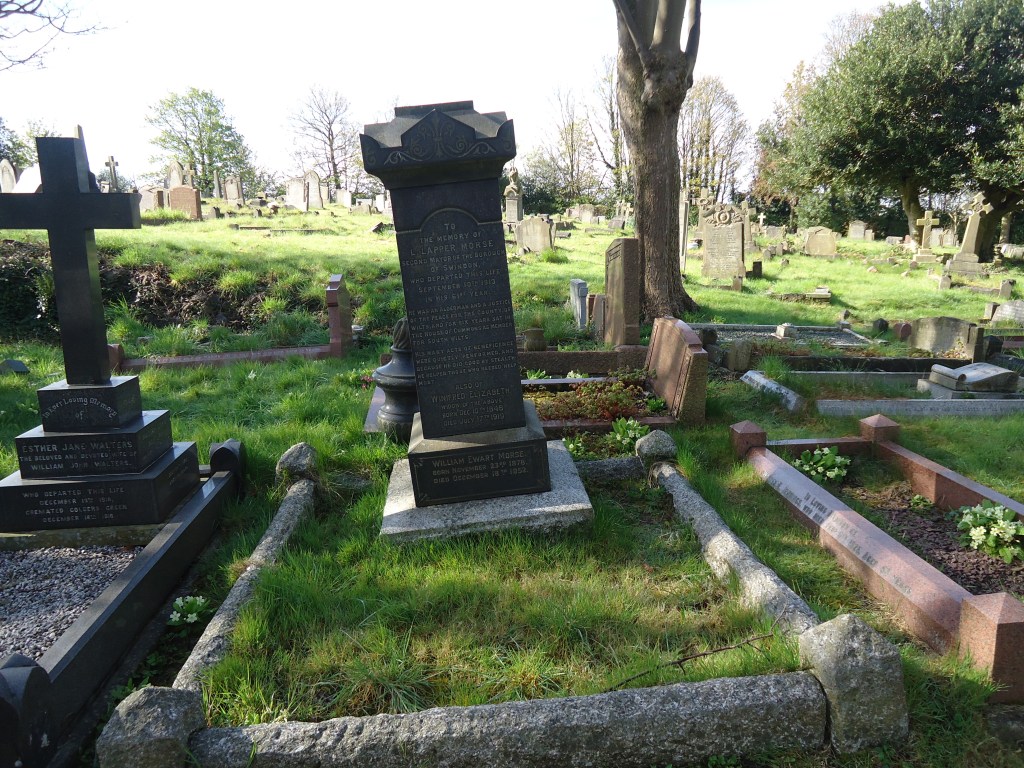
The Morse family grave is surmounted by a magnificent black, granite monument and occupies two plots, 27A and 28A in Section D.
This is the last resting place of Levi Lapper Morse and as the inscription explains he was a Justice of the Peace and served as an Alderman and the second Mayor of Swindon. He was MP for South Wiltshire for six years. He was an active and energetic member of the Primitive Methodists, serving as Circuit Steward of the Swindon II circuit from its formation until his death. He was elected chair of the Brinkworth District Meeting and Vice President of Conference in 1896 and also served as District Missionary Treasurer for about nine years. He was a lay preacher, Sunday school teacher and an accomplished organist. Levi played a prominent role in both the political, commercial and religious life of Swindon and there is plenty of information available about him, but what about his wife?
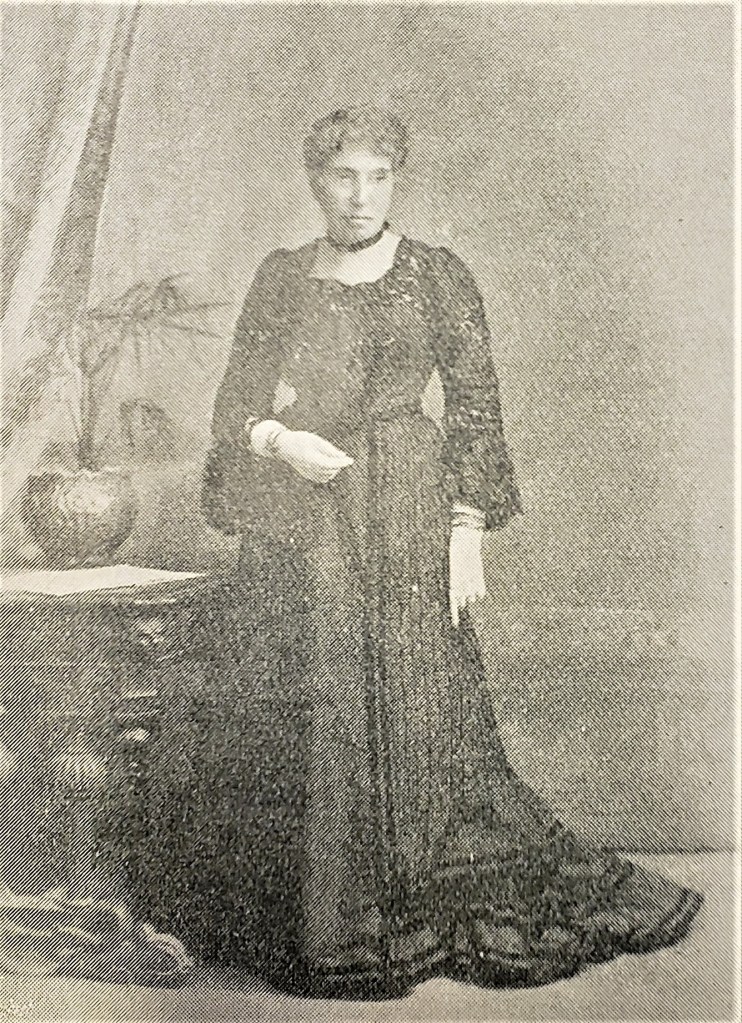
Winifred Elizabeth Humphries was born on December 10, 1848 the eldest child of Farmer Isaac Humphries and his wife Elizabeth. She grew up at Cockroost Farm, Broad Hinton where her father employed five men and two boys and a 17 year old governess to teach his growing family.
Charles Morse established a family retail business in Stratton St Margaret but his son Levi went on to accomplish far greater things. Levi opened one of Swindon’s first departmental stores, which until the 1960s stood on the present site of W H Smith’s in Regent Street, Swindon.
Levi and Winifred married in 1875 and set up home above the shop in Stratton Street, Stratton St. Margaret where he described himself as a grocer and draper, employing two men, two females and two boys. Winifred’s first child Ella Elizabeth was born in 1876 with seven more to follow. Levi states on the census returns of 1911 that he and Winifred had been married 35 years and that they have eight children, six of whom are still living while two have died.
Winifred supported her husband throughout his political career, but it was within the Primitive Methodist Church that she did most of her work. Winifred had been an active member of the Primitive Methodist Church since before her marriage and as a young girl played the organ at chapel services, often walking several miles from her home on a Sunday morning. The first Primitive Methodist Church in Regent Street was built in 1849. Further structural changes saw the church become the largest of the three Primitive Methodist Churches that formed the Swindon Circuit in 1877. It was also the focal point for the missionary activities of the Primitive Methodists in Swindon in the 1880s and where Winifred was the founder of the Women’s Missionary Federation Swindon branch in 1909.
The Morse family moved into The Croft in 1896, an elegant property that stood in four acres of land with paddocks, flower beds and ornamental trees, a tennis lawn and a fountain. William Ewart Morse, the couple’s son, remained in residence until his death in 1952 after which the house fell into disrepair and was eventually demolished. Hesketh Crescent built in 1957 now stands on the site.
Winifred died on 17 July 1919 following a long illness. Her funeral took place at the Regent Street Primitive Methodist Church with which she had so long been associated. The service was conducted by Rev F.W. Harper assisted by Rev J. Dobson, an old family friend. The Rev Dobson spoke in his address of Winifred’s good works and the loss which the church had sustained by her death.
Elias Isaac Webb worked in the railway works for 48 years as a painter and sign writer and painted landscapes in oil in his spare time. In 1947 when Elias was 83 years old he won first prize in an arts exhibition organised in Swindon by the Council of Social Services.
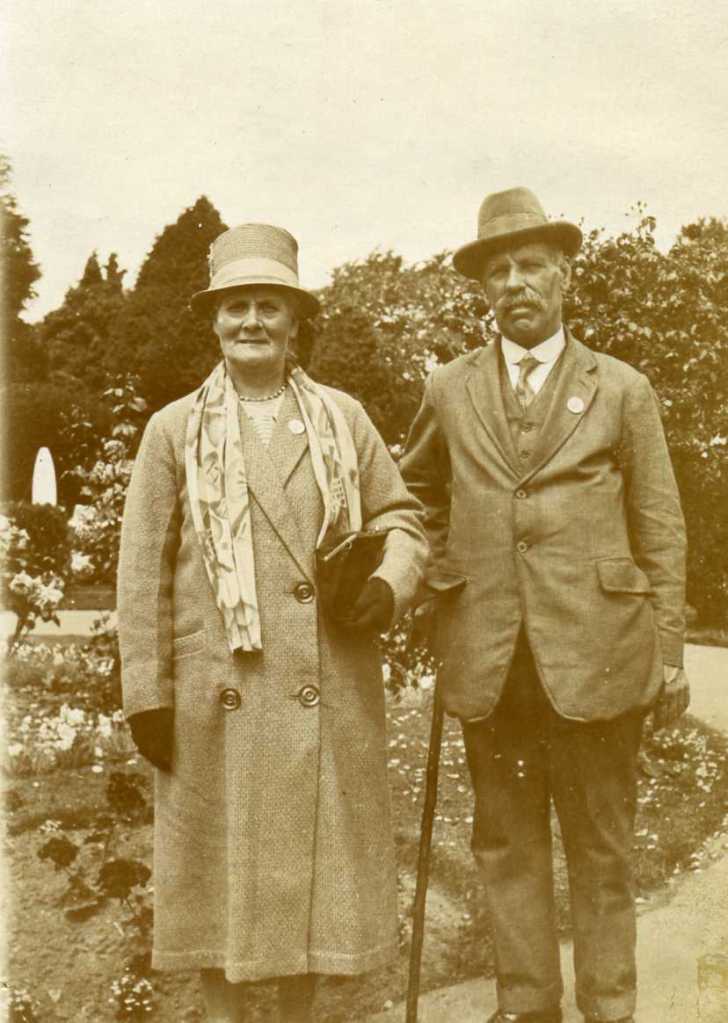
Elias was born in Westbury in 1864, one of nine children. By 1889 he was living in Swindon where he married Ada Hancox at St Mark’s Church on December 14th. The couple had three daughters and a son.
Elias and Ada were interviewed by the Advertiser on the occasion of their Golden Wedding anniversary in 1939. By then in their mid seventies they were both very active. They were members of the Worker’s Education Association and still enjoyed the summer rambles organised by that group.
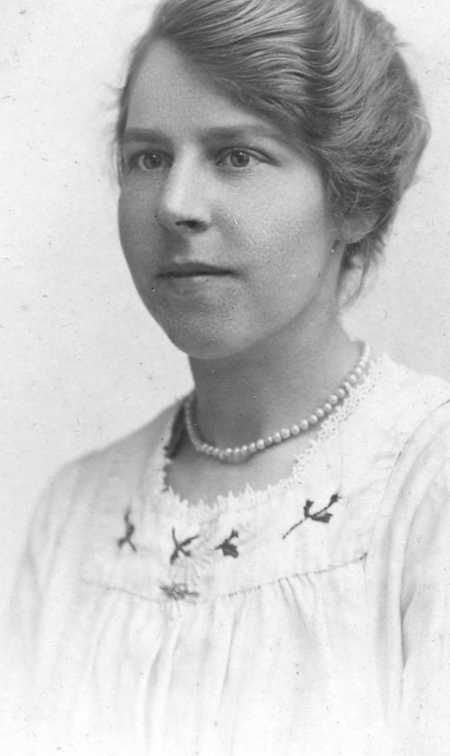
Elsie Webb
They told the Advertiser reporter that ‘we celebrated our silver wedding in war time, and now our golden wedding in war time. We hope, if spared, that our diamond wedding will be in peace time.’
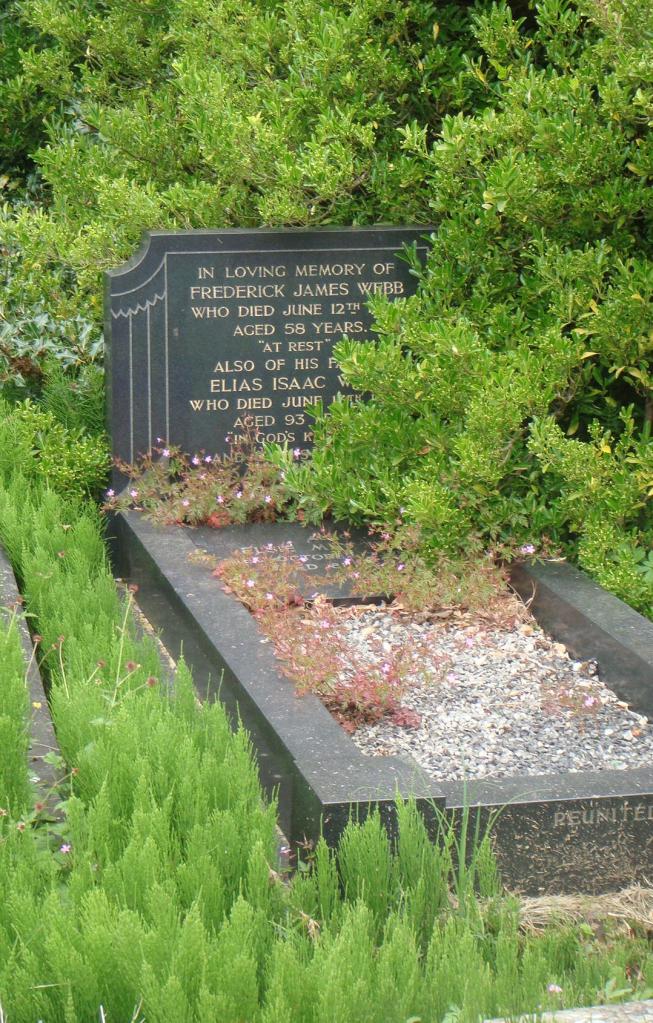
Well they did make it to their Diamond Wedding. Elias died in 1957 aged 93 and Ada in 1962 also aged 93. They are buried here with two of their children; Frederick James who died in 1949 and daughter Elsie who died in 1974 aged 80.
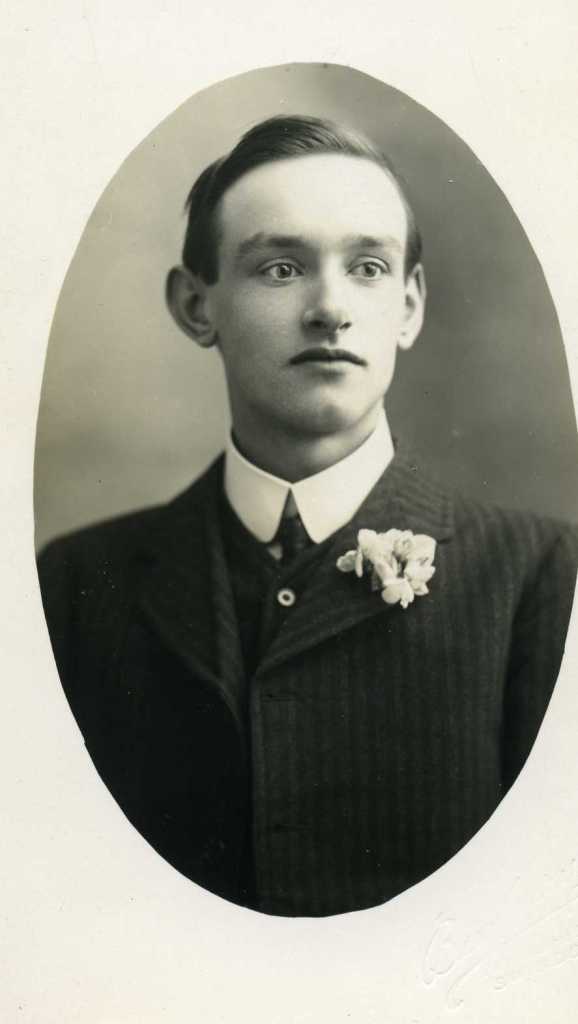
Frederick James Webb
The couple’s great-granddaughter told me that Ada originally paid a guinea for grave plot C1849 in 1914 for herself and Elias to be buried in. However their married daughter Ada Irene Jones died suddenly in 1932 so she was buried there instead.
In 1933 Elias bought this plot in E Section from Agatha Mary Beak of 49 Union Street. He paid £2 8s.
The facts …
Painting at the Age of 83
To mention the world “artist” immediately conjures up visions of a gaunt figure with carelessly combed hair, living in an attic. But these characteristics do not belong to Mr. Elias Webb, of 45 Newcastle-street, he is a leisurely pensioner undistinguished by peculiarity.
Walking into his drawing room is like entering a cave enchantment, studded with rare works of nature. On the walls are “works,” notably Killarney lakes, which show how sensitively he handles his materials.
The textures are evolved with utmost refinement the colours modulated to the most delicate adjustments of temperamental choice. He has captured in its entirety the importance of light and shade, colour planes and geometric configurations.
Country Visits
Many years ago Mr. Webb and a friend became interest in oil painting and attended the studio of a Mrs Hack, who was the first women to serve on the Swindon [School Board] Council.
On the GWR staff he was engaged mostly on lettering and sign writing in his spare time he used to go into the country draw outlines, put the wash on the canvas and finish the work at home.
He won first prize at a recent arts exhibition organised by the Council of Social Services with a landscape showing misty hills with a winding track in the middle distance, a crofter’s cottage and cattle grazing. He painted this landscape when he was 83 years of age.
One of his paintings is now hanging in the Baptist Sunday School at Westbury, where he sat as a boy more than 70 years ago.
His Other Hobbies
Mr Webb’s other interest include gardening and music, although he said they are not strictly his hobbies. Before he retired 17 years ago, he worked an allotment garden on the Wootton Basset road for 40 years, and even now grows a few flowers in his back garden.
Since his marriage, 57 years ago, he has lived in Swindon. He came from Westbury where members of his family were well known in musical circles.
For 60 years Mr Webb has been a teetotaller, but he hastened to add “I don’t mind a person having a glass of beer it does some people good. But I am fit and do quite well without it.”
And then there were those who came back – to a home fit for heroes.
Ernest Abraham Rivers was born in 1882 the second youngest child of James and Elizabeth Rivers’ large family. Ernest worked as a bricklayer and builder and married Eliza Painter on August 5, 1903. Eliza was born in 1882, the middle child of John Painter and his wife Hannah. Ernest and Eliza went on to have their own large family; their eldest son George Rivers (sometimes known as Painter) was born on October 13 1902, ten months before they married.
The family lived at 23 Prospect Hill when the 1911 census reveals they had five children, George 8, Raymond 7, Lancelot 5, Avis 3 and six months old Edna. They would go on to have another four children – Eileen born in 1913, Myrtle in 1915, Winifred in 1916 and Eric who was born in the summer of 1918.
On August 4, 1914 Britain declared war on Germany and at the end of 1915 Ernest joined the Royal Engineers leaving a wife and seven children behind in Swindon. Unfortunately, his service records are incomplete but it seems unlikely that he ever saw service overseas. Following his attestation he was sent to the army reserve before being mobilised to the Royal Engineers Depot W. Lancs. It was here that he served for 1 year 108 days before being discharged as no longer physically fit for War Service, suffering from a prolapse rectum, apparently a pre-existing condition that dated back to 1913.
Ernest returned to Swindon and his job as a bricklayer but in 1918 tragedy hit the family with the death of Eliza aged just 37. She left behind nine children including a baby just a few months old. There was no money for a private grave plot and Eliza was buried on November 13 in a public grave in Radnor Street Cemetery with four other unrelated people.
In 1939 war loomed large again. Ernest was living at 23 Prospect Hill with his two unmarried daughters. He had never remarried. That same year, youngest son Eric married Emily F. Gadd but sadly they would not have a happy ever after ending either. Gunner Eric Rivers, a member of the Field Rgt Royal Artillery, was killed on February 21, 1945. He was buried in Jonkerbos War Cemetery, Nijmegen Part 2, Belgium.
Ernest Abraham Rivers died in February 1951 aged 68. His last address was 23 Prospect Hill, the home he had shared with Eliza all those years ago. He was buried on February 24, 1951 in a public grave plot B1940, with four other unrelated people.
We continue to gather around the Cross of Sacrifice in Radnor Street Cemetery each Remembrance Day to remember those who sacrificed their lives in two world wars and those who died in more recent conflicts. And we remember those who returned but whose lives were never the same again – Tell Them of Us.
William Dorling Bavin wrote the definitive book recording the story of Swindon during the First World War. Commissioned by Swindon Borough Council and published in 1922 Bavin compiled a complete record of local activities, charitable and otherwise, in connection with the war. It is a book which has been the source material for so many others and to mark the centenary of the First World War a facsimile copy was published by Local Studies, Swindon Central Library and is available from the Library Shop.
W.D. Bavin was born in Lincoln in 1871 and spent his early career as an assistant tutor at Westminster Training College, London and later as an instructor of pupil teachers at Bath Technical College. In 1897 he was appointed the first head of the Swindon Pupil Teacher Centre for teachers at Swindon Board Schools.
His other appointments included head of Swindon Higher Grade Elementary School and headmaster of Sanford Street Boys School.
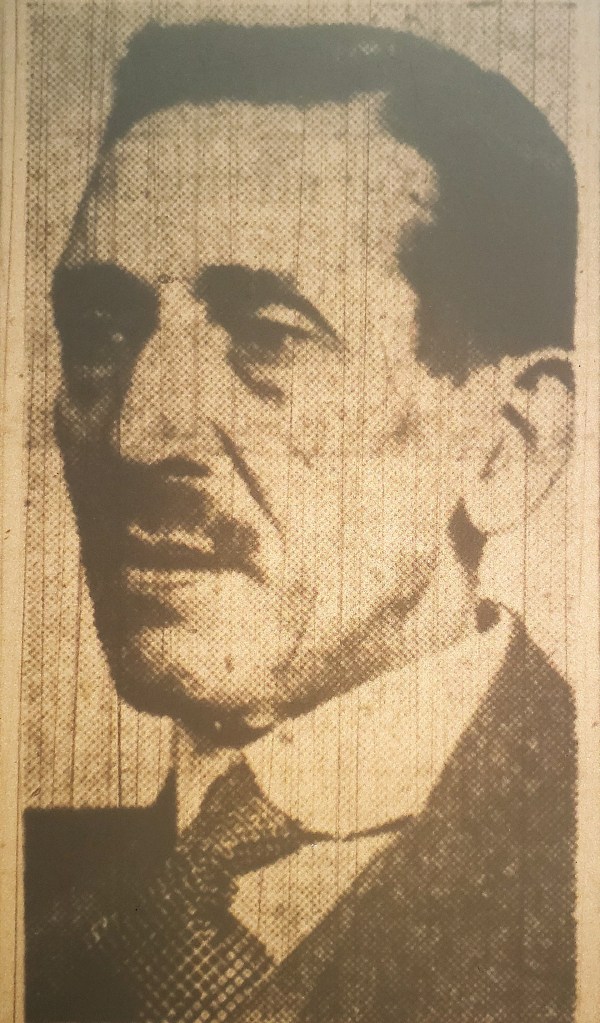
William D. Bavin married twice. His first wife Jessie died in 1915 and his second wife Helen in 1959. Bavin died in 1948 and is buried with both his wives.
Swindon J.P.
Death of Mr W.D. Bavin
After a short illness the death occurred in the Victoria Hospital this morning of Mr W.D. Bavin, aged 76, of 160 Goddard-avenue, Swindon a retired headmaster of Sanford-street Boys’ School.
Starting his career as a pupil teacher in 1889 at Lincoln he completed his training at Westminster Training College and was then engaged as a resident tutor.
Two and a half years later he took up an appointment at Bath Technical College as head of the pupil teachers’ centre department and was then appointed head of the Pupil Teachers’ Centre which opened in Swindon in 1897.
In 1903 he became head of the Swindon Higher Elementary School and in 1919 was transferred to the headmastership of Sanford-street Boys’ School when his elementary school was converted into a secondary school.
For some years he was the National Union of Teachers’ representative on the Education Committee and was vice-chairman of the Swindon Juvenile Employment Sub-Committee. He was also founder and chairman of the After-Care Committee.
His activities for youth had not been confined to school service however. He was founder and treasurer of the Swindon Triangle Boys’ Club, and for many years was the president of the local Sunday School Union.
Mr Bavin was also the author of various works on mathematics and local history and his record of Swindon’s part in the 1914-1918 war received compliments from universities in America, France, Scotland and Wales. He wrote two volumes on teaching for Sunday School teachers and since 1918 had written the annual Sunday School Union handbook.
The late Autumn sunshine glances across the cemetery. Everyone says how unseasonably warm it is this year. The Scouts who stood around the Cross of Sacrifice on Remembrance Day struggled in their uniforms. One little chap fainted. He hit the ground with such a thud. Never seen that happen before. November is usually a bleak month; the weather bitter, the memories more so.
I’ve walked past this grave so many times over the years, but do you know what, I can’t remember what once stood atop the memorial. Perhaps they placed an angel here after Isabel died. I wonder if her father ever got to meet his little daughter. Most probably it would have been a cross though, I think. What happened to it? Did it topple over during a winter storm?
The cemetery volunteers will be around in a little while. I see them most Thursdays. They do a fantastic job keeping the war graves clear. And not only the official ones but the monuments like this one, too. Today the distinctive feature about the dilapidated memorial is the inscription:
In Loving Memory of Private Alfred George Richman 5th Wilts Rgt Husband of F.E. Richman Died in Mesopotamia Feb 19, 1917 Aged 32.
Private Archibald David Richman Machine Gun Corps Died in France Feb 4th 1918 Aged 21 sons of D. & S.J. Richman.
I remember the Richman family like it was only yesterday. But can I remember what stood on the top of this monument? Perhaps it will come to me later.
The facts …
When David Richman completed the 1911 census returns he recorded that he and his wife Sarah Jane had been married 28 years. They had five children, all of whom were living. By the time of the next census in 1921 they had lost two sons.
In 1911 Alfred George Richman lived at 18 Plymouth Street. He was 26 years old and worked as a branch manager in a grocery store. He had been married to Frances Edith just under a year. They would go on to have three children, Kenneth and Raymond and little Isabel who was born in 1916 and died in 1917. In 1911 Archibald David was just 14 years old. He lived with his parents and his elder brother and younger sister at 10 St Margarets Road, working as a grocery apprentice alongside his father. Another elder brother Frank was also married. He worked as a railway clerk in the GWR Works and was married to Annie Mary. They lived at 86 Kent Road with their baby daughter Phyllis Irene.
Archibald David Richman is buried in the Hazebrouck Communal Cemetery, one of 877 Commonwealth burials of the First World War (17 of them unidentified).
Alfred George Richman is buried in Amara War Cemetery in modern day Iraq where his name is recorded on Panel No. 39 XXVII E.
Those buried in grave C1575E are Fanny Withey, Sarah Jane Richman’s sister. She died in January 1910 and her burial took place in Radnor Street Cemetery on January 31, 1910. Isabel Annie Richman is buried in the same plot. She was buried on March 14, 1917 the daughter of Alfred George and Frances Edith Richman. She was just 15 months old.
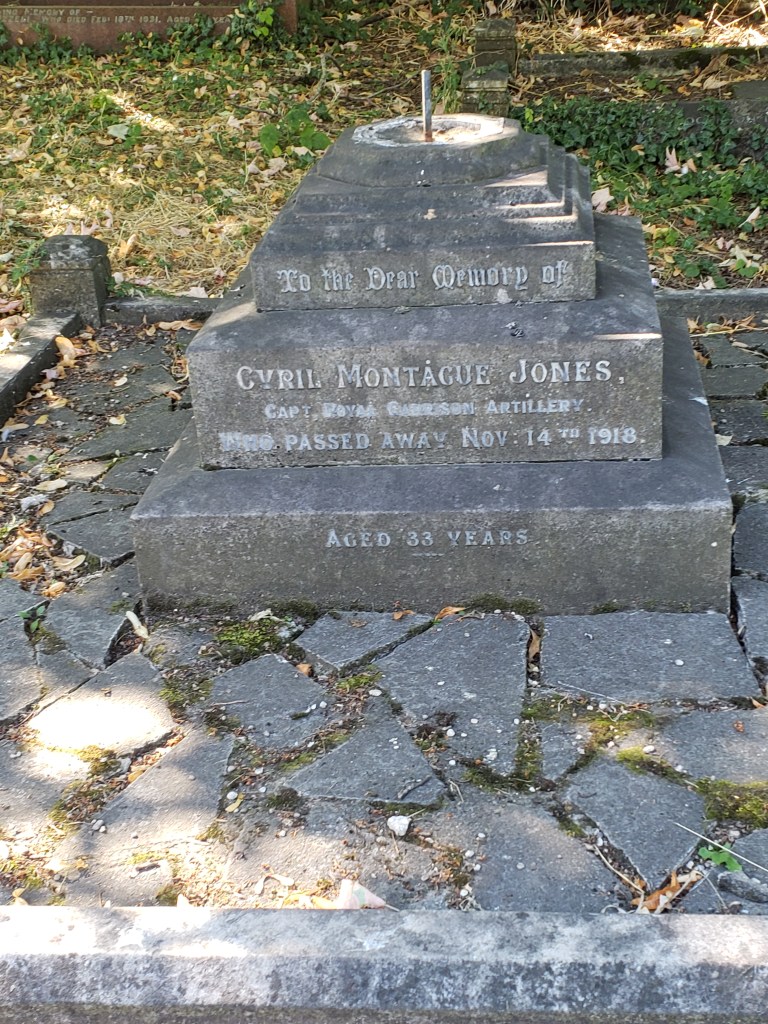
The graves around the chapel area include some well-known names in Swindon’s history, but I must admit I had never heard of Cyril Hammond Montague Jones.
Cyril was the son of William Jones and Jane Moss. William was born in Gloucester in around 1854. He married Jane Moss at St. Luke’s, Gloucester on July 10, 1882 when he described himself as ‘Lay Clerk St Andrew’s, Bristol.’ William and Jane’s two children were both born in Bristol, Edith Hammond Jones born in 1883 and Cyril Hammond Montague Jones in 1885.
By 1891 William and Jane were living in Churcham, Glos with their two young children and a 10 year old nephew. William now states that he is ‘Living on own means’ suggesting he has a private income or inheritance.
The family eventually made their appearance in Swindon at the time of the 1901 census when they were living at 27 Regent Street where William describes his occupation as ‘Draper.’
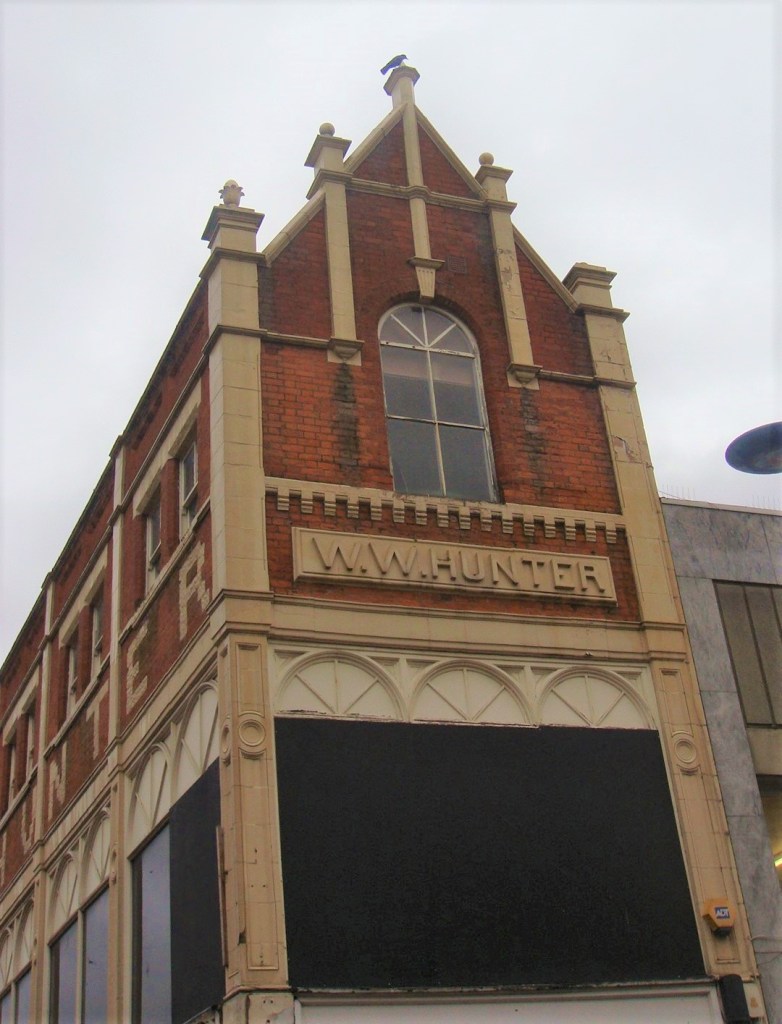
In 1917 Regent Street was the centre of a busy and vibrant shopping area. Morses department store occupied premises at numbers 10, 11 & 12. The 1,000 seater Arcadia Cinema had opened in 1912 on the site of a former shopping arcade. W.W. Hunter’s furniture shop stood on the corner of Edgware Road and Regent Street (look up and you can still see the name in the brickwork). The County Electric Pavilion picture house opened in 1910 and was in operation for more than 20 years. The site was later occupied by F.W. Woolworth and today is home to the One Below Discount Store and Peacocks. Then there was the Artillery Arms at No. 25; F.E. Cottell, jewellers and watchmakers at No 26 and in 1917 Mrs J. Jones, Milliner was at No. 27. Perhaps the nature of their business had changed. There was some fierce competition with Morses at one end of Regent Street and McIlroys at the other.
Cyril trained as an architect but on April 1, 1915 he enlisted with the Royal Navy serving on the President before transferring to the Royal Garrison Artillery (RGA). Lieutenant A Captain Cyril Hammond Montague Jones died on November 14, 1918 at the 2nd Eastern General Hospital, Brighton. He was 33 years old. He was buried in Radnor Street Cemetery on November 20 in plot D15A.
This now a large double family plot where Cyril lies with his mother Jane who died in 1924, his father William who died in 1949 and his sister Edith who died in 1965.
Dixon Street published courtesy of Local Studies, Swindon Central Library.
What brought brothers Harry and Lazarus Goldstein to Swindon at the end of the 19th century – and it wasn’t a job in the Works?
The brothers were born in Mlawa, a town in north eastern Poland, Harry in about 1848 and Lazarus in 1858, two of the six children of Isaac Goldstein, a Hebrew teacher and his first wife. Mlawa was annexed by Russia as part of the Congress Poland and remained Russian territory until the independence of Poland was declared in 1918. By the 1860s the Goldstein family were among the Jewish immigrants living in London’s East End where both brothers worked in the tailoring trade.
Harry’s first marriage was to Julia Hyams and had taken place in the Great Synagogue in Dukes Place in the City of London in 1868. In 1886 Harry petitioned for a divorce on the grounds of his wife’s adulterous behaviour. At the time of the 1891 census Harry was living at 49 Cannon Street Road with his three daughters Deborah, Jane and Rachel who had all followed him into the tailoring trade.
Harry arrived in Swindon after 1893 following his second marriage to Sophia Ashby, a woman half his age and by 1899 Harry and Sophia were living at 7 Dixon Street where their daughter Lilian Beatrice was born. The baby was baptised at St Marks Church on February 4, 1900. Sadly her mother died just three years later. Sophia Goldstein was buried on September 11, 1903 in Radnor Street Cemetery in plot E7025, a public grave. Harry died in the March quarter of 1909 but does not appear to have been buried in Radnor Street Cemetery. Following the death of her parents the couple’s daughter Lilian was adopted by William Smith, a warehouse man and his wife Alice, a family who had lived at 7 Dixon Street with the Goldsteins. In 1911 aged 11 years old Lilian was living with the Smith family at 20 Shelley Street.
The private life of Lazarus Goldstein is more difficult to circumnavigate. He married Sophia Davis in about 1879. The couple lived at various addresses in the East End but their long term home was at 38 Pereira Street in Bethnal Green where they were living in 1891 with their five children.
However, by 1906 Lazarus had also found his way to Swindon having followed a woman with whom he obviously had a long term relationship. The couple already had two children, Leonora and George, both born in the West Ham district of North London in 1901 and 1902 respectively. A third child, Esther Alice Goldstein was born in 1906 at the family home in Bright Street, Gorse Hill. It was here that Lazarus was taken suddenly ill and died in 1909.
Inquest and Verdict
An inquest was held on Monday last by Mr. A.L. Forrester (Coroner for North Wilts) on the body of Lazarus Goldstein, a tailor of 109 Bright Street, Gorse Hill, Swindon who was taken ill on Saturday afternoon at 1.30, and died the same night at 9.30.
The inquiry was held at the Frome Hotel, Hythe Road, Swindon, in consequence of the body having been brought to the mortuary.
Evidence of identification, and also as to the deceased being taken suddenly ill, was given. Dr. Reid, who conducted a post mortem, attributed death to valvular disease of the heart, and a verdict in accordance with the medical evidence was returned.
Swindon Advertiser Friday April 16, 1909.
Lazarus Goldstein was buried on April 14, 1909 in Radnor Street Cemetery, plot A931, a public grave. He was 49 years old.
While trying to find more about the Goldstein brothers before they left London and moved to Swindon I came across the work of a Lazarus Goldstein, a union activist in the East End tailoring trade.
The summer of 1889 saw extensive strike action in the East End of London, including a five week long shut down of the tailoring industry called by the Amalgamated Society of Tailors and two small pressers’ and machinists’ unions. The unions called for improvement in the working conditions of the small tailoring workshops, including a 12 hour day with a dinner and tea break, regulated overtime and trade union rates of pay with an end to ‘sweated’ labour.
The two names that live on in trade union history are William Wess, Secretary of the Tailors’ Strike Committee and Lewis Lyons, the Chair. In 1889 Lazarus represented the smaller London Tailors’ and Pressers’ Union.
[The following has been issued in the form of a large placard by the East End Tailors.]
Manifesto!
To The Tailoring Trade.
Fellow Workers, – On October 2nd, 1889, there was signed by representatives of the Employers and Employed, and counter signed by S. Montague, Esq., M.P., a document, in which it was agreed that the hours of labour should be from 8 a.m. to 8 p.m., with an interval of 1 hour for Dinner, and half-an-hour for Tea, and four hours’ Overtime only to be worked in a week. You are well aware how by one mean subterfuge and another the above regulations are being evaded. After the late strike the Employers’ Committee issued a large poster announcing that had they known what we required they would willingly have conceded our just demands; they have now had over 6 months to know what our just demands are, and we who work for them know how unjustly they have conceded them.
Fellow Workers,- Before we go any further into the Summer months, consider whether you would not be justified in dropping your work and refusing to work on any other terms than those gained after so hard a struggle in the late Strike. We hear around us the cry we have so long laboured for “the abolition of the Sweating System and Middlemen,” and it would be as well for those in our trade who employ us to be just to their workmen, lest we take up the cry and refuse to work for them on any terms, but compel them to be fellow workers side by side with us in workshops supplied by the manufacturer direct. We, in consequence, feel ourselves justified in calling upon you to show your determination not to work for those employers who work you the sweaters’ hours of 14 to 18 per day, but come out on the 4th of May, and strike against them shoulder to shoulder, and by combination show them you are not the willing tools they unfair sweaters say you are. That they will not give way to us unless forced is a foregone conclusion; they have surely had more than enough time already had they any intention of being fair. Long hours is the sweater’s first weapon, and that must once and for all times be wrested from them. So combine and tell them you will no longer be their slaves, let no worker in the trade be false to the others, and remember that unity is strength!
By Order of the Chairman and Committee,
Lazarus Goldstein, Secretary,
“The Hall,” 20, Booth Street, E.
No more Long Hours! Don’t forget 4th May!
The Tailor and Cutter May 1, 1890.
East London Tailors
To “The Evening News and Post.”
Sir – In your issue of Wednesday you have inserted a letter from Mr. Lewis Lyons, also a leaderette, as to the probable renewal of the strike. Mr Lyons writes to defend the action of the Machinists’ Union, and says we called a strike, and the managing committee remained at work, only 50 men out of 1,000 members responding to the call.
Mr Lyons must surely know that he is inaccurate, 92 employers having signed individually on the documents which we issued, and 92 employers surely employ more than 50 men.
The strike was not one of principle, but one calling out those only who worked the long hours. Again, Mr. Lyons states that the object of the Machinists’ Union is to abolish the sweater; but he is again wandering from the truth, their rules being in effect the same as ours, the objects of our Union as registered being to maintain the normal day’s work from 8 to 8 (subject to alteration), and obtain by the best legitimate means for its members clean and healthy workshops. Those should be their objects. In your leaderette you state under these circumstances, Mr. Lyons does not think the machinists are to blame for sticking to their original programme from which they have never varied. I am sorry to see they have not. It is the misfortune of the trade that they did not come out on strike against the long hours with us. By the majority of them working long hours and piecework they make the sweater worse than he is. While other clamour for a eight hours’ working day they are sticking to their programme and working long hours for the sweater, whom they wish to abolish, and yet do nothing to further it. I would like to see them do something myself; but we have to exhaust all peaceable means first, and if we cannot get short hours then I say away with the sweaters, but not till we give them the last trial by combination for better prices. – I am, etc.
Lazarus Goldstein
Sec London Tailors and Pressers Union
The Hall, 20 Booth street, E.C.
Evening News (London) – Thursday 29 May 1890
In 1893 Lazarus was the General Secretary of the London Tailor’s Federation. He also served as Secretary of The “German” City Branch of the Amalgamated Society of Tailors and in 1898 he was Secretary of the Jewish Branch of the Amalgamated Society of Tailors.
The compelling evidence would suggest that the union activist Lazarus Goldstein is the same man who came to Swindon in around 1906 and died here three years later. I am presently in contact with a descendant of the family living in the USA who is trying to establish if they are one and the same person.
A 1960s photo of Bright Street, Gorse Hill published courtesy of Local Studies, Swindon Central Library.
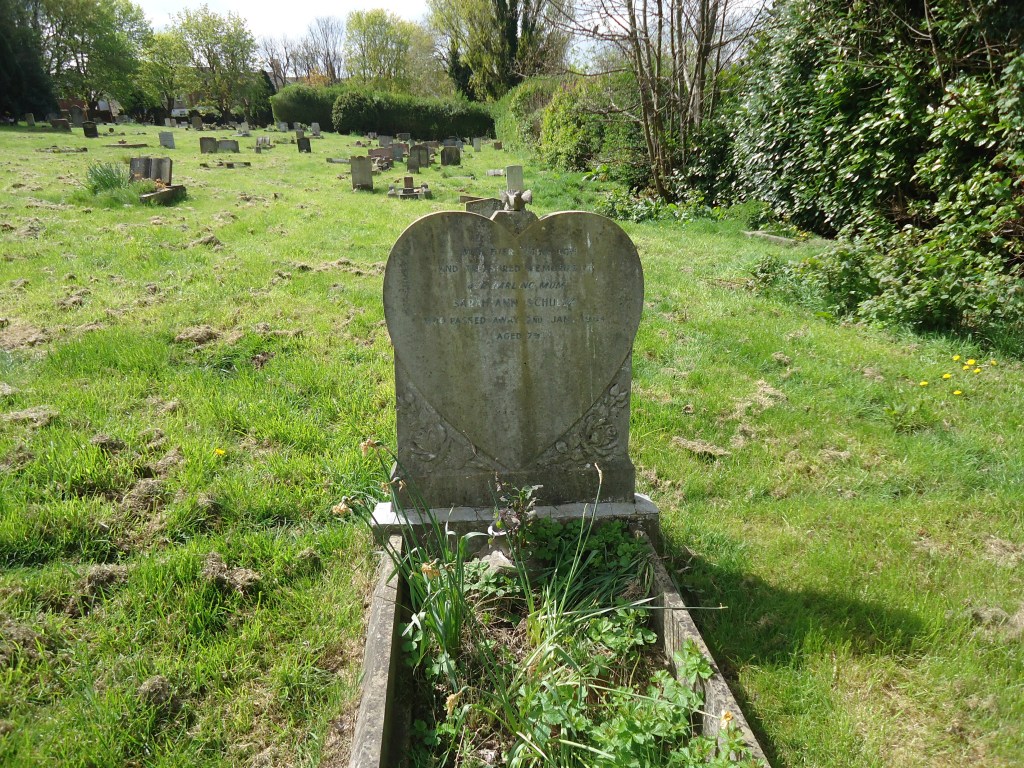
This gravestone was erected by the children of Sarah Ann Shulze who died on January 2, 1964 at the Victoria Hospital, Swindon.
This beautiful heart shaped headstone displays a dove, symbolic of peace and I can’t help but wonder if perhaps Sarah had a life lacking in peace.
Sarah Schulze was born in Avon near Chippenham in 1884, the daughter of George Poulton and his wife Emma. In 1903 she married George William Schulze, the son of Albert Gustav Schulze, a military tailor and cap maker born in Germany.
Albert was living in Aldershot at the time of his marriage in 1876, but the family obviously moved around a fair bit. George was born in 1879 in Norwich while his sister Clara was born in Ireland. In 1881 the family were living in Scotland and by 1891 they were back in Aldershot.
By 1911 George, now married to Sarah Ann, was living at 16 Gordon Gardens here in Swindon where he worked as a Traffic arranger in the Rolling Mills in the GWR Works. The couple had seven children, including little Freda Saturnia who died at the age of 5 on December 23 1914 at the family home, 30 Reading Street.
George died in 1955, a patient at Roundway Hospital, the psychiatric hospital near Devizes. Sarah survived her husband by almost ten years.
I can’t help but wonder how this family with such an obvious German sounding name had coped with living through a period of two world wars.
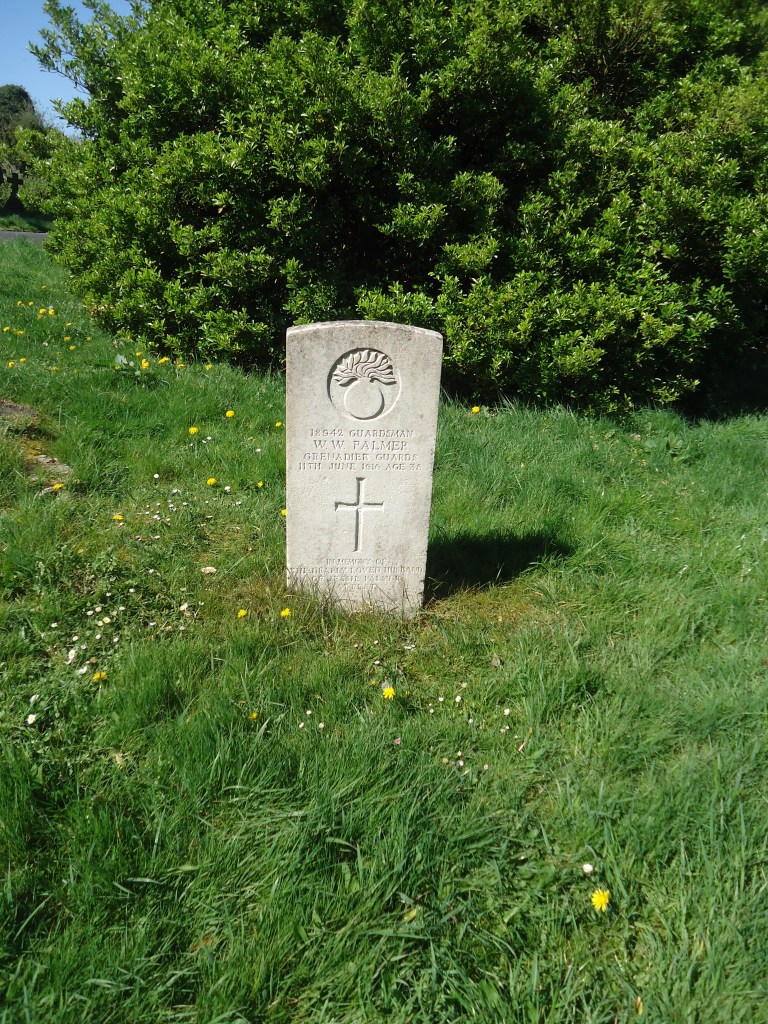
Walter William Palmer was born in 1878, the son of Stephen Palmer, a general labourer, and his wife Selena, and he grew up at 70 Gooch Street.
He first enlisted with the Coldstream Guards, later transferring to the Grenadier Guards, on September 4, 1894 as an 18 year old when he gave his occupation as an engine cleaner. His height is recorded as 5ft 11¼ inches.
His military records remain largely intact and we can learn all about his service and his medical history.
He served for 12 years and along with periods at home he served in Gibraltar, Egypt and South Africa. He was awarded the Queen’s Soudan Medal for service in the Soudan Campaign 1896-1897 and the Khedives Sudan Medal with Khartoum clasp for action in the Mahdist War in Sudan in 1897. He also received the South Africa Medal with Cape Colony clasp for service in the Second Boer War 1902.
He married Jessie Duprey at St. Mark’s Church on December 21, 1901 and they had one son, Frederick Walter Palmer. On the 1911 census Walter, Jessie and their 7-year-old son were living at 24 Deburgh Street, Rodbourne. Walter was employed as a boilerman in the GWR Works.
As a former soldier Walter was called up as a reservist at the outbreak of the Great War. He enlisted with his old regiment on September 12, 1914 and left for France as part of the Expeditionary Force on November 11.
His medical record is long and detailed. He was treated for a wound to his leg, which is described as an accident but by February 1916 his medical records reveal that he was suffering from Tubercle of lung (tuberculosis). His appearance was described as very wasted and that he was a tired and depressed looking man who was always hungry and thirsty. He was so ill that not only was he declared unfit for military service it was thought he would be unable to get any kind of job. He was discharged with a pension of 25/- (£1.25) a week with an additional 2/6 (12½p) as he had a child to support.
He was home for less than three months when he died. He was 38 years old. His cause of death was attributable to his military service as recognised by the Commonwealth War Graves Commission and he was entitled to an official headstone.








 Radnor Street Cemetery