In May 2024 I attended the Friends of Swindon Railway Museum’s monthly lecture, entitled ‘Into the Jaws of Death – working and dying on Britain’s railways 1900-1939,’ delivered by Mike Esbester from the University of Portsmouth. The subject was the danger railwaymen faced on a daily basis whether working on the trackside or in railway factories such as Swindon Works.
One of the facts Mike raised was that saftey both on the line and in the factories was considered by the railway companies to be largely a matter of personal responsibility. Despite the incredibly dangerous nature of the work, employees were expected to look out for themselves.
The following account records the extreme stoicism of Charles Edmonds, a shunter, who stepped between the buffers to couple up two engines. Despite his injuries he walked to the accident hospital and then home to Princes Street, a distance of approximately a mile.
Fatal Accident at the GWR Works
Mr J.B. Baker, coroner, held an inquest at the Red Cow Princes-street, on the body of Charles Edmonds, 48, shunter, who resided at 51, Princes-street, and who died on the previous Saturday night from injuries received whilst following his usual employ, which he had been engaged in many years, at the west yard of the GWR Works, on the 11th inst. It appeared to be generally admitted that death was the result of a pure accident.
The jury, of whom Mr W.E. Morris was foreman, having viewed the body, proceeded to hear the following evidence:- Felix Hale, 52, Bath-street, engine driver, said he knew the deceased, who was employed as a shunter in the GWR. On the morning of the 12th of October, at 9-45, they were engaged together shunting some engines. The deceased got in between the buffers to hook them on. When he had done so the engines rebounded and thus caused a space between the buffers. The deceased attempted to pass through these, thinking there was time, but the chains suddenly tightening the engines rebounded and he was caught. Witness said he did not know for certain that deceased was caught, as he saw him put his hands up. He remarked to his mate on the engine “Well, if Charley was not caught then he had a narrow escape.” As deceased did not come out witness got off his engine to go and see for him, and found him leaning against the coupling. He asked him how he came to try and pass through the buffers like that, and he answered that he thought he had time. With assistance deceased walked to the hospital and home.
By the Jury: There were hooks for shunters on the line, but not for engine shunters, the couplings being different. If deceased had stopped instead of trying to go between the buffers he would have escaped. Deceased was a man of experience.
John Hunt, Brunel-street, foreman of the “A” Shop, GWR Works, said Brown, the fireman for the last witness, told him of the accident and he went and found deceased sitting in the watchman’s cabin. He asked him if he was hurt very bad, to which he replied that he did not think he was. He asked him how it happened, to which deceased replied that he got between the engines to couple them, when one touched the other and sent it the length of the chain, thus leaving room for him to pass out, but as he was doing so the engine rebounded and caught him, but only for a moment, as he was instantly released. Deceased declined the use of a chair to go to the hospital, preferring to walk.
In answer to the Foreman, witness said there was no appliance for coupling engines without going between, as there was with trucks. In the Works they had so many classes of engines and tenders that they were bound to connect them by hand. It would have been all right if deceased had stooped under the buffer.
Dr. C. Spackman (Messrs. Swinhoe, Howse, and Bromley) said he saw the deceased when he came to the hospital on the morning of the accident. He said he had been “nipped” by the buffers, but did not appear to be in much pain. There was no abrasions or broken bones. He gave him a little stimulant, and deceased said he could walk home. Dr. Bromley saw him later in the day, but could find no sign of injury. It was impossible now to say the exact cause of death; there was no doubt internal injuries, and also injuries to the spine, as paralysis of the legs followed in a few days. He, however, rallied once or twice, and it was thought he would recover. He could take all kinds of food.
The Jury at once Returned a verdict of “Accidental death.” As it was said he had left a family of eight children, the Jury made a collection for the widow.
Swindon Advertiser, Saturday, October 31, 1885.
Charles Edmonds was buried on October 30, 1885 in an unmarked, public grave plot number A151 with three other unrelated persons.
Pollux – Hawthorn Class 2-4-0 built in Swindon Works in 1866.
Photograph published courtesy of P.A. Williams and Local Studies, Swindon Central Library.
Laudanum was the 19th century go-to drug for – well, pretty much anything really. The opium tincture was used to relieve everything from diarrhoea and the common cold to heart disease. It was a pain suppressant, induced sleep and was very, very addictive.
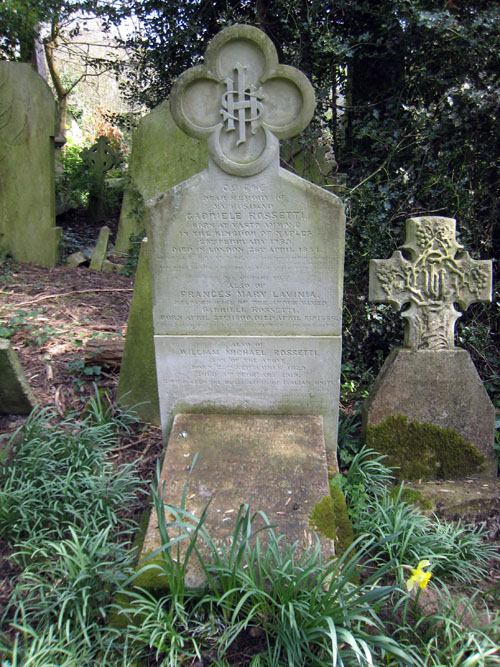
It was also very popular in Victorian artistic circles. One of the many victims of laudanum addiction was Elizabeth Siddal (1829-1862) a talented artist in her own right but better known as the muse, mistress and eventual wife of Pre-Raphaelite artist Dante Gabriel Rossetti. Lizzie died of a suspected overdose of laudanum following the birth of her stillborn daughter.
Laudanum was readily available, cheaper than a bottle of gin and in Swindon in 1888 could be bought over the counter by a 14-year-old girl, apparently.
This is the story of Henry Simpson who also died from an overdose of laudanum taken to relieve back pain.
Henry Simpson was born in Lechlade in about 1837, the son of plasterer John Simpson and his wife Sarah. Henry married Ellen Clifford in 1857 and throughout his life worked as a slater and plasterer, eventually adding grocer to his list of occupations, so obviously a hardworking man. The couple had two children, a daughter Lydia and a son William. In 1861 the family were living in Kempsford. By 1871 they had moved to Poulton in Wiltshire and by 1881 they had arrived in Swindon and were living at 21 Oriel Street, described on the census returns of that year as a Grocer Shop.
Death Through an Over-dose of Laudanum at New Swindon
Yesterday (Friday) Mr W.E.N. Browne (Coroner for North Wilts) held enquiry at the “Whale” Inn, Princes-street, New Swindon, touching the death of Henry Simpson, plasterer, who was found dead in bed on Thursday morning at his residence in Oriel-street. Mr. J. Maylott was chosen foreman of the jury.
After viewing the body, the first witness called was Richard James Page, who stated that he had lodged with deceased for 10 years. Deceased was at work on Wednesday last, but went home in the afternoon, complaining of pains in his back. He had been suffering all the week. On the previous Saturday someone recommended deceased to take a dose of laudanum to ease the pain. Deceased obtained a bottle, and on Sunday evening he took 30 drops in some water. Witness counted the drops. Deceased then went to bed, and got up as usual on Monday morning. He took about the same quantity of laudanum again on Monday night. Witness did not see the bottle again until Thursday. It was then empty, but was quite full when deceased bought it.
Minnie Browning, 14, a young girl residing in Oriel-street, proved going to Mr Smith, chemist, of New Swindon, and obtaining a bottle of laudanum and some opodeldoc, for which she paid 1s, and told the chemist it was for Mr. Simpson.
Hannah Browning gave evidence, stating that she was called to deceased’s house on Thursday morning about 11 o’clock, and between twelve and one she was asked to go and call deceased, as he had not got up. She did so but received no answer. She went half an hour afterwards and went into the room, and saw deceased in bed. She felt his hand and found it quite warm, but stiff. She then sent for some one, and she felt sure he was dead.
Dr Arnold, MB, FRCS, LRCP, stated that he was called to see deceased about three o’clock on Thursday afternoon. He found him dead, lying in the position of natural sleep. He examined the body of deceased, but found no marks of violence. In his opinion deceased had taken an over-dose of laudanum. The bottle produced would hold about eight drachms. Two drachms would be sufficient to kill a man who was not used to taking it.
The jury returned a verdict that deceased came by his death through taking an overdose of laudanum.
The Swindon Advertiser, Saturday, July 21, 1888.
From the evidence given at the inquest by Richard Page it was stated that Henry was suffering from back pain, causing him to take to his bed. Perhaps today the verdict arrived at by the jury might have been a more empathetic ‘accidental overdose.’
Henry was buried in grave plot B1575 on July 23, 1888. This was most probably a public grave at the time of his death but was subsequently purchased in 1948 for the burial of Edward Richard Green and his wife Emma Selina who died in 1952.
Administration of Henry’s will was granted to Ellen and his personal effects were valued at £147 6s 9d. Ellen moved to Chester after Henry’s death where she lived with her daughter Lydia and son-in-law Charles Arthur White. She died at their home on June 14, 1890 and was buried in Overleigh Old Cemetery, Chester.
For those of you interested in the story of Elizabeth Siddal you can read more here. This is one of the many portraits Rossetti painted of her.
Elizabeth was buried in the Rossetti family plot in Highgate Cemetery.
Sometimes the details are too scant to piece together the before and after stories.
This is the tragic story of a little girl who died in a wash tub in a back garden at 8 Thomas Street, Rodbourne. Sadly, even her name is incorrectly reported – she is Rose Morris, not Morse.
Her father, Charles James Morris, a 36 year old Engine Fitter, died three years later.
What happened to the bereaved wife and mother Hannah Morris?
Even Swindon
Death of a Child. – A little girl named Rose Morse, aged two years, daughter of Charles Morse, fitter in the GWR Works, New Swindon, and residing at 189 Rodbourne Road, met with a sad death on Easter Monday. She was playing with other children in a back garden at 8 Thomas Street, Even Swindon, when she was all at once lost sight of. One of the other children went into the house and asked a lad named Clifford where the lost girl was. He went out and searched for her, and noticing that a piece of sacking was removed from off the top of a wash tub which was “let into” the ground. The tub contained a small quantity of liquid and some grains. Clifford on looking into the tub, saw the poor little child, suspended from the top of the tub, head downwards, quite dead. He at once raised the alarm, and medical aid was sought. Dr. Bromley (Messrs Swinhoe, Howse and Bromley) quickly attended, but pronounced life to be extinct. – On Wednesday, an inquest was held on the body at the Dolphin Inn, by Coroner Browne. After hearing the evidence, the jury, of whom Mr Jonah Hawkins was foreman, returned a “death from suffocation,” and recommended that a proper covering should be placed firm on such tubs as deceased fell into when placed on the ground.
Swindon Advertiser, Saturday, April 27, 1889.
Rose Ethel Morris was buried in plot B1207, an unmarked public grave, on April 27, 1889. She is buried with three other children; two month old George Mills who was buried the previous day and 4 year old Phyllis Holmes and 2 year old Flora Maude Barnes who both died in 1922.
Charles James Morris died in February 1892 and was buried in plot A875, another unmarked public grave, with three other unrelated persons.
Looking towards the Kent Road gate – Section A to the left and Section E to the right.
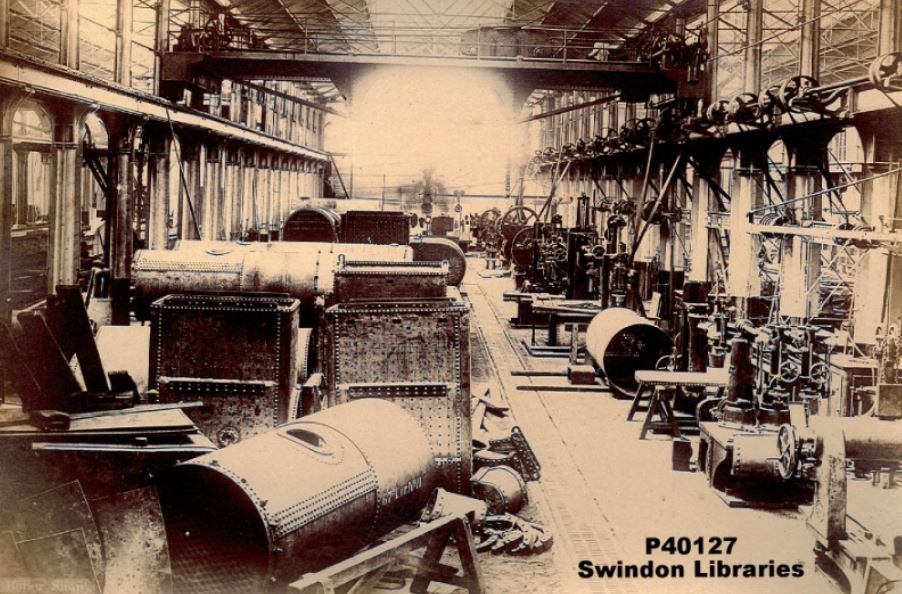
Working in the GWR factory was a dangerous affair. Serious injuries were commonplace and even fatal accidents occurred such as the one that highlighted poor safety practise in the works in 1896.
Fifteen-year-old Matthew William Fox Burton had been working as a rivet boy for just seven weeks when he was involved in an horrific accident early one Tuesday morning. Matthew – known as William – was the second son of Matthew and Mahalah Maud Burton. He was baptised at St. Mark’s Church on August 9, 1880 when his father’s occupation was given as Engine Fitter. And like just about every other boy living in New Swindon at that time, William followed his father into a job in the railway works.
His duties as a rivet boy included cleaning out the rivet forge when on that morning an hydraulic pressure riveter weighing 35 cwt, suspended by chains from an overhead crane capsized.
published courtesy of Local Studies, Swindon Central Library.
Men working nearby carried William to the Medical Fund Hospital.
“But it is feared that he has sustained very serious internal injuries and that he will not recover,” reported the Advertiser.
William died in the hospital five days later; the cause of death was shock following the injuries he had sustained.
An inquest attended by Works Manager G.J. Churchward held at the Cricketer’s Arms on Monday March 2, 1896 heard how the accident in V1 (Boiler) Shop happened just after the men returned to work at 9 a.m.
Mr R.L. Dyer, the foreman of the shop, suggested that a very slight leak in the valves could have caused the machine to drop to the ground when the water was turned off while the men were at breakfast. The subsequent slackness in the chain may have caused it to slip from one of the two hooks that supported it.
The coroner adjourned the proceedings in order to inform the Inspector of Factories.
When the inquest reconvened on Wednesday afternoon the jury heard how as the machine was lifted off the boy it slipped again, landing on him for a second time.
Dr Simms, the assistant to GWR medical officer Dr Swinhoe, said the boy had a fracture of the upper jaw and left arm and extensive bruising of the chest and back.
The jury asked to examine the machine and the inquest was adjourned for a second time, much to the consternation of Mr Churchward.
When asked when the machine had last been officially inspected, Churchward replied that Mr Dyer and himself “would see it each time they passed it.” It became apparent that inspections were done on an ad hoc basis. Mr Maitland, the Inspector of Factories, said there was no definite period for examination or visits to factories.
The jury returned a verdict of accidental death but recommended greater precautions should be taken to prevent accidents with machines of this kind.
William’s funeral service was held on March 5 at St Mark’s, the church where he had been baptised. He was buried in grave plot C771, an unmarked public grave, with four other unrelated people.
My thanks to Debra and Peter Melsom who first brought this story to my attention. The story of Matthew Burton was originally published in the Swindon Advertiser on April 1, 2011.
Alfred William Haynes served as Mayor of Swindon 1917-18. It must have been a particularly difficult time to be a local politician as the Great War drew to a slow and painful conclusion.
Alfred William Haynes was born on October 13, 1862 and was baptised on December 7 at St. Leonard’s Church, Eynsham. Eynsham is an ancient village about 5 miles north west of Oxford. He spent his early childhood at Crown Crescent, (the site of a serious outbreak of typhoid in 1875) Acre End Street, with his parents John, a sawyer, his mother Ann (d 1874) and his four younger siblings, George, Florence, Arthur (d. 1874) and Frederick.
In 1880 Alfred married Rosa Major at St. Mark’s, Old Street, Shoreditch where he stated his age as 21 when in fact he was only 18. The newly married couple returned to Wantage where they lived with Rosa’s parents Frederick and Amy Major. Sadly, Rosa died on January 30, 1885 and was buried in Chain Hill Cemetery, Wantage.
At the time of the 1891 census Alfred was boarding with James White at 20 Regent Street and was employed in the Works as an Engine Fitter.
Alfred married for a second time on April 18, 1892 at St. Friedswide, New Osney, Oxford. His bride was Amy Whiting who worked as a domestic servant at the time of their marriage.
Alfred served as a councillor for the Kings Ward from around 1911 and was appointed an Alderman in 1915. He was appointed Mayor in 1917. In 1924 he was awarded the OBE in King George V’s Birthday Honours list for his work as Chairman of the Swindon, Chippenham & District War Pensions Committee.
He died on July 31, 1935 and was buried in grave plot C1820 where Amy joined him 10 years later.
The area in Section C where Alfred and Amy are buried.
Having read my story about John and Florence Sterry, Elaine Maloney was prompted to write to me about her recollections of the cemetery conveniences. Elaine grew up in Clifton Street and writes of her childhood memories, extracts of which I share here with you.
I remember the gent’s urinal very well. I used to live in nearby Clifton Street, just across from the pub. My Mum, Joan Maloney, used to run the Clifton Street Playgroup in the Methodist Church Hall opposite the Post Office and next to the Clifton Street entrance to the cemetery. I was often hanging about in that area waiting for my Mum to lock the Playgroup hall up and come home. During these times my Clifton Street pals and I would often climb up the quite steep path to the chapel and we would dare each other to quickly dash in and out of the urinals. Hardly surprising I suppose but the urinal always smelled strongly of stale urine, which added to the fun of the dare.
With your back to the chapel and facing the urinal straight ahead you entered from an opening in the bottom right area and went down a couple of broad steps in keeping will the slope it was built into. At the bottom of the steps you turned left into the one room toilet. A long trough was situated on the southern wall and ran all along that wall only stopping at the edge the steps began at so from your starting point you would have turned 180 degrees to use the urinal so would now be facing south or thereabouts. It wasn’t very interesting architecture just utility concrete probably covering brick. At the bottom of the walls there was moss or lichen growing up the wall. If I remember correctly I believe the floor was tiled but with quite a few of them broken. Also I believe the roof was like corrugated iron but with possibly a layer of what looked like a layer of asbestos on top of the iron.
From outside the urinal at times you could have blinked and missed it as it was often overgrown with some kind of vegetation which would cover the whole roof and hang down the side walls. Just before it was due to be trimmed back it always covered the whole building so from other areas of the cemetery you could easily miss it and I can never recall any signs about the cemetery announcing it was even there.
Of course there were also a gents and a ladies toilet located to the left of the Radnor Street entrance if you were heading out of the gates there. I cannot remember inspecting the gents but you could cram maybe six people into the ladies. It contained one of those sanitary towel burners where you would pull the handle and a wedge shaped box section, hinged at the bottom, would come into view revealing a hollow section where you could place what needed burning, supposed to be sanitary towels ONLY and when you closed this part again you could hear the furnace flash up and whatever you had placed inside would be turned to ash.
Nobody could tell you were in there and if you ran down the path back onto the pavement quickly enough you lessened the chances of a parent driving by and seeing you come out. I can never remember anybody asking us to vacate the toilet for them to use so when we decided to spend time in there we were pretty much left alone.
It’s a shame but as I take an interest in public toilets when browsing online as often they have been built in a multitude of styles depending on the era they were commissioned and I find them fascinating. Many toilet blocks were sold off and later transformed into magical looking homes. I even saw some right on a seafront which an enterprising couple turned into a neat little home with the best views you could ever hope for.
I noticed a while back after looking through some old Victorian maps of Swindon that we used to have lots of urinals dotted around Swindon with them marked clearly on the corner of every third or fourth street. This must have been fantastic for the men as they were well catered for. I have noticed though that this is far from the case for women who had to trek much further to find a lavatory suitable for them to use, which seemed to be few and far between.
Today I have found the situation is no better in fact it is several times worse and even if you can find a public toilet marked on a map you would be extremely lucky to find it is still open and serviceable which is a crying shame as once you begin to age you may find you have need of them more often than previously yet you will find yourself disappointed and will be unlikely to find any toilets today.
From Swindonian Elaine Maloney
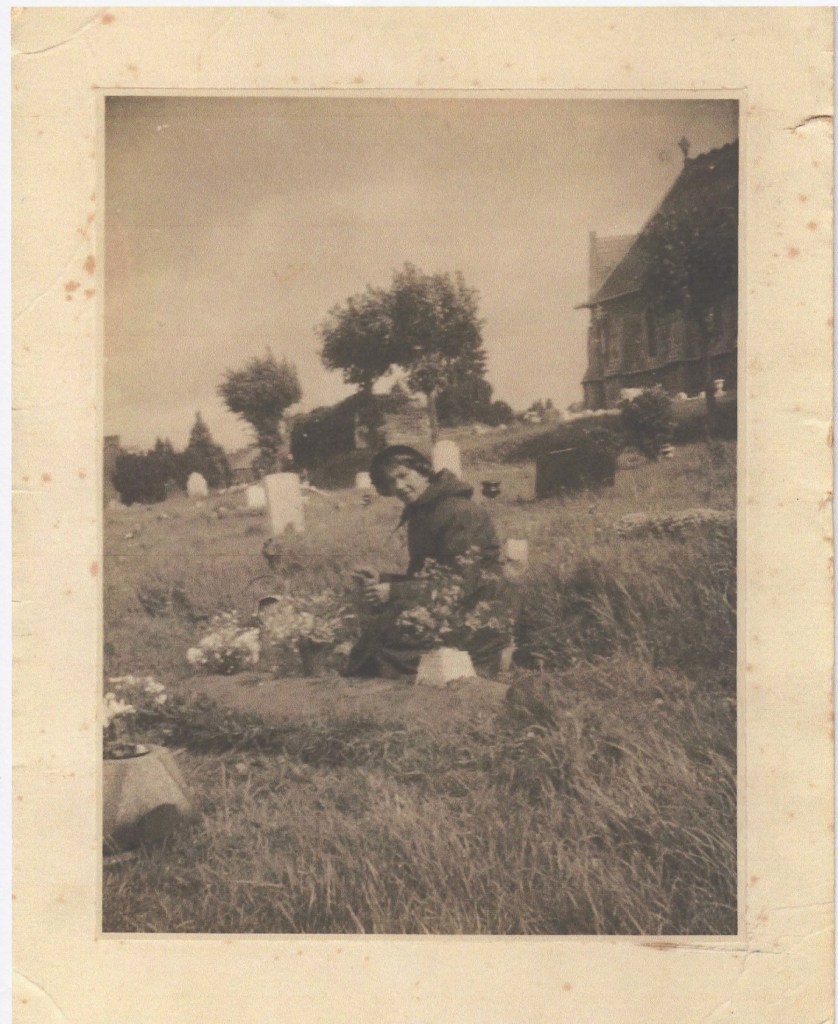
Florence Skerry pictured at her husband’s grave (with the urinals in the background).
In the summer of 2013 I had the privilege of interviewing Bob Townsend at his home in Wroughton. I knew him as a member of the Swindon Society, but he had many more strings to his bow! Here is the article published in the Swindon Heritage Magazine in the 2013 Autumn edition.
On March 19, 1921, a crowd gathered at the County Ground to see history being made – but this time they weren’t there for the football.
They had come to see the first road race organised by the newly founded Swindon Athletic Club, over three miles.
Swindon historian Bob Townsend’s father William, a 17-year-old novice, not only ran in that historic race, but won it.
And so began a long family association with the club that would last for more than 60 years.
“Some of the lads joked that it might as well have been called the Townsend Athletic Club,” said Bob, who joined the committee in his teens and was chairman for more than 20 years, following in his father’s footsteps as President.
Bob got the running bug when his father organised the Swindon School Championships, held at Ferndale Road School in the mid 1950s. “I was in my last year at school and dad asked if I fancied comming down and having a run,” said Bob, so he and his older brother John joined the Townsend training camp and were soon making headlines on the sports pages of the Evening Advertiser.
In May 1961, at the RAOC Depot Hawthorne, the Adver reported: “Leading all the way, and taking turns to set the pace, the brothers shook of Brooksby (Salisbury Athletic Club) at the halfway mark and increased their lead, eventually to lap two of the competitors.” Both achieved a personal best over three miles, with John finishing first and Bob close behind.
Bob has competed in events all over the country, running in cross country and road races of varying distances.
He set the Wiltshire record for the 3,000m senior steeplechase championship when the Wiltshire Athletic Association held the event at Marlborough College in the 1960s, and twice won the Wiltshire Cross Country Championship.
In 1965 he ran the course in 33.07 minutes, coming in 200 yards ahead of the rest of the field – just one of the many occasions when he “finished before anyone else did” as he modestly puts it.
Bob was selected three times for the British Rail Staff Association (BRSA) team to compete in the prestigious Railwaymen’s International Cross Country Championship. At Leipzig in 1962 the British team came second in both the men’s and women’s overall championship.
In 1981 the club celebrated its 60th anniversary with a jubilee run. Bob is picture wearing number 502 and one of the original 1921 vests.
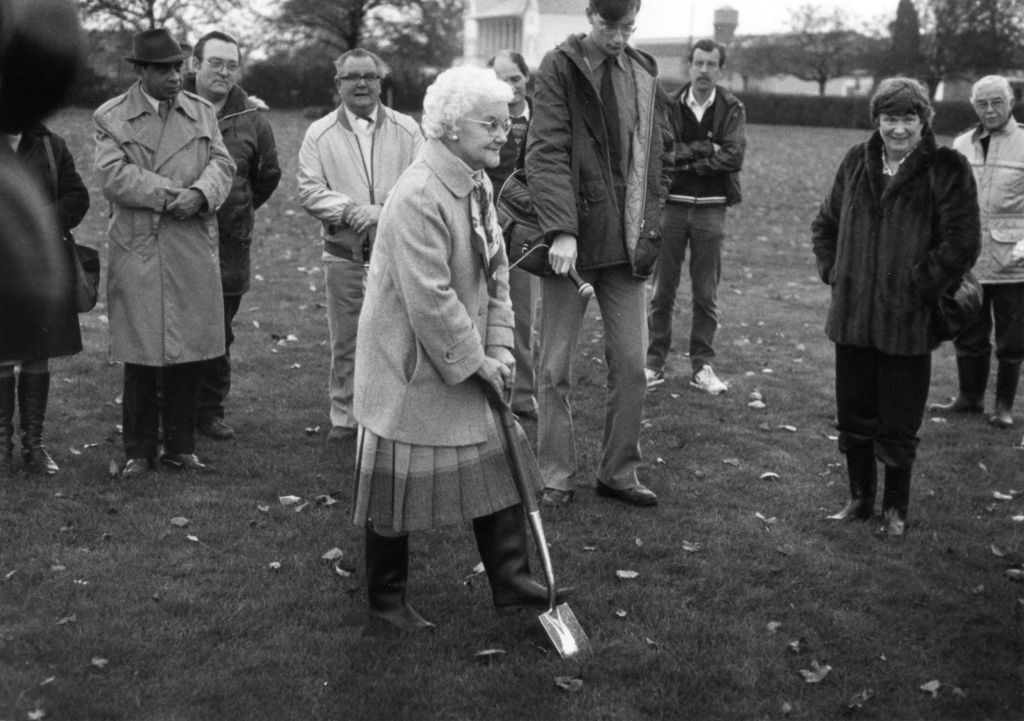
In the early days the club had no running track and their headquarters were on the County Ground car park, so when Swindon finally did get a track, in 1984, it was fitting that Bob’s mother Emily was asked to cut the ceremonial first sod.
Although Bob’s competitive running career began to tail off in the 1980s, his involvement with the sport continued.
He served on the Wiltshire Athletic Association, where he was secretary and team manager of the Cross Country Championships for 27 years. He did everything from finding a course to typing up the race schedule and ordering the medals.
Today he helps organise the Lions Disabled Games, hed every August at the County Ground track – a meeting that attracts teams from all over the country.
“It’s a wonderful afternoon,” he said.
The Swindon AC name has now gone, but the club lives on because it amalgamated with Swindon Road Runners in 1996 to become Swindon Harriers.
And, driven by the ‘marathon mania’ of the 1980s and no doubt the legacy of London 2012, athletics in Swindon goes from strength to strength.
Bob reflects on his early days with Swindon AC when the average entry for a County Champtionship numbered 40-50.
“My dad wouldn’t believe it today to see 500 entries in a Swindon half marathon,” he says.
The Townsend family are at the heart of Swindon athletics history, and although Bob is reluctant to talk about his own achievements, both on and off the track, he does recall when the story came full circle at Babbacombe in Devon in the 1960s.
“I won the mile handicap and an old man came out of the crowd waving his programme at me.
“‘I’ve been coming to his meeting for more than 30 years,’ he said, ‘and about 30 years ago another boke called Townsend from Swindon won this race.’
“That was my dad,” said Bob, proudly.
Bob died in August following a long battle with Alzheimer’s. His funeral took place yesterday at Immanual Church, Upham Road, Swindon where a large congregation of family and friends celebrated his life and said goodbye.
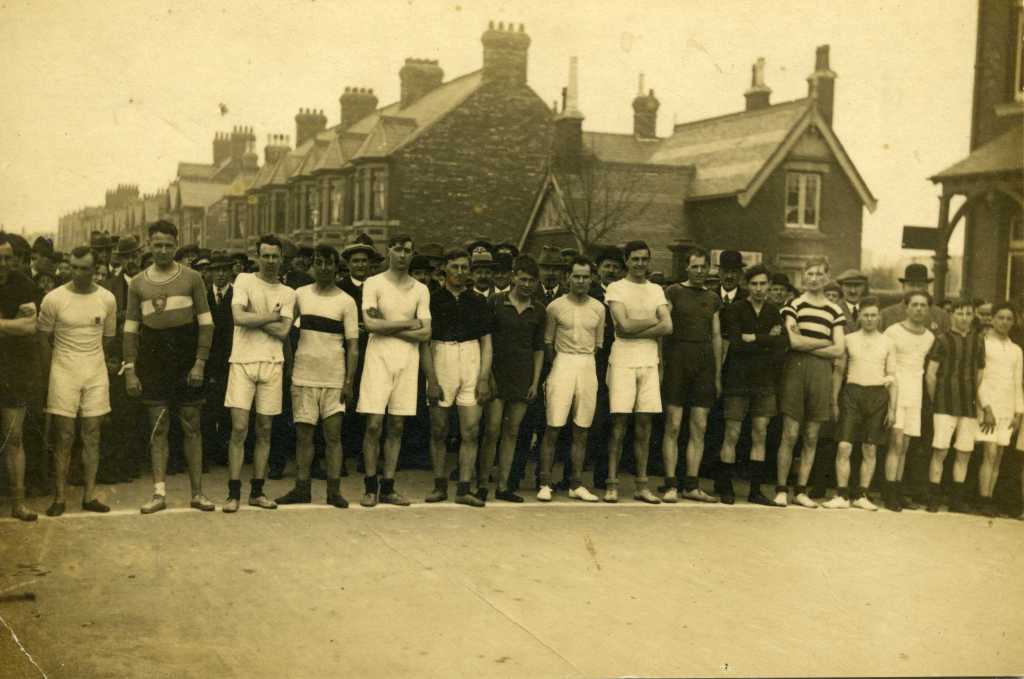
Swindon AC’s first race, in March 1921, with Bob Townsend’s father William, aged 17, second from the right.
Swindon wins South of the Thames Cross Country Championships, Sevenoaks, Kent 1961.
The British Rail Sports Association athletics team bound for Leipzig, East Germany, in 1962 – Bob is pictured seventh from the left.
The club’s 60th anniversary race in 1981. Bob is pictured wearing number 502 and one of the original 1921 vests.
Bob’s mother Emily cutting the first sod at the County Ground athletics track in 1984.
Stories still circulate that in the 19th and early 20th century babies who died within days of their birth were buried with unrelated adults awaiting a funeral, usually an elderly woman – a comfort to the bereaved mother. So far I have not found any examples in Radnor Street Cemetery, but then how would such an incident be discovered?
Mostly the babies were buried in large, communal plots. In section Lower B there are a number of these plots reserved for the burial of infants under a year old. Several babies lived for just five minutes. Some entries contain the barest details while others include the parents’ names; one sad entry records ‘male child found in Wilts & Berks Canal.’ Burials often took place daily, sometimes with more than one burial a day.
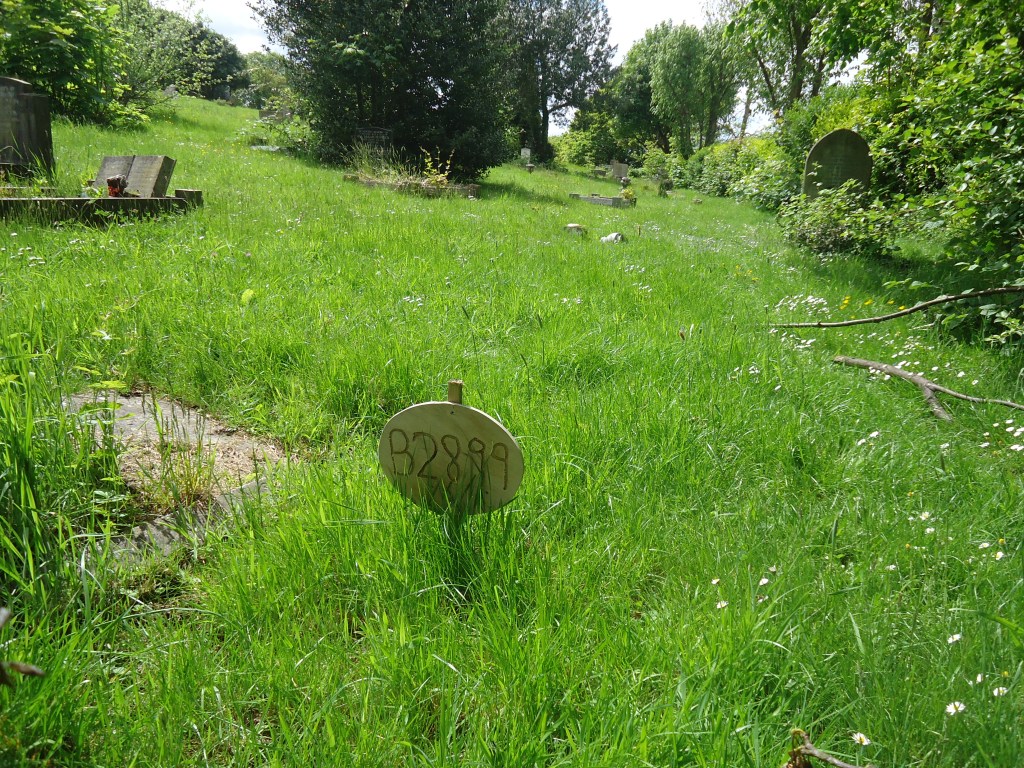
Here is a list of the names of those babies buried in grave plot B2899 between 1903-1905.
1903
7771 Margaretta Hobbs 10 days 23 Poulton Street 3rd March
7796 Ethel Blake 24 hours 39 Summers Street 25th March
7804 Edward John Gibbs 16 days 107 Salisbury Street 28th March
7811 Florence May Alder 13 days 6 Avening Street 1st April 1903
7812 George Jackson 5 min 14 Ripley Road 1st April
7814 Alfred George Gibbs 3 weeks 107 Salisbury Street 4th April (twin of Edward John Gibbs)
7830 child of John and Lily Selwood 13 days 50 Suffolk Street 16th April
7846 George Edmund Jackson 6 hours 28 Whiteman Street 24th April
7851 Turner (male) 1 hour 25 Vilett Street 28th April
7853 Edith Thesbe Ashton 1 month 22 Regent Place 29th April
7882 Albert Edward King 1 day 24 Byron Street 28th May
7855 David William Williams 14 days 14 Regent Place 6th June
7893 Ernest Speake 8 days 162 Westcott Place 11th June
7947 Frederick Hudd 1 hour 28 Avening Street 27th July
7961 Charles Blake 7 hours 64 Bridge Street 7th August
7971 Stanley (female) 10 minutes 65 Ponting Street 12th August
7975 Alice Irene Beard 17 hours 59 Eastcott Hill 18th August
7982 Gladys Eliza Smith 25 days 3 Gloucester Street 23th August
7986 Percival James Lawrence 12 days 2 Dowling Street 28th August
7991 Edward Ockwell 4 hours 10 Hythe Road 1st September
7996 Annie & Jessie Smith (twins) 1 day 41 Avening Street 10th September
8015 George Ricks 1 day 224 Ferndale Road 24th September
8016 John Baker 25 days 14 Whitehead Street 25th September
8017 Lily Barington 4 days 22 Rosebery Street 28th September
8022 Minnie Broadbear 22 hours 76 Crombey Street 2nd October
8048 Herbert George Mitchell 1 day 19 Dowling Street 25th October
8062 William Alfred Farrer 2 days 1 Holbrook Street 5th November
8068 William Thomas Payne 1 day 5 Carr Street 10th November
8070 Violet Harding 1 day 7 Morley Street 11th November
8074 Violet Law 21 days 122 Morrison Street 14th November
8081 Ethel May Payne 12 days 5 Carr Street 20th November (twin of William Thomas)
8089 Elizabeth May Peters 11 days 89 Medgbury Road 27th November
8095 George Morris 7 hours 95 Ponting Street 30th November
8097 James Rawlinson 25 days 3 Medgbury Place 1st December
8110 Dolly Rendell Illegitimate child of Charlotte Rendell 1 month 22 Swindon Road 9th December
8114 Albert Edward Ponting 16 days 26 Hinton Street 10th December
8135 Hall (male child) 13 hours 146 Beatrice Street 19th December
8138 John Chandler 2 days 9 Whitney Street 23rd December 1903
1904
8156 Elizabeth Chappell 12 days 6 Morris Cottages 1st January
8162 Charles Frederick Lander 15 days 6 Kitchener Street 5th January
8170 Stephen John Warren 3 weeks 12 Bradford Road 7th January
8181 Grace Wright 7 days 12 Granville Terrace 11th January
8189 William Arthur Franklin 1 month 155 Redcliffe Street 15th January
8196 Frederick James Webb 1 month 11 Bright Street 18th January
8197 Pope Francis Pope 21 hours 71 Curtis Street 19th January
8210 Fred Jefferies 1 day View Point House, North Street 28th January 1904
8216 Gladys Carter 13 days 4 Salisbury Street 30th January
8217 Alfred Edward Lord 27 days 46 Prospect Hill 30th January
8230 James Woolford 36 hours 134 Morrison Street 5th February 1904
8235 Speck (male) 10 months 13 Chester Street 8th February
8238 Mabel Boucher 1 month 25 Oriel Street 10th February
8247 Edith Beer 2 days 26 Prospect Place 19th February
8253 Bertie Green 3 days 101 Westcott Place 20th February
8262 (a) Albert Edward Button 1 month 14 Commercial Road 27th February
8263 Harold Edwards 5 days 69 Caulfield Road 29th February 1904
8264 Percival (male) 5 minutes 4 Bruce Street 29th February 1904
8271 Henry William Turner 5 days 7 Cambria Bridge Road 3rd March
8301 Elizabeth Ann Mayell 1 month 17 Florence Street 26th March 1904
8317 Lily Griffiths 2 days 18 Avening Street 11th April
8323 Sidney Alfred Leach 13 hours 25 Avening Street 19th April
8326 Stanley (male) 3 days 85 Dixon Street 19th April
8328 Gladys Kent 14 days 36 Cricklade Street 20th April
8330 Sarah Osborne minor 20 mins 20 Belgrave Street 22nd April
8353 Florence May Wright 1 month 23 Dean Street 7th May
8356 Charles Brown 6 hours 151 Morrison Street 13th May
8363 Emma Lecomte 12 hours 87 Eastcott Hill 18th May
8372 Elizabeth Ellen Adams 13 days 12 Exeter Street 24th May
8382 Harry Loxton 12 hours 1 Sonning Villa 30th May
8405 Hector Cecil Ashfield 2 days 34 Prospect Place 21st June
8409 Cox (Male) minor ¾ hour 151 Manchester Road 25th June
8415 Viscount Heath 2 weeks 2 Western Street 1st July
8423 Amelia Ann Hewer 14 days 118 Chapel Street 8th July
8436 Godfrey Smart 3 days 48 Albion Street 18th July
8467 Dobson (Female) 2 days 3 Stanier Street 11th August
8476 Ivy Price ½ hour 4 Argyle Street 17th August
8487 Leslie Gordon Ralph 7 days 58 Manchester Road 29th August
8511 Sandling (Female) 7 hours 201 Rodbourne Road 15th September
8536 (female) Leach 1½ 19 Cricklade Road 11th October
8545 Emily Florence Morris 3 days 49 Kingshill Road 18th October
8549 George John Spencer 1 month 50 Newport Street 19th October
8551 Edith Ellen Wait 1 day 128 Ferndale Road 19th October
8552 Leslie Slatter 18 hours 42 Goddard Avenue 19th October
8564 Nellie Fagan 7 hours 121 Beatrice Street 26th October
8572 Leonard Pitman 2 days 16 Kitchener Street 29th October
8591 Nellie Tarrant 4 hours 23 Jennings Street 5th November
8597 John Romans 3 days 18 Edmund Street 11th November
8602 (male) Dowse 5 min 70 Edinburgh Street 14th November
8632 Philip Arthur Nash 19 days 3 Sanford Street 28th November
8657 Albert Scutts 3 weeks 10 Albion Terrace 7th December
8660 Gladys Marcia Dowers 19 days 28 Hughes Street 7th December
These are difficult times for old cemeteries, long closed and with no dedicated caretaker and groundsmen. When interments take place only occasionally and few people attend their family graves, cemeteries today are quiet places.
Some complain about the lack of care and maintenance provided by local authorities whose budgets are sorely stretched. So, what is the answer for our cemeteries?
Highgate Cemetery in London has long led the way in cemetery conservation and guided cemetery walks. Opened in 1839 by a private company (as most Victorian cemeteries were) by the 1970s the cemetery was no longer a profitable concern and became neglected and vandalised. Today it is run by volunteers of the Friends of Highgate Cemetery Trust supported by some members of paid staff. Highgate remains a working cemetery although space for new burials is running out, which presents more problems.
Abney Park Cemetery in Stoke Newington is another of the ‘Magnificent Seven’ garden cemeteries of London. The cemetery was opened in 1840, again by a private company. In the 1970s the company went into administration and the cemetery was abandoned and fell into disrepair. Today it is thriving as a woodland memorial park and Local Nature Reserve maintained by the Abney Park Trust, a small volunteer led charity, and the London Borough of Hackney.
Our closed Victorian cemeteries pose a problem nationwide. In 1999 the Friends of Lister Lane Cemetery came to the rescue of the Halifax General Cemetery, again after a long period of neglect. This cemetery opened in 1841 and was designed according to the ethos of the period to be not only a burial ground but to provide a public space for walks and outdoor relaxation. The Friends group now cares for the cemetery with support from Calderdale Bereavement Services when funds permit.
Here in Radnor Street Cemetery we have a small team of volunteers who attend to not only the Commonwealth War Graves, but other graves where a fallen serviceman is remembered. Occasionally the Community Payback Team are allocated to the cemetery and always perform valuable work. Sadly, the local authority can only perform the most basic of maintenance and mowing now takes place just once a year.
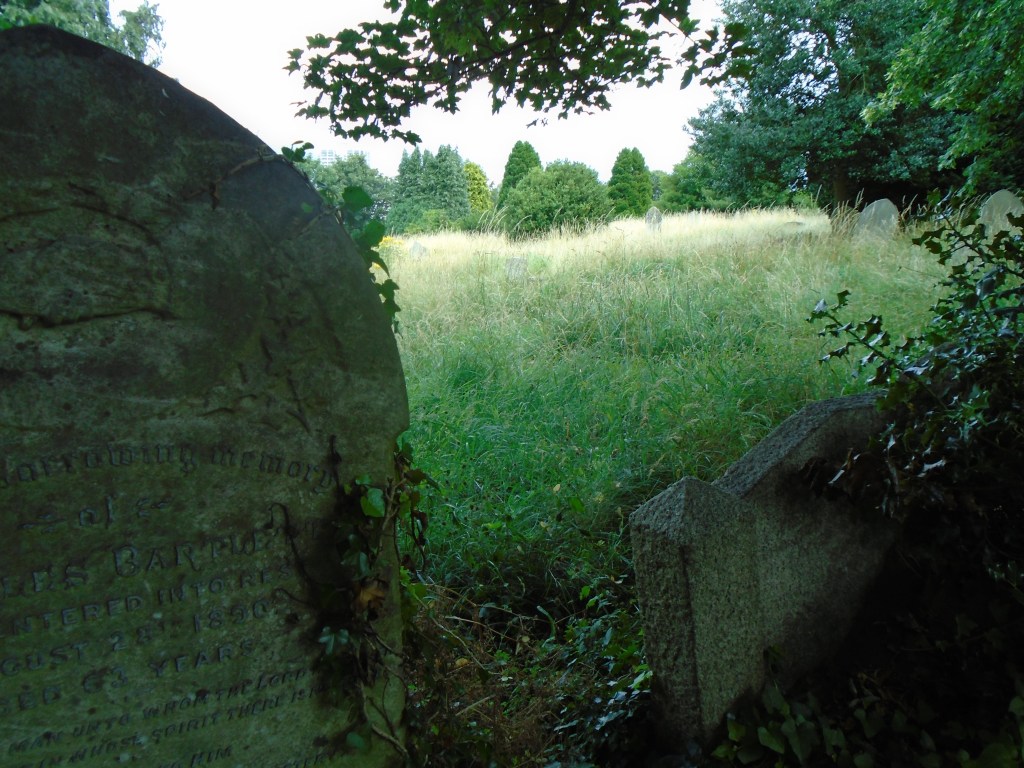
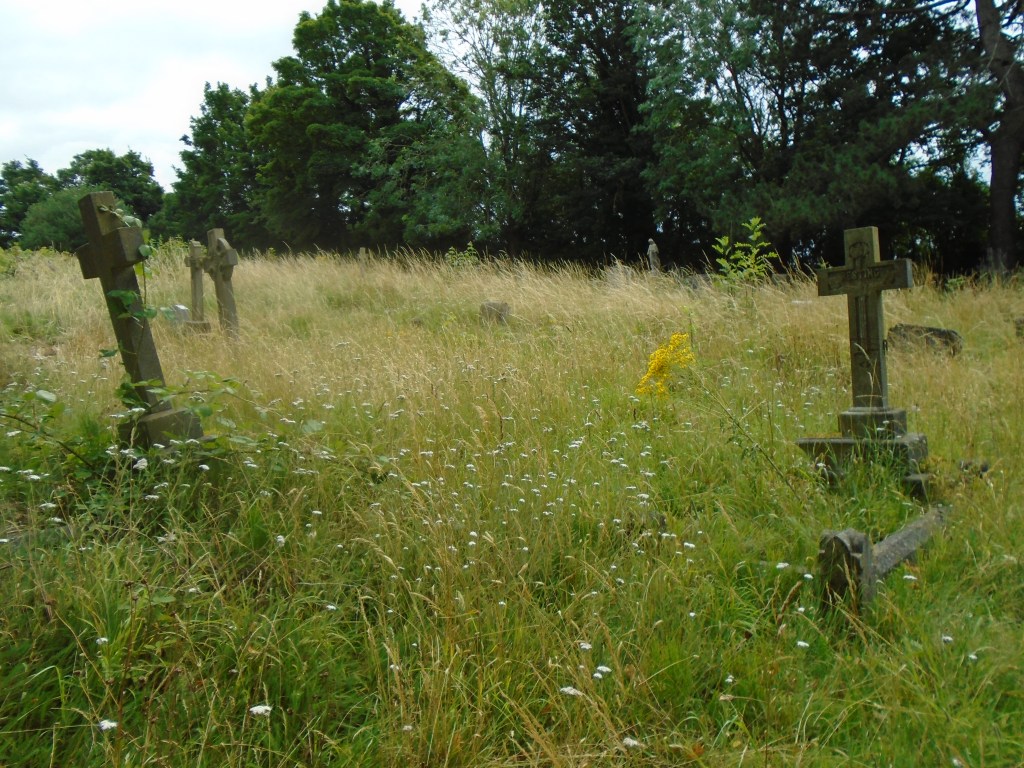
The summer of 2024 has served up a combination of heavy rain and long, hot sunny days. Today the cemetery is a vision of wild abandonment. A place of serene beauty and perfect for the proliferation of wildlife and biodiversity in this densley populated urban area. For the time being we must try to be patient and rest awhile, as the cemetery residents are so well practised at doing.
You may like to join us for a guided cemetery walk during the Heritage Open Days next month. Meet us at the cemetery chapel Sunday September 15 at 1.45 pm for a 2 pm start.
Sometimes a family leaves a very small footprint in this world and the Bentley family seems to be just such a one. But there is a lot to say about their stylish headstone full of symbolism. The fluted columns represent the entrance to heaven while the furled scroll indicates a life that had more to be lived. The bouquet of flowers express condolences and grief.
This is the last resting place of Pelham Bentley who is buried with his parents. It is likely their names are mentioned on the kerbstone edging.
William Charles Bentley married Sarah Wynn Malley at St. George’s Church, Wolverton in 1877. Like Swindon, Wolverton was established as a locomotive repair shop for a railway line under construction, situated at the midpoint of the London & Birmingham Railway in 1838.
William and Sarah both hailed from Lancashire, William from Bury and Sarah from Lancaster. In 1878 Sarah gave birth to twins, a boy Pelham and a girl Lily. By 1881 they had moved to Swindon where William worked as a Coach Trimmer and the family lived at 11 Harding Street.
By 1901 Pelham was lodging in North Manchester where he was was also working as a Coach Trimmer but by 1911 he was back in Swindon. Aged 32 he was living at 129 Broad Street with his parents and his sister Lily who was an Elementary School Teacher.
Lily married John Wells in Swindon during the December quarter of 1912 but at the moment I can find nothing more about him or them. William died in 1937 and by 1939 both Lily and her mother Sarah are widowed and living at 21 York Road.
The Bentley family were obviously a small, close knit family, the type of ordinary people who worked hard and contributed to the building of Swindon. They do not seem to have left us much to remember them by, except this rather beautiful headstone.