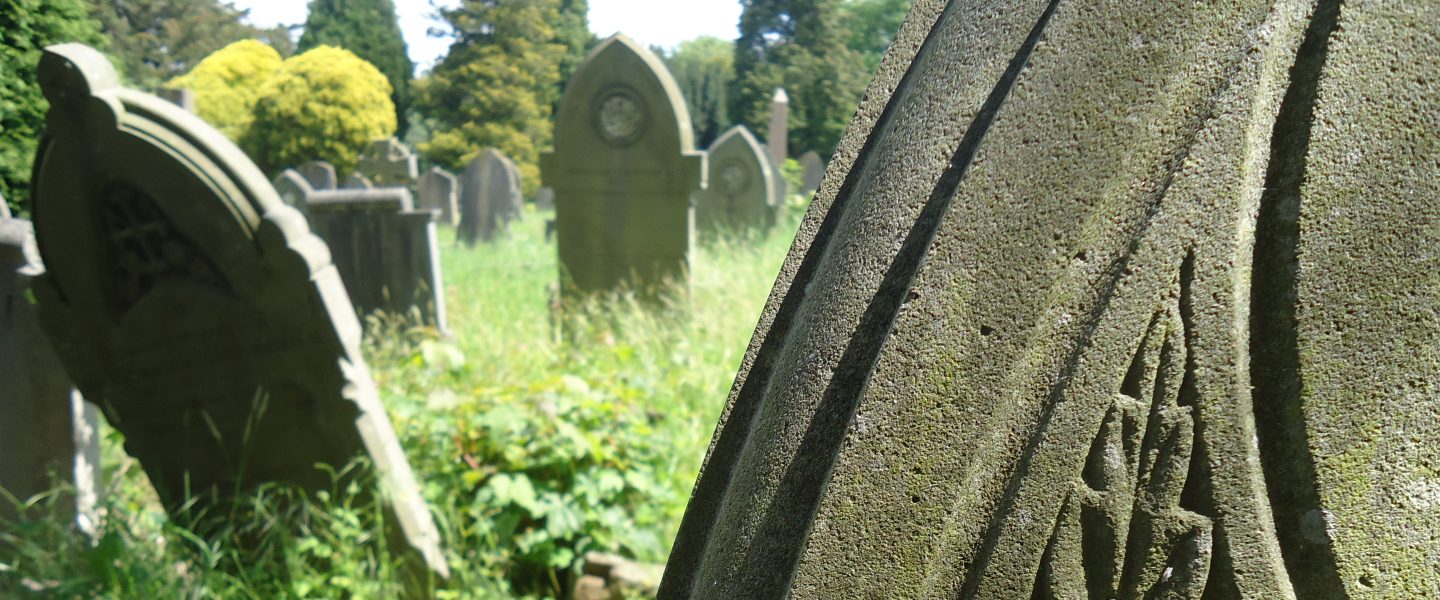
‘Churchyards and cemeteries are scenes not only calculated to improve the morals and the taste, and by their botanical riches to cultivate the intellect but they serve as historical records.’
J.C. Loudon – On the Laying Out, Planting and Managing of Cemeteries and on the Improvement of Churchyards1843
I wonder how many times you’ve walked past this notice without reading it.
The sign displays some important information about the status of the cemetery as a Local Nature Reserve and outlines some dos and don’ts.
During Covid we all came to recognise the importance of nature and green spaces to both our physical and mental well-being. (Well, some of us knew this already). In lock-down, when we were only allowed a limited amount of time outdoors, everyone went in search of beautiful places to walk and suddenly people discovered cemeteries (well, some of us had already).
Is there a conflict between respecting an historic burial ground and creating a Local Nature Area?
Mr Loudon had something to say about the continued function of burial grounds.
‘All burial grounds whatever within the precincts of towns, when once filled, that is, when the whole ground has been buried in, even if with only one body in a grave, should be shut up as burygrounds, and a few years afterwards opened as public walks or gardens …’
Many local residents gain a great deal of pleasure from walking through the cemetery, especially, as we have mentioned, during the difficult two to three years we have all experienced. A small team of volunteers at Radnor Street Cemetery preserve and promote the stories of those buried in the cemetery while our gardening volunteers maintain the Commonwealth War Graves (and others with a military reference) as well as helping people find family graves, so I think we pretty much have it covered!
Image published courtesy of P.A. Williams and Local Studies, Swindon Central Library
The re-imagined story …
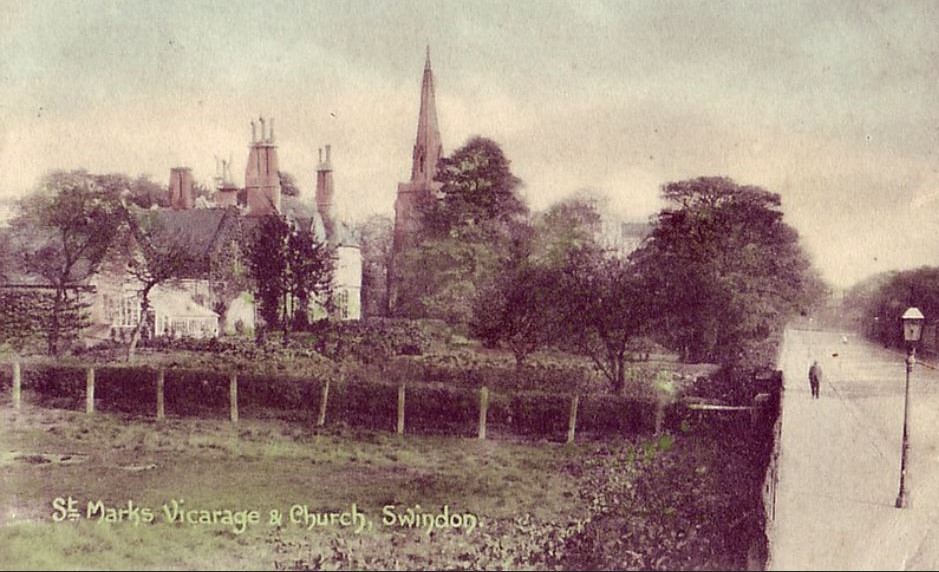
There was no easy route to the cemetery on the hill, as he soon discovered. The steepest was the walk from town up Deacon Street, and this was the one he seldom used, not wishing to arrive out of breath, the sweat on his brow.
Usually he walked from the vicarage around the cricket ground and up Cambria Bridge Road. The only disadvantage with this route was that he met many parishioners who wished to stop him and chat. On these occasions he allowed longer to get to there.
He had little realised how much time he would spend at the cemetery. The parish of New Swindon was large and growing when he joined the team of clergy but, perhaps naively, he had not expected so much death.
Sometimes he accompanied the funeral party, but he soon realised there would be many occasions when he made that long walk alone to stand at a grave beside a grieving father. He never grew accustomed to the burial of infants. How could he give thanks for a life that numbered in weeks? How could he offer consolation to parents that their child was with God when it had been with them such a short time?
That first time he left the cemetery by the Dixon Street gate and walked down Deacon Street to the town centre. He was grateful there were few people about on that wet day at the end of October 1891.
The facts …
Alexander George Gordon Ross was born in 1866 and baptised on April 14,1866 at Trinity Church, Westminster. He was the younger of two sons born to Alexander Henry Ross and his wife Juliana Moseley.
The Rev Ross’s name appears frequently in the Radnor Street Cemetery burial registers, the first time on October 29, 1891 when he attended the funeral of William Crocker aged 48, a solicitor’s clerk who lived at 28 Read Street.
The following day he was at the cemetery again to conduct the service at the burial of twin babies. Ada Kathleen and Agnes Hilda Thompson were two months old.
Death of Canon A.G.G. Ross
Swindon Vicar for Many Years
A Keen Chessman
Canon A.G.G. Ross, Vicar of St Mark’s, Swindon, until September of last year, died suddenly at Oxford on Tuesday. For 47 years he worked at St. Mark’s, which was the only parish to which he was ever attached. He was the son of a former Member of Parliament for Maidstone, and was educated at Eton and New College, Oxford. He was trained at Wells Theological College, and ordained deacon by Bishop C.J. Ellicott, at Bristol in 1891. He came to Swindon the same year.
For 12 years he was assistant priest at St. Mark’s under Canon the Hon. M.J.G. Ponsonby, now Lord de Mauley. He had much to do with the rapid expansion and increasing activities of the growing parish, and he was one of the first to introduced amateur theatricals in Swindon on a large scale.
For some years he was in charge of St. John’s district church, and when Lord deMauley left Swindon, on his appointment as Vicar of Wantage, Canon Ross was appointed Vicar of St. Mark’s in his place. The office of honorary Canon of Bristol Cathedral was conferred on him in 1909.
St. Luke’s Built
The principal extension of the parish with which Canon Ross was connectedwas the building of the district church of St. Luke’s. Services were previously held in the buildings which are now used as schoolrooms.
The spiritual work of the district increased greatly during Canon Ross’s incumbency, although during the war the parish had to suffer the reduction of the clergy from eight to five. When he retired Canon Ross had many tributes paid him. The Bishop of Malmesbury wrote: “We all thank God for his ministry.” And the Rev. Lord de Mauley referred to his “long and good time” in the parish.
A Chess Enthusiast
One of Canon Ross’s main interests outside his work, was chess. He was president of the British Chess Federation and his knowledge of the game was of great value to the Swindon Mechanics’ Institution Club, to the Wilts County team and to the St. Mark’s Chess Club.
When he had been 25 years as vicar of the parish, the parishioners presented him with an illuminated album as a memento of the dedication of a beautiful oak rood screen which was set up as a thanksgiving for the 25 years of his vicariate.
Since his retirement, Canon Ross had spent a good deal of his time at Maidstone, where he went to live. At the time of his death he was staying with the Rev. Trevor Jalland, Vicar of St. Thomas’s, Oxford, and formerly of St. Luke’s, Swindon.
There will be a Requiem Mass at St. Mark’s, Swindon, on Saturday morning.
North Wilts Herald, Friday, 13 May, 1938.
The late Canon Ross
The funeral of Canon A.G.G. Ross, former Vicar of St Mark’s, Swindon, who died suddenly at Oxford on Tuesday, will take place at Swindon on Saturday. The body will be brought to Swindon to-day (Friday) and will rest in St. Mark’s Church, where watch will be kept. On Saturday morning there will be Requiem Masses at 7, 7.30 and 8 o’clock, and a solemn requiem will be sung at 9.30. The funeral service will take place at St. Mark’s at 2.30 the same day, and the interment will be in Radnor-street cemetery.
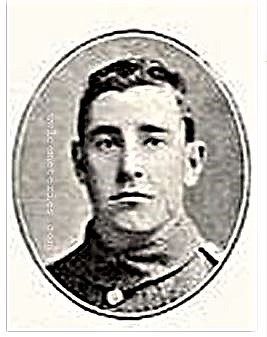
Archibald Edward Knee was born in Stroud in 1892, the son of Francis and Rose Knee. The family later moved to 123 Albion Street where Francis worked as a railway carriage painter in the GWR Works and Rose cared for their seven young children. Archibald joined his father in the GWR Works on leaving school, working as a railway carriage painter and sign writer; a job he could safely expect to hold for life.
Archibald enlisted in the Wiltshire Regiment in July 1915, when a war initially anticipated to be over by Christmas 1914 approached its first anniversary. He embarked for France on New Year’s Eve 1915, part of desperately needed reinforcements at the front.
Archibald Edward Knee
The British army began preparing for the ‘big push,’ in the Spring of 1916. It was believed this allied offensive would finish the war. The Battle of the Somme, in which more than 57,000 British soldiers were killed, wounded or reported missing during the first 24 hours of action, was yet to come.
The 1st Battalion of the Wiltshire Regiment was at Pylones, three kilometres north of the German held Vimy Ridge. The German army bombarded this section of the Western Front on May 21, firing everything at their disposal, including gas and lachrymatory (tear gas) shells.
The men of D Company were in battle by day and making running repairs to fencing and trenches throughout the night.
Lt Col W.S. Brown recorded the events of May 24 in the regimental war diary:
“In the trenches. The enemy were able to reach the Birkin Crater post with Cylinder stick bombs and some casualties were caused.
Many rifle grenades were fired at the outpost line of P73: those fired in retaliation appeared to do considerable damage. After 5 p.m. the enemy fired several heavy trench mortars at P74 and P75 and also at the head of Grange C.T. Snipers claimed three Germans. Repairs to the P line were carried out and a large amount of wire was put out along the whole front during the night of 24th/25th.”
Private F. Daniels of A Company was killed outright. Lance Corporal Knee was among 10 other casualties that night.
Archibald was taken to the 22nd General Hospital at Etaples where he received emergency treatment. He had suffered a gunshot wound to his left thigh, which in itself would probably not have proved life threatening. It was the effect of the German gas attack that proved fatal. Archibald developed gas gangrene and died at 11.20 on the morning of May 29. He is buried in the Etaples Military Cemetery.
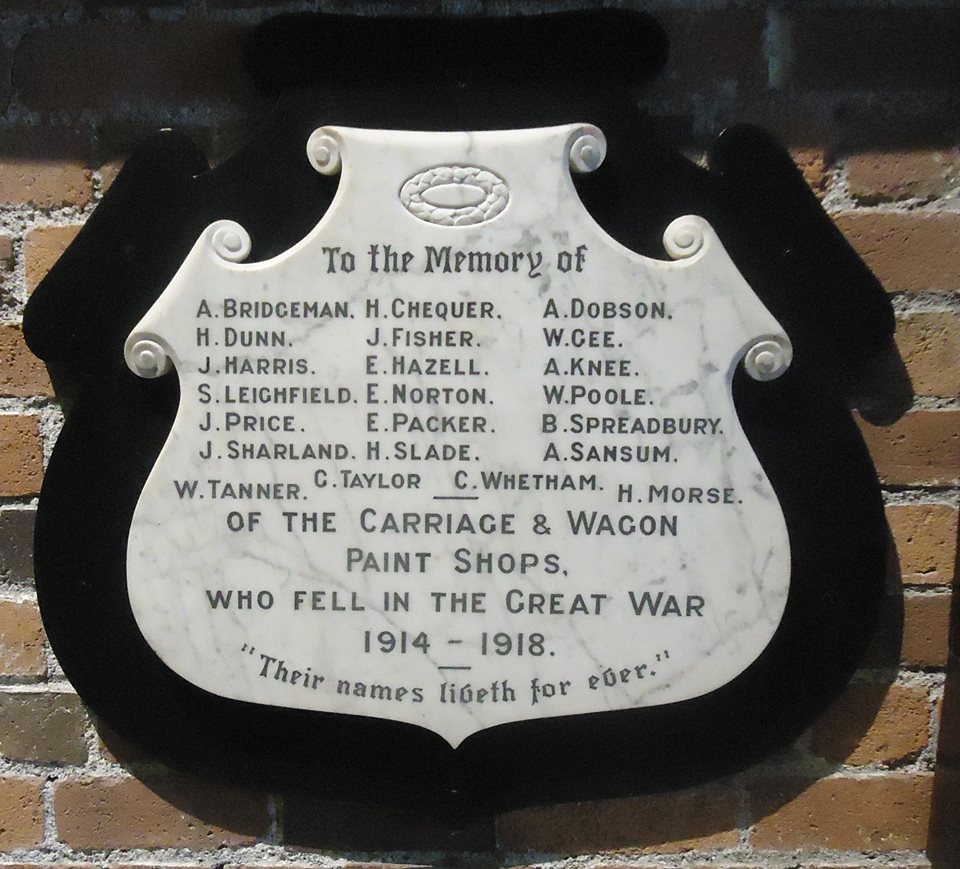
Archibald’s name appears on the memorial dedicated to the memory of those from the Carriage & Wagon Paint Shops who gave their lives in the Great War. This plaque can now be seen in the STEAM Museum.
Princess Helena Victoria visited Swindon on April 21, 1923 published courtesy of Local Studies, Swindon Central Library.
The re-imagined story …
When I told mum the Mayor had selected me to meet Princess Helena Victoria when she came to Swindon, she said nothing at first.
I joined the Girl Guides when I was 12 and went on to become a Ranger. It was in this role that the Mayor, Cllr Harding, had invited me to meet the Princess when she came to town to open the Boys’ Red Triangle Club.
I loved everything about being a Guide. I loved the fellowship and the feeling that I was making a contribution to society. I had made some good friends. Where we met was the only place I could relax and have fun and laugh and be myself. There wasn’t much laughter in our house. Mum’s grief was all consuming, to laugh seemed to be making a mockery of her sadness.
She hadn’t always been a serious kind of person, it was dad who was the sombre character. She would tease him and tickle him when he refused to smile and I can hear her tinkling laughter somewhere in my memory.
“I’d rather you didn’t meet her, Sylvia.”
I was stunned. The Mayor had paid me a huge honour, selecting me to meet the Princess.
“It’s a real privilege mum. The Mayor has only asked George Akins from the Scouts and me to meet her.”
“She’s German,” said mum, blunt just like that. ‘She’s German.’
“She’s Queen Victoria’s granddaughter.” I was incredulous.
“And she was German, too. I’ll not have a daughter of mine shake hands with a German.”
I couldn’t argue with her, that would have been too cruel. She had lost dad and my uncle in the war. Sometimes it felt as if the war had been in another age, at other times it felt as if we were still living through it. Some people would bear the scars for a lifetime, limbs lost, faces disfigured, minds broken. My mum had a broken heart and I doubted whether she would ever recover.
Everyone was excited about seeing the Princess. There was to be a luncheon at the Queen’s Royal Hotel first before she opened the Boys’ Red Triangle Club and a Civic Gathering in the Town Hall afterwards.
I explained to the Mayor why I couldn’t greet the Princess. I thought he would be angry, but actually he seemed to understand.
Sometimes it felt as if the war had been in another age; at other times it felt as if we were still living through it.
Mayor A.E. Harding
The facts …
Princess Helena Victoria visited Swindon on Saturday, April 21, 1923. The Princess was the elder daughter of Prince Christian of Schleswig-Holstein and Princess Helena, the daughter of Queen Victoria and Prince Albert. She was born at Frogmore House in 1870 and lived her entire life in Britain. During the First World War she visited British troops in France and afterwards worked to promote and support the YMCA and the YWCA. During the war King George V relinquished the use of German royal titles for himself and his numerous cousins.
Albert Edward Harding was born in London in 1865. At the time of the 1881 census he was working in the railway factory as a clerk and lodging with the Hunt family at 38 Prospect. He married Agnes Westmacott in 1889 and the couple had three children, Stewart Jasper, Myrtle Marion Westmacott and Albert Edward Benjamin Harding.
The family first lived at 115 Princes Street where in 1898 Harding was the divisional secretary to the National Deposit Friendly Society, in addition to his job as a Clerk in the railway works. The family later moved to their long-time home at 56 Victoria Road.
Albert Edward Harding was a Councillor representing the East Ward from about 1911 and served as Mayor of Swindon in 1922/23, the year that Princess Helena Victoria visited Swindon.
Albert Edward Harding died at his home on December 30, 1943. He is buried in plot E8568 with his wife Agnes, their son Albert Edward Benjamin Harding and daughter in law Kathleen.
Their eldest son Stewart Jasper Harding is buried in the neighbouring grave plot E8569 with his wife Gladys.
Dr George Money Swinhoe was the GWR surgeon at Swindon between c1861 to his death in 1908. He and his wife Diana produced a large family based first at 4 London Street and then later at Park House, which served as family home and doctor’s surgery. They had eight daughters, one of whom died in infancy, five who married and two who didn’t; of their five sons one entered the military, one trained as an engineer and two became doctors working alongside their father. Youngest child Maurice chose a somewhat different career – that of banana planter and fruit exporter working with Elder & Fyfe in Kingston, Jamaica.
Unfortunately Maurice was in Jamaica when an earthquake occurred on January 14, 1907. The first terrifying reports stated that almost all the buildings in Kingston had been destroyed and there was a great loss of life. In the following days an estimated 20,000 people were made homeless, camping out on the racecourse. One report told how ‘continual religious services are being held, in which the people join with hysterical fervour.’ While fires continued to rage in the dock area, a tsunami flooded the lower part of Kingston. The death toll quickly escalated with 1,000 declared dead, although this figure was thought to be an inaccurate and low estimation. The earthquake was described as one of the world’s deadliest recorded in history with aftershocks still being recorded up to March 22, 1907.
Maurice survived and in due course returned to England, but it would appear from the obituary published in the North Wilts Herald, Friday, September 29, 1911 that he never fully recovered from the ordeal.
A Swindonian in Jamaica
News from Mr Maurice C. Swinhoe
On Sunday a cable message was received by Dr George Money Swinhoe from his youngest son, Mr C. Maurice Swinhoe, who went out to Jamaica and settled near Kingston some five or six years ago, stating that he is safe, having, happily, escaped those terrible consequences of the recent earthquake which have been shared by so many.
It is hardly necessary to say that the message, so eagerly looked for, has afforded considerable relief to Dr. Swinhoe and the members of his family.
As stated a fortnight ago in the “Advertiser,” Mr Maurice Swinhoe went out to Jamaica some five or six years ago, and settled some three miles outside Kingston, where he threw in his lot with a partner, possessing an extensive banana plantation, as a planter. Close by the plantation is the racecourse, covering a wide stretch of turf, and, according to the reports received from the stricken area, it was upon this racecourse that the desolated people camped out. Dr. Swinhoe, however, received no news from or concerning his son, and, naturally, the absence of any intelligence gave rise to a little anxiety.
Dr Rodway Swinhoe was, perhaps, the most sanguine member of the family for when fears for the absent one’s safety were beginning to be felt, he said to an “Advertiser” reporter in the course of an interview, “I don’t think anything can have happened to my brother. You see, he picked up a little medical knowledge while out there, and no doubt he has been so busy doing what he can for the sufferers that he has not had the time or opportunity to send any word home.”
The Evening Swindon Advertiser Monday, January 28, 1907
Death of Mr M.C. Swinhoe
The death occurred on Wednesday at the residence of his sister, 11, St. Mary Abbott’s Terrace, London, W., of Mr Maurice Carew Swinhoe, [the youngest age,] was the thirteenth child of Dr. G.M. Swinhoe and was, of course, a brother of Dr. G.R. Swinhoe, of Swindon. Some years ago he went to Jamaica and was occupied as a fruit exporter, being connected with the well known firm of Elder & Fyfe at Kingston. He was in Jamaica at the time of the great earthquake, and a series of letters was published in the columns of this paper at that time vividly descriptive of the stirring phases of danger which the deceased experienced. He suffered much in consequence from nervous derangement, and returned to England, and some two years ago underwent an operation at Bournemouth. It subsequently transpired that this was of little avail, and a further operation was performed at St. Thomas’s Hospital, London. The deceased had been ill for a considerable time previous to his death.
North Wilts Herald, Friday, September 29, 1911.
The body of Maurice Carew Swinhoe was returned to Swindon where he was buried in grave E8228, a large family plot. He was 30 years old.
I’d returned from the war pretty much fit for nothing. But my wounds were not obvious. I had not lost a limb, I was not scarred or hideous to look upon.
I suffered from being subjected to heavy shelling, day after day, week after week, from living on the edge of terror.
Others seem to return home unaffected from the hell they had endured, although I would question that. I don’t think any returning soldier was the man he had been when he left for the war. Even now, twenty years later, you can see the men ravaged by their experiences. The men who drink too much, the men whose temper is easily ignited, the men who retreat into silence. We all carry our wounds, the obvious ones and the hidden ones.
Mr Hustings must have wondered if he had been ill advised employing me. I’m sure plenty of his other workmen must have thought so to. At first I couldn’t go up a ladder, but there were plenty of jobs I could do at the yard. Gradually my life became more of the now and less of the then. My confidence grew, my health improved and I began to pull my weight in the firm.
I shall add Mr Hustings to the memory of those others I mourn. He gave me a job when no one else would, he gave me back my life.
The facts …
With just a week left to complete his term of office as Mayor, Councillor H.R. Hustings died suddenly at the Victoria Hospital on Sunday, October 27, 1940.
A tough speaking, no nonsense Labour politician, Henry Russell Hustings, Swindon’s 40th successive Mayor, took office on Thursday, November 9th 1939 as the town got to grips with the black out, air raid warnings and wartime restrictions.
A former trade union organiser for the National Union of Vehicle Workers and the Transport and General Workers’ Union, Henry had enjoyed a varied working life and the Swindon Advertiser styled him as the ‘Jack of All Trades Mayor.’
His first job was with a firm of agricultural engineers in Dorset followed by stints as a traction engine driver, shop assistant, porter, engine driver in a laundry, miner, stoker, baker and in 1939 he was a window cleaning contractor.
Henry was born in 1883 in the Dorset village of Hilton to John W. Hustings and his wife Susan. In 1903 he married Alice Maud Ball and the couple had four children.
A member of the Labour party since 1919 Henry began his political career in Devizes in 1921 where he was the first Labour member of the Town Council. By 1927 he was living at 38 Regent Circus, Swindon and represented the West Ward on the Swindon Town Council.
Councillor Hustings was a founder member of the Unemployed Association, launched at a time when Swindon had more than 5,000 unemployed. In 1939 he was President of both the Swindon branch of the Labour Party and the Swindon Trades Council. He also served on the Management Committee of the Swindon Co-operative Society, the Council of Social Service, the local Food Control Committee and the Western Area Federation of Trades Councils.
On August 22, 1940 Henry launched Swindon’s own Spitfire Fund. The aim was to raise £5,000 and in less than a week the fund stood at £245. By October Swindonians had raised £3,300 and were well on the way to achieving their target. Donations came from across the Swindon and district area. Two little girls sold some of their toys and gave the 8 shillings they had raised to the fund while Kingsdown brewer J. Arkell & Sons presented the Mayor with a cheque for £100.
At the time of the Mayor’s death the fund stood at £3,956, just over £1,000 short of its £5,000 target.
“The fund had a very good start, but it seems to have slowed down during the last two or three weeks,” said Mr Raymond Thompson, director and general manager of the Swindon Press who was behind the last desperate drive to complete the fund. “We owe this and a lot more to our late Mayor.”
In just seven days generous Swindonians had donated £1,352 to complete the project inaugurated by Henry Hustings. A cheque for £5,308 was presented to Col J.J. Llewellin, Parliamentary Secretary to the Minister of Aircraft Production by Swindon’s MP Mr W.W. Wakefield in January 1940.
Henry’s death at the age of 57 followed recent surgery from which it was thought he was making a good recovery, and came as a great shock to fellow members of the Council.
The funeral service conducted by Major W.J. Hills of the Salvation Army took place at the Mission Hall followed by interment at Radnor Street Cemetery.
“Representatives of practically every industrial and social organisation in the town and district took their place in the cortege, and also paid their last tribute at the graveside at Radnor Street Cemetery,” reported the Advertiser.
“The public life of Swindon will be much poorer by the passing of Councillor Hustings,” Mr G.A. Marshman, presiding magistrate said paying tribute to a man who had devoted his life to the underdog – Swindon’s Jack of All Trades Mayor Henry Russell Hustings.
Surprisingly there is no headstone to mark Henry’s grave.
St Margaret’s Road published courtesy of P.A. Williams and Local Studies, Swindon Central Library.
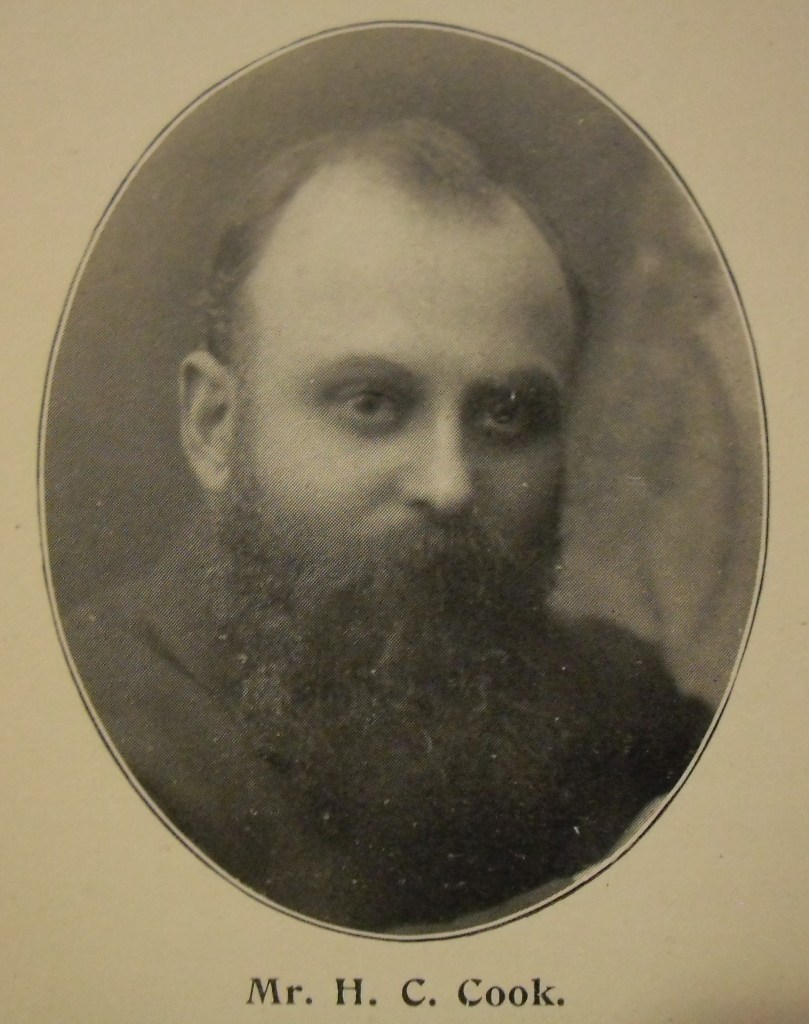
Henry Charles Cook was born in Bledington, Gloucestershire in 1860 the son of Charles Cook, a carrier, and his wife Jemima. By 1881 Henry had moved to Swindon with his mother and her second husband Thomas Smith where the family lived at 19 Prospect Hill. Henry, then aged 21, was working as a plumber and glazier. In 1882 Henry married Elizabeth Jane Carpenter and the couple went on to have three children, William, Daisy and Frederick.
Henry’s building business was soon up and running with projects in progress by 1884. He built numerous properties in Gorse Hill including houses in Florence Street, Omdurman Street and in 1907 he built property in Osbourne Terrace, a new street off Ferndale Road. But he didn’t confine himself to this area of town. In 1897 he was building in St Margaret’s Road and Goddard Avenue and in 1903 he built 23 houses in Devizes Road. During the 1920s Henry’s firm returned to Gorse Hill where they built more than 25 houses in Harcourt Road and another 9 properties just round the corner in Cobden Road.
And like so many men of his generation, Henry took an active part in the civic, political and religious life of the town.
Elizabeth died in 1925 aged 66 and was buried on June 13 in Radnor Street Cemetery plot E8273. Henry died at his home, 59 Broome Manor Lane, ten years later. He was buried with his wife on August 14, 1935.
Death of Mr H.C. Cook
Well Known Swindon Methodist
The death occurred on Saturday night, at his residence, 59, Broome Manor lane, Swindon, of Mr Henry Charles Cook, who for 50 years had been prominent in the business and civic life of Swindon. He was 75 years of age.
Mr Cook came to Swindon as a youth and was apprenticed to the decorating trade. He began in business on his own account as a very young man, later taking up building, and was in business in the town for over 60 years, for a great part of that time at his present premises in Wood Street.
Mr Cook had been an Alderman of the Borough and had served capably as chairman of the Education Committee. He was also active in Methodist circles in the town, being attached to the Regent Street church; he was Circuit Steward for many years, and was a splendid delegate to conference. He was an ex-president of the Swindon Liberal Association.
Mrs Cook died ten years ago, and there are left three children – Mr W.H. Cook, chemist, of Faringdon; Mrs J.B. Hodges, of Andover; and Mr F.C. Cook of Wood street, Swindon.
The Funeral
The funeral took place on Wednesday. The service took place at the Regent Street Methodist Church, and was conducted by the Rev. T. Allison Brown, the interment being at Radnor Street Cemetery.
The principal mourners were Mr and Mrs W.H. Cook Faringdon (son and daughter in law), Mr and Mrs J.B. Hodges, Andover (son in law and daughter), Mr S.C. Cook, Swindon, (son), Mrs Button and Mrs Cull, Swindon (sisters), Mr B.W. Cook, Faringdon, (grandson), Mr K.L.W. Cook, Swindon, (grandson), Messrs W.H. Kent, F. Tucker, W. Smith, E. Liddiard and Covey.
Messrs A.E. Smith and Son, Gordon Road, Swindon, had charge of the funeral arrangements.
Extracts published from North Wilts Herald, Friday, 16 August, 1935
Goddard Avenue published courtesy of P.A. Williams and Local Studies, Swindon Central Library.
The store closed the day of Mr Levi’s funeral, as a mark of respect. That kind of thing seldom happens now, but things were different in those days.
I had only just started work at Morse’s in the summer of 1913. Drapery assistants worked a long day and as a new, young apprentice I was called upon to do the more menial tasks as I learned my trade. I remember doing a lot of dusting.
Morse’s had begun as a small draper’s shop in Stratton St Margaret, opened by Mr Levi’s father Charles, more than 50 years ago. It was Mr Levi who opened the Regent Street store where he proudly announced that you could furnish your house ‘cheaply and well.’
I often wondered how much of his own stock he used to furnish his big old house at The Croft where he entertained his political friends and held the large Primitive Methodist conventions. My mum told me not to let the manager at Morse’s hear me speak like that as I would soon get my marching orders.
The staff were gathered together when the announcement of his death was made earlier that week. Many were moved to tears. I hung my head but to be honest I didn’t know him, his days of calling into the store and overseeing the business had long passed. We opened late that day, after we dressed the store in black, trimming last used when the old Queen died.
That week in September everyone spoke about Mr Levi in hushed, reverent voices. I wondered if he was really that well liked, or whether this was just the ‘old order’ speaking; those who touched their forelock when the squire drove past in his carriage.
The end of an era, people said. At 16 you don’t really appreciate what that means. But a year later the world was at war. Nothing was ever the same again.
The facts …
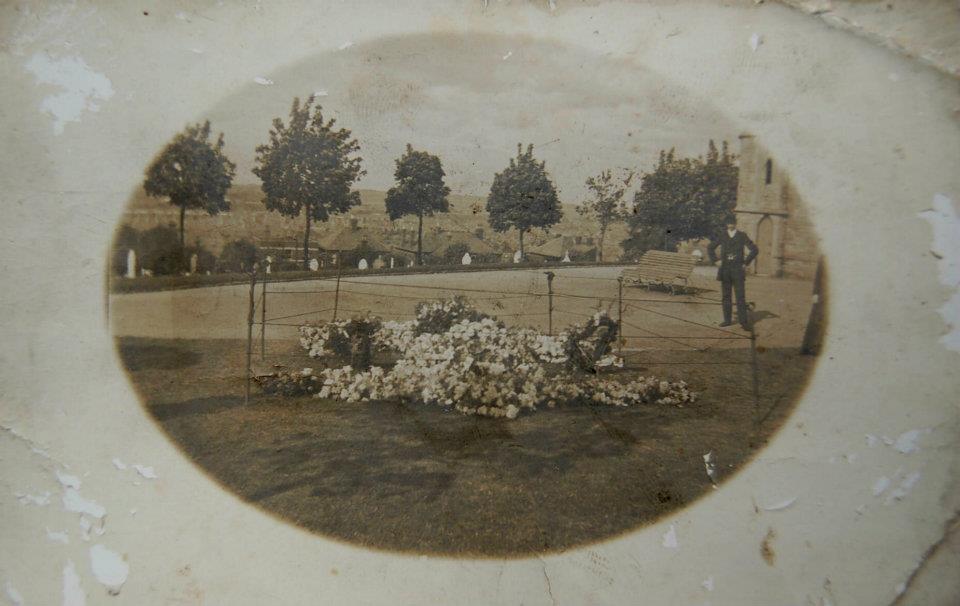
The remains of the late Mr Levi Lapper Morse were laid to rest at Swindon Cemetery on Saturday, when nearly 5,000 people witnessed the last rites.
The Cortege, on leaving The Croft, proceeded to the Regent Street primitive Methodist Church. It was headed by a posse of police under Inspector Winchcombe. Then followed the borough magistrates and the Mayor (Mr J.J. Shawyer). The deputy mayor (Mr G. Brooks), and the Town Clerk (Mr R. Hilton). Most of the members of the Corporation and representatives of the principal public bodies brought up the rear of the first portion of the procession. Two carriages laden with beautiful wreaths proceeded the handbier, on which the coffin was laid.
An imposing spectacle was made by the male and female employees of Mr Morse’s business, who came immediately behind the carriages conveying the family mourners. Next were the representatives of religious bodies, and finally about 200 friends and acquaintances who had attend to pay their last tributes of respect.
Besides the family wreaths were tributes from Sir William and Lady Hartley, the members of the Swindon Primitive Methodist circuits, the North Wilts Liberal Association, Members of the second Methodist circuit quarterly meeting, the business staff etc.
A Friend’s Tribute
An impressive panegyric was delivered by the Rev T.M. Pinnock, who described the late alderman as ‘my faithful and true friend for 40 years.” Speaking with evident emotion, the reverend gentleman referred to Mr Morse’s generosity to the Church both locally and in the connexion generally. Without him it would have been impossible for their church in Swindon to be what it was that day. Reference was also made to Mr Morse’s unobtrusiveness and natural business talent, which latter quality he made of immense serve to the Church. “He never forsook the friends of his youth,” added the speaker, “and he died fearing God. He sought to make God’s will the rule of his conduct, God’s service the joy of his heart, and God’s glory was the aim of his life.”
Another brief but earnest tribute was given by the Rev J.D. Thompson (general committee secretary), who said the sympathy of Primitive Methodists all over the country went out to the bereaved.
During the service the hymns “O God our help in ages past” and “Rock of Ages” were sung.
A cordon of police had been drawn round the chapel, on the west side of which was the grave, lined with the deceased’s favourite flowers – red roses – and many other beautiful blooms. Large and sympathetic crowds witnessed the final rites, conducted by the Revs. J.D. Jackson and J. Dobson.
A memorial service was conducted by the Rev T. Mostyn Pinnock (formerly of Swindon), at the Regent Street Church on Sunday night.
Extracts from The Wiltshire Times Saturday published September 20 1913
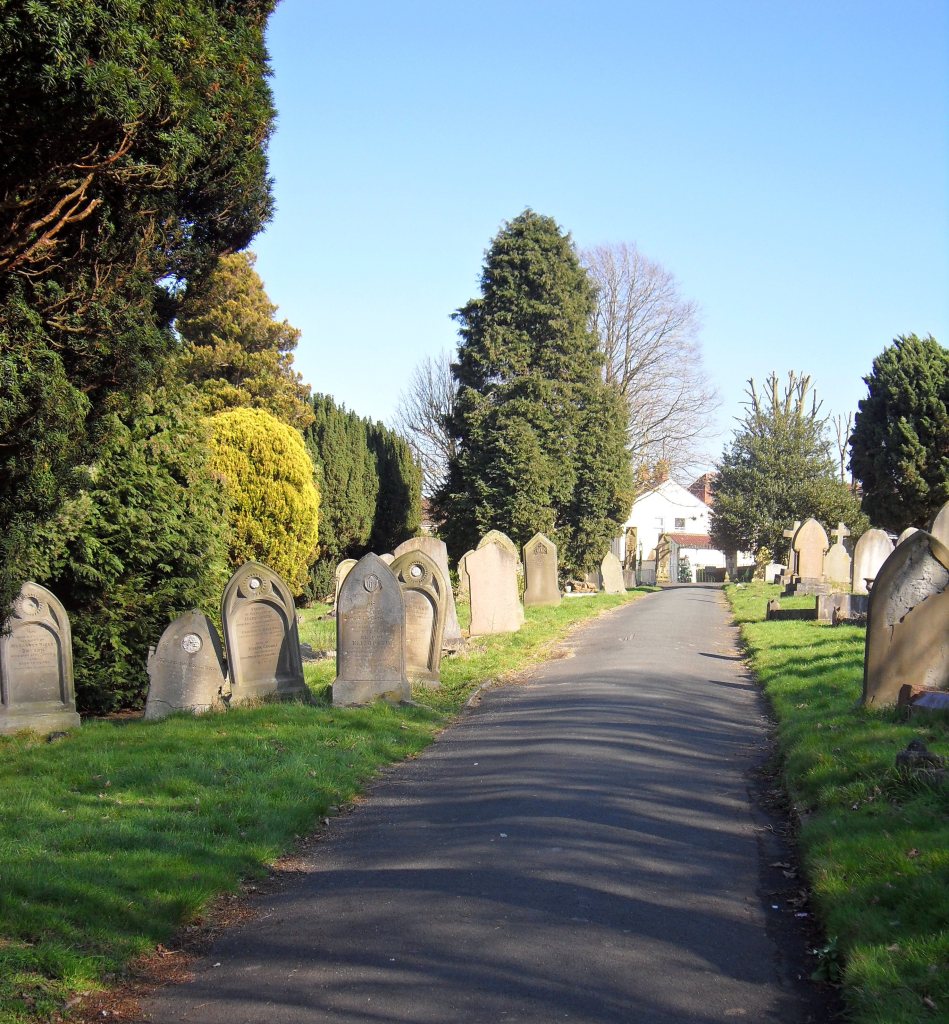
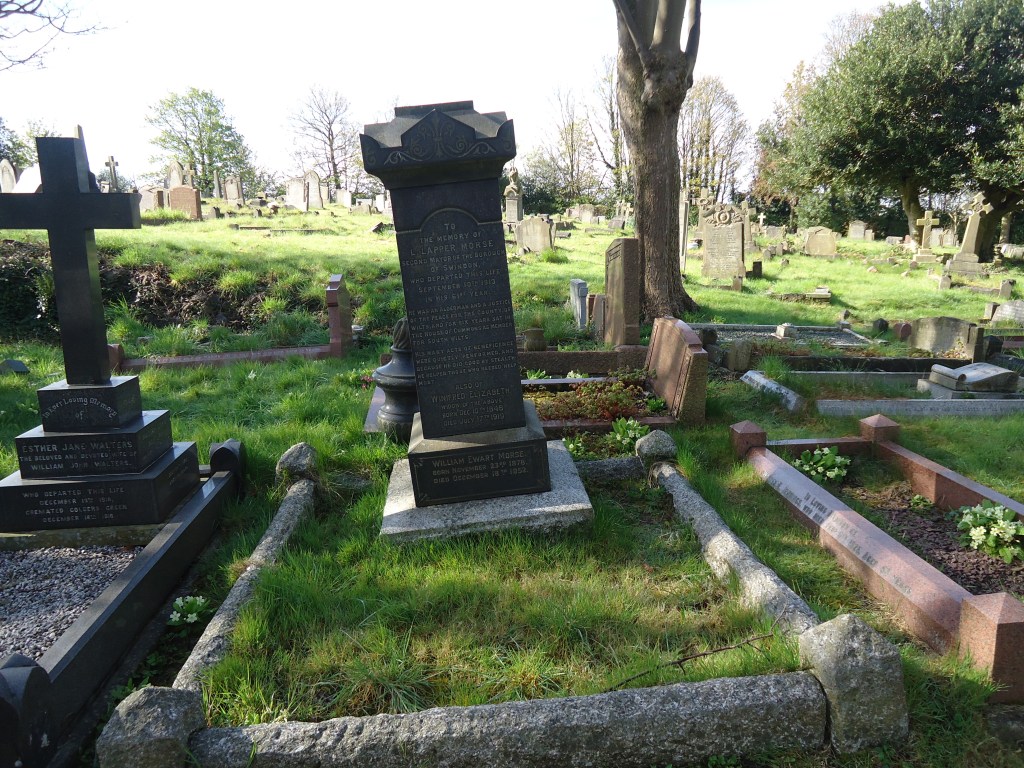
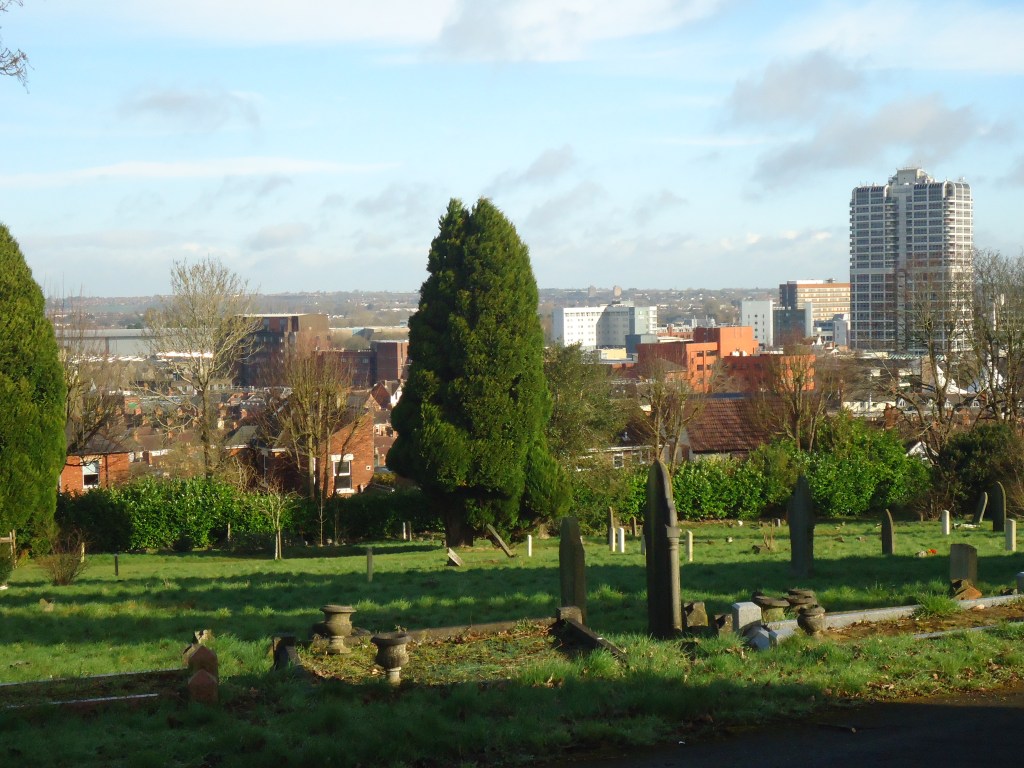
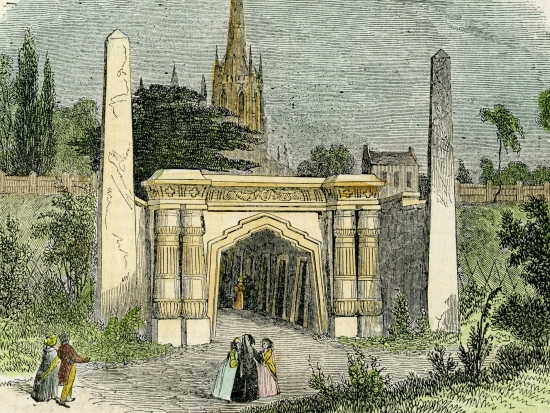
Unlike Highgate Cemetery in London, Radnor Street Cemetery is not a tourist destination. Plenty of Swindonians don’t even know of its existence. There are no elaborate mausolea, no Egyptian Avenue or Terrace Catacombs and although at first sight there appear to be large numbers of headstones, the vast majority of graves are unmarked.
The GWR Works opened in 1842 and employed more than 1,700 men twenty years later. At the same time a shortage of burial spaces in the town became of critical concern, but the Radnor Street cemetery was not opened until 1881.
Highgate Cemetery has been the setting for numerous books, several films and in the 1970s was subject to a bizarre vampire obsession. Radnor Street cemetery online archives include just a few early 20th century photographs and a 1980s music video filmed by Swindon music legend XTC.
Highgate Cemetery is famous for being famous; for the number of people of note and celebrities interred there. Radnor Street cemetery is all about working class history. The men who rose through the ranks of the railway engineering hierarchy and others who spent a lifetime on the factory floor in the GWR Works. Those men who served in two world wars and died as the result of their service. The women who trained as nurses, who taught in Swindon’s schools, worked in factories, shops and offices and raised large families who began the cycle all over again.
This is Swindon’s working class history – stories of the triumphs and the tragedies and the sheer hard work.
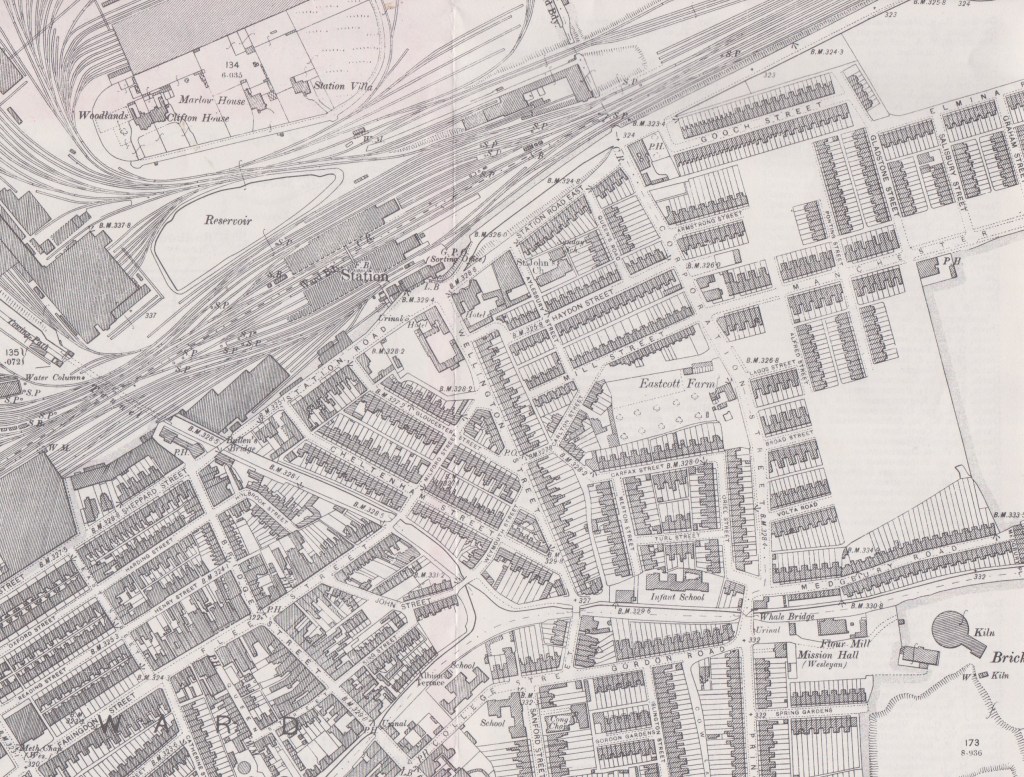
Job Day, Jabez Henry Forshaw and C. Joyce were among the builders who begun work on a New Swindon street in 1869/70. By the time of the 1871 census Cheltenham Street was a busy residential town centre street extending from Station Road to the canal. It vanished in all but name with the demolition of more than 80 houses and the later construction of the Tri Centre complex built in the 1980s.
Photographs taken recently show the Fleming Way area as work begins on the ambitious £33m bus boulevard project due for completion in 2024. Reduced to the Cheltenham Street car park for many years this latest project may be the final death knell for a street that provided homes for a busy town centre community. This aerial view is believed to date from the late 1950s before the area was ‘improved’ during an earlier regeneration scheme.
So, what brought James Hager Adnams and his wife Elizabeth to Swindon following their marriage in London in 1863. Two years previously James had served as a Chief Quartermaster on HMS Ganges before the ship was converted into a training ship however, by 1871 the couple were living at 47 Cheltenham Street in a house they shared with Zacharias Peskett and his wife Ann. James describes his status as Seaman Pensioner. James and Elizabeth continued to live with Zacharias when in 1881 their address is 75 Cheltenham Street. They may have moved into another house in the same street or the street may have been renumbered as further properties were added.
James died at number 75 Cheltenham Street in April 1887 and was buried in a public grave in Radnor Street Cemetery plot number B1392. Elizabeth continued to live in the same house, taking a lodger by the time of the 1901 census. Elizabeth died in April 1910 and was buried on April 9, the anniversary of her husband’s funeral. She is also buried in a public grave plot B2360.
In 1912 Cheltenham Street was the former home of retired GWR foreman Benjamin Howard 63, and his wife Ellen 61, when they decided to join their two sons in America. Having sold up their belongings and said goodbye to friends they set sail in style on the ill-fated, luxury liner, the Titanic. Benjamin and Ellen were among more than 1,500 people who died on the ship’s maiden voyage. Their bodies were never recovered.