James Hinton – a return visit

So, what did James Hinton ever do for us? Not me personally, but Swindon in general. Here is a quick resume of the roles he played in both his personal life and his public one.

Published courtesy of Local Studies, Swindon Central Library.

He was born in 1842 in Newport Street, Swindon but grew up on the family farm at Wanborough. In 1860 he married Sarah Ann May and the following year the couple were living in Lambourn where he worked as a Corn, Seed and Flour Factor. He next worked as a butcher, first in Longcot and then in Wroughton. Sarah died in 1870 and after his second marriage to Sarah Honor Whiteman he moved back to Swindon and emerged on the Swindon scene as a businessman of considerable influence.  A builder and brick maker he soon became an auctioneer with premises in Regents Circus. He was a railway entrepreneur, a Freemason and a Forester, New Swindon Local Board member, Alderman and Mayor of Swindon in 1903. 

But his biggest legacy has to be the numerous properties he built across the town, which still survive to this day. Perhaps his two largest building projects were the development in Kingshill where he laid out the Mount Pleasant housing estate in 1877, building 35 houses in 1878. In 1879 he laid out land between Dixon, Stafford and Clifton Streets where he continued to build in 1883 and 1884. In 1881 he built a brick kiln in Kingshill, obviously to keep up with the demand for bricks while work continued. In 1889 he began work on the Gorse Hill Farm housing estate, meanwhile continuing with further projects across both New and Old Swindon.
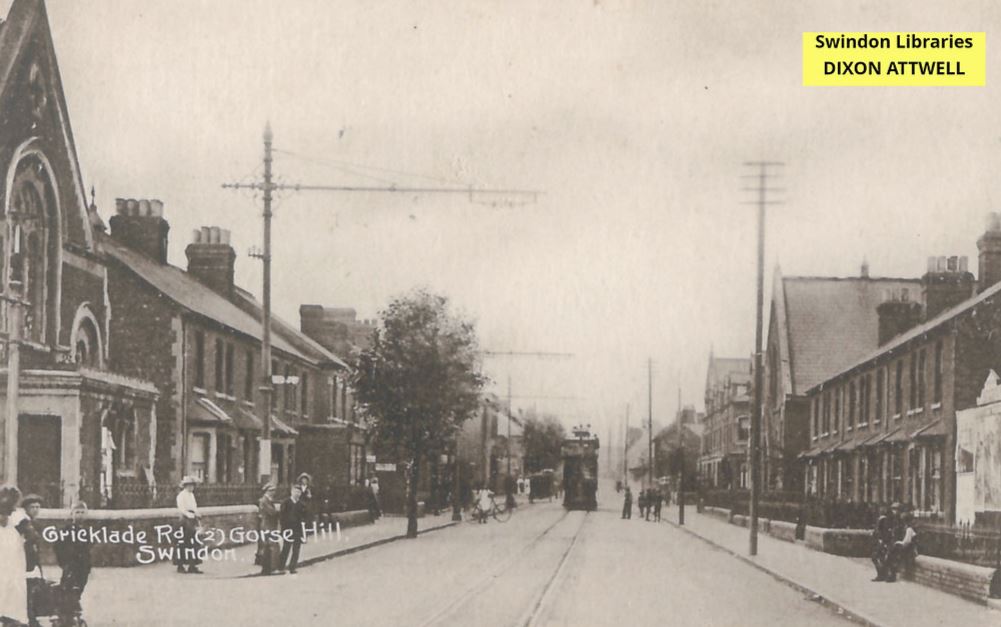
published courtesy of Local Studies, Swindon Central Library

There can be no denying that James Hinton made a tidy penny for himself. After his death in 1907 his effects were valued at £18,910 4s 1d (worth today approximately £2.1m) but without his investment in the fabric of the town it is questionable that it would have developed so extensively or so rapidly as it did in the 1870/80s.

James Hinton died in 1907 and is buried in Radnor Street Cemetery with his wife Sarah who died in 1928.

W.H. Read – the continuing story

Occasionally I return to a Radnor Street Cemetery resident for a second blogpost and I felt that W.H. Read was a worthy candidate. You can read about him here where I mention a couple of the building commissions he is best remembered for, but looking at his long list of projects I felt he deserved a revisit.

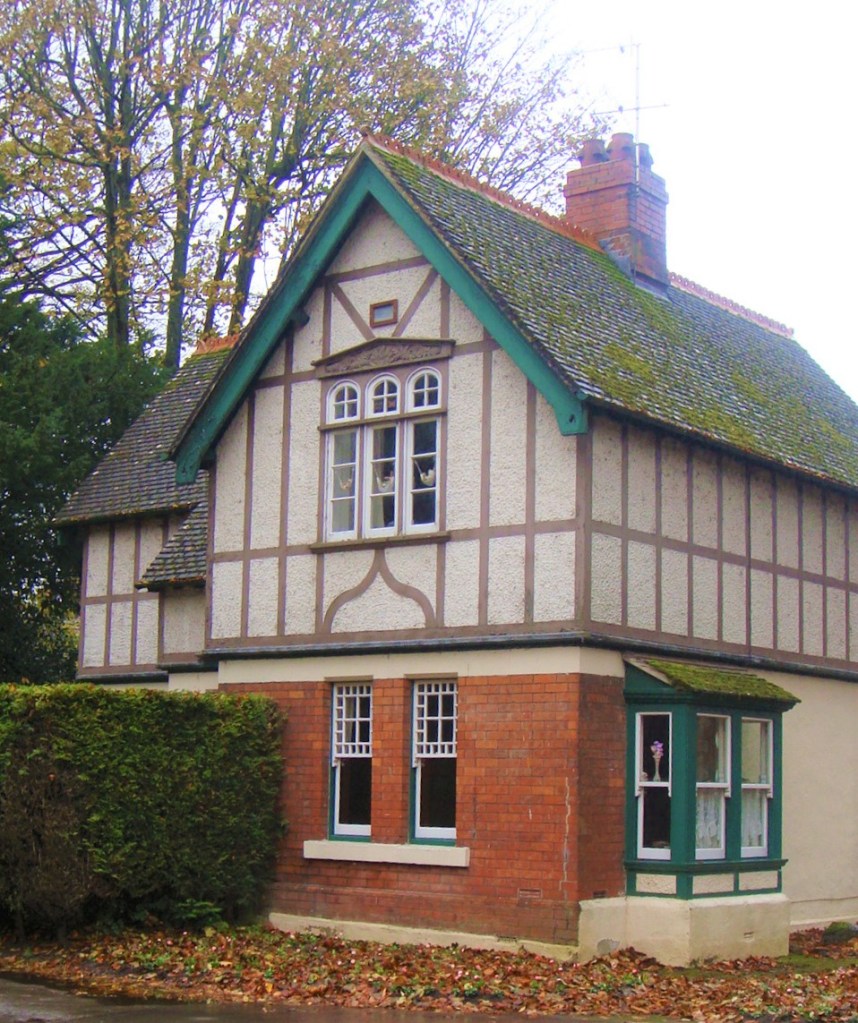
In 1894 the town celebrated the opening of the Town Gardens with a parade and a celebratory dinner for local dignitaries held in the evening at the Goddard Arms Hotel.  The pleasure park was created on a 7-8 acre site of the worked out Swindon quarries and purchased from Ambrose Goddard. W.H. Read had designed the layout of the new recreation ground, the park keeper’s lodge and the band stand. The band stand was erected by Messrs Allan of Glasgow with the assistance of local builder Joseph Williams who also built the lodge at the Westlecott Road entrance. On the arrival of the procession at the Westlecott Road entrance W.H. Read presented W. Reynolds (chairman of the Local Board) with a silver plated key and the gardens were officially opened.

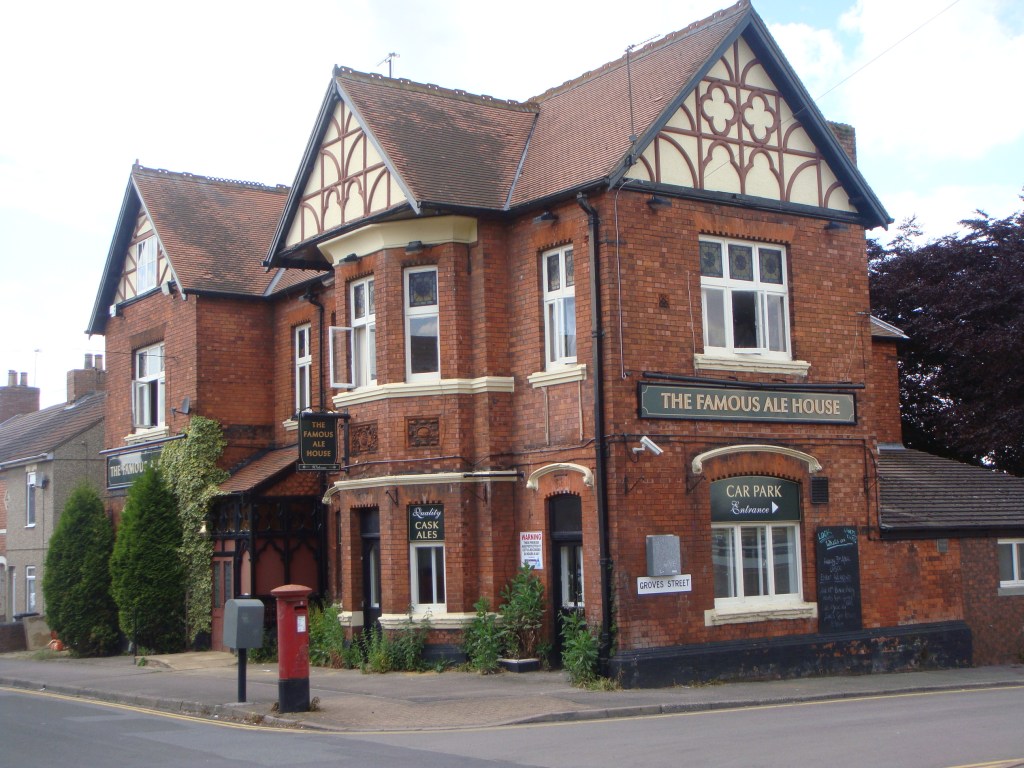
In 1898 Read designed the Even Swindon Hotel for John Groves and Sons Ltd of the Hope Brewery, Weymouth. The hotel was built on a plot of land owned by James Morrison on the corner of an intended new street, which would later become Groves Road, Rodbourne.

And among the prestigious, prize winning projects were the bread and butter commissions – four houses in Cow Lane in 1876, repairs to seven cottages in Mill Street for Swindon Permanent Building Society in 1881 and in 1892 houses in Turner Street.

William Henry Read died in November 1901. A brief report of his funeral, which had taken place earlier that day, was published in the Swindon Advertiser dated Wednesday November 6.

The Late Mr W.H. Read

Funeral To-day

The funeral of the late Mr William Henry Read, architect of Swindon, took place this afternoon. The cortege left deceased’s late residence in Bath Road at two p.m., and the first portion of the service was conducted in the Parish Church. The coffin was conveyed on a hand-bier, and the mourners were all on foot. They included deceased’s sons, and also the following relatives and tradesmen:- Messrs J.H. Chandler, T. Chandler, W. Reynolds, H.W. Reynolds, R. Reynolds, R.S. Edmonds, A. Plummer, S. Snell, R.J. Beswick, Cullingford, Cox, etc

There were signs of mourning on every hand, shutters being up and blinds drawn at all the residences and shops en route to the church. The officiating clergy were the Rev Canon E.W. Estcourt (vicar), and Rev W. Scott (curate). After the first portion of the service at the Parish Church the cortege proceeded to the Cemetery, where the interment took place. The coffin was covered with beautiful wreaths from sorrowing relatives and friends.

Swindon Advertiser, Wednesday, November 6, 1901.

Samuel Joseph Limmex – ironmonger

The re-imagined story …

Mr Limmex’s shop stood on the corner of High Street and Wood Street. Every morning one of the shop assistants was tasked with assembling the shop front display out on the street and then at the end of the day taking it all back in again.

It must have taken ages. There were brooms and spades and tools of every description that the gardener, handyman and farmer would ever require.

You could buy anything and everything at Limmex’s, but one day my granddad sent me shopping for a seemingly impossible item.

“Fred – have you heard what this young man wants?”

“We did have a packet of those once – now where did I see them?”

“I think we ought to ask Mr. Limmex – he’ll know where they would be.”

“Now what’s all this chatter going on?”

“It’s this young man, sir, he’s desirous of a very specialised item of carpentry.”

“It’s for my granddad,” I said helpfully. “He said you’d be sure to have a packet of rubber nails.”

The shop assistants laughed, the customers laughed and even Mr Limmex laughed.

Well if Mr. Limmex didn’t stock them I don’t know where my granddad would find his rubber nails.

The facts …

Limmex ironmongers shop dominated the corner of High Street and Wood Street for more than a hundred years. 

Samuel Joseph Limmex opened his shop in about 1873.  Before this he had a similar business in Brighton where he had married Rebecca Bartrop, a young widow with three children.

Samuel was born in the West Indies in 1842, the son of Methodist Missionary William and his wife Eleanor who are both buried here as well.

The couple led a nomadic life as William continued to follow his calling.  After their return from the West Indies they lived in various places across the UK.  In the 1870s William was preaching on the Allendale Circuit in Northumberland, travelling across the Scottish Borders.  But by 1881 William had retired and he and Eleanor were living next door to Samuel and his family at 15 Prospect.

The shop on the corner of Wood Street continued under the management of Samuel’s son Frederick William following Samuel’s death in 1935.  It eventually closed in 2000.

William Morris, founder of the Advertiser, is captured on film in this Victorian photograph of the High Street frontage of the Limmex shop.

The photograph of this stained glass window, a memorial to the Limmex family in the Bath Road Methodist Church, was sent to us following one of our walks. 

Liddington’s Loss

Death of Mr S.J. Limmex

Mr Samuel Joseph Limmex of Liddington, who was one of the oldest men in the district, died at his home, Fair View, yesterday. He was 94 years of age, and had been confined to his bed for only a week.

The son of a missionary, he was born in the West Indies, but was brought to England as a child, in a four-masted sailing ship. He was sent to Woodhouse Grove School Yorkshire, and when his father left the West Indies and was appointed superintendent minister in Swindon of the Wesleyan Church, Mr. S.J. Limmex accompanied his parents to Wiltshire.

Mr. Limmex served his apprenticeship with the late Mr. W.V. Edwards ironmonger, of Swindon. Later he set up business in Brighton, but not long afterwards came back to Swindon, and founded the business which is now carried on by his son, Mr. F.W. Limmex, at Old Town, Swindon.

Mr. S.J. Limmex retired about 25 years ago, and went to Wanborough to live, but after the war he removed to Liddington. Since the death of his wife, about 30 years ago, his daughter, Miss Limmex, has kept house for him.

Mr. Limmex was a member of the Swindon Chamber of Commerce since its inception. He took a keen interest in Swindon Bath-road Methodist Church, having held every office to a layman.

North Wilts Herald, Friday, 6 December, 1935.

Robert James Rick Beswick – architect and surveyor

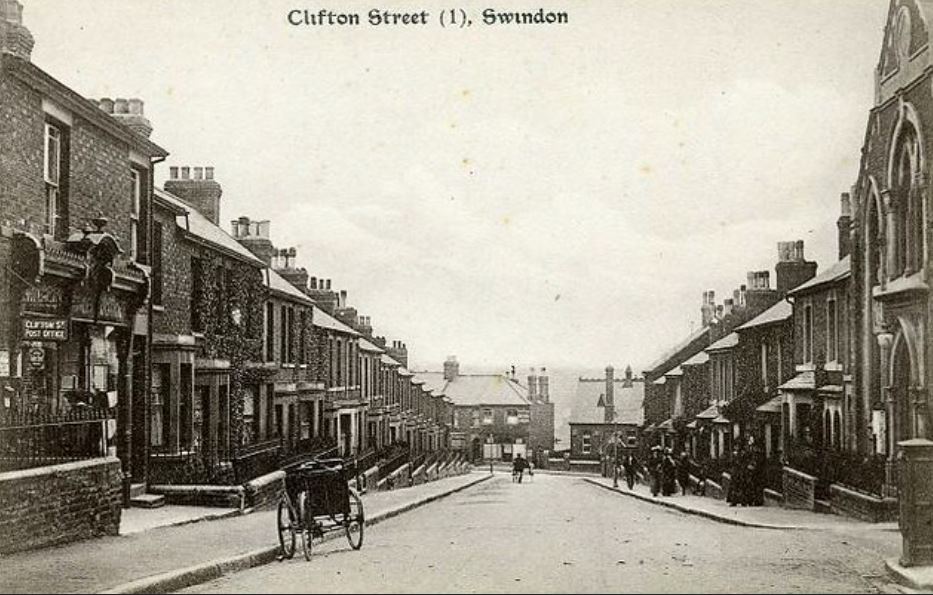
Clifton Street with Beswick’s Primitive Methodist chapel on the edge of the photo to the right. Published courtesy of Swindon Museum and Art Gallery

Robert J.R. Beswick was born in Manchester on November 30, 1856 the son of Robert, a Spirits Merchant, and his wife Anne. Robert was christened on January 4, 1857 in Manchester Cathedral.

Robert had moved to Swindon by the mid 1870s when he was articled to another popular local architect W.H. Read and was in practice from about 1874. In 1884 he married Emilie Matilda Elliott, the daughter of John Elliott, a painter in the works.

During a prolific career he designed many landmark buildings in Swindon including the Mechanics Institute Reading Room at 158-9 Rodbourne Road. He also designed the Primitive Methodist Chapel which stood at the Clifton Street entrance to the cemetery, long since demolished and replaced by a modern property. He designed the Co-op premises in East Street and John Street and the Palace Cinema in Gorse Hill.

In 1911 Beswick, by then widowed, was living at a property in Westlecott Road called Kingswood, a house he designed himself. He lived there with his architect son Robert Frederick Beswick (the son who later died in India) and the two men were looked after by housekeeper Gertrude Woodward and a general domestic servant Alice Brinkworth.

Beswick died at the Cheriton Nursing Home on March 28, 1931. He left administration of his will to his only surviving son Alfred Edward Beswick, another architect. His effects were valued at £6,129 4s 3d.

William Grainger – Builder with nothing to do

Manchester Road c1912. For more images of the Broadgreen and Queenstown area of Swindon visit the Local Studies flickr page.

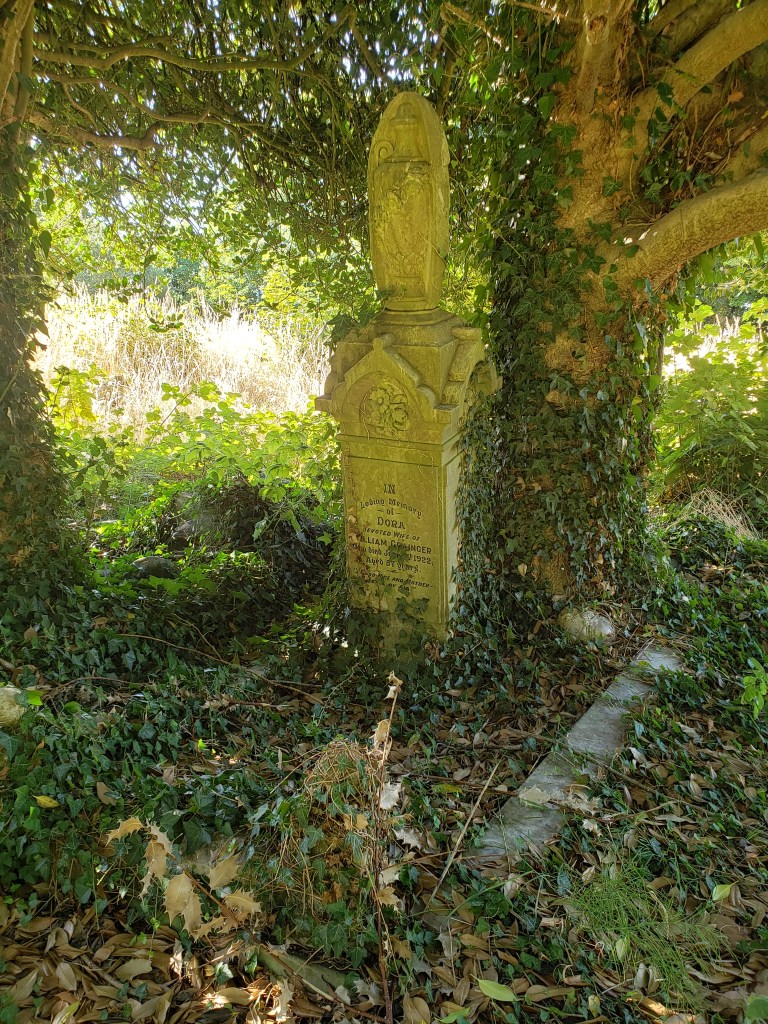
Nestling beneath the shade of a tree is this attractive memorial to Dora and William Grainger, a restful place to lie during the current heatwave.

The report of William Grainger’s death (see below) includes an account of his business career, but a rather vague version.

William Grainger was born in about 1865, the second son of Edward Grainger and his wife Sarah. He grew up in Quenington, Gloucestershire and followed his father into the building trade working as a plasterer. By 1887 William was living at 35a Cheltenham Street when he married Dora Ockwell at St. Mark’s Church. The couple had four children but sadly only two daughters survived to adulthood – Emily born in 1891 and Helen in 1893.

George’s business premises were first located at 60 Dryden Street before moving to 141 Manchester Road and spanned the years 1891-1907. During this time he did indeed build a great many properties. In 1897 alone he built a stable and traphouse in Dryden Street; 12 houses numbered 15-26 on the east side of Gladstone Street; 12 houses numbered 107-118 on the west side of Salisbury Street and 12 houses numbered 1-12 on the south side of Elmina Road.

In 1898 he was even busier. The Eastcott Hotel in Manchester Road was built in this year by Strong & Co Brewery of Romsey, most probably with the work sub contracted out to William. In 1898 William built 147 properties in Salisbury Street; Manchester Road (which included his own home); Edinburgh Street, Elmina Road, Graham Street and Rosebery Street.

He appears to have finished work in around 1907 when he was about 41 years old. At the time of the 1911 census he states his occupation as ‘builder with nothing to do.’

Dora died at the family home at 141 Manchester Road and was buried on this spot on June 7, 1922. Perhaps William planted this tree to shade her grave during the hot summers to come. William died five years later and was buried with his wife on May 18, 1927.

Death of Mr W. Grainger – The death took place on Saturday at 141, Manchester Road, at the age of 62 years, of Mr William Grainger. The deceased formerly carried on an extensive business as a builder, and was responsible for the erection of between 400 and 500 houses in Swindon. Among his large contracts was the building of the Eastcott Hotel in Manchester Road. He retired from business at an early age. He was a keen sportsman and was a popular member of the Swindon Town Bowling Club and was also a member of the North Wilts Constitutional Club. He leaves two daughters, who are living in Swindon, and two brothers and two sisters, who reside out of the town. His wife predeceased him some years ago.

North Wilts Herald, Friday, May 20, 1927

Elsie Wootten White – wartime volunteer

Elsie Wootten White was born on August 26, 1885 the daughter of Frank James White, a machineman in the GWR Works, and his wife Susan. She was baptised at St. Mark’s Church on October 19 when the family were living at 5 Bangor Terrace, Rodbourne Road.

Elsie began her long teaching career as a 15 year old pupil teacher and at the outbreak of the First World War she was working as an Assistant Mistress at one of the town’s board schools. By 1916 she was a member of Miss Slade and Miss Handley’s growing band of volunteers.

The Swindon Committee for the Provision of Comforts for the Wiltshire Regiment was formed in 1914. Miss Mary E. Slade, Infant Head Teacher at King William Street School, led a team of volunteers, most of whom were women. These volunteers were based at the Victoria Hall where they collected and packed boxes to send to soldiers serving in the Wiltshire Regiment. However, this work soon became a matter of life and death as the plight of the prisoners of war was revealed.

“When letters began to arrive from the men themselves begging for bread, it was soon realised that they were in dire need, and in imminent risk of dying from starvation, exposure and disease,” W. D. Bavin wrote in his seminal book Swindon’s War Record published in 1922.

All the prisoners received daily was a slice of dry bread for breakfast and tea and a bowl of cabbage soup for dinner.

“Had it not been for the parcels received out there from Great Britain we should have starved,” said returning serviceman T. Saddler.

In the beginning the committee spent £2 a week on groceries to be sent to Gottingen and other camps where a large number of Wiltshire men had been interned following their capture in 1914. By October 1915 the committee was sending parcels to 660 men, including 332 at Gottingen and 152 at Munster.  And at the end of July 1916 they had despatched 1,365 parcels of groceries, 1,419 of bread comprising 4,741 loaves, 38 parcels of clothing and 15 of books.

As the men were moved from prison camps on labour details, the committee adopted a system of sending parcels individually addressed.  Each prisoner received a parcel once every seven weeks containing seven shillings worth of food.  More than 3,750 individual parcels were despatched in the five months to the end of November 1916.

Elsie and her mother Susan lived for many years at 25 Euclid Street where Susan died in 1941. Elsie died at the Victoria Hospital in July 1954 and was buried with her mother in grave plot D44A.

Charles Herbert Henry Gore – Swindon museum’s first curator

In 2016 we all got very excited when Make Architects produced an ambitious £22m design concept for our town’s much needed new Museum and Art Gallery. But sadly, the bid for a Heritage Lottery Fund grant that would make this possible was unsuccessful and it was back to the drawing board.

And then four years later Covid struck. In March 2020 the Swindon Museum and Art Gallery closed its doors, like everywhere else, as the country shut down in an attempt to halt the spread of Covid 19. But when other museums and galleries nationwide reopened in May 2021, Swindon’s didn’t.

Swindon Borough Council subsequently announced that the Grade II listed Apsley House property wasn’t fit for purpose (which we knew anyway) but what was their solution. The top floor of the Civic Offices in Euclid Street was to be converted into a museum and art gallery while selected artefacts and paintings were to go on tour around Swindon. The long-term plan is to build a new museum and art exhibition facility in the centre of town but when they say long term, they really do mean long term. The estimated timeline is in the region of 10 years.

So why am I telling you this sorry saga?

Charles Gore pictured left

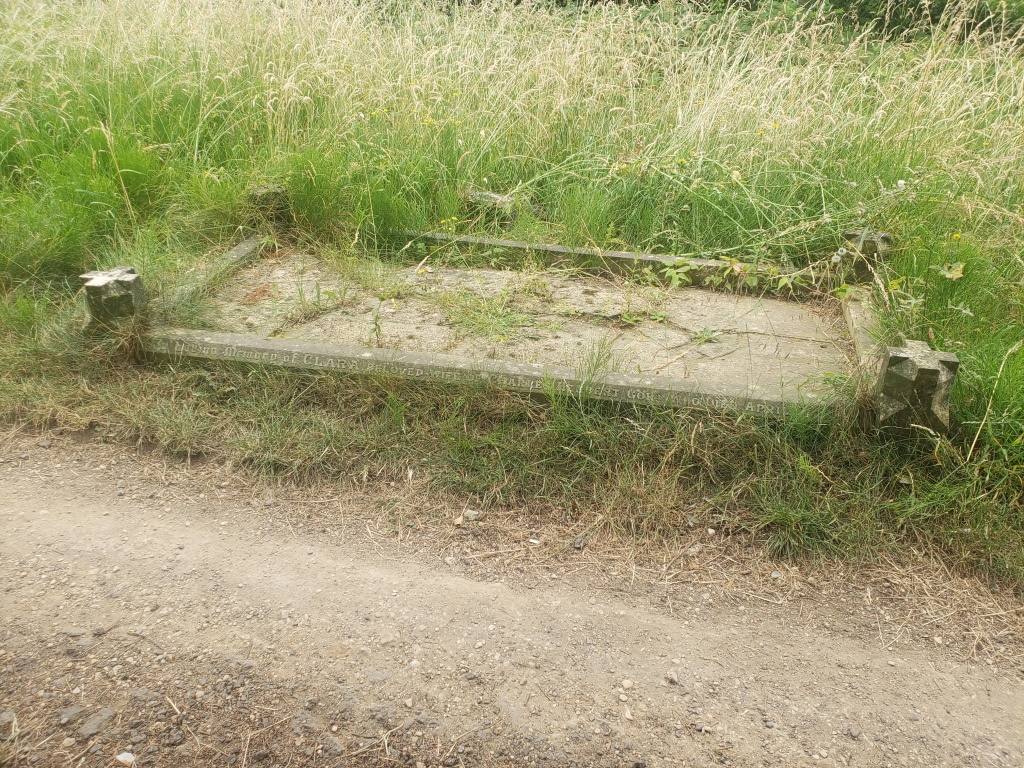
This is the last resting place of Charles Herbert Henry Gore and his wife Clara. As a ten-year-old boy Charles found the fossilised bones of a prehistoric animal on the site of the Queen Street gasometer and this discovery began a lifetime’s interest in geology and natural history. But of course, what career opportunities were there for the son of a house painter in the 19th century.

By 1881 14-year-old Charles had finished his education and was working as an apprentice coach body maker in the GWR Works according to the census taken that year. In 1890 he married Clara Downs at St Mark’s Church and they set up home just round the corner from here at 31 Radnor Street.

By the turn of the century ill health had prevented him continuing his job in the Works and by 1911 he was working as a Draper’s Traveller. The 1911 census also describes him as a ‘part time student.’ It can probably be safely assumed that his studies involved his interest in fossils and geology.

By 1919 Charles had accumulated an extensive collection, which he offered to the Swindon Corporation on condition that it provided a building in which to accommodate it all (sounds familiar).

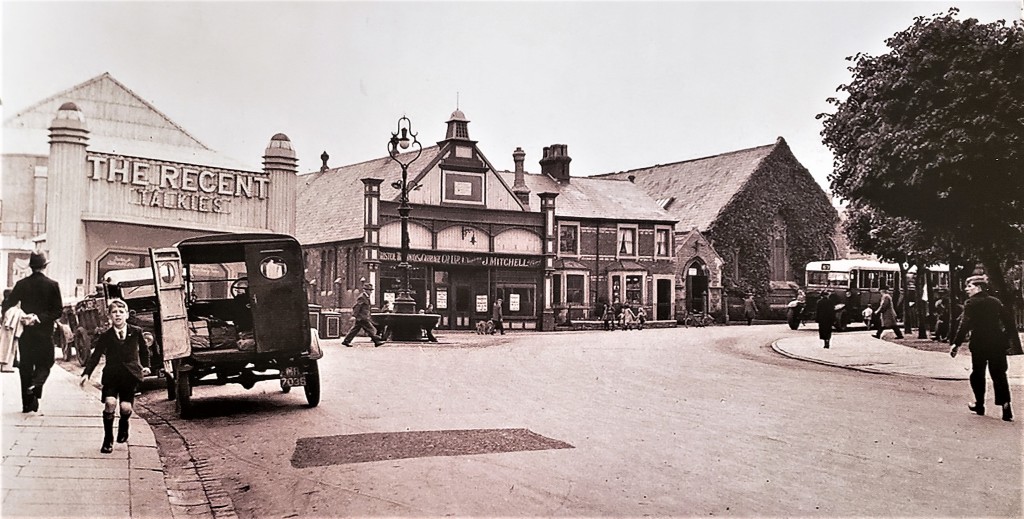
It was decided to use the Victoria Hall, a property in Regent Circus, which had just be vacated by the Roman Catholic congregation awaiting completion of their new church at Holy Rood.

Victoria Hall is the building on the extreme right of the photo – published courtesy of the Swindon Society

Charles was appointed curator, cataloguing and displaying his collection, which opened to the public on October 27, 1920.

Ten years later Charles packed up his collection again and moved it all up to Apsley House where it remained until 2020, when the museum closed it doors for the last time.

Where is Charles’s collection now? Well to be honest we don’t actually know. ‘In storage’ is the official comment – it certainly isn’t on display, that we do know.

Charles’s wife Clara died in 1912 aged 44 and was buried here on May 1. Charles died in 1951 aged 84 years.

There is one last fact concerning Charles Gore who was born in Newbury in 1867, the son of Frederick and Hepzibah Gore. By 1881 the family were living in Swindon at 4 East Street where Frederick died on Tuesday, August 2. Frederick Gore was the first person to be buried in the new cemetery which opened in 1881. His funeral took place on August 6.

Radnor Street Cemetery supporter and local historian Mandy Lea added this fascinating extra to the Charles Gore story.

Charles Herbert Henry Gore – founder/curator of the Swindon Museum. After he left the GWR (due to injury) he owned a draper’s shop in Granville Street. He was also a medium and an artist. His love of fossils and is what started off his geological collection and became a Fellow at The Geological Society – he even had two ammonites named after him – Perisphinctes Gorei and Crendonites Gorei. He and others donated their collections as the Museum was founded; he also sourced the gharial (we all call it crocodile!) and the mummy. The Museum has a bust of him somewhere, but when we asked to see it they couldn’t find it. He was awarded the Freedom of the Borough of Swindon. It appears he led a rather colourful and varied life!

Lance Sergeant John Wilfred Goodwin – Tell Them of Us

Following yesterday’s Remembrance Day service in Radnor Street Cemetery we continue with our series of stories – Tell Them of Us.

Sometimes it can be frustratingly difficult to find out much information about the soldiers buried beneath the Commonwealth War Graves headstones in Radnor Street Cemetery.

Local and military historian Mark Sutton had a vast knowledge of all aspects of the Great War and during our guided cemetery walks was able to describe details about the action in which the soldiers had been involved. Quoting from his book Tell Them of Us Mark tells us that John Wilfred Goodwin was a Lance Sergeant in the Welsh Horse Yeomanry and that he died on January 5, 1918 aged 35 years.

John Wilfred Goodwin was baptised at St John the Evangelist, Farnworth, Lancashire on February 12, 1882, the eldest of James and Elizabeth’s five sons. James worked as a grocer and in 1891 he was Manager at the Co-operative Stores in Bisley, Gloucestershire.

In 1899 John Wilfred enlisted with the Royal Artillery. He was 18 years old. However, by the time of the 1911 census, twelve years later, he had left the army and was lodging at 68 Curtis Street and working as a grocery assistant.

As a former member of the regular army he would have been on the reservist list and recalled for service when war broke out in 1914. Unfortunately his military records have not survived, but we do know that he was discharged on Jul 21, 1916 due to a disability.

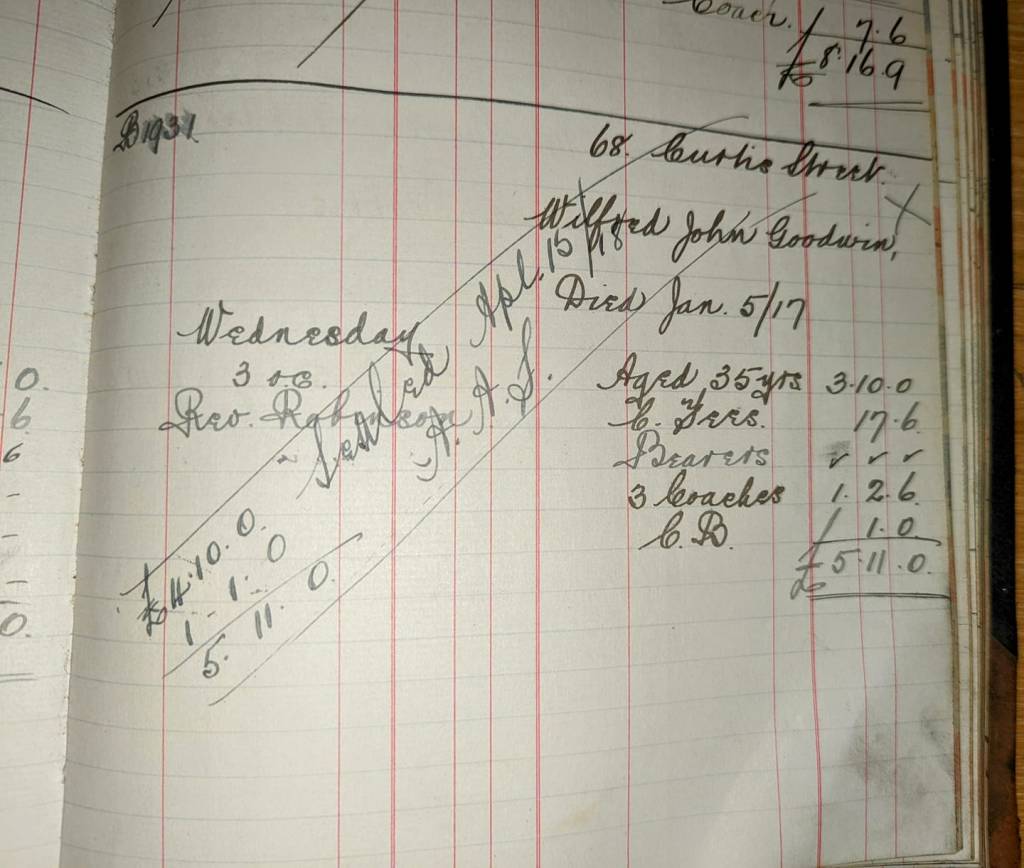
John’s last address in January 1918 was at his former lodgings 68 Curtis Street. The funeral took place on January 9 when John was buried in grave plot B1931. His initials were incorrectly recorded as W.J. Goodwin in the burial registers, but even a search under this name does not reveal any further information.

We would like to purchase the death certificate of the people we research, but sadly with the amount of research we conduct this is impossible.

John’s youngest brother, Samuel Colin Roy Goodwin, served with the Somerset Light Infantry and survived the war. He later emigrated to Australia following elder brother Josiah, and served as a Leading Aircraftman with the 13 Aircraft Depot, Melbourne during WWII.

Image kindly provided from the funeral records of A.E. Smith & Son, Funeral Directors

#TellThemofUs

#Mark Sutton

Pte. Thomas Tugby – Tell Them of Us

Sometimes the death of a soldier received a lengthy obituary in the local newspaper. One such case was that of Thomas Tugby.

Swindon Soldier’s Funeral

Man Who Was Wounded at Ypres

Great sympathy has been extended to Mrs Thomas Tugby in the loss she has sustained by the death of her husband, which resulted from wounds sustained in action. Pte. Tugby was the son of Mr. and Mrs. J. Tugby, of 9 Gooch Street, Swindon, and was only 29 years old. He joined the Army at the age of 17 and became attached to the South Wales Borderers, and on taking his discharge, some years later, he entered the employ of the GWR Company and worked in ‘V’ Shop (Loco. Dept.) of the Swindon Works. On the outbreak of hostilities, he was called up on reserve, and went to the front with his old regiment. He was a participant in the heavy fighting at Mons and on the Aisne, and was wounded at Ypres by bursting shrapnel. On Nov. 1st he arrived in England with a batch of wounded, and was sent to St. Bartholomew’s Hospital, Rochester, and hopes were entertained that he would recover from his wounds. On Wednesday last, however, his condition gave cause for anxiety, and his relatives were summoned. They were in time to see him before he died later in the day, and on Saturday his body was brought to his home in Swindon.

The remains were interred with full military honours at Swindon Cemetery on Monday afternoon. A large number of the Royal Field Artillery stationed at Swindon were present, and formed a guard of honour as the body was borne from the house in Gooch Street to St. John’s Church. The coffin was of plain oak and was covered with a Union Jack. The service at the church was impressively conducted by the Rev. W.H. Walsham How, who also officiated at the graveside. After the coffin had been lowered into the grave, the firing party fired three volleys and the “Last Post” was sounded by the buglers. The inscription on the breastplate of the coffin read:-

Pte. Thomas Tugby

Died Feb. 17th, 1915.

Aged 29.

The chief mourners were the widow, Mr. and Mrs. J. Tugby (father and mother), Mr and Mrs E. Lewis, Mrs. Lewis, Mrs Lewis (sister), Mr J. Tugby and Miss Lily Tugby, Mrs W. Turner and Mrs. J. Green (sisters) Sergt. J. Green (brother-in-law) Mr W. Turner (brother-in-law) Miss Ivy Lewis (sister-in-law), Mr. W. Lewis (brother-in-law), Messrs. J. Smith and A. Whale (representing deceased’s old shopmates), Mr C. Hill, Mrs. W. Gleed and Mrs Skeates (aunts) and Mrs W. O’Neil (cousin). Beautiful floral tributes were placed on the coffin from the widow, Mrs and Mrs Tugby, Mr and Mrs. Turner, St. Mark’s Ward of the Hospital at Rochester, Mr. and Mrs. J.A. Cooper, Mrs Dance and Mrs Gleed, ‘The family at 1 Linslade Street,’ Sergt and Mrs Green, Shopmates in ‘V’ Shop, Loco, Dept. GWR Works.

It is interesting to note that Sergt. Green was with deceased in the early days of the war. He has been invalided home, and is shortly to return to the front.

North Wilts Herald, Friday, February 26, 1915.

But after the funeral what happened to the family left behind?

His widow Alice was just 24 years old when he died. On April 22, 1916 she married for the second time. The wedding took place at St Mark’s Church, the groom was Thomas Henry Walter Archer, himself a widower.

The UK World War I Pension Ledgers and Index Cards 1914-1923 record that sadly Alice’s second husband died on September 10, 1925, also as a result of the war.

Quite what happened to Alice after this second bereavement remains difficult to discover. The impact of that terrible war can never be under estimated.

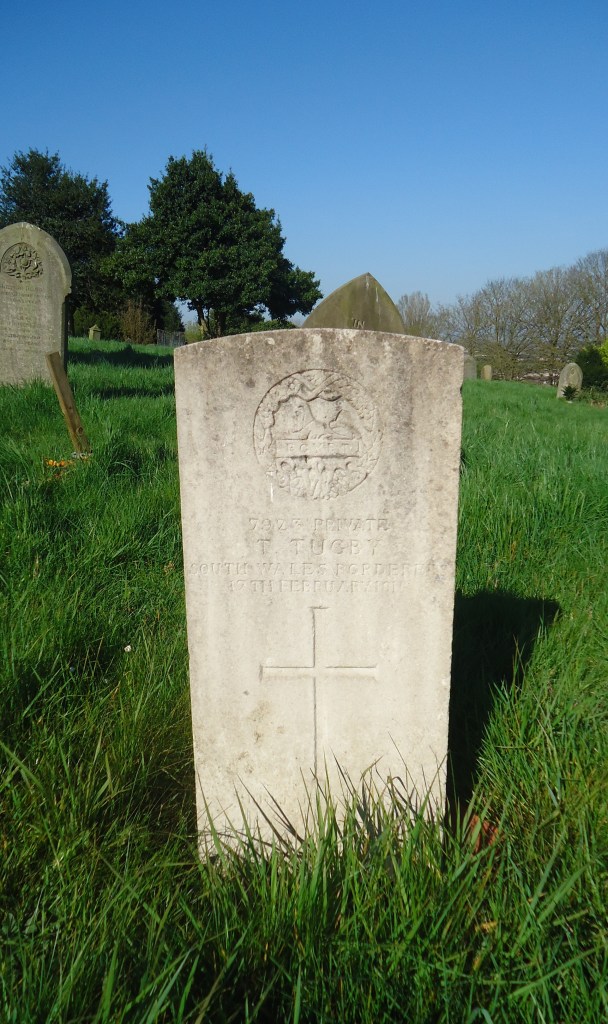
Tugby, T.

Private 7923 1st Battalion South Wales Borderers

Died 17th February 1915

Husband of A. Tugby of 9 Gooch Street

B1722 Radnor Street Cemetery

Tell Them of Us by Mark Sutton

Pioneer Andrew Lowe Young

And then there are the men about whom so little can be discovered. Even the Commonwealth War Graves Commission website can provide little information about one such soldier buried in Radnor Street Cemetery.

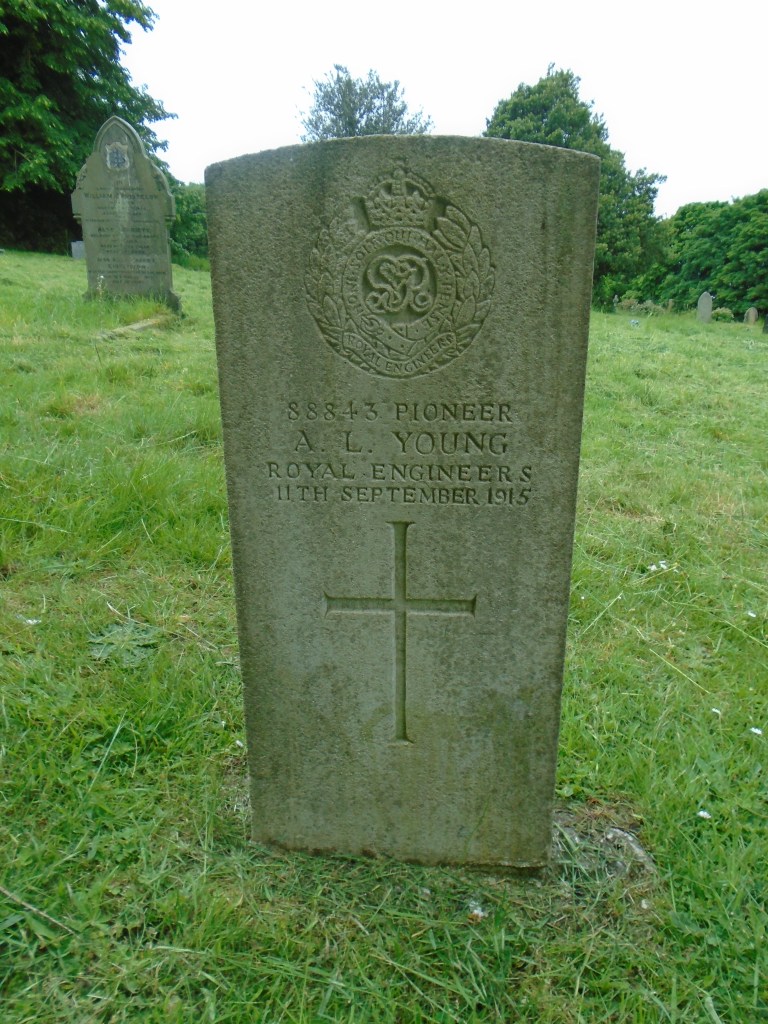
Andrew died in the Isolation Hospital, Gorse Hill on September 11, 1915. The cemetery burial registers record that he was buried on September 14, 1915 in grave plot B1769, a public plot where he lies with two others. His headstone displays the regimental badge of the Royal Engineers and his regimental number, but there are no personal details – not his age nor a few words chosen by his family.*

Andrew Lowe Young was born in Longforgan, Perth and Kinross, Scotland in about 1890. The UK World War I Pensions Ledgers and Index Cards 1914-1923 reveal that he left a widow, Elizabeth Young and an illegitimate stepchild, John Binett Gillatley born April 25, 1905, but even this information is not enough to reveal more about the young soldier’s life and times.

Andrew enlisted at Dundee and served in the 205th (1st Dundee) Field Company, Royal Engineers, raised in March 1915 as part of Kitchener’s 5th New Army. The 35th Division included units known as “Bantams”; soldiers who were under the minimum regulation height of 5ft 3ins, so perhaps Andrew was of small statue.

We can see from the headstone that Andrew served as a Pioneer, but what is that exactly? The extensive network of trenches across the battlefields of France and Flanders were dug by infantry regiments’ own pioneer battalions, however, it would seem that Andrew probably never saw service overseas. In August 1915 the 35th Division moved to Salisbury Plain with headquarters in Marlborough. Further moves during that month were made to the training camp at Chiseldon, which may explain why Andrew ended up in Swindon’s Isolation Hospital after he took ill.

Andrew was about 26 years old when he died as a result of his military service.

*more information might be available on the death certificate but we do not have funds to purchase the certificates of everyone we research.