How good are you at dating photographs? This one is thought to have been taken around 1920. I have been unable to discover any details about this photograph taken outside W.J. Knee’s shop in Emlyn Square. What clues are there in the fashions? The girl at the centre of the group is holding a photograph – is this someone who has recently died or someone who has left Swindon to work abroad? And finally, is this a gathering of the Knee family?
The following two stories may help us date this photograph.
Postcard reproduction
William James Knee was the eldest of Arthur and Eliza Knee’s large family of 10 children. William was born in Melksham but by the time of the 1891 census the family had moved to Medgbury Road, Swindon where Arthur was employed as a Rivetter in the Works.
William also entered the GWR and in 1911 he was working as a labourer in Newport, Monmouthshire where he was lodging with a relative by the name of John Knee. That same year he left Newport to return to Swindon where he subsequently opened a newsagents shop on the corner of London Street and Emlyn Square.
Death of Mr W.J. Knee -The death has taken place at the Old Manor House, Salisbury, of Mr William James Knee, son of Mr and Mrs Arthur Knee, of 78 Medgbury Road, Swindon. Mr Knee, who was in his 46th year, carried on business as a newsagent in Emlyn square for a number of years. He had a breakdown in health and went to Salisbury for treatment of an internal complaint. He was well known in Swindon and was popular with many GWR employees. A telegram announcing his death was received this morning.
North Wilts Herald Friday January 10, 1930.
William was buried on January 13, 1930 in grave plot D494. His mother Eliza died in 1937 and his father Arthur in 1940 and both were buried with him.
The second story is that of William’s younger brother Dennis Arthur Knee.
Dennis was born in 1895 after the family arrived in Swindon, and at the age of 16 he was working as a Rivetter Carrier in the Works. But like so many men of his generation, Dennis would leave the Works to serve in the First World War. Unfortunately, Dennis’s attestation papers do not survive but we do know that in 1917 he was serving as a gunner with the Royal Marine Artillery on board HMS Vanguard. Dennis died on July 9, 1917 when the Vanguard sunk following a series of internal explosions while on a routine patrol in Scapa Flow. He was 22 years old and one of 843 out of 845 men who died that night.
Acting Bombardier Dennis Knee is remembered on the Portsmouth Naval Memorial.
Please get in touch if you have any further information about this photograph and/or the Knee family.
It took local residents living in the Kingshill area a little while to get to grips with the rules and regulations concerning the new cemetery. And the ever vigilent caretaker Charles Brown was always keen to enforce them.
Joseph Deacon found himself in trouble with the Burial Board barely four months after the opening of the Swindon Cemetery after finding himself locked in the burial ground. But the full story may have been left untold.
Damaging the Cemetery Fence – Joseph Deacon, 36, carpenter, 6, Albion Street, was charged with committing wilful damage to the rails enclosing the Swindon Cemetery. Mr J.C. Townsend appeared to prosecute on behalf of the Burial Board. On Monday, the 5th inst. The defendant was in the cemetery and went to the Clifton street gates to leave. He was told by John Bastin, a man working there, that the gates were locked, and that he would have to go to the lodge entrance. The gate had been locked by order of the board. Defendant replied to Bastin that he should not go any further round, but should get over the rails. He was told not to do so, but he went up to near the mortuary, and climbed over the rails, scratching off the paint, and telling witness that he could go and tell Brown (the keeper) if he liked. The damage was estimated at 1s – Defendant said he did what he did in a passion. He never heard that the lodge gate was open or he should have gone out by it, that being his nearest road. He should like to know if a person could go through the cemetery? – The Chairman said certainly not; the cemetery was a sacred place and must not be trespassed on. If he was to send defendant to gaol for two months, or fine him £2 and costs, as he could do, every man in Swindon would know that it was a private place. – The defendant said he did not know this. – The Chairman fined defendant and costs, in all £1 8s.
Swindon Advertiser Monday December 19, 1881.
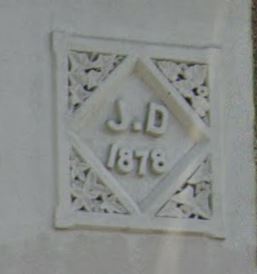
Plaque above No. 9 Albion Street
So how had Joseph come to find himself locked in the cemetery on Monday December 5, and why had he acted “in a passion” as he told prosector Mr J.C. Townsend.
Joseph Deacon married Eliza Wakefield in 1875 at the parish church in Dauntsey. Their daughter Sarah Jane was baptised at Christ Church, Swindon on July 25, 1877 and by the time of the 1881 census Joseph and Eliza with Sarah 3, Harry 2 and one month old William were living in Albion Street.
At the time of the 1891 census Joseph and Eliza’s family had increased with the birth of Julia, then aged 8 years old – but what had happened to little Harry, not mentioned on the census returns of that year.
On October 11, 1881, just weeks before Joseph’s cemetery crime, he had buried his 2 year old son in a pauper’s grave in the new cemetery. Could it be that Joseph was visiting the child’s grave that day when he discovered he had inadvertantly been locked in? Was this why he had acted “in a passion” still mourning the death of his little boy? We’ll never know, but it is worth a consideration.
Numbers 9 and 10 Albion Street
Eliza Deacon died in February 1917 aged 74 years and was buried in grave plot C3416 where Joseph joined her upon his death in 1925. Their daughter Julia was buried with her parents when she died in 1956.
I’ve been on some strange first dates in my time, but this one took the biscuit.
“It’s a lovely day. Let’s go for a walk round the cemetery,” she said, taking the initiative, as women so often do these days. When I was a youngster it was usual to ask a girl to go to the cinema on a first date, not to take a turn round a cemetery.
We paused at a crossroads where the meandering footpaths converged and she pointed out the grave of Trooper Cecil Howard Goodman. I was wearing the wrong glasses so she read the inscription to me.
“To the Memory of Trooper Cecil Howard Goodman 1st Co. Imperial Yeomanry who died November 11 1900 while fighting for his country in South Africa. Erected by his fellow clerks GWR Staff, Swindon, April 1901.”
I mentioned what an unusual headstone it was.
“He isn’t buried here of course, he’s in South Africa,” she said. “The headstone resembles the graves of the fallen soldiers buried in South Africa. There they heaped rocks on the grave to stop the wild animals digging up the bodies.”
How did she know such a bizarre fact?
The chapel was closed, but she could describe it perfectly.
“There used to be some lovely pews in there. Some said they were made in the Works. The council took them away a long time ago. Shame that.” We walked on.
“Poor Mr. Shopland – his was a tragic death,” she said pausing by a grave carpeted in primroses. I really hoped she wasn’t planning on going into detail.
At the end of the path, she stopped at a decorative headstone. Someone else she knew?
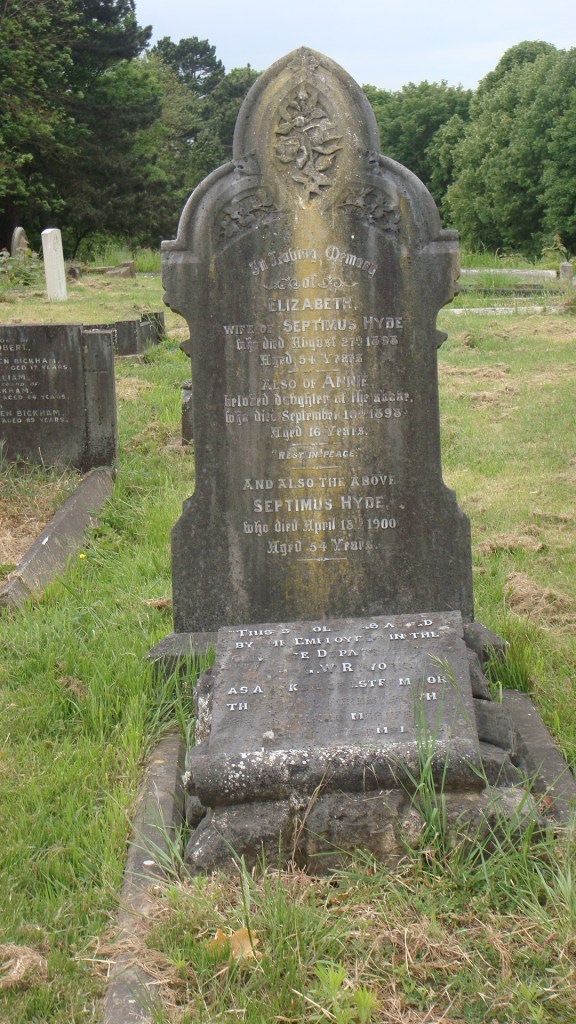
“Mr Septimus Hyde.” We paused while she read the inscription. “The story goes that he chose this plot because he could see his house from here.”
I looked around. The gardens on Clifton Street were clearly visible from this point, as the cemetery must be to those who lived in them. I assumed Mr Septimus Hyde must have lived there. I’m not sure how I’d feel about living alongside a cemetery.
“He must have had good eyesight,” she said, “he lived in Exmouth Street.” She looked at me with a twinkle in her eye. “Come on – I need a drink, and I don’t mean a cup of tea.”
This was the weirdest first date I had ever been on – but what can you expect when you’re pushing 80 – at least I’m not pushing up daisies.
The eldest child of Henry Hyde, a tailor and his wife Elizabeth, Septimus was born in Worcester on May 26, 1846. He married Elizabeth Sturge at St. Peter’s, Worcester on August 2, 1868.
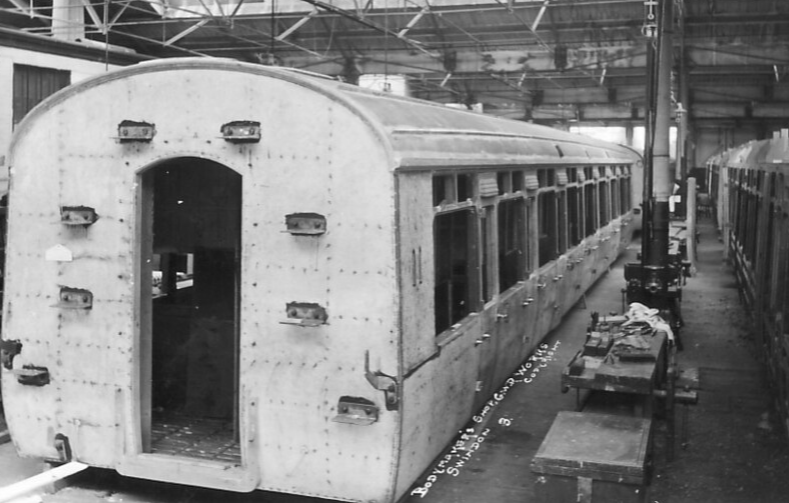
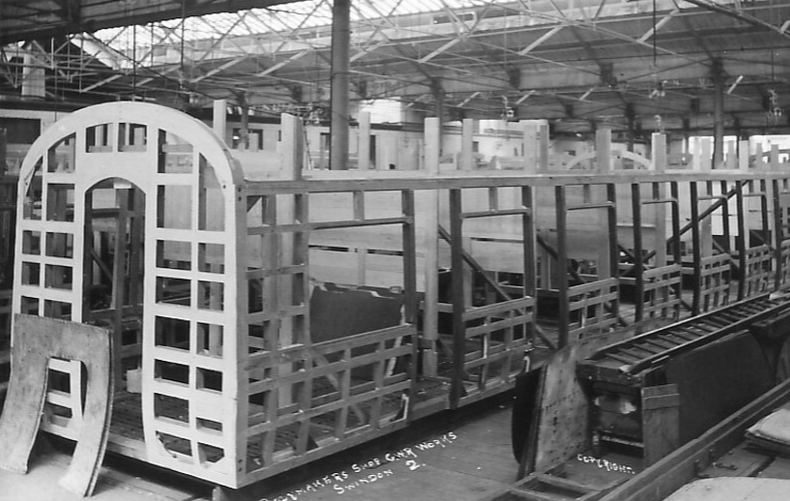
The UK, Railway Employment records, 1833-1956 state that Septimus Hyde re-entered the GWR as a Foreman in the Carriage Body Makers Shop on August 5, 1871. At the time of the 1881 census Septimus and Elizabeth were living at 5 East Street, New Swindon with their three children Frank E., Septimus G. and Robert.
Death of Mr. S. Hyde
A G.W.R. Foreman
Deep regret was expressed throughout the GWR Works, at Swindon, on Wednesday in last week, and especially in the Coach Body Making Department, when it was known that Mr. Septimus Hyde had passed away at his residence, No. 58, Exmouth Street. Deceased, who was born on May 26th, 1846, was during his long service as foreman of the coach body making shop, a very popular official. He was ever kind and thoughtful to his men, willing at all times to hear their troubles and to give them advice. As a foreman he will be greatly missed both by his employes and by the GWR Company, to whom he was ever a very faithful servant. Deceased had been unwell for some time past, suffering from paralysis of the brain, but in spite of his doctor’s orders to stay at home he would be at his post. So late as Saturday the 21st he was in theworks attending to his duties. Later in the day he had a stroke from which he did not recover, and passed away at noon on Wednesday, deeply mourned by all who knew him.
Deceased served his time with the Oxford, Worcester, and Wolverhampton Railway Company at Worcester, a line afterwards taken over by the GWR Company. When out of his time he worked at various places until August 5th, 1871, when he entered the service of the GWR at Swindon. Three years later, on August 8th, 1874, he was appointed foreman of his shop, which position he held till the time of his death. The Royal train used for the Diamond Jubilee and subsequent journeys was made under his supervision. He leaves a grown up family to mourn their loss, his wife having predeceased him.
The deep respect in which the late Mr. Hyde was held in Swindon generally, and in the GWR Works in particular, was evidenced by the large attendance at the cemetery on Saturday afternoon, when the remains were interred in the family grave, where some eighteen months ago the deceased’s wife and daughter were buried. Hundreds of the employes at the works took part in the funeral procession, and a large crowd awaited the arrival at the Cemetery. From the home the body was taken to St. Saviour’s Church, where a short service was conducted by Canon the Hon. M. Ponsonby, who also performed the last rites at the graveside….
The coffin which was of polished elm, bore the following inscription: “Septimus Hyde. Died April 18th, 1900: age 54 years.” A large number of wreaths and tokens of respect and sorrow were sent by his fellow employes and relatives.
All images of the Bodymakers Shop are published courtesy of P.A. Williams and Local Studies, Swindon Central Library
Jane Helena Tuckey photograph courtesy of Peter Guggenheim
The re-imagined story …
Mother went to Mrs Dicks funeral. It was a very quiet affair, she said. Not many at the church and even fewer at the graveside.
“I don’t know why she wasn’t buried at St Mary’s, along with all her family,” said mother. “There’s a long avenue of Tuckey graves in the churchyard there. Great big gravestones enclosed by iron railings. Of course, there was money in the family then.”
A familiar guilty twinge stabbed me.
I used to visit Mrs Dicks most weeks. Mother would send me round with a meat pie or a suet pudding.
“She doesn’t eat very well.”
Mrs Dicks lived opposite us in Hawkins Street. Her husband had died several years before.
“He was a fitter in the Works. Nice man, people said, although a bit of a come down for her. Her first husband had been a wealthy farmer from Chippenham.”
Mrs Dicks’ terrace house was crammed full of great big pieces of dark furniture.
“No doubt from her father’s house in Shaw.”
Sometimes she would open the drawer in the big, old dresser and hand me a tortoiseshell casket and together we would look at her ‘treasures’ as she called them.
Then one day Nellie Fitch came with me.
I usually went to Mrs Dicks on my own but this day Nellie was sitting on our front wall.
“She can smell the pie.”
Nellie Fitch wore shoes with holes in them and her winter coat was too small for her. Nothing unusual about that. During the war most of the kids in Rodbourne wore hand me downs. But then she told me she often didn’t eat.
We didn’t have much, but I always knew I would have a cooked dinner. Nothing fancy mind, but mother was a good, plain cook and she knew how to make a little go a long way.
Nellie’s dad was away fighting the Hun, she told me.
“Nellie’s father disappeared years ago,” said mother. “And so has the layabout she thinks is her father.”
Mrs Dicks opened her front door to a small hallway, just like the one in our house and all the other houses in Hawkins Street.
She was pleased to see me, but less so to see Nellie. I don’t think it was her dirty clothes and shabby shoes that bothered Mrs Dicks. I imagine it was more the fact that now Nellie would know she accepted food from neighbours. Mrs Dicks tried to keep up appearances. She had come down in the world and keenly felt her loss of status. But to me she was just another little old lady who wore old fashioned dresses and spoke in a posh voice.
“Good morning girls. How lovely Violet. Please thank your mother,” she said as she took the warm basin into the kitchen. “Tell her I will settle up with her at the end of the week.”
She always said the same thing. No money ever changed hands, my mother wouldn’t have expected any and Mrs Dicks had none to give.
“Come into the kitchen girls. I was just making a cup of tea.”
If Nellie was hoping for a piece of cake or a biscuit she would be out of luck.
Nellie probably wondered why I spent time with the posh old lady in her dark and dreary house where there was nothing nice to eat.
Mrs Dicks would tell me about the house in Shaw where she had grown up with her eight sisters and her brother. How they played in the orchard at the back of the house and on Sundays they would walk all the way to the church in Lydiard Millicent. She would bring out her photograph album and tell me about the people; bewhiskered old men and wasp waisted ladies.
And sometimes she would bring out the tortoiseshell box and show me the beaded bag she took to dances when she was a young woman, and the diamond tiara that became a pair of dangly earrings at the click of a pin at the back. There was an amethyst ring that had belonged to her grandmother and brooches and pins.
Please don’t bring out the tortoiseshell box today, I silently pleaded. But the atmosphere was awkward with Nellie there. We were probably the only two quiet children in Rodbourne that morning.
I watched Nellie’s eyes grow as wide as saucers as she peeped inside Mrs Dicks’ tortoiseshell box, and she looked at me and smiled. Not a big, open smile, but something sly.
I never wanted to visit Mrs Dicks after that.
“I don’t have time to go calling in on Mrs Dicks,” my mother complained when she had to deliver the meat pie.
Nellie got a new winter coat that year, and a new step father.
“They’re not married,” said my mother. “She’s never marries any of them.” And then they moved away from Rodbourne.
The facts …
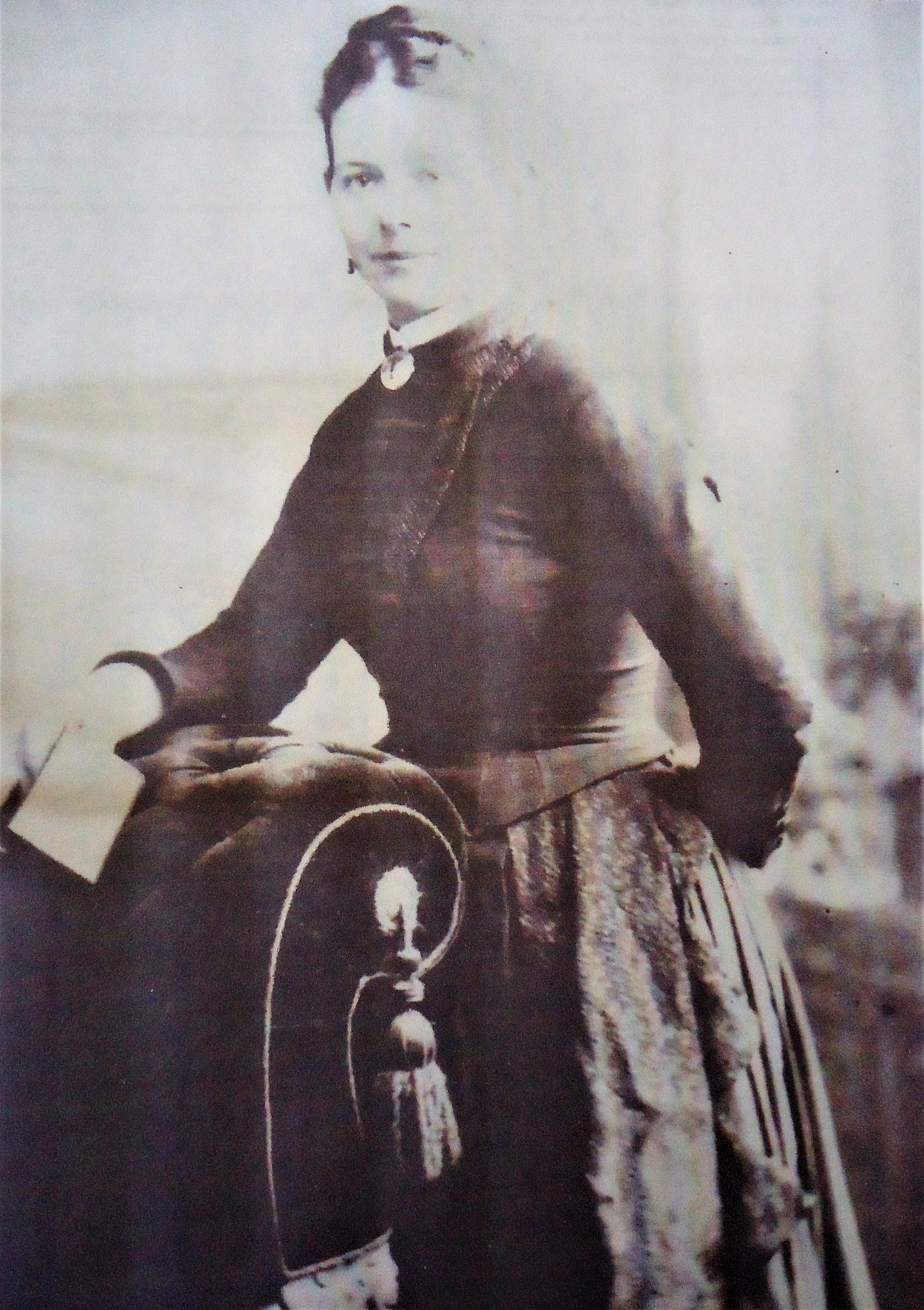
Jane Helena Tuckey was born on March 15th 1848 at Langley Burrell, the fourth daughter of Robert and Ann Tuckey.
The 1841 census returns for Yatesbury record wealthy bachelor farmer Robert Tuckey living with Ann Trotman, an unmarried servant and her four year old daughter.
Perhaps Tuckey family opposition to this mismatched alliance delayed a wedding. By the time the couple did get around to walking up the aisle at St. Saviours in Bath they had two daughters and Ann was pregnant again.
But by 1851 Robert had come into his inheritance and the growing family moved into Shaw House along what is now called Old Shaw Lane in West Swindon.
In 1872, shortly after the death of her father, Jane married farmer John Clarke, thirty years her senior, and moved to nearby Kington St. Michael where John farmed 381 acres. With 20 farm and house servants on the payroll, this was a big establishment.
Then in 1882 John Clarke was found dead in one of his fields having suffered a fatal heart attack and Jane’s life was to change dramatically.
In 1884 Jane married Francis Dicks. Her second husband, seven years her junior, was a fitter employed in the GWR works. The couple with Jane’s girls moved into 37 Hawkins Street, Rodbourne where a further two children were born.
In the small terraced house Jane’s lifestyle was far removed from the comfortable childhood she had enjoyed, playing in the orchard at Shaw House.
Widowed for the second time in 1903 she survived on an income derived from taking in a lodger.
Mrs Dicks died on November 26, 1918. She was buried in plot B1494, a pauper’s grave in Radnor Street Cemetery.
There is a world of difference between enjoying a drink and taking a bottle of whiskey to bed and I wonder what propelled Mary Bailey from the one to the other.
Drunkenness was the scourge of the 19th century working classes. Even in Swindon where the much lauded Great Western Railway Company provided wrap around care ‘from the cradle to the grave’ there was still want and destitution for those who fell through the cracks of society.
Temperance societies encouraged people to abstain from drink and to take the pledge of a lifetime of sobriety. By the end of the century Swindon numbered around 18 such organisations, including the GWR Temperance Union with around 3,000 members, however it is unlikely Mary joined their ranks.
A Fatal Taste for Alcohol
A sad case came from Coroner W.E.N. Browne, on Monday in an inquest concerning the death of Mary Baily, wife of a GWR fitter of 11 Hawkins Street, New Swindon.
The deceased who was 49 years of age, was stated by a neighbour to be of intemperate habits. Her husband on Friday night went to bed at 10 o’clock, and thinking his wife was asleep did not disturb her. He arose at five o’clock on Saturday morning and found his wife dead and quite cold. A whiskey bottle was found beneath the bed. Dr. Duffield stated that death was due to asphysxia, cause by the woman lying on her face in a helpless condition ensuing upon an over-dose of alcohol.
Gloucester Citizen Tuesday November 28, 1899.
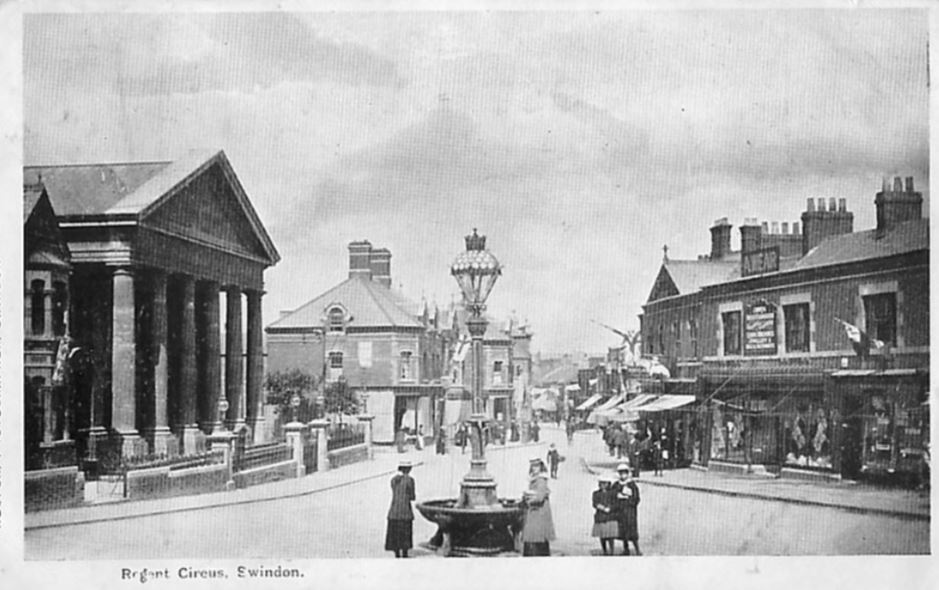
Drinking fountain erected by the Swindon United Temperance Board in Regent Circus 1893
Mary Christianna Dance was born in Stratton, Gloucestershire and baptised on February 4, 1849, the eldest of John and Jane Dance’s eight children. She married Thomas Bailey in 1871 and by 1881 they were living at 11 Henry Street (later renamed Hawkins Street) with their 8 year old son Thomas, and Mary’s brother Charles. Both men worked as carriage fitters in the Works.
So what happened to Mary between 1881 and 1899, or had her problem with alcohol begun long before? Did she try to control her drinking, or was she aided and abetted by her husband Thomas, whose comments at the inquest appear ingenuous when compared with the neighbours observations.
Mary was buried on November 28, 1899 in grave plot C109, a privately purchased grave, which might come as some surprise. In 1908 she was joined by Tryphena Bailey, Thomas’s second wife and then in 1937 by Thomas himself.
Many thanks to David Lewis and his book Between the Bridges – The Early Days of Rodbourne.
There are 33,000 burials in Radnor Street Cemetery but rather fewer memorials. The spread of headstones vary in the different sections with E and D sections the most densely populated and dotted across the cemetery are 104 distinctive Commonwealth War Graves headstones.
When the Burial Board published a list of fees concerning interment in the new cemetery in 1881 it included the following statement:
All inscriptions and plans of monuments, tablets, and stones, to be erected in the Cemetery or chapels to be submitted to the Board for its approval.
The majority of the headstones in Radnor Street Cemetery are simple and stylish, but have a closer look and you will find some fascinating detail.
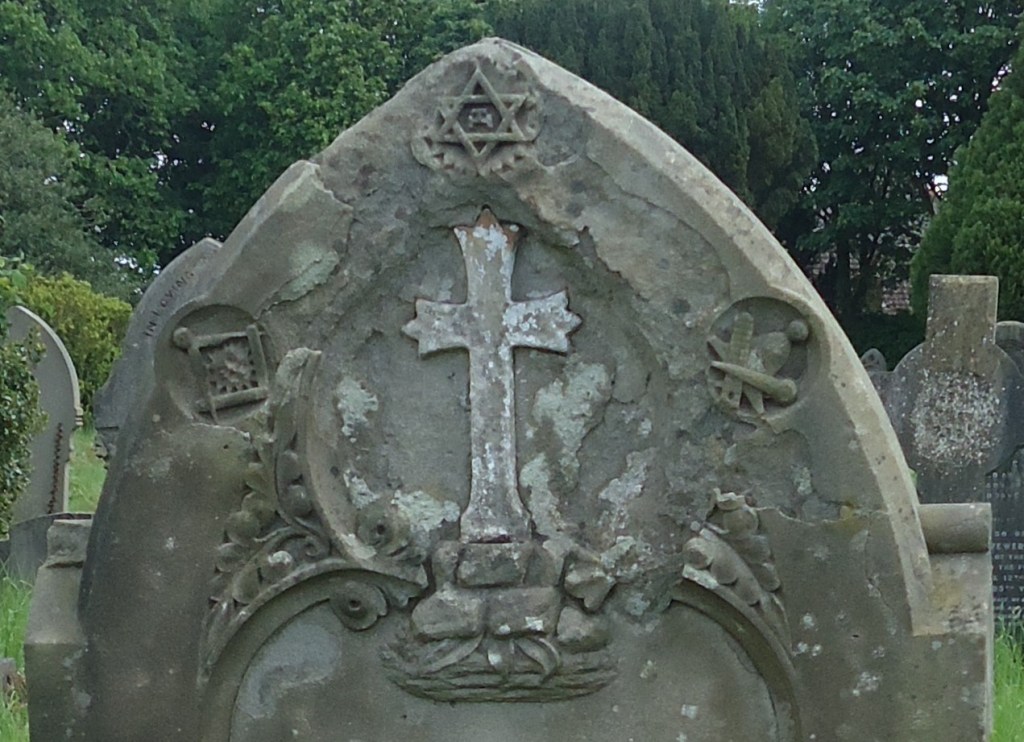
Victorian Swindon had strong links with Freemasonry and this headstone (see below) has examples of Freemasonry symbolism, including the Square and Compasses, which depict a builder’s square joined by a compass.
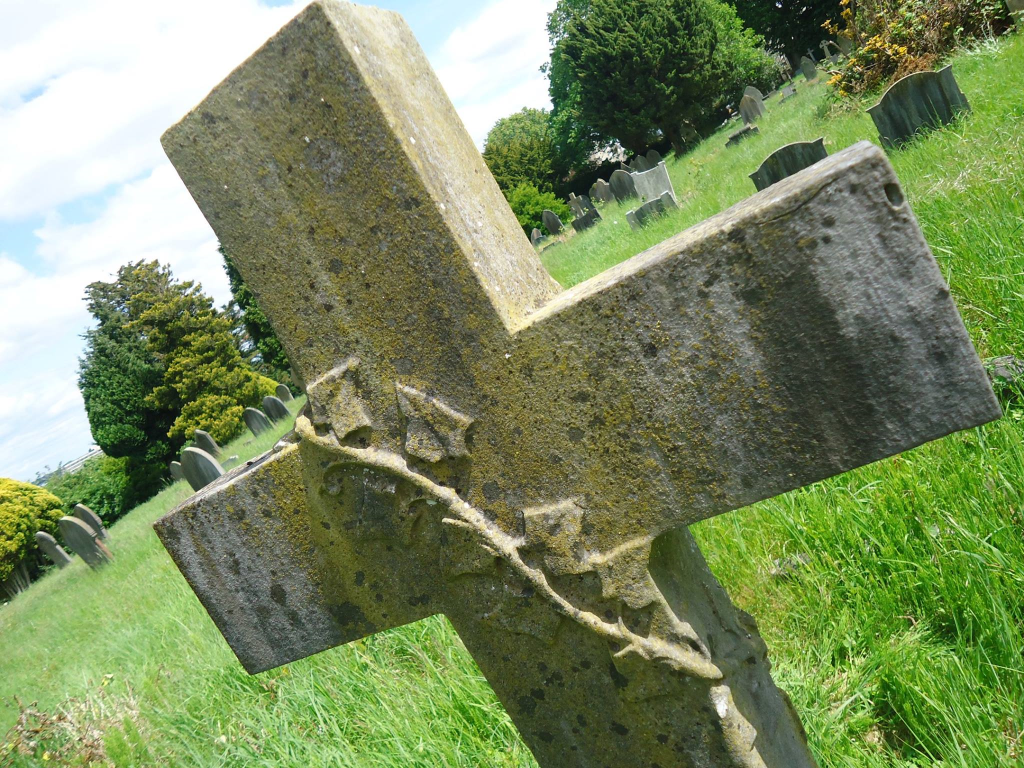
Ivy trailing across a headstone symbolises friendship and immortality.
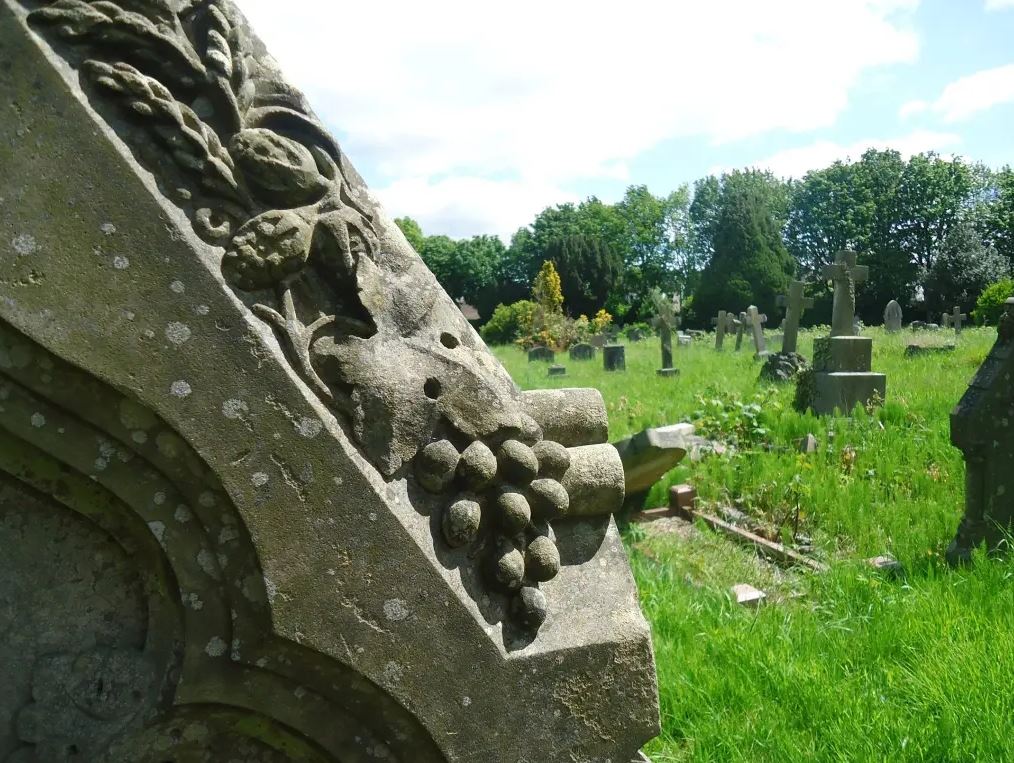
Fruits in many varieties are symbolic of the fruit of life, while grapes and leaves represent Christ and Christian faith.
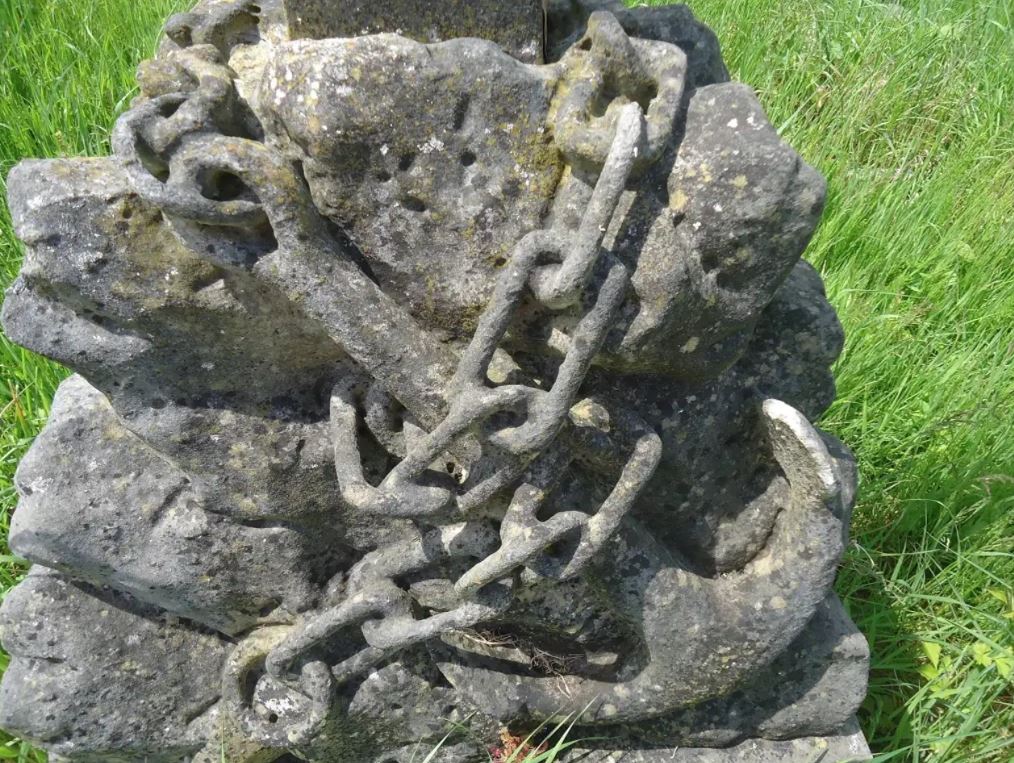
An anchor and/or chains have various meanings, apart from the obvious naval one, and include the severance of the body and soul. There is also a connection with the International Order of Odd Fellows, another popular organisation here in Swindon.
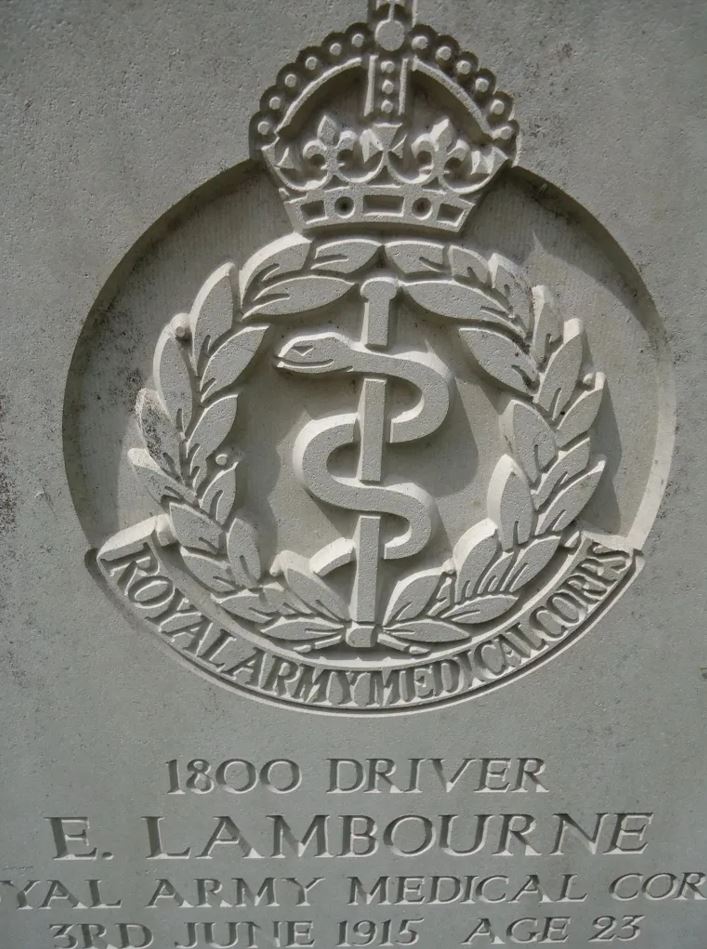
The Commonwealth War Graves headstones all carry the regimental insignia of the deceased service personnel. This is the badge of the Royal Army Medical Corps.
Flowers have various meanings for example the rose is symbolic of love and virtue. A rosebud can indicate the death of a young person. The problem is trying to identify what the variety of flower is on a weathered headstone.
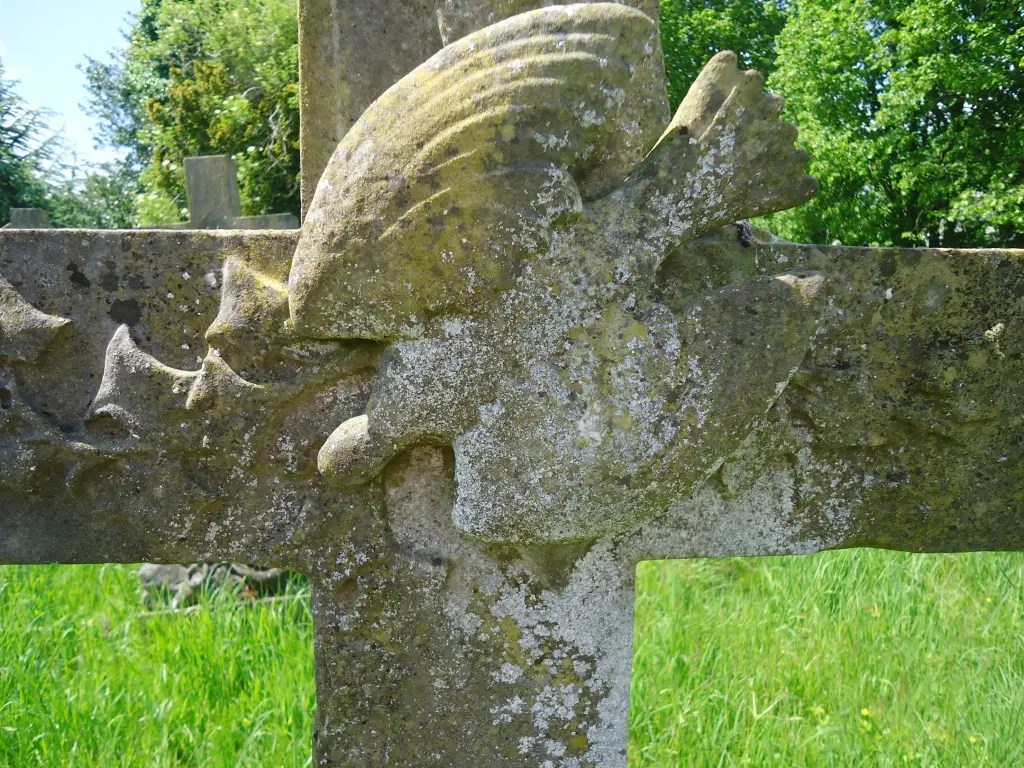
The bird/dove has various meanings including that of eternal peace.
And the letters IHS seen on many headstones in the cemetery, come from the Greek spelling of Jesus and symbolise the first three letters – Iota, Eta, Sigma.
What can a headstone tell you? A surprising amount actually, and that doesn’t just include the inscription.
In older churchyards you might find skulls and crossed bones and dancing skeletons on headstones but you are unlikely to come across these symbols in Radnor Street Cemetery. There are angel monuments and angels carved in relief, but most of the iconography is more subdued.
The cemetery was established in response to several urgent needs. The rapid growth of the town saw diminishing space for burials in the existing churchyards (see Proposed Cemetery for Swindon) and a large and a growing congregation of Dissenters or Non-Conformists. This accounts for the non-denominational nature of the cemetery chapel (most municipal cemeteries have an Anglican and a Dissenters’ Chapel) and why the burial ground itself is unconsecrated ground.
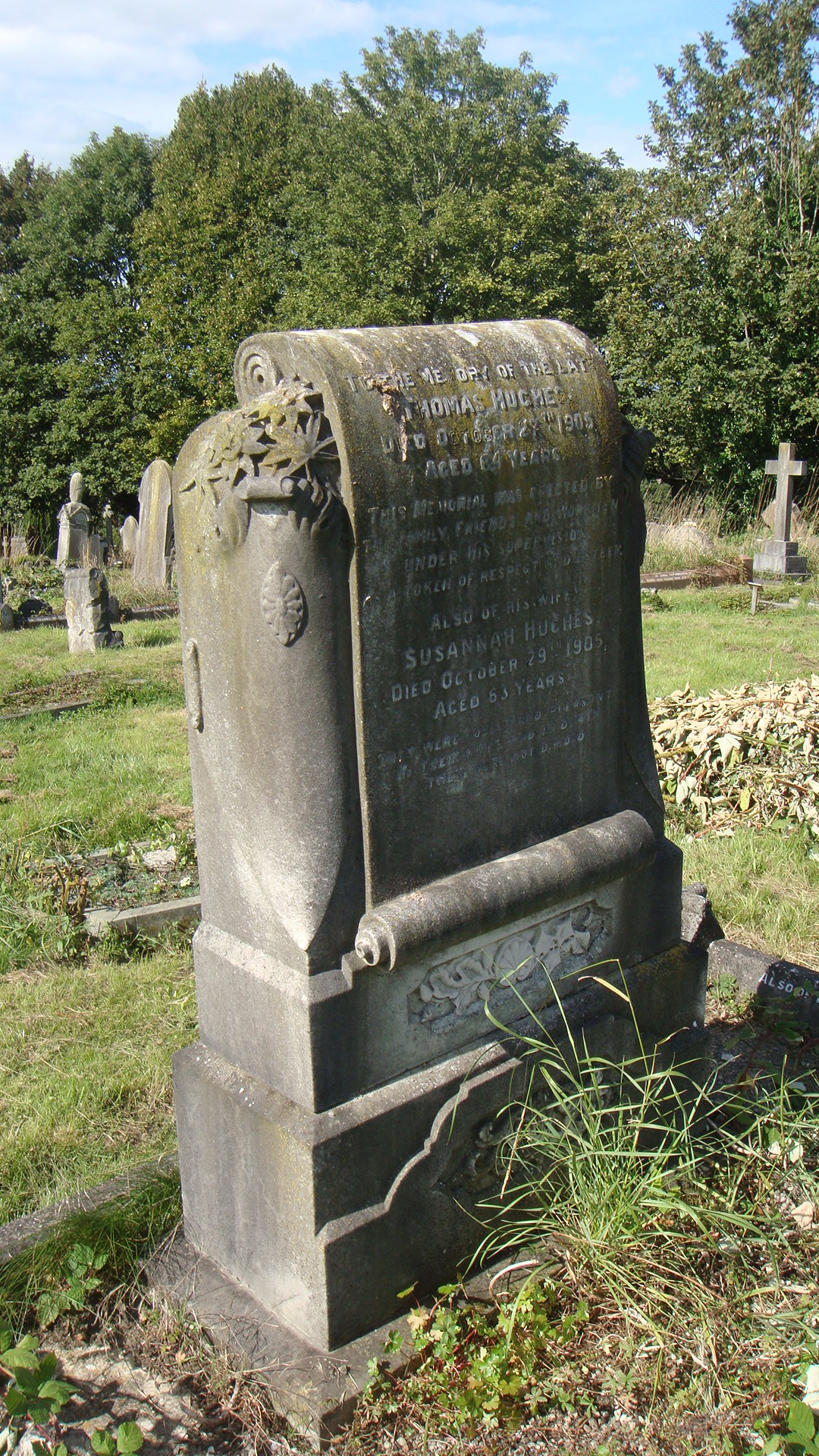
So, what does the inscription on Thomas and Susannah Hughes’s headstone tell us?
To the memory of the late Thomas Hughes/Died October 27th 1905/Aged 64 years/This memorial was erected by the family friends and workmen under his supervision/a token of respect and esteem/also of his wife/Susannah Hughes/died October 29th 1905/aged 63 years/They were (illegible) and pleasant/(illegible) their lives and death/they were not divided
The headstone is in the shape of a scroll, which itself has various interpretations. It can signify a love of learning or a religious conviction. A scroll partially unfurled can indicate a premature death, although not in this case as both Thomas and his wife Susannah were in their 60s.
Acanthus leaves are a classical symbol dating from antiquity and represent both immortality and life’s prickly path. Ivy leaves represent friendship and immortality and oak leaves hospitality and endurance. The medallion shaped flower is most probably a sunflower, representing affection and remembrance while the Easter lily signifies resurrection.
The facts …
We regret to announce the death, on October 27th, after a very short illness, of Mr Thomas Hughes, foreman of the Erecting Shops at Swindon.
Mr Hughes was born at Smethwick, Staffordshire in 1841, and in 1855 was apprenticed to Messrs. James Watt & Co., late Boulton & Watt, Engineers, Soho Foundry, Smethwick, near Birmingham, as general engineer, machinist, turner, fitter and erector. He left Soho Foundry in 1862, after the completion of his apprenticeship, and joined the service of the London and North Western Railway at Crewe, where he stayed for only a short time, returning to Soho Foundry and eventually entering the service of the Great Western Railway Company at Swindon in 1866, as an erector. He was appointed foreman in 1876, and his position was one of the most important at Swindon, as he had full control of the erection of new engines, also of the erecting work in connection with repairs.
He was a man of marked ability in his profession, and was held in high esteem by the officials, particularly by the Chief Superintendent, who, at the opening meeting of the Junior Engineering Society on October 31st, alluded to the said incident in the following terms: – “This Society is unfortunate in a lost which we have sustained within the past few days. I allude to the death of poor Foreman Hughes. He was a member of our Committee, and I am sure I express your views when I say he was one of your most respected members. I am proud to say that Tom Hughes was a friend of mine for a great number of years, and I can scarcely express to you the shock it gave me when I heard of his death.”
For a number of years Mr Hughes held the position of First Engineer in the Company’s Fire Brigade, and in this direction exhibited characteristic energy and interest. He was also a Member of the Council of the Mechanics’ Institution, to which he was devotedly attached. The case is a peculiarly sad one, as within a day or two of Mr Hughes’s death, his wife, who had been ailing for some time, passed away.
Great Western Railway Magazine December 1905.
Death of Mr Hughes
We regret to announce the death, which took place on Friday morning, at his residence, 8 Faringdon Street, Swindon, of Mr T. Hughes, a foreman in the GWR works. Deceased, who had only been ailing a short time, passed away somewhat suddenly. He had been a foreman in the GWR works – over the A Shop (New Work & Erectors), B Shop (Erectors), and P Shop, for 30 years, having been employed in the GWR Works 40 years. He was well known as a member of the Council of the Mechanics’ Institute, in which he took an active interest, especially in the Library and Reading Room, having been a member of the council for seven years. Deceased leaves a widow and grown up family, for whom the deepest sympathy will be felt, especially as Mrs Hughes is lying seriously ill. Mr Hughes was also a prominent member of the GWR Fire Brigade.
Death of Mrs Hughes
An extremely pathetic sequel to the death of Mr T. Hughes, a GWR foreman, which took place on Friday last, is the fact that his wife passed away yesterday morning. She had been ill for some time, and was lying prostrate when her husband died. The funeral takes place tomorrow, when the bodies of Mr & Mrs Hughes will be buried in the same grave in the Swindon cemetery.
Swindon Advertiser November, 1905
In 1871 Thomas and Susannah lived in a shared property at 24 Oxford Street. By the time of the 1881 census they had moved with their six children into one of the larger, foreman’s houses at 8 Faringdon Street where they remained for the rest of their married life.
They were buried on the same day, October 31, 1905 in plot D141. They share their grave with their eldest son Charles Thomas, who died in 1907 and their son in law, Ernest James John Tarrant, the husband of their daughter Alma Susan, who died in 1914.
This is the case of a man who placed a few stolen flowers on a grave where he would later lie himself.
Helen Hill died on January 31, 1885. She was 84 years of age and a widow. The Hill family were originally from Scotland where her husband Mathew worked as a Flax Mill Spinner in Leven, Fife. By 1861 Helen, and her son James, a turner in the Works, and her daughter Henrietta, were living in Faringdon Street.
This wasn’t exactly the crime of the century, more the act of a grieving son. Even Mr. H. Kinneir, Clerk to the Local Board, emphasised that this was a trivial case but the theft of flowers on existing graves was taking place all over the cemetery. Standards had to be unheld and such petty thieving would not be tolerated! (I detect here the opinion of cemetery caretaker Charles Brown.)
Charge of stealing flowers from a grave – James Hill, 51, fitter, of Faringdon street, New Swindon, was summoned at the instance of the Swindon Local Board and Burial Board, charged with stealing some flowers – daisies – from a certain grave in the Swindon Cemetery and placing them on that of his mother – Mr. H. Kinneir, Clerk to the Local Board, appeared to prosecute, and in opening the case stated that the action was taken at the instance of the New Swindon Local Board and the Cemetery Committee. The case, although not a serious one – possibly a trivial one to many – was one of importance to the Cemetery Authority, and people interested in the cemetery. It was well known that persons who had relatives lying buried therein took pains with the graves, and planted flowers thereon. The present action arose through defendant, who was a man well known and highly respected, going through the cemetery on a Sunday and plucking several flowers from a certain grave and placing them on his mother’s grave. It was to point out the seriousness of the case that the present action was taken. Mr Kinneir said the Board did not wish to press the case, but wished for a small fine to be imposed, to let the public know that they must not gather flowers from a churchyard or cemetery. This proceeding of gathering flowers was going on all over the cemetery, and the Board wished to put a stop to it. The maximum penalty for the offence was £5. Without hearing any witness the bench imposed a fine of 2s 6d, and ordered payment of court fees.
James died in 1897 and was buried with his mother in grave plot A631, a public grave. They share the grave with 23 years old Lily Palmer who died in 1928 and is unlikely to be any relation.
For more than 15 years a small group of volunteers have been working to bring the history of the cemetery alive again and the cemetery chapel has been central to our work.
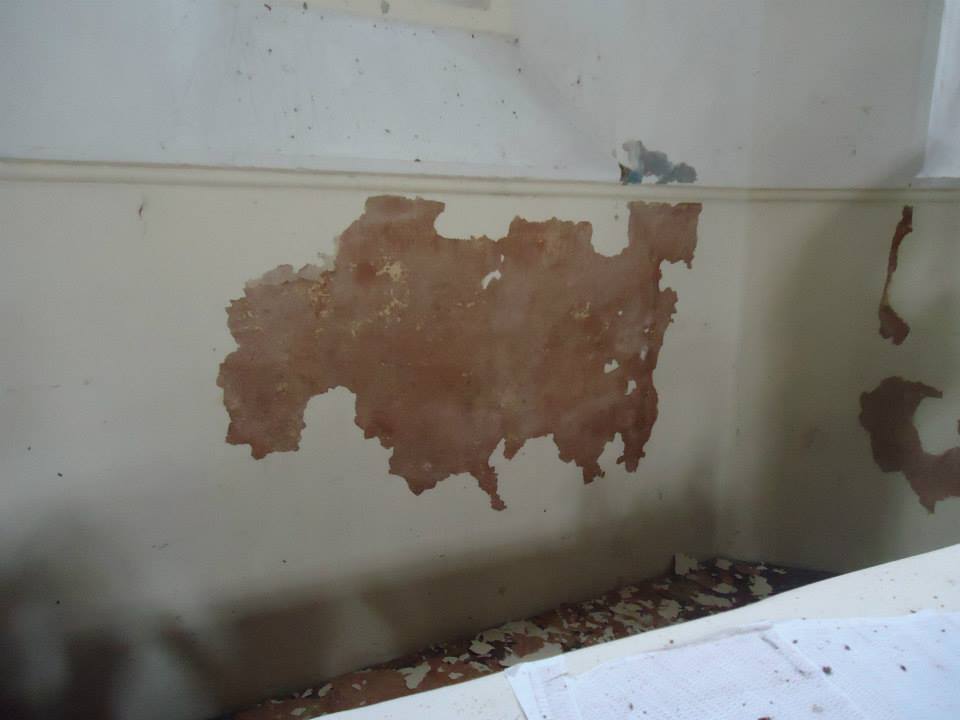
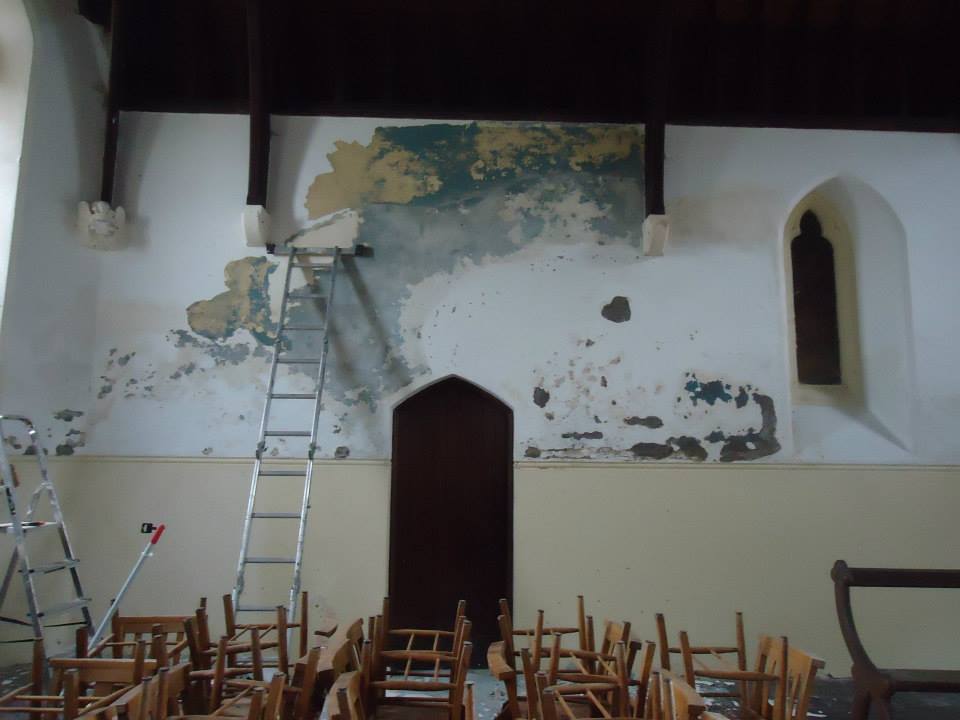
The chapel was designed in 1881 in the Gothic Revivalist style by popular local architect William Henry Read (who is buried in the cemetery). The cemetery chapel was non denominational and the burial plots in the cemetery were unconsecrated, at last the non-conformist residents of Swindon could be buried according to their own beliefs. Built to seat 100 people the chapel is austere and unfussy and painted white throughout, but this was not the original colour scheme. During repair and restoration work undertaken in 2013 we discovered that the upper walls were painted dark blue with the lower section a dark red, another fascinating aspect of the history of the building.
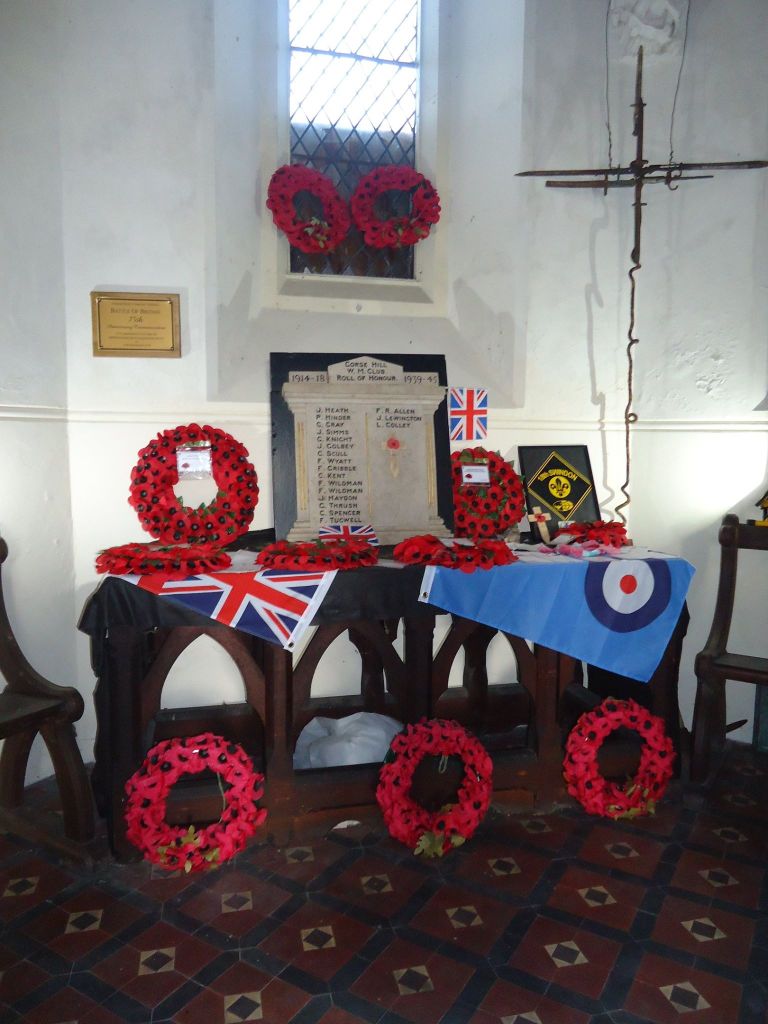
The cemetery chapel is central to the activities we hold, especially the Service of Remembrance. However, in recent years the numbers who attend this service have increased to such an extent that we are no longer able to meet in the chapel. Instead we gather round the Cross of Sacrifice, the Commonwealth War Graves memorial. At the end of the service the scouts place a cross on each of the 104 Commonwealth War Graves.
In 2014 we hosted the launch of Swindon in the Great War, a four year project to commemorate the events of the First World War. An exhibition of First World War artefacts and photographs at the end of the commemoration period was a great success.
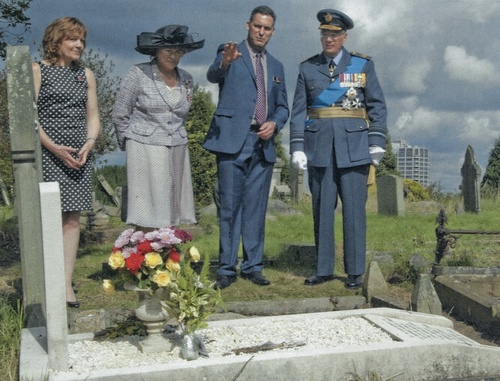
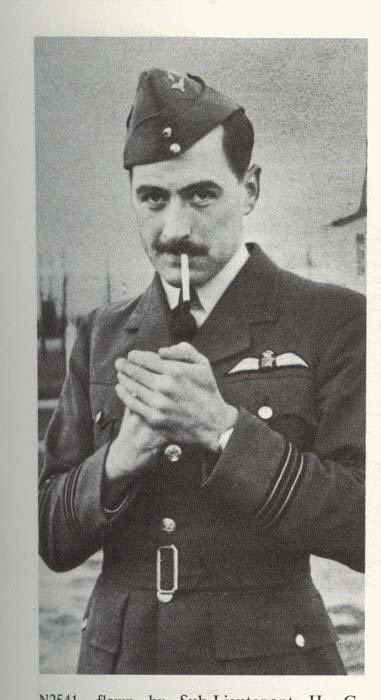
And in 2015 the Duke of Gloucester was guest of honour at a Battle of Britain 75th anniversary commemorative event held at the cemetery. The Battle of Britain Memorial Flight flew over Radnor Street Cemetery and the grave of Squadron Leader Harold Morley Starr, a Swindon born pilot who was shot down by enemy aircraft above Kent on August 31, 1940.
Launch of Swindon in the Great War commemorations 2014restoration and redecoration work in 2013Remembrance Day 2015 and the Trinity Wesleyan Methodist War memorial rescued from a garden in Gorse Hill
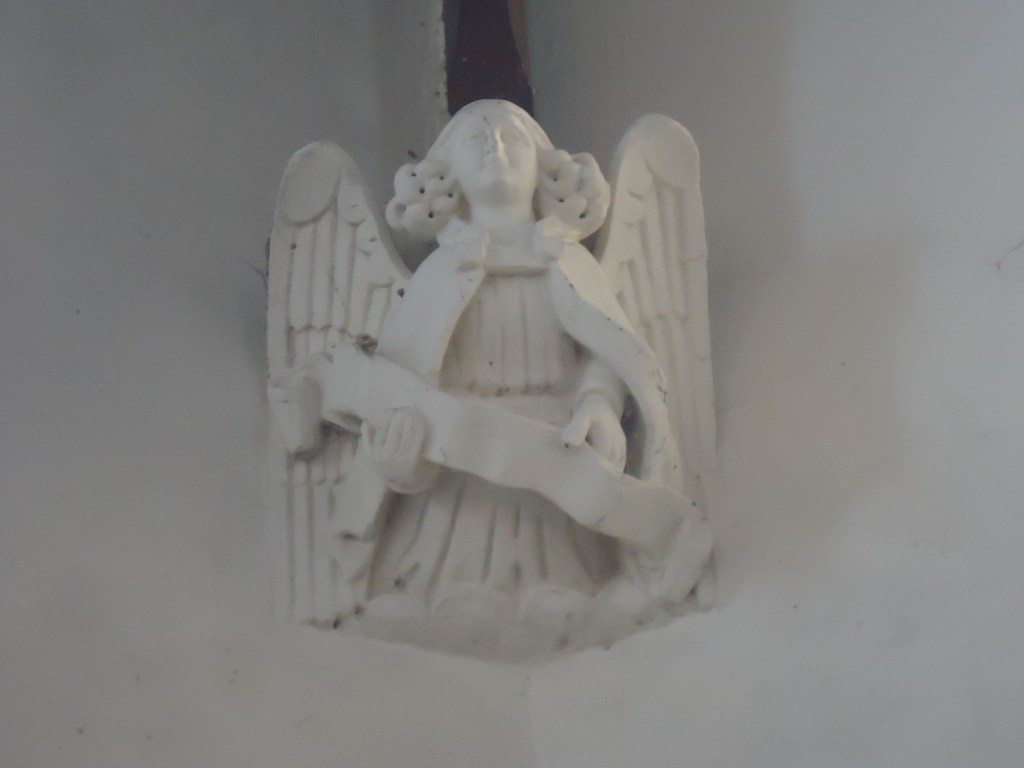
The Sanford Street School Roll of Honour was placed in the cemetery chapel for safekeepingThis commemorative plaque was placed in the cemetery chapel for safekeepingAngel bosses in the Chapel roof
The Duke of Gloucester at the grave of Squadron Leader Harold Morley Starr
Local schoolchildren designed stained glass windows for the chapel as part of the 2015Battle of Britain 75th anniversary commemorations.
Squadron Leader Harold Morley Starr
Join us for a guided cemetery walk on September 15, 2024 to celebrate Heritage Open Days. Meet at the chapel at 1.45. Walk begins at 2 p.m.
If you are in the habit of cutting through the cemetery to reach your destination you will appreciate what an inconvenience it is to find the gates locked.
This is just the situation in which William Richard Crook found himself on October 17, 1882. The 25 year old carpenter did what any able bodied young man would do and climbed over the fence.
However, he had been spotted by the fiercesome cemetery caretaker Charles Brown. Brown’s care of his kingdom and its deceased residents was exemplary. He had less patience with the general public!
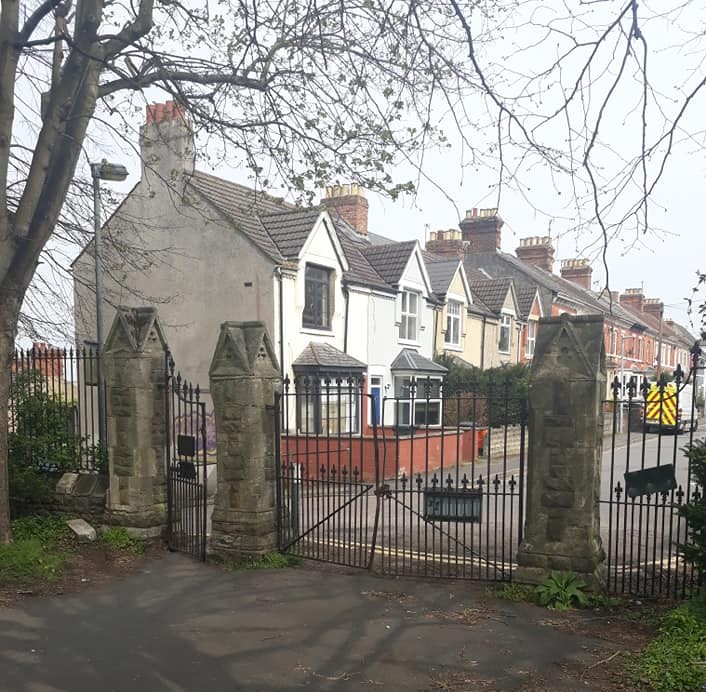
Radnor Street gate
Damaging the Cemetery Fence – William Crook, carpenter, Swindon-road, was charged by the Burial Board with damaging the fencing at the Swindon Cemetery, on the 17th inst. Charles Brown, caretaker, proved seeing defendant climb over the rails of the cemetery when he found the gate locked. – Defendant admitted the offence, and was ordered to pay 1s damage, 1s fine, and 7s costs, the Bench cautioning him not to offend again.
The Swindon Advertiser, Monday, October 30, 1882.
Dixon Street gate
William was born in Pewsey in about 1858, the younger son of George and Amaryllis Crook. By 1871 the family had moved to Swindon and were lodging at 4 Union Street.
William married Alice Pauline Carlton the same year in which he was charged with damaging the cemetery fence. The couple went on to have two children, Victor and Lilian, and by 1891 William was working as a publican at the Oddfellows Arms in Queen Street.
He died at the prematurely young age of 35 years old in 1893 and, of course, his last resting place was in the cemetery, the scene of his fence vaulting crime. I wonder if Charles Brown ever made the connection.
William lies in an unmarked, public grave B1702 which he shares with three others, including his son Victor who died in 1899 aged 15.


















 Radnor Street Cemetery