Private Francis James Gleed – Royal Army Medical Corps

456089 Private Francis James Gleed of the Royal Army Medical Corps died on October 28, 1918. He was not killed in action, neither did he die from wounds or disease, but he did die as a direct result of his military service.

Francis James Gleed was born in 1893 the third of four sons of blacksmith striker Thomas Gleed and his wife Elizabeth. Unlike his two elder brothers, Francis did not follow his father into the railway works but instead took up a tailor’s apprenticeship.

Francis enlisted in Swindon on May 11, 1915 in the Royal Army Medical Corps and was posted with the Mediterranean Expeditionary Force on November 30, 1915. His military service would last for 3 years 199 days, most of it spent in Egypt. Francis continued to serve in the 231st F.A. before being transferred to France in May 1918. Three months later he was granted 14 days leave to the UK, the last time he would see his family in Swindon.

His medical notes detail the nature of his injury which occurred in March 1916 when he was loading an ambulance train in Minia Station, Egypt. He was working with a bearer party when he strained himself, causing a hernia. An operation was successfully performed, but Francis complained of a recurrence in October 1918.  After wearing a truss with unsuccessful results he was admitted to the 32 Casualty Clearing Station and then transferred to the 54 Casualty Station before being moved to the 7 Stationary Hospital where he died on October 28, 1918. His cause of death was an inguinal hernia caused by a weakening of the muscles in the lower abdomen.

Francis James Gleed was buried in Terlincthun British Cemetery, Wimille on the northern outskirts of Boulogne. The inscription on his headstone as submitted by his mother Elizabeth reads – Life’s Work Well Done Life’s Race Well Run Life’s Crown Well Won Now Comes Rest

In 1921 Thomas Gleed took receipt of his son’s 1914-1915 Star Medal followed a year later by his British War and Victory Medals.

On April 22, 1919 Francis’s personal effects were returned to his family. They were listed as follows:

Letters

2 religious books

Valet safety razor in case

Metal cig. Case

Pipe

2 titles

Purse

2 wallets

Photos

Note book

P. cards

Safety razor & blades in tin box

Defaced coin 5 cts coin ½

However, there was something of far more significance that Elizabeth wanted returned. She acknowledged receipt of the above mentioned items and wrote:

There is my sons 2 pairs of scissors one large and one small and a pen knife white handle – should be pleased if you could find it and send it on. Yours truly E. Gleed.

The scissors were possibly tools of his tailoring trade tangible reminders of the son she had lost and the career he had pursued at home in Swindon.

Francis James Gleed is remembered on the Gleed family headstone in Radnor Street Cemetery.
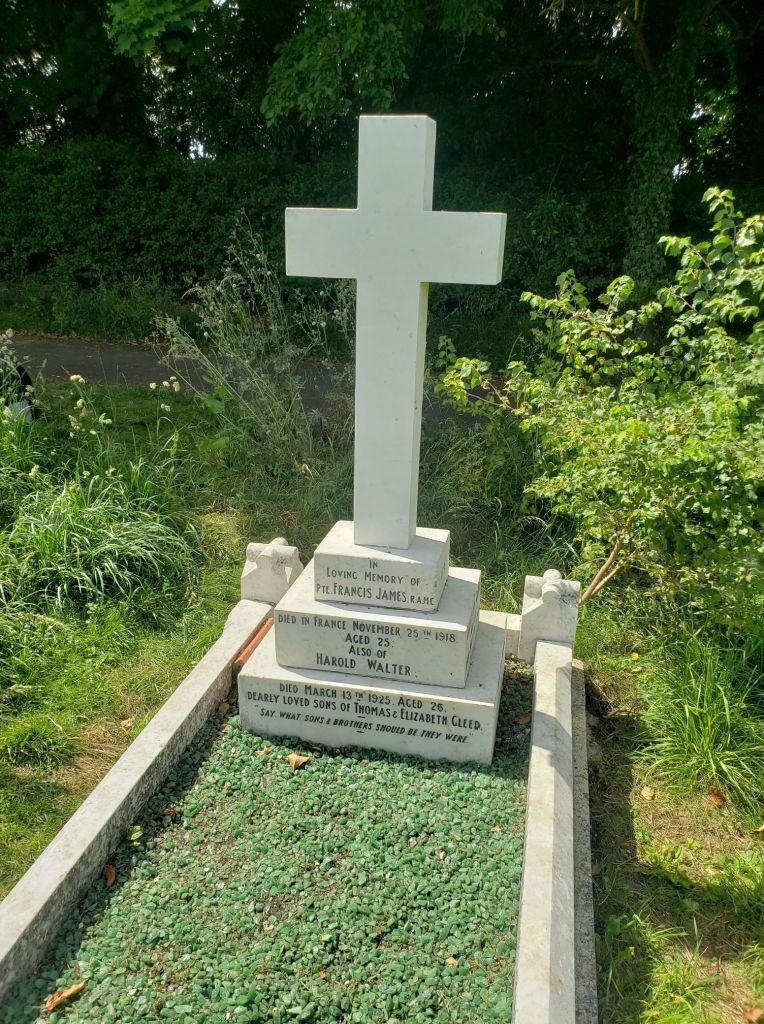
“Say what sons & brothers should be. They were.”

Hubert John Deacon – jeweller and watchmaker

Image of Hubert John Deacon published courtesy of Deacons website

I’m sure the name Deacon will be familiar to many, but did you know Hubert John Deacon was also a leading figure in the Baptist Church, Swindon.

The jewellers at 11-13 Wood Street was founded in 1848 by George Deacon who was later joined in business by his two nephews Hubert and Joshua.

Hubert John was born in Trowbridge in 1846 and joined the business in the late 1860s, during what was a period of considerable expansion for the family firm.

In the online company history Hubert is described as an entrepreneurial figure.  He was the first President of the Swindon Chamber of Commerce in 1893 and was responsible for supplying Swindon’s first public clock on the Town Hall.  He also brought the plot of land on which Deacon Street was built and named in his honour.

By 1881 he and his wife Susan had moved in over the Wood Street shop where they lived with their six children, cousin William Nash who was a watchmaker apprentice, Ann Shackleton, a jeweller’s shopwoman and two young servant girls. The Deacon children would eventually number ten.  The youngest, a daughter was named Dorothy Decima.

Hubert was succeeded in the business by his only surviving son George. Today the family firm is in the hands of Richard Deacon and his sister Sara, the 6th generation

Image of Deacons store published courtesy of Deacons website

Death of Mr H.J. Deacon

50 Years a Resident in Swindon

Public Activities

The death took place on Thursday at Margate of Mr Hubert John Deacon, who was associated with the public life of Swindon for over half a century. Mr Deacon, who was 81 years of age, had been in delicate health for some time, and succumbed to an attack of bronchitis.

For many years Mr. Deacon carried on business as a jeweller and watchmaker in Wood Street, a business that was established by his uncle, Mr George Deacon, nearly a century ago. On the death of his uncle, Mr. Deacon succeeded to the business. His son, the late Mr. George Deacon, entered the business, but died at a comparatively early age, and it is now carried on by the widow, Mrs Mildred Grace Deacon, under the style of Deacon & Son.

The late Mr. Deacon first married Miss Lay, of Harwell, Berks, who predeceased him soon after they celebrated their golden wedding when they resided at “Grovelands”, Springfield Road. They had a family of two sons and eight daughters, and two daughters survive. Deceased married again when he went to Margate to reside.

An ardent worker for many years in connection with the Baptist Church in Swindon, Mr Deacon was a member when the old church was in existence at the corner of Bridge Street and Fleet Street. He took a prominent part in the scheme for building the Tabernacle 40 years ago, and gave liberally to the church funds. On the retirement of the late Mr. W.B. Wearing as superintendent of the Sunday School, Mr Deacon succeeded to that post, which he filled with success for many years. He was also a member of the Baptist Union of Great Britain and Ireland.

Interest in Public Work

Mr Deacon was associated with many enterprises in the town, notably the Swindon Permanent Building Society, of which he became successively vice-chairman and chairman, and witnessed a wonderful advance in that society as the town grew.

The public work and interests of the town always commanded his attention, and his greatest interest. He was for a number of years a member of the Local Boards, and afterwards of the District Councils of Old and New Swindon, and was also one of the first members of the Corporation, when Mr. G.J. Churchward was Mayor. He also devoted some years to Poor Law work as a member of the Swindon and Highworth Board of Guardians.

Of the Swindon Horticultural Society he was a great supporter, and his lovely garden and grounds at “Grovelands,” which he frequently lent for social gatherings in connection with churches in the summer months, were evidence of his love for flowers.

Mr. Deacon also interested himself greatly in the Victoria Hospital, with the establishment of which he was associated, as well as with its opening in Queen Victoria’s Jubilee year. For some years he was vice-chairman of the committee of management. He was one of the founders of the Old Swindon Traders’ Society, which was the forerunner of the Swindon Chamber of Commerce. Of the latter body Mr. Deacon was the first President. He was also a former chairman of the Swindon Plate Glass Insurance Society and for some years chairman of the Southern Laundry Company.

Bowls was his only out-door sport, though he did not play that extensively. He was a member of the Westlecott Club, and was instrumental in its formation.

In various other spheres the deceased did good work in the town.

Extracts from the North Wilts Herald, Friday, January 28, 1927.

This is the last resting place of Hubert, his wife Susan, their daughters Honoria Edith and Winifred Elsie and their son also named Hubert John. Susan died in Swindon in 1920 aged 73.  Hubert died in 1927. 

Charles and Annie Guley and their two soldier sons

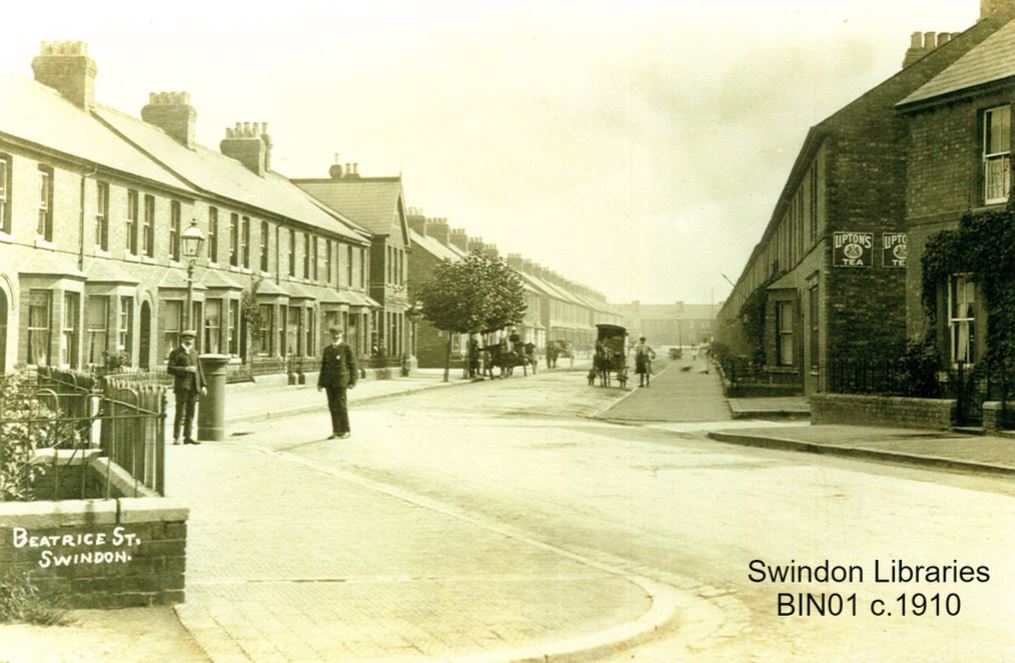
Edward George Guley was born on January 25, 1895 and baptised at St. Paul’s Church, Swindon on July 7. He was the second son of railway carriage fitter Charles Guley and his wife Annie. In 1911, the last census taken before the outbreak of war in 1914, the family lived at 8 Beatrice Street, Gorse Hill. All three men in the family worked in the railway factory. Charles as a Railway Carriage Fitter, his eldest son Harold Charles Guley was 19 and employed as an Engine Fitter apprentice and part time student and Edward George Guley was 16 and a machine boy and part time student.

Both Charles and Annie’s boys enlisted – possibly together, and both served in Basra. Harold was nearly 24 years old, Edward was 20. Harold’s service records have survived but unfortunately Edward’s haven’t. Harold served in the Royal Army Service Corps and Edward in the 5th (Service) Battalion. Harold returned home to Swindon at the end of the war; Edward didn’t.

The First World War campaign in Mesopotamia (modern day Iraq) cost 85,000 British casualties, one of whom was Edward George Gulley, killed in action on March 29, 1917.

The 5th (Service) battalion were in action on the 25th January 1917 when they assaulted the Turkish front line, one flank of which rested on the Hai River which they had crossed only a month before. They took heavy casualties in this action. On the 25th of February they crossed the River Tigris and by the end of the month after hard marching they were 40 miles short of Baghdad. On the 10th March they made a night river crossing over the Diala River establishing a bridgehead and taking 120 prisoners in the process. The way to Baghdad was open and the battalion was the first to enter the city. At the end of March the battalion advanced on Turkish positions 35 miles north of Baghdad near Daltawa. They sustained heavy casualties in this attack. In April and May they continued the advance up the line of the River Adhaim with contact being made with the Russians operating from the Caspian Sea. They then took up defensive positions between the rivers Tigris and Adhaim, East of Samara. In early December they advanced towards Kara Tepe, with the battalion pursuing the Turks through Sakaltutan Pass. They paused at this point and ended the year reorganizing and training.

The Rifles Berkshire and Wiltshire Museum

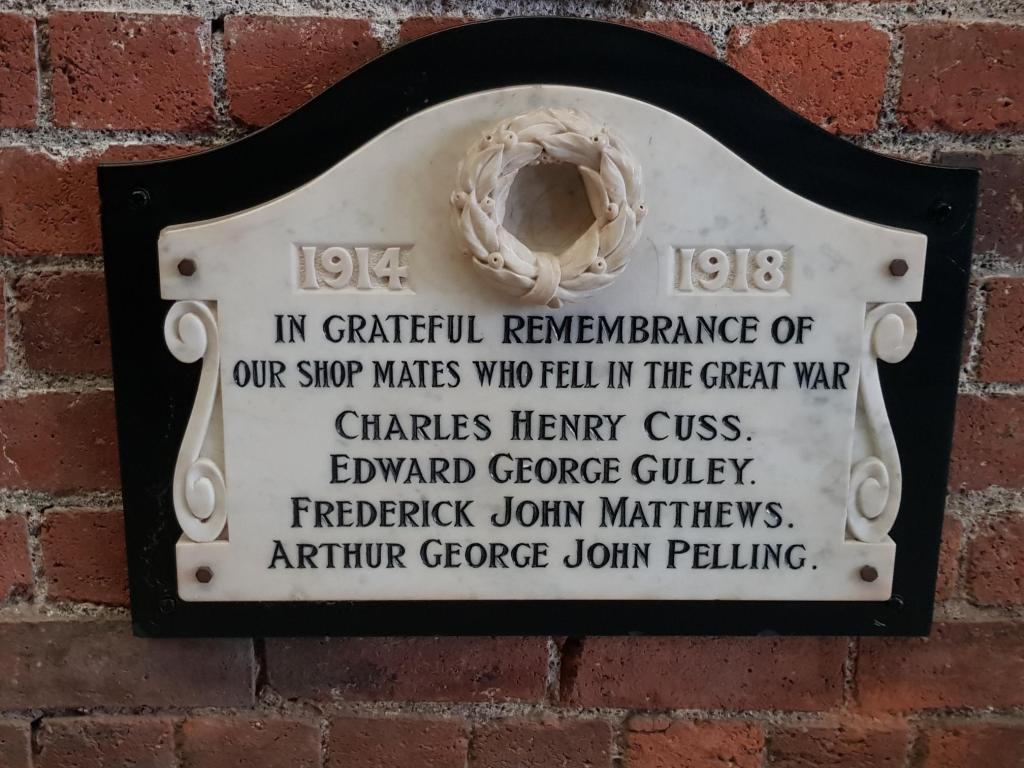
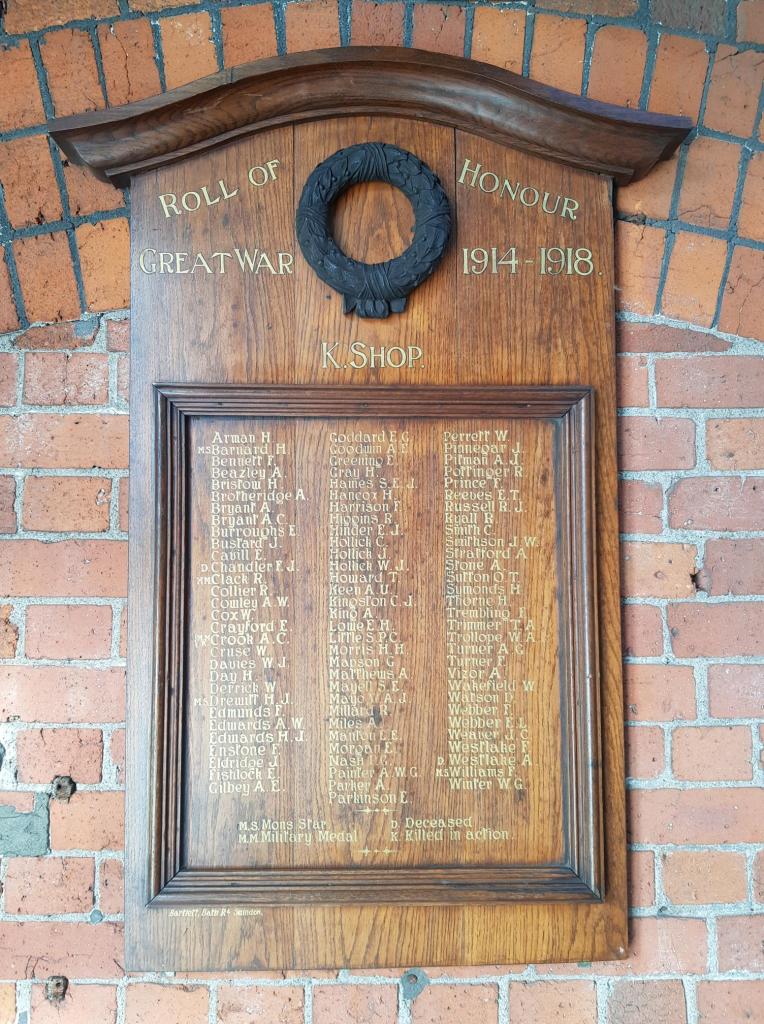
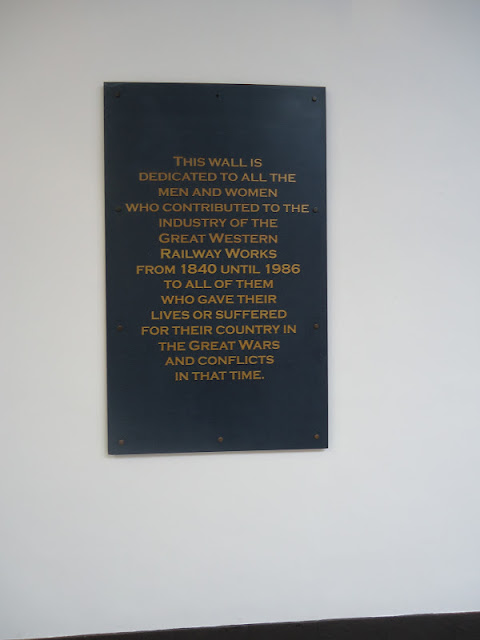
Edward has no known grave and is remembered on the Basra Memorial. He is also remembered on a plaque raised by his colleagues in the GWR Works, which now hangs in the STEAM – Museum of the Great Western Railway

Annie survived the war and the loss of her son, but what was survival like for her? Did parents ever recover from the loss of their boys? I doubt it. Her husband Charles was buried in Radnor Street Cemetery on January 5, 1928 in plot D245 where Annie joined him on June 20, 1933.

Down Your Way – Old Town

The ‘fur coated women of Old Town’ received a bad press when the Swindon Advertiser interviewed local bus drivers and conductresses during the Second World War.

“They expect to be picked up and put down outside their own homes, regardless of the approved stopping places, take twice as long as the average passenger to leave the bus because they are too busily engaged in a conversation which almost monopolises the vehicle, and invariably need change from a half crown or a note,” reported the Advertiser.*

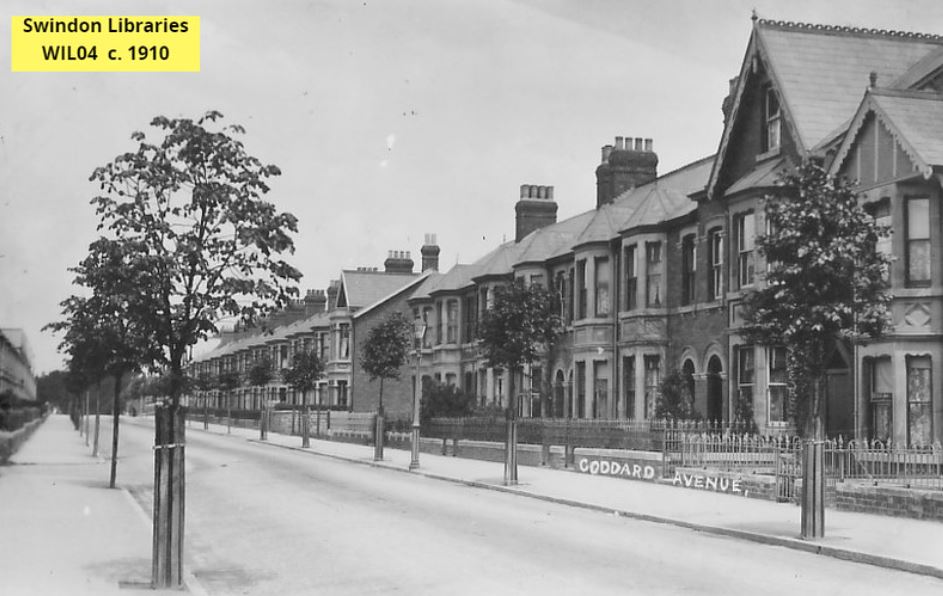
Read about some of the former residents of Goddard Avenue who were hopefully less annoying!

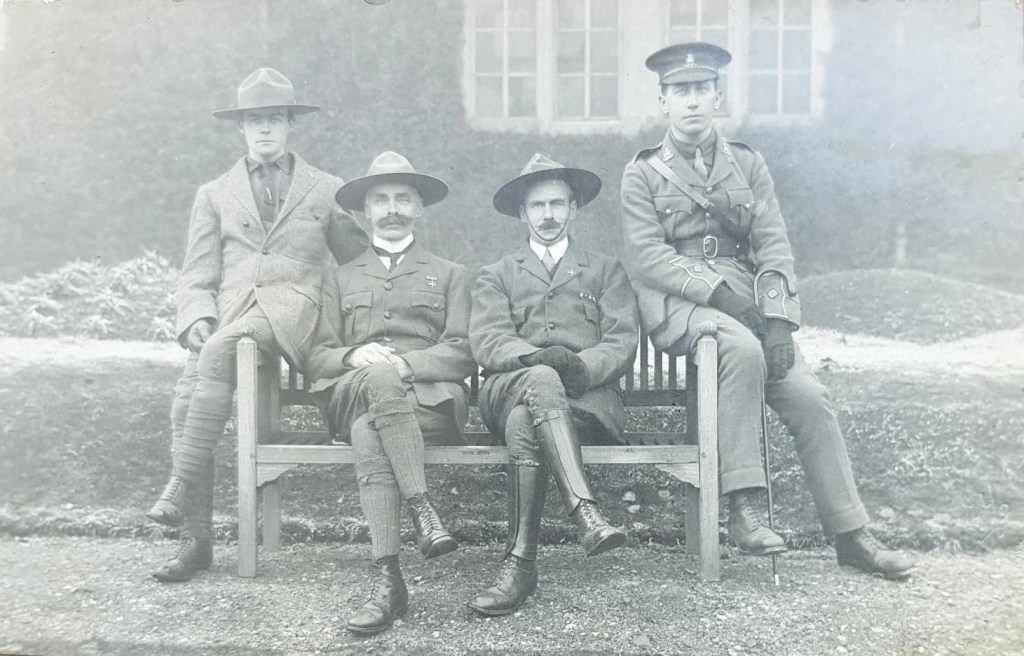
William Rowland Bird – chief chemist at GWR Works and Scout Leader

Phyllis Mary Peters – Railway Clerk

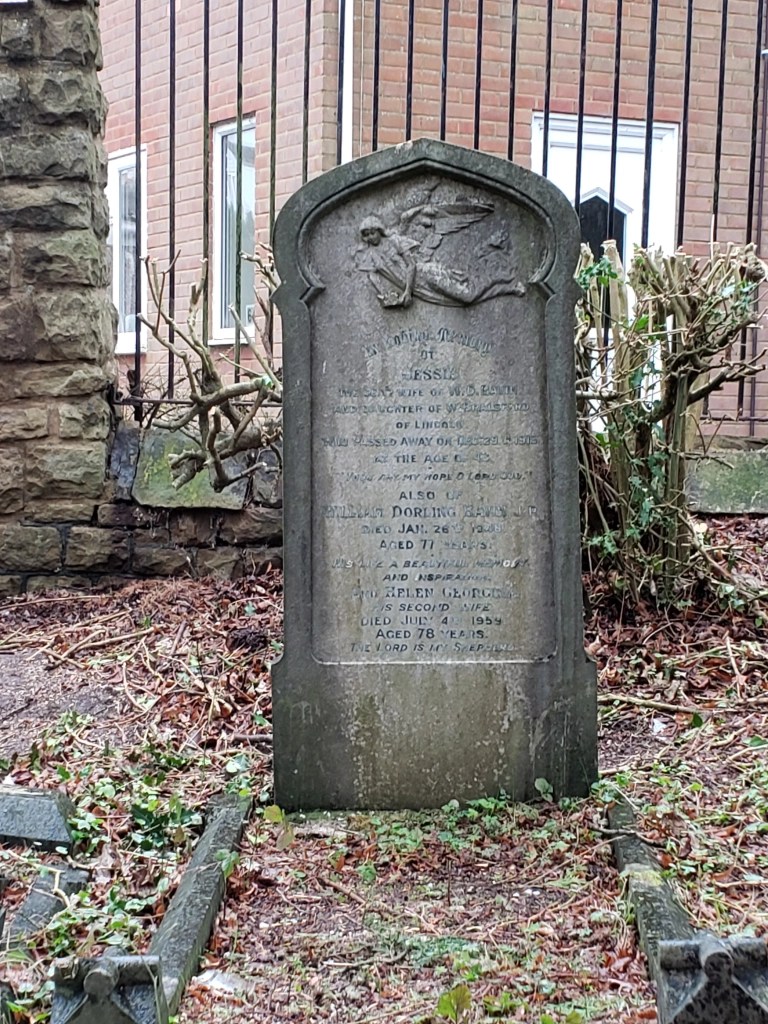
William Dorling Bavin – Swindon’s War Record

*Swindon at War was a series of articles published in 2011 sourced from the Swindon Advertiser 1939-1941 and compiled by myself.

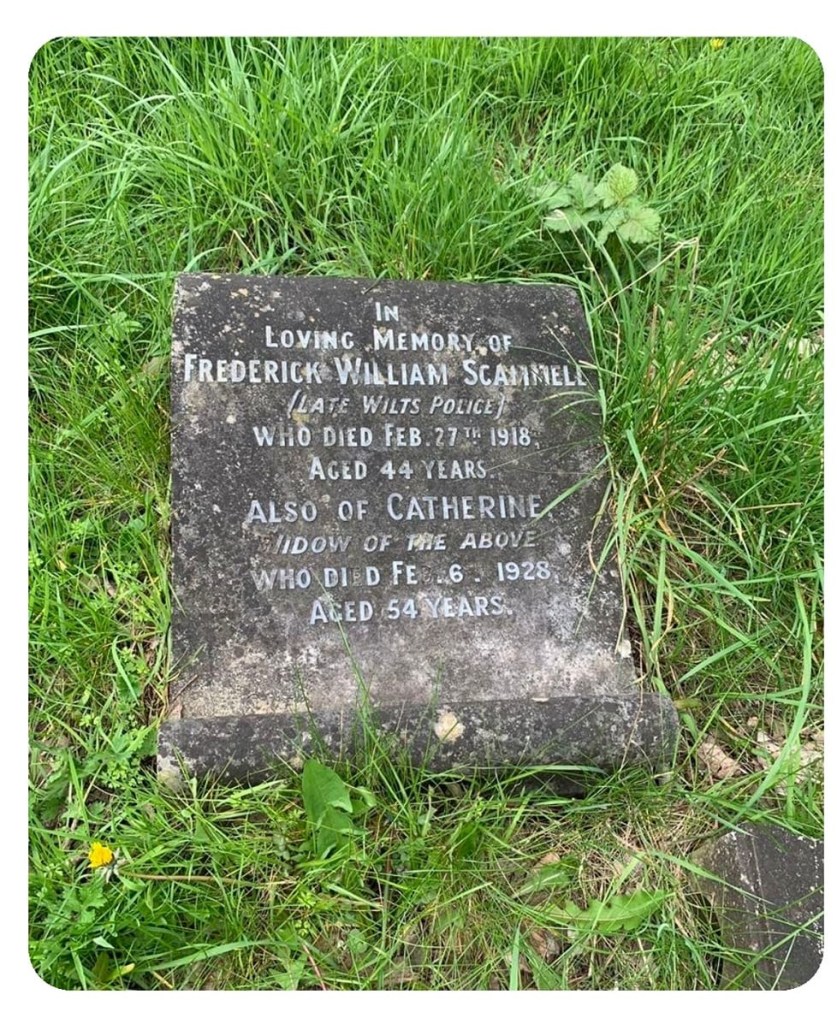
Police constable Frederick Scammell and his family

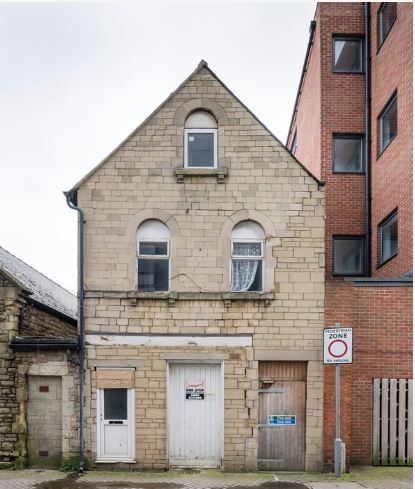
Is this the original Bridge Street Club where Frederick William Scammell moved to when he left the police force?

Born in Donhead St Mary in 1872 Frederick was posted to the Police Station in Eastcott when he married Catherine Noad at Christ Church in 1897.

By 1901 he was serving in Shalbourne, Wiltshire. The couple had three sons Philip Edwin, Norman Robert and three weeks old Maurice Frederick.

Of these three boys two would enlist in the Wiltshire Regiment during the First World War. Philip, 19, was discharged just 13 days after he enlisted in Devizes in 1914, declared “Not being likely to become an efficient soldier.” Maurice died on January 14, 1917 in hospital in England. His cause of death was a fracture to the base of the skull, but it is not known how this happened.

But in 1901 this was all in the distant future for Frederick and Catherine. In 1911 Frederick was serving in Corsley Heath, Warminster. He was 38 years old and Catherine 37. They had been married for about 13 years and had 6 children who were all living.

Frederick died in 1918 when the burial registers record that he was Club Steward at the Bridge Street Club. He was buried on March 4 in grave plot C3468.

Catherine moved to Gorse Hill where she ran a shop at 147 Beatrice Street. She died at the Glenwood Nursing Home and was buried with Frederick on February 9, 1928.

Their son Philip Edwin, who was spared the ordeal of serving in the First World War, was buried with his parents in 1965.

Railway Stories

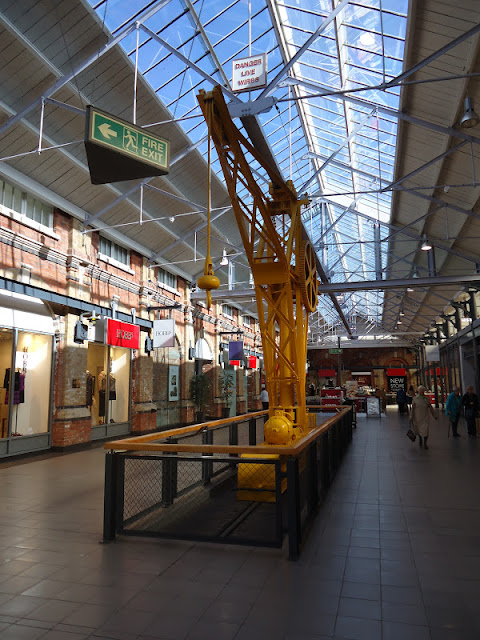
I’m having a rather expensive sandwich and a cup of tea (not many people drink tea now, I find it’s become an ‘old persons’ beverage) in a coffee bar which proudly boasts on the signage that it was ‘established 1999.’ It is situated in the former railway factory established slightly earlier – in 1843!

The model train has just done a circuit – a nod to the railway history of the McArthur Glen Designer Outlet Village. In all fairness there are plenty of reminders – machinery, overhead cranes and the war memorials to the railwaymen who gave their lives in two world wars.

There is still a generation of railwaymen around who can remember the Works when it closed in 1986 making 1,100 redundant. A far cry from the glory days of the 1920s when there were more than 14,000 on the payroll.

As I sit here enjoying my sandwich and (generous) mug of tea, listening to the hum of conversation around me, I think of all those men who spent a lifetime grafting within these walls.

You may like to read the stories of some of them – see below.

Some railway stories

Elias Isaac Webb – still painting at the age of 83

Luke Higgs – a first class engineman

Edwin Thomas Brittain – oldest foreman in the Works

The Order of the White Feather

The Order of the White Feather was founded at the outbreak of war in August 1914 by Admiral Charles Penrose Fitzgerald. The campaign encouraged women to present white feathers, a potent symbol of cowardice, to men not wearing uniform. The campaign was incredibly successful, even as the details of the death toll and casualties became widely known.

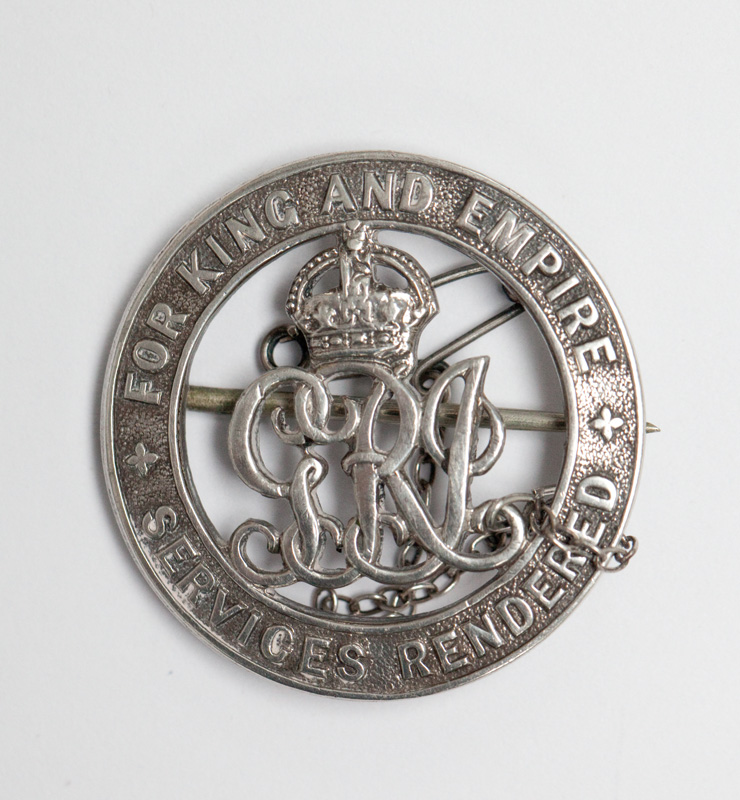
The practice seems to have carried on for the greater part of the war and in September 1916 the Silver War Badge was issued for men to wear who had been honourably discharged due to wounds or sickness.

Why did women subscribe to this propaganda?  The writer Compton Mackenzie, who served with British Intelligence in the Eastern Mediterranean, said ‘idiotic young women were using white feathers to get rid of boyfriends of whom they were tired.’

For some it was no doubt misplaced patriotism.  For those who had lost husbands and loved ones it might have been a reaction to their grief.

One such young woman who handed out white feathers on the streets of Swindon did so because her four brothers were all serving soldiers.

Alice Elizabeth Godwin grew up at 21 Redcliffe Street, the daughter of Charles Thomas Godwin, a furnaceman in the Works, and his wife Clara Annie.  You can imagine the daily dread the family experienced with four sons in service and how a young, impressionable girl might have been coerced into joining the white feather campaign.

But it would be the experiences of one of her brothers which ultimately changed her mind.

She was at the station in Swindon seeing him off back to the front at the end of his leave, when he broke down, weeping and shaking uncontrollably.  It was seeing him so terrified that made her cease her practise of handing out white feathers. Thankfully, all four brothers returned home.

Propaganda poster

Charles Thomas Godwin died on November 8, 1914 and was buried in grave plot B3265. His wife Clara Annie died in 1939 and was buried with him. Their son Albert Howell, who had served in WWI, died in 1940 and joined his parents. In 1985 Albert’s wife Clara Agnes was buried with her husband and his parents. In 1993 the ashes of their son Arnold William Godwin were interred in the family grave.

Down Your Way – Stories from Gorse Hill

In the beginning Gorse Hill barely stretched from the railway line to St. Barnabas’s Church with the Duke of Edinburgh pub and Baptist and Methodist Chapels in between. Taking its name from Gorse Hill House which once stood on Cricklade Road, early development was called the Gorse Hill Farm Estate and began in about 1885.

Read about some of Gorse Hill’s residents here:

Nellie and William James Bacon – A Gorse Hill Story

Lydia Fry – For Services Rendered

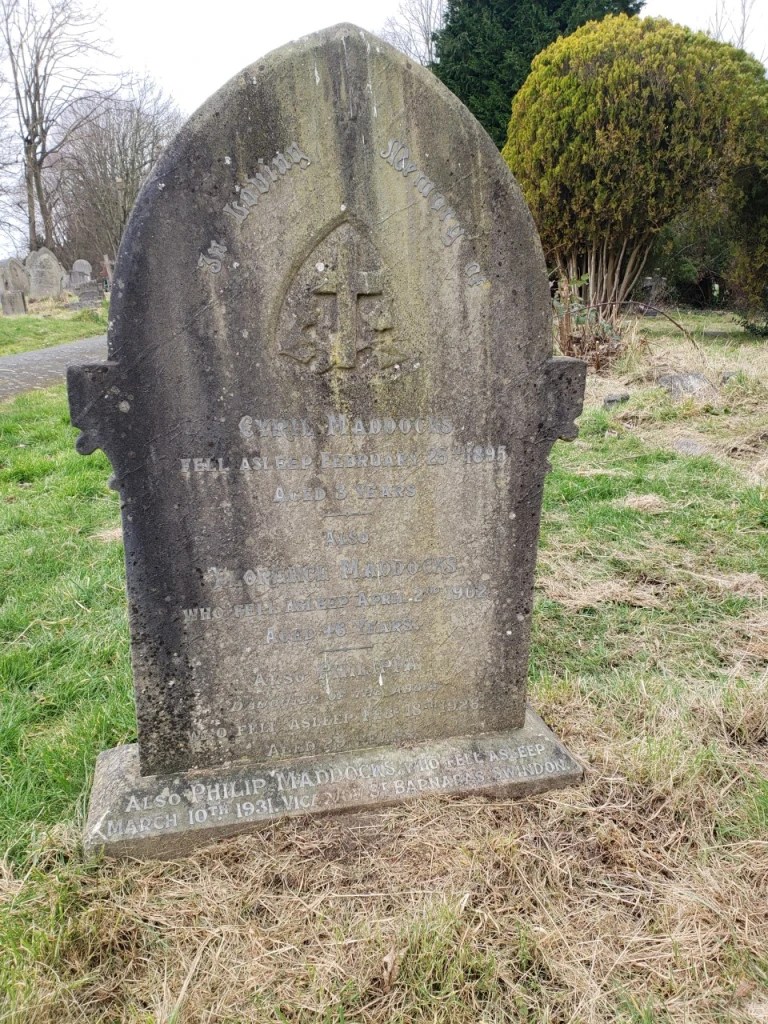
Rev P. Maddocks – Funeral of Swindon’s Oldest Vicar

Miss Lorna Dawes and a life inside

Women’s Work

It is probably fair to say that Edmund and Elizabeth Bramwell were an aspirational couple. Edmund was a fitter and turner in the Great Western Railway Works, a skilled occupation in which he had served a lengthy apprenticeship. Elizabeth had worked as a school mistress, a career she could no longer pursue after her marriage, a situation that didn’t alter within the teaching profession until 1944.

Edmund Bramwell and Elizabeth Burroughs married at Christ Church, Swindon on December 23, 1854. They both came from a railway family. Edmund’s father Joseph was a mechanic as was Elizabeth’s father Richard.

The couple made their home in Reading Street where their four daughters were born; Frances in 1856, Mary in 1859, Clara in 1866 and Maud in 1870.

Frances and Mary trained as draper’s assistants. By 1881 Mary had left Swindon and in subsequent years worked in large stores in Bath and Birmingham. Clara and Maud became teachers. Clara began her teaching career working as a 14 year old pupil teacher. By 1891 she was headmistress at one of Swindon’s local board schools. Her sister Maud also worked as an Assistant School Mistress.

Swindon Suffragette Edith New was some ten years younger than the two teaching Bramwell sisters. In 1891 she was also beginning her teaching career as a 14 year old pupil teacher in Swindon. By 1908 she had left Swindon and teaching and had joined the women’s suffrage movement as a paid organiser for the Women’s Social and Political Union. Edith fought in the Votes for Women campaign, serving several terms of imprisonment and going on hunger strike. She eventually returned to teaching and devoted her life to fighting for women’s rights within that profession.

Edith New

Perhaps the sisters followed the news of Edith’s involvement in the suffrage campaign, which featured in the Swindon Advertiser on several occasion. Perhaps they had known her when they were all setting out on their teaching careers.

Draper’s Assistant Frances married in 1885, ending any career progression she might have had. She briefly moved away to Portsmouth where her husband was a fitter in the dockyard and where her son Edmund was born, before returning to Swindon by 1890.

Maud married in 1896 and Clara married in 1901 and in so doing sacrificed their teaching careers. Clara’s status as Headmistress was not even mentioned on her marriage certificate.

Elizabeth Bramwell died in 1907 and was buried in grave plot D87 with her brother Samuel Burroughs, a boilermaker, who had died five years previously. Her husband Edmund died in 1910 and was buried with her. Mary, the daughter who spent a lifetime working in the drapery business, eventually returned to Swindon. She was buried in the family grave on January 18, 1911.

Frances died in 1915 and is buried with her husband in grave plot B3327.

Clara died in 1909 and is buried alone in grave plot E8626B

Maud died in Swansea in 1957.

After a life time teaching in London, Edith New retired to Polperro in Cornwall where she died in 1951.

Sampson Birkby – found drowned

On Wednesday January 14, 1925 Sampson Birkby bought half an ounce of tobacco, a box of matches and half a pint of bitter at the Carpenter’s Arms, Gorse Hill.  At 2.30 pm he left the pub and was never seen alive again.

Five days later the Advertiser published an account of his disappearance.  Described as 62 years of age, 5ft 6ins tall with a pale complexion and a grey moustache, Sampson Birkby was a charge hand coach body maker at the GWR Works.

On the day of his disappearance he had returned home for lunch at 76 Dean Street where he lived with his wife Alice, his married daughter, son in law and young grandson.

Sampson called in at the Baker’s Arms near the GWR factor entrance on his way back to work.  Reminded that he would be late, he hurried out, but as was later revealed, he did not clock in, but instead walked to the Carpenter’s Arms at Gorse Hill.

Later that evening one of his workmates called in on Alice Birkby to tell her Sampson had not checked in for work.  The worried family immediately reported him missing.

Nearly four weeks later Sampson’s body was pulled out of the river at Buscot Weir by Samuel Kemble, a lock keeper employed by the Thames Conservancy at St. John’s Lock, Lechlade.

How did Sampson Birkby, described as being of a happy disposition and without any financial worries, end up drowned in the river at Lechlade?

Sampson was born in Hunslet, Yorkshire in 1862.  By 1891 he had moved to 47 Cambria Place, Swindon and a job in the railway works.  Ten years later he and Alice were living at 37 George Street with their two year old daughter Edith and 14 year old May Beswick, described as ‘adopted.’

Evidence suggested that Sampson, although not especially talkative, was a social man.  A member of the High Street Workingman’s Club, he was an enthusiastic amateur photographer and a keen fisherman.

Giving evidence at the inquest, his son in law, George Bridgeman told how Sampson had been suffering from giddy fits during which he staggered and fell if someone did not support him.

Mr A.P. Ross Ormiston, the Coroner for North Berkshire, supposed that finding himself late for work, Sampson had decided to catch the bus to Lechlade and plan the fishing trip he had previously discussed with his son in law.

Summing up, the Coroner suggested that Sampson had suffered one of these giddy fits whilst walking along the tow path and had fallen into the river.  He returned a verdict of ‘Found drowned’ and expressed his sympathy with the relatives of the deceased.

Houses on Dean Street

Sampson Birkby was buried on February 14, 1925 in grave plot D892. His wife Alice died just seven months later and was buried with him. The cremated remains of their son-in-law George were buried with them following his death in 1983 and their daughter Edith Annie when she died in 1986.